REVIEW 4 major objections 6 minor 1 cited by
Hyper-modal Imputation Diffusion Embedding with Dual-Distillation for Federated Multimodal Knowledge Graph Completion
T0 review · 4 major / 6 minor · reviewed 2026-08-06 · deepseek-v4-flash
Pith's one-line read The paper's central claim is that MMFeD3-HidE, a federated multimodal knowledge graph completion framework, recovers randomly missing image and text modalities so effectively that it outperforms federated, incomplete-multimodal, and even…
desk verdict Useful new FedMKGC benchmark and distillation framework, but the diffusion imputation's conditioning claim does not match the algorithm. read the letter →
The pith
A machine-rendered reading of the paper's core claim, the machinery that carries it, and where it could break.
The reading
What carries the argument
The load-bearing mechanism is Hyper-modal Imputation Diffusion Embedding (HidE). An entity's multimodal features are concatenated into $H^c=[S^c||V^c||D^c]$, a hyper-modal vector in which the structural block $S^c$ is always available while visual and textual blocks are partly masked by $M^c$. HidE runs a standard DDPM forward process that adds Gaussian noise to $H^c$, then a reverse process in which a Cascade Residual Autoencoder (CRA) predicts the complete $\hat{x}_0$ at each diffusion step. The training objective, Equation (7) (equivalently Equation (19)), supervises only the observed slots: $\mathbb{E}\,\lVert M^c\odot \hat{x}_\theta(x_t,t)-M^c\odot x_0\rVert_2^2$, and the final imputation fills the missing slots with the predicted values while keeping the observed slots intact. Around this, MMFeD3 adds a KL-divergence logit distillation in both directions between client and server, plus an L2 feature distillation between the client's imputed embeddings and the server's available-modality embeddings; the diffusion parameters stay local and are never transmitted.
What would settle it
Replace the diffusion imputer in MMFeD3-HidE on FB15K-237-Fed3 at a 50% availability rate with constant or random padding of missing slots while keeping both distillation losses and all other hyperparameters; if the MRR stays near the reported 0.387 instead of collapsing toward the MMFedE range, the gains attributed to diffusion-based distribution recovery are not load-bearing. A complementary check is to hold out known image and text features, impute them from the remaining modalities, and measure each entity's distance to the true held-out features.
Extended reading notes
Core claim
The paper's central claim is that uncertain modality unavailability in federated multimodal knowledge graphs can be handled by treating each entity's structural, visual, and textual embeddings as one incomplete hyper-modal vector and learning to complete that vector with a diffusion model whose training signal touches only the observed slots. On the paper's own terms, the discovery is that this masked diffusion imputation, combined with logit and feature distillation between clients and the server, yields better link prediction than federated graph baselines, incomplete-multimodal baselines, and even a centralized model trained on the same data with weighted fusion. The key experimental comparison is Table III at a 50% modality availability rate, where MMFeD3-HidE reports the best MRR and Hits@1 on all three Fed settings and improves over the centralized upper bound, which the paper attributes to genuine recovery of the unavailable modalities rather than to the extra training signal alone.
Load-bearing premise
The load-bearing premise is that supervising the diffusion model only on the observed modality slots of an entity is enough to force the imputed missing slots to come from the same distribution, so HidE's recovered visual and textual embeddings are genuinely meaningful rather than arbitrary fill-ins.
Editorial extensions
If this is right
- Federated MKGC is feasible: training over decentralized multimodal knowledge graphs without sharing triples, images, or descriptions improves local link prediction beyond independent local training.
- Imputing uncertain missing modalities with a masked diffusion objective improves MRR and Hits@1 beyond GAN-, autoencoder-, and cycle-consistency-based incomplete multimodal baselines.
- Dual logit and feature distillation gives faster and more stable convergence than logit-only federated distillation baselines such as MMFedLU.
- The full framework outperforms the centralized weighted-fusion upper bound on FB15K-237-Fed3, Fed5, and Fed10, suggesting that imputation can compensate for not having all data in one place.
- At a 50% modality availability rate, performance stays close to the fully observed setting, so partial image and text coverage does not necessarily degrade reasoning quality.
Reading between the lines
- An untested but direct extension is that the same masked-diffusion objective could impute missing modality features in other federated graph tasks, provided each client keeps its own availability mask.
- The comparison against MMCen-weighted may understate the true centralized upper bound, because that bound also trains on the randomly zero-padded incomplete features; a centralized model trained on genuinely complete modalities would be the stricter test.
- A practical follow-up would feed the imputed visual and textual features back into the server aggregation so later rounds refine the imputation with global knowledge, whereas the current design keeps the diffusion model strictly local.
- Because the diffusion parameters are never shared, HidE offers a natural starting point for differentially private federated multimodal reasoning, where noise added to gradients could be absorbed by the already noisy diffusion process.
Editorial analysis
A structured set of objections, weighed in public.
Referee Report
Summary. The paper introduces a new task, Federated Multimodal Knowledge Graph Completion (FedMKGC), where multiple clients hold multimodal knowledge graphs with potentially missing visual/textual modalities and aim to train a global model without sharing raw data. The proposed framework MMFeD3-HidE combines a hyper-modal diffusion imputation model (HidE) that is intended to recover missing modalities from incomplete entity embeddings, with a federated dual-distillation mechanism (MMFeD3) transferring knowledge between clients and server via logit and feature distillation. The authors construct a benchmark based on FB15K-237 with non-IID partitions and random modality missingness, and compare against several FL and incomplete-multimodal baselines, reporting improvements on MRR and Hits@K. The paper also presents ablations, convergence analyses, and visualizations.
Significance. The task is timely and practical, and the paper is, to my knowledge, the first to formulate FedMKGC with uncertain missing modalities. The benchmark construction with Dirichlet-based multimodal partition and random availability masks is a useful contribution. The empirical results show consistent improvements over the included baselines. However, the central mechanism claimed for HidE—that missing modalities are imputed conditionally from available ones—is not supported by the described inference procedure, which weakens the interpretation of the gains. Provided the authors can fix the inference procedure or provide evidence that the imputation genuinely recovers missing modalities (rather than benefiting from distillation), the contribution could be valuable.
major comments (4)
- [§IV.B and §IV.C, Eq. (6)] The reverse process is described as sampling from p_θ(x_{t-1}|x_t) starting from x_T ~ N(0,I), with no conditioning on the observed slots M^c ⊙ x0. Equation (6) overwrites the observed slots only after the full reverse chain, so the missing slots are drawn from the marginal p_θ(x_mis), not from p_θ(x_mis | x_obs). Consequently, the sentence in §IV.C asserting that 'x̂_0 ∼ pθ(x|x̂_obs^0 = x_obs^0)' does not describe the implemented procedure. Since Eq. (7) supervises only observed slots, there is no training signal that forces the missing slots to be consistent with observed modalities. The improvements in Table III could therefore be driven by the feature distillation loss L_FD (Eq. 11) and logit distillation rather than by genuine modality recovery. Please either modify the reverse process to condition on observed data at every step (e.g., by replacing observed slots with forward-noised observed values during sampling) or provide a controlled experiment that isolates the imputation contribution.
- [§V.C, Table III] The text states that 'MMFeD3-HidE also outperforms MMCen-weighted on three datasets,' but Table III shows on FB15K-237-Fed10 an MRR of 0.372 for MMFeD3-HidE versus 0.373 for MMCen-weighted. The paper's own numbers do not support the claim of beating the upper bound on all three datasets. Please correct the claim and discuss the Fed10 result in the text.
- [§V.A and Tables III–IV] All reported numbers are single runs without variance estimates or significance tests. Several differences are very small (e.g., Fed5 MRR 0.382 vs. 0.380 for MMCen-weighted; Fed10 0.372 vs. 0.373), so without error bars or multiple seeds the reported improvements may be within noise. Please report means and standard deviations over at least three random seeds for all main tables.
- [§IV.C and App. B.B] The derivation calls Eq. (7) a 'masked variational bound,' but masking the per-dimension squared error means the objective does not lower-bound the log-marginal likelihood of the full observation (only of the observed dimensions, and even that is not shown). The step from Eq. (18) to Eq. (19) drops the missing dimensions from the loss without providing any guarantee about their distribution. This is not merely a presentation issue: it is the basis for the claim that 'the completed three modalities are from the same distributions.' Please either provide a formal statement of what the masked objective optimizes, or soften the claims to say that the objective encourages consistency only among observed slots.
minor comments (6)
- [§I] The phrase 'It is non-trivial to propose address the FedMKGC task' should be 'It is non-trivial to address the FedMKGC task.'
- [§III.B] The phrase 'MKG multimodal information partition following Dirichlet distribution' is grammatically awkward; please rephrase for clarity.
- [Table II] The average entity and triple counts are non-integer; state explicitly whether these are means rounded to one decimal place.
- [Fig. 7] The hyperparameter sensitivity plots are difficult to read; the weight labels (e.g., '2 2', '2 1' at the top of the figure) appear corrupted and should be fixed.
- [Algorithm 2] Variables S^{s,c}_{ro+1}, W^{s,c}_{v,ro+1}, W^{s,c}_{d,ro+1} are updated by the arg min but are not defined in the notation table; please clarify the update targets.
- [Eq. (6)] The notation \x^{c}_0 appears before it is explicitly defined; consider introducing it as the original hyper-modal feature H^c.
Circularity Check
No equation-level circularity or load-bearing self-citation; one explanatory claim in Section IV.C restates its own distributional assumption as a conclusion.
-
other
[Section IV-C, Eq. (7) and the following paragraph]
"Since after the optimization, the observed modalities and their reconstructed features are the same ˆxobs0 = xobs0, and the reconstructed hyper-modal ˆx0 ∼ pθ(x|ˆxobs0 = xobs0), thus estimated missing features ˆxmis0 are also from the same distributions... which made sure the completed three modalities are from the same distributions and maintain the semantic consistency."
The 'same distributions' conclusion is the same assumption used to motivate Eq. (7): the text first says the missing modalities xmis_t are 'from the same distributions' so that constraining observed slots suffices, and after optimizing Eq. (7) it presents that assumption as a consequence. Eq. (7) is ∥M^c⊙x̂θ(xt,t)−M^c⊙x0∥², which contains no term for the (1−M^c) missing slots; Eq. (6) copies the observed slots after an unconditional reverse chain. Thus the conditional statement pθ(x|ˆxobs0=xobs0) is not implemented or implied by the objective; it is the input assumption restated as a result.
full rationale
No circularity was found in the main predictive chain: the KGC loss, logit/feature distillation, and masked diffusion loss are not fitted to MRR or Hits@K, no parameter is tuned on the target metric, and the cited prior work (FedE, DDPM, CRA, etc.) is used as a component rather than as self-referential authority. The benchmark is author-constructed, but it uses standard FB15K-237 and standard filtered ranking metrics, so the empirical comparison is not definitionally forced. The one genuinely circular passage is Section IV.C, where the claim that imputed missing modalities come from the same distribution as observed modalities is the motivating assumption restated after Eq. (7); because Eq. (7) only supervises observed slots and Eq. (6) overwrites them after an unconditional reverse sampling process, the conditional-imputation explanation has no mechanism. This is partly a correctness/omitted-proof concern rather than equation-level circularity, and it does not by itself invalidate the empirical comparison. Separately, the text's claim that MMFeD3-HidE outperforms MMCen-weighted on three datasets is contradicted by Table III on FB15K-237-Fed10 (MRR 0.372 vs 0.373); that is an internal inconsistency, not circularity. Overall circularity is limited to the one explanatory restatement, so the score is low.
Assumptions & free parameters
free parameters (6)
- lambda, mu, eta (loss weights) =
not stated in main text; swept in Fig. 7
- diffusion schedule beta_low, beta_up, scale s =
5e-4, 5e-2, 1e-4
- diffusion training steps T and inference steps =
not stated; Fig. 7 sweeps training steps 0..5 and inference steps 2..50
- modality availability rate r =
50% in main experiments
- partition heterogeneity alpha_Dir =
0.1
- entity and relation embedding sizes, negative samples, batch size, local epochs =
512, 256, 256, 1024, 3
assumptions (6)
- standard math DDPM ELBO simplification and Gaussian posterior assumptions (Eq. 13-21)
- domain assumption Missing visual/textual modalities are missing completely at random, independent of entity semantics
- domain assumption Enforcing equality on observed slots forces unobserved slots to come from the same distribution
- domain assumption Partition by relation IDs and Dirichlet-split images/texts yields realistic cross-silo MKGs
- domain assumption Fixed pretrained BERT/ViT features are sufficient representations of textual and visual modalities
- domain assumption Not sharing raw features, relation embeddings, or diffusion parameters preserves privacy
Cite this review
Pith. "Pith review of Hyper-modal Imputation Diffusion Embedding with Dual-Distillation for Federated Multimodal Knowledge Graph Completion." pith.science (2026). https://pith.science/paper/ZYGZYDFF
@misc{pith2026250622036,
  author       = {Pith},
  title        = {Pith review of: Hyper-modal Imputation Diffusion Embedding with Dual-Distillation for Federated Multimodal Knowledge Graph Completion},
  year         = {2026},
  howpublished = {\url{https://pith.science/paper/ZYGZYDFF}},
  note         = {Machine review of arXiv:2506.22036}
}
read the original abstract
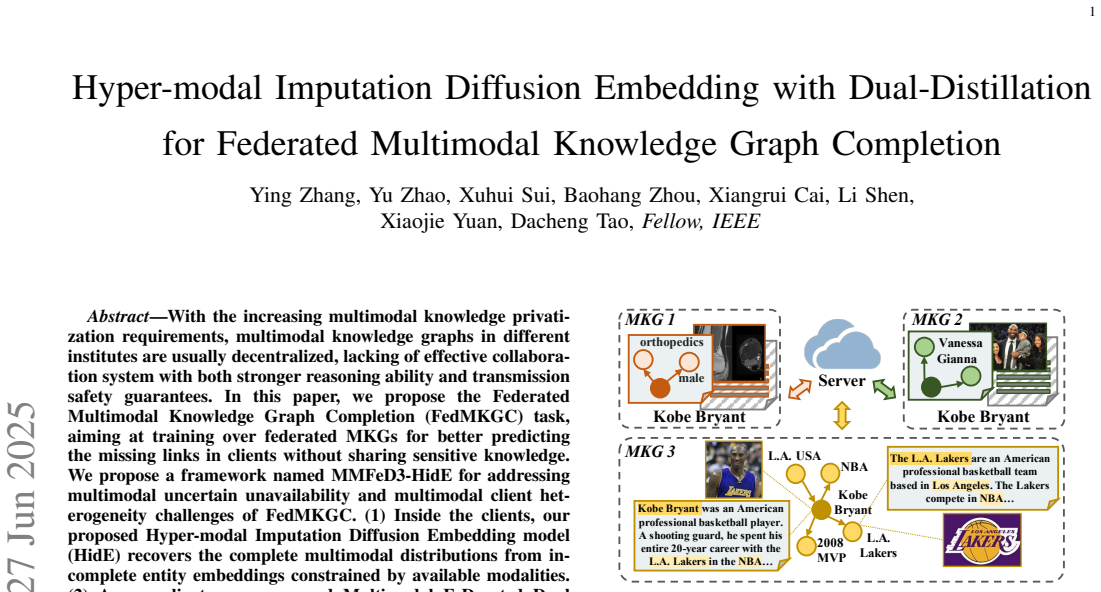
With the increasing multimodal knowledge privatization requirements, multimodal knowledge graphs in different institutes are usually decentralized, lacking of effective collaboration system with both stronger reasoning ability and transmission safety guarantees. In this paper, we propose the Federated Multimodal Knowledge Graph Completion (FedMKGC) task, aiming at training over federated MKGs for better predicting the missing links in clients without sharing sensitive knowledge. We propose a framework named MMFeD3-HidE for addressing multimodal uncertain unavailability and multimodal client heterogeneity challenges of FedMKGC. (1) Inside the clients, our proposed Hyper-modal Imputation Diffusion Embedding model (HidE) recovers the complete multimodal distributions from incomplete entity embeddings constrained by available modalities. (2) Among clients, our proposed Multimodal FeDerated Dual Distillation (MMFeD3) transfers knowledge mutually between clients and the server with logit and feature distillation to improve both global convergence and semantic consistency. We propose a FedMKGC benchmark for a comprehensive evaluation, consisting of a general FedMKGC backbone named MMFedE, datasets with heterogeneous multimodal information, and three groups of constructed baselines. Experiments conducted on our benchmark validate the effectiveness, semantic consistency, and convergence robustness of MMFeD3-HidE.
Figures


Figures from the paper (4 more)


Forward citations
Cited by 1 Pith paper
-
Dark Side of Modalities: Reinforced Multimodal Distillation for Multimodal Knowledge Graph Reasoning
A unimodal student model, taught by reinforcement-selected combinations of multimodal teachers via neighbor-decoupled knowledge distillation, sets new state-of-the-art results on five multimodal knowledge graph reason...
Reference graph
Works this paper leans on
-
[1]
Multi-modal knowledge graph construction and application: A survey,
X. Zhu, Z. Li, X. Wang, X. Jiang, P. Sun, X. Wang, Y . Xiao, and N. J. Yuan, “Multi-modal knowledge graph construction and application: A survey,” IEEE Transactions on Knowledge and Data Engineering , vol. 36, no. 2, pp. 715–735, 2024
2024
-
[2]
A survey of knowledge graph reasoning on graph types: Static, dynamic, and multi-modal,
K. Liang, L. Meng, M. Liu, Y . Liu, W. Tu, S. Wang, S. Zhou, X. Liu, F. Sun, and K. He, “A survey of knowledge graph reasoning on graph types: Static, dynamic, and multi-modal,” IEEE TPAMI, 2024
2024
-
[3]
Ok-vqa: A visual question answering benchmark requiring external knowledge,
K. Marino, M. Rastegari, A. Farhadi, and R. Mottaghi, “Ok-vqa: A visual question answering benchmark requiring external knowledge,” in CVPR, 2019, pp. 3195–3204
2019
-
[4]
Mukea: Multimodal knowledge extraction and accumulation for knowledge-based visual question answering,
Y . Ding, J. Yu, B. Liu, Y . Hu, M. Cui, and Q. Wu, “Mukea: Multimodal knowledge extraction and accumulation for knowledge-based visual question answering,” in Proceedings of the IEEE/CVF Conference on Computer Vision and Pattern Recognition , 2022, pp. 5089–5098
2022
-
[5]
Multi-modal knowledge graphs for recommender systems,
R. Sun, X. Cao, Y . Zhao, J. Wan, K. Zhou, F. Zhang, Z. Wang, and K. Zheng, “Multi-modal knowledge graphs for recommender systems,” in CIKM, 2020, pp. 1405–1414
2020
-
[6]
Context matters: Distilling knowledge graph for enhanced object detection,
A. Yang, S. Lin, C. Yeh, M. Shu, Y . Yang, and X. Chang, “Context matters: Distilling knowledge graph for enhanced object detection,” IEEE Trans. Multim. , vol. 26, pp. 487–500, 2024
2024
-
[7]
Image-embodied knowledge representation learning,
R. Xie, Z. Liu, H. Luan, and M. Sun, “Image-embodied knowledge representation learning,” in IJCAI, 2017, pp. 3140–3146
2017
-
[8]
Representation learning of knowledge graphs with entity descriptions,
R. Xie, Z. Liu, J. Jia, H. Luan, and M. Sun, “Representation learning of knowledge graphs with entity descriptions,” in AAAI, vol. 30, no. 1, 2016
2016
Show all 91 references
-
[9]
Is visual context really helpful for knowledge graph? a representation learning perspective,
M. Wang, S. Wang, H. Yang, Z. Zhang, X. Chen, and G. Qi, “Is visual context really helpful for knowledge graph? a representation learning perspective,” in ACM MM, 2021, pp. 2735–2743
2021
-
[10]
Mose: Modality split and ensemble for multimodal knowledge graph completion,
Y . Zhao, X. Cai, Y . Wu, H. Zhang, Y . Zhang, G. Zhao, and N. Jiang, “Mose: Modality split and ensemble for multimodal knowledge graph completion,” in EMNLP, 2022, pp. 10 527–10 536
2022
-
[11]
Hybrid transformer with multi-level fusion for multimodal knowledge graph completion,
X. Chen, N. Zhang, L. Li, S. Deng, C. Tan, C. Xu, F. Huang, L. Si, and H. Chen, “Hybrid transformer with multi-level fusion for multimodal knowledge graph completion,” in Proceedings of the 45th International ACM SIGIR Conference on Research and Development in Information Retr...
2022
-
[12]
Lafa: Multimodal knowledge graph completion with link aware fusion and aggregation,
B. Shang, Y . Zhao, J. Liu, and D. Wang, “Lafa: Multimodal knowledge graph completion with link aware fusion and aggregation,” in Proceed- ings of the AAAI Conference on Artificial Intelligence , vol. 38, no. 8, 2024, pp. 8957–8965
2024
-
[13]
Dbpedia: A nucleus for a web of open data,
S. Auer, C. Bizer, G. Kobilarov, J. Lehmann, R. Cyganiak, and Z. Ives, “Dbpedia: A nucleus for a web of open data,” in international semantic web conference. Springer, 2007, pp. 722–735
2007
-
[14]
Wikidata: a free collaborative knowl- edgebase,
D. Vrande ˇci´c and M. Kr ¨otzsch, “Wikidata: a free collaborative knowl- edgebase,” Communications of the ACM , vol. 57, no. 10, pp. 78–85, 2014
2014
-
[15]
Free- base: a collaboratively created graph database for structuring human knowledge,
K. Bollacker, C. Evans, P. Paritosh, T. Sturge, and J. Taylor, “Free- base: a collaboratively created graph database for structuring human knowledge,” in Proceedings of the 2008 ACM SIGMOD international conference on Management of data , 2008, pp. 1247–1250. 13
2008
-
[16]
Amazon-kg: A knowledge graph enhanced cross-domain recommendation dataset,
Y . Wang, Q. Xie, M. Tang, L. Li, J. Yuan, and Y . Liu, “Amazon-kg: A knowledge graph enhanced cross-domain recommendation dataset,” in Proceedings of the 47th International ACM SIGIR Conference on Research and Development in Information Retrieval , 2024, pp. 123– 130
2024
-
[17]
Alime mkg: A multi-modal knowledge graph for live- streaming e-commerce,
G. Xu, H. Chen, F.-L. Li, F. Sun, Y . Shi, Z. Zeng, W. Zhou, Z. Zhao, and J. Zhang, “Alime mkg: A multi-modal knowledge graph for live- streaming e-commerce,” in Proceedings of the 30th ACM CIKM , 2021, pp. 4808–4812
2021
-
[18]
Learning a health knowledge graph from electronic medical records,
M. Rotmensch, Y . Halpern, A. Tlimat, S. Horng, and D. Sontag, “Learning a health knowledge graph from electronic medical records,” Scientific reports, vol. 7, no. 1, p. 5994, 2017
2017
-
[19]
Federated machine learning: Concept and applications,
Q. Yang, Y . Liu, T. Chen, and Y . Tong, “Federated machine learning: Concept and applications,” ACM Transactions on Intelligent Systems and Technology (TIST), vol. 10, no. 2, pp. 1–19, 2019
2019
-
[20]
Communication-efficient learning of deep networks from decentralized data,
B. McMahan, E. Moore, D. Ramage, S. Hampson, and B. A. y Arcas, “Communication-efficient learning of deep networks from decentralized data,” in Artificial intelligence and statistics . PMLR, 2017, pp. 1273– 1282
2017
-
[21]
Advances and open problems in federated learning,
P. Kairouz, H. B. McMahan, B. Avent, A. Bellet, M. Bennis, A. N. Bhagoji, K. Bonawitz, Z. Charles, G. Cormode, R. Cummings et al. , “Advances and open problems in federated learning,” Foundations and trends® in machine learning , vol. 14, no. 1–2, pp. 1–210, 2021
2021
-
[22]
Fede: Embedding knowledge graphs in federated setting,
M. Chen, W. Zhang, Z. Yuan, Y . Jia, and H. Chen, “Fede: Embedding knowledge graphs in federated setting,” in Proceedings of the 10th International Joint Conference on Knowledge Graphs , 2021, pp. 80– 88
2021
-
[23]
Federated knowledge graph completion via embedding- contrastive learning,
——, “Federated knowledge graph completion via embedding- contrastive learning,” Knowledge-Based Systems, 2022
2022
-
[24]
Heterogeneous federated knowledge graph embedding learning and unlearning,
X. Zhu, G. Li, and W. Hu, “Heterogeneous federated knowledge graph embedding learning and unlearning,” in Proceedings of the ACM Web Conference 2023, 2023, pp. 2444–2454
2023
-
[25]
Fedean: Entity-aware adversarial negative sampling for federated knowledge graph reasoning,
L. Meng, K. Liang, H. Yu, Y . Liu, S. Zhou, M. Liu, and X. Liu, “Fedean: Entity-aware adversarial negative sampling for federated knowledge graph reasoning,” IEEE Transactions on Knowledge and Data Engi- neering, 2024
2024
-
[26]
Imf: Interactive multimodal fusion model for link prediction,
X. Li, X. Zhao, J. Xu, Y . Zhang, and C. Xing, “Imf: Interactive multimodal fusion model for link prediction,” in ACM Web Conference, 2023, pp. 2572–2580
2023
-
[27]
Fedmultimodal: A bench- mark for multimodal federated learning,
T. Feng, D. Bose, T. Zhang, R. Hebbar, A. Ramakrishna, R. Gupta, M. Zhang, S. Avestimehr, and S. Narayanan, “Fedmultimodal: A bench- mark for multimodal federated learning,” in Proceedings of the 29th ACM SIGKDD Conference on Knowledge Discovery and Data Mining , 2023, pp. 4035–4045
2023
-
[28]
Multimodal federated learning via contrastive representation ensemble,
Q. Yu, Y . Liu, Y . Wang, K. Xu, and J. Liu, “Multimodal federated learning via contrastive representation ensemble,” in The Eleventh In- ternational Conference on Learning Representations , 2023
2023
-
[29]
A unified framework for multi- modal federated learning,
B. Xiong, X. Yang, F. Qi, and C. Xu, “A unified framework for multi- modal federated learning,” Neurocomputing, vol. 480, pp. 110–118, 2022
2022
-
[30]
Maco: A modality adversarial and contrastive framework for modality-missing multi-modal knowledge graph completion,
Y . Zhang, Z. Chen, and W. Zhang, “Maco: A modality adversarial and contrastive framework for modality-missing multi-modal knowledge graph completion,” in CCF International Conference on Natural Lan- guage Processing and Chinese Computing . Springer, 2023, pp. 123– 134
2023
-
[31]
Unleashing the power of imbalanced modality information for multi-modal knowledge graph completion,
Y . Zhang, Z. Chen, L. Liang, H. Chen, and W. Zhang, “Unleashing the power of imbalanced modality information for multi-modal knowledge graph completion,” in Proceedings of the 2024 Joint International Conference on Computational Linguistics, Language Resources and Evaluation ...
2024
-
[32]
Missing modality imagination network for emotion recognition with uncertain missing modalities,
J. Zhao, R. Li, and Q. Jin, “Missing modality imagination network for emotion recognition with uncertain missing modalities,” in Proceedings of the 59th Annual Meeting of the Association for Computational Linguistics and the 11th International Joint Conference on Natural Langu...
2021
-
[33]
Transformer-based feature re- construction network for robust multimodal sentiment analysis,
Z. Yuan, W. Li, H. Xu, and W. Yu, “Transformer-based feature re- construction network for robust multimodal sentiment analysis,” in Proceedings of the 29th ACM International Conference on Multimedia , 2021, pp. 4400–4407
2021
-
[34]
Robust multimodal sentiment analysis via tag encoding of uncertain missing modalities,
J. Zeng, J. Zhou, and T. Liu, “Robust multimodal sentiment analysis via tag encoding of uncertain missing modalities,” IEEE Transactions on Multimedia, vol. 25, pp. 6301–6314, 2022
2022
-
[35]
Unimf: a unified multimodal framework for multimodal sentiment analysis in missing modalities and unaligned multimodal sequences,
R. Huan, G. Zhong, P. Chen, and R. Liang, “Unimf: a unified multimodal framework for multimodal sentiment analysis in missing modalities and unaligned multimodal sequences,” IEEE Transactions on Multimedia , 2023
2023
-
[36]
Incomplete multimodality-diffused emo- tion recognition,
Y . Wang, Y . Li, and Z. Cui, “Incomplete multimodality-diffused emo- tion recognition,” Advances in Neural Information Processing Systems , vol. 36, 2024
2024
-
[37]
Federated optimization in heterogeneous networks,
T. Li, A. K. Sahu, M. Zaheer, M. Sanjabi, A. Talwalkar, and V . Smith, “Federated optimization in heterogeneous networks,” Proceedings of Machine learning and systems , vol. 2, pp. 429–450, 2020
2020
-
[38]
Federated learning on non-iid data silos: An experimental study,
Q. Li, Y . Diao, Q. Chen, and B. He, “Federated learning on non-iid data silos: An experimental study,” in 2022 IEEE 38th international conference on data engineering (ICDE) . IEEE, 2022, pp. 965–978
2022
-
[39]
Fedsea: Federated learning via selective feature alignment for non-iid multimodal data,
M. Tan, Y . Feng, L. Chu, J. Shi, R. Xiao, H. Tang, and J. Yu, “Fedsea: Federated learning via selective feature alignment for non-iid multimodal data,” IEEE Trans. Multim. , vol. 26, pp. 5807–5822, 2024
2024
-
[40]
Gain: Missing data imputation using generative adversarial nets,
J. Yoon, J. Jordon, and M. Schaar, “Gain: Missing data imputation using generative adversarial nets,” in International conference on machine learning. PMLR, 2018, pp. 5689–5698
2018
-
[41]
Multivariate time series imputation with generative adversarial networks,
Y . Luo, X. Cai, Y . Zhang, J. Xu et al. , “Multivariate time series imputation with generative adversarial networks,” NeurIPS, vol. 31, 2018
2018
-
[42]
Generative adversarial networks,
I. Goodfellow, J. Pouget-Abadie, M. Mirza, B. Xu, D. Warde-Farley, S. Ozair, A. Courville, and Y . Bengio, “Generative adversarial networks,” Communications of the ACM , vol. 63, no. 11, pp. 139–144, 2020
2020
-
[43]
Vigan: Missing view imputation with generative adversarial networks,
C. Shang, A. Palmer, J. Sun, K.-S. Chen, J. Lu, and J. Bi, “Vigan: Missing view imputation with generative adversarial networks,” in 2017 IEEE International conference on big data (Big Data) . IEEE, 2017, pp. 766–775
2017
-
[44]
Extract- ing and composing robust features with denoising autoencoders,
P. Vincent, H. Larochelle, Y . Bengio, and P.-A. Manzagol, “Extract- ing and composing robust features with denoising autoencoders,” in Proceedings of the 25th international conference on Machine learning , 2008, pp. 1096–1103
2008
-
[45]
Autoencoders, unsupervised learning, and deep architectures,
P. Baldi, “Autoencoders, unsupervised learning, and deep architectures,” in Proceedings of ICML workshop on unsupervised and transfer learn- ing. JMLR Workshop and Conference Proceedings, 2012, pp. 37–49
2012
-
[46]
Missing modalities imputation via cascaded residual autoencoder,
L. Tran, X. Liu, J. Zhou, and R. Jin, “Missing modalities imputation via cascaded residual autoencoder,” in Proceedings of the IEEE conference on computer vision and pattern recognition , 2017, pp. 1405–1414
2017
-
[47]
Distribution-consistent modal recovering for incomplete multimodal learning,
Y . Wang, Z. Cui, and Y . Li, “Distribution-consistent modal recovering for incomplete multimodal learning,” in Proceedings of the IEEE/CVF International Conference on Computer Vision, 2023, pp. 22 025–22 034
2023
-
[48]
Gcnet: Graph completion network for incomplete multimodal learning in conversation,
Z. Lian, L. Chen, L. Sun, B. Liu, and J. Tao, “Gcnet: Graph completion network for incomplete multimodal learning in conversation,” IEEE Transactions on pattern analysis and machine intelligence, vol. 45, no. 7, pp. 8419–8432, 2023
2023
-
[49]
Mitigating inconsistencies in multimodal sentiment analysis under uncertain missing modalities,
J. Zeng, J. Zhou, and T. Liu, “Mitigating inconsistencies in multimodal sentiment analysis under uncertain missing modalities,” in Proceedings of the 2022 Conference on Empirical Methods in Natural Language Processing, 2022, pp. 2924–2934
2022
-
[50]
Correlation-decoupled knowledge distillation for multimodal sentiment analysis with incomplete modalities,
M. Li, D. Yang, X. Zhao, S. Wang, Y . Wang, K. Yang, M. Sun, D. Kou, Z. Qian, and L. Zhang, “Correlation-decoupled knowledge distillation for multimodal sentiment analysis with incomplete modalities,” in Pro- ceedings of the IEEE/CVF Conference on Computer Vision and Pattern R...
2024
-
[51]
Mmanet: Margin-aware distillation and modality-aware regularization for incomplete multimodal learning,
S. Wei, C. Luo, and Y . Luo, “Mmanet: Margin-aware distillation and modality-aware regularization for incomplete multimodal learning,” in Proceedings of the IEEE/CVF Conference on Computer Vision and Pattern Recognition, 2023, pp. 20 039–20 049
2023
-
[52]
Federated learning for vision- and-language grounding problems,
F. Liu, X. Wu, S. Ge, W. Fan, and Y . Zou, “Federated learning for vision- and-language grounding problems,” in AAAI, vol. 34, no. 07, 2020, pp. 11 572–11 579
2020
-
[53]
Pfedprompt: Learning personalized prompt for vision-language models in federated learning,
T. Guo, S. Guo, and J. Wang, “Pfedprompt: Learning personalized prompt for vision-language models in federated learning,” in Proceed- ings of the ACM Web Conference 2023 , 2023, pp. 1364–1374
2023
-
[54]
Federated modality-specific encoders and multimodal anchors for personalized brain tumor segmentation,
Q. Dai, D. Wei, H. Liu, J. Sun, L. Wang, and Y . Zheng, “Federated modality-specific encoders and multimodal anchors for personalized brain tumor segmentation,” in Proceedings of the AAAI Conference on Artificial Intelligence, vol. 38, no. 2, 2024, pp. 1445–1453
2024
-
[55]
Multi- modal federated learning for cancer staging over non-iid datasets with unbalanced modalities,
K. Borazjani, N. Khosravan, L. Ying, and S. Hosseinalipour, “Multi- modal federated learning for cancer staging over non-iid datasets with unbalanced modalities,” IEEE Transactions on Medical Imaging , 2024
2024
-
[56]
Multimodal federated learning on iot data,
Y . Zhao, P. Barnaghi, and H. Haddadi, “Multimodal federated learning on iot data,” in 2022 IEEE/ACM IoTDI . IEEE, 2022, pp. 43–54
2022
-
[57]
Meld: A multimodal multi-party dataset for emotion recognition in conversations,
S. Poria, D. Hazarika, N. Majumder, G. Naik, E. Cambria, and R. Mihal- cea, “Meld: A multimodal multi-party dataset for emotion recognition in conversations,” arXiv preprint arXiv:1810.02508 , 2018
2018 arXiv
-
[58]
Crema-d: Crowd-sourced emotional multimodal actors dataset,
H. Cao, D. G. Cooper, M. K. Keutmann, R. C. Gur, A. Nenkova, and R. Verma, “Crema-d: Crowd-sourced emotional multimodal actors dataset,” IEEE transactions on affective computing , vol. 5, no. 4, pp. 377–390, 2014. 14
2014
-
[59]
Ucf101: A dataset of 101 human actions classes from videos in the wild,
K. Soomro, A. R. Zamir, and M. Shah, “Ucf101: A dataset of 101 human actions classes from videos in the wild,” arXiv:1212.0402, 2012
2012 arXiv
-
[60]
Moments in time dataset: one million videos for event understanding,
M. Monfort, A. Andonian, B. Zhou, K. Ramakrishnan, S. A. Bargal, T. Yan, L. Brown, Q. Fan, D. Gutfreund, C. V ondrick et al., “Moments in time dataset: one million videos for event understanding,” IEEE transactions on pattern analysis and machine intelligence, vol. 42, no. 2, ...
2019
-
[61]
The hateful memes challenge: Detecting hate speech in multimodal memes,
D. Kiela, H. Firooz, A. Mohan, V . Goswami, A. Singh, P. Ringshia, and D. Testuggine, “The hateful memes challenge: Detecting hate speech in multimodal memes,” Advances in neural information processing systems, vol. 33, pp. 2611–2624, 2020
2020
-
[62]
Crisismmd: Multimodal twitter datasets from natural disasters,
F. Alam, F. Ofli, and M. Imran, “Crisismmd: Multimodal twitter datasets from natural disasters,” in Proceedings of the international AAAI con- ference on web and social media , vol. 12, no. 1, 2018
2018
-
[63]
Reducing training time in cross-silo federated learning us- ing multigraph topology,
T. Do, B. X. Nguyen, V . Pham, T. Tran, E. Tjiputra, Q. D. Tran, and A. Nguyen, “Reducing training time in cross-silo federated learning us- ing multigraph topology,” in Proceedings of the IEEE/CVF International Conference on Computer Vision , 2023, pp. 19 409–19 419
2023
-
[64]
Robust heterogeneous federated learning under data corruption,
X. Fang, M. Ye, and X. Yang, “Robust heterogeneous federated learning under data corruption,” in Proceedings of the IEEE/CVF International Conference on Computer Vision , 2023, pp. 5020–5030
2023
-
[65]
Client-adaptive cross-model reconstruction network for modality-incomplete multimodal federated learning,
B. Xiong, X. Yang, Y . Song, Y . Wang, and C. Xu, “Client-adaptive cross-model reconstruction network for modality-incomplete multimodal federated learning,” in Proceedings of the 31st ACM International Conference on Multimedia , 2023, pp. 1241–1249
2023
-
[66]
Fedmsplit: Correlation-adaptive federated multi- task learning across multimodal split networks,
J. Chen and A. Zhang, “Fedmsplit: Correlation-adaptive federated multi- task learning across multimodal split networks,” in Proceedings of the 28th ACM SIGKDD conference on knowledge discovery and data mining, 2022, pp. 87–96
2022
-
[67]
Con- trast then memorize: Semantic neighbor retrieval-enhanced inductive multimodal knowledge graph completion,
Y . Zhao, Y . Zhang, B. Zhou, X. Qian, K. Song, and X. Cai, “Con- trast then memorize: Semantic neighbor retrieval-enhanced inductive multimodal knowledge graph completion,” in Proceedings of the 47th International ACM SIGIR Conference on Research and Development in Informatio...
2024
-
[68]
Tokenization, fusion, and augmentation: Towards fine- grained multi-modal entity representation,
Y . Zhang, Z. Chen, L. Guo, Y . Xu, B. Hu, Z. Liu, W. Zhang, and H. Chen, “Tokenization, fusion, and augmentation: Towards fine- grained multi-modal entity representation,” 2024. [Online]. Available: https://arxiv.org/abs/2404.09468
2024 arXiv
-
[69]
Translating embeddings for modeling multi-relational data,
A. Bordes, N. Usunier, A. Garcia-Duran, J. Weston, and O. Yakhnenko, “Translating embeddings for modeling multi-relational data,” Advances in neural information processing systems , vol. 26, 2013
2013
-
[70]
Com- plex embeddings for simple link prediction,
T. Trouillon, J. Welbl, S. Riedel, ´E. Gaussier, and G. Bouchard, “Com- plex embeddings for simple link prediction,” in International conference on machine learning . PMLR, 2016, pp. 2071–2080
2016
-
[71]
Rotate: Knowledge graph embedding by relational rotation in complex space,
Z. Sun, Z.-H. Deng, J.-Y . Nie, and J. Tang, “Rotate: Knowledge graph embedding by relational rotation in complex space,” in ICLR, 2018
2018
-
[72]
Differentially private fed- erated knowledge graphs embedding,
H. Peng, H. Li, Y . Song, V . Zheng, and J. Li, “Differentially private fed- erated knowledge graphs embedding,” in Proceedings of the 30th ACM International Conference on Information & Knowledge Management , 2021, pp. 1416–1425
2021
-
[73]
Fedcke: Cross-domain knowledge graph embedding in federated learning,
W. Huang, J. Liu, T. Li, S. Ji, D. Wang, and T. Huang, “Fedcke: Cross-domain knowledge graph embedding in federated learning,” IEEE Transactions on Big Data , 2022
2022
-
[74]
Efficient federated learning on knowledge graphs via privacy-preserving relation embedding aggregation,
K. Zhang, Y . Wang, H. Wang, L. Huang, C. Yang, X. Chen, and L. Sun, “Efficient federated learning on knowledge graphs via privacy-preserving relation embedding aggregation,” in Findings of the Association for Computational Linguistics: EMNLP 2022 , 2022, pp. 613–621
2022
-
[75]
Exploiting pre- trained language models for black-box attack against knowledge graph embeddings,
G. Yang, L. Zhang, Y . Liu, H. Xie, and Z. Mao, “Exploiting pre- trained language models for black-box attack against knowledge graph embeddings,” ACM Transactions on Knowledge Discovery from Data , 2024
2024
-
[76]
Poisoning attack on federated knowledge graph embedding,
E. Zhou, S. Guo, Z. Ma, Z. Hong, T. Guo, and P. Dong, “Poisoning attack on federated knowledge graph embedding,” in Proceedings of the ACM on Web Conference 2024 , 2024, pp. 1998–2008
2024
-
[77]
Quantifying and defending against privacy threats on federated knowl- edge graph embedding,
Y . Hu, W. Liang, R. Wu, K. Xiao, W. Wang, X. Li, J. Liu, and Z. Qin, “Quantifying and defending against privacy threats on federated knowl- edge graph embedding,” in Proceedings of the ACM Web Conference 2023, 2023, pp. 2306–2317
2023
-
[78]
Bert: Pre-training of deep bidirectional transformers for language understanding,
J. Devlin, M.-W. Chang, K. Lee, and K. Toutanova, “Bert: Pre-training of deep bidirectional transformers for language understanding,” in NAACL, 2019, pp. 4171–4186
2019
-
[79]
An image is worth 16x16 words: Transformers for image recognition at scale,
A. Dosovitskiy, L. Beyer, A. Kolesnikov, D. Weissenborn, X. Zhai, T. Unterthiner, M. Dehghani, M. Minderer, G. Heigold, S. Gelly et al., “An image is worth 16x16 words: Transformers for image recognition at scale,” in International Conference on Learning Representations , 2020
2020
-
[80]
Measuring the effects of non- identical data distribution for federated visual classification,
T.-M. H. Hsu, H. Qi, and M. Brown, “Measuring the effects of non- identical data distribution for federated visual classification,” arXiv preprint arXiv:1909.06335, 2019
1909 arXiv
-
[81]
Deep unsupervised learning using nonequilibrium thermodynamics,
J. Sohl-Dickstein, E. Weiss, N. Maheswaranathan, and S. Ganguli, “Deep unsupervised learning using nonequilibrium thermodynamics,” in ICML. PMLR, 2015, pp. 2256–2265
2015
-
[82]
Denoising diffusion probabilistic models,
J. Ho, A. Jain, and P. Abbeel, “Denoising diffusion probabilistic models,” Advances in neural information processing systems , vol. 33, pp. 6840– 6851, 2020
2020
-
[83]
Understanding diffusion models: A unified perspective,
C. Luo, “Understanding diffusion models: A unified perspective,” arXiv preprint arXiv:2208.11970, 2022
2022 arXiv
-
[84]
Think locally, act globally: Federated learning with local and global representations,
P. P. Liang, T. Liu, L. Ziyin, N. B. Allen, R. P. Auerbach, D. Brent, R. Salakhutdinov, and L.-P. Morency, “Think locally, act globally: Federated learning with local and global representations,” arXiv preprint arXiv:2001.01523, 2020
2001 arXiv
-
[85]
Distilling the knowledge in a neural network,
G. Hinton, O. Vinyals, and J. Dean, “Distilling the knowledge in a neural network,” arXiv preprint arXiv:1503.02531 , 2015
2015 arXiv
-
[86]
Mmkg: multi-modal knowledge graphs,
Y . Liu, H. Li, A. Garcia-Duran, M. Niepert, D. Onoro-Rubio, and D. S. Rosenblum, “Mmkg: multi-modal knowledge graphs,” in The Semantic Web: 16th International Conference, ESWC 2019, Portoro ˇz, Slovenia, June 2–6, 2019, Proceedings 16 . Springer, 2019, pp. 459–474
2019
-
[87]
Kg-bert: Bert for knowledge graph completion,
L. Yao, C. Mao, and Y . Luo, “Kg-bert: Bert for knowledge graph completion,” arXiv preprint arXiv:1909.03193 , 2019
1909 arXiv
-
[88]
Adam: A method for stochastic optimization,
D. P. Kingma and J. Ba, “Adam: A method for stochastic optimization,” arXiv preprint arXiv:1412.6980 , 2014
2014 arXiv
-
[89]
Diffusion recommender model,
W. Wang, Y . Xu, F. Feng, X. Lin, X. He, and T.-S. Chua, “Diffusion recommender model,” in Proceedings of the 46th International ACM SI- GIR Conference on Research and Development in Information Retrieval, 2023, pp. 832–841
2023
-
[90]
Efficient large-scale multi-modal classification,
D. Kiela, E. Grave, A. Joulin, and T. Mikolov, “Efficient large-scale multi-modal classification,” in AAAI, vol. 32, no. 1, 2018
2018
-
[91]
Visualizing data using t-sne
L. Van der Maaten and G. Hinton, “Visualizing data using t-sne.” Journal of machine learning research , vol. 9, no. 11, 2008
2008
Reviewed August 6, 2026 · model on record in the stance chip above.
Discussion (0). Sign in to comment.