REVIEW 3 major objections 6 minor 77 references
Training Language Model to Critique for Better Refinement
T0 review · 3 major / 6 minor · reviewed 2026-08-06 · deepseek-v4-flash
Pith's one-line read The paper claims that a critic model trained to maximize the measured utility of its critiques—how often refinements beat the original response—produces better critiques and refinements than a critic trained on direct critique preferences.
desk verdict A genuinely new training signal for critic models, with a broad empirical sweep, but the central comparison to DPCO is confounded by a roughly 20x difference in preference supervision per prompt. read the letter →
The pith
A machine-rendered reading of the paper's core claim, the machinery that carries it, and where it could break.
The reading
What carries the argument
The central object is critique utility (CU): a scalar reward for a critique defined as the probability that a refinement produced under that critique is preferred over the initial response. It is estimated by sampling $M$ refinements per critique, having a preference judge score each as win, tie, or loss (1, 0.5, 0), and averaging, with position-swapped judgments to reduce order bias. CU enters the training objective through a KL-regularized expected-reward maximization; the paper follows the DPO-style closed form $p^*(c) \propto p(c) \exp(\mathrm{CU}/\beta)$, estimates the partition function by sampling $N$ critiques, and uses a Direct Reward Optimization-inspired squared-error loss to push the critic's log-likelihood ratio toward the scaled CU. This machinery converts refinement outcomes into dense per-critique rewards, so no one has to say which critique is better in the abstract.
What would settle it
Take a held-out set where human judges disagree with the preference judge about which refinement is better. If RCO-trained critics produce higher judge-based critique utility but lower human-preferred refinement rates on precisely the disagreement subset, the method is rewarding judge-appeasing critiques rather than genuine improvement.
Extended reading notes
Core claim
RCO claims that the right supervision for a critic model is the outcome of refinement, not a preference judgment over critiques. Given an initial response $y_0$ and a critique $c$, the critique utility $\mathrm{CU}(c \mid y_0, x)$ is the probability that a response sampled from the actor conditioned on the critique is preferred to $y_0$; it is estimated by having a judge model compare $M$ refined responses against $y_0$. RCO maximizes an expected-utility objective with a KL penalty, whose closed-form optimal critic is $p^*(c \mid y_0, x) \propto p(c \mid y_0, x) \exp(\mathrm{CU}(c \mid y_0, x)/\beta)$, and then fits the trainable critic to this target with the minimum-square-error objective in Eq. (7). The paper argues this objective exploits scalar rewards more fully than DPO-style critique preferences, and presents experiments across dialog, summarization, question answering, mathematical reasoning, and code generation showing that RCO-trained critics yield higher critique utility, higher response quality scores, higher accuracy on ten reasoning and code benchmarks, and higher human preference for both critiques and refinements, while also improving RewardBench pairwise judgment without explicit training.
Load-bearing premise
The entire training signal rests on the preference judge's estimates of when a refined response is better than the original; if that judge is systematically biased or easy to game, RCO will reward critiques that fool the judge rather than critiques that genuinely improve answers.
Editorial extensions
If this is right
- RCO-trained critics improve average critique utility and refinement quality over base models, direct-preference-trained critics, and larger open-source critics on all five tasks in the test set.
- Smaller RCO-trained critics (7B-8B parameters) approach or exceed much larger baseline critics (70B parameters) at driving refinements, implying the training compresses critique expertise into smaller models.
- RCO-trained critics outperform the same base models and direct-preference training on ten verifiable benchmarks covering question answering, math, and code generation, so the benefit transfers to objective correctness.
- RCO training produces an emergent improvement on RewardBench pairwise judgment, suggesting that generation-oriented critique training can strengthen general preference judgment.
- Over three iterative refinement rounds, RCO maintains a rising refinement quality trend while self-refinement and direct-preference training plateau, and RCO still beats direct-preference training at the minimal sampling setting of two critiques and one refinement per critique.
Reading between the lines
- Editorial: because the training signal is a judge model's preference between a refined and an initial response, a judge biased toward length, style, or sycophancy would train critics to exploit that bias; the paper's human validation covers only 200 samples, so the strongest open check is to compare judge-disagreement cases against human judgment at scale.
- Editorial: RCO critics are implicitly tuned to the distribution of actor models used during training, since CU measures whether those particular actors can exploit a critique; an explicit test would hold out actor families unseen in training and measure how much of the RCO gain survives.
- Editorial: the paper itself notes that sampling four critiques and five refinements is only a crude estimate of CU and the partition function, and its scaling experiments show mild degradation at smaller sample sizes; a principled estimator-variance analysis, rather than point comparisons, would tell practitioners where the cost-quality trade-off truly lies.
- Editorial: because human evaluators in the paper sometimes preferred DPCO critiques while preferring RCO-driven refinements, 'good critique' and 'usable critique' are not equivalent; RCO may be learning a different skill, one tied to actionable suggestions rather than to polished analysis, which could make it a useful component in self-improving systems even when judges and humans disagree.
Editorial analysis
A structured set of objections, weighed in public.
Referee Report
Summary. The paper introduces Refinement-oriented Critique Optimization (RCO), a training scheme for critic models that rewards critiques based on the quality of the refinements they elicit from an actor model. For each critique, several refined responses are sampled, a judge model compares each refinement with the initial response, and the average preference (critique utility, CU) is used as a scalar reward. The training objective, Eq. (7), is a mean-square error on the log-ratio between the trained critic and a reference critic, motivated by Direct Reward Optimization. The method is evaluated on five tasks with five base critic models, comparing against base models, self-refinement, large open-source LLMs, Aligner, and a DPO-based critique-preference baseline (DPCO). Main results report consistent improvements in CU, response quality score (RQS), accuracy on reasoning/code benchmarks, RewardBench, and human preference.
Significance. If the central claim holds, RCO provides a scalable way to train critics without direct critique-preference labels, using refinement outcomes as the reward signal. The paper's strengths include a clean formulation of critique utility, release of code and data, a broad evaluation across dialogue, summarization, QA, math, and code, deterministic code-accuracy and RewardBench evaluations, human evaluation, and an analysis of robustness to the choice of judge model. The weak-to-strong generalization analysis in Section 6.1 is a useful addition. However, the main comparison to DPCO is confounded by a large difference in the amount of preference supervision per prompt, and the training objective is presented as a heuristic rather than being derived; these issues must be addressed before the central claim can be considered established.
major comments (3)
- [§4.2, §3.1, Appendix C] The comparison between RCO and DPCO is confounded by the number of preference annotations used per prompt. Section 3.1 specifies N=4 critiques and M=5 refinements per critique, with two position-flipped judgments per refinement, giving 2×N×M = 40 preference judgments per prompt for RCO. Section 4.2 states that DPCO labels only the two critique pairs (c1,c2) and (c3,c4), i.e., two preference pairs per prompt. Appendix C claims that using M=5 times more prompts for DPCO equalizes preference judgment times, but even with 5× more prompts, two pairs per prompt yields only 10 labels per RCO prompt, not 40; the reported post-filtering count of 56,535 preference pairs also seems inconsistent with a two-pair-per-prompt scheme. Since reported gains such as the LLaMA-2-7B overall CU of 81.1 vs. 72.3 in Table 1 could be explained by the quantity of supervision rather than the refinement-oriented objective, the paper must run a matched-supervision baseline (e.g., DPCO with all pairwise critique comparisons, or RCO with reduced N/M to match DPCO's annotation budget) and clarify the exact annotation counts for both methods.
- [§3, Eq. (7)] The training objective is not derived from the stated regularized RL problem. The paper says the objective is inspired by Direct Reward Optimization, but the step from Eq. (4)–(6) to the MSE loss in Eq. (7) is not shown; substituting pθ for p* in Eq. (4) and then taking a mean-square error between log-ratio terms is an ad-hoc choice. Because the central claim is that RCO is superior to DPO-based critique-preference training, the paper should either provide a derivation of Eq. (7) or clearly identify it as a heuristic and provide an ablation that isolates the objective (e.g., compare against a scalar-reward DPO variant or a proper DRO regression loss). Without this, the empirical results do not demonstrate that the objective itself, rather than the reward construction or supervision scale, drives the improvement.
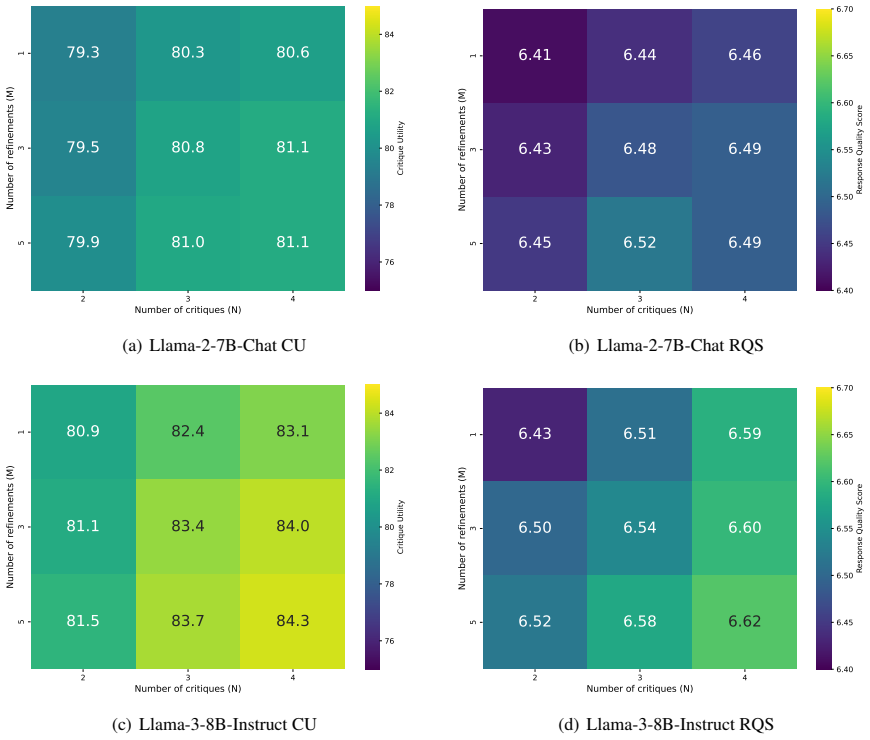
- [§3.1 and Limitation] The critique utility CU(ci|y0,x) and the partition function Zβ(y0,x) are estimated from very small samples: N=4 critiques and M=5 refinements per critique. The Limitation section acknowledges that these estimates may be inaccurate, but the paper does not quantify the estimation error or show that the reported differences (e.g., CU 81.1 vs. 72.3 in Table 1) exceed the sampling noise introduced by M=5 binomial trials and judge-model variability. Figure 6 in Section 6.3 provides a sensitivity analysis over N and M, but it does not report confidence intervals or variance estimates. Since CU is the only training reward, the paper should include bootstrap or other error-bar analyses demonstrating that the observed improvements are robust to this estimation noise.
minor comments (6)
- [§3] The phrase 'Inspired this' in the Critique Utility paragraph should be 'Inspired by this'.
- [§4.1, Table 2] In Table 2, the column header 'QA. Math Code Reward' is ambiguous because RewardBench is placed under the same grouping as the code benchmarks; consider a separate header for RewardBench or a footnote clarifying its placement.
- [§5.4] The sentence 'comparing RCO against three baselines: its base version, LLaMA-3-70B-Instruct, and DPCO with' ends with an incomplete phrase; it should be 'and DPCO' or specify what is being compared.
- [Appendix C] The statement 'Each of these models are fully trained 5 epochs for RCO and 1 epoch for DPCO, ensuring equalized numbers of optimization steps' is unclear without knowing the number of training examples used by each method; please state the actual number of optimizer steps or the dataset sizes.
- [§3.1] The sentence 'Among these, 8,000 responses are selected per model, ensuring 1,600 responses per task and 2,000 per actor model' is arithmetically ambiguous; clarify whether these numbers refer to totals per model, per task, or per actor model, and reconcile them with the 10,000-prompt and 40,000-response figures.
- [Figure 1 caption] The caption uses 'which train critic models' and should be 'which trains critic models' for grammatical agreement.
Circularity Check
No significant circularity: RCO's central claims rest on external accuracy benchmarks and human evaluation rather than on a self-referential training objective.
full rationale
The paper's reward signal CU is computed offline from critiques sampled from the base critic and refinements from the actor, judged by Qwen-2.5-72B (Section 3.1); the training objective in Eq. 7 regresses the trained critic's log-ratio toward these fixed scalar labels. The main evaluation re-estimates CU with GPT-4 and also reports GPT-4 RQS, accuracy on BBH/MATH/GSM8K/MBPP/MBPP-Plus/MMLU/GPQA/TruthfulQA, RewardBench pairwise accuracy, and human preference of critiques and refinements. None of the non-CU metrics is the training objective, and even the CU metric uses a different judge from the training judge, so improved CU is a transfer result rather than an identity forced by construction. Eq. 7 is a standard KL-regularized reward-maximization objective with a DRO least-squares approximation, not a restatement of the evaluation. The Related Work citation to CriticLLM (Ke et al.) shares authors but is not load-bearing; the method's derivation relies on Rafailov et al. and Richemond et al., which are external. The uneven preference-supervision count between RCO and DPCO is a potential experimental confound but is not a circularity of the kind this pass flags.
Assumptions & free parameters
free parameters (1)
- beta (temperature) =
0.1
assumptions (4)
- standard math The KL-constrained RL optimum has the form p*(c|x) ∝ p(c|x) exp(R(c|x)/β)
- ad hoc to paper The MSE objective (Eq. 7) is a valid surrogate for the RL objective
- domain assumption The preference judge (Qwen-2.5-72B-Instruct) provides a reliable proxy for human preferences
- domain assumption Actor model refinements are i.i.d. samples from π_ci
Cite this review
Pith. "Pith review of Training Language Model to Critique for Better Refinement." pith.science (2026). https://pith.science/paper/ZUQLYRYL
@misc{pith2026250622157,
  author       = {Pith},
  title        = {Pith review of: Training Language Model to Critique for Better Refinement},
  year         = {2026},
  howpublished = {\url{https://pith.science/paper/ZUQLYRYL}},
  note         = {Machine review of arXiv:2506.22157}
}
read the original abstract
Large language models (LLMs) have demonstrated remarkable evaluation and critique capabilities, providing insightful feedback and identifying flaws in various tasks. However, limited research has explored which types of critiques are most effective for improving model responses or how to generate such critiques. To address this gap, we introduce \textbf{R}efinement-oriented \textbf{C}ritique \textbf{O}ptimization (RCO), a novel framework designed to train critic models using refinement signals. RCO uses a feedback loop where critiques, generated by the critic model, guide the actor model in refining its responses. The critique utility (CU) quantifies the effectiveness of these refinements, serving as the reward signal for training the critic model. By focusing on critiques that lead to better refinements, RCO eliminates the need for direct critique preference assessment, ensuring that critiques driving meaningful improvements are rewarded. We evaluate RCO across five tasks, i.e., dialog generation, summarization, question answering, mathematical reasoning, and code generation, and show that it significantly outperforms traditional methods and open-source models in terms of critique quality and refinement outcomes. Our contributions include the introduction of RCO, a novel supervision scheme based on refined response preferences, and comprehensive experimental results that highlight the method's effectiveness in enhancing LLM critique-refinement loops.
Figures


Figures from the paper (8 more)




Reference graph
Works this paper leans on
-
[1]
**Accuracy:** Does the critique accurately identify any issues with my response? Are any mistakes or shortcomings in my response correctly pointed out?
-
[4]
arXiv preprint arXiv:2404.04298
Self-[in] correct: Llms struggle with re- fining self-generated responses. arXiv preprint arXiv:2404.04298. Mandar Joshi, Eunsol Choi, Daniel Weld, and Luke Zettlemoyer. 2017. triviaqa: A Large Scale Distantly Supervised Challenge Dataset for Reading Compre- hension. arXiv e-prints, arXiv:1705.03551. Pei Ke, Bosi Wen, Andrew Feng, Xiao Liu, Xuanyu Lei, Ji...
arXiv 2017
-
[5]
**Thoroughness:** Does the critique cover all significant aspects of my response, or does it overlook any important issues? Does it delve into the reasoning behind the suggestions for improvement?
-
[6]
arXiv preprint arXiv:2405.19107
Offline regularised reinforcement learning for large language models alignment. arXiv preprint arXiv:2405.19107. Evan Sandhaus. 2008. The new york times annotated corpus. Linguistic Data Consortium, Philadelphia, 6(12):e26752. William Saunders, Catherine Yeh, Jeff Wu, Steven Bills, Long Ouyang, Jonathan Ward, and Jan Leike. 2022. Self-critiquing models fo...
arXiv 2008
-
[7]
Self-rewarding language models. arXiv preprint arXiv:2401.10020. Lianmin Zheng, Wei-Lin Chiang, Ying Sheng, Siyuan Zhuang, Zhanghao Wu, Yonghao Zhuang, Zi Lin, Zhuohan Li, Dacheng Li, Eric Xing, et al. 2023a. Judging llm-as-a-judge with mt-bench and chatbot arena. Advances in Neural Information Processing Systems, 36:46595–46623. Qinkai Zheng, Xiao Xia, X...
arXiv 2019
-
[11]
**Objectivity:** Is the critique unbiased and impartial? Does it focus solely on the quality of my response and avoid unnecessary personal opinions or judgments?
-
[13]
**Tone:** Is the critique delivered in a respectful and professional tone, avoiding any condescen- sion or harshness? You should focus particularly on the "Suggestions for improvement" field in each critique and evaluate how well each assistant has provided guidance to improve the response. Avoid being influenced by the length of the critiques or the orde...
-
[14]
**Accuracy:** Does the critique accurately identify any issues with my summary? Are any mistakes or shortcomings in my summary correctly pointed out?
Show all 77 references
-
[17]
**Objectivity:** Is the critique unbiased and impartial? Does it focus solely on the quality of my summary and avoid unnecessary personal opinions or judgments?
-
[18]
**Thoroughness:** Does the critique cover all significant aspects of my summary, or does it overlook any important issues? Does it delve into the reasoning behind the suggestions for improvement?
-
[19]
Suggestions for improvement
**Tone:** Is the critique delivered in a respectful and professional tone, avoiding any condescen- sion or harshness? You should focus particularly on the "Suggestions for improvement" field in each critique and evaluate how well each assistant has provided guidance to improve...
-
[25]
Suggestions for improvement
**Tone:** Is the critique delivered in a respectful and professional tone, avoiding any condescen- sion or harshness? You should focus particularly on the "Suggestions for improvement" field in each critique and evaluate how well each assistant has provided guidance to improve...
-
[26]
**Accuracy:** Does the critique accurately identify any issues with my answer? Are any mistakes or shortcomings in my answer correctly pointed out?
-
[29]
**Objectivity:** Is the critique unbiased and impartial? Does it focus solely on the quality of my answer and avoid unnecessary personal opinions or judgments?
-
[30]
**Thoroughness:** Does the critique cover all significant aspects of my answer, or does it overlook any important issues? Does it delve into the reasoning behind the suggestions for improvement?
-
[31]
Suggestions for improvement
**Tone:** Is the critique delivered in a respectful and professional tone, avoiding any condescen- sion or harshness? You should focus particularly on the "Suggestions for improvement" field in each critique and evaluate how well each assistant has provided guidance to improve...
-
[32]
**Accuracy:** Does the critique accurately identify any issues with my code? Are any mistakes or shortcomings in my code correctly pointed out?
-
[33]
**Clarity:** Is the critique clearly written, easy to understand, and well-structured? Does it explain the issues in a way that is accessible and straightforward?
-
[34]
**Constructiveness:** Does the critique provide practical and actionable suggestions for improve- ment? Are the suggestions detailed, specific, and relevant to the issues identified?
-
[35]
**Objectivity:** Is the critique unbiased and impartial? Does it focus solely on the quality of my code and avoid unnecessary personal opinions or judgments?
-
[36]
**Thoroughness:** Does the critique cover all significant aspects of my code, or does it overlook any important issues? Does it delve into the reasoning behind the suggestions for improvement?
-
[37]
Suggestions for improvement
**Tone:** Is the critique delivered in a respectful and professional tone, avoiding any condescen- sion or harshness? You should focus particularly on the "Suggestions for improvement" field in each critique and evaluate how well each assistant has provided guidance to improve...
-
[38]
In a large bowl, whisk together the buttermilk and eggs until smooth
-
[39]
Add the chopped pickled cabbage and carrots to the bowl and stir to combine
-
[40]
Season with salt and pepper to taste
-
[41]
Chill the soup in the refrigerator for at least 30 minutes to allow the flavors to meld
-
[42]
Critique by Llama-3-8B-Instruct+RCO **Helpfulness:** 0/5 - The assistant's response is not helpful at all
Serve the Koldskå l cold, garnished with chopped fresh herbs or a sprinkle of paprika. Critique by Llama-3-8B-Instruct+RCO **Helpfulness:** 0/5 - The assistant's response is not helpful at all. It provides a list of ingredients with no instructions on how to prepare the dish, ...
-
[43]
Provide a correct and accurate recipe for Koldskål, including ingredients, quantities, and instructions on how to prepare and serve the dish
-
[44]
Consider providing a brief description of the dish and its origins to give the user a better understanding of what they are making
-
[45]
Use a clear and concise format for the recipe, making it easy to read and follow
-
[46]
By following these suggestions, the assistant can provide a helpful, harmless, and correct response that will assist the user in making a delicious Danish dish
Consider providing variations or alternatives to the recipe to cater to different tastes and dietary restrictions. By following these suggestions, the assistant can provide a helpful, harmless, and correct response that will assist the user in making a delicious Danish dish. R...
-
[47]
In a medium-sized bowl, whisk together the sour milk, sugar, cornstarch, and salt until well combined
-
[48]
Add the vanilla extract and mix well
-
[49]
Fold in the chopped fresh fruit
-
[50]
Cover the bowl with plastic wrap and refrigerate for at least 2 hours or overnight
-
[51]
I hope you enjoy this recipe for Koldskå l! Let me know if you have any questions or if you would like any variations on the recipe
Serve the Koldskå l chilled, garnished with additional fresh fruit if desired. I hope you enjoy this recipe for Koldskå l! Let me know if you have any questions or if you would like any variations on the recipe. The assistant's response is a mess, to put it mildly. However, it...
-
[52]
Provide a clear and concise recipe for Koldskål, including measurements, cooking method, and nutritional information
-
[53]
Use accurate and authentic ingredients and cooking techniques to ensure the recipe is true to the traditional Danish dish
-
[54]
Consider adding a brief introduction to the recipe, explaining the history and cultural context of Koldskål in Denmark
-
[55]
on my team
Consider adding a visual representation of the dish, such as a photo or diagram, to help illustrate the cooking process. Figure 7: One typical case from the dialog generation task in CriticEval dataset. Our critique is preferred mainly based on the criteria of Accuracy. Questi...
-
[56]
It's more of a generalization about the use of steel in construction
Lack of clarity: The answer doesn't address the question directly. It's more of a generalization about the use of steel in construction. This doesn't provide any specific information about the steel rocking chair
-
[57]
This lack of credibility can undermine the answer's authority
No supporting evidence: The answer doesn't provide any evidence or references to support its claim. This lack of credibility can undermine the answer's authority
-
[58]
It doesn't mention the specific types of steel or techniques used to create the chair
No depth or nuance: The answer doesn't provide any depth or nuance about the steel used in the rocking chair. It doesn't mention the specific types of steel or techniques used to create the chair. Suggestions for improvement:
-
[59]
Address the question directly: The answer should clearly and explicitly state that it's discussing the material used in a specific object, in this case, a steel rocking chair
-
[60]
This could include links to reputable sources or citations to academic studies
Provide specific evidence: The answer should provide references or evidence to support its claims. This could include links to reputable sources or citations to academic studies
-
[61]
This could include specific types of steel used, techniques employed, or processes involved in its creation
Provide depth and nuance: The answer should provide some depth and nuance about the steel used in the rocking chair. This could include specific types of steel used, techniques employed, or processes involved in its creation
-
[62]
This could include specific measurements or technical specifications
Use clear language: The answer should use clear and concise language to describe the material and its properties. This could include specific measurements or technical specifications. Figure 9: One typical case from the question answering task in CriticEval dataset. Our critiq...
2000
-
[63]
how many grams can you eat
The code doesn't address the question directly. The question asks "how many grams can you eat" from the 300g bag, not the entire bag or the maximum number of grams that can be eaten. The code should calculate the number of servings or grams from the 300g bag that can be eaten,...
-
[64]
The question mentions the specific values of these variables, so the code should use these values to calculate the answer
The code doesn't mention the variable names that are related to the 300g bag, such as `bag_weight` and `servings_per_bag`. The question mentions the specific values of these variables, so the code should use these values to calculate the answer
-
[65]
The question asks for the number of grams that can be eaten, not the number of grams per calorie
The code has a variable `grams_per_calorie` that is not related to the question. The question asks for the number of grams that can be eaten, not the number of grams per calorie. The code should not use this variable to calculate the answer
-
[66]
The question asks for the specific number of grams that can be eaten, not the maximum
The code returns the maximum number of grams that can be eaten, not the specific number of grams that can be eaten from the 300g bag. The question asks for the specific number of grams that can be eaten, not the maximum. Suggestions for improvement:
-
[67]
This can be done by subtracting the minimum of the daily calorie target and the consumed calories from the total calories in the 300g bag, not the maximum
Calculate the number of servings or grams from the 300g bag that can be eaten, not the entire bag or an arbitrary amount. This can be done by subtracting the minimum of the daily calorie target and the consumed calories from the total calories in the 300g bag, not the maximum
-
[68]
Use the specific values of `bag_weight` and `servings_per_bag` to calculate the answer, not an arbitrary value
-
[69]
Use the correct calculation to convert the number of calories to grams, such as `grams = (calories / calories_per_serving) * servings_per_bag`, not an arbitrary conversion
-
[70]
Critique by Llama-3-8B-Instruct+RCO The answer provided is a Python code snippet that attempts to solve the problem, but it has several issues
Return the specific number of grams that can be eaten from the 300g bag, not the maximum. Critique by Llama-3-8B-Instruct+RCO The answer provided is a Python code snippet that attempts to solve the problem, but it has several issues. Here's a breakdown of the problems:
-
[71]
The code should calculate the number of grams that can be eaten while staying within the daily calorie target
The problem statement asks for the number of grams that can be eaten, but the code calculates the maximum number of grams that can be eaten, which is not the same thing. The code should calculate the number of grams that can be eaten while staying within the daily calorie target
-
[72]
The problem statement does not provide this information, and the code should not make this assumption
The code assumes that 1 gram of the bag of chips is equivalent to 4 calories, which is not always the case. The problem statement does not provide this information, and the code should not make this assumption
-
[73]
The code does not take into account the number of servings in the bag when calculating the maximum number of grams that can be eaten. It only calculates the total number of calories in the bag and the remaining calories for the day, but it does not use this information to dete...
-
[74]
For example, `calories_per_serving` should be in calories, `servings_per_bag` should be in servings, and `bag_weight` should be in grams
Clearly define the variables and their units. For example, `calories_per_serving` should be in calories, `servings_per_bag` should be in servings, and `bag_weight` should be in grams
-
[75]
Instead of assuming 1 gram of the bag of chips is equivalent to 4 calories, use the information that there are 250 calories per serving and 5 servings in the bag
Use the correct information from the problem statement. Instead of assuming 1 gram of the bag of chips is equivalent to 4 calories, use the information that there are 250 calories per serving and 5 servings in the bag
-
[76]
Calculate the total number of calories in the bag by multiplying the number of servings by the calories per serving, not by multiplying the bag weight by the number of servings by the calories per serving
-
[77]
Calculate the number of grams that can be eaten by dividing the remaining calories by the calories per gram, not by multiplying the remaining calories by the grams per calorie
-
[78]
Figure 10: One typical case from the mathematical reasoning task in CriticEval dataset
Return the result in grams, not in calories. Figure 10: One typical case from the mathematical reasoning task in CriticEval dataset. Our critique is preferred mainly based on the criteria of Thoroughness. Question Initial Response def find_rotation_count(arr): n = len(arr) rot...
-
[79]
This can be done by using a more accurate approach, such as the one described in the solution
**Correct the code:** The code should be modified to correctly solve the problem. This can be done by using a more accurate approach, such as the one described in the solution
-
[80]
**Use more descriptive variable names:** The code should be modified to use more descriptive variable names, such as `n` for the length of the array, `start` for the starting index, and `end` for the ending index
-
[81]
**Use a more efficient algorithm:** The code should be modified to use a more efficient algorithm, such as the one that iterates over the array only once, not twice
-
[82]
**Use a more accurate count:** The code should be modified to use a more accurate count, such as the one that counts the number of rotations, not the number of pairs of elements that are in the wrong order
-
[83]
Critique by Llama-3-8B-Instruct+RCO **Correctness:** The code is not entirely correct
**Use a more readable code:** The code should be modified to be more readable, with more comments, variable names, and a more logical organization. Critique by Llama-3-8B-Instruct+RCO **Correctness:** The code is not entirely correct. The problem statement asks to find the num...
-
[84]
In this case, the problem is to find the number of rotations in a circularly sorted array, not just to check if the array is sorted
**Understand the problem:** Before writing the code, make sure you understand the problem correctly. In this case, the problem is to find the number of rotations in a circularly sorted array, not just to check if the array is sorted
-
[85]
**Use a more descriptive variable name:** Instead of using `n`, use a more descriptive variable name like `array_length` to make the code more readable
-
[86]
Then, subtract this index from the length of the array to get the number of rotations
**Implement the correct solution:** To find the number of rotations, you can iterate through the array and find the index where the array is no longer sorted. Then, subtract this index from the length of the array to get the number of rotations
-
[87]
You can improve the efficiency by using a single loop to find the index where the array is no longer sorted
**Use a more efficient algorithm:** The current code has a time complexity of O(n^2) because of the nested loops. You can improve the efficiency by using a single loop to find the index where the array is no longer sorted
-
[88]
Figure 11: One typical case from the code generation task in CriticBench dataset
**Test the code:** Before submitting the code, make sure to test it with different inputs to ensure it produces the correct output. Figure 11: One typical case from the code generation task in CriticBench dataset. Our critique is preferred mainly based on the criteria of Clarity
-
[2020]
arXiv preprint arXiv:2009.03300
Measuring massive multitask language under- standing. arXiv preprint arXiv:2009.03300. Dan Hendrycks, Collin Burns, Saurav Kadavath, Akul Arora, Steven Basart, Eric Tang, Dawn Song, and Ja- cob Steinhardt. 2021. Measuring mathematical prob- lem solving with the math dataset. a...
2009 arXiv
-
[2022]
arXiv preprint arXiv:2204.05862
Training a helpful and harmless assistant with reinforcement learning from human feedback. arXiv preprint arXiv:2204.05862. Loubna Ben Allal, Niklas Muennighoff, Lo- gesh Kumar Umapathi, Ben Lipkin, and Leandro von Werra. 2022. A framework for the evaluation of code generation...
2022 arXiv
-
[2023]
arXiv preprint arXiv:2305.18290
Direct preference optimization: Your language model is secretly a reward model. arXiv preprint arXiv:2305.18290. David Rein, Betty Li Hou, Asa Cooper Stickland, Jack- son Petty, Richard Yuanzhe Pang, Julien Dirani, Ju- lian Michael, and Samuel R Bowman. 2024. Gpqa: A graduate-...
2024 arXiv
-
[2024]
arXiv preprint arXiv:2409.12147
Magicore: Multi-agent, iterative, coarse- to-fine refinement for reasoning. arXiv preprint arXiv:2409.12147. Wenhu Chen, Ming Yin, Max Ku, Pan Lu, Yixin Wan, Xueguang Ma, Jianyu Xu, Xinyi Wang, and Tony Xia. 2023. Theoremqa: A theorem-driven question answering dataset. In Proc...
2023
Reviewed August 6, 2026 · model on record in the stance chip above.
Discussion (0). Continue with ORCID to comment.