REVIEW 3 major objections 4 minor 34 references
Correcting astigmatism and ellipticity in Gaussian beams using a cylindrical lens pair with tunable focal lengths
T0 review · 3 major / 4 minor · reviewed 2026-08-06 · deepseek-v4-flash
Pith's one-line read Three cylindrical lenses can turn an astigmatic elliptical Gaussian beam into a circular Gaussian beam without precise focal-length matching, and the paper gives the exact rotation angle that does it.
desk verdict A solid, genuinely useful three-lens circularization scheme with sound derivations and a convincing experiment; the main gaps are the missing quantitative validation of Eq. (17) and an under-analyzed alignment sensitivity of the first lens. read the letter →
The pith
A machine-rendered reading of the paper's core claim, the machinery that carries it, and where it could break.
The reading
What carries the argument
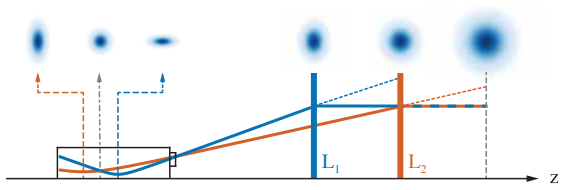
The central object is the tunable biaxial lens realized by two counter-rotated cylindrical lenses of equal focal length $f$. The key identity is $T_{-\theta}(f)T_{+\theta}(f)=T_x\!\big(f\sec^2(\theta)/2\big)\,T_y\!\big(f\csc^2(\theta)/2\big)$, which converts one rotation angle into two independently tunable focal lengths and underlies the whole design. The supporting formalism is the generalized Gaussian beam matrix $\Lambda(z)$: its real part gives the beam radii and principal-axis orientation, free-space propagation acts as an inversion, and lens transmission acts as an imaginary matrix addition. The commutator $[\Re\Lambda,\Im\Lambda]$ diagnoses beam twisting, so its vanishing is exactly the condition for a plane with circular intensity to exist. Existence proofs that a first lens creates such a plane and that the pair can always de-astigmatize the beam use the intermediate value theorem on the difference of the two beam radii or of the two waist positions.
What would settle it
Take an astigmatic elliptical Gaussian beam with independently measured beam parameters, place the lens pair at the circular-intensity plane, and scan the relative angle around the predicted $\theta^*$ from Eq.~(17): the central claim implies far-field circularity is maximized exactly when the output waist separation $\Delta z$ vanishes and the waist radii coincide, so a systematic offset between the measured optimum and Eq.~(17) would falsify the design rule.
Extended reading notes
Core claim
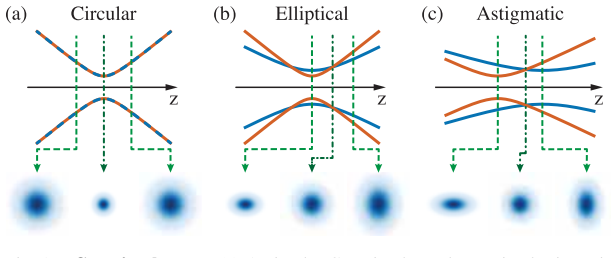
The central claim is that astigmatism and ellipticity in a non-twisted elliptical Gaussian beam can be corrected simultaneously with three cylindrical lenses, and the core design rule is explicit. Two identical uniaxial cylindrical lenses with focal length $f$, mounted one behind the other and rotated by equal and opposite angles, have a cumulative phase identical to a single biaxial lens with focal lengths $f_x(\theta)=f\sec^2(\theta)/2$ and $f_y(\theta)=f\csc^2(\theta)/2$; rotating the pair therefore tunes both effective focal lengths continuously. When the pair sits in a plane where the beam's intensity is already circular, the condition for a fully circular output reduces to Eq.~(17) for the optimal angle $\theta^*$, with the existence condition $|f|\le f_{\max}$. The paper proves that the first cylindrical lens can always create such a circular-intensity plane for an elliptical Gaussian beam, and that misaligning that lens produces a generalized Gaussian beam with $[\Re\Lambda,\Im\Lambda]\neq0$, for which the paper proves no downstream plane can have a radially symmetric intensity profile, with a $2^\circ$ misalignment capping the reachable circularity near $0.97$. It also shows the design formulas survive imperfect uniaxiality by replacing $f$ with the effective focal length $f'=(1/f-1/f_\perp)^{-1}$, and that nonzero spacing between the two lenses degrades circularity approximately linearly, more slowly for larger focal lengths.
Load-bearing premise
The method assumes the input beam is a non-twisted elliptical Gaussian beam and that the first cylindrical lens is aligned precisely with the beam's major axis, so that a plane with an exactly circular intensity profile exists downstream.
Editorial extensions
If this is right
- Any elliptical Gaussian beam with astigmatism can be circularized with three catalog cylindrical lenses, as long as the pair's focal length satisfies $|f|\le f_{\max}$; no exact focal-length ratio is required.
- The optimal lens-pair angle is given in closed form by Eq.~(17), so alignment becomes a single-parameter search near $\theta^*$ rather than a search over both lens powers and positions.
- Imperfect uniaxial cylindrical lenses, which have a finite weak-axis focal length $f_\perp$, do not break the method: replacing $f$ by $f'=(1/f-1/f_\perp)^{-1}$ keeps the formulas valid, provided the two weak-axis focal lengths are equal.
- Nonzero spacing between the two lenses is tolerable, and its effect decreases as the lens focal length grows, so practical rotation-mount thickness does not prevent circularity close to unity.
- Once circularized, the beam remains circular in every subsequent plane, so a spherical lens can collimate or focus it without reintroducing astigmatism.
Reading between the lines
- Because the pair's effective focal lengths are continuously tunable through the rotation angle, the same three-lens hardware could serve as an adjustable in-situ astigmatism corrector whose angle is re-optimized when the source beam drifts, without exchanging optics.
- The predicted beam twisting at nonzero first-lens misalignment suggests a practical alignment diagnostic: monitor the rotation of the principal axes downstream and lock the first lens to the orientation that eliminates that rotation.
- The minimum-circularity metric $C_0$ defined in Eq.~(22) could be used as a feedback signal for closed-loop rotation control; testing whether maximizing $C_0$ in one downstream plane yields the predicted full-propagation circularity would be a direct experimental check of the model.
- Because standard cylindrical lenses handle high power and the design avoids diffractive elements, the method may extend naturally to high-power beams where spatial-light-modulator solutions are lossy, though the paper does not test this regime.
Signed reviews
Editorial analysis
A structured set of objections, weighed in public.
Referee Report
Summary. The paper introduces a passive three-cylindrical-lens method for converting an astigmatic elliptical Gaussian beam into a circular Gaussian beam. The first cylindrical lens creates a plane P2 with circular intensity profile; two counter-rotated cylindrical lenses placed at P2 act as an effective biaxial lens with tunable focal lengths, and Eqs. (17)-(18) give the optimal rotation angle and focal-length bound for circularization. The authors provide an analytical derivation using the generalized Gaussian beam formalism, a numerical robustness study of inter-lens spacing and lens misalignment, and experimental demonstrations: the lens pair is validated as a tunable biaxial lens, and the full three-lens system circularizes a commercial Ti:sapphire beam to far-field circularity 0.97±0.01 with residual waist separation 0.008 z_R. The paper explicitly discusses several limitations, including the effect of L1 misalignment in App. D.2.
Significance. If the claims hold, the method is a useful, low-cost, compact alternative to active or precisely matched passive circularization schemes, and the use of a counter-rotated cylindrical lens pair to avoid precise focal-length matching is an elegant and practical idea. The analytical derivation is largely self-contained and the generalized Gaussian beam treatment of finite inter-lens distance and misalignment is a genuine strength. The experimental demonstration reaches good circularity with modest residual astigmatism. However, the central design equation Eq. (17) is not directly validated in the experiment, and the main circularization claim is conditional on an idealized alignment assumption that the paper discloses but does not turn into a practical tolerance procedure.
major comments (3)
- [Sec. 3.2 and Eq. (17)] The experimental demonstration does not test the predictive content of Eq. (17): the optimal angle θ*=28.7° is found by direct optimization, and the manuscript does not compare this measured value with the prediction of Eq. (17) computed from independently characterized input-beam parameters. Because Eq. (17) is the central design rule of the paper, the authors should provide this comparison, or explicitly state that the experimental validation covers the method with feedback optimization rather than the predictive use of Eq. (17).
- [Sec. 2.1.3 and App. D.2] The existence of the circular plane P2, and therefore the circularization proof, requires that L1 be exactly aligned with the major axis of a non-twisted elliptical Gaussian beam. App. D.2 itself proves that any misalignment makes a radially symmetric P2 impossible, and Fig. 10 shows that a 2° misalignment caps the achievable circularity at about 0.97. Since Sec. 3.2 reports C_P2=0.9996 only after explicit orientation optimization, the main-text claim that the beam is converted into a circular Gaussian beam without astigmatism is conditional on an ideal alignment assumption. The paper should add a quantitative tolerance budget or a measurement procedure to determine when P2 is attainable for a given alignment error.
- [Sec. 2.2 and Fig. 7] The robustness analysis shows that for the experimental inter-lens distance d23=6 mm the optimal angles θ2 and θ3 deviate from the equal-angle value θ*, yet the experimental section reports only the optimized angle θ*=28.7° and does not connect it to Eq. (17) or to a finite-spacing correction. Since d23=6 mm is the actual experimental configuration, the manuscript should provide a quantitative procedure for choosing θ2 and θ3 when d23≠0, or state that the finite-spacing case is handled purely by experimental optimization.
minor comments (4)
- [App. B.1, Eq. (54) and Eq. (55)] Eq. (54) contains a typographical error in the term (z0y/w0y^2 - z0y/w0x^2), which should be (z0y/w0y^2 - z0x/w0x^2) to match Eq. (17); Eq. (55) has a garbled term "w0^2 w" and should be corrected to the form in Eq. (17).
- [Sec. 3.1] The residual transverse focal length f⊥=51.4 m is introduced as a fitted parameter that minimizes the discrepancy between theory and experiment, but no independent measurement or uncertainty is reported; the authors should state whether this value is consistent with manufacturer specifications or with a separate measurement.
- [Sec. 3.2 and Fig. 9] The text reports far-field circularity C∞=0.97±0.01, while Fig. 9c states that the minimum beam circularity near the waist averages 0.95(1); the relationship between these two quantities and their measurement ranges should be clarified.
- [Abstract and Sec. 2.1.3] The phrase "without requiring precise focal length matching" should be qualified: Eq. (18) imposes an upper bound |f|≤f_max rather than an exact ratio, so the requirement is a bound rather than no constraint at all.
Circularity Check
No significant circularity: the central circularization condition is derived from paraxial propagation and thin-lens phase rules, not from fitted data or self-citation.
full rationale
The paper's central result, Eq. (17), is obtained in App. B by requiring that the imaginary part of the Lambda matrix after transmission through a counter-rotated cylindrical lens pair has equal eigenvalues, with all input parameters (w0x, w0y, z0x, z0y, lambda, and w_r) referring to the input beam and the chosen lens focal length. This is an explicit first-principles condition, not an equivalent restatement of the desired output. The effective biaxial focal lengths of the two-lens pair are derived algebraically from the product of their phase transmittances (Eqs. 12-15). The existence of the circular plane P2 is proven by an intermediate-value argument in App. D.1 under the stated alignment assumption, and App. D.2 explicitly proves and quantifies that misalignment prevents perfect circularization; that is a disclosed conditionality, not circularity. The only fitted parameter, f_perp = 51.4 m in Sec. 3.1, is a residual weak-axis focal length inferred from observed deviations in the validation experiment; it does not enter Eq. (17) or (18), and the paper does not present it as an independent prediction of the circularization outcome. No load-bearing self-citation is used: the citations to the authors' previous work appear only in the introduction as applications, and the technical formalism cites Arnaud and Kogelnik and standard texts. Accordingly, the derivation is self-contained against the experimental benchmarks, and the honest finding is no significant circularity.
Assumptions & free parameters
free parameters (1)
- f_perp (residual transverse focal length of the cylindrical lenses) =
51.4 m
assumptions (6)
- standard math Paraxial approximation and Gaussian beam propagation (Fresnel diffraction kernel, Eq. 27)
- domain assumption Thin-lens approximation: a cylindrical lens imparts a pure quadratic phase exp(-i pi x^2/(lambda f)) without amplitude change (Eq. 10)
- domain assumption Input beam is an elliptical Gaussian beam with orthogonal astigmatism whose principal axes are aligned with the lens axes (Eq. 4)
- standard math Intermediate Value Theorem applied to the continuous functions Delta z(theta) and Delta w(z) for the existence proofs
- domain assumption A sufficiently small focal length f1 (f1 much less than z_R) can create the needed circular plane; practical lens catalogs can provide such focal lengths
- domain assumption Zero inter-lens distance and equal nominal focal lengths f2=f3=f for the pair in the analytical derivation (Eqs. 12-17)
Cite this review
Pith. "Pith review of Correcting astigmatism and ellipticity in Gaussian beams using a cylindrical lens pair with tunable focal lengths." pith.science (2026). https://pith.science/paper/VDMCFAJO
@misc{pith2026250622308,
  author       = {Pith},
  title        = {Pith review of: Correcting astigmatism and ellipticity in Gaussian beams using a cylindrical lens pair with tunable focal lengths},
  year         = {2026},
  howpublished = {\url{https://pith.science/paper/VDMCFAJO}},
  note         = {Machine review of arXiv:2506.22308}
}
read the original abstract
Correcting astigmatism and ellipticity in laser beams is critical for improving performance in many applications like microscopy, atomic physics, quantum information processing, and advanced manufacturing. Passive correction methods based on cylindrical lens telescopes require choosing lenses with precise focal lengths, effectively limiting the range of tunability when using standard catalog optics. Active solutions based on diffractive optical elements can achieve superior performance, but they are bulky, expensive, and suffer from finite diffraction efficiency and added complexity. Here, we introduce a simple method to convert astigmatic elliptical beams into circular Gaussian beams without astigmatism. Our method comprises three cylindrical lenses. The first lens focuses the beam along its major axis to create a plane where the intensity profile is radially symmetric. The second and third lenses are placed one behind the other in that plane at a relative angle, acting as a biaxial lens pair with tunable focal lengths. By adjusting the relative angle of the lenses, the two separate beam waists of the astigmatic beam can be overlapped, resulting in a circular Gaussian beam without astigmatism. We theoretically validate our method, numerically quantify its robustness to experimental imperfections, and experimentally demonstrate its ability to circularize the output beam of a commercial laser source. Our method corrects astigmatism and ellipticity in laser beams without requiring precise focal length matching, offering greater flexibility than other passive solutions and greater cost-effectiveness than active methods. Its simple and compact design makes it well suited for integration into both tabletop optical setups and industrial systems.
Figures

Figures from the paper (8 more)


Reference graph
Works this paper leans on
-
[1]
Astigmatic gaussian beams produced by axially asymmetric laser cavities,
D. Hanna, “Astigmatic gaussian beams produced by axially asymmetric laser cavities,” IEEE J. Quantum Electron.5, 483–488 (1969)
work page 1969
-
[2]
Two-mirror beam-shaping technique for high-power diode bars,
W. A. Clarkson and D. C. Hanna, “Two-mirror beam-shaping technique for high-power diode bars,” Opt. Lett.21, 375–377 (1996)
work page 1996
-
[3]
Optimization of optical tweezers,
M. Knecht, “Optimization of optical tweezers,” Southern Scholars Senior Research Project, Southern Adventist University (2007). Available through KnowledgeExchange@Southern
work page 2007
-
[4]
M. Serkan and H. Kirkici, “Optical beam-shaping design based on aspherical lenses for circularization, collimation, and expansion of elliptical laser beams,” Appl. Opt.47, 230–241 (2008)
work page 2008
-
[5]
Beam shaping of edge-emitting diode lasers using a single double-axial hyperboloidal micro-lens,
Z.-N. Tian, L.-J. Wang, Q.-D. Chen,et al., “Beam shaping of edge-emitting diode lasers using a single double-axial hyperboloidal micro-lens,” Opt. Lett.38, 5414–5417 (2013)
work page 2013
-
[6]
Sun,Laser Diode Beam Manipulations(Springer Netherlands, Dordrecht, 2015), pp
H. Sun,Laser Diode Beam Manipulations(Springer Netherlands, Dordrecht, 2015), pp. 53–104
work page 2015
-
[7]
M. N. Hasan, M.-U. Haque, and Y. C. Lee, “Deastigmatism, circularization, and focusing of a laser diode beam using a single biconvex microlens,” Opt. Eng.55, 095107 (2016)
work page 2016
-
[8]
Mode-coupling enhancement by pump astigmatism correction in a ti:sapphire femtosecond laser,
C. Ramírez-Guerra, J. A. Moreno-Larios, M. Rosete-Aguilar, and J. Garduño-Mejía, “Mode-coupling enhancement by pump astigmatism correction in a ti:sapphire femtosecond laser,” Appl. Opt.55, 9889–9894 (2016)
work page 2016
Show all 34 references
-
[9]
Spectra-Physics,Model 3900S CW Ti:Sapphire Laser User’s Manual, The Solid-State Laser Company, 1335 Terra Bella Avenue, Mountain View, CA 94043 (2002)
2002
-
[10]
Magnification of prisms: an apparent anomaly and its explanation,
M. V. R. K. Murty and J. R. Moya-Cessa, “Magnification of prisms: an apparent anomaly and its explanation,” Opt. Eng.23, 83–87 (1984)
1984
-
[11]
Single aspherical lens for deastigmatism, collimation, and circularization of a laser beam,
Z. Xiao-Qun, B. Ngoi Kok Ann, and K. S. Seong, “Single aspherical lens for deastigmatism, collimation, and circularization of a laser beam,” Appl. Opt.39, 1148–1151 (2000)
2000
-
[12]
Deastigmatism and circularization of an elliptical gaussian beam by off-axis ellipsoid reflector based off-focus configuration,
S. Yang, M. Bai, and J. Miao, “Deastigmatism and circularization of an elliptical gaussian beam by off-axis ellipsoid reflector based off-focus configuration,” Prog. In Electromagn. Res. B10, 91–103 (2008)
2008
-
[13]
Reshaping of a divergent elliptical gaussian laser beam into a circular, collimated, and uniform beam with aspherical lens design,
M. Serkan and H. Kirkici, “Reshaping of a divergent elliptical gaussian laser beam into a circular, collimated, and uniform beam with aspherical lens design,” IEEE Sensors J.9, 36–43 (2009)
2009
-
[14]
Aberration correction for slm-generated bessel beams propagating through tilted interfaces,
H. Cheng, C. Xia, S. M. Kuebler, and X. Yu, “Aberration correction for slm-generated bessel beams propagating through tilted interfaces,” Opt. Commun.475, 126213 (2020)
2020
-
[15]
An slm-based shack–hartmann wavefront sensor for aberration correction in optical tweezers,
R. W. Bowman, A. J. Wright, and M. J. Padgett, “An slm-based shack–hartmann wavefront sensor for aberration correction in optical tweezers,” J. Opt.12, 124004 (2010)
2010
-
[16]
Coupling efficiency of optics in single-mode fiber components,
R. E. Wagner and W. J. Tomlinson, “Coupling efficiency of optics in single-mode fiber components,” Appl. Opt.21, 2671–2688 (1982)
1982
-
[17]
Ultrapreciseholographicopticaltweezerarray,
Y.T.Chew,M.Poitrinal,T.Tomita,etal.,“Ultrapreciseholographicopticaltweezerarray,”Phys.Rev.A110,053518 (2024)
2024
-
[18]
Aberration correction in holographic optical tweezers,
K. D. Wulff, D. G. Cole, R. L. Clark,et al., “Aberration correction in holographic optical tweezers,” Opt. Express14, 4169–4174 (2006)
2006
-
[19]
Efficient algorithms to solve atom reconfiguration problems. i. redistribution-reconfiguration algorithm,
B. Cimring, R. El Sabeh, M. Bacvanski,et al., “Efficient algorithms to solve atom reconfiguration problems. i. redistribution-reconfiguration algorithm,” Phys. Rev. A108, 023107 (2023)
2023
-
[20]
Efficient algorithms to solve atom reconfiguration problems. ii. assignment- rerouting-ordering algorithm,
R. El Sabeh, J. Bohm, Z. Ding,et al., “Efficient algorithms to solve atom reconfiguration problems. ii. assignment- rerouting-ordering algorithm,” Phys. Rev. A108, 023108 (2023)
2023
-
[21]
Efficient algorithms to solve atom reconfiguration problems. iii. the bird and batching algorithms and other parallel implementations on gpus,
F. Afiouni, R. E. Sabeh, N. Nishimura,et al., “Efficient algorithms to solve atom reconfiguration problems. iii. the bird and batching algorithms and other parallel implementations on gpus,” arXiv:2504.06182 (2025)
2025 arXiv
-
[22]
Low-latency control system for feedback experiments with optical tweezer arrays,
A. H. Dadpour, T. Khayrullin, F. Afiouni,et al., “Low-latency control system for feedback experiments with optical tweezer arrays,” arXiv:2504.06528 (2025)
2025 arXiv
-
[23]
A guided light system for agile individual addressing of ba+ qubits with 10−4 level intensity crosstalk,
A. Binai-Motlagh, M. L. Day, N. Videnov,et al., “A guided light system for agile individual addressing of ba+ qubits with 10−4 level intensity crosstalk,” Quantum Sci. Technol.8, 045012 (2023)
2023
-
[24]
Designandcharacterizationofindividualaddressingopticsbasedonmulti-channel acousto-optic modulator for171Yb+ qubits,
S.Lim,S.Baek,J.Whitlow,etal.,“Designandcharacterizationofindividualaddressingopticsbasedonmulti-channel acousto-optic modulator for171Yb+ qubits,” Opt. Laser Technol.180, 111436 (2025)
2025
-
[25]
Anamorphic zoom lens based on rotating cylindrical lenses,
E. A. DeHoog, “Anamorphic zoom lens based on rotating cylindrical lenses,” Opt. Express29, 12206–12215 (2021)
2021
-
[26]
D. B. Elliott,Clinical Procedures in Primary Eye Care(Butterworth-Heinemann, 2007), 3rd ed
2007
-
[27]
J. T. Verdeyen,Laser Electronics, Prentice Hall Series in Solid State Physical Electronics (Prentice Hall, Upper Saddle River, NJ, 1995), 3rd ed
1995
-
[28]
In situ equalization of single-atom loading in large-scale optical tweezer arrays,
K.-N. Schymik, B. Ximenez, E. Bloch,et al., “In situ equalization of single-atom loading in large-scale optical tweezer arrays,” Phys. Rev. A106, 022611 (2022)
2022
-
[29]
The airy fiber: an optical fiber that guides light diffracted by a circular aperture,
I. Gris-Sánchez, D. V. Ras, and T. A. Birks, “The airy fiber: an optical fiber that guides light diffracted by a circular aperture,” Optica3, 270–276 (2016)
2016
-
[30]
Gaussian light beams with general astigmatism,
J. A. Arnaud and H. Kogelnik, “Gaussian light beams with general astigmatism,” Appl. Opt.8, 1687–1693 (1969)
1969
-
[31]
A. E. Siegman,Lasers(University Science Books, Mill Valley, California, 1986)
1986
-
[32]
J. W. Goodman,Introduction to Fourier Optics(Roberts and Company Publishers, 2005), 3rd ed
2005
-
[33]
(2011).https://docs
OpenCV Development Team,The OpenCV Reference Manual, OpenCV, release 2.3 ed. (2011).https://docs. opencv.org/2.3.0/
2011
-
[34]
A buyer’s guide to conic fitting,
A. W. Fitzgibbon and R. B. Fisher, “A buyer’s guide to conic fitting,” inBritish Machine Vision Conference,(1995)
1995
Reviewed August 6, 2026 · model on record in the stance chip above.
Discussion (0). Continue with ORCID to comment.