Enhanced thermoelectric effects in a driven one-dimensional system
Pith reviewed 2026-05-19 07:49 UTC · model grok-4.3
The pith
External periodic driving enhances the Seebeck coefficient by up to 200 percent in a one-dimensional quantum conductor at low temperatures.
A machine-rendered reading of the paper's core claim, the machinery that carries it, and where it could break.
Core claim
In a single-channel one-dimensional conductor subjected to a periodically varying delta-like potential barrier, Floquet scattering theory shows that the Seebeck coefficient is enhanced relative to the static case, with increases reaching 200 percent at high driving frequencies and low temperatures. When a static step barrier is introduced in one lead to represent a nanoscale inhomogeneous semiconducting system, the driven thermoelectric Onsager coefficient is also larger than its static counterpart and displays a significant photon-assisted effect at low temperatures when the chemical potential lies within the semiconductor gap.
What carries the argument
Floquet scattering theory applied to a periodically driven delta-like potential barrier in a single-channel conductor, with an optional static step barrier added to one lead.
If this is right
- The thermoelectric Onsager coefficient increases when the step barrier modeling the semiconductor is present.
- Photon-assisted processes contribute visibly at low temperatures when the chemical potential is inside the gap.
- External driving parameters provide a means to tune the magnitude of the thermoelectric response.
- Low-electron-density nanodevices can achieve higher thermoelectric capability through periodic driving alone.
Where Pith is reading between the lines
- The same driving strategy may extend to other mesoscopic geometries such as quantum dots or rings.
- Gate-defined structures in semiconductor heterostructures could serve as experimental platforms for testing the predicted enhancement.
- Varying the driving amplitude and waveform shape offers additional handles for further optimization beyond the frequencies examined.
Load-bearing premise
The model of a single-channel conductor with a periodically varying delta-like potential barrier accurately captures the linear-response stationary thermoelectric figures of merit under Floquet scattering theory.
What would settle it
A direct measurement of the Seebeck coefficient in a driven single-channel quantum wire or point contact at low temperature and high driving frequency that shows no enhancement relative to the static case would falsify the reported increase.
Figures



read the original abstract
We investigate the thermoelectric properties of a one-dimensional quantum system in the presence of an external driving. We employ Floquet scattering theory to calculate linear-response stationary thermoelectric figures of merit in a single-channel conductor subjected to a periodically varying delta-like potential barrier. We also include a step barrier in one of the leads as a model of a nanoscale inhomogeneous semiconducting system. In the absence of a step barrier, we found that external driving can significantly enhance the Seebeck coefficient, particularly at low temperatures, with a relative increase of up to 200% at high frequencies compared to the static case. In the presence of a step barrier, we found that the thermoelectric Onsager coefficient for the driven case is also enhanced compared to the static case, with a significant photon-assisted effect at low temperatures when the chemical potential is within the semiconductor's gap. Our results demonstrate that external driving can be used to tune and enhance the thermoelectric capabilities of low-electron-density nanodevices.
Editorial analysis
A structured set of objections, weighed in public.
Referee Report
Summary. The paper applies Floquet scattering theory to a single-channel 1D conductor with a time-periodic delta-like potential barrier (and optionally a step barrier in one lead) to compute linear-response thermoelectric coefficients. It reports that periodic driving enhances the Seebeck coefficient by up to 200% relative to the static case at high frequencies and low temperatures, and produces photon-assisted enhancements in the Onsager coefficient when the chemical potential lies inside the gap of the step barrier.
Significance. If the reported enhancements are robust, the work would show that external periodic driving offers a tunable route to improve Seebeck response in low-electron-density nanodevices without altering static material parameters. The concrete numerical predictions (200% relative increase) are potentially falsifiable and could guide experiments in mesoscopic thermoelectric systems.
major comments (2)
- [§2, Eq. (3)] §2, Eq. (3) (time-dependent delta potential): The central 200% Seebeck enhancement claim rests on the delta-function barrier idealization. Because a true delta potential produces infinitely sharp scattering, it can artificially strengthen photon-assisted sideband couplings; the manuscript must demonstrate that the relative increase survives for a smooth barrier whose width is comparable to the Fermi wavelength.
- [§4, Figs. 2–3] §4, Figs. 2–3 (Seebeck vs. frequency and temperature): The quantitative claim of a 200% enhancement lacks reported convergence tests with respect to the number of retained Floquet modes or integration tolerances. At high driving frequencies many sidebands contribute, so the absence of such checks makes the precise magnitude uncertain.
minor comments (2)
- [Abstract and §1] The abstract and introduction could more explicitly state the range of validity of the linear-response assumption under strong driving.
- [Figure captions] Figure captions should list all numerical parameters (driving amplitude, frequency range, temperature scale) used to generate the plotted curves.
Simulated Author's Rebuttal
We thank the referee for the positive assessment of our work's potential significance and for the detailed, constructive comments. We address each major point below and outline the revisions we will make to strengthen the manuscript.
read point-by-point responses
-
Referee: [§2, Eq. (3)] §2, Eq. (3) (time-dependent delta potential): The central 200% Seebeck enhancement claim rests on the delta-function barrier idealization. Because a true delta potential produces infinitely sharp scattering, it can artificially strengthen photon-assisted sideband couplings; the manuscript must demonstrate that the relative increase survives for a smooth barrier whose width is comparable to the Fermi wavelength.
Authors: We agree that the delta-function barrier is an idealization whose infinite sharpness can enhance photon-assisted sideband couplings relative to a realistic finite-width potential. While the delta barrier is a standard and analytically tractable model in mesoscopic transport, we acknowledge that the quantitative enhancement should be checked for robustness. In the revised manuscript we will add a new subsection (or appendix) with calculations for a smooth Gaussian barrier whose width is comparable to the Fermi wavelength. We will include a direct comparison of the Seebeck coefficient versus frequency for both potentials and show that a substantial relative enhancement (still exceeding 100% at high frequencies and low temperatures) persists, although the precise factor may be reduced. A new figure will be added to illustrate this comparison. revision: yes
-
Referee: [§4, Figs. 2–3] §4, Figs. 2–3 (Seebeck vs. frequency and temperature): The quantitative claim of a 200% enhancement lacks reported convergence tests with respect to the number of retained Floquet modes or integration tolerances. At high driving frequencies many sidebands contribute, so the absence of such checks makes the precise magnitude uncertain.
Authors: We thank the referee for highlighting this omission. Explicit convergence tests with respect to the number of Floquet modes and numerical integration tolerances were not included in the original manuscript. In the revised version we will add a dedicated appendix (or subsection) that reports the Seebeck coefficient for increasing numbers of retained Floquet modes (N = 5, 10, 15, 20, 30) at the highest frequencies considered. We will also state the integration tolerances employed and demonstrate that the reported 200% relative enhancement stabilizes to within a few percent once N exceeds approximately 15. These checks confirm that the central quantitative claim remains robust within the stated numerical precision. revision: yes
Circularity Check
No circularity: direct numerical application of Floquet theory
full rationale
The derivation applies standard Floquet scattering theory to compute linear-response thermoelectric coefficients (Seebeck, Onsager) for a time-periodic delta barrier in a 1D channel. The reported enhancements (up to 200% at high frequency, low T) are obtained by solving the scattering problem numerically for the given Hamiltonian; they are not forced by redefining inputs as outputs or by self-referential fitting. No self-citation chain, uniqueness theorem, or ansatz smuggling is load-bearing for the central result. The model assumptions (delta potential, single channel) are explicit and externally falsifiable, placing any concerns under validity rather than circularity.
Axiom & Free-Parameter Ledger
axioms (1)
- domain assumption Floquet scattering theory accurately yields the stationary thermoelectric figures of merit for the periodically driven barrier
Lean theorems connected to this paper
-
IndisputableMonolith/Foundation/DimensionForcing.leanreality_from_one_distinction unclear?
unclearRelation between the paper passage and the cited Recognition theorem.
We employ Floquet scattering theory to calculate linear-response stationary thermoelectric figures of merit in a single-channel conductor subjected to a periodically varying delta-like potential barrier.
What do these tags mean?
- matches
- The paper's claim is directly supported by a theorem in the formal canon.
- supports
- The theorem supports part of the paper's argument, but the paper may add assumptions or extra steps.
- extends
- The paper goes beyond the formal theorem; the theorem is a base layer rather than the whole result.
- uses
- The paper appears to rely on the theorem as machinery.
- contradicts
- The paper's claim conflicts with a theorem or certificate in the canon.
- unclear
- Pith found a possible connection, but the passage is too broad, indirect, or ambiguous to say the theorem truly supports the claim.
Reference graph
Works this paper leans on
-
[1]
We consider the Seebeck coefficient S, which is derived in Sec
Thermoelectric effects of AC driving We can now calculate how the thermoelectric proper- ties of the system are affected by the periodic driving. We consider the Seebeck coefficient S, which is derived in Sec. II in Eq. (6). As discussed in Sec. II, in the low- temperature limit (kBT ≪ µ) S grows linearly with tem- perature T . In order to emphasize the d...
work page 2022
-
[2]
3, we need to focus on the numer- ator of Eq
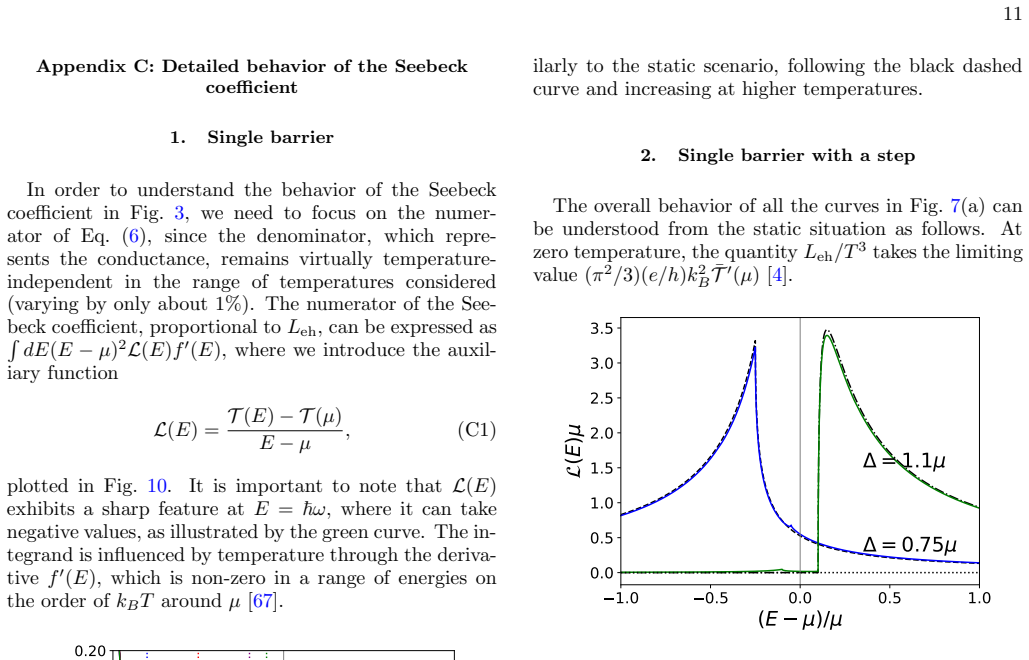
Single barrier In order to understand the behavior of the Seebeck coefficient in Fig. 3, we need to focus on the numer- ator of Eq. (6), since the denominator, which repre- sents the conductance, remains virtually temperature- independent in the range of temperatures considered (varying by only about 1%). The numerator of the See- beck coefficient, propor...
-
[3]
7(a) can be understood from the static situation as follows
Single barrier with a step The overall behavior of all the curves in Fig. 7(a) can be understood from the static situation as follows. At zero temperature, the quantity Leh/T 3 takes the limiting value (π2/3)(e/h)k2 B ¯T ′(µ) [4]. 1.0 0.5 0.0 0.5 1.0 (E )/ 0.0 0.5 1.0 1.5 2.0 2.5 3.0 3.5 (E) = 0.75 = 1.1 FIG. 11: Auxiliary function L(E) defined in the tex...
-
[4]
Auff` eves, Quantum technologies need a quantum en- ergy initiative, PRX Quantum 3, 020101 (2022)
A. Auff` eves, Quantum technologies need a quantum en- ergy initiative, PRX Quantum 3, 020101 (2022)
work page 2022
-
[5]
S. Lee, D. Pandiyan, J. sun Seo, P. E. Phelan, and C.- J. Wu, Thermoelectric-based sustainable self-cooling for fine-grained processor hot spots, in 2016 15th IEEE In- tersociety Conference on Thermal and Thermomechan- ical Phenomena in Electronic Systems (ITherm) (2016) pp. 847–856
work page 2016
- [6]
-
[7]
G. Benenti, G. Casati, K. Saito, and R. Whitney, Funda- mental aspects of steady-state conversion of heat to work at the nanoscale, Phys. Rep. 694, 1 (2017)
work page 2017
-
[8]
R. C. Jones, The ultimate sensitivity of radiation detec- tors, J. Opt. Soc. Am. 37, 879 (1947)
work page 1947
-
[9]
D. Van Vechten, K. Wood, G. Fritz, A. Gyulamiryan, V. Nikogosyan, N. Giordano, T. Jacobs, and A. Gu- lian, Thermoelectric single-photon detectors: isotropic seebeck sensors, in Eighteenth International Confer- ence on Thermoelectrics. Proceedings, ICT’99 (Cat. No. 99TH8407) (IEEE, 1999) pp. 477–480
work page 1999
-
[10]
F. Giazotto, P. Solinas, A. Braggio, and F. S. Bergeret, Ferromagnetic-insulator-based superconduct- ing junctions as sensitive electron thermometers, Phys. Rev. Appl. 4, 044016 (2015)
work page 2015
-
[11]
A. Varpula, A. V. Timofeev, A. Shchepetov, K. Grigoras, J. Hassel, J. Ahopelto, M. Ylilammi, and M. Prunnila, Thermoelectric thermal detectors based on ultra-thin heavily doped single-crystal silicon membranes, Appl. Phys. Lett. 110, 262101 (2017)
work page 2017
-
[12]
T. T. Heikkil¨ a, R. Ojaj¨ arvi, I. J. Maasilta, E. Strambini, F. Giazotto, and F. S. Bergeret, Thermoelectric radiation detector based on superconductor-ferromagnet systems, Phys. Rev. Appl. 10, 034053 (2018)
work page 2018
-
[13]
F. Paolucci, G. Germanese, A. Braggio, and F. Giazotto, A highly sensitive broadband superconducting thermo- electric single-photon detector, Appl. Phys. Lett. 122, 173503 (2023)
work page 2023
-
[14]
F. S. Bergeret, M. Silaev, P. Virtanen, and T. T. Heikkil¨ a, Colloquium: Nonequilibrium effects in superconductors with a spin-splitting field, Rev. Mod. Phys. 90, 041001 (2018)
work page 2018
-
[15]
G. Marchegiani, A. Braggio, and F. Giazotto, Nonlinear thermoelectricity with electron-hole symmetric systems, Phys. Rev. Lett. 124, 106801 (2020)
work page 2020
- [16]
- [17]
-
[18]
G. Marchegiani, A. Braggio, and F. Giazotto, Supercon- ducting nonlinear thermoelectric heat engine, Phys. Rev. B 101, 214509 (2020)
work page 2020
- [19]
-
[20]
A. N. Singh, B. Bhandari, A. Braggio, F. Giazotto, and A. N. Jordan, Giant thermoelectric response of fluxons in superconductors, Phys. Rev. Lett. 133, 256002 (2024)
work page 2024
-
[21]
G. Germanese, F. Paolucci, G. Marchegiani, A. Brag- gio, and F. Giazotto, Bipolar thermoelectric Josephson engine, Nature Nanotech. 17, 1084 (2022)
work page 2022
-
[22]
L. Arrachea, A. Braggio, P. Burset, E. J. H. Lee, A. L. Yeyati, and R. S´ anchez, Thermoelectric pro- cesses of quantum normal-superconductor interfaces, arXiv:2505.07426 [cond-mat.mes-hall]
-
[23]
M. Moskalets and M. B¨ uttiker, Dissipation and noise in adiabatic quantum pumps, Phys. Rev. B 66, 035306 (2002)
work page 2002
-
[24]
L. Arrachea, M. Moskalets, and L. Martin-Moreno, Heat production and energy balance in nanoscale engines driven by time-dependent fields, Phys. Rev. B75, 245420 (2007)
work page 2007
-
[25]
M. Moskalets and M. B¨ uttiker, Heat production and cur- rent noise for single- and double-cavity quantum capaci- tors, Phys. Rev. B 80, 081302 (2009)
work page 2009
-
[26]
A. Cr´ epieux, F.ˇSimkovic, B. Cambon, and F. Michelini, Enhanced thermopower under a time-dependent gate voltage, Phys. Rev. B 83, 153417 (2011)
work page 2011
-
[27]
S. Juergens, F. Haupt, M. Moskalets, and J. Splettstoesser, Thermoelectric performance of a driven double quantum dot, Phys. Rev. B 87, 245423 (2013)
work page 2013
-
[28]
J. S. Lim, R. L´ opez, and D. S´ anchez, Dynamic ther- moelectric and heat transport in mesoscopic capacitors, Phys. Rev. B 88, 201304 (2013)
work page 2013
-
[29]
Q. Chen, Z.-y. Wang, and Z.-X. Xie, Enhancement of the thermoelectric figure of merit in a quantum dot due to external ac field, Phys. Lett. A 377, 1373 (2013)
work page 2013
-
[30]
X. Chen, D. Liu, W. Duan, and H. Guo, Photon-assisted thermoelectric properties of noncollinear spin valves, Phys. Rev. B 87, 085427 (2013)
work page 2013
-
[31]
M. B. Tagani and H. R. Soleimani, Time-dependent ther- mopower effect in an interacting quantum dot, Int. J. Thermophys. 35, 136 (2014)
work page 2014
-
[32]
P. Virtanen and F. Giazotto, Thermal transport through ac-driven transparent Josephson weak links, Phys. Rev. B 90, 014511 (2014)
work page 2014
-
[33]
J. Chen, M. ShangGuan, and J. Wang, A gauge invariant theory for time dependent heat current, New J. Phys.17, 053034 (2015)
work page 2015
-
[34]
G. Rossell´ o, F. Battista, M. Moskalets, and J. Splettstoesser, Interference and multiparticle effects in a Mach-Zehnder interferometer with single-particle sources, Phys. Rev. B 91, 115438 (2015). 13
work page 2015
-
[35]
M. F. Ludovico, F. Battista, F. von Oppen, and L. Ar- rachea, Adiabatic response and quantum thermoelectrics for ac-driven quantum systems, Phys. Rev. B 93, 075136 (2016)
work page 2016
- [36]
-
[37]
M. F. Ludovico, M. Moskalets, D. S´ anchez, and L. Ar- rachea, Dynamics of energy transport and entropy pro- duction in ac-driven quantum electron systems, Phys. Rev. B 94, 035436 (2016)
work page 2016
-
[38]
M. F. Ludovico, L. Arrachea, M. Moskalets, and D. S´ anchez, Periodic energy transport and entropy pro- duction in quantum electronics, Entropy 18, 419 (2016)
work page 2016
-
[39]
F. Gallego-Marcos and G. Platero, Coherent long-range thermoelectrics in nonadiabatic driven quantum systems, Phys. Rev. B 95, 075301 (2017)
work page 2017
-
[40]
P. Haughian, M. Esposito, and T. L. Schmidt, Quantum thermodynamics of the resonant-level model with driven system-bath coupling, Phys. Rev. B 97, 085435 (2018)
work page 2018
-
[41]
P. A. Erdman, V. Cavina, R. Fazio, F. Taddei, and V. Giovannetti, Maximum power and corresponding effi- ciency for two-level heat engines and refrigerators: opti- mality of fast cycles, New J. Phys. 21, 103049 (2019)
work page 2019
-
[42]
K. Brandner and K. Saito, Thermodynamic geometry of microscopic heat engines, Phys. Rev. Lett. 124, 040602 (2020)
work page 2020
-
[43]
P. Sengupta and S. Das, Photon-assisted heat engines in the THz regime, J. Appl. Phys. 127, 024305 (2020)
work page 2020
-
[44]
S. Ganguly and S. K. Maiti, High figure of merit in an ac driven graphene nanoribbon, in Journal of Physics: Conference Series , Vol. 1579 (IOP Publishing, 2020) p. 012005
work page 2020
-
[45]
B. Bhandari, P. T. Alonso, F. Taddei, F. von Oppen, R. Fazio, and L. Arrachea, Geometric properties of adi- abatic quantum thermal machines, Phys. Rev. B 102, 155407 (2020)
work page 2020
-
[46]
L. M. Cangemi, V. Cataudella, G. Benenti, M. Sassetti, and G. De Filippis, Violation of thermodynamics un- certainty relations in a periodically driven work-to-work converter from weak to strong dissipation, Phys. Rev. B 102, 165418 (2020)
work page 2020
-
[47]
E. Potanina, C. Flindt, M. Moskalets, and K. Brandner, Thermodynamic bounds on coherent transport in period- ically driven conductors, Phys. Rev. X11, 021013 (2021)
work page 2021
- [48]
-
[49]
Y. Izumida, Hierarchical Onsager symmetries in adiabat- ically driven linear irreversible heat engines, Phys. Rev. E 103, L050101 (2021)
work page 2021
-
[50]
J. Lu, Z. Wang, J. Peng, C. Wang, J.-H. Jiang, and J. Ren, Geometric thermodynamic uncertainty relation in a periodically driven thermoelectric heat engine, Phys. Rev. B 105, 115428 (2022)
work page 2022
-
[51]
S. Ryu, R. L´ opez, L. Serra, and D. S´ anchez, Beating carnot efficiency with periodically driven chiral conduc- tors, Nature Comm. 13, 2512 (2022)
work page 2022
- [52]
- [53]
-
[54]
A. Kara Slimane and G. Fleury, Thermoelectric study of the time-dependent resonant level model, J. Appl. Phys. 133, 154301 (2023)
work page 2023
-
[55]
R. L´ opez, P. Simon, and M. Lee, Heat and charge transport in interacting nanoconductors driven by time- modulated temperatures, SciPost Phys. 16, 094 (2024)
work page 2024
-
[56]
S. E. Deghi and R. A. Bustos-Mar´ un, Second-order adi- abatic expansion of heat and charge currents within the nonequilibrium Green’s function approach, Phys. Rev. B 110, 115409 (2024)
work page 2024
-
[57]
D. Chowdhury, O. Entin-Wohlman, and A. Aharony, Thermoelectric performance of nanojunctions subjected to microwave-driven spin-orbit coupling, Phys. Rev. B 109, 155402 (2024)
work page 2024
-
[58]
J. Lu, J. Liu, J.-H. Jiang, and C. Wang, Floquet engi- neering of strongly driven inelastic heat engines, Phys. Rev. B 111, 245407 (2025)
work page 2025
-
[59]
M. Aguilar and E. Lutz, Correlated quantum ma- chines beyond the standard second law, arXiv:2409.07899 [quant-ph]
- [60]
-
[61]
S. Kafanov, A. Kemppinen, Y. A. Pashkin, M. Meschke, J. S. Tsai, and J. P. Pekola, Single-electronic radio- frequency refrigerator, Phys. Rev. Lett. 103, 120801 (2009)
work page 2009
-
[62]
M. Moskalets and M. B¨ uttiker, Floquet scattering theory of quantum pumps, Phys. Rev. B 66, 205320 (2002)
work page 2002
-
[63]
M. Moskalets and M. B¨ uttiker, Adiabatic quantum pump in the presence of external ac voltages, Phys. Rev. B 69, 205316 (2004)
work page 2004
-
[64]
M. Moskalets and M. B¨ uttiker, Dynamic scattering chan- nels of a double barrier structure, Phys. Rev. B 78, 035301 (2008)
work page 2008
- [65]
-
[66]
N. W. Ashcroft and D. N. Mermin, Solid state physics (New York: Holt, Rinehart and Winston, 1976)
work page 1976
-
[67]
J. H. Shirley, Solution of the Schr¨ odinger equation with a Hamiltonian periodic in time, Phys. Rev. 138, B979 (1965)
work page 1965
-
[68]
S. R. Barone, M. A. Narcowich, and F. J. Narcowich, Floquet theory and applications, Phys. Rev. A 15, 1109 (1977)
work page 1977
-
[69]
D. F. Martinez and L. E. Reichl, Transmission properties of the oscillating δ-function potential, Phys. Rev. B 64, 245315 (2001)
work page 2001
-
[70]
f ′(E) is a delta function at zero temperature, and broad- ens when temperature increases
discussion (0)
Sign in with ORCID, Apple, or X to comment. Anyone can read and Pith papers without signing in.