REVIEW 4 major objections 6 minor 62 references
Exploiting Vision Language Model for Training-Free 3D Point Cloud OOD Detection via Graph Score Propagation
T0 review · 4 major / 6 minor · reviewed 2026-08-06 · deepseek-v4-flash
Pith's one-line read The paper proposes a training-free graph score propagation method that exploits the test-data manifold to make frozen VLM features reliably separate in-distribution from out-of-distribution 3D point clouds, consistently beating direct…
desk verdict Solid incremental extension of label propagation to 3D point cloud OOD detection with useful new benchmarks; fix the Eq. 3 typo, the FPR95 trade-off, and the Nc discrepancy before accepting. read the letter →
The pith
A machine-rendered reading of the paper's core claim, the machinery that carries it, and where it could break.
The reading
What carries the argument
The load-bearing mechanism is Graph Score Propagation, a two-stage label diffusion over a blockwise KNN graph whose weight matrix is written in Eq. 7: identity blocks connect ID prototypes to themselves, and KNN blocks connect prototypes and few-shot labeled samples to test points and test points to test points. Scores evolve by the standard propagation rule $S_t = \tilde{W}S_{t-1} + \alpha S_0$ with symmetric normalization $\tilde{W} = D^{-1/2} W D^{-1/2}$, $\alpha = 0.5$, and $T = 5$ iterations, so nodes close to the positive seeds on the manifold inherit high ID scores. The first run of propagation harvests pseudo labels: the most confident top $m\%$ of test nodes become $+1$ positive prompts and the bottom $m\%$ become $-1$ negative prompts, which are re-injected as graph nodes before the final propagation produces the OOD scores. Prompt clustering (K-means over the prompt-template features of each class, with $N_c = 3$ centers) replaces the standard single averaged prototype and gives the graph multiple positive seeds that capture prompt diversity.
What would settle it
Construct an OOD category whose frozen features lie closer to the ID text prototypes than the ID test samples do, so the graph edges run from prototypes toward genuinely OOD points; under the smoothness assumption those OOD points should receive high propagated scores, and GSP's AUROC should fall below the plain cosine-similarity baseline. A cheaper check is to build the graph on shuffled feature vectors, destroying semantic edges, and observe whether GSP's advantage over cosine scoring collapses.
Extended reading notes
Core claim
On the paper's own terms, the central discovery is that a VLM's frozen features contain enough structure for OOD detection when the test-data manifold is exploited, even though the raw text-to-point-cloud distances are too poorly calibrated to score on their own. The method assigns each ID prototype a score of $+1$, each test point an initial score of $0$, and iterates $S_t = \tilde{W} S_{t-1} + \alpha S_0$ with $\tilde{W} = D^{-1/2} W D^{-1/2}$ on a KNN graph until the scores indicate OOD likelihood; a second propagation round uses self-training to turn confident OOD test points into pseudo-negative prompts scored $-1$, which compete with the positive prototypes. Two refinements carry part of the gain: clustering the per-class prompt templates with K-means into several representative prototypes instead of averaging them, and the self-trained negative prompting that supplies the 'not an ID object' direction without any labeled OOD data. Under the zero-shot protocol the reported gains over the ULIP2 cosine baseline exceed 5% AUROC on ScanObjectNN and are large on real LiDAR-derived datasets, while in the few-shot protocol five labeled samples per class outperform the best fully supervised baseline on ScanObjectNN.
Load-bearing premise
The load-bearing premise is that the nearest-neighbor graph built on the frozen feature representations connects samples that are semantically related, so that ID scores spread along meaningful paths; if test points are linked by feature-space artifacts instead, the propagation spreads misleading scores and the self-training step amplifies the mistakes.
Editorial extensions
If this is right
- Zero-shot 3D OOD detection improves by several AUROC points on real-world LiDAR datasets without training, fine-tuning, or prompt learning.
- With only one to five labeled ID samples added as graph nodes, performance jumps by roughly 5-15% AUROC and can surpass fully supervised baselines (86.6% vs 83.6% on ScanObjectNN at 5-shot).
- The gains are largest when the shift between VLM pretraining data and the downstream task is large, so the method is most valuable exactly where direct scoring fails.
- Graph construction and score propagation add only about 2% of the total inference time, and the approach works with different 3D VLM backbones.
Reading between the lines
- (Inference) The same recipe, propagating scores over a KNN graph instead of trusting raw text-feature distances, should transfer to other modalities where VLM calibration is weak, such as fine-grained 2D recognition or audio, since the mechanism uses nothing 3D-specific beyond the encoder.
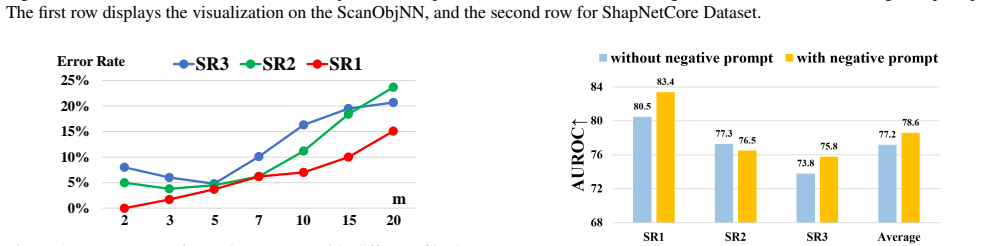
- (Inference) The fixed top-$m\%$ pseudo-prompt selection is the fragile part; the paper reports that error rates among pseudo prompts rise with $m$ and that performance peaks near $m = 5\%$. An adaptive selection criterion based on score margins or graph consistency is a natural, testable improvement.
- (Inference) The stated limitation, that the method needs a substantial batch of test data to build the graph, invites an incremental variant that updates edges and re-propagates as samples arrive; whether stale pseudo prompts degrade accuracy in a drifting stream is an open question the paper does not address.
- (Inference) Because the ShapeNetCore zero-shot gain is only about 0.5% while the gain on shifted real-world sets is much larger, the paper effectively predicts that GSP's advantage scales with pretraining-to-task distribution shift; this is directly testable by measuring GSP versus cosine scoring on backbones at controlled shift levels.
Editorial analysis
A structured set of objections, weighed in public.
Referee Report
Summary. This paper proposes Graph Score Propagation (GSP), a training-free method for 3D point cloud out-of-distribution (OOD) detection built on frozen vision-language model features (ULIP/ULIP2 with a Point-BERT encoder). GSP constructs a KNN graph over ID text prototypes, optional few-shot labeled samples, and the unlabeled test set, assigns +1 scores to prototype nodes and 0 to test nodes, and propagates scores iteratively. Two extensions are proposed: prompt clustering via K-means over per-class text-template features, and self-training negative prompting, in which the top and bottom m% of initial propagated scores become pseudo-positive and pseudo-negative nodes (labeled +1 and -1) for a second propagation round. Experiments on the 3DOS ScanObjectNN and ShapeNetCore splits plus Sydney Urban Objects, S3DIS, and nuScenes report AUROC and FPR95 under zero-shot and few-shot protocols, with ablations over components, hyperparameter sensitivity, pseudo-label error rates, and inference time.
Significance. If the results hold, GSP is a timely contribution to 3D OOD detection: it introduces label propagation as a one-class VLM scoring mechanism for point clouds and shows large, consistent AUROC gains over zero-shot baselines on the three real-world shifted benchmarks (+10.8 on nuScenes and +6.3 on S3DIS and Sydney over the best baseline), which is exactly the regime where the proposed manifold correction should help. The paper ships code, provides ablations, quantifies pseudo-label error rates at different selection thresholds, validates backbone-agnosticism with PointClip V2, and reports a timing breakdown showing graph operations are about 2% of inference cost; the supplement also states the main limitation (dependence on a substantial test batch) candidly. However, the headline claim of consistent state-of-the-art performance is contradicted by the SN2/SN3 rows of Table 1, and the core update rule is specified inconsistently between Eq. (3) and Fig. 2, so the empirical claims cannot be taken at face value until these are resolved.
major comments (4)
- [§3.3, Eq. (3), Fig. 2] The score propagation rule is specified inconsistently. Eq. (3) states S_t = W̃ S_{t−1} + α S_0, whereas Fig. 2 shows S_t = α W̃ S_{t−1} + (1−α) S_0 (the bounded convex form). These two rules produce different scores: with α=0.5 and T=5, the Eq. (3) form adds α S_0 at every iteration and diffuses the initial scores without the α^T damping, which changes the relative weighting of prototype proximity versus initial scores and can change the top/bottom m% sets selected in Eq. (5), and hence the reported AUROC/FPR95 values. The citation to [61] does not disambiguate, since the Zhu and Ghahramani rule is S_t = W̃ S_{t−1} with labeled nodes clamped, not either form. Please state the exact implemented update, reconcile the equation with the figure, and confirm which form generated the numbers in Tables 1–3 and Fig. 3–5.
- [§4.2, Table 1] The abstract and the third contribution bullet claim that GSP 'consistently outperform[s] state-of-the-art methods' across benchmarks. Table 1 contradicts this on the ShapeNetCore splits: on SN2, zero-shot GSP achieves AUROC 70.7 versus 84.1 for ULIP2 and 83.2 for MCM, and on SN3 it achieves 79.7 versus 88.0 for NegLabel. The paper's only comment on ShapeNetCore is that the average gap to ULIP is about 0.5%, which leaves the two large negative deviations unexplained. The central claim should be qualified (for example, 'large consistent gains on real-world shifted benchmarks, marginal on ShapeNetCore'), or the SN2/SN3 failures should be analyzed; such an analysis would also be the natural place to test the core graph-smoothness assumption of Section 3.3, which is otherwise not verified.
- [§4.1, Table 1, Fig. 3] The few-shot results rest on a single random draw of the labeled samples, with no error bars or multiple seeds anywhere in Table 1 or Fig. 3. The 1-shot GSP AUROC ranges from 79.3 to 88.6 across the three ScanObjectNN splits, so sampling variance at 1–5 shots is likely large, and the headline comparison '5-shot (86.6%) surpasses the best fully supervised method, Cosine proto (83.6%)' could depend on the particular draw. Please report mean plus/minus standard deviation over at least five random draws for all few-shot rows and for Fig. 3, and state the number of seeds. In addition, that comparison is favorable to GSP because, as described in the supplement, the supervised baselines are trained on synthetic ModelNet40 while GSP's few-shot rows use real target-domain ScanObjectNN labels; this asymmetry should be stated wherever the comparison appears.
- [§4.4, Fig. 4; Supp. C.2] GSP introduces five hyperparameters (Nk, α, T, m, Nc) and the implementation fixes them at Nk=10, α=0.5, T=5, m=5%, Nc=3. Sensitivity is reported only for Nk, m, and Nc in Fig. 4; there is no sensitivity analysis for α or T, and the paper does not state whether all five values are held fixed across the five datasets and two backbones or tuned per dataset. For a method advertised as training-free, this should be clarified, and the α sensitivity is particularly relevant given the Eq. (3)/Fig. 2 discrepancy. Relatedly, the candid limitation in Supp. C.2 (the graph needs a substantial amount of test data) is never quantified: there is no experiment showing AUROC as a function of test-set size, although this determines whether the method is usable in small-batch or streaming deployment, which is the setting named in the conclusion.
minor comments (6)
- [§4.4, Fig. 4] Fig. 4 is self-inconsistent: the caption labels panel (a) as 'prompt clustering with different K-means cluster numbers,' but the panel's x-axis is 'K Nearest Neighbors,' and the text in Sections 4.4 cites Fig. 4(a) for both the Nc and the Nk analyses; the panels, axes, captions, and text citations should be reconciled, and the typo 'Neaerst' in the caption should be fixed.
- [§4.2, S3DIS paragraph] Section 4.2 states that on S3DIS 'GSP's FPR95 (94.0%) is slightly higher than ULIP (95.1%),' which is arithmetically wrong (94.0 is lower, i.e., better) and the following sentence about 'challenges in suppressing false positives' contradicts the direction of the comparison.
- [References] The reference list contains garbled entries: reference [18] reads '...object deteclabel propagation for zero-shot classification with visiontion' (a merger of two distinct titles), and reference [61] has 'ProQuest number: information to all users' as its title; both need to be replaced with correct bibliographic data.
- [Abstract] The abstract contains two grammatical errors: 'we exploit the data manifold structure to enhancing the effectiveness' and 'across synthetic and real-world datasets 3D point cloud OOD detection' (missing 'for'); several prompt templates in the supplement also contain typos (e.g., 'itap').
- [§3.2, Eq. (2)] In Eq. (2), the score is defined as a softmax over class similarities, but the text describes it as a 'maximum normalized cosine similarity'; the notation should make explicit how the maximum and the normalization interact, since Eq. (2) as written is a softmax value, not the maximum.
- [Table 1] In Table 1, the GSP few-shot and full-shot rows are placed under the heading 'Requiring training dataset' although GSP performs no training; move them to a separate block or relabel the section, and specify which training split is used for the GSP(full-shot) row on each benchmark.
Circularity Check
GSP is an empirical graph-propagated scoring method; the self-training loop is acknowledged as confirmation bias and no equation-level circular reduction is present.
full rationale
The paper's claimed contribution is an empirical OOD scoring method (GSP), not a derivation from first principles. The score in Eq. 3 is standard label propagation initialized with +1 on ID prototypes and 0 on test points; its output is a function of the graph and initial scores, not of the quantity it predicts. Prompt clustering (Eq. 4) is unsupervised K-means on text-prompt features; negative prompting (Eqs. 5-6) is a transductive self-training loop that re-labels the extreme percentile of the first propagated scores and relaunches propagation. This is a feedback procedure, and the paper explicitly acknowledges the associated confirmation bias ('This highlights the importance of mitigating the effects of confirmation bias [3]', Section 4.4), but it is not a case where a fitted parameter is renamed as a prediction or where the output equals an input equation by construction. The graph construction cites the authors' prior work [31] alongside [44], but the cited observation is not a uniqueness theorem and the bulk of validation is external benchmarking on ScanObjectNN, ShapeNetCore, Sydney, S3DIS, and nuScenes. No circular step can be exhibited with an equation-level reduction; the GSP AUROC/FPR95 numbers are independent empirical results. Score 1 reflects a minor non-load-bearing self-citation, not circular reasoning.
Assumptions & free parameters
free parameters (5)
- KNN neighborhood size Nk =
10
- Propagation mixing coefficient alpha =
0.5
- Propagation iterations T =
5
- Pseudo prompt selection ratio m =
5%
- Prompt cluster count Nc =
3 in implementation, 6 reported as best in ablation
assumptions (5)
- domain assumption The VLM contrastive objective (Eq. 1) produces a feature space in which cosine distance between point-cloud and text features is semantically meaningful.
- domain assumption Labels vary smoothly over the KNN graph built from VLM features, so ID and OOD samples separate on the test-data manifold.
- ad hoc to paper The top and bottom m% of initial propagated scores identify reliable ID and OOD pseudo-labels for self-training.
- domain assumption K-means centers of prompt embeddings are better ID prototypes than the mean prompt embedding.
- standard math The iterative label propagation update in Eq. 3 converges to a meaningful score distribution.
Cite this review
Pith. "Pith review of Exploiting Vision Language Model for Training-Free 3D Point Cloud OOD Detection via Graph Score Propagation." pith.science (2026). https://pith.science/paper/CFIMB2AR
@misc{pith2026250622375,
  author       = {Pith},
  title        = {Pith review of: Exploiting Vision Language Model for Training-Free 3D Point Cloud OOD Detection via Graph Score Propagation},
  year         = {2026},
  howpublished = {\url{https://pith.science/paper/CFIMB2AR}},
  note         = {Machine review of arXiv:2506.22375}
}
read the original abstract
Out-of-distribution (OOD) detection in 3D point cloud data remains a challenge, particularly in applications where safe and robust perception is critical. While existing OOD detection methods have shown progress for 2D image data, extending these to 3D environments involves unique obstacles. This paper introduces a training-free framework that leverages Vision-Language Models (VLMs) for effective OOD detection in 3D point clouds. By constructing a graph based on class prototypes and testing data, we exploit the data manifold structure to enhancing the effectiveness of VLMs for 3D OOD detection. We propose a novel Graph Score Propagation (GSP) method that incorporates prompt clustering and self-training negative prompting to improve OOD scoring with VLM. Our method is also adaptable to few-shot scenarios, providing options for practical applications. We demonstrate that GSP consistently outperforms state-of-the-art methods across synthetic and real-world datasets 3D point cloud OOD detection.
Figures



Figures from the paper (7 more)




Reference graph
Works this paper leans on
-
[61]
Learning from labeled and unlabeled data with label propagation
Xiaojin Zhu and Zoubin Ghahramani. Learning from labeled and unlabeled data with label propagation. ProQuest num- ber: information to all users , 2002. 4
work page 2002
-
[1]
Antonio Alliegro, Francesco Cappio Borlino, and Ta- tiana Tommasi. 3dos: Towards 3d open set learning- benchmarking and understanding semantic novelty detection on point clouds. Advances in Neural Information Processing Systems, 2022. 2, 5, 6
work page 2022
-
[2]
Neco: Neural col- lapse based out-of-distribution detection
Mouin Ben Ammar, Nacim Belkhir, Sebastian Popescu, An- toine Manzanera, and Gianni Franchi. Neco: Neural col- lapse based out-of-distribution detection. arXiv preprint arXiv:2310.06823, 2023. 2
arXiv 2023
-
[3]
Pseudo-labeling and confirmation bias in deep semi-supervised learning
Eric Arazo, Diego Ortego, Paul Albert, Noel E O’Connor, and Kevin McGuinness. Pseudo-labeling and confirmation bias in deep semi-supervised learning. In International joint conference on neural networks, 2020. 8
work page 2020
-
[4]
3d semantic parsing of large-scale indoor spaces
I Armeni, O Sener, Ar Zamir, H Jiang, I Brilakis, M Fischer, S Savarese, and IEEE. 3d semantic parsing of large-scale indoor spaces. In IEEE/CVF Conference on Computer Vision and Pattern Recognition, 2016. 5, 6
work page 2016
-
[5]
Id-like prompt learn- ing for few-shot out-of-distribution detection
Yichen Bai, Zongbo Han, Bing Cao, Xiaoheng Jiang, Qinghua Hu, and Changqing Zhang. Id-like prompt learn- ing for few-shot out-of-distribution detection. In IEEE/CVF Conference on Computer Vision and Pattern Recognition ,
-
[6]
Graph out-of-distribution detection goes neighborhood shaping
Tianyi Bao, Qitian Wu, Zetian Jiang, Yiting Chen, Jiawei Sun, and Junchi Yan. Graph out-of-distribution detection goes neighborhood shaping. In International Conference on Machine Learning. 2
-
[7]
Holger Caesar, Varun Bankiti, Alex H. Lang, Sourabh V ora, Venice Erin Liong, Qiang Xu, Anush Krishnan, Yu Pan, Gi- ancarlo Baldan, and Oscar Beijbom. nuscenes: A multi- modal dataset for autonomous driving. In IEEE/CVF Con- ference on Computer Vision and Pattern Recognition , 2020. 5, 6
work page 2020
Show all 62 references
-
[8]
A theory of label propagation for subpopulation shift
Tianle Cai, Ruiqi Gao, Jason Lee, and Qi Lei. A theory of label propagation for subpopulation shift. In International Conference on Machine Learning, 2021. 2
2021
-
[9]
Shapenet: An information-rich 3d model repository
Angel X Chang, Thomas Funkhouser, Leonidas Guibas, Pat Hanrahan, Qixing Huang, Zimo Li, Silvio Savarese, Manolis Savva, Shuran Song, Hao Su, et al. Shapenet: An information-rich 3d model repository. arXiv preprint arXiv:1512.03012, 2015. 5
2015 arXiv
-
[10]
Adversarial reciprocal points learning for open set recognition
Guangyao Chen, Peixi Peng, Xiangqian Wang, and Yonghong Tian. Adversarial reciprocal points learning for open set recognition. IEEE Transactions on Pattern analysis and Machine Intelligence, 2021. 1, 7
2021
-
[11]
Unsupervised feature learning for clas- sification of outdoor 3d scans
Mark De Deuge, Alastair Quadros, Calvin Hung, and Bertrand Douillard. Unsupervised feature learning for clas- sification of outdoor 3d scans. In Australasian Conference on Robitics and Automation , 2013. 5, 6
2013
-
[12]
Sub-center arcface: Boosting face recognition by large-scale noisy web faces
Jiankang Deng, Jia Guo, Tongliang Liu, Mingming Gong, and Stefanos Zafeiriou. Sub-center arcface: Boosting face recognition by large-scale noisy web faces. In European Conference on Computer Vision, 2020. 7
2020
-
[13]
A note on two problems in connexion with graphs
Edsger W Dijkstra. A note on two problems in connexion with graphs. In Edsger Wybe Dijkstra: his life, work, and legacy. 2022. 3
2022
-
[14]
Learn- ing from label proportions: Bootstrapping supervised learn- ers via belief propagation
Shreyas Havaldar, Navodita Sharma, Shubhi Sareen, Karthikeyan Shanmugam, and Aravindan Raghuveer. Learn- ing from label proportions: Bootstrapping supervised learn- ers via belief propagation. arXiv preprint arXiv:2310.08056,
-
[15]
A baseline for detect- ing misclassified and out-of-distribution examples in neural networks
Dan Hendrycks and Kevin Gimpel. A baseline for detect- ing misclassified and out-of-distribution examples in neural networks. In International Conference on Learning Repre- sentations, 2022. 1, 2, 7
2022
-
[16]
Deep anomaly detection with outlier exposure
Dan Hendrycks, Mantas Mazeika, and Thomas Dietterich. Deep anomaly detection with outlier exposure. In Interna- tional Conference on Learning Representations , 2019. 7
2019
-
[17]
Reclip: Refine contrastive language image pre-training with source free domain adaptation
Xuefeng Hu, Ke Zhang, Lu Xia, Albert Chen, Jiajia Luo, Yuyin Sun, Ken Wang, Nan Qiao, Xiao Zeng, Min Sun, et al. Reclip: Refine contrastive language image pre-training with source free domain adaptation. In IEEE/CVF Winter Confer- ence on Applications of Computer Vision , 2024. 2
2024
-
[18]
Out-of-distribution detection for lidar-based 3d object deteclabel propagation for zero-shot classification with visiontion
Chengjie Huang, Vahdat Abdelzad, Christopher Gus Mannes, Luke Rowe, Benjamin Therien, Rick Salay, Krzysztof Czarnecki, et al. Out-of-distribution detection for lidar-based 3d object deteclabel propagation for zero-shot classification with visiontion. In IEEE International Con-...
2022
-
[19]
On the impor- tance of gradients for detecting distributional shifts in the wild
Rui Huang, Andrew Geng, and Yixuan Li. On the impor- tance of gradients for detecting distributional shifts in the wild. Advances in Neural Information Processing Systems ,
-
[20]
Clip2point: Transfer clip to point cloud classification with image-depth pre-training
Tianyu Huang, Bowen Dong, Yunhan Yang, Xiaoshui Huang, Rynson WH Lau, Wanli Ouyang, and Wangmeng Zuo. Clip2point: Transfer clip to point cloud classification with image-depth pre-training. In IEEE/CVF International Conference on Computer Vision, 2023. 2, 3
2023
-
[21]
Ikotun, Absalom E
Abiodun M. Ikotun, Absalom E. Ezugwu, Laith Abualigah, Belal Abuhaija, and Jia Heming. K-means clustering algo- rithms: A comprehensive review, variants analysis, and ad- vances in the era of big data. Information science, 2023. 4
2023
-
[22]
Label propagation for deep semi-supervised learning
Ahmet Iscen, Giorgos Tolias, Yannis Avrithis, and Ondrej Chum. Label propagation for deep semi-supervised learning. In IEEE/CVF Conference on Computer Vision and Pattern Recognition, 2019. 2
2019
-
[23]
Scaling up visual and vision-language representa- tion learning with noisy text supervision
Chao Jia, Yinfei Yang, Ye Xia, Yi-Ting Chen, Zarana Parekh, Hieu Pham, Quoc Le, Yun-Hsuan Sung, Zhen Li, and Tom Duerig. Scaling up visual and vision-language representa- tion learning with noisy text supervision. In International Conference on Machine Learning, 2021. 1
2021
-
[24]
Negative label guided ood de- tection with pretrained vision-language models
Xue Jiang, Feng Liu, Zhen Fang, Hong Chen, Tongliang Liu, Feng Zheng, and Bo Han. Negative label guided ood de- tection with pretrained vision-language models. In Interna- tional Conference on Learning Representations , 2024. 3, 6, 7 9
2024
-
[25]
Supervised contrastive learning
Prannay Khosla, Piotr Teterwak, Chen Wang, Aaron Sarna, Yonglong Tian, Phillip Isola, Aaron Maschinot, Ce Liu, and Dilip Krishnan. Supervised contrastive learning. Advances in Neural Information Processing Systems , 2020. 7
2020
-
[26]
Out-of-distribution detection with logical reasoning
Konstantin Kirchheim, Tim Gonschorek, and Frank Ort- meier. Out-of-distribution detection with logical reasoning. In IEEE/CVF Winter Conference on Applications of Com- puter Vision, 2024. 2
2024
-
[27]
Michael K ¨osel, Marcel Schreiber, Michael Ulrich, Claudius Gl¨aser, and Klaus C. J. Dietmayer. Revisiting out-of- distribution detection in lidar-based 3d object detection. IEEE Intelligent V ehicles Symposium, 2024. 2
2024
-
[28]
Blip: Bootstrapping language-image pre-training for unified vision-language understanding and generation
Junnan Li, Dongxu Li, Caiming Xiong, and Steven Hoi. Blip: Bootstrapping language-image pre-training for unified vision-language understanding and generation. In Interna- tional Conference on Machine Learning , 2022. 1
2022
-
[29]
Rethinking out-of-distribution (ood) detection: Masked image modeling is all you need
Jingyao Li, Pengguang Chen, Zexin He, Shaozuo Yu, Shu Liu, and Jiaya Jia. Rethinking out-of-distribution (ood) detection: Masked image modeling is all you need. In IEEE/CVF Conference on Computer Vision and Pattern Recognition, 2023. 2
2023
-
[30]
Learning transferable negative prompts for out-of- distribution detection
Tianqi Li, Guansong Pang, Xiao Bai, Wenjun Miao, and Jin Zheng. Learning transferable negative prompts for out-of- distribution detection. In IEEE/CVF Conference on Com- puter Vision and Pattern Recognition, 2024. 2, 4
2024
-
[31]
Efficient and context-aware label propagation for zero- /few-shot training-free adaptation of vision-language model
Yushu Li, Yongyi Su, Adam Goodge, Kui Jia, and Xun Xu. Efficient and context-aware label propagation for zero- /few-shot training-free adaptation of vision-language model. In International Conference on Learning Representations ,
-
[32]
Enhancing the re- liability of out-of-distribution image detection in neural net- works
Shiyu Liang, Yixuan Li, and R Srikant. Enhancing the re- liability of out-of-distribution image detection in neural net- works. In International Conference on Learning Represen- tations, 2018. 7
2018
-
[33]
Energy-based out-of-distribution detection
Weitang Liu, Xiaoyun Wang, John Owens, and Yixuan Li. Energy-based out-of-distribution detection. Advances in Neural Information Processing Systems, 2020. 7
2020
-
[34]
Toward unsupervised 3d point cloud anomaly detection using variational autoencoder
Mana Masuda, Ryo Hachiuma, Ryo Fujii, Hideo Saito, and Yusuke Sekikawa. Toward unsupervised 3d point cloud anomaly detection using variational autoencoder. In IEEE International Conference on Image Processing, 2021. 1
2021
-
[35]
Geometrically-driven aggregation for zero-shot 3d point cloud understanding
Guofeng Mei, Luigi Riz, Yiming Wang, and Fabio Poiesi. Geometrically-driven aggregation for zero-shot 3d point cloud understanding. In IEEE/CVF Conference on Computer Vision and Pattern Recognition, 2024. 2
2024
-
[36]
Delving into out-of-distribution detection with vision-language representations
Yifei Ming, Ziyang Cai, Jiuxiang Gu, Yiyou Sun, Wei Li, and Yixuan Li. Delving into out-of-distribution detection with vision-language representations. In Advances in Neural Information Processing Systems, 2022. 1, 3, 6, 7
2022
-
[37]
Locoop: Few-shot out-of-distribution detection via prompt learning
Atsuyuki Miyai, Qing Yu, Go Irie, and Kiyoharu Aizawa. Locoop: Few-shot out-of-distribution detection via prompt learning. Advances in Neural Information Processing Sys- tems, 2024. 1, 2
2024
-
[38]
Out-of-distribution detection with negative prompts
Jun Nie, Yonggang Zhang, Zhen Fang, Tongliang Liu, Bo Han, and Xinmei Tian. Out-of-distribution detection with negative prompts. In International Conference on Learning Representations, 2024. 2, 4
2024
-
[39]
Out-of-distribution detection for automotive perception
Julia Nitsch, Masha Itkina, Ransalu Senanayake, Juan Nieto, Max Schmidt, Roland Siegwart, Mykel J Kochenderfer, and Cesar Cadena. Out-of-distribution detection for automotive perception. In IEEE International Intelligent Transportation Systems Conference, 2021. 1
2021
-
[40]
Label propagation with weak supervi- sion
Rattana Pukdee, Dylan Sam, Maria-Florina Balcan, and Pradeep Ravikumar. Label propagation with weak supervi- sion. arXiv preprint arXiv:2210.03594, 2022. 2
2022 arXiv
-
[41]
3d object detection for autonomous driving: A survey
Rui Qian, Xin Lai, and Xirong Li. 3d object detection for autonomous driving: A survey. Pattern Recognition, 2022. 1
2022
-
[42]
Learning transferable visual models from natural language supervision
Alec Radford, Jong Wook Kim, Chris Hallacy, Aditya Ramesh, Gabriel Goh, Sandhini Agarwal, Girish Sastry, Amanda Askell, Pamela Mishkin, Jack Clark, Gretchen Krueger, and Ilya Sutskever. Learning transferable visual models from natural language supervision. In International Con...
2021
-
[43]
Graph posterior network: Bayesian predictive uncertainty for node classifi- cation
Maximilian Stadler, Bertrand Charpentier, Simon Geisler, Daniel Z ¨ugner, and Stephan G ¨unnemann. Graph posterior network: Bayesian predictive uncertainty for node classifi- cation. Advances in Neural Information Processing Systems,
-
[44]
Label propagation for zero-shot classification with vision-language models
Vladan Stojni ´c, Yannis Kalantidis, and Giorgos Tolias. Label propagation for zero-shot classification with vision-language models. In IEEE/CVF Conference on Computer Vision and Pattern Recognition, 2024. 2, 4, 6, 7
2024
-
[45]
Benchmarking ro- bustness of 3d point cloud recognition against common cor- ruptions
Jiachen Sun, Qingzhao Zhang, Bhavya Kailkhura, Zhiding Yu, Chaowei Xiao, and Z Morley Mao. Benchmarking ro- bustness of 3d point cloud recognition against common cor- ruptions. arXiv preprint arXiv:2201.12296, 2022. 2
2022 arXiv
-
[46]
React: Out-of- distribution detection with rectified activations
Yiyou Sun, Chuan Guo, and Yixuan Li. React: Out-of- distribution detection with rectified activations. Advances in Neural Information Processing Systems, 2021. 7
2021
-
[47]
Out-of- distribution detection with deep nearest neighbors
Yiyou Sun, Yifei Ming, Xiaojin Zhu, and Yixuan Li. Out-of- distribution detection with deep nearest neighbors. In Inter- national Conference on Machine Learning , 2022. 2
2022
-
[48]
Argue: Attribute-guided prompt tuning for vision-language models
Xinyu Tian, Shu Zou, Zhaoyuan Yang, and Jing Zhang. Argue: Attribute-guided prompt tuning for vision-language models. In IEEE/CVF Conference on Computer Vision and Pattern Recognition, 2024. 2, 4
2024
-
[49]
Revisiting point cloud classification: A new benchmark dataset and classification model on real-world data
Mikaela Angelina Uy, Quang-Hieu Pham, Binh-Son Hua, Thanh Nguyen, and Sai-Kit Yeung. Revisiting point cloud classification: A new benchmark dataset and classification model on real-world data. In IEEE/CVF International Con- ference on Computer Vision, 2019. 5
2019
-
[50]
Open-set recognition: A good closed-set classifier is all you need
Sagar Vaze, Kai Han, Andrea Vedaldi, and Andrew Zisser- man. Open-set recognition: A good closed-set classifier is all you need. In International Conference on Learning Rep- resentations, 2022. 7
2022
-
[51]
Clipn for zero-shot ood detection: Teaching clip to say no
Hualiang Wang, Yi Li, Huifeng Yao, and Xiaomeng Li. Clipn for zero-shot ood detection: Teaching clip to say no. In IEEE/CVF International Conference on Computer Vision,
-
[52]
Learning to augment distributions for out-of-distribution detection
Qizhou Wang, Zhen Fang, Yonggang Zhang, Feng Liu, Yix- uan Li, and Bo Han. Learning to augment distributions for out-of-distribution detection. Advances in Neural Informa- tion Processing Systems, 2023. 2 10
2023
-
[53]
Energy-based out-of-distribution detection for graph neural networks
Qitian Wu, Yiting Chen, Chenxiao Yang, and Junchi Yan. Energy-based out-of-distribution detection for graph neural networks. ArXiv, 2023. 2
2023
-
[54]
Ulip: Learning a unified representation of language, images, and point clouds for 3d understanding
Le Xue, Mingfei Gao, Chen Xing, Roberto Mart ´ın-Mart´ın, Jiajun Wu, Caiming Xiong, Ran Xu, Juan Carlos Niebles, and Silvio Savarese. Ulip: Learning a unified representation of language, images, and point clouds for 3d understanding. In IEEE/CVF Conference on Computer Vision a...
2023
-
[55]
Ulip-2: Towards scalable multimodal pre-training for 3d understanding
Le Xue, Ning Yu, Shu Zhang, Artemis Panagopoulou, Jun- nan Li, Roberto Mart´ın-Mart´ın, Jiajun Wu, Caiming Xiong, Ran Xu, Juan Carlos Niebles, et al. Ulip-2: Towards scalable multimodal pre-training for 3d understanding. In IEEE/CVF Conference on Computer Vision and Pattern Re...
-
[56]
Point-bert: Pre-training 3d point cloud transformers with masked point modeling
Xumin Yu, Lulu Tang, Yongming Rao, Tiejun Huang, Jie Zhou, and Jiwen Lu. Point-bert: Pre-training 3d point cloud transformers with masked point modeling. In IEEE/CVF Conference on Computer Vision and Pattern Recognition ,
-
[57]
Discriminability-driven channel selection for out-of-distribution detection
Yue Yuan, Rundong He, Yicong Dong, Zhongyi Han, and Yilong Yin. Discriminability-driven channel selection for out-of-distribution detection. In IEEE/CVF Conference on Computer Vision and Pattern Recognition, 2024. 2, 6, 7
2024
-
[58]
Pointclip: Point cloud understanding by clip
Renrui Zhang, Ziyu Guo, Wei Zhang, Kunchang Li, Xu- peng Miao, Bin Cui, Yu Qiao, Peng Gao, and Hongsheng Li. Pointclip: Point cloud understanding by clip. In IEEE/CVF Conference on Computer Vision and Pattern Recognition ,
-
[59]
Tip- adapter: Training-free adaption of clip for few-shot clas- sification
Renrui Zhang, Wei Zhang, Rongyao Fang, Peng Gao, Kun- chang Li, Jifeng Dai, Yu Qiao, and Hongsheng Li. Tip- adapter: Training-free adaption of clip for few-shot clas- sification. In European Conference on Computer Vision . Springer, 2022. 2
2022
-
[60]
Decoupling maxlogit for out- of-distribution detection
Zihan Zhang and Xiang Xiang. Decoupling maxlogit for out- of-distribution detection. In IEEE/CVF Conference on Com- puter Vision and Pattern Recognition, 2023. 2
2023
-
[62]
a photo of
Xiaojin Zhu, Zoubin Ghahramani, and John D Lafferty. Semi-supervised learning using gaussian fields and harmonic functions. In International Conference on Machine Learn- ing, 2003. 2 11 Exploiting Vision Language Model for Training-Free 3D Point Cloud OOD Detection via Graph S...
2003
Reviewed August 6, 2026 · model on record in the stance chip above.
Discussion (0). Sign in to comment.