REVIEW 4 major objections 5 minor 47 references
LIGHT: Multi-Modal Text Linking on Historical Maps
T0 review · 4 major / 5 minor · reviewed 2026-08-06 · deepseek-v4-flash
Pith's one-line read LIGHT predicts the reading-order successor of each detected word by fusing text, image, and polygon geometry, reaching an 83.7% link-level F-score on the ICDAR 2024/2025 MapText benchmark with ground-truth detection and recognition.
desk verdict Solid new polygon-encoder approach to map text linking, but the missing train/test disjointness check could inflate the headline numbers. read the letter →
The pith
A machine-rendered reading of the paper's core claim, the machinery that carries it, and where it could break.
The reading
What carries the argument
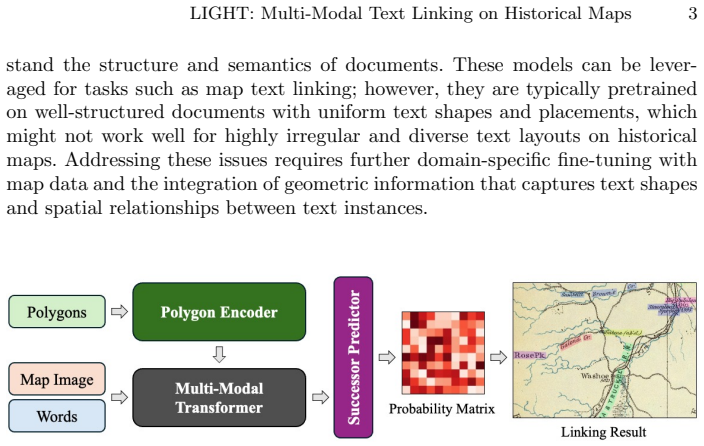
The load-bearing mechanism is a geometry-to-reading-order bridge. A polygon encoder, a six-layer BERT-style transformer, takes the normalized $(X_i, Y_i)$ coordinate sequence of each detected text polygon, pads it to length 32, and emits a $[CLS]$ embedding that summarizes shape and placement; it is pretrained with coordinate masking plus auxiliary regressions for minimum-enclosing-rectangle angle, bounding-box center, first-to-last point distance (a height proxy), and nearest-neighbor selection. That embedding is added to the word's token embeddings in the LayoutLMv3 multi-modal transformer, whose pretraining includes masked language modeling, masked image modeling, and word-patch alignment on map crops. Link prediction is then an $N \times N$ association matrix $S = E_{\text{pre}} E_{\text{succ}}^\top$, row-softmax over which gives each word's successor distribution; a transposed matrix $S' = E_{\text{succ}} E_{\text{pre}}^\top$ gives predecessor distributions, and the training loss combines cross-entropy with focal loss on both directions. During inference, successors are chosen greedily with a conflict-resolution rule so each word belongs to at most one link.
What would settle it
Retrain LIGHT on the same pretraining tiles but replace the spotter-generated polygons and transcripts with manually corrected ground truth on a subset, then compare link-level F-score on the 700-tile test set; a material drop under human-corrected labels would show the automatic labels are load-bearing. A second, easier check is to inject controlled coordinate or transcript noise into 10-30% of the pretraining labels and measure the resulting F-score decline.
Extended reading notes
Core claim
The paper's central claim is that the full polygonal outline of a text instance, not just its bounding box or recognized string, is a distinct and useful modality for map text linking, and that a single cross-modal model can learn to use it together with language and image. Concretely, LIGHT encodes each text polygon into a fixed embedding with a BERT-style encoder, adds that embedding to the word tokens inside a LayoutLMv3 transformer, and produces a successor distribution over all other words via the score matrix $S = E_{\text{pre}} E_{\text{succ}}^\top$. With ground-truth detection and recognition on the MapText benchmark, LIGHT reaches 83.7% link-level F-score, above every non-linguistic baseline and the competition submissions compared, and the ablations show each modality contributes: geometry alone gives 59.8, language alone gives 59.8, language plus image gives 64.6 (77.8 after map pretraining), and all three together give 83.7.
Load-bearing premise
The linking model is pretrained on polygons and transcripts generated automatically by a text spotter, and the paper does not measure how often those labels are wrong; if the spotter errs systematically, the learned geometric and visual representations could be biased in ways the final test score does not reveal.
Editorial extensions
If this is right
- At 83.7% link-level F-score with perfect detection and recognition, multi-word place-name extraction is accurate enough to feed downstream georeferencing and entity-linking pipelines.
- Adding polygon geometry to language and image features gives a 5.9-point F-score gain over the best two-modality variant, so text shape and relative placement are load-bearing, not incidental.
- Bidirectional successor and predecessor learning plus focal loss lifts the plain cross-entropy model from 74.2 to 83.7 F-score, showing the sparse and self-link imbalance was the main obstacle.
- When applied on top of existing spotters' imperfect output, LIGHT improves end-to-end linking H-mean substantially, for example from 46.2 to 62.8 for DS-LP and from 80.8 to 84.9 for Self-Sequencer.
- Domain-adaptive pretraining on map images accounts for a 13.2-point gain over the off-the-shelf LayoutLMv3 baseline, meaning generic layout-model weights are not enough for map text.
Reading between the lines
- Editorial inference: the polygon-coordinate masking and auxiliary geometric pretraining could transfer to curved or otherwise irregular text in scene images, manuscripts, or charts, where bounding-box layout models lose shape information.
- Editorial inference: because the whole 2,000 by 2,000 tile is downsampled to 224 by 224 before feature extraction, a multi-scale or patch-based version could recover fine visual detail and may improve linking in very dense map regions.
- Editorial inference: a controlled noise study on the automatic pretraining labels would quantify how much of the 83.7% F-score depends on spotter accuracy, a robustness question the paper leaves open.
Editorial analysis
A structured set of objections, weighed in public.
Referee Report
Summary. The paper presents LIGHT, a system for linking recognized text instances on historical maps into multi-word phrases. LIGHT extends LayoutLMv3 with a BERT-based polygon encoder that embeds polygon coordinate sequences, and uses cross-modal transformer representations to predict, for each word, its successor in reading order. Training combines cross-entropy and focal losses in both forward and backward directions. The authors pretrain the encoders on 397,385 tiles cropped from 41,279 David Rumsey Map Collection maps with labels produced by PaLeTTe, then fine-tune on the ICDAR 2024/2025 MapText competition Rumsey split. On the competition test set with ground-truth detection and recognition, LIGHT achieves link F-score 83.7% (Table 1); ablations (Tables 2 and 3) show gains from the language, image, and geometry modalities and from the focal and bidirectional losses; end-to-end experiments (Table 4) show link-F improvements over three text spotters.
Significance. The task is practically useful, and the architecture is well motivated: polygon shape and geometric context are genuinely underused in document-layout models, and the bi-directional successor-prediction formulation with greedy conflict resolution is a reasonable and clearly described design. The paper has concrete strengths: it evaluates on an external competition test set, reports ablations isolating each modality and each loss component, provides algorithm pseudocode, and gives code and data links. However, the central comparative claim currently rests on pretraining/test data provenance. Because the pretraining corpus is drawn from the same map collection as the test tiles and no disjointness check is reported, the magnitude of the reported gains (e.g., the 13.2% gain from domain-adaptive pretraining in Table 2) is not yet trustworthy. With a clean provenance analysis and label-noise sensitivity checks, this would be a solid contribution; in its current form the evidence is incomplete.
major comments (4)
- [Section 4.1, Pretraining Dataset] The pretraining corpus is generated from 41,279 maps in the same David Rumsey Map Collection from which the evaluation benchmark's 700 test tiles are drawn, and the paper never states whether the pretraining tiles are disjoint from the test tiles. Because pretraining objectives include masked image modeling, masked language modeling, and word-patch alignment on actual map images and PaLeTTe transcripts, any overlap could let the encoders memorize test-specific layouts, text shapes, and local visual patterns, inflating the headline F-scores in Tables 1-4 relative to baselines that did not pretrain on test-derived data. Please report exact tile-level overlap (e.g., by source-map identifiers or image hashing) between the 397,385 pretraining tiles and the 200/40/700 benchmark tiles, exclude overlapping tiles from pretraining if any exist, and re-run the experiments; without this, the current numbers cannot support the claimed improvements.
- [Section 4.1, label source] The pretraining labels are generated by PaLeTTe [20], a model fine-tuned on the same Rumsey training split used for the downstream benchmark, and the paper provides no estimate of PaLeTTe's word-level precision/recall on the pretraining corpus and no sensitivity analysis to label noise. If PaLeTTe systematically omits words in dense regions or mis-transcribes place names, the polygon and multi-modal encoders will be trained on biased geometry and text distributions, and this bias would be invisible in the final test F-scores. Please add a sample-based label-quality evaluation and an ablation (e.g., pretraining on a clean subset or on synthetic labels) to show that the conclusions are robust to label noise.
- [Section 3.3, Eq. (5)] The focal loss in Eq. (5) is written as a binary focal loss over a single probability p_i, yet the model predicts a row-wise softmax over N candidate successors in Eq. (4). It is unclear whether the focal loss is applied per pair after flattening the N x N matrix, per row with the true successor as the single positive, or in some other reduction. This matters for interpreting Table 3 and for reproducibility. Please state the exact reduction, including how alpha_i and gamma are applied to the row-softmax outputs.
- [Section 4.4, Tables 2 and 3] All results are based on a single training run, and the ablations report differences of 3-5 F-score points (e.g., LIGHT-focal at 78.8 vs. LIGHT-bidirectional at 77.6). Without standard deviations over multiple seeds or significance tests, the claims that each modality and each loss component contributes cannot be statistically distinguished from run-to-run noise. Please report mean and standard deviation over at least three seeds for the main tables, or use a paired bootstrap over test links.
minor comments (5)
- [Section 3.2 and Section 3.3] The text says that text tokens belonging to the same word share the same polygon embedding, but Section 3.3 says link prediction uses the first token embedding of each word; please clarify how multi-token words are pooled to obtain E_text and whether the polygon embedding is added to every token or only to the first token.
- [Table 4] The column headers 'Links', 'Words', and 'H' are not self-explanatory; please define in the caption which quantities enter the harmonic mean H and how the link-level metrics are computed, or refer explicitly to the competition evaluation repository.
- [Figure 3] The caption mentions dashed purple arrows and underlined purple labels but does not describe the solid pink arrows; please add a legend or describe all arrow types in the caption.
- [Section 4.2] The paper states that the token-level maximum sequence length is 1,000, while Eq. (4) computes softmax over N words; please clarify the relationship between the token sequence length and the number of word instances N used for link prediction.
- [Section 5] The limitation of downsampling from 2000 x 2000 to 224 x 224 is acknowledged, but the paper does not quantify how much resolution contributes to the remaining errors; a sentence linking this limitation to the failure cases in Figure 5 would be useful.
Circularity Check
No significant circularity: LIGHT's link predictions are trained on ground-truth successor matrices and evaluated on the official MapText competition test set; self-cited components and provenance gaps are external-validity concerns, not derivation-level circularity.
full rationale
The central claim (an 83.7% link F-score with ground-truth detection/recognition) is obtained by supervised training on the Rumsey benchmark's 200 training tiles and evaluation on its 700 test tiles. The successor predictor is trained with cross-entropy and focal losses against ground-truth successor matrices, so the reported link-level precision/recall is not forced by construction to equal any pretraining objective. Pretraining (Section 4.1) uses self-supervised objectives (MLM, MIM, WPA, coordinate reconstruction, polygon property regression) that do not use the link labels; the polygon encoder's auxiliary targets are properties of the very polygons fed as input, but they are not the successor labels and no equation equates them to the output probabilities. The reverse score matrix S' = Esucc * Epre^T is the transpose of S = Epre * Esucc^T, so the bidirectional loss is a regularizer on the same pairwise scores, not an independent prediction that could be circular. Two self-referential elements deserve note but do not constitute circularity: (1) pretraining transcripts/polygons are generated by PaLeTTe [20], a same-group model finetuned on the same Rumsey training split, which is a label-provenance risk; and (2) the pretraining corpus and the benchmark both draw on the David Rumsey Map Collection without an explicit disjointness statement, which is a potential data-contamination risk for the absolute numbers. Neither is a demonstrated reduction of the evaluated prediction to an input; the paper's derivation chain is otherwise self-contained against the external competition benchmark.
Assumptions & free parameters
free parameters (4)
- lambda_1..lambda_4 =
0.1
- focal_gamma =
2
- focal_alpha_self =
0.25
- image_resize =
224x224
assumptions (3)
- domain assumption Reading-order successor formulation is a valid model of text linking.
- domain assumption PaLeTTe-generated polygons and transcriptions are accurate enough for pretraining.
- domain assumption LayoutLMv3 pretrained representations transfer to map text after domain-adaptive pretraining.
Cite this review
Pith. "Pith review of LIGHT: Multi-Modal Text Linking on Historical Maps." pith.science (2026). https://pith.science/paper/VFLOCGIH
@misc{pith2026250622589,
  author       = {Pith},
  title        = {Pith review of: LIGHT: Multi-Modal Text Linking on Historical Maps},
  year         = {2026},
  howpublished = {\url{https://pith.science/paper/VFLOCGIH}},
  note         = {Machine review of arXiv:2506.22589}
}
read the original abstract
Text on historical maps provides valuable information for studies in history, economics, geography, and other related fields. Unlike structured or semi-structured documents, text on maps varies significantly in orientation, reading order, shape, and placement. Many modern methods can detect and transcribe text regions, but they struggle to effectively ``link'' the recognized text fragments, e.g., determining a multi-word place name. Existing layout analysis methods model word relationships to improve text understanding in structured documents, but they primarily rely on linguistic features and neglect geometric information, which is essential for handling map text. To address these challenges, we propose LIGHT, a novel multi-modal approach that integrates linguistic, image, and geometric features for linking text on historical maps. In particular, LIGHT includes a geometry-aware embedding module that encodes the polygonal coordinates of text regions to capture polygon shapes and their relative spatial positions on an image. LIGHT unifies this geometric information with the visual and linguistic token embeddings from LayoutLMv3, a pretrained layout analysis model. LIGHT uses the cross-modal information to predict the reading-order successor of each text instance directly with a bi-directional learning strategy that enhances sequence robustness. Experimental results show that LIGHT outperforms existing methods on the ICDAR 2024/2025 MapText Competition data, demonstrating the effectiveness of multi-modal learning for historical map text linking.
Figures


Figures from the paper (2 more)


Reference graph
Works this paper leans on
-
[20]
In: Proceedings of the 30th ACM SIGKDD Conference on Knowl- edge Discovery and Data Mining
Lin, Y., Chiang, Y.Y.: Hyper-local deformable transformers for text spotting on historical maps. In: Proceedings of the 30th ACM SIGKDD Conference on Knowl- edge Discovery and Data Mining. pp. 5387–5397 (2024)
work page 2024
-
[1]
In: Proceedings of the IEEE/CVF international conference on computer vision
Appalaraju, S., Jasani, B., Kota, B.U., Xie, Y., Manmatha, R.: Docformer: End-to- end transformer for document understanding. In: Proceedings of the IEEE/CVF international conference on computer vision. pp. 993–1003 (2021)
work page 2021
-
[2]
Bao, H., Dong, L., Piao, S., Wei, F.: BEit: BERT pre-training of image trans- formers. In: International Conference on Learning Representations (2022), https: //openreview.net/forum?id=p-BhZSz59o4
work page 2022
-
[3]
In: Proceedings of the IEEE/CVF Conference on Computer Vision and Pattern Recognition
Bi, T., Zhang, X., Zhang, Z., Xie, W., Lan, C., Lu, Y., Zheng, N.: Text grouping adapter: Adapting pre-trained text detector for layout analysis. In: Proceedings of the IEEE/CVF Conference on Computer Vision and Pattern Recognition. pp. 28150–28159 (2024)
work page 2024
-
[4]
Cartography Associates: David Rumsey map collection. https://www.davidrumsey. com 16 Lin et al. Fig. 5: Examples of poor linking results (left) and ground truth (right)
-
[5]
In: Handbook of Geospatial Artificial Intelligence, pp
Chiang, Y.Y., Chen, M., Duan, W., Kim, J., Knoblock, C.A., Leyk, S., Li, Z., Lin, Y., Namgung, M., Shbita, B., et al.: GeoAI for the digitization of historical maps. In: Handbook of Geospatial Artificial Intelligence, pp. 217–247. CRC Press (2023)
work page 2023
-
[6]
Chiang, Y.Y., Duan, W., Leyk, S., Uhl, J.H., Knoblock, C.A.: Using historical maps in scientific studies: Applications, challenges, and best practices. Springer (2020)
work page 2020
-
[7]
Devlin, J., Chang, M.W., Lee, K., Toutanova, K.: BERT: Pre-training of deep bidirectional transformers for language understanding. In: Proceedings of the 2019 conference of the North American chapter of the association for computational linguistics: human language technologies, volume 1 (long and short papers). pp. 4171–4186 (2019)
work page 2019
Show all 47 references
-
[8]
In: Proceedings of the 30th ACM International Conference on Multimedia
Huang, Y., Lv, T., Cui, L., Lu, Y., Wei, F.: LayoutLMv3: Pre-training for docu- ment AI with unified text and image masking. In: Proceedings of the 30th ACM International Conference on Multimedia. pp. 4083–4091 (2022) LIGHT: Multi-Modal Text Linking on Historical Maps 17
2022
-
[9]
In: Findings of the Association for Computational Linguistics: ACL-IJCNLP 2021
Hwang, W., Yim, J., Park, S., Yang, S., Seo, M.: Spatial dependency parsing for semi-structured document information extraction. In: Findings of the Association for Computational Linguistics: ACL-IJCNLP 2021. pp. 330–343 (2021)
2021
-
[10]
In: European Conference on Computer Vision
Kim, G., Hong, T., Yim, M., Nam, J., Park, J., Yim, J., Hwang, W., Yun, S., Han, D., Park, S.: OCR-free document understanding transformer. In: European Conference on Computer Vision. pp. 498–517. Springer (2022)
2022
-
[11]
In: Proceedings of the 31st ACM International Conference on Advances in Geographic Information Systems
Kim, J., Li, Z., Lin, Y., Namgung, M., Jang, L., Chiang, Y.Y.: The mapKurator system: a complete pipeline for extracting and linking text from historical maps. In: Proceedings of the 31st ACM International Conference on Advances in Geographic Information Systems. SIGSPATIAL ’2...
2023 doi
-
[12]
arXiv preprint arXiv:2103.11943 (2021)
Koroteev, M.V.: BERT: a review of applications in natural language processing and understanding. arXiv preprint arXiv:2103.11943 (2021)
2021 arXiv
-
[13]
The His- torical Review/La Revue Historique 17, 205–250 (May 2020)
Kyramargiou, E., Papakondylis, Y., Scalora, F., Dimitropoulos, D.: Changing the map in Greece and Italy: place-name changes in the nineteenth century. The His- torical Review/La Revue Historique 17, 205–250 (May 2020). https://doi.org/10. 12681/hr.27072
2020
-
[14]
In: 2018 24th International Conference on Pattern Recognition (ICPR)
Li, X.H., Yin, F., Liu, C.L.: Page object detection from PDF document images by deep structured prediction and supervised clustering. In: 2018 24th International Conference on Pattern Recognition (ICPR). pp. 3627–3632. IEEE (2018)
2018
-
[15]
In: Document Analysis Systems: 14th IAPR International Workshop, DAS 2020, Wuhan, China, July 26–29, 2020, Proceedings 14
Li, X.H., Yin, F., Liu, C.L.: Page segmentation using convolutional neural network and graphical model. In: Document Analysis Systems: 14th IAPR International Workshop, DAS 2020, Wuhan, China, July 26–29, 2020, Proceedings 14. pp. 231–
2020
-
[16]
In: Proceedings of the 26th ACM SIGKDD International Conference on Knowledge Discovery & Data Mining
Li, Z., Chiang, Y.Y., Tavakkol, S., Shbita, B., Uhl, J.H., Leyk, S., Knoblock, C.A.: An automatic approach for generating rich, linked geo-metadata from historical map images. In: Proceedings of the 26th ACM SIGKDD International Conference on Knowledge Discovery & Data Mining....
2020
-
[17]
In: 18th International Conference on Document Analysis and Recognition (ICDAR 2024)
Li, Z., Lin, Y., Chiang, Y.Y., Weinman, J., Tual, S., Chazalon, J., Perret, J., Dum´ enieu, B., Abadie, N.: ICDAR 2024 competition on historical map text de- tection, recognition, and linking. In: 18th International Conference on Document Analysis and Recognition (ICDAR 2024)....
2024
-
[18]
In: Proceedings of the IEEE/CVF Conference on Computer Vision and Pattern Recognition
Liang, M., Ma, J.W., Zhu, X., Qin, J., Yin, X.C.: Layoutformer: Hierarchical text detection towards scene text understanding. In: Proceedings of the IEEE/CVF Conference on Computer Vision and Pattern Recognition. pp. 15665–15674 (2024)
2024
-
[19]
In: Proceedings of the IEEE international conference on computer vision
Lin, T.Y., Goyal, P., Girshick, R., He, K., Doll´ ar, P.: Focal loss for dense object detection. In: Proceedings of the IEEE international conference on computer vision. pp. 2980–2988 (2017)
2017
-
[21]
https://doi.org/10.5281/zenodo
Lin, Y., Li, Z., Chiang, Y.Y., Weinman, J.: Rumsey Train and Validation Data for ICDAR’24 MapText Competition (Jun 2024). https://doi.org/10.5281/zenodo. 11516933
2024 doi
-
[22]
Lin, Y., Tual, S., Li, Z., Jang, L., Chiang, Y.Y., Weinman, J., Chazalon, J., Car- linet, E., Perret, J., Abadie, N., Dum´ enieu, B., Chan, T.C., Liao, H.M., Su, W.R.: ICDAR 2025 competition on historical map text detection, recognition, and link- ing, https://rrc.cvc.uab.es/?ch=32
2025
-
[23]
Zou, M., Dai, T., Petitpierre, R., Vaienti, B., Kaplan, F., di Lenardo, I., Baek, Y.: Icdar 2024 competition on historical map text detection, recognition, and linking
Lin, Y., Tual, S., Li, Z., Jang, L., Chiang, Y.Y., Weinman, J., Chazalon, J., Car- linet, E., Perret, J., Abadie, N., Dum´ enieu, B., Chan, T.C., Liao, H.M., Su, W.R., 18 Lin et al. Zou, M., Dai, T., Petitpierre, R., Vaienti, B., Kaplan, F., di Lenardo, I., Baek, Y.: Icdar 202...
2024
-
[24]
https://doi.org/10.5281/zenodo.10776183
Lin, Y., Li, Z., Chiang, Y.Y., Weinman, J.: Rumsey test data for ICDAR’24 Map- Text competition (Mar 2024). https://doi.org/10.5281/zenodo.10776183
2024 doi
-
[25]
arXiv preprint arXiv:1907.11692 (2019)
Liu, Y., Ott, M., Goyal, N., Du, J., Joshi, M., Chen, D., Levy, O., Lewis, M., Zettlemoyer, L., Stoyanov, V.: RoBERTa: A robustly optimized BERT pretraining approach. arXiv preprint arXiv:1907.11692 (2019)
2019 arXiv
-
[26]
In: Proceedings of the IEEE/CVF Winter Conference on Applications of Computer Vision
Long, S., Qin, S., Fujii, Y., Bissacco, A., Raptis, M.: Hierarchical text spotter for joint text spotting and layout analysis. In: Proceedings of the IEEE/CVF Winter Conference on Applications of Computer Vision. pp. 903–913 (2024)
2024
-
[27]
In: Proceedings of the IEEE/CVF Conference on Computer Vision and Pattern Recognition
Long, S., Qin, S., Panteleev, D., Bissacco, A., Fujii, Y., Raptis, M.: Towards end- to-end unified scene text detection and layout analysis. In: Proceedings of the IEEE/CVF Conference on Computer Vision and Pattern Recognition. pp. 1049– 1059 (2022)
2022
-
[28]
In: International Con- ference on Document Analysis and Recognition
Long, S., Qin, S., Panteleev, D., Bissacco, A., Fujii, Y., Raptis, M.: ICDAR 2023 competition on hierarchical text detection and recognition. In: International Con- ference on Document Analysis and Recognition. pp. 483–497. Springer (2023)
2023
-
[29]
In: Proceedings of the IEEE/CVF Conference on Computer Vision and Pattern Recognition (CVPR)
Luo, C., Cheng, C., Zheng, Q., Yao, C.: Geolayoutlm: Geometric pre-training for visual information extraction. In: Proceedings of the IEEE/CVF Conference on Computer Vision and Pattern Recognition (CVPR). pp. 7092–7101 (June 2023)
2023
-
[30]
In: Proceedings of the 29th International Conference on Computational Linguistics
Luo, S., Ding, Y., Long, S., Poon, J., Han, S.C.: Doc-GCN: Heterogeneous graph convolutional networks for document layout analysis. In: Proceedings of the 29th International Conference on Computational Linguistics. pp. 2906–2916. Interna- tional Committee on Computational Ling...
2022
-
[31]
In: Proceedings of the 3rd ACM SIGSPATIAL International Workshop on Searching and Mining Large Collections of Geospatial Data
Olson, R., Kim, J., Chiang, Y.Y.: Automatic search of multiword place names on historical maps. In: Proceedings of the 3rd ACM SIGSPATIAL International Workshop on Searching and Mining Large Collections of Geospatial Data. pp. 9–12 (2024)
2024
-
[32]
In: Proceedings of the 31st ACM International Conference on Advances in Geographic Information Systems
Olson, R.M., Kim, J., Chiang, Y.Y.: An automatic approach to finding geographic name changes on historical maps. In: Proceedings of the 31st ACM International Conference on Advances in Geographic Information Systems. pp. 1–2 (2023)
2023
-
[33]
In: Proceedings of the 2014 conference on empirical methods in natural language processing (EMNLP)
Pennington, J., Socher, R., Manning, C.D.: GloVe: Global vectors for word repre- sentation. In: Proceedings of the 2014 conference on empirical methods in natural language processing (EMNLP). pp. 1532–1543 (2014)
2014
-
[34]
In: Document Analysis and Recognition–ICDAR 2021: 16th International Conference, Lausanne, Switzerland, September 5–10, 2021, Proceedings, Part II
Powalski, R., Borchmann, L., Jurkiewicz, D., Dwojak, T., Pietruszka, M., Pa lka, G.: Going full-tilt boogie on document understanding with text-image-layout trans- former. In: Document Analysis and Recognition–ICDAR 2021: 16th International Conference, Lausanne, Switzerland, S...
2021
-
[35]
pp. 732–747. Springer (2021)
2021
-
[36]
The Bell Sys- tem Technical Journal 36(6), 1389–1401 (1957)
Prim, R.C.: Shortest connection networks and some generalizations. The Bell Sys- tem Technical Journal 36(6), 1389–1401 (1957)
1957
-
[37]
In: International conference on machine learning
Ramesh, A., Pavlov, M., Goh, G., Gray, S., Voss, C., Radford, A., Chen, M., Sutskever, I.: Zero-shot text-to-image generation. In: International conference on machine learning. pp. 8821–8831 (2021)
2021
-
[38]
In: International Conference on Document Analysis and Recogni- tion
Wang, J., Hu, K., Huo, Q.: DLAFormer: An end-to-end transformer for document layout analysis. In: International Conference on Document Analysis and Recogni- tion. pp. 40–57. Springer (2024) LIGHT: Multi-Modal Text Linking on Historical Maps 19
2024
-
[39]
Pattern Recognition 156, 110836 (2024)
Wang, J., Hu, K., Zhong, Z., Sun, L., Huo, Q.: Detect-order-construct: A tree construction based approach for hierarchical document structure analysis. Pattern Recognition 156, 110836 (2024)
2024
-
[40]
In: International Conference on Document Analysis and Recognition
Wang, J., Zhang, S., Hu, K., Ma, C., Zhong, Z., Sun, L., Huo, Q.: Dynamic relation transformer for contextual text block detection. In: International Conference on Document Analysis and Recognition. pp. 313–330. Springer (2024)
2024
-
[41]
In: Proceedings of the IEEE/CVF Winter Conference on Ap- plications of Computer Vision
Wang, R., Fujii, Y., Popat, A.C.: Post-OCR paragraph recognition by graph con- volutional networks. In: Proceedings of the IEEE/CVF Winter Conference on Ap- plications of Computer Vision. pp. 493–502 (2022)
2022
-
[42]
In: European Conference on Computer Vision
Xue, C., Huang, J., Zhang, W., Lu, S., Wang, C., Bai, S.: Contextual text block detection towards scene text understanding. In: European Conference on Computer Vision. pp. 374–391. Springer (2022)
2022
-
[43]
In: Proceedings of the IEEE/CVF Conference on Computer Vision and Pattern Recognition
Ye, M., Zhang, J., Zhao, S., Liu, J., Liu, T., Du, B., Tao, D.: DeepSolo: Let trans- former decoder with explicit points solo for text spotting. In: Proceedings of the IEEE/CVF Conference on Computer Vision and Pattern Recognition. pp. 19348– 19357 (2023)
2023
-
[44]
In: Proceedings of the 2024 Conference on Empirical Methods in Natural Language Processing
Zhang, C., Tu, Y., Zhao, Y., Yuan, C., Chen, H., Zhang, Y., Chai, M., Guo, Y., Zhu, H., Zhang, Q., et al.: Modeling layout reading order as ordering relations for visually-rich document understanding. In: Proceedings of the 2024 Conference on Empirical Methods in Natural Langu...
2024
-
[45]
In: Proceedings of the IEEE/CVF conference on computer vision and pattern recognition
Zhang, X., Su, Y., Tripathi, S., Tu, Z.: Text spotting transformers. In: Proceedings of the IEEE/CVF conference on computer vision and pattern recognition. pp. 9519–9528 (2022)
2022
-
[46]
In: International Conference on Document Analysis and Recognition
Zhong, Z., Wang, J., Sun, H., Hu, K., Zhang, E., Sun, L., Huo, Q.: A hybrid approach to document layout analysis for heterogeneous document images. In: International Conference on Document Analysis and Recognition. pp. 189–206. Springer (2023)
2023
-
[47]
Zou, M., Dai, T., Petitpierre, R., Vaienti, B., Kaplan, F., di Lenardo, I.: Recog- nizing and sequencing multi-word texts in maps using an attentive pointer (2025). https://doi.org/10.21203/rs.3.rs-6330456/v1, under review Supplementary Material A Complexity Analysis Table S1 ...
2025 doi
Reviewed August 6, 2026 · model on record in the stance chip above.
Discussion (0). Sign in to comment.