REVIEW 3 major objections 5 minor 1 cited by
Fundamental Nuclear and Particle Physics At Neutron Sources
T0 review · 3 major / 5 minor · reviewed 2026-08-06 · deepseek-v4-flash
Pith's one-line read The paper's central claim is that precision neutron and neutrino measurements at the European Spallation Source can probe new physics at energy scales beyond the LHC's reach.
desk verdict A comprehensive ESS whitepaper that earns its place as an input document but lets upgrade-dependent projections outrun the funded baseline. read the letter →
The pith
A machine-rendered reading of the paper's core claim, the machinery that carries it, and where it could break.
The reading
What carries the argument
The load-bearing mechanism is the ESS accelerator-and-moderator complex as a dual neutron and neutrino source. A 2.86 ms, 14 Hz proton pulse on a rotating tungsten target produces intense spallation neutrons; the paper's program depends on the HighNESS liquid-deuterium moderator in the currently unused lower moderator slot to deliver roughly ten times the cold-neutron brightness for wavelengths above 4 A, and on beamlines such as ANNI, HIBEAM, and NNBAR that exploit the pulse's time structure for background suppression and velocity separation. For neutrinos, the same spallation process gives an intense decay-at-rest flux for coherent scattering and sterile-neutrino searches, while a future accumulator ring compresses linac pulses to about 1.2 microseconds to feed a horn-focused superbeam for the long-baseline CP-violation measurement. These components convert a single proton beam into a broad set of intensity-frontier searches.
What would settle it
After ESS commissioning, measure the cold-neutron flux delivered to the proposed lower-moderator beam port and the delivered linac beam power; if the flux is below the HighNESS design brightness or the linac remains at 2 MW, the projected event rates, including the factor-of-15 ANNI gain, the 300 ILL-units-per-year NNBAR figure of merit, and the coherent scattering rates, drop by factors of two to three, falsifying the paper's claim that ESS surpasses existing sources by an order of magnitude. A null result in a free neutron-antineutron search at NNBAR's projected three-orders-of-magnitude sensitivity would falsify that specific discovery claim.
Extended reading notes
Core claim
The paper's central claim is that the ESS will be both the world's most powerful pulsed neutron source and the world's brightest pulsed neutrino source, and that this combination lets a single facility attack several of the Standard Model's open problems at once. On the neutron side, the pulse structure and high cold-neutron flux enable time-of-flight background suppression and wavelength-resolved measurements that make beam-type neutron EDM searches, neutron-charge interferometry, and hadronic parity-violation experiments competitive with or superior to ultracold-neutron and reactor approaches. On the neutrino side, decay-at-rest neutrinos from the spallation target enable high-rate coherent elastic neutrino-nucleus scattering and sterile-neutrino searches, while the same linac, upgraded to 5 MW with an accumulator ring and a second target station, could drive a neutrino superbeam measuring the leptonic CP-violating phase to about 8 degrees at the second oscillation maximum. The paper further claims that neutron-antineutron oscillation searches at the ESS (HIBEAM then NNBAR) can improve the free-neutron discovery sensitivity by three orders of magnitude over the last ILL experiment, and that several of these searches probe effective new-physics scales around $10^{3}$-$10^{4}$ TeV, beyond the LHC's direct reach.
Load-bearing premise
The load-bearing premise is that the ESS will actually deliver the design 5 MW, 2 GeV beam and that the HighNESS liquid-deuterium moderator or an equivalent will supply the projected high cold-neutron fluxes; today only 2 MW at 870 MeV is funded, so if the upgrade never happens the projected event rates and sensitivities fall by factors of two to three.
Editorial extensions
If this is right
- At the ANNI beamline, simulated event-rate gains of a factor of 15 or more at 5 MW would make pulsed-beam experiments such as Beam EDM and Talbot-Lau neutron-charge interferometry world-leading, with the neutron-charge sensitivity improved by up to two orders of magnitude over the best current limit.
- HIBEAM and NNBAR would make the first competitive free-neutron-antineutron searches since the 1991 ILL experiment, with NNBAR's figure of merit reaching about 300 ILL units per year and a discovery sensitivity three orders of magnitude beyond the last free-neutron search; HIBEAM would also probe neutron-to-sterile-neutron oscillations over an order of magnitude of unexplored parameter space.
- A coherent elastic neutrino-nucleus scattering program at the ESS, combining several detector technologies, would improve constraints on non-standard neutrino interactions and light Z' bosons, and could exclude the 17 MeV Atomki-inspired Z' explanation in the models considered.
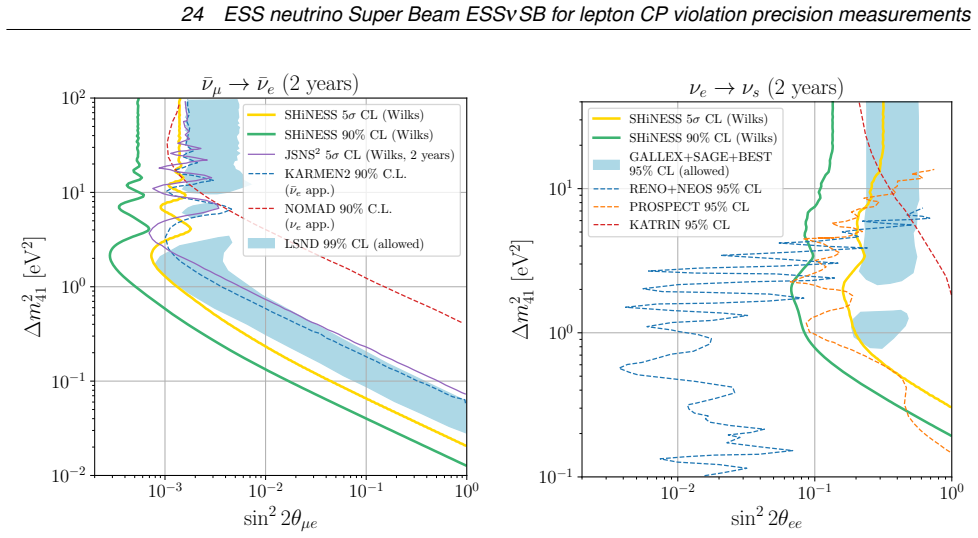
- The ESSnuSB long-baseline program could determine the leptonic CP-violating phase with a precision of about 8 degrees, compared with about 22 degrees projected for Hyper-K and DUNE, while also constraining sterile-neutrino mixing, neutrino mass ordering, and non-standard interactions.
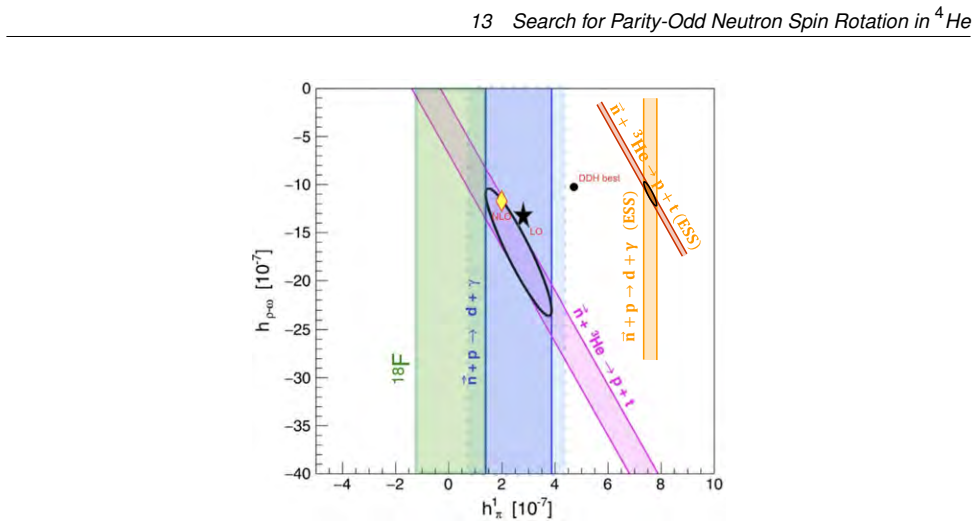
- Precision neutron beta decay and hadronic-parity-violation measurements at the ESS could pin down the CKM matrix element V_ud at the 10^-4 level and map the weak nucleon-nucleon couplings to about 10 percent, sharpening the CKM-unitarity and low-energy weak-interaction tests.
Reading between the lines
- Editorial extension: the "beyond the LHC" statement is an effective-field-theory reach, not a direct energy reach; the ESS does not collide particles at higher energy, it measures rare or symmetry-violating processes whose Wilson coefficients already imply new-physics scales around 10^3-10^4 TeV. A null result would still sharpen those bounds, but would not by itself identify the underlying theory
- Editorial extension: because the 5 MW upgrade is unfunded, a conservative reading is that the early-ESS program at 2 MW and 870 MeV delivers perhaps a third of the projected rates; the physics case would weaken but not vanish, so the sharpest near-term test of the white paper's premise is the actual delivered cold-neutron flux at the lower moderator port.
- Editorial extension: several of the highest-sensitivity channels, such as exotic neutron decays and axion dark matter via a time-varying neutron EDM, can run parasitically on the HIBEAM/NNBAR infrastructure, so the first discovery-level results from this program may come from these side searches rather than from the flagship neutron-antineutron or CP-violation experiments.
- Editorial extension: the paper's portfolio argument, that no single experiment is guaranteed to find new physics, implies that the appropriate measure of success is collective coverage of beyond-Standard-Model parameter space, not any one projected limit; this makes the case robust to individual null results but harder to falsify as a whole.
Editorial analysis
A structured set of objections, weighed in public.
Referee Report
Summary. This paper is a community white paper, prepared as input to the European Strategy Update, summarizing a January 2025 workshop at Lund University on fundamental neutron and neutrino physics at the European Spallation Source and other neutron sources. It surveys a wide range of proposed and ongoing experiments: neutron EDM searches, neutron beta decay and lifetime, short-range and exotic interactions, hadronic parity violation, HIBEAM and NNBAR baryon-number-violation searches, neutron interferometry, axion searches, epithermal-neutron physics, CEνNS, fifth-force and sterile-neutrino searches, the ESSnuSB long-baseline neutrino program, and the REDTOP eta-factory proposal. The central claim, stated in the abstract, is that this combined program can probe new physics at energy scales well beyond those accessible at the LHC. The report is explicitly a survey and advocacy document rather than a presentation of new experimental results.
Significance. If the projected sensitivities are realized, the ESS program would provide a genuinely complementary, cost-effective route to BSM physics, with discovery-class sensitivity in baryon number violation, CP violation, and sterile-neutrino searches, and with precision neutron measurements probing effective scales of order 10^4 TeV, as correctly noted in Section 3. The paper's strengths include its broad community authorship, detailed references to conceptual design reports and prior experiments, transparent statements of the current funding and construction status in Section 2, and the staged strategy from HIBEAM to NNBAR. Many of the flagship projections, however, are simulation-based and come from the proponents' own design studies, and several key sensitivities depend on ESS upgrades that are not currently funded. The paper is a useful and largely accurate roadmap, but its central claim should be framed with explicit attention to these contingencies.
major comments (3)
- [Abstract and Section 2] The abstract's central claim that the ESS program 'can probe new physics at energy scales well beyond the LHC' is presented without the qualifications that the body of the paper itself supplies. Section 2 states that only 2 MW at 870 MeV is currently funded and that the 5 MW/2 GeV upgrade is 'possible in the future, pending funding from the member states.' Many of the headline projections, including the ANNI factor-15 gain (Section 4), the NNBAR figure of merit (Section 15), and the ESSnuSB 8-degree δ_CP resolution (Section 24), assume the 5 MW configuration. Section 19 further states that the HighNESS liquid-deuterium moderator is 'essential to achieve the sensitivity goals of NNBAR,' and that the region below the target is currently occupied by a steel plug. Because the discovery-class claim is load-bearing for the paper, the abstract and executive summary should explicitly state that the flagship sensitivities assume the 5 MW upgrade and the HighNESS moderator, and the paper should include the projected sensitivities at the currently funded 2 MW configuration and without the lower moderator.
- [Sections 14 and 15] The claimed 'three orders of magnitude' improvement in free neutron-antineutron sensitivity for NNBAR rests on simulation-based assumptions that are not independently verified in this paper. Section 15 reports a figure of merit of 300 ILL units per year and discovery potentials of 1.1×10^3 (2.7×10^3) ILL units at 2 MW (5 MW), but these numbers depend on the HighNESS moderator performance, the nested-mirror focusing efficiency, magnetic shielding below 10 nT, a background-free analysis, and a 50% detector-efficiency gain, all taken from the proponents' CDR. The paper should list these assumptions explicitly next to the quoted figures and, where possible, give the sensitivity degradation if any one assumption fails. In addition, Section 14 describes HIBEAM as something that 'could be installed' in the vacant E5 slot, which is itself contingent on the ESS instrument-roadmap process described in Section 2; the text should not imply that the beamline is scheduled.
- [Section 24] The ESSnuSB claim that leptonic CP violation can be measured with an uncertainty of at most 8 degrees is presented as a capability of 'the ESS,' but it requires an essentially new facility: a 2-billion-euro investment including an accumulator ring, a four-target station, a 540,000 m^3 underground detector at Zinkgruvan, and the 5 MW linac upgrade, none of which is funded. The sentence in Section 24.1.4 stating that 'ESSnuSB will obtain a 5σ sensitivity and better than 8 degrees resolution' should be qualified as a projection from the ESSnuSB design study under the assumed accelerator and detector parameters. This distinction between an approved facility and a proposed extension is important for a strategy document, since it materially affects how the abstract's 'can probe' claim is read.
minor comments (5)
- [Section 10] The bullet list of interaction types has items (a), (b), (c), (d), and (f), but no item (e); the chameleon potential is referenced in Figure 8 but not given an equation in the list. Please add the missing item or renumber.
- [Sections 7, 17.2, 21, 24] There are several typographical errors: 'P ERKEO' in Section 7, 'hve been conducted' in Section 17.2, 'COEHERENT' in Section 21, and 'lareg part' in Section 24.1.4. The terminology 'LEnSTORM' in Section 24.3.3 should be made consistent with 'LEnuSTORM' elsewhere.
- [Section 22, Eq. (4)] Equation (4) defines the expected recoil rate but does not define the symbols r, L, P, and E_p in the immediately surrounding text; they are only introduced later through the HighNear and LowFar scenarios. Please define all variables at the equation.
- [Section 14 and 15] The improvement factors quoted for HIBEAM and NNBAR are easy to confuse: Section 14 says HIBEAM can achieve a 'discovery sensitivity increase of an order of magnitude,' while Section 15 says NNBAR will improve on the ILL result by three orders of magnitude. Please state explicitly in both places that HIBEAM is the first stage and NNBAR the full three-order-of-magnitude search.
- [Figures 10 and 17] The 'ESS projection' curves in Figure 10 and the HIBEAM/Rabi projections in Figure 17 would benefit from a sentence in the captions or text stating the assumed running time, beam power, and statistical treatment, since these curves are reproduced from separate publications.
Circularity Check
No circular derivation: the sensitivity projections are explicitly labeled simulated design-study estimates anchored to external experimental benchmarks, not fitted inputs renamed as predictions.
full rationale
The paper is a community white paper that aggregates proposed experiments. The load-bearing sensitivity statements do not reduce to their own inputs by construction. The neutron-antineutron improvement claim in Sec. 15 defines FOM = N<t^2>, normalizes to the independent ILL experiment, and quotes 300 ILL units/year from the NNBAR/HighNESS conceptual design; this is a design simulation with stated assumptions (2 MW/5 MW linac power, LD2 moderator), not a fit whose output is its input. The ANNI factor-15 gain in Sec. 4 is a simulated comparison against reference experiments, not a fitted parameter relabeled as a prediction. Section 19's statement that the LD2 moderator is "essential to achieve the sensitivity goals of NNBAR" is an internal design-consistency statement, not a uniqueness theorem imported to forbid alternatives. ESSnuSB's delta-CP reach in Sec. 24 is explicitly a projection from a conceptual design and is tied to the unfunded 5 MW/2 GeV linac assumption stated in Sec. 2. The paper contains external anchors throughout: the ILL free-neutron oscillation limit, Super-K bound-neutron limit, COHERENT CEνNS measurements, PDG neutron lifetime values, and NPDGamma/n3He results. No quantity is defined in terms of the claim it is supposed to support, and no fitted value is renamed as a prediction. The presence of self-citations to the proponents' own design studies is normal for a roadmap document and does not, on the evidence quoted, constitute circularity. The funding contingency affects projected reach but is an assumption, not a circular step.
Assumptions & free parameters
assumptions (4)
- domain assumption The Standard Model is incomplete and new physics must exist.
- domain assumption The ESS will be constructed and will operate at the design parameters (5 MW, 2 GeV, 14 Hz).
- standard math The Standard Model inputs used in projections (weak mixing angle, form factors, quenching factors) are correct.
- ad hoc to paper The simulations of beam optics, backgrounds, and detector efficiencies in the cited design reports are reliable.
Cite this review
Pith. "Pith review of Fundamental Nuclear and Particle Physics At Neutron Sources." pith.science (2026). https://pith.science/paper/GT4VHN2A
@misc{pith2026250622682,
  author       = {Pith},
  title        = {Pith review of: Fundamental Nuclear and Particle Physics At Neutron Sources},
  year         = {2026},
  howpublished = {\url{https://pith.science/paper/GT4VHN2A}},
  note         = {Machine review of arXiv:2506.22682}
}
read the original abstract
Fundamental neutron and neutrino physics at neutron sources, combining precision measurements and theory, can probe new physics at energy scales well beyond the highest energies probed by the LHC and possible future high energy collider facilities. The European Spallation Source (ESS) will in the not too far future be a most powerful pulsed neutron source and simultaneously the world's brightest pulsed neutrino source. The ESS, and neutron sources in general, can provide unprecedented and unique opportunities to contribute to the search for the missing elements in the Standard Model of particle physics. Currently there are no strong indications where hints of the origin of the new physics will emerge. A multi-pronged approach will provide the fastest path to fill the gaps in our knowledge and neutron sources have a pivotal role to play. To survey the ongoing and proposed physics experiments at neutron sources and assess their potential impact, a workshop was held at Lund University in January, 2025. This report is a summary of that workshop and has been prepared as input to the European Strategy Update.
Figures


Figures from the paper (32 more)








Forward citations
Cited by 1 Pith paper
-
Hadronic parity violation: successes, challenges, and future prospects
A review of hadronic parity violation covers observed effects, theoretical and experimental progress, and prospects for extending few-nucleon precision studies to nuclei and new physics searches.
Reference graph
Works this paper leans on
-
[1]
H. Abele et al., Particle physics at the European Spallation Source, Physics Reports 1023 (2023), Particle Physics at the European Spallation Source 1, ISSN : 0370-1573, DOI:10.1016/j.physrep.2023.06.001
-
[2]
Statutes of the European Spallation Source
"Statutes of the European Spallation Source", 2017, URL:https://europeanspallationsource.se/sites/default/files/ downloads/2017/09/ERIC%5C%20Statutes.pdf
2017
-
[3]
M. González-Alonso, O. Naviliat-Cuncic, N. Severijns, New physics searches in nuclear and neutron β decay, Prog. Part. Nucl. Phys. 104 (2019) 165, DOI:10.1016/j.ppnp.2018.08.002, arXiv:1803.08732[hep-ph]
arXiv 2019
-
[4]
M. Gorchtein, C.-Y . Seng, The Standard Model Theory of Neutron Beta Decay, Universe 9 (2023) 422, DOI:10.3390/universe9090422, arXiv:2307.01145[hep-ph]
arXiv 2023
-
[5]
NuPECC Long Range Plan 2024 for European Nuclear Physics (2025), ed. by M. Lewitowicz, E. Widmann, G.-E. Körner, arXiv:2503.15575[nucl-ex]
arXiv 2025
-
[6]
Seng et al., Reduced Hadronic Uncertainty in the Determination of Vud, Phys
C.-Y . Seng et al., Reduced Hadronic Uncertainty in the Determination of Vud, Phys. Rev. Lett. 121 (2018) 241804, DOI:10.1103/PhysRevLett.121.241804, arXiv:1807.10197[hep-ph]
arXiv 2018
-
[7]
Cirigliano et al., Pion-Induced Radiative Corrections to Neutron β Decay, Phys
V. Cirigliano et al., Pion-Induced Radiative Corrections to Neutron β Decay, Phys. Rev. Lett. 129 (12 2022) 121801, DOI:10.1103/PhysRevLett.129.121801, URL:https://link.aps.org/doi/10.1103/PhysRevLett.129.121801
-
[8]
P .-X. Ma et al., Lattice QCD Calculation of Electroweak Box Contributions to Superallowed Nuclear and Neutron Beta Decays, Phys. Rev. Lett.132 (19 2024) 191901, DOI:10.1103/PhysRevLett.132.191901, URL:https://link.aps.org/doi/10.1103/PhysRevLett.132.191901
Show all 291 references
-
[9]
C. C. Chang et al., A per-cent-level determination of the nucleon axial coupling from quantum chromodynamics, Nature 558 (2018) 91, DOI:10.1038/s41586-018-0161-8, arXiv:1805.12130[hep-lat]
2018 arXiv
-
[10]
Aoki et al., Flavour Lattice Averaging Group (FLAG), FLAG Review 2024 (2024), arXiv:2411.04268[hep-lat]
Y . Aoki et al., Flavour Lattice Averaging Group (FLAG), FLAG Review 2024 (2024), arXiv:2411.04268[hep-lat]
2024 arXiv
-
[11]
Cirigliano et al., Pion-Induced Radiative Corrections to Neutron β Decay, Phys
V. Cirigliano et al., Pion-Induced Radiative Corrections to Neutron β Decay, Phys. Rev. Lett. 129 (2022) 121801, DOI:10.1103/PhysRevLett.129.121801, arXiv:2202.10439[nucl-th]
2022 arXiv
-
[12]
Cirigliano, M
V. Cirigliano, M. Gonzalez-Alonso, M. L. Graesser, Non-standard Charged Current Interactions: beta decays versus the LHC, JHEP 02 (2013) 046, DOI:10.1007/JHEP02(2013)046, arXiv:1210.4553[hep-ph]
2013 arXiv
-
[13]
Falkowski, M
A. Falkowski, M. González-Alonso, O. Naviliat-Cuncic, Comprehensive analysis of beta decays within and beyond the Standard Model, JHEP04 (2021) 126, DOI:10.1007/JHEP04(2021)126, arXiv:2010.13797[hep-ph]
2021 arXiv
-
[14]
Cirigliano et al., Anomalies in global SMEFT analyses
V. Cirigliano et al., Anomalies in global SMEFT analyses. A case study of first-row CKM unitarity, JHEP 03 (2024) 033, DOI:10.1007/JHEP03(2024)033, arXiv:2311.00021[hep-ph]
2024 arXiv
-
[15]
Pospelov, A
M. Pospelov, A. Ritz, Electric dipole moments as probes of new physics, Annals Phys. 318 (2005) 119, DOI:10.1016/j.aop.2005.04.002, arXiv:hep-ph/0504231
2005 arXiv
-
[16]
Chupp et al., Electric dipole moments of atoms, molecules, nuclei, and particles, Rev
T. Chupp et al., Electric dipole moments of atoms, molecules, nuclei, and particles, Rev. Mod. Phys. 91 (2019) 015001, DOI:10.1103/RevModPhys.91.015001, arXiv:1710.02504[physics.atom-ph]. 56 26 High-energy neutrons irradiation facility
2019 arXiv
-
[17]
Abel et al., Measurement of the Permanent Electric Dipole Moment of the Neutron, Phys
C. Abel et al., Measurement of the Permanent Electric Dipole Moment of the Neutron, Phys. Rev. Lett. 124 (8 2020) 081803, DOI:10.1103/PhysRevLett.124.081803, URL:https://link.aps.org/doi/10.1103/PhysRevLett.124.081803
2020 doi
-
[18]
Liang et al., χQCD, Nucleon electric dipole moment from the θ term with lattice chiral fermions, Phys
J. Liang et al., χQCD, Nucleon electric dipole moment from the θ term with lattice chiral fermions, Phys. Rev. D 108 (2023) 094512, DOI:10.1103/PhysRevD.108.094512, arXiv:2301.04331[hep-lat]
2023 arXiv
-
[19]
Liu, Lattice QCD and the Neutron Electric Dipole Moment (2024), DOI:10.1146/annurev-nucl-121423-100927, arXiv: 2411.15198[hep-lat]
K.-F . Liu, Lattice QCD and the Neutron Electric Dipole Moment (2024), DOI:10.1146/annurev-nucl-121423-100927, arXiv: 2411.15198[hep-lat]
2024 arXiv
-
[20]
Buchmüller, D
W. Buchmüller, D. Wyler, Effective lagrangian analysis of new interactions and flavour conservation, Nuclear Physics B 268 (1986) 621, ISSN : 0550-3213, DOI:https://doi.org/10.1016/0550-3213(86)90262-2, URL: https://www.sciencedirect.com/science/article/pii/0550321386902622
1986
-
[21]
Grzadkowski et al., Dimension-Six Terms in the Standard Model Lagrangian, JHEP 10 (2010) 085, DOI:10.1007/JHEP10(2010)085, arXiv:1008.4884[hep-ph]
B. Grzadkowski et al., Dimension-Six Terms in the Standard Model Lagrangian, JHEP 10 (2010) 085, DOI:10.1007/JHEP10(2010)085, arXiv:1008.4884[hep-ph]
2010 arXiv
-
[22]
R. N. Mohapatra, Neutron-Anti-Neutron Oscillation: Theory and Phenomenology, J. Phys. G 36 (2009) 104006, DOI:10.1088/0954-3899/36/10/104006, arXiv:0902.0834[hep-ph]
2009 arXiv
-
[23]
Nussinov, R
S. Nussinov, R. Shrock, N - anti-N oscillations in models with large extra dimensions, Phys. Rev. Lett. 88 (2002) 171601, DOI:10.1103/PhysRevLett.88.171601, arXiv:hep-ph/0112337
2002 arXiv
-
[24]
Rinaldi et al., Neutron-antineutron oscillations from lattice QCD, Phys
E. Rinaldi et al., Neutron-antineutron oscillations from lattice QCD, Phys. Rev. Lett. 122 (2019) 162001, DOI:10.1103/PhysRevLett.122.162001, arXiv:1809.00246[hep-lat]
2019 arXiv
-
[25]
I. Y . Kobzarev, L. B. Okun, I. Y . Pomeranchuk, On the possibility of experimental observation of mirror particles, Sov. J. Nucl. Phys. 3 (1966) 837
1966
-
[26]
Z. Berezhiani, Through the looking-glass: Alice’s adventures in mirror world, From Fields to Strings: Circumnavigating Theoretical Physics: A Conference in Tribute to Ian Kogan, 2005, p. 2147, DOI:10.1142/9789812775344_0055, arXiv:hep-ph/0508233
2005 arXiv
-
[27]
Fornal, B
B. Fornal, B. Grinstein, Dark Matter Interpretation of the Neutron Decay Anomaly, Phys. Rev. Lett. 120 (2018), [Erratum: Phys.Rev.Lett. 124, 219901 (2020)] 191801, DOI:10.1103/PhysRevLett.120.191801, arXiv:1801.01124[hep-ph]
2018 arXiv
-
[28]
Dubbers et al., Exotic decay channels are not the cause of the neutron lifetime anomaly, Phys
D. Dubbers et al., Exotic decay channels are not the cause of the neutron lifetime anomaly, Phys. Lett. B 791 (2019) 6, DOI:10.1016/j.physletb.2019.02.013, arXiv:1812.00626[nucl-ex]
2019 arXiv
-
[29]
M. J. Ramsey-Musolf, S. A. Page, Hadronic parity violation: A New view through the looking glass, Ann. Rev. Nucl. Part. Sci. 56 (2006) 1, DOI:10.1146/annurev.nucl.54.070103.181255, arXiv:hep-ph/0601127
2006
-
[30]
W. C. Haxton, B. R. Holstein, Hadronic Parity Violation, Prog. Part. Nucl. Phys. 71 (2013) 185, DOI:10.1016/j.ppnp.2013.03.009, arXiv:1303.4132[nucl-th]
2013 arXiv
-
[31]
M. T. Gericke et al., n3He Collaboration, First Precision Measurement of the Parity Violating Asymmetry in Cold Neutron Capture on 3He, Phys. Rev. Lett. 125 (13 2020) 131803, DOI:10.1103/PhysRevLett.125.131803, URL:https://link.aps.org/doi/10.1103/PhysRevLett.125.131803
2020 doi
-
[32]
Blyth et al., NPDGamma Collaboration, First Observation of P-odd γ Asymmetry in Polarized Neutron Capture on Hydrogen, Phys
D. Blyth et al., NPDGamma Collaboration, First Observation of P-odd γ Asymmetry in Polarized Neutron Capture on Hydrogen, Phys. Rev. Lett. 121 (24 2018) 242002, DOI:10.1103/PhysRevLett.121.242002, URL:https://link.aps.org/doi/10.1103/PhysRevLett.121.242002. 57 26 High-energy n...
2018 doi
-
[33]
Abele et al., Particle Physics at the European Spallation Source, Phys
H. Abele et al., Particle Physics at the European Spallation Source, Phys. Rept. 1023 (2023) 1, DOI:10.1016/j.physrep.2023.06.001, arXiv:2211.10396[physics.ins-det]
2023 arXiv
-
[34]
Theroine et al., ANNI – a cold neutron beam facility for Particle Physics, tech
C. Theroine et al., ANNI – a cold neutron beam facility for Particle Physics, tech. rep., ESS Instrument construction proposal to 2015 Round, unpublished, ESS, 2015
2015
-
[36]
Märkisch et al., Measurement of the Weak Axial-Vector Coupling Constant in the Decay of Free Neutrons Using a Pulsed Cold Neutron Beam, Phys
B. Märkisch et al., Measurement of the Weak Axial-Vector Coupling Constant in the Decay of Free Neutrons Using a Pulsed Cold Neutron Beam, Phys. Rev. Lett. 122 (2019) 242501, DOI:10.1103/PhysRevLett.122.242501, arXiv:1812.04666[nucl-ex]
2019 arXiv
-
[37]
Märkisch, Systematic Advantages of Pulsed Beams for Measurements of Correlation Coefficients in Neutron Decay, Phys
B. Märkisch, Systematic Advantages of Pulsed Beams for Measurements of Correlation Coefficients in Neutron Decay, Phys. Procedia 51 (2014), ed. by C. Theroine, G. Pignol, T. Soldner 41, DOI:10.1016/j.phpro.2013.12.010
2014 doi
-
[38]
Monreal, J
B. Monreal, J. A. Formaggio, Relativistic Cyclotron Radiation Detection of Tritium Decay Electrons as a New Technique for Measuring the Neutrino Mass, Phys. Rev. D80 (2009) 051301, DOI:10.1103/PhysRevD.80.051301, arXiv:0904.2860[nucl-ex]
2009 arXiv
-
[39]
F . M. Piegsa, New Concept for a Neutron Electric Dipole Moment Search using a Pulsed Beam, Phys. Rev. C 88 (2013) 045502, DOI:10.1103/PhysRevC.88.045502, arXiv:1309.1959[physics.ins-det]
2013 arXiv
-
[40]
S. I. Penttila, J. D. Bowman, Precision Neutron Polarimetry for Neutron Beta Decay, J. Res. Natl. Inst. Stand. Technol. 110 (2005) 309, DOI:10.6028/jres.110.045
2005 doi
-
[41]
R. Maruyama et al., A resonance neutron-spin flipper for neutron spin echo at pulsed sources, Physica B: Condensed Matter 335 (2003), Proceedings of the Fourth International Workshop on Polarised Neutrons for Condensed Matter Investigations 238, ISSN : 0921-4526, DOI:10.1016/S...
2003 doi
-
[42]
Golub, J
R. Golub, J. Pendlebury, The interaction of Ultra-Cold Neutrons (UCN) with liquid helium and a superthermal UCN source, Physics Letters A 62 (1977) 337, ISSN : 0375-9601, DOI:https://doi.org/10.1016/0375-9601(77)90434-0, URL: https://www.sciencedirect.com/science/article/pii/0...
1977
-
[43]
F . M. Piegsa, Novel concept for a neutron electric charge measurement using a Talbot-Lau interferometer at a pulsed source, Phys. Rev. C98 (2018) 045503, DOI:10.1103/PhysRevC.98.045503, arXiv:1812.03986[physics.ins-det]
2018 arXiv
-
[44]
Saul et al., Limit on the Fierz Interference Term b from a Measurement of the Beta Asymmetry in Neutron Decay, Phys
H. Saul et al., Limit on the Fierz Interference Term b from a Measurement of the Beta Asymmetry in Neutron Decay, Phys. Rev. Lett. 125 (2020) 112501, DOI:10.1103/PhysRevLett.125.112501, arXiv:1911.01766[nucl-ex]
2020 arXiv
-
[45]
Persoz, Measuring the Neutron Electric Charge with High-Visibility Grating Interferometry, PhD thesis, Bern U., 2024, DOI:10.48549/5780
M. Persoz, Measuring the Neutron Electric Charge with High-Visibility Grating Interferometry, PhD thesis, Bern U., 2024, DOI:10.48549/5780
2024 doi
-
[46]
Märkisch et al., The new neutron decay spectrometer PERKEO III, Nucl
B. Märkisch et al., The new neutron decay spectrometer PERKEO III, Nucl. Instrum. Methods Phys. Res., Sect. A 611 (2009) 216, DOI:10.1016/j.nima.2009.07.066
2009 doi
-
[47]
Dubbers et al., A Clean, bright, and versatile source of neutron decay products, Nucl
D. Dubbers et al., A Clean, bright, and versatile source of neutron decay products, Nucl. Instrum. Meth. A 596 (2008) 238, DOI:10.1016/j.nima.2008.07.157, arXiv:0709.4440[nucl-ex]
2008 arXiv
-
[48]
Konrad et al., Neutron Decay with PERC: a Progress Report, J
G. Konrad et al., Neutron Decay with PERC: a Progress Report, J. Phys. Conf. Ser. 340 (2012), ed. by P . Mikula et al. 012048, DOI:10.1088/1742-6596/340/1/012048. 58 26 High-energy neutrons irradiation facility
2012 doi
-
[50]
Klauser, H
C. Klauser, H. Abele, T. Soldner, Beam Line Parameters for PERC at the ESS, Phys. Procedia 51 (2014), ed. by C. Theroine, G. Pignol, T. Soldner 46, DOI:10.1016/j.phpro.2013.12.011
2014 doi
-
[51]
Andersen, Change of SKADI beamport from E5 to E3, tech
K. Andersen, Change of SKADI beamport from E5 to E3, tech. rep. ESS-0080327 Rev. 2, ESS, 2016
2016
-
[54]
Degenkolb, P
S. Degenkolb, P . Fierlinger, O. Zimmer, Approaches to high-density storage experiments with in-situ production and detection of ultracold neutrons, J. Neutron Research 24 (2023), Proceedings of the Workshop on Very Cold and Ultra Cold Neutrons for ESS 123, DOI:http://dx.doi.o...
2023 doi
-
[55]
The Fundamental Nuclear and Particle Physics at the ESS workshop
S. Degenkolb, EDM 2: A Case for the Neutron EDM, Presentation at “The Fundamental Nuclear and Particle Physics at the ESS workshop”, https://indico.ess.eu/event/3663, and these proceedings
-
[56]
The Fundamental Nuclear and Particle Physics at the ESS workshop
B. Märkisch, ANNI 2: Neutron Beta Decay at ANNI, Presentation at “The Fundamental Nuclear and Particle Physics at the ESS workshop”, https://indico.ess.eu/event/3663, and these proceedings
-
[57]
C. S. Unnikrishnan, G. T. Gillies, The electrical neutrality of atoms and of bulk matter, Metrologia 41 (2004) S125, DOI:10.1088/0026-1394/41/5/S03, URL:https://dx.doi.org/10.1088/0026-1394/41/5/S03
2004 doi
-
[58]
Baumann et al., Experimental limit for the charge of the free neutron, Phys
J. Baumann et al., Experimental limit for the charge of the free neutron, Phys. Rev. D 37 (1988) 3107, DOI:10.1103/PhysRevD.37.3107, URL:https://link.aps.org/doi/10.1103/PhysRevD.37.3107
1988 doi
-
[59]
Persoz, Measuring the Neutron Electric Charge with High-Visibility Grating Interferometry, PhD thesis, Bern, URL:http://boristheses.unibe.ch/5780/
M. Persoz, Measuring the Neutron Electric Charge with High-Visibility Grating Interferometry, PhD thesis, Bern, URL:http://boristheses.unibe.ch/5780/
-
[60]
Falkowski, Adam, Lectures on SMEFT, The European Physical Journal C 83 (2023) 656, DOI:10.1140/epjc/s10052-023-11821-3, URL:https://doi.org/10.1140/epjc/s10052-023-11821-3
2023 doi
-
[61]
219 (2019) 02006, DOI:10.1051/epjconf/201921902006, URL:https://doi.org/10.1051/epjconf/201921902006
Wurm, David et al., The PanEDM neutron electric dipole moment experiment at the ILL, EPJ Web Conf. 219 (2019) 02006, DOI:10.1051/epjconf/201921902006, URL:https://doi.org/10.1051/epjconf/201921902006
2019
-
[62]
Ayres, N. J, et al., The design of the n2EDM experiment, The European Physical Journal C 81 (2021) 512, DOI:10.1140/epjc/s10052-021-09298-z, URL:https://doi.org/10.1140/epjc/s10052-021-09298-z
2021 doi
-
[63]
262 (2022) 01015, DOI:10.1051/epjconf/202226201015, URL:https://doi.org/10.1051/epjconf/202226201015
Higuchi, Takashi, on behalf of the TUCAN collaboration, Prospects for a neutron EDM measurement with an advanced ultracold neutron source at TRIUMF, EPJ Web Conf. 262 (2022) 01015, DOI:10.1051/epjconf/202226201015, URL:https://doi.org/10.1051/epjconf/202226201015
2022
-
[64]
T. M. Ito et al., Performance of the upgraded ultracold neutron source at Los Alamos National Laboratory and its implication for a possible neutron electric dipole moment experiment, Phys. Rev. C 97 (1 2018) 012501, DOI:10.1103/PhysRevC.97.012501, URL:https://link.aps.org/doi/...
2018 doi
-
[65]
Abel et al., Measurement of the Permanent Electric Dipole Moment of the Neutron, Phys
C. Abel et al., Measurement of the Permanent Electric Dipole Moment of the Neutron, Phys. Rev. Lett. 124 (2020) 081803, DOI:10.1103/PhysRevLett.124.081803, arXiv:2001.11966[hep-ex]
2020 arXiv
-
[66]
Alarcon et al., Electric dipole moments and the search for new physics, 2022, arXiv:2203.08103[hep-ph], URL:https://arxiv.org/abs/2203.08103
R. Alarcon et al., Electric dipole moments and the search for new physics, 2022, arXiv:2203.08103[hep-ph], URL:https://arxiv.org/abs/2203.08103
2022 arXiv
-
[67]
N. F . Ramsey, A New Molecular Beam Resonance Method, Phys. Rev. 76 (1949) 996, DOI:10.1103/PhysRev.76.996, URL:https://link.aps.org/doi/10.1103/PhysRev.76.996
1949 doi
-
[69]
Golub, S
R. Golub, S. K. Lamoreaux, Neutron electric dipole moment, ultracold neutrons and polarized 3He, Phys. Rep. 237 (1994) 1
1994
-
[70]
M. W. Ahmed et al., A new cryogenic apparatus to search for the neutron electric dipole moment, JINST 14 (2019) P11017
2019
-
[71]
Märkisch et al., Measurement of the Weak Axial-Vector Coupling Constant in the Decay of Free Neutrons Using a Pulsed Cold Neutron Beam, Phys
B. Märkisch et al., Measurement of the Weak Axial-Vector Coupling Constant in the Decay of Free Neutrons Using a Pulsed Cold Neutron Beam, Phys. Rev. Lett. 122 (24 2019) 242501, DOI:10.1103/PhysRevLett.122.242501
2019 doi
-
[72]
Saul et al., Limit on the Fierz Interference Term b from a Measurement of the Beta Asymmetry in Neutron Decay, Phys
H. Saul et al., Limit on the Fierz Interference Term b from a Measurement of the Beta Asymmetry in Neutron Decay, Phys. Rev. Lett. 125 (11 2020) 112501, DOI:10.1103/PhysRevLett.125.112501
2020 doi
-
[73]
D. Dubbers et al., A clean, bright, and versatile source of neutron decay products, Nuclear Instruments and Methods in Physics Research Section A: Accelerators, Spectrometers, Detectors and Associated Equipment 596 (2008) 238, ISSN : 0168-9002, DOI:10.1016/j.nima.2008.07.157
2008 doi
-
[74]
Lewitowicz, E
M. Lewitowicz, E. Widmann, G.-E. Körner, NuPECC Long Range Plan 2024 for European Nuclear Physics, working paper or preprint, 2025, URL:https://hal.science/hal-05016858
2024
-
[75]
A. T. Yue et al., Lifetime, Improved Determination of the Neutron, Phys. Rev. Lett.111 (2013)
2013
-
[76]
F . M. Gonzalez et al., UCNτ Collaboration, Improved Neutron Lifetime Measurement with UCNτ, Phys. Rev. Lett. 127 (16 2021) 162501, DOI:10.1103/PhysRevLett.127.162501, URL:https://link.aps.org/doi/10.1103/PhysRevLett.127.162501
2021 doi
-
[77]
V. F . Ezhova et al., Measurement of the Neutron Lifetime with Ultracold Neutrons, JETP Lett. 107 (2018) 671
2018
-
[78]
Serebrov et al., Measurement of the Neutron Lifetime with Ultracold Neutrons, Phys
A. Serebrov et al., Measurement of the Neutron Lifetime with Ultracold Neutrons, Phys. Lett. B 605 (2005) 72
2005
-
[79]
Pichlmaier et al., Neutron lifetime measurement with the UCN trap-in-trap MAMBO II, Phys
A. Pichlmaier et al., Neutron lifetime measurement with the UCN trap-in-trap MAMBO II, Phys. Lett. 693 (2010) 221
2010
-
[80]
Steyerl et al., Quasielastic scattering in the interaction of ultracold neutrons with a liquid wall and application in a reanalysis of the Mambo I neutron-lifetime experiment, Phys
A. Steyerl et al., Quasielastic scattering in the interaction of ultracold neutrons with a liquid wall and application in a reanalysis of the Mambo I neutron-lifetime experiment, Phys. Rev.C 85 (2012)
2012
-
[81]
A. P . Serebrov et al., Neutron lifetime measurements with a large gravitational trap for ultracold neutrons, Phys. Rev. C 97 (2018)
2018
-
[82]
J. R. W. Pattie et al., Neutron lifetime measurements with a large gravitational trap for ultracold neutrons, Science 360 (2018) 627. 60 26 High-energy neutrons irradiation facility
2018
-
[83]
S. Arzumanov et al., A measurement of the neutron lifetime using the method of storage of ultracold neutrons and detection of inelastically up-scattered neutrons, Physics Letters B 745 (2015) 79, ISSN : 0370-2693, DOI:https://doi.org/10.1016/j.physletb.2015.04.021, URL: https:...
2015 doi
-
[84]
Fuwa et al., Improved measurements of neutron lifetime with cold neutron beam at J-PARC, 2024, arXiv:2412.19519[nucl-ex], URL:https://arxiv.org/abs/2412.19519
Y . Fuwa et al., Improved measurements of neutron lifetime with cold neutron beam at J-PARC, 2024, arXiv:2412.19519[nucl-ex], URL:https://arxiv.org/abs/2412.19519
2024 arXiv
-
[85]
Rajendran, H
S. Rajendran, H. Ramani, Composite solution to the neutron lifetime anomaly, Phys. Rev. D 103 (2021)
2021
-
[86]
Oks, New results on the two-body decay of neutrons shed new light on neutron stars, New Astron
E. Oks, New results on the two-body decay of neutrons shed new light on neutron stars, New Astron. 113 (2024)
2024
-
[87]
Berezhiani, Neutron lifetime puzzle and neutron mirror-neutron oscillation, Eur
Z. Berezhiani, Neutron lifetime puzzle and neutron mirror-neutron oscillation, Eur. Phys. J C 79 (2019)
2019
-
[88]
Fornal, B
B. Fornal, B. Grinstein, Dark Matter Interpretation of the Neutron Decay Anomaly, Phys. Rev. Lett. 120 (19 2018) 191801, DOI:10.1103/PhysRevLett.120.191801, URL:https://link.aps.org/doi/10.1103/PhysRevLett.120.191801
2018 doi
-
[89]
S. Sponar et al., Tests of fundamental quantum mechanics and dark interactions with low-energy neutrons, Nature Reviews Physics 3 (2021) 309, ISSN : 2522-5820, DOI:10.1038/s42254-021-00298-2, URL:https://doi.org/10.1038/s42254-021-00298-2
2021 doi
-
[90]
H. Leeb, J. Schmiedmayer, Constraint on hypothetical light interacting bosons from low-energy neutron experiments, Phys. Rev. Lett. 68 (10 1992) 1472, DOI:10.1103/PhysRevLett.68.1472, URL:https://link.aps.org/doi/10.1103/PhysRevLett.68.1472
1992 doi
-
[91]
Y . N. Pokotilovski, Constraints on new interactions from neutron scattering experiments, Phys. Atom. Nucl. 69 (2006) 924, DOI:10.1134/S1063778806060020, arXiv:hep-ph/0601157
2006 arXiv
-
[92]
V. V. Nesvizhevsky, G. Pignol, K. V. Protasov, Neutron scattering and extra-short-range interactions, Phys. Rev. D 77 (3 2008) 034020, DOI:10.1103/PhysRevD.77.034020, URL:https://link.aps.org/doi/10.1103/PhysRevD.77.034020
2008 doi
-
[93]
V. V. Nesvizhevsky, K. V. Protasov, Constraints on nonNewtonian gravity from the experiment on neutron quantum states in the earth’s gravitational field, Class. Quant. Grav. 21 (2004) 4557, DOI:10.1088/0264-9381/21/19/005, arXiv: hep-ph/0401179
2004 arXiv
-
[94]
Voronin, V
V. Voronin, V. Fedorov, I. Kuznetsov, Neutron Diffraction Test on Spin-Dependent Short Range Interaction, JETP Letters 90 (2009) 5, DOI:10.1134/S0021364009130025
2009 doi
-
[95]
A. e. a. Serebrov, Neutron Diffraction Test on Spin-Dependent Short Range Interaction, JETP Letters 91 (2010) 6
2010
-
[96]
F . M. Piegsa, G. Pignol, Limits on the Axial Coupling Constant of New Light Bosons, Phys. Rev. Lett. 108 (18 2012) 181801, DOI:10.1103/PhysRevLett.108.181801, URL:https://link.aps.org/doi/10.1103/PhysRevLett.108.181801
2012 doi
-
[97]
H. Y an, W. M. Snow, New Limit on Possible Long-Range Parity-Odd Interactions of the Neutron from Neutron-Spin Rotation in Liquid 4He, Phys. Rev. Lett. 110 (8 2013) 082003, DOI:10.1103/PhysRevLett.110.082003, URL:https://link.aps.org/doi/10.1103/PhysRevLett.110.082003
2013 doi
-
[98]
Jenke et al., Realization of a gravity-resonance-spectroscopy technique, Nature Physics 7 (2011) 468, ISSN : 1745-2481, DOI:10.1038/nphys1970, URL:https://doi.org/10.1038/nphys1970
T. Jenke et al., Realization of a gravity-resonance-spectroscopy technique, Nature Physics 7 (2011) 468, ISSN : 1745-2481, DOI:10.1038/nphys1970, URL:https://doi.org/10.1038/nphys1970. 61 26 High-energy neutrons irradiation facility
2011 doi
-
[99]
Jenke et al., Gravity Resonance Spectroscopy Constrains Dark Energy and Dark Matter Scenarios, Phys
T. Jenke et al., Gravity Resonance Spectroscopy Constrains Dark Energy and Dark Matter Scenarios, Phys. Rev. Lett. 112 (15 2014) 151105, DOI:10.1103/PhysRevLett.112.151105, URL:https://link.aps.org/doi/10.1103/PhysRevLett.112.151105
2014 doi
-
[100]
Cronenberg et al., Acoustic Rabi oscillations between gravitational quantum states and impact on symmetron dark energy, Nature Phys
G. Cronenberg et al., Acoustic Rabi oscillations between gravitational quantum states and impact on symmetron dark energy, Nature Phys. 14 (2018) 1022, DOI:10.1038/s41567-018-0205-x, arXiv:1902.08775[hep-ph]
2018 arXiv
-
[101]
C. Haddock et al., A search for possible long range spin dependent interactions of the neutron from exotic vector boson exchange, Physics Letters B 783 (2018) 227, ISSN : 0370-2693, DOI:https://doi.org/10.1016/j.physletb.2018.06.066, URL: https://www.sciencedirect.com/science/...
2018 doi
-
[102]
Wasem, Lattice QCD Calculation of Nuclear Parity Violation, Phys
J. Wasem, Lattice QCD Calculation of Nuclear Parity Violation, Phys. Rev. C85 (2012) 022501, DOI:10.1103/PhysRevC.85.022501, arXiv:1108.1151[hep-lat]
2012 arXiv
-
[103]
E. G. Adelberger, W. C. Haxton, Parity Violation in the Nucleon-Nucleon Interaction, Ann. Rev. Nucl. Part. Sci. 35 (1985) 501, DOI:10.1146/annurev.ns.35.120185.002441
1985
-
[104]
Desplanques, Parity-non-conservation in nuclear forces at low energy: Phenomenology and questions, Phys
B. Desplanques, Parity-non-conservation in nuclear forces at low energy: Phenomenology and questions, Phys. Rept. 297 (1998) 1, DOI:10.1016/S0370-1573(97)00072-0
1998 doi
-
[105]
M. R. Schindler, R. P . Springer, The Theory of Parity Violation in Few-Nucleon Systems, Prog. Part. Nucl. Phys. 72 (2013) 1, DOI:10.1016/j.ppnp.2013.05.002, arXiv:1305.4190[nucl-th]
2013 arXiv
-
[106]
de Vries, U.-G
J. de Vries, U.-G. Meissner, Eur. Phys. J. A 49 (2013) 149
2013
-
[107]
Gardner, W
S. Gardner, W. C. Haxton, B. R. Holstein, A New Paradigm for Hadronic Parity Nonconservation and its Experimental Implications, Ann. Rev. Nucl. Part. Sci. 67 (2017) 69, DOI:10.1146/annurev-nucl-041917-033231, arXiv:1704.02617[nucl-th]
2017 arXiv
-
[108]
de Vries et al., Parity- and Time-Reversal-Violating Nuclear Forces, Front
J. de Vries et al., Parity- and Time-Reversal-Violating Nuclear Forces, Front. in Phys.8 (2020) 218, DOI:10.3389/fphy.2020.00218, arXiv:2001.09050[nucl-th]
2020
-
[109]
Kurth et al., Nuclear Parity Violation from Lattice QCD, PoS LATTICE2015 (2016) 329, DOI:10.22323/1.251.0329, arXiv:1511.02260[hep-lat]
T. Kurth et al., Nuclear Parity Violation from Lattice QCD, PoS LATTICE2015 (2016) 329, DOI:10.22323/1.251.0329, arXiv:1511.02260[hep-lat]
2016 arXiv
-
[110]
Drischler et al., Towards grounding nuclear physics in QCD, Prog
C. Drischler et al., Towards grounding nuclear physics in QCD, Prog. Part. Nucl. Phys. 121 (2021) 103888, DOI:10.1016/j.ppnp.2021.103888, arXiv:1910.07961[nucl-th]
2021
-
[111]
Desplanques, J
B. Desplanques, J. F . Donoghue, B. R. Holstein, Unified Treatment of the Parity Violating Nuclear Force, Annals Phys.124 (1980) 449, DOI:10.1016/0003-4916(80)90217-1
1980 doi
-
[112]
G. S. Danilov, Circular polarization of γ quanta in absorption of neutrons by protons and isotopic structure of weak interactions, Phys. Lett. 18 (1965) 40, DOI:10.1016/0031-9163(65)90024-7
1965 doi
-
[113]
Blyth et al., NPDGamma, First Observation of P-odd γ Asymmetry in Polarized Neutron Capture on Hydrogen, Phys
D. Blyth et al., NPDGamma, First Observation of P-odd γ Asymmetry in Polarized Neutron Capture on Hydrogen, Phys. Rev. Lett. 121 (2018) 242002, DOI:10.1103/PhysRevLett.121.242002, arXiv:1807.10192[nucl-ex]
2018 arXiv
-
[114]
M. T. Gericke et al., n3He, First Precision Measurement of the Parity Violating Asymmetry in Cold Neutron Capture on 3He, Phys. Rev. Lett. 125 (2020) 131803, DOI:10.1103/PhysRevLett.125.131803, arXiv:2004.11535[nucl-ex]. 62 26 High-energy neutrons irradiation facility
2020 arXiv
-
[115]
Viviani et al., The Parity-violating asymmetry in the 3He(n,p)3H reaction, Phys
M. Viviani et al., The Parity-violating asymmetry in the 3He(n,p)3H reaction, Phys. Rev. C 82 (2010) 044001, DOI:10.1103/PhysRevC.82.044001, arXiv:1007.2052[nucl-th]
2010 arXiv
-
[116]
Viviani et al., The 3He(⃗n,p)3H parity-conserving asymmetry (2024), arXiv:2405.10258[nucl-ex]
M. Viviani et al., The 3He(⃗n,p)3H parity-conserving asymmetry (2024), arXiv:2405.10258[nucl-ex]
2024 arXiv
-
[117]
Sen et al., Hadronic Parity Violation from 4-quark Interactions, PoS LATTICE2021 (2022) 114, DOI:10.22323/1.396.0114, arXiv:2111.09025[hep-lat]
A. Sen et al., Hadronic Parity Violation from 4-quark Interactions, PoS LATTICE2021 (2022) 114, DOI:10.22323/1.396.0114, arXiv:2111.09025[hep-lat]
2022 arXiv
-
[118]
Petschlies et al., Exploring a new approach to hadronic parity violation from lattice QCD, Eur
M. Petschlies et al., Exploring a new approach to hadronic parity violation from lattice QCD, Eur. Phys. J. A 60 (2024) 9, DOI:10.1140/epja/s10050-023-01208-z, arXiv:2306.03211[hep-lat]
2024 arXiv
-
[119]
Gardner, G
S. Gardner, G. Muralidhara, QCD analysis of ∆S=0 hadronic parity violation, Phys. Lett. B 833 (2022) 137372, DOI:10.1016/j.physletb.2022.137372, arXiv:2203.00033[hep-ph]
2022
-
[120]
Gardner, G
S. Gardner, G. Muralidhara, Towards a unified treatment of ∆S = 0 parity violation in low-energy nuclear processes (2022), arXiv:2210.03567[nucl-th]
2022 arXiv
-
[121]
Muralidhara, S
G. Muralidhara, S. Gardner, ∆S=0 hadronic parity violation in next-to-leading order QCD: Anomalous dimension matrices and their implications, Phys. Lett. B 849 (2024) 138428, DOI:10.1016/j.physletb.2023.138428, arXiv:2311.05086[hep-ph]
2024
-
[123]
I. B. Zel’dovich, ELECTROMAGNETIC INTERACTION WITH PARITY VIOLATION, Soviet Phys. JETP (1958), DOI:10.1016/j.physletb.2003.12.004, URL:https://www.osti.gov/biblio/4309791
1958
-
[124]
V. V. Flambaum, I. B. Khriplovich, P Odd Nuclear Forces as a Source of Parity Nonconservation in Atoms, Sov. Phys. JETP 52 (1980) 835
1980
-
[125]
C. S. Wood et al., Measurement of parity nonconservation and an anapole moment in cesium, Science 275 (1997) 1759, DOI:10.1126/science.275.5307.1759
1997
-
[126]
Hao et al., Nuclear spin-dependent parity-violating effects in light polyatomic molecules, Phys
Y . Hao et al., Nuclear spin-dependent parity-violating effects in light polyatomic molecules, Phys. Rev. A 102 (2020) 052828, DOI:10.1103/PhysRevA.102.052828, arXiv:2007.00922[physics.atom-ph]
2020 arXiv
-
[127]
Hao et al., Nuclear anapole moment interaction in BaF from relativistic coupled-cluster theory, Phys
Y . Hao et al., Nuclear anapole moment interaction in BaF from relativistic coupled-cluster theory, Phys. Rev. A 98 (3 2018) 032510, DOI:10.1103/PhysRevA.98.032510, URL:https://link.aps.org/doi/10.1103/PhysRevA.98.032510
2018 doi
-
[128]
Derevianko, S
A. Derevianko, S. G. Porsev, Theoretical overview of atomic parity violation, Proceedings of The 3rd Workshop From Parity Violation to Hadronic Structure and more... Springer, 2007, p. 157
2007
-
[129]
Tomsovic et al., Statistical theory of parity nonconservation in compound nuclei, Phys
S. Tomsovic et al., Statistical theory of parity nonconservation in compound nuclei, Phys. Rev. C 62 (5 2000) 054607, DOI:10.1103/PhysRevC.62.054607, URL:https://link.aps.org/doi/10.1103/PhysRevC.62.054607
2000 doi
-
[130]
H. E. Swanson et al., Experimental upper bound and theoretical expectations for parity-violating neutron spin rotation in 4He, Phys. Rev. C 100 (2019) 015204, DOI:10.1103/PhysRevC.100.015204, arXiv:1902.08026[nucl-ex]
2019 arXiv
-
[132]
Fierlinger et al., Proposal for a Ramsey Neutron-Beam Experiment to Search for Ultralight Axion Dark Matter at the European Spallation Source, Phys
P . Fierlinger et al., Proposal for a Ramsey Neutron-Beam Experiment to Search for Ultralight Axion Dark Matter at the European Spallation Source, Phys. Rev. Lett. 133 (18 2024) 181001, DOI:10.1103/PhysRevLett.133.181001, URL:https://link.aps.org/doi/10.1103/PhysRevLett.133.181001
2024 doi
-
[133]
European Strategy Group, 2020 Update of the European Strategy for Particle Physics (2020), DOI:10.17181/ESU2020
2020 doi
-
[134]
Santoro et al., HighNESS conceptual design report: Volume II
V. Santoro et al., HighNESS conceptual design report: Volume II. The NNBAR experiment. J. Neutron Res. 25 (2024) 315, DOI:10.3233/jnr-230951
2024 doi
-
[135]
Baldo-Ceolin et al., A New experimental limit on neutron - anti-neutron oscillations, Z
M. Baldo-Ceolin et al., A New experimental limit on neutron - anti-neutron oscillations, Z. Phys. C 63 (1994) 409, DOI:10.1007/BF01580321
1994 doi
-
[136]
Ban et al., A Direct experimental limit on neutron: Mirror neutron oscillations, Phys
G. Ban et al., A Direct experimental limit on neutron: Mirror neutron oscillations, Phys. Rev. Lett. 99 (2007) 161603, DOI:10.1103/PhysRevLett.99.161603, arXiv:0705.2336[nucl-ex]
2007 arXiv
-
[137]
A. P . Serebrov et al., Experimental search for neutron: Mirror neutron oscillations using storage of ultracold neutrons, Phys. Lett. B 663 (2008) 181, DOI:10.1016/j.physletb.2008.04.014, arXiv:0706.3600[nucl-ex]
2008 arXiv
-
[138]
Altarev et al., Neutron to Mirror-Neutron Oscillations in the Presence of Mirror Magnetic Fields, Phys
I. Altarev et al., Neutron to Mirror-Neutron Oscillations in the Presence of Mirror Magnetic Fields, Phys. Rev. D 80 (2009) 032003, DOI:10.1103/PhysRevD.80.032003, arXiv:0905.4208[nucl-ex]
2009 arXiv
-
[139]
Bodek et al., Additional results from the first dedicated search for neutronmirror neutron oscillations, Nucl
K. Bodek et al., Additional results from the first dedicated search for neutronmirror neutron oscillations, Nucl. Instrum. Meth. A 611 (2009), ed. by T. Soldner et al. 141, DOI:10.1016/j.nima.2009.07.047
2009 doi
-
[140]
A. P . Serebrov et al., Search for neutronmirror neutron oscillations in a laboratory experiment with ultracold neutrons, Nucl. Instrum. Meth. A 611 (2009), ed. by T. Soldner et al. 137, DOI:10.1016/j.nima.2009.07.041, arXiv:0809.4902[nucl-ex]
2009 arXiv
-
[141]
Berezhiani, F
Z. Berezhiani, F . Nesti, Magnetic anomaly in UCN trapping: signal for neutron oscillations to parallel world?, Eur. Phys. J. C 72 (2012) 1974, DOI:10.1140/epjc/s10052-012-1974-5, arXiv:1203.1035[hep-ph]
2012 arXiv
-
[142]
Berezhiani et al., New experimental limits on neutron - mirror neutron oscillations in the presence of mirror magnetic field, Eur
Z. Berezhiani et al., New experimental limits on neutron - mirror neutron oscillations in the presence of mirror magnetic field, Eur. Phys. J. C 78 (2018) 717, DOI:10.1140/epjc/s10052-018-6189-y, arXiv: 1712.05761[hep-ex]
2018 arXiv
-
[143]
Abel et al., nEDM, A search for neutron to mirror-neutron oscillations using the nEDM apparatus at PSI, Phys
C. Abel et al., nEDM, A search for neutron to mirror-neutron oscillations using the nEDM apparatus at PSI, Phys. Lett. B 812 (2021) 135993, DOI:10.1016/j.physletb.2020.135993, arXiv:2009.11046[hep-ph]
2021
-
[144]
Ban et al., Search for Neutron-to-Hidden-Neutron Oscillations in an Ultracold Neutron Beam, Phys
G. Ban et al., Search for Neutron-to-Hidden-Neutron Oscillations in an Ultracold Neutron Beam, Phys. Rev. Lett. 131 (2023) 191801, DOI:10.1103/PhysRevLett.131.191801, arXiv:2303.10507[hep-ph]
2023 arXiv
-
[145]
Bargholtz et al., CELSIUS/WASA, The WASA Detector Facility at CELSIUS, Nucl
C. Bargholtz et al., CELSIUS/WASA, The WASA Detector Facility at CELSIUS, Nucl. Instrum. Meth. A 594 (2008) 339, DOI:10.1016/j.nima.2008.06.011, arXiv:0803.2657[nucl-ex]
2008 arXiv
-
[146]
Dunne et al., The HIBEAM/NNBAR Calorimeter Prototype, J
K. Dunne et al., The HIBEAM/NNBAR Calorimeter Prototype, J. Phys. Conf. Ser. 2374 (2022) 012014, DOI:10.1088/1742-6596/2374/1/012014, arXiv:2107.02147[physics.ins-det]. 64 26 High-energy neutrons irradiation facility
2022 arXiv
-
[147]
Aad et al., ATLAS, Observation of a new particle in the search for the Standard Model Higgs boson with the ATLAS detector at the LHC, Phys
G. Aad et al., ATLAS, Observation of a new particle in the search for the Standard Model Higgs boson with the ATLAS detector at the LHC, Phys. Lett. B 716 (2012) 1, DOI:10.1016/j.physletb.2012.08.020, arXiv:1207.7214[hep-ex]
2012 arXiv
-
[148]
Chatrchyan et al., CMS, Observation of a New Boson at a Mass of 125 GeV with the CMS Experiment at the LHC, Phys
S. Chatrchyan et al., CMS, Observation of a New Boson at a Mass of 125 GeV with the CMS Experiment at the LHC, Phys. Lett. B 716 (2012) 30, DOI:10.1016/j.physletb.2012.08.021, arXiv:1207.7235[hep-ex]
2012 arXiv
-
[149]
J. R. Ellis et al., Implications of recent measurements of B meson mixing and ε ′/εK , Nucl. Phys. B 304 (1988) 205, DOI:10.1016/0550-3213(88)90625-6
1988 doi
-
[150]
Araki et al., KamLAND, Measurement of neutrino oscillation with KamLAND: Evidence of spectral distortion, Phys
T. Araki et al., KamLAND, Measurement of neutrino oscillation with KamLAND: Evidence of spectral distortion, Phys. Rev. Lett. 94 (2005) 081801, DOI:10.1103/PhysRevLett.94.081801, arXiv:hep-ex/0406035
2005 arXiv
-
[151]
K. S. Babu, R. N. Mohapatra, S. Nasri, Post-Sphaleron Baryogenesis, Phys. Rev. Lett. 97 (2006) 131301, DOI:10.1103/PhysRevLett.97.131301, arXiv:hep-ph/0606144
2006 arXiv
-
[152]
D. G. Phillips II et al., Neutron-Antineutron Oscillations: Theoretical Status and Experimental Prospects, Phys. Rept. 612 (2016) 1, DOI:10.1016/j.physrep.2015.11.001, arXiv:1410.1100[hep-ex]
2016 arXiv
-
[153]
Abe et al., Super-Kamiokande, Neutron-antineutron oscillation search using a 0.37 megaton-years exposure of Super-Kamiokande, Phys
K. Abe et al., Super-Kamiokande, Neutron-antineutron oscillation search using a 0.37 megaton-years exposure of Super-Kamiokande, Phys. Rev. D 103 (2021) 012008, DOI:10.1103/PhysRevD.103.012008, arXiv:2012.02607[hep-ex]
2021
-
[154]
Wheeler, DUNE, Signal discrimination for neutron-antineutron oscillation sensitivity study at DUNE ()
J. Wheeler, DUNE, Signal discrimination for neutron-antineutron oscillation sensitivity study at DUNE ()
-
[155]
Backman et al., The development of the NNBAR experiment, JINST 17 (2022) P10046, DOI:10.1088/1748-0221/17/10/P10046, arXiv: 2209.09011[physics.ins-det]
F . Backman et al., The development of the NNBAR experiment, JINST 17 (2022) P10046, DOI:10.1088/1748-0221/17/10/P10046, arXiv: 2209.09011[physics.ins-det]
2022 arXiv
-
[156]
Addazi et al., New high-sensitivity searches for neutrons converting into antineutrons and/or sterile neutrons at the HIBEAM/NNBAR experiment at the European Spallation Source, J
A. Addazi et al., New high-sensitivity searches for neutrons converting into antineutrons and/or sterile neutrons at the HIBEAM/NNBAR experiment at the European Spallation Source, J. Phys. G 48 (2021) 070501, DOI:10.1088/1361-6471/abf429, arXiv:2006.04907[physics.ins-det]
2021 arXiv
-
[157]
Santoro et al., HighNESS conceptual design report: Volume I, Journal of Neutron Research 25 (2024) 85
V. Santoro et al., HighNESS conceptual design report: Volume I, Journal of Neutron Research 25 (2024) 85
2024
-
[158]
Wagner et al., Design of an optimized nested-mirror neutron reflector for a NNBAR experiment, Nucl
R. Wagner et al., Design of an optimized nested-mirror neutron reflector for a NNBAR experiment, Nucl. Instrum. Meth. A 1051 (2023) 168235, DOI:10.1016/j.nima.2023.168235
2023
-
[159]
Wodey et al., A scalable high-performance magnetic shield for Very Long Baseline Atom Interferometry, Rev
E. Wodey et al., A scalable high-performance magnetic shield for Very Long Baseline Atom Interferometry, Rev. Sci. Instrum. 91 (2020) 035117, DOI:10.1063/1.5141340, arXiv:1911.12320[physics.ins-det]
2020 arXiv
-
[160]
E. S. Golubeva, J. L. Barrow, C. G. Ladd, Model of ¯n annihilation in experimental searches for ¯n transformations, Phys. Rev. D 99 (2019) 035002, DOI:10.1103/PhysRevD.99.035002, arXiv:1804.10270[hep-ex]
2019 arXiv
-
[161]
J. L. Barrow et al., New model of intranuclear neutron-antineutron transformations in O816, Phys. Rev. C 105 (2022) 065501, DOI:10.1103/PhysRevC.105.065501, arXiv:2111.10478[hep-ex]. 65 26 High-energy neutrons irradiation facility
2022 arXiv
-
[162]
S.-C. Yiu et al., Status of the Design of an Annihilation Detector to Observe Neutron-Antineutron Conversions at the European Spallation Source, Symmetry 14 (2022) 76, DOI:10.3390/sym14010076
2022 doi
-
[163]
C. B. Dover, A. Gal, J. M. Richard, NEUTRON ANTI-NEUTRON OSCILLATIONS IN NUCLEI, Phys. Rev. D 27 (1983) 1090, DOI:10.1103/PhysRevD.27.1090
1983 doi
-
[164]
W. M. Alberico et al., N ANTI-N MIXING INSIDE NUCLEI, Nucl. Phys. A 429 (1984) 445, DOI:10.1016/0375-9474(84)90691-2
1984 doi
-
[165]
C. B. Dover, A. Gal, J. M. Richard, Neutron Anti-neutron Oscillations in Nuclei, Nucl. Instrum. Meth. A 284 (1989) 13, DOI:10.1016/0168-9002(89)90239-8
1989 doi
-
[166]
W. M. Alberico, A. De Pace, M. Pignone, Neutron - anti-neutron oscillations in nuclei, Nucl. Phys. A 523 (1991) 488, DOI:10.1016/0375-9474(91)90032-2
1991 doi
-
[167]
Czarnecki, W
A. Czarnecki, W. J. Marciano, A. Sirlin, Neutron Lifetime and Axial Coupling Connection, Phys. Rev. Lett. 120 (2018) 202002, DOI:10.1103/PhysRevLett.120.202002, arXiv:1802.01804[hep-ph]
2018 arXiv
-
[168]
Abe et al., Calibration of the Super-Kamiokande Detector, Nucl
K. Abe et al., Calibration of the Super-Kamiokande Detector, Nucl. Instrum. Meth. A 737 (2014) 253, DOI:10.1016/j.nima.2013.11.081, arXiv:1307.0162[physics.ins-det]
2014 arXiv
-
[169]
Takhistov, Super-Kamiokande, Review of Nucleon Decay Searches at Super-Kamiokande, 51st Rencontres de Moriond on EW Interactions and Unified Theories, 2016, p
V. Takhistov, Super-Kamiokande, Review of Nucleon Decay Searches at Super-Kamiokande, 51st Rencontres de Moriond on EW Interactions and Unified Theories, 2016, p. 437, arXiv:1605.03235[hep-ex]
2016 arXiv
-
[170]
B. Meirose et al., Searching for Long-Lived Particles in Free Neutron Experiments, Journal of Physics G: Nuclear and Particle Physics (2025), arXiv:2506.08701[hep-ex], URL:http://iopscience.iop.org/article/10.1088/1361-6471/ade3f2
2025 arXiv
-
[171]
Colella, A
R. Colella, A. W. Overhauser, S. A. Werner, Observation of gravitationally induced quantum interference, Physical Review Letters34 (1975) 1472
1975
-
[172]
Rauch et al., Verification of coherent spinor rotation of fermions, Phys
H. Rauch et al., Verification of coherent spinor rotation of fermions, Phys. Lett. 54A (1975) 425, ISSN : 0375-9601
1975
-
[173]
Hasegawa et al., Violation of a Bell-like inequality in single-neutron interferometry, Nature 425 (2003) 45
Y . Hasegawa et al., Violation of a Bell-like inequality in single-neutron interferometry, Nature 425 (2003) 45
2003
-
[174]
Zeilinger, Experiment and the foundations of quantum physics, Reviews of Modern Physics 71 (1999) S288
A. Zeilinger, Experiment and the foundations of quantum physics, Reviews of Modern Physics 71 (1999) S288
1999
-
[175]
Pushin et al., Experimental realization of decoherence-free subspace in neutron interferometry, Physical Review Letters 107 (2011) 150401
D. Pushin et al., Experimental realization of decoherence-free subspace in neutron interferometry, Physical Review Letters 107 (2011) 150401
2011
-
[176]
Y . Hasegawa et al., Entanglement between degrees of freedom of single neutrons, Nuclear Instruments and Methods in Physics Research Section A: Accelerators, Spectrometers, Detectors and Associated Equipment 611 (2009) 310
2009
-
[177]
C. W. Clark et al., Controlling neutron orbital angular momentum, Nature 525 (2015) 504
2015
-
[178]
Sarenac et al., Experimental realization of neutron helical waves, Science Advances 8 (2022) eadd2002
D. Sarenac et al., Experimental realization of neutron helical waves, Science Advances 8 (2022) eadd2002
2022
-
[179]
Sarenac et al., Small-angle scattering interferometry with neutron orbital angular momentum states, Nature Communications 15 (2024) 10785
D. Sarenac et al., Small-angle scattering interferometry with neutron orbital angular momentum states, Nature Communications 15 (2024) 10785
2024
-
[180]
Heacock et al., Pendellösung interferometry probes the neutron charge radius, lattice dynamics, and fifth forces, Science 373 (2021) 1239
B. Heacock et al., Pendellösung interferometry probes the neutron charge radius, lattice dynamics, and fifth forces, Science 373 (2021) 1239
2021
-
[181]
T. R. Gentile et al., Direct observation of neutron spin rotation in Bragg scattering due to the spin-orbit interaction in silicon, Phys. Rev. C 100 (3 2019) 034005. 66 26 High-energy neutrons irradiation facility
2019
-
[182]
Nsofini et al., Quantum-information approach to dynamical diffraction theory, Physical Review A 94 (2016), ISSN : 2469-9934
J. Nsofini et al., Quantum-information approach to dynamical diffraction theory, Physical Review A 94 (2016), ISSN : 2469-9934
2016
-
[183]
Nahman-Lévesque et al., Generalizing the quantum information model for dynamic diffraction, Physical Review A 105 (2022) 022403
O. Nahman-Lévesque et al., Generalizing the quantum information model for dynamic diffraction, Physical Review A 105 (2022) 022403
2022
-
[184]
Nahman-L©vesque et al., Quantum Information Approach to the implementation of a neutron cavity, New Journal of Physics 25 (2023) 073016
O. Nahman-L©vesque et al., Quantum Information Approach to the implementation of a neutron cavity, New Journal of Physics 25 (2023) 073016
2023
-
[185]
Lemmel et al., Neutron interference from a split-crystal interferometer, Applied Crystallography 55 (2022) 870
H. Lemmel et al., Neutron interference from a split-crystal interferometer, Applied Crystallography 55 (2022) 870
2022
-
[186]
A. Saha, Colella-Overhauser-Werner test of the weak equivalence principle: A low-energy window to look into the noncommutative structure of space-time?, Physical Review D 89 (2014) 025010
2014
-
[187]
Lemmel et al., Neutron interferometry constrains dark energy chameleon fields, Physics Letters B 743 (2015) 310
H. Lemmel et al., Neutron interferometry constrains dark energy chameleon fields, Physics Letters B 743 (2015) 310
2015
-
[188]
Hammad, A
F . Hammad, A. Landry, K. Mathieu, Prospects for testing the inverse-square law and gravitomagnetism using quantum interference, International Journal of Modern Physics D 30 (2021) 2150004
2021
-
[189]
Rauch, S
H. Rauch, S. A. Werner, Neutron Interferometry: Lessons in Experimental Quantum Mechanics, Wave-Particle Duality, and Entanglement, 2nd, Oxford University Press, 2015
2015
-
[190]
Werner, Observation of Berry’s Geometric Phase by Neutron Interferometry, English, Foundations of Physics 42 (1 2012) 122, ISSN : 0015-9018, DOI:10.1007/s10701-010-9526-z
S. Werner, Observation of Berry’s Geometric Phase by Neutron Interferometry, English, Foundations of Physics 42 (1 2012) 122, ISSN : 0015-9018, DOI:10.1007/s10701-010-9526-z
2012 doi
-
[191]
Danner et al., Neutron Interferometer Experiments Studying Fundamental Features of Quantum Mechanics, Atoms 11 (2023), ISSN : 2218-2004, DOI:10.3390/atoms11060098
A. Danner et al., Neutron Interferometer Experiments Studying Fundamental Features of Quantum Mechanics, Atoms 11 (2023), ISSN : 2218-2004, DOI:10.3390/atoms11060098
2023 doi
-
[192]
Li et al., The INDEX Collaboration, Neutron limit on the strongly-coupled chameleon field, Phys
K. Li et al., The INDEX Collaboration, Neutron limit on the strongly-coupled chameleon field, Phys. Rev. D 93 (6 2016) 062001, DOI:10.1103/PhysRevD.93.062001, URL:https://link.aps.org/doi/10.1103/PhysRevD.93.062001
2016 doi
-
[193]
Heacock et al., Pendellösung interferometry probes the neutron charge radius, lattice dynamics, and fifth forces, Science 373 (2021) 1239, DOI:10.1126/science.abc2794
B. Heacock et al., Pendellösung interferometry probes the neutron charge radius, lattice dynamics, and fifth forces, Science 373 (2021) 1239, DOI:10.1126/science.abc2794
2021 doi
-
[194]
Nahman-Lévesque et al., Quantum information approach to the implementation of a neutron cavity, New Journal of Physics 25 (2023) 073016, DOI:10.1088/1367-2630/acdb93
O. Nahman-Lévesque et al., Quantum information approach to the implementation of a neutron cavity, New Journal of Physics 25 (2023) 073016, DOI:10.1088/1367-2630/acdb93
2023 doi
-
[195]
Zeilinger, C
A. Zeilinger, C. G. Shull, Magnetic field effects on dynamical diffraction of neutrons by perfect crystals, Physical Review B 19 (1979) 3957, DOI:10.1103/PhysRevB.19.3957
1979 doi
-
[196]
Lemmel, Dynamical diffraction of neutrons and transition from beam splitter to phase shifter case, Physical Review B76, 144305 (2007) 144305, DOI:10.1103/PhysRevB.76.144305
H. Lemmel, Dynamical diffraction of neutrons and transition from beam splitter to phase shifter case, Physical Review B76, 144305 (2007) 144305, DOI:10.1103/PhysRevB.76.144305
2007 doi
-
[197]
Kostelecky, N
A. Kostelecky, N. Russell, Data Tables for CPT/Lorentz Violation, Rev. Mod. Phys.83 (2011) 11
2011
-
[198]
C. G. Shao, Phys. Rev. Lett. 117 (2016) 071102
2016
-
[199]
C. G. Shao, Phys. Rev. Lett. 122 (2019) 011102
2019
-
[200]
Bonder, Phys
Y . Bonder, Phys. Rev. D 88 (2013) 105011
2013
-
[201]
Kostelecky, Z
A. Kostelecky, Z. Li, Phys. Rev. D 99 (2019) 056016
2019
-
[202]
M. F . Pusey, Phys. Rev. Lett. 113 (2014) 200401
2014
-
[203]
J. Shen et al., Unveiling contextual realities by microscopically entangling a neutron, Nature Communications 11 (2020) 930, DOI:10.1038/s41467-020-14741-y, URL:https://doi.org/10.1038/s41467-020-14741-y. 67 26 High-energy neutrons irradiation facility
2020 doi
-
[204]
S. J. Kuhn et al., Neutron-state entanglement with overlapping paths, Phys. Rev. Research 3 (2 2021) 023227, DOI:10.1103/PhysRevResearch.3.023227, URL:https://link.aps.org/doi/10.1103/PhysRevResearch.3.023227
2021 doi
-
[205]
M. G. Sagnac, Compt. Rend. 157 (1913) 708
1913
-
[206]
S. A. Werner, J. L. Staudenmann, R. Collela, Phys. Rev. Lett. 42 (1979) 1103
1979
-
[207]
R. A. Bertlmann et al., Phys. Rev. A 69 (2004) 032112
2004
-
[208]
Sponar et al., Phys
S. Sponar et al., Phys. Rev. A 81 (2010) 042113
2010
-
[209]
D. Sarenac et al., Generation and detection of spin-orbit coupled neutron beams, Proceedings of the National Academy of Sciences 116 (2019) 20328, DOI:10.1073/pnas.1906861116, eprint:https://www.pnas.org/doi/pdf/10.1073/pnas.1906861116, URL:https://www.pnas.org/doi/abs/10.1073...
2019 doi
-
[210]
A. V. Afanasev, D. V. Karlovets, V. G. Serbo, Schwinger scattering of twisted neutrons by nuclei, Phys. Rev. C 100 (5 2019) 051601, DOI:10.1103/PhysRevC.100.051601, URL:https://link.aps.org/doi/10.1103/PhysRevC.100.051601
2019 doi
-
[211]
A. V. Afanasev, D. V. Karlovets, V. G. Serbo, Elastic scattering of twisted neutrons by nuclei, Phys. Rev. C 103 (5 2021) 054612, DOI:10.1103/PhysRevC.103.054612, URL:https://link.aps.org/doi/10.1103/PhysRevC.103.054612
2021 doi
-
[212]
Geerits, S
N. Geerits, S. Sponar, Twisting neutral particles with electric fields, Phys. Rev. A 103 (2 2021) 022205, DOI:10.1103/PhysRevA.103.022205, URL:https://link.aps.org/doi/10.1103/PhysRevA.103.022205
2021 doi
-
[213]
P . J. Mohr et al., CODATA recommended values of the fundamental physical constants: 2022, Reviews of Modern Physics 97 (2025) 025002
2025
-
[214]
C. V. Boys, I. On the cavendish experiment, Proceedings of the Royal Society of London 46 (1890) 253, ISSN : 0370-1662, DOI:10.1098/rspl.1889.0032
-
[215]
P . R. Heyl, P . Chrzanowski,A redetermination of the constant of gravitation, Bureau of Standards. Physics Department, 1930
1930
-
[216]
Kapahi et al., Design and Monte Carlo Simulation of a Phase Grating Moir\’e Neutron Interferometer to Measure the Gravitational Constant, arXiv preprint arXiv:2505.00170 (2025)
C. Kapahi et al., Design and Monte Carlo Simulation of a Phase Grating Moir\’e Neutron Interferometer to Measure the Gravitational Constant, arXiv preprint arXiv:2505.00170 (2025)
2025 arXiv
-
[217]
D. A. Pushin et al., Far-field interference of a neutron white beam and the applications to noninvasive phase-contrast imaging, Physical review A 95 (2017) 043637
2017
-
[218]
Sarenac et al., Three phase-grating moiré neutron interferometer for large interferometer area applications, Physical review letters 120 (2018) 113201
D. Sarenac et al., Three phase-grating moiré neutron interferometer for large interferometer area applications, Physical review letters 120 (2018) 113201
2018
-
[219]
Heacock et al., Angular alignment and fidelity of neutron phase-gratings for improved interferometer fringe visibility, AIP Advances 9 (2019)
B. Heacock et al., Angular alignment and fidelity of neutron phase-gratings for improved interferometer fringe visibility, AIP Advances 9 (2019)
2019
-
[220]
Sarenac et al., Cone beam neutron interferometry: from modeling to applications, Physical Review Research 6 (2024) 023260
D. Sarenac et al., Cone beam neutron interferometry: from modeling to applications, Physical Review Research 6 (2024) 023260
2024
-
[221]
Sarenac et al., Phase and contrast moiré signatures in two-dimensional cone beam interferometry, Physical Review Research 6 (2024) L032054
D. Sarenac et al., Phase and contrast moiré signatures in two-dimensional cone beam interferometry, Physical Review Research 6 (2024) L032054
2024
-
[222]
Sarenac et al., Holography with a neutron interferometer, Optics express 24 (2016) 22528
D. Sarenac et al., Holography with a neutron interferometer, Optics express 24 (2016) 22528
2016
-
[223]
Geerits et al., Phase vortex lattices in neutron interferometry, Communications Physics 6 (2023) 209
N. Geerits et al., Phase vortex lattices in neutron interferometry, Communications Physics 6 (2023) 209
2023
-
[224]
Sarenac et al., Generation of neutron Airy beams, Physical Review Letters 134 (2025) 153401
D. Sarenac et al., Generation of neutron Airy beams, Physical Review Letters 134 (2025) 153401. 68 26 High-energy neutrons irradiation facility
2025
-
[225]
Larocque et al., Twisting neutrons may reveal their internal structure, Nature Physics14 (2018) 1
H. Larocque et al., Twisting neutrons may reveal their internal structure, Nature Physics14 (2018) 1
2018
-
[226]
Afanasev, V
A. Afanasev, V. G. Serbo, M. Solyanik, Radiative capture of cold neutrons by protons and deuteron photodisintegration with twisted beams, Journal of Physics G: Nuclear and Particle Physics 45 (2018) 055102
2018
-
[227]
A. V. Afanasev, D. Karlovets, V. Serbo, Schwinger scattering of twisted neutrons by nuclei, Physical Review C 100 (2019) 051601
2019
-
[228]
Afanasev, D
A. Afanasev, D. Karlovets, V. Serbo, Elastic scattering of twisted neutrons by nuclei, Physical Review C 103 (2021) 054612
2021
-
[229]
J. A. Sherwin, Scattering of slow twisted neutrons by ortho-and parahydrogen, Physics Letters A 437 (2022) 128102
2022
-
[230]
T. Jach, J. Vinson, Method for the definitive detection of orbital angular momentum states in neutrons by spin-polarized he 3, Physical Review C 105 (2022) L061601
2022
-
[231]
Pavlov, A
I. Pavlov, A. Chaikovskaia, D. Karlovets, Angular momentum effects in neutron decay, Physical Review C 111 (2025) 024619
2025
-
[232]
Nsofini et al., Spin-orbit states of neutron wave packets, Physical Review A94 (2016) 013605
J. Nsofini et al., Spin-orbit states of neutron wave packets, Physical Review A94 (2016) 013605
2016
-
[233]
Sarenac et al., Methods for preparation and detection of neutron spin-orbit states, New journal of physics 20 (2018) 103012
D. Sarenac et al., Methods for preparation and detection of neutron spin-orbit states, New journal of physics 20 (2018) 103012
2018
-
[234]
Sarenac et al., Generation and detection of spin-orbit coupled neutron beams, Proceedings of the National Academy of Sciences 116 (2019) 20328
D. Sarenac et al., Generation and detection of spin-orbit coupled neutron beams, Proceedings of the National Academy of Sciences 116 (2019) 20328
2019
-
[235]
Kitaguchi et al., Cold-neutron interferometer of the Jamin type, Phys
M. Kitaguchi et al., Cold-neutron interferometer of the Jamin type, Phys. Rev. A67 (3 2003) 033609, DOI:10.1103/PhysRevA.67.033609, URL:https://link.aps.org/doi/10.1103/PhysRevA.67.033609
2003 doi
-
[236]
Fujiie et al., Development of Neutron Interferometer Using Multilayer Mirrors and Measurements of Neutron-Nuclear Scattering Length with Pulsed Neutron Source, Phys
T. Fujiie et al., Development of Neutron Interferometer Using Multilayer Mirrors and Measurements of Neutron-Nuclear Scattering Length with Pulsed Neutron Source, Phys. Rev. Lett. 132 (2 2024) 023402, DOI:10.1103/PhysRevLett.132.023402, URL:https://link.aps.org/doi/10.1103/Phy...
2024 doi
-
[237]
Particle Data Group et al., Review of Particle Physics, Progress of theoretical and experimental physics 2022 (2022) 083C01
2022
-
[238]
Roszkowski, E
L. Roszkowski, E. M. Sessolo, S. Trojanowski, WIMP dark matter candidates and searches—current status and future prospects, Reports on Progress in Physics 81 (2018) 066201, DOI:10.1088/1361-6633/aab913, URL:https://dx.doi.org/10.1088/1361-6633/aab913
2018 doi
-
[239]
J. E. Kim, G. Carosi, Axions and the strong CP problem, Rev. Mod. Phys. 82 (1 2010) 557, DOI:10.1103/RevModPhys.82.557, URL:https://link.aps.org/doi/10.1103/RevModPhys.82.557
2010 doi
-
[242]
M. Dine, W. Fischler, The not-so-harmless axion, Physics Letters B 120 (1983) 137, ISSN : 0370-2693, DOI:https://doi.org/10.1016/0370-2693(83)90639-1, URL: https://www.sciencedirect.com/science/article/pii/0370269383906391
1983
-
[243]
P . W. Graham, S. Rajendran, Axion dark matter detection with cold molecules, Phys. Rev. D 84 (5 2011) 055013, DOI:10.1103/PhysRevD.84.055013, URL:https://link.aps.org/doi/10.1103/PhysRevD.84.055013. 69 26 High-energy neutrons irradiation facility
2011 doi
-
[244]
Y . V. Stadnik, V. V. Flambaum, Axion-Induced Effects in Atoms, Molecules, and Nuclei: Parity Nonconservation, Anapole Moments, Electric Dipole Moments, and Spin-Gravity and Spin-Axion Momentum Couplings, Phys. Rev. D 89 (2014) 043522, DOI:10.1103/PhysRevD.89.043522, (visited ...
2014 doi
-
[245]
V. V. Flambaum et al., Sensitivity of EDM experiments in paramagnetic atoms and molecules to hadronic CP violation, Phys. Rev. D 102 (3 2020) 035001, DOI:10.1103/PhysRevD.102.035001, URL:https://link.aps.org/doi/10.1103/PhysRevD.102.035001
2020 doi
-
[246]
V. V. Flambaum, in Proceedings of the 9th Patras Workshop on Axions, WIMPs and WISPs, Mainz, Germany, 2013, 2013, URL:http://axion-wimp2013.desy.de/e201031/index_eng.html
2013
-
[247]
Y . V. Stadnik, Manifestations of dark matter and variations of the fundamental constants in atoms and astrophysical phenomena, Springer, 2017
2017
-
[248]
Abel et al., Search for Axionlike Dark Matter through Nuclear Spin Precession in Electric and Magnetic Fields, Phys
C. Abel et al., Search for Axionlike Dark Matter through Nuclear Spin Precession in Electric and Magnetic Fields, Phys. Rev. X 7 (2017) 041034, DOI:10.1103/PhysRevX.7.041034, (visited on 28/01/2024)
2017 doi
-
[249]
Wu et al., Search for Axionlike Dark Matter with a Liquid-State Nuclear Spin Comagnetometer, Phys
T. Wu et al., Search for Axionlike Dark Matter with a Liquid-State Nuclear Spin Comagnetometer, Phys. Rev. Lett. 122 (2019) 191302, DOI:10.1103/PhysRevLett.122.191302, (visited on 28/01/2024)
2019 doi
-
[250]
Garcon et al., Constraints on Bosonic Dark Matter from Ultralow-Field Nuclear Magnetic Resonance, Science Advances 5 (2019) eaax4539, DOI:10.1126/sciadv.aax4539
A. Garcon et al., Constraints on Bosonic Dark Matter from Ultralow-Field Nuclear Magnetic Resonance, Science Advances 5 (2019) eaax4539, DOI:10.1126/sciadv.aax4539
2019 doi
-
[251]
I. M. Bloch et al., Axion-like relics: new constraints from old comagnetometer data, Journal of High Energy Physics 2020 (2020) 1
2020
-
[252]
Jiang et al., Search for Axion-like Dark Matter with Spin-Based Amplifiers, Nat
M. Jiang et al., Search for Axion-like Dark Matter with Spin-Based Amplifiers, Nat. Phys. 17 (2021) 1402, ISSN : 1745-2481, DOI:10.1038/s41567-021-01392-z, (visited on 02/01/2023)
2021 doi
-
[253]
I. M. Bloch et al., New Constraints on Axion-like Dark Matter Using a Floquet Quantum Detector, Science Advances 8 (2022) eabl8919, DOI:10.1126/sciadv.abl8919
2022 doi
-
[254]
I. M. Bloch et al., Constraints on Axion-like Dark Matter from a SERF Comagnetometer, Nat Commun 14 (2023) 5784, ISSN : 2041-1723, DOI:10.1038/s41467-023-41162-4, (visited on 28/01/2024)
2023 doi
-
[255]
C. Abel et al., Search for Ultralight Axion Dark Matter in a Side-Band Analysis of a 199Hg Free-Spin Precession Signal, SciPost Physics 15 (2023) 058, ISSN : 2542-4653, DOI:10.21468/SciPostPhys.15.2.058, (visited on 30/08/2023)
2023 doi
-
[256]
Gavilan-Martin et al., Searching for dark matter with a 1000 km baseline interferometer (2024), arXiv:2408.02668[hep-ph]
D. Gavilan-Martin et al., Searching for dark matter with a 1000 km baseline interferometer (2024), arXiv:2408.02668[hep-ph]
2024
-
[257]
C. Smorra et al., Direct Limits on the Interaction of Antiprotons with Axion-like Dark Matter, Nature 575 (2019) 310, ISSN : 1476-4687, DOI:10.1038/s41586-019-1727-9, (visited on 13/02/2024)
2019 doi
-
[258]
Schulthess et al., New Limit on Axionlike Dark Matter Using Cold Neutrons, Phys
I. Schulthess et al., New Limit on Axionlike Dark Matter Using Cold Neutrons, Phys. Rev. Lett. 129 (19 2022) 191801, DOI:10.1103/PhysRevLett.129.191801, URL:https://link.aps.org/doi/10.1103/PhysRevLett.129.191801
2022 doi
-
[259]
Santoro et al., The HIBEAM program: search for neutron oscillations at the ESS, 2023, arXiv:2311.08326[physics.ins-det]
V. Santoro et al., The HIBEAM program: search for neutron oscillations at the ESS, 2023, arXiv:2311.08326[physics.ins-det]
2023 arXiv
-
[260]
Fierlinger et al., Detecting the Coupling of Axion Dark Matter to Neutron Spins at Spallation Sources via Rabi Oscillation, arXiv preprint arXiv:2412.10832 (2024)
P . Fierlinger et al., Detecting the Coupling of Axion Dark Matter to Neutron Spins at Spallation Sources via Rabi Oscillation, arXiv preprint arXiv:2412.10832 (2024). 70 26 High-energy neutrons irradiation facility
2024 arXiv
-
[261]
Yuan et al., Parity nonconservation in polarized-neutron transmission through 139La, Physical Review C 44 (1991) 2187, DOI:10.1103/PhysRevC.44.2187Â˚ u
V. Yuan et al., Parity nonconservation in polarized-neutron transmission through 139La, Physical Review C 44 (1991) 2187, DOI:10.1103/PhysRevC.44.2187Â˚ u
1991 doi
-
[262]
G. E. Mitchell et al., Parity violation in compound nuclei: experimental methods and recent results, Physics Reports 354 (2001) 157, DOI:doi.org/10.1016/S0370-1573(01)00016-3
2001 doi
-
[263]
V. P . Gudkov, On the test of CP violation models in neutron reactions, Phys. Lett. B 243 (1990) 319, DOI:10.1016/0370-2693(90)91390-W
1990 doi
-
[264]
Gudkov, Y .-H
V. Gudkov, Y .-H. Song, Discover potential in a search for time-reversal invariance violation in nuclei, Hyperfine Interact. 214 (2013) 105
2013
-
[265]
J. D. Bowman, V. Gudkov, Search for time reversal invariance violation in neutron transmission, Phys. Rev. C 90 (2014) 065503, DOI:10.1103/PhysRevC.90.065503, arXiv:1407.7004[hep-ph]
2014 arXiv
-
[266]
G. E. Mitchell, J. D. Bowman, H. A. Weidenmuller, Parity violation in the compound nucleus, Rev. Mod. Phys. 71 (1999) 445, DOI:10.1103/RevModPhys.71.445
1999 doi
-
[267]
O. P . Sushkov, V. V. Flambaum, Parity Breaking In The Interaction Of Neutrons With Heavy Nuclei, Sov. Phys. Usp. 25 (1982) 1
1982
-
[268]
V. E. Bunakov, V. P . Gudkov, Parity violation and related effects in neutron induced reactions, Nucl. Phys. A401 (1983) 93
1983
-
[269]
A. L. Barabanov, Time Parity Breaking In Neutron Interaction With Aligned Nuclei. Sov. J. Nucl. Phys. 44 (1986) 775
1986
-
[270]
V. E. Bunakov, Enhancement Effects of the P Conserving T Invariance Violation in Neutron Transmission, Phys. Rev. Lett. 60 (1988) 2250, DOI:10.1103/PhysRevLett.60.2250
1988 doi
-
[271]
V. P . Gudkov, Theory of T violating P conserving effects in neutron induced reactions, Nucl.Phys. A524 (1991) 668
1991
-
[272]
P . R. Huffman et al., Test of parity conserving time reversal invariance using polarized neutrons and nuclear spin aligned holmium, Phys. Rev. C55 (1997) 2684, DOI:10.1103/PhysRevC.55.2684, arXiv:nucl-ex/9605005[nucl-ex]
1997 arXiv
-
[273]
Okudaira et al., Angular distribution of γ rays from neutron-induced compound states of 140La, Phys
T. Okudaira et al., Angular distribution of γ rays from neutron-induced compound states of 140La, Phys. Rev. C 97 (2018) 034622, DOI:10.1103/PhysRevC.97.034622, arXiv:1710.03065[nucl-ex]
2018 arXiv
-
[274]
Takahashi, T
Y . Takahashi, T. Y abuzaki, H. M. Shimizu, Possible nuclear polarization of La-139 in Nd-3+: LaAlO-3 for the test of time reversal invariance, Nucl. Instrum. Meth. A 336 (1993) 583, DOI:10.1016/0168-9002(93)91266-P
1993 doi
-
[275]
Hautle, M
P . Hautle, M. Iinuma, Dynamic nuclear polarization in crystals of Nd3+: LaAlO3, a polarized 139La target for a test of time-reversal invariance, Nuclear Instruments and Methods in Physics Research Section A: Accelerators, Spectrometers, Detectors and Associated Equipment 440 ...
2000
-
[276]
A. L. Barabanov, A. G. Beda, Testing T Invariance in the Interaction of Slow Neutrons with Aligned Nuclei, J. Phys. G: Nucl. Part. Phys. 31 (2005) 161
2005
-
[277]
A. G. Beda, V. R. Skoy, Current status of research on T invariance in neutron-nuclear reactions, Physics of Particles and Nuclei 38 (2007) 775
2007
-
[278]
Gudkov, H
V. Gudkov, H. M. Shimizu, Pseudomagnetic effects for resonance neutrons, Phys. Rev. C95 (2017) 045501, DOI:10.1103/PhysRevC.95.045501
2017 doi
-
[279]
Gudkov, H
V. Gudkov, H. M. Shimizu, Nuclear spin dependence of time reversal invariance violating effects in neutron scattering, Phys. Rev. C97 (2018) 065502, DOI:10.1103/PhysRevC.97.065502, arXiv:1710.02193[nucl-th]. 71 26 High-energy neutrons irradiation facility
2018 arXiv
-
[280]
Gudkov, H
V. Gudkov, H. M. Shimizu, Neutron spin dynamics in polarized targets, Phys. Rev. C102 (2020) 015503, arXiv:1910.08598[nucl-th]
2020 arXiv
-
[281]
Arai et al., The performance of ESS spectrometers in comparison with instruments at a short-pulse source, Journal of Neutron Research 22 (2020) 71, DOI:10.3233/JNR-190119
M. Arai et al., The performance of ESS spectrometers in comparison with instruments at a short-pulse source, Journal of Neutron Research 22 (2020) 71, DOI:10.3233/JNR-190119
2020 doi
-
[282]
De Romeri et al., Neutrino electromagnetic properties and sterile dipole portal in light of the first solar CEν NS data, 2024, arXiv:2412.14991[hep-ph]
V. De Romeri et al., Neutrino electromagnetic properties and sterile dipole portal in light of the first solar CEν NS data, 2024, arXiv:2412.14991[hep-ph]
2024 arXiv
-
[283]
Cadeddu, F
M. Cadeddu, F . Dordei, C. Giunti, A view of coherent elastic neutrino-nucleus scattering, EPL 143 (2023) 34001, DOI:10.1209/0295-5075/ace7f0, arXiv: 2307.08842[hep-ph]
2023 arXiv
-
[284]
D. Z. Freedman, Coherent Neutrino Nucleus Scattering as a Probe of the Weak Neutral Current, Phys. Rev. D 9 (1974) 1389, DOI:10.1103/PhysRevD.9.1389
1974 doi
-
[285]
Akimov et al., COHERENT, Observation of Coherent Elastic Neutrino-Nucleus Scattering, Science 357 (2017) 1123, DOI:10.1126/science.aao0990, arXiv:1708.01294[nucl-ex]
D. Akimov et al., COHERENT, Observation of Coherent Elastic Neutrino-Nucleus Scattering, Science 357 (2017) 1123, DOI:10.1126/science.aao0990, arXiv:1708.01294[nucl-ex]
2017 arXiv
-
[286]
D. Akimov et al., COHERENT, COHERENT Collaboration data release from the first observation of coherent elastic neutrino-nucleus scattering, 2018, DOI:10.5281/zenodo.1228631, arXiv:1804.09459[nucl-ex]
2018 arXiv
-
[287]
Akimov et al., COHERENT, Measurement of the Coherent Elastic Neutrino-Nucleus Scattering Cross Section on CsI by COHERENT, Phys
D. Akimov et al., COHERENT, Measurement of the Coherent Elastic Neutrino-Nucleus Scattering Cross Section on CsI by COHERENT, Phys. Rev. Lett. 129 (2022) 081801, DOI:10.1103/PhysRevLett.129.081801, arXiv:2110.07730[hep-ex]
2022 arXiv
-
[288]
Akimov et al., COHERENT, First Measurement of Coherent Elastic Neutrino-Nucleus Scattering on Argon, Phys
D. Akimov et al., COHERENT, First Measurement of Coherent Elastic Neutrino-Nucleus Scattering on Argon, Phys. Rev. Lett. 126 (2021) 012002, DOI:10.1103/PhysRevLett.126.012002, arXiv:2003.10630[nucl-ex]
2021 arXiv
-
[289]
Adamski et al., COHERENT, First detection of coherent elastic neutrino-nucleus scattering on germanium, 2024, arXiv:2406.13806[hep-ex]
S. Adamski et al., COHERENT, First detection of coherent elastic neutrino-nucleus scattering on germanium, 2024, arXiv:2406.13806[hep-ex]
2024
-
[290]
Aprile et al., XENON, First Indication of Solar B8 Neutrinos via Coherent Elastic Neutrino-Nucleus Scattering with XENONnT, Phys
E. Aprile et al., XENON, First Indication of Solar B8 Neutrinos via Coherent Elastic Neutrino-Nucleus Scattering with XENONnT, Phys. Rev. Lett. 133 (2024) 191002, DOI:10.1103/PhysRevLett.133.191002, arXiv:2408.02877[nucl-ex]
2024
-
[291]
Bo et al., PandaX, First Indication of Solar B8 Neutrinos through Coherent Elastic Neutrino-Nucleus Scattering in PandaX-4T, Phys
Z. Bo et al., PandaX, First Indication of Solar B8 Neutrinos through Coherent Elastic Neutrino-Nucleus Scattering in PandaX-4T, Phys. Rev. Lett. 133 (2024) 191001, DOI:10.1103/PhysRevLett.133.191001, arXiv:2407.10892[hep-ex]
2024 arXiv
-
[292]
Colaresi et al., First results from a search for coherent elastic neutrino-nucleus scattering at a reactor site, Phys
J. Colaresi et al., First results from a search for coherent elastic neutrino-nucleus scattering at a reactor site, Phys. Rev. D 104 (2021) 072003, DOI:10.1103/PhysRevD.104.072003, arXiv:2108.02880[hep-ex]
2021 arXiv
-
[293]
Atzori Corona et al., On the impact of the Migdal effect in reactor CEνNS experiments, Phys
M. Atzori Corona et al., On the impact of the Migdal effect in reactor CEνNS experiments, Phys. Lett. B 852 (2024) 138627, DOI:10.1016/j.physletb.2024.138627, arXiv:2307.12911[hep-ph]
2024
-
[294]
Ackermann et al., First observation of reactor antineutrinos by coherent scattering, 2025, arXiv:2501.05206[hep-ex]
N. Ackermann et al., First observation of reactor antineutrinos by coherent scattering, 2025, arXiv:2501.05206[hep-ex]
2025 arXiv
-
[295]
Atzori Corona et al., Refined determination of the weak mixing angle at low energy, Phys
M. Atzori Corona et al., Refined determination of the weak mixing angle at low energy, Phys. Rev. D 110 (2024) 033005, DOI:10.1103/PhysRevD.110.033005, arXiv:2405.09416[hep-ph]
2024 arXiv
-
[296]
Karmakar et al., TEXONO, New Limits on Coherent Neutrino Nucleus Elastic Scattering Cross Section at the Kuo-Sheng Reactor Neutrino Laboratory, 2024, arXiv:2411.18812[nucl-ex]
S. Karmakar et al., TEXONO, New Limits on Coherent Neutrino Nucleus Elastic Scattering Cross Section at the Kuo-Sheng Reactor Neutrino Laboratory, 2024, arXiv:2411.18812[nucl-ex]. 72 26 High-energy neutrons irradiation facility
2024
-
[297]
Akimov et al., The COHERENT Experimental Program (), eprint:arXiv:2204.04575 (hep-ex)
D. Akimov et al., The COHERENT Experimental Program (), eprint:arXiv:2204.04575 (hep-ex)
-
[298]
Baxter et al., Coherent Elastic Neutrino-Nucleus Scattering at the European Spallation Source, JHEP 2002 (2020) 123, eprint:arXiv:1911.00762 (physics)
D. Baxter et al., Coherent Elastic Neutrino-Nucleus Scattering at the European Spallation Source, JHEP 2002 (2020) 123, eprint:arXiv:1911.00762 (physics)
2020 arXiv
-
[299]
Bonet et al., CONUS, Constraints on elastic neutrino nucleus scattering in the fully coherent regime from the CONUS experiment, Phys
H. Bonet et al., CONUS, Constraints on elastic neutrino nucleus scattering in the fully coherent regime from the CONUS experiment, Phys. Rev. Lett. 126 (2021) 041804, DOI:10.1103/PhysRevLett.126.041804, arXiv:2011.00210[hep-ex]
2021 arXiv
-
[300]
Angloher et al., Exploring CEvNS with NUCLEUS at the Chooz Nuclear Power Plant, Eur.Phys.J
G. Angloher et al., Exploring CEvNS with NUCLEUS at the Chooz Nuclear Power Plant, Eur.Phys.J. C79 (2019) 1018, eprint:arXiv:1905.10258 (physics)
2019
Reviewed August 6, 2026 · model on record in the stance chip above.
Discussion (0). Sign in to comment.