REVIEW 3 major objections 4 minor 12 references
Energy-energy correlators in small and large systems
T0 review · 3 major / 4 minor · reviewed 2026-08-06 · deepseek-v4-flash
Pith's one-line read Energy-energy correlators show jet momentum independence, charm dead-cone suppression, and a low-pT p-Pb modification.
desk verdict A clean conference-proceedings summary of ALICE's EEC program; the p-Pb modification claim needs a UE-subtraction closure test before I'd trust the 10% effect. read the letter →
The pith
A machine-rendered reading of the paper's core claim, the machinery that carries it, and where it could break.
The reading
What carries the argument
The central object is the N-point energy-energy correlator, the energy-weighted distribution of angular separations among N particles inside a jet, normalized by powers of the total jet transverse momentum; for N=2 it gives the pair-energy flow as a function of $R_L=\sqrt{\Delta\phi^2+\Delta\eta^2}$. The argument runs on three pieces: plotting the 2-point correlator against $\langle p_T\rangle R_L$ makes the curves from different jet momenta coincide; the $D^0$-tagged version isolates the charm contribution through $D^0$ reconstruction and jet clustering; and the perpendicular-cone background method, which estimates the underlying event with a cone $90^\circ$ away in $\phi$, makes the p-Pb comparison possible. The 3-point E3C enters through the E3C/EEC ratio, whose wide-angle slope is proportional to $\alpha_s\ln R_L$ and depends on the anomalous dimensions of twist-2 operators with spin 3 and 4.
What would settle it
Recompute the p-Pb EEC with an independent background estimator, such as event mixing or a template fit, and check whether the 20-40 GeV/c jets still show 10% suppression at small angles and 10% enhancement at large angles; if the shift vanishes, it was a subtraction artifact.
Extended reading notes
Core claim
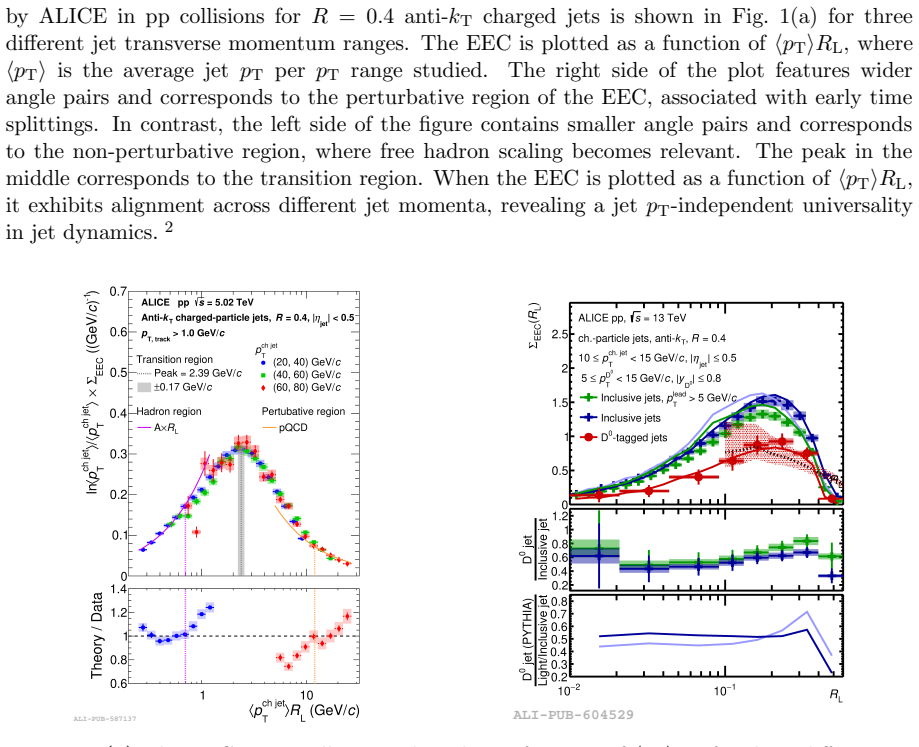
The paper's core discovery is a set of experimental observations: for $R=0.4$ anti-$k_T$ charged jets in pp collisions, the 2-point energy-energy correlator collapses onto a common curve when the angular separation $R_L$ is multiplied by the average jet $p_T$, revealing $p_T$-independent jet dynamics. In $D^0$-meson-tagged jets, the EEC is visibly suppressed relative to inclusive jets, and the paper interprets this as reduced radiation inside the dead cone of the charm quark, with the peak position consistent within $1\sigma$ because color and mass effects pull in opposite directions. In p-Pb collisions, only jets with $p_T$ between 20 and 40 GeV/c differ from pp: the EEC is about 10% suppressed at small angles and 10% enhanced at large angles, a modification whose underlying cause the paper says remains undetermined. Finally, the ratio of the 3-point to 2-point correlator shows a wide-angle slope proportional to $\alpha_s\ln R_L$ that changes with jet energy, indicating sensitivity to the running coupling.
Load-bearing premise
The p-Pb modification claim assumes that the particle background measured in a cone 90 degrees away from the jet is the same as the background inside the jet cone, so a biased background estimate could create the reported 10 percent shift; the paper also leaves the physical cause of the shift undetermined.
Editorial extensions
If this is right
- With $\langle p_T\rangle R_L$ scaling, the 2-point EEC offers a jet-momentum-independent baseline for jet substructure in pp collisions.
- Charm-tagged EEC suppression gives a jet-substructure signature of the dead-cone effect that can be tested against pQCD and hadronization models.
- The 10% small-angle suppression and large-angle enhancement in 20-40 GeV/c p-Pb jets, if physical, is a new low-energy nuclear-matter effect distinct from high-$p_T$ jet quenching.
- The E3C/EEC wide-angle slope provides a jet-based observable for extracting the strong coupling constant at scales set by the jet energy.
Reading between the lines
- A direct test the paper leaves implicit is to match pp and p-Pb jets by charged-particle multiplicity; if the 10% shift disappears, the modification is an effect of jet composition rather than cold nuclear matter.
- The observed $\langle p_T\rangle R_L$ collapse could be turned into an event-generator tuning rule: any generator that fails to reproduce the collapse is likely mis-modeling the parton-to-hadron transition.
- Applied to heavy-ion collisions, the same correlator could separate dead-cone-like suppression from quark-gluon plasma energy loss, using the pp and p-Pb measurements as baselines.
- The E3C/EEC extraction could be combined with measurements at different jet radii to map the running of the strong coupling over a wide range of scales from a single dataset.
Editorial analysis
A structured set of objections, weighed in public.
Referee Report
Summary. This proceedings contribution reports on behalf of the ALICE Collaboration a set of energy-energy correlator (EEC) measurements: the 2-point EEC in inclusive charged jets in pp collisions, in D0-tagged jets in pp collisions, and in inclusive jets in p-Pb collisions, together with the 3-point energy correlator (E3C) in pp collisions. The main physics claims are (1) a jet-pT-independent universality of the EEC when plotted as a function of <pT>*R_L, (2) a suppression of the D0-tagged-jet EEC consistent with the dead-cone effect, (3) a roughly 10% suppression at small angles and 10% enhancement at large angles for 20-40 GeV/c jets in p-Pb relative to pp, and (4) sensitivity of the E3C/EEC ratio to the strong coupling constant. The text is qualitative in nature; no numerical values, uncertainties, or systematic breakdowns are given, and quantitative statements rely on internal ALICE preliminary plots and references.
Significance. Energy-energy correlators are an active and important jet-substructure avenue, and extending them to heavy-flavor jets and to p-Pb collisions is genuinely interesting: these measurements can probe dead-cone physics and cold-nuclear-matter effects in new ways. The paper is a useful summary of ALICE activity and points to several publicly archived preliminary plots and papers. Its central value is as a status report; the physics conclusions, if substantiated by the underlying analyses, would be of interest to the heavy-ion and jet-substructure communities. However, as written, the quantitative claims (especially the 10% p-Pb modification) cannot be independently assessed because no uncertainties or method validations are provided.
major comments (3)
- [2.3] The p-Pb modification claim (approximately 10% suppression at small angles and 10% enhancement at large angles for 20-40 GeV/c jets) rests entirely on the perpendicular-cone underlying-event subtraction. The paper states, 'the UE-related combinatorial background in the EEC is corrected for using a perpendicular-cone method, which uses a cone 90 deg in phi away from the signal jet to estimate the background contribution.' This procedure assumes the transverse UE is representative of the UE inside the jet cone in both density and angular pair structure. In p-Pb collisions, anisotropic flow and away-side correlations can break that assumption, and the EEC background is angle-dependent rather than a single scalar. The modification appears only in the lowest-pT bin, where the UE fraction is largest and subtraction systematics scale as 1/pT. The paper provides no closure test, no cross-check against an independent subtraction method, and no systematic uncertainty estimate for this step. Because the paper itself admits the underlying cause 'remains currently undetermined,' this subtraction is the load-bearing step for the central p-Pb result. A quantitative assessment of the subtraction bias, or a presentation of the result as a preliminary observation with a clear caveat, is needed.
- [2.2] The dead-cone claim is based on a visual comparison: 'The D0-tagged jets, in the red points, are visibly suppressed compared to the inclusive jets, in the dark blue points.' No significance, no numerical suppression factor, no quoted uncertainties, and no explicit comparison to a pQCD calculation are given. The text notes 'some indication of the importance of non-perturbative effects... given the slight tension between the scaling of the pQCD calculation and the data,' but this tension is not quantified. To support the claim that the suppression is consistent with the dead-cone effect, the analysis should state the statistical and systematic significance of the difference, and confirm that the comparison is made at the same jet pT and similar kinematic selections. Without these, the reader cannot distinguish dead-cone suppression from selection or fragmentation effects.
- [2.1] The 'jet pT-independent universality' claim is stated as a visual alignment of the EEC curves when plotted against <pT>*R_L. The manuscript gives no quantitative measure of the degree of alignment across the three pT ranges, nor does it specify the pT ranges and their mean values. Since the universality is presented as a central feature of the inclusive-jet result, a quantitative statement (e.g., residual scatter or a comparison of peak positions) is needed to make the claim falsifiable.
minor comments (4)
- [2.3] In Figure 2(b), the ratio of p-Pb to pp EECs is described as showing 'approximately 10% suppression' and 'approximately 10% enhancement,' but no uncertainty bands or error bars are visible or described in the text; adding them, even schematically, would help the reader gauge the significance.
- [1] Equation (1) uses the notation 'R_L' for both the angular distance between pairs and the variable in the delta function; the definition of R_{L,ij} would be clearer if the index on the delta function were explicitly tied to the pair (i,j), and if the integral limits were stated consistently with the text.
- [2.2] Figure 1(b) is described for '10-15 GeV/c jets' but the text does not state whether the inclusive-jet curve is in the same pT range; please clarify the comparison kinematics.
- [3] The sentence 'The ratio of the E3C to EEC can be seen in Fig. 3(b)' and the following description would benefit from explicitly stating that no alpha_s extraction is presented yet; the phrase 'currently working to extract' is appropriate but should be linked to the figure's role as a projection rather than a result.
Circularity Check
No significant circularity: the paper reports ALICE measurements and compares them to external pQCD predictions; the p-Pb subtraction concern is a systematic-validity issue, not a circular derivation.
full rationale
The paper is a conference proceedings that reports existing ALICE measurements; it does not derive a new result from fitted parameters or from a self-citation chain. The EEC definition in Eq. (1) is a standard observable, and the claims of jet-pT universality, dead-cone suppression, p-Pb modification, and E3C sensitivity to alpha_s are empirical observations compared against external theory references (Chen et al., Craft et al., CMS). The self-citations to ALICE papers are the original measurements being summarized, not unverified uniqueness theorems, and the interpretation also invokes independent pQCD calculations. The perpendicular-cone UE subtraction in Sec. 2.3 is a systematic-validity concern: the paper explicitly states that the cause of the p-Pb modification 'remains currently undetermined,' so the modification is not presented as a consequence of the subtraction by construction. A biased background estimate would be an experimental error, not a circular argument. No equation reduces to another by construction, and no fitted parameter is renamed as a prediction. Therefore no circular step meets the evidentiary bar.
Assumptions & free parameters
assumptions (4)
- domain assumption The N-point energy correlator defined in Eq. (1) is the correct observable for the measurements.
- domain assumption Anti-kT jet clustering with R=0.4 reconstructs the relevant jets.
- domain assumption The perpendicular-cone method provides an unbiased estimate of the underlying event background in the EEC for p-Pb.
- domain assumption The dead-cone effect expectation from pQCD applies to charm-tagged jets at these energies.
Cite this review
Pith. "Pith review of Energy-energy correlators in small and large systems." pith.science (2026). https://pith.science/paper/7BTUF5DP
@misc{pith2026250622692,
  author       = {Pith},
  title        = {Pith review of: Energy-energy correlators in small and large systems},
  year         = {2026},
  howpublished = {\url{https://pith.science/paper/7BTUF5DP}},
  note         = {Machine review of arXiv:2506.22692}
}
read the original abstract
Energy-energy correlators (EECs) provide a powerful tool to study the evolution of scattered partons into final-state hadrons. In these proceedings, a variety of energy correlator measurements performed by the ALICE collaboration are reported. The 2-point energy-energy correlator (EEC) is measured in inclusive jets and heavy-flavor jets in pp collisions, as well as in inclusive jets in p-Pb collisions. The 3-point energy correlator is also discussed, including prospects for its use in extracting the strong coupling constant.
Figures


Reference graph
Works this paper leans on
-
[1]
H. Chen, I. Moult, X. Zhang, and H. X. Zhu. Phys. Rev. D , 102:054012, Sep 2020
work page 2020
- [2]
- [3]
- [4]
- [5]
-
[6]
CMS Collaboration. J. High Energ. Phys. , 2012:130
work page 2012
-
[7]
Y. Fu, B. M¨ uller, and C. Sirimanna. [arXiv:2411.04866 [nucl-th]]
-
[8]
J. Barata, Z.-B. Kang, X. M. L´ opez, and J. Penttala. [arXiv:2411.11782 [hep-ph]]
Show all 12 references
-
[9]
Andres, F
C. Andres, F. Dominguez, J. Holguin, C. Marquet, and I. Moult. [arXiv:2411.15298 [hep-ph]]
-
[10]
Nambrath
A. Nambrath. [https://indico.cern.ch/event/1334113/contributions/6350975/]
-
[11]
Chen, M.-X
H. Chen, M.-X. Luo, I. Moult, T.-Z. Yang, X. Zhang, and H. X. Zhu. Journal of High Energy Physics, 2020(8), Aug 2020
2020
-
[12]
CMS Collaboration. Phys. Rev. Lett., 133:071903, Aug 2024
2024
Reviewed August 6, 2026 · model on record in the stance chip above.
Discussion (0). Continue with ORCID to comment.