REVIEW 3 major objections 6 minor 66 references
Robust Tensor Completion via Gradient Tensor Nulclear L1-L2 Norm for Traffic Data Recovery
T0 review · 3 major / 6 minor · reviewed 2026-08-06 · deepseek-v4-flash
Pith's one-line read A single parameter-free norm on the gradient tensor performs robust traffic tensor completion with simultaneous denoising and imputation.
desk verdict Strong empirical results on traffic data, but the paper's central theoretical claim about parameter-free fusion of low-rankness and smoothness is broken by the null space of the temporal difference operator. read the letter →
The pith
A machine-rendered reading of the paper's core claim, the machinery that carries it, and where it could break.
The reading
What carries the argument
The central object is the gradient tensor nuclear $\ell_1$-$\ell_2$ norm (GTNLN), defined as $\|\nabla(\mathcal{X})\|_{\circledast,\ell} = \sum_{i=1}^3 \alpha_i (\|\sigma(G_i)\|_1 - \|\sigma(G_i)\|_2)$, where $G_i$ is the mode-$i$ unfolding of the temporal gradient tensor $\nabla(\mathcal{X})$ and $\sigma(G_i)$ is its singular value vector. It combines the tensor nuclear $\ell_1$-$\ell_2$ norm (TNLN), a non-convex Tucker-rank surrogate, with a temporal difference operator $D$ that encodes local consistency. Lemma 1 connects GTNLN to total variation by the two-sided inequality $(\sqrt{1+1/\eta(G)}-1)\|\mathcal{X}\|_{TV} \le \|\nabla(\mathcal{X})\|_{\circledast,\ell} \le (\sqrt{r}-1)\|\mathcal{X}\|_{TV}$, which is what lets one regularizer do the work of two. The ADMM solver updates all variables with closed-form steps, including a Sylvester-type linear solve for $\mathcal{X}$ via spectral decomposition of $D^\top D$ and a proximal step for the $\ell_1$-$\ell_2$ penalty on singular values.
What would settle it
Take a synthetic low-rank traffic-like tensor and add a large constant to one location's entire time series, so the tensor's rank increases but its temporal gradient tensor is unchanged. Run RTC-GTNLN and a plain low-rank tensor completion method on noisy partial observations of this tensor; if RTC-GTNLN cannot recover the constant-shifted fiber while the low-rank method can, the global-low-rankness claim fails.
Extended reading notes
Core claim
The paper's central claim is that the tensor $\ell_1$-$\ell_2$ norm serves as a hyperparameter-free non-convex surrogate for the weighted Tucker rank, and that applying it to the temporal-gradient tensor $\nabla(\mathcal{X}) = \mathcal{X} \times_2 D$ yields a regularizer that simultaneously controls global low-rankness and local consistency. The mathematical core is Lemma 1, which bounds the new gradient norm above and below by constant multiples of the total variation $\|\nabla(\mathcal{X})\|_F$, showing that minimizing the new norm also minimizes total variation. In the robust tensor completion framework with noise separation $\mathcal{Y} = \mathcal{P}_\Omega(\mathcal{X} + \mathcal{E})$ and fixed weight $\lambda = 1/\sqrt{\max(n_1,n_2)\,n_3}$, the model recovers the clean tensor and the sparse noise tensor together. Experiments on PeMS04, PeMS08, and Guangzhou traffic tensors report consistently lower MAE/RMSE than seven baselines across six noise-missingness scenarios, with example improvements such as PeMS04 RMSE 2.55 versus 3.50 for the best baseline under 50% Laplace noise and 50% missing entries.
Load-bearing premise
The load-bearing premise is that the temporal difference operator $D$ is approximately full-rank, so that forcing the gradient tensor to be low-rank also forces the original data tensor to be low-rank; in reality $D$ annihilates constant time-series, so a constant shift on one fiber can raise the rank of $\mathcal{X}$ without affecting the gradient tensor.
Editorial extensions
If this is right
- Robust tensor completion becomes parameter-free: the only weight, $\lambda = 1/\sqrt{\max(n_1,n_2)\,n_3}$, is fixed by tensor dimensions, removing trade-off tuning between global low-rankness and local consistency.
- A single non-convex regularizer provably bounds total variation, so minimizing GTNLN yields both rank reduction and local smoothness in one step.
- The method simultaneously imputes missing entries and removes sparse noise, covering random and non-random missing patterns combined with Laplace, Gaussian, and composite noise.
- Reported MAE/RMSE improvements over existing robust tensor completion methods on three real-world traffic datasets, with comparable or lower runtime than high-accuracy baselines.
Reading between the lines
- Because $D$ has a null space of constant temporal vectors, the equivalence between low rank of $\nabla(\mathcal{X})$ and low rank of $\mathcal{X}$ is fragile; in settings with large constant offsets the method may act mainly as a smoothness regularizer, and a low-rank prior on the raw tensor would be needed to guarantee global low-rankness.
- The $\ell_1$-$\ell_2$ difference penalizes singular-value spread rather than total magnitude, so the norm is best suited to tensors whose singular values decay sharply; for tensors with gradual, flat spectra the gap between GTNLN and TV narrows and the theoretical advantage may shrink.
- The same construction, a non-convex tensor norm applied to a difference operator, transfers to other spatiotemporal tensors such as energy or environmental data, where temporal smoothness and global low-rank structure both hold.
- The element-wise sparse noise model is likely to saturate under heavy-tailed or structured noise; the paper itself points toward Laplacian regularization of the noise component as a follow-up.
Editorial analysis
A structured set of objections, weighed in public.
Referee Report
Summary. The paper proposes RTC-GTNLN for recovering traffic tensors from incomplete and noisy observations. It introduces a tensor nuclear L1-L2 norm (TNLN) as a nonconvex surrogate for weighted Tucker rank and applies it to the temporal gradient tensor (GTNLN), claiming that this simultaneously enforces global low-rankness and local smoothness without a trade-off parameter, while a sparse component handles noise. The optimization is carried out by ADMM with supposedly closed-form updates, and experiments on PeMS04, PeMS08, and Guangzhou report superior MAE/RMSE over seven baselines under random and fiber missing patterns with Laplace, Gaussian, and composite noise.
Significance. If the modeling claims held, the paper would provide a useful parameter-free nonconvex RTC formulation with strong empirical performance, and the code release is a positive for reproducibility. The experimental study is broad, covering three datasets, multiple noise types, and several missing ratios, and the reported gains over the best baseline are often substantial. However, the central theoretical claim that GTNLN encodes global low-rankness is not established: the temporal difference operator has a nontrivial null space, so constant temporal fibers can inflate the rank of X at zero gradient cost. As a result, the main novelty reduces, as far as the paper shows, to a nonconvex smoothness regularizer combined with sparse noise, and the manuscript needs either a corrected theoretical statement or a numerical demonstration of rank preservation before the advertised contribution can be accepted.
major comments (3)
- [Section IV-B, Remark 1] The claim that D is 'approximately full-rank' and hence that low rank of ∇(X) implies low rank of X is not valid for the operator actually used. The n2×n2 row-circulant matrix D defined in Eq. (7) has eigenvalue −1+ω^0=0 for the constant Fourier mode, so its null space contains the constant vector; consequently the mode-2 map X ↦ X×2 D has a null space consisting of all tensors whose mode-2 fibers are constant in time. Such tensors can have arbitrarily large mode-2 rank while contributing exactly zero to ∥∇(X)∥_{⊛,ℓ}. Thus the 'global low-rankness' part of Remark 1 is unsupported, and Lemma 1 only establishes an equivalence with total variation, i.e., with local smoothness. For the fiber-like (NM) missing patterns of Section VI, this also implies that unobserved constant temporal fibers can be assigned arbitrary values at zero cost under the objective; please add an argument or numerical evidence addressing the null space, or revise the contribution to claim only smoothness regularization.
- [Section V, Eqs. (27)-(29)] The Z-subproblem is a nonconvex DC minimization because of the −∥Zi∥F term, and the statement that Eq. (28) provides 'a globally feasible solution' is not justified. Reduction by von Neumann's trace inequality leads to the nonconvex vector problem (29), and no proof is given that the proximal result of [57] yields a global minimizer of the matrix problem; convergence of the overall nonconvex ADMM is only demonstrated empirically in Fig. 10. Please either prove or cite the global-solution property of the Z-update, or describe it as an approximate or empirically convergent step.
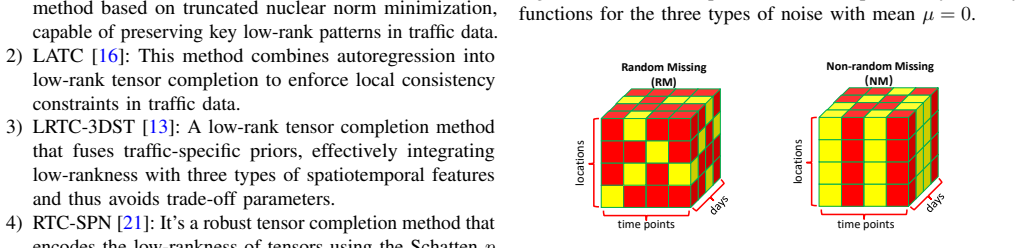
- [Abstract and Table IV] The statement that RTC-GTNLN 'consistently outperforms' all baselines is contradicted by the authors' own results. In Table IV, PeMS04 with 80% random missing + 20% noise, LATC achieves MAE 2.07 versus RTC-GTNLN's 2.13; in Guangzhou with the same degradation, RTC-TTSVD achieves 2.76 versus 2.86. The text in Section VI-D-2 correctly says 'almost all missing rates'; the abstract, introduction, and conclusion should be reworded to match the data.
minor comments (6)
- [Title and Section IV] The word 'Nulclear' should be 'Nuclear' in the title, abstract, and Section IV headings.
- [Table II caption] The caption refers to 'LRTC-GTNLN', but the model is named 'RTC-GTNLN'; please correct the typo.
- [Eq. (20)] The multiplier M_t appears with a subscript k in Eq. (20), although M is defined as a tensor; please define the notation or remove the inconsistent subscript.
- [Section VI-D-1] The sentence 'In the case of purely missing data degradation, the recovery accuracy of the proposed RTC-GTNLN method is slightly lower but very close to that of the LRTC-3DST model' describes a comparison that is not reported in any table; either add the corresponding experiment or delete the sentence.
- [Eq. (24)] The all-ones tensor 1 and the componentwise division in Eq. (24) are used without prior definition; please define these objects and clarify the notation of the spectral decomposition D^T D A = A S.
- [Algorithm 1] Algorithm 1 fixes α_i=1/3, but Definition 1 allows arbitrary α_i satisfying the sum-to-one constraint; state explicitly whether α_i is a user-choice parameter or a fixed constant of the method.
Circularity Check
No circular reduction is found; the sole self-citation is non-load-bearing, and the Remark 1 rank-consistency gap is a correctness concern rather than circularity.
full rationale
The central construction is not circular: TNLN (Definition 1) and GTNLN (Definition 2) are fixed functionals of singular values and of the temporal gradient tensor, with no fitted parameters (alpha_i = 1/3, lambda closed-form from [18], and comparisons against external baselines). The only self-citation inside the algorithm is "Following lemma 1 in [13]" for the closed-form X update (Eq. 24); that lemma solves the linear system (I + D^T D)X = W by spectral diagonalization and does not carry the paper's low-rankness/local-consistency claim, so it is not load-bearing. Lemma 1 is proved in the appendix as a norm-comparison, not assumed. The flagged weakness is Remark 1 (Section IV-B), which asserts that D is "approximately full-rank, so the rank of ∇X remains consistent with that of X"; this is unsupported because the circulant difference matrix has a one-dimensional null space, so constant mode-2 fibers can inflate rank(X) at zero GTNLN cost. That is a correctness/robustness gap in the theoretical justification, not a circular reduction of the model to its inputs, so it does not raise the circularity score beyond the minor self-citation note.
Assumptions & free parameters
free parameters (3)
- Tucker-mode weights alpha_i =
1/3 (uniform)
- Noise regularization weight lambda =
1/sqrt(max(n1,n2)*n3)
- ADMM penalty schedule mu_t =
mu_0 = 1e-6, multiplied by 1.1 per iteration
assumptions (4)
- domain assumption Spatiotemporal traffic tensors are globally low-rank and locally smooth.
- domain assumption The temporal difference operator D preserves rank approximately, so rank(gradient tensor) is consistent with rank(X).
- domain assumption The noise tensor E is sparse, justifying the L1 regularizer.
- domain assumption The ADMM scheme converges for the non-convex DC objective (10).
Cite this review
Pith. "Pith review of Robust Tensor Completion via Gradient Tensor Nulclear L1-L2 Norm for Traffic Data Recovery." pith.science (2026). https://pith.science/paper/75ZKISAU
@misc{pith2026250622732,
  author       = {Pith},
  title        = {Pith review of: Robust Tensor Completion via Gradient Tensor Nulclear L1-L2 Norm for Traffic Data Recovery},
  year         = {2026},
  howpublished = {\url{https://pith.science/paper/75ZKISAU}},
  note         = {Machine review of arXiv:2506.22732}
}
read the original abstract
In real-world scenarios, spatiotemporal traffic data frequently experiences dual degradation from missing values and noise caused by sensor malfunctions and communication failures. Therefore, effective data recovery methods are essential to ensure the reliability of downstream data-driven applications. while classical tensor completion methods have been widely adopted, they are incapable of modeling noise, making them unsuitable for complex scenarios involving simultaneous data missingness and noise interference. Existing Robust Tensor Completion (RTC) approaches offer potential solutions by separately modeling the actual tensor data and noise. However, their effectiveness is often constrained by the over-relaxation of convex rank surrogates and the suboptimal utilization of local consistency, leading to inadequate model accuracy. To address these limitations, we first introduce the tensor L1-L2 norm, a novel non-convex tensor rank surrogate that functions as an effective low-rank representation tool. Leveraging an advanced feature fusion strategy, we further develop the gradient tensor L1-L2 norm by incorporating the tensor L1-L2 norm in the gradient domain. By integrating the gradient tensor nuclear L1-L2 norm into the RTC framework, we propose the Robust Tensor Completion via Gradient Tensor Nuclear L1-L2 Norm (RTC-GTNLN) model, which not only fully exploits both global low-rankness and local consistency without trade-off parameter, but also effectively handles the dual degradation challenges of missing data and noise in traffic data. Extensive experiments conducted on multiple real-world traffic datasets demonstrate that the RTC-GTNLN model consistently outperforms existing state-of-the-art methods in complex recovery scenarios involving simultaneous missing values and noise.
Figures


Figures from the paper (7 more)




Reference graph
Works this paper leans on
-
[57]
A novel nonconvex relaxation approach to low-rank matrix completion of inexact observed data,
Y . Li and L. Zhang, “A novel nonconvex relaxation approach to low-rank matrix completion of inexact observed data,” SIAM J. Optim. , vol. 34, no. 3, pp. 2378–2410, 2024
work page 2024
-
[1]
Real-time lagrangian traffic state estimator for freeways,
Y . Yuan, J. Van Lint, R. E. Wilson, F. van Wageningen-Kessels, and S. P. Hoogendoorn, “Real-time lagrangian traffic state estimator for freeways,” IEEE Trans. Intell. Transp. Syst. , vol. 13, no. 1, pp. 59–70, Jan. 2012
work page 2012
-
[2]
Spatiotemporal tensor completion for improved urban traffic imputation,
A. B. Said and A. Erradi, “Spatiotemporal tensor completion for improved urban traffic imputation,” IEEE Trans. Intell. Transp. Syst., vol. 23, no. 7, pp. 6836–6849, 2021
work page 2021
-
[3]
Z. Zhang, X. Lin, M. Li, and Y . Wang, “A customized deep learning approach to integrate network-scale online traffic data imputation and prediction,” Transp. Res. C, Emerg. Technol. , vol. 132, p. 103372, 2021
work page 2021
-
[4]
Low-rank and deep plug-and-play priors for missing traffic data imputation,
P. Chen, F. Li, D. Wei, and C. Lu, “Low-rank and deep plug-and-play priors for missing traffic data imputation,” IEEE Trans. Intell. Transp. Syst., 2024
work page 2024
-
[5]
Traffic data recovery from corrupted and incomplete observations via spatial-temporal trpca,
X. Feng, H. Zhang, C. Wang, and H. Zheng, “Traffic data recovery from corrupted and incomplete observations via spatial-temporal trpca,” IEEE Trans. Intell. Transp. Syst. , vol. 23, no. 10, pp. 17 835–17 848, 2022
work page 2022
-
[6]
Traffic data reconstruction via adaptive spatial-temporal correlations,
Y . Wang, Y . Zhang, X. Piao, H. Liu, and K. Zhang, “Traffic data reconstruction via adaptive spatial-temporal correlations,” IEEE Trans. Intell. Transp. Syst. , vol. 20, no. 4, pp. 1531–1543, 2018
work page 2018
-
[7]
X. Chen, Z. He, Y . Chen, Y . Lu, and J. Wang, “Missing traffic data imputation and pattern discovery with a bayesian augmented tensor factorization model,” Transp. Res. Pt. C-Emerg. Technol. , vol. 104, pp. 66–77, 2019
work page 2019
Show all 66 references
-
[8]
Bayesian temporal factorization for multidimen- sional time series prediction,
X. Chen and L. Sun, “Bayesian temporal factorization for multidimen- sional time series prediction,” IEEE Trans. Pattern Anal. Mach. Intell. , vol. 44, no. 9, pp. 4659–4673, 2021
2021
-
[9]
Robust tensor ring decomposition for urban traffic data imputation,
L. Yu, C. Guan, H. Wang, Y . He, W. Cao, and C.-S. Leung, “Robust tensor ring decomposition for urban traffic data imputation,” IEEE Trans. Intell. Transp. Syst. , 2025
2025
-
[10]
Tensor based missing traffic data completion with spatial–temporal correlation,
B. Ran, H. Tan, Y . Wu, and P. J. Jin, “Tensor based missing traffic data completion with spatial–temporal correlation,” Physica A, vol. 446, pp. 54–63, 2016
2016
-
[11]
A nonconvex low-rank tensor completion model for spatiotemporal traffic data imputation,
X. Chen, J. Yang, and L. Sun, “A nonconvex low-rank tensor completion model for spatiotemporal traffic data imputation,” Transp. Res. Pt. C- Emerg. Technol., vol. 117, p. 102673, 2020
2020
-
[12]
Truncated tensor schatten p-norm based approach for spatiotemporal traffic data imputation with complicated missing patterns,
T. Nie, G. Qin, and J. Sun, “Truncated tensor schatten p-norm based approach for spatiotemporal traffic data imputation with complicated missing patterns,” Transp. Res. Pt. C-Emerg. Technol., vol. 141, p. 103737, 2022
2022
-
[13]
Low-rank tensor completion with 3-d spatiotemporal transform for traffic data imputation,
H. Shu, H. Wang, J. Peng, and D. Meng, “Low-rank tensor completion with 3-d spatiotemporal transform for traffic data imputation,” IEEE Trans. Intell. Transp. Syst. , vol. 25, no. 11, pp. 18 673–18 687, 2024
2024
-
[14]
An algorithm for total variation minimization and applications,
A. Chambolle, “An algorithm for total variation minimization and applications,” J. Math. Imaging Vis. , vol. 20, pp. 89–97, 2004
2004
-
[15]
Adaptive fractional-order multi-scale method for image denoising,
J. Zhang, Z. Wei, and L. Xiao, “Adaptive fractional-order multi-scale method for image denoising,” J. Math. Imaging Vis. , vol. 43, pp. 39–49, 2012
2012
-
[16]
Low-rank autoregressive tensor completion for spatiotemporal traffic data imputation,
X. Chen, M. Lei, N. Saunier, and L. Sun, “Low-rank autoregressive tensor completion for spatiotemporal traffic data imputation,” IEEE Trans. Intell. Transp. Syst. , vol. 23, no. 8, pp. 12 301–12 310, 2021
2021
-
[17]
Laplacian convolutional representation for traffic time series imputation,
X. Chen, Z. Cheng, H. Cai, N. Saunier, and L. Sun, “Laplacian convolutional representation for traffic time series imputation,” IEEE Trans. Knowl. Data Eng. , 2024. 15
2024
-
[18]
A flexible and robust tensor completion approach for traffic data recovery with low-rankness,
L. Hu, Y . Jia, W. Chen, L. Wen, and Z. Ye, “A flexible and robust tensor completion approach for traffic data recovery with low-rankness,” IEEE Trans. Intell. Transp. Syst. , vol. 25, no. 3, pp. 2558–2572, 2023
2023
-
[19]
Robust tensor completion via capped frobenius norm,
X. P. Li, Z.-Y . Wang, Z.-L. Shi, H. C. So, and N. D. Sidiropoulos, “Robust tensor completion via capped frobenius norm,” IEEE Trans. Neural Netw. Learn. Syst. , 2023
2023
-
[20]
Robust low-tubal-rank tensor completion via convex optimization
Q. Jiang and M. Ng, “Robust low-tubal-rank tensor completion via convex optimization.” in IJCAI, 2019, pp. 2649–2655
2019
-
[21]
Robust schatten-p norm based approach for tensor completion,
S. Gao and Q. Fan, “Robust schatten-p norm based approach for tensor completion,” J. Sci. Comput. , vol. 82, pp. 1–23, 2020
2020
-
[22]
Robust tensor completion using transformed tensor singular value decomposition,
G. Song, M. K. Ng, and X. Zhang, “Robust tensor completion using transformed tensor singular value decomposition,” Numer. Linear Algebr. Appl., vol. 27, no. 3, p. e2299, 2020
2020
-
[23]
Vehicle state recovery: A tailored laplace function-based tensor completion approach,
L. Hu, W. Chen, Y . Liu, X. Qu, and Z. Ye, “Vehicle state recovery: A tailored laplace function-based tensor completion approach,” IEEE Trans. Veh. Technol., 2024
2024
-
[24]
Scalable low-rank tensor learning for spatiotemporal traffic data imputation,
X. Chen, Y . Chen, N. Saunier, and L. Sun, “Scalable low-rank tensor learning for spatiotemporal traffic data imputation,” Transp. Res. Pt. C-Emerg. Technol., vol. 129, p. 103226, 2021
2021
-
[25]
A flexible approach based on hybrid global low-rankness and smoothness regularization with nonlocal structure for traffic data imputation,
Z. Zeng, J. Feng, Z. Huang, B. Liu, and B. Zhou, “A flexible approach based on hybrid global low-rankness and smoothness regularization with nonlocal structure for traffic data imputation,” IEEE Trans. Intell. Transp. Syst., 2025
2025
-
[26]
A symmetric admm-type algorithm for robust tensor completion problems using a regularized scad-schatten-p model with application in color image and video recovery,
Z. Zhang, S. Liu, L. Liu, and Z. Lin, “A symmetric admm-type algorithm for robust tensor completion problems using a regularized scad-schatten-p model with application in color image and video recovery,” J. Comput. Appl. Math., p. 116604, 2025
2025
-
[27]
Convolutional low-rank tensor representation for structural missing traffic data imputation,
B.-Z. Li, X.-L. Zhao, X. Chen, M. Ding, and R. W. Liu, “Convolutional low-rank tensor representation for structural missing traffic data imputation,” IEEE Trans. Intell. Transp. Syst. , 2024
2024
-
[28]
A bayesian tensor decomposition approach for spatiotemporal traffic data imputation,
X. Chen, Z. He, and L. Sun, “A bayesian tensor decomposition approach for spatiotemporal traffic data imputation,” Transp. Res. Pt. C-Emerg. Technol., vol. 98, pp. 73–84, 2019
2019
-
[29]
Tucker factorization-based tensor completion for robust traffic data imputation,
C. Lyu, Q.-L. Lu, X. Wu, and C. Antoniou, “Tucker factorization-based tensor completion for robust traffic data imputation,” Transp. Res. Pt. C-Emerg. Technol., vol. 160, p. 104502, 2024
2024
-
[30]
Learning spatiotemporal latent factors of traffic via regularized tensor factorization: Imputing missing values and forecasting,
A. Baggag, S. Abbar, A. Sharma, T. Zanouda, A. Al-Homaid, A. Mohan, and J. Srivastava, “Learning spatiotemporal latent factors of traffic via regularized tensor factorization: Imputing missing values and forecasting,” IEEE Trans. Knowl. Data Eng. , vol. 33, no. 6, pp. 2573–2587, 2019
2019
-
[31]
T-product factorization method for internet traffic data completion with spatio-temporal regularization,
C. Ling, G. Yu, L. Qi, and Y . Xu, “T-product factorization method for internet traffic data completion with spatio-temporal regularization,” Comput. Optim. Appl. , vol. 80, pp. 883–913, 2021
2021
-
[32]
Transforms- based bayesian tensor completion method for network traffic measurement data recovery,
Z. Yang, L. T. Yang, L. Yi, X. Deng, C. Zhu, and Y . Ruan, “Transforms- based bayesian tensor completion method for network traffic measurement data recovery,” IEEE Trans. Netw. Sci. Eng. , 2023
2023
-
[33]
Nt-dptc: a non-negative temporal dimension preserved tensor completion model for missing traffic data imputation,
H. Chen, M. Lin, J. Liu, H. Yang, C. Zhang, and Z. Xu, “Nt-dptc: a non-negative temporal dimension preserved tensor completion model for missing traffic data imputation,” Information Sciences, vol. 653, p. 119797, 2024
2024
-
[34]
The expression of a tensor or a polyadic as a sum of products,
F. L. Hitchcock, “The expression of a tensor or a polyadic as a sum of products,” ” J. Math. Phys. , vol. 6, no. 1-4, pp. 164–189, 1927
1927
-
[35]
Tensor decompositions and applications,
T. G. Kolda and B. W. Bader, “Tensor decompositions and applications,” SIAM Rev., vol. 51, no. 3, pp. 455–500, 2009
2009
-
[36]
Low-rank tensor completion with a new tensor nuclear norm induced by invertible linear transforms,
C. Lu, X. Peng, and Y . Wei, “Low-rank tensor completion with a new tensor nuclear norm induced by invertible linear transforms,” in Proc. IEEE Conf. Comput. Vis. Pattern Recognit. , 2019, pp. 5996–6004
2019
-
[37]
Tensor-train decomposition,
I. V . Oseledets, “Tensor-train decomposition,” SIAM J. Sci. Comput. , vol. 33, no. 5, pp. 2295–2317, 2011
2011
-
[38]
Tensor ring decomposition,
Q. Zhao, G. Zhou, S. Xie, L. Zhang, and A. Cichocki, “Tensor ring decomposition,” arXiv preprint arXiv:1606.05535 , 2016
2016 arXiv
-
[39]
Most tensor problems are np-hard,
C. J. Hillar and L.-H. Lim, “Most tensor problems are np-hard,” Journal of the ACM , vol. 60, no. 6, pp. 1–39, 2013
2013
-
[40]
Tensor completion for estimating missing values in visual data,
J. Liu, P. Musialski, P. Wonka, and J. Ye, “Tensor completion for estimating missing values in visual data,” IEEE Trans. Pattern Anal. Mach. Intell., vol. 35, no. 1, pp. 208–220, 2012
2012
-
[41]
Exact tensor completion using t-svd,
Z. Zhang and S. Aeron, “Exact tensor completion using t-svd,” IEEE Trans. Signal Process., vol. 65, no. 6, pp. 1511–1526, 2016
2016
-
[42]
Fast and accurate matrix completion via truncated nuclear norm regularization,
Y . Hu, D. Zhang, J. Ye, X. Li, and X. He, “Fast and accurate matrix completion via truncated nuclear norm regularization,” IEEE Trans. Pattern Anal. Mach. Intell. , vol. 35, no. 9, pp. 2117–2130, 2012
2012
-
[43]
Analysis of multi-stage convex relaxation for sparse regularization
T. Zhang, “Analysis of multi-stage convex relaxation for sparse regularization.” J. Mach. Learn. Res. , vol. 11, no. 3, 2010
2010
-
[44]
Fast sparse regression and classification,
J. H. Friedman, “Fast sparse regression and classification,” Int. J. Forecasting, vol. 28, no. 3, pp. 722–738, 2012
2012
-
[45]
Highly undersampled magnetic resonance image reconstruction via homotopic backslash ℓ1 minimization,
J. Trzasko and A. Manduca, “Highly undersampled magnetic resonance image reconstruction via homotopic backslash ℓ1 minimization,” IEEE Trans. Med.Imag., vol. 28, no. 1, pp. 106–121, 2008
2008
-
[46]
A feasible nonconvex relaxation approach to feature selection,
C. Gao, N. Wang, Q. Yu, and Z. Zhang, “A feasible nonconvex relaxation approach to feature selection,” in Proc. 25th AAAI Conf. Artif. Intell. , vol. 25, 2011, pp. 356–361
2011
-
[47]
Nearly unbiased variable selection under minimax concave penalty,
C.-H. Zhang, “Nearly unbiased variable selection under minimax concave penalty,” Ann. Statist., vol. 38, no. 2, pp. 894–942, 2010
2010
-
[48]
Variable selection via nonconcave penalized likelihood and its oracle properties,
J. Fan and R. Li, “Variable selection via nonconcave penalized likelihood and its oracle properties,” J. Amer. Stat. Assoc. , vol. 96, no. 456, pp. 1348–1360, 2001
2001
-
[49]
Correlating sparse sensing for large-scale traffic speed estimation: A laplacian-enhanced low-rank tensor kriging approach,
T. Nie, G. Qin, Y . Wang, and J. Sun, “Correlating sparse sensing for large-scale traffic speed estimation: A laplacian-enhanced low-rank tensor kriging approach,” Transp. Res. C, Emerg. Technol. , vol. 152, p. 104190, 2023
2023
-
[50]
Real-time spatiotemporal prediction and imputation of traffic status based on lstm and graph laplacian regularized matrix factorization,
J.-M. Yang, Z.-R. Peng, and L. Lin, “Real-time spatiotemporal prediction and imputation of traffic status based on lstm and graph laplacian regularized matrix factorization,” Transp. Res. Pt. C-Emerg. Technol. , vol. 129, p. 103228, 2021
2021
-
[51]
Generalized least squares kernelized tensor factorization,
M. Lei and L. Sun, “Generalized least squares kernelized tensor factorization,” arXiv preprint arXiv:2412.07041 , 2024
2024 arXiv
-
[52]
Exact decomposition of joint low rankness and local smoothness plus sparse matrices,
J. Peng, Y . Wang, H. Zhang, J. Wang, and D. Meng, “Exact decomposition of joint low rankness and local smoothness plus sparse matrices,” IEEE Trans. Pattern Anal. Mach. Intell. , vol. 45, no. 5, pp. 5766–5781, 2022
2022
-
[53]
Guaranteed tensor recovery fused low-rankness and smoothness,
H. Wang, J. Peng, W. Qin, J. Wang, and D. Meng, “Guaranteed tensor recovery fused low-rankness and smoothness,” IEEE Trans. Pattern Anal. Mach. Intell., 2023
2023
-
[54]
Generalized nonconvex approach for low-tubal-rank tensor recovery,
H. Wang, F. Zhang, J. Wang, T. Huang, J. Huang, and X. Liu, “Generalized nonconvex approach for low-tubal-rank tensor recovery,” IEEE Trans. Neural Netw. Learn. Syst. , vol. 33, no. 8, pp. 3305–3319, 2021
2021
-
[55]
Minimization of 1-2 for compressed sensing,
P. Yin, Y . Lou, Q. He, and J. Xin, “Minimization of 1-2 for compressed sensing,” SIAM J. Sci, Comput. , vol. 37, no. 1, pp. A536–A563, 2015
2015
-
[56]
Fast l1–l2 minimization via a proximal operator,
Y . Lou and M. Yan, “Fast l1–l2 minimization via a proximal operator,” J. Sci. Comput. , vol. 74, no. 2, pp. 767–785, 2018
2018
-
[58]
Sparse laplacian component analysis for internet traffic anomalies detection,
M. Khatua, S. H. Safavi, and N.-M. Cheung, “Sparse laplacian component analysis for internet traffic anomalies detection,” IEEE Trans. Signal Inf. Process. Netw., vol. 4, no. 4, pp. 697–711, 2018
2018
-
[59]
Traffic state estimation from vehicle trajectories with anisotropic gaussian processes,
F. Wu, Z. Cheng, H. Chen, Z. Qiu, and L. Sun, “Traffic state estimation from vehicle trajectories with anisotropic gaussian processes,” Transp. Res. C, Emerg. Technol. , vol. 163, p. 104646, 2024
2024
-
[60]
Stable local-smooth principal component pursuit,
J. Peng, H. Wang, X. Cao, X. Jia, H. Zhang, and D. Meng, “Stable local-smooth principal component pursuit,” SIAM J. Imag. Sci. , vol. 17, no. 2, pp. 1182–1205, 2024
2024
-
[61]
Distributed optimization and statistical learning via the alternating direction method of multipliers,
S. Boyd, N. Parikh, E. Chu, B. Peleato, J. Eckstein et al., “Distributed optimization and statistical learning via the alternating direction method of multipliers,” Found. Trends Mach. Learn., vol. 3, no. 1, pp. 1–122, 2011
2011
-
[62]
Generalized symmetric admm for separable convex optimization,
J. Bai, J. Li, F. Xu, and H. Zhang, “Generalized symmetric admm for separable convex optimization,” Comput. Optim. Appl. , vol. 70, no. 1, pp. 129–170, 2018
2018
-
[63]
An inexact accelerated stochastic admm for separable convex optimization,
J. Bai, W. W. Hager, and H. Zhang, “An inexact accelerated stochastic admm for separable convex optimization,” Comput. Optim. Appl. , pp. 1–40, 2022
2022
-
[64]
Nonsmooth analysis of singular values
A. S. Lewis and H. S. Sendov, “Nonsmooth analysis of singular values.” Set-Valued Analysis, vol. 13, pp. 213–241, 2005
2005
-
[65]
Low-rank hankel tensor completion for traffic speed estimation,
X. Wang, Y . Wu, D. Zhuang, and L. Sun, “Low-rank hankel tensor completion for traffic speed estimation,” IEEE Trans. Intell. Transp. Syst., vol. 24, no. 5, pp. 4862–4871, 2023
2023
-
[66]
Guaranteed minimum-rank solutions of linear matrix equations via nuclear norm minimization,
B. Recht, M. Fazel, and P. A. Parrilo, “Guaranteed minimum-rank solutions of linear matrix equations via nuclear norm minimization,” SIAM Rev., vol. 52, no. 3, pp. 471–501, 2010
2010
Reviewed August 6, 2026 · model on record in the stance chip above.
Discussion (0). Continue with ORCID to comment.