REVIEW 5 major objections 4 minor 1 cited by
Degradation-Modeled Multipath Diffusion for Tunable Metalens Photography
T0 review · 5 major / 4 minor · reviewed 2026-08-06 · deepseek-v4-flash
Pith's one-line read This paper claims that a LoRA-fine-tuned, multi-prompt diffusion model, guided by a spatially varying degradation-aware attention module, can restore sharp and faithful images from a millimeter-scale metalens camera without precise…
desk verdict A real millimeter-scale metalens camera plus a well-engineered diffusion restorer, but the paper's own Table 1 undercuts the 'surpasses all baselines' claim on SSIM. read the letter →
The pith
A machine-rendered reading of the paper's core claim, the machinery that carries it, and where it could break.
The reading
What carries the argument
The central mechanism is the spatially varying degradation-aware attention (SVDA) module, which turns a per-patch blur estimate into a matrix that reshapes the LoRA update. The input image is divided into $n \times n$ patches; for each patch, a simulated metalens point-spread function is fit with a 2D Gaussian to get a FWHM blur width, and the transformer-based MUSIQ no-reference metric scores the patch's quality. An attention network $N_A$ maps the FWHM score $S_f$ and quality score $S_i$ to an $r \times r$ attention matrix $Q$, and the LoRA weight update becomes $W^* = W + A Q B$, so patches with different degradation receive different adaptation strength. Around this sits the multipath training design: positive, neutral, and negative prompt paths share one model, with the negative path generating pseudo pairs that imitate MetaCamera capture, and inference merges the positive and neutral latents as $D(\alpha z_{pos} + (1-\alpha) z_{neu})$ for a tunable fidelity-perception trade-off.
What would settle it
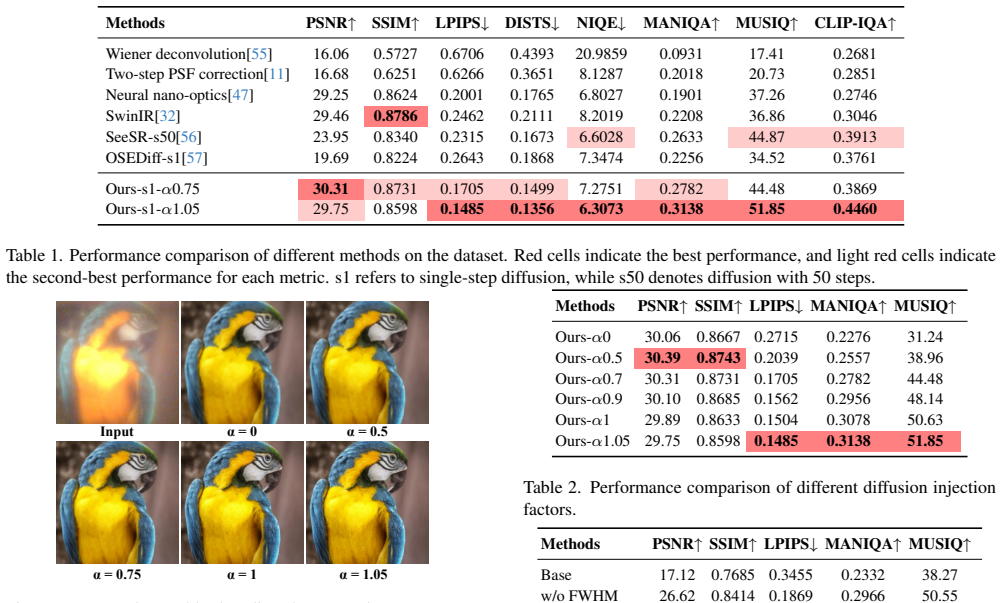
Measure the fabricated MetaCamera's point-spread function across the full field of view and at several wavelengths, then rerun the SVDA-guided training with those measured FWHM values in place of the simulated ones; if the restoration gain vanishes or degrades, the simulated-degradation proxy is load-bearing and fabrication mismatch can break the method. A second check is to recompute Table 1 under a fixed rule for choosing the diffusion strength $\alpha$: the printed table lists SwinIR with SSIM 0.8786 above both DMDiff variants, so the blanket claim that the method surpasses all baselines on all metrics depends on how the two $\alpha$ variants are counted.
Extended reading notes
Core claim
The paper's central claim is that metalens restoration need not choose between physics-based fidelity and generative realism: DMDiff combines a pretrained one-step latent diffusion model with LoRA fine-tuning that is spatially modulated by a degradation-aware attention matrix, and this combination reconstructs images that are simultaneously sharp, faithful, and free of hallucinated artifacts. On the authors' test set, the method reports the best or second-best scores on the fidelity and perceptual metrics against Wiener deconvolution, two-step PSF correction, neural nano-optics, SwinIR, SeeSR, and OSEDiff, with the full method reaching a PSNR of 30.31 dB at diffusion strength $\alpha=0.75$ and the best perceptual scores at $\alpha=1.05$. Ablations attribute the gain to all three components: removing the FWHM guidance drops PSNR from 29.89 dB to 26.62 dB, removing the negative-prompt path drops it to 28.21 dB, and the bare LoRA-fine-tuned base reaches only 17.12 dB. The paper further validates the pipeline on real-world captures with the fabricated MetaCamera, where competing methods visibly degrade but DMDiff maintains color, structure, and edge detail.
Load-bearing premise
The method assumes that a simulated blur width plus an automatic image-quality score accurately describes how the metalens blurs each patch of the real image; if the real point-spread function diverges from simulation, or the quality score is unreliable on metalens artifacts, the attention guidance points the fine-tuning in the wrong direction and the gain collapses.
Editorial extensions
If this is right
- Because inference is single-step ($k=1$), the method runs fast enough for practical camera use; the positive and neutral latent codes are computed once, and changing $\alpha$ only re-decodes them.
- The negative-prompt path doubles as a data generator, producing pseudo captured images from clean images, so the training set can be expanded without additional real captures.
- SVDA guidance keeps performance high in image-edge regions where metalens blur is strongest and where competing baselines visibly fail.
- The tunable decoder gives users a continuous fidelity-versus-perceptual-quality knob at inference time, with higher $\alpha$ favoring perceptual metrics and lower $\alpha$ favoring PSNR and SSIM.
- Because prompts describe imaging quality rather than scene content, the restoration is stable across scene types and avoids the color and structural drift that text-semantics-conditioned diffusion methods show on strongly chromatic metalens images.
Reading between the lines
- Editorial: the same SVDA recipe—simulated PSF feature plus no-reference quality score modulating a LoRA update—should transfer to other flat-optics cameras whose PSF varies spatially but is hard to calibrate, such as diffuser-based lensless cameras; a direct test would replace the metalens PSF simulator with a diffuser simulator and retrain on matched data.
- Editorial: the paired-data collection uses a screen displayed through the MetaCamera, so an untested stress is whether the gains persist for scenes with 3D depth, motion, or illumination outside the training setup, since the screen-captured pairs are effectively planar and static.
- Editorial: because the ablation ties the largest single gain to the FWHM channel, a natural next experiment is to replace the simulated FWHM with a cheap measured proxy such as an edge-spread width and see whether the gain survives fabrication mismatch; the paper does not report such a mismatch test.
Editorial analysis
A structured set of objections, weighed in public.
Referee Report
Summary. This manuscript presents DMDiff, a LoRA fine-tuned latent diffusion restoration method for images captured by a custom millimeter-scale metalens camera (MetaCamera). The method comprises a spatially varying degradation-aware attention (SVDA) module that uses simulated PSF FWHM and no-reference image quality scores to modulate LoRA update matrices, a three-path training and inference scheme with positive, neutral, and negative prompts, and a tunable decoder that interpolates between positive and neutral latent codes. The authors fabricate a roughly 1 mm3 MetaCamera, collect real paired screen-display data, augment it with 10,000 pseudo pairs generated by the negative diffusion path, and report quantitative results on 3,000 test images plus qualitative real-world captures. The central claim is that the method surpasses all baselines on all metrics.
Significance. The paper addresses a real and timely problem in computational imaging, and the hardware demonstration is a notable strength: a fully integrated metalens camera at millimeter scale with real paired training data is valuable for validating restoration algorithms under practical conditions. The pseudo-pair generation idea and the instantly tunable decoder are practical contributions that may transfer to other imaging tasks. The SVDA formulation is a reasonable lightweight alternative to full per-pixel PSF calibration. However, the quantitative evidence currently does not support the headline claim, several load-bearing components lack isolated validation, and the missing statistical analysis makes the reported gains uncertain. With corrected claims and additional experiments, the work could be a solid contribution to the metalens imaging literature.
major comments (5)
- [Section 5.3, Table 1] Section 5.3 states that "our method surpasses all baselines across all metrics," but the paper's own Table 1 contradicts this: SwinIR reaches SSIM 0.8786, while the best DMDiff operating point shown is Ours-s1-α0.75 with SSIM 0.8731, and Table 2 shows Ours-α0.5 with SSIM 0.8743. All reported DMDiff SSIM values are below SwinIR's. The claim should be revised to "most metrics" or "overall perceptual quality," or the authors should provide a statistical or aggregate argument that justifies the stronger statement.
- [Section 5.3, Tables 1-3] No error bars, confidence intervals, or significance tests are reported for any metric. The PSNR advantage of 30.31 over 29.46 against SwinIR, and the differences among the α operating points in Table 2, could be within training or test variation. The authors should report variance over seeds or evaluation subsets, or perform paired significance tests, before claiming state-of-the-art performance.
- [Section 2.3, Tables 1-3] The related-work section highlights Metaformer [26] as a metalens-specific transformer-based restoration method, but no comparison to Metaformer appears in Tables 1-3 or in the qualitative figures. Since Metaformer is the closest prior computational-imaging baseline for this exact task, its omission substantially weakens the "surpasses state-of-the-art" claim.
- [Section 3.3, Table 3] The ablation labeled "w/o Neg prompt" removes the entire negative-prompt path, so it cannot separate the contribution of the negative prompt from the contribution of the 10,000 pseudo image pairs generated by that same path. The paper argues that pseudo augmentation improves generalization, but no ablation isolates pseudo-pair augmentation. Moreover, because the same DMDiff network generates both the pseudo inputs and targets, the authors should verify that these pairs are not trivially invertible and that the reported gains are not partly an artifact of the closed loop.
- [Section 3.2, Table 3] Removing the simulated FWHM component from SVDA drops PSNR from 29.89 to 26.62 (Table 3), a 3.27 dB change that makes the simulated PSF a load-bearing element of the method. Yet Section 3.2 itself notes that fabrication errors and illumination cause discrepancies between simulated and real distortions. The paper should include a sensitivity analysis with respect to PSF mismatch (e.g., perturbing the simulated FWHM or comparing with independently measured PSFs) to show that performance does not collapse under realistic calibration error.
minor comments (4)
- [Section 3.1] There are typographical artifacts in the text, such as "the V AE encoderE" and "the latent coded imagez"; these should be cleaned up and the notation typeset consistently.
- [Section 3.2, Eq. (3)] The matrices A, B, and Q in Eq. (3) are used without defining their roles or dimensions beyond the LoRA decomposition in Eq. (1); the text should explicitly state that A and B are the LoRA factors and Q is the degradation attention matrix.
- [Section 3.4] The phrase "neural-coded images" appears to be a typo for "latent-coded images"; please correct it.
- [References] References [20] and [21] are the same MUSIQ paper and should be merged into a single citation; the numbering should then be updated throughout.
Circularity Check
No significant circularity: the restoration result is anchored by real paired MetaCamera captures and external priors, not by construction from its own inputs.
full rationale
The derivation chain is self-contained. DMDiff is trained on real paired MetaCamera captures (7,800 training images) plus auxiliary pseudo pairs generated by the negative path; the central restoration output is not defined in terms of the evaluation metrics or the SVDA conditioning. SVDA uses simulated FWHM and MUSIQ scores as conditioning inputs to the LoRA attention (Eq. 3), but the training loss is L2+LPIPS (Eq. 7), not the evaluation metrics, and the FWHM/MUSIQ inputs are not fitted to the test outputs. The tunable decoder (Eq. 6) is a user-controlled interpolation of two latents, not a fitted prediction. The negative-path pseudo augmentation (Eq. 4) is a self-training loop, but it is an auxiliary data source rather than the basis of the reported evaluation; the real paired data anchors the restoration mapping, so the gains are not forced by construction. No load-bearing self-citation or imported uniqueness theorem appears; citations to OSEDiff, SeeSR, and neural nano-optics are external prior work. The literal claim of surpassing all baselines across all metrics is contradicted by SwinIR's higher SSIM in Table 1, but that is an internal-consistency/correctness issue, not a circular derivation.
Assumptions & free parameters
free parameters (4)
- loss weight lambda =
2.5
- SVDA patch number n =
7
- multi-path probabilities p1, p2, p3 =
not reported
- pseudo image count =
10000
assumptions (5)
- domain assumption The metalens PSF is locally constant within each of the n x n patches and is radially symmetric so it can be rotated before Gaussian fitting.
- domain assumption FWHM from simulated PSFs plus a no-reference MUSIQ score suffices to characterize all spatially varying optical and sensor-induced degradation.
- domain assumption SD-Turbo's pretrained latent diffusion prior can be adapted to one-step restoration via LoRA without altering the base model.
- domain assumption The edge-preserving low-pass filter separates high-frequency details from structural content so the neutral path learns structural fidelity.
- domain assumption Pseudo-captured images generated by the negative path match the real MetaCamera degradation distribution closely enough to improve training.
Cite this review
Pith. "Pith review of Degradation-Modeled Multipath Diffusion for Tunable Metalens Photography." pith.science (2026). https://pith.science/paper/VII5KQR7
@misc{pith2026250622753,
  author       = {Pith},
  title        = {Pith review of: Degradation-Modeled Multipath Diffusion for Tunable Metalens Photography},
  year         = {2026},
  howpublished = {\url{https://pith.science/paper/VII5KQR7}},
  note         = {Machine review of arXiv:2506.22753}
}
read the original abstract
Metalenses offer significant potential for ultra-compact computational imaging but face challenges from complex optical degradation and computational restoration difficulties. Existing methods typically rely on precise optical calibration or massive paired datasets, which are non-trivial for real-world imaging systems. Furthermore, a lack of control over the inference process often results in undesirable hallucinated artifacts. We introduce Degradation-Modeled Multipath Diffusion for tunable metalens photography, leveraging powerful natural image priors from pretrained models instead of large datasets. Our framework uses positive, neutral, and negative-prompt paths to balance high-frequency detail generation, structural fidelity, and suppression of metalens-specific degradation, alongside \textit{pseudo} data augmentation. A tunable decoder enables controlled trade-offs between fidelity and perceptual quality. Additionally, a spatially varying degradation-aware attention (SVDA) module adaptively models complex optical and sensor-induced degradation. Finally, we design and build a millimeter-scale MetaCamera for real-world validation. Extensive results show that our approach outperforms state-of-the-art methods, achieving high-fidelity and sharp image reconstruction. More materials: https://dmdiff.github.io/.
Figures


Figures from the paper (6 more)




Forward citations
Cited by 1 Pith paper
-
BeyondFusion: Self-Aligned Latent Diffusion for Calibration-Free Infrared Super-Resolution and Infrared-Visible Fusion
One latent diffusion model, with token-level cross-modal attention, performs calibration-free visible-guided infrared super-resolution and infrared-visible fusion as two outputs of the same process.
Reference graph
Works this paper leans on
-
[26]
Metaformer: High-fidelity metalens imaging via aberration correcting transformers
Byeonghyeon Lee, Youbin Kim, Yongjae Jo, Hyunsu Kim, Hyemi Park, Yangkyu Kim, Debabrata Mandal, Praneeth Chakravarthula, Inki Kim, and Eunbyung Park. Metaformer: High-fidelity metalens imaging via aberration correcting transformers. arXiv preprint arXiv:2412.04591, 2024. 3
arXiv 2024
-
[1]
Multiwavelength achromatic metasurfaces by dispersive phase compensation
Francesco Aieta, Mikhail A Kats, Patrice Genevet, and Fed- erico Capasso. Multiwavelength achromatic metasurfaces by dispersive phase compensation. Science, 347(6228):1342– 1345, 2015. 2
work page 2015
-
[2]
Diffusercam: lensless single-exposure 3d imaging.Optica, 5(1):1–9, 2017
Nick Antipa, Grace Kuo, Reinhard Heckel, Ben Mildenhall, Emrah Bostan, Ren Ng, and Laura Waller. Diffusercam: lensless single-exposure 3d imaging.Optica, 5(1):1–9, 2017. 2, 3
work page 2017
-
[3]
Thin on-sensor nanophotonic array cameras
Praneeth Chakravarthula, Jipeng Sun, Xiao Li, Chenyang Lei, Gene Chou, Mario Bijelic, Johannes Froesch, Arka Ma- jumdar, and Felix Heide. Thin on-sensor nanophotonic array cameras. ACM Transactions on Graphics (TOG) , 42(6):1– 18, 2023. 2
work page 2023
-
[4]
Pre-trained image processing transformer
Hanting Chen, Yunhe Wang, Tianyu Guo, Chang Xu, Yiping Deng, Zhenhua Liu, Siwei Ma, Chunjing Xu, Chao Xu, and Wen Gao. Pre-trained image processing transformer. InPro- ceedings of the IEEE/CVF conference on computer vision and pattern recognition, pages 12299–12310, 2021. 3
work page 2021
-
[5]
Planar wide-angle-imaging camera enabled by metalens array
Ji Chen, Xin Ye, Shenglun Gao, Yuxin Chen, Yunwei Zhao, Chunyu Huang, Kai Qiu, Shining Zhu, and Tao Li. Planar wide-angle-imaging camera enabled by metalens array. Op- tica, 9(4):431–437, 2022. 2
work page 2022
-
[6]
Activating more pixels in image super- resolution transformer
Xiangyu Chen, Xintao Wang, Jiantao Zhou, Yu Qiao, and Chao Dong. Activating more pixels in image super- resolution transformer. InProceedings of the IEEE/CVF con- ference on computer vision and pattern recognition , pages 22367–22377, 2023. 3
work page 2023
-
[7]
Dual aggregation transformer for image super-resolution
Zheng Chen, Yulun Zhang, Jinjin Gu, Linghe Kong, Xi- aokang Yang, and Fisher Yu. Dual aggregation transformer for image super-resolution. In Proceedings of the IEEE/CVF international conference on computer vision , pages 12312– 12321, 2023. 3
work page 2023
Show all 63 references
-
[8]
Fast motion deblurring
Sunghyun Cho and Seungyong Lee. Fast motion deblurring. In ACM SIGGRAPH Asia 2009 papers, pages 1–8. 2009. 1
2009
-
[9]
Image quality assessment: Unifying structure and texture similarity
Keyan Ding, Kede Ma, Shiqi Wang, and Eero P Simoncelli. Image quality assessment: Unifying structure and texture similarity. IEEE transactions on pattern analysis and ma- chine intelligence, 44(5):2567–2581, 2020. 6
2020
-
[10]
Learning a deep convolutional network for image super-resolution
Chao Dong, Chen Change Loy, Kaiming He, and Xiaoou Tang. Learning a deep convolutional network for image super-resolution. In Computer Vision–ECCV 2014: 13th European Conference, Zurich, Switzerland, September 6-12, 2014, Proceedings, Part IV 13 , pages 184–199. Springer,
2014
-
[11]
Fast two-step blind optical aberration correction
Thomas Eboli, Jean-Michel Morel, and Gabriele Facciolo. Fast two-step blind optical aberration correction. In Eu- ropean Conference on Computer Vision , pages 693–708. Springer, 2022. 6, 8
2022
-
[12]
The advantages of metal- enses over diffractive lenses
Jacob Engelberg and Uriel Levy. The advantages of metal- enses over diffractive lenses. Nature communications, 11(1): 1991, 2020. 2
1991
-
[13]
Sunet: Swin transformer unet for image denoising
Chi-Mao Fan, Tsung-Jung Liu, and Kuan-Hsien Liu. Sunet: Swin transformer unet for image denoising. In 2022 IEEE International Symposium on Circuits and Systems (ISCAS) , pages 2333–2337. IEEE, 2022. 3
2022
-
[14]
Beating bandwidth limits for large aperture broadband nano- optics
Johannes E Fr ¨och, Praneeth K Chakravarthula, Jipeng Sun, Ethan Tseng, Shane Colburn, Alan Zhan, Forrest Miller, Anna Wirth-Singh, Quentin AA Tanguy, Zheyi Han, et al. Beating bandwidth limits for large aperture broadband nano- optics. arXiv preprint arXiv:2402.06824, 2024. 2
2024 arXiv
-
[15]
Generative adversarial nets
Ian Goodfellow, Jean Pouget-Abadie, Mehdi Mirza, Bing Xu, David Warde-Farley, Sherjil Ozair, Aaron Courville, and Yoshua Bengio. Generative adversarial nets. Advances in neural information processing systems, 27, 2014. 2
2014
-
[16]
Reconfigurable metasurfaces towards commercial suc- cess
Tian Gu, Hyun Jung Kim, Clara Rivero-Baleine, and Juejun Hu. Reconfigurable metasurfaces towards commercial suc- cess. Nature Photonics, 17(1):48–58, 2023. 1
2023
-
[17]
High-quality computational imaging through simple lenses
Felix Heide, Mushfiqur Rouf, Matthias B Hullin, Bjorn Lab- itzke, Wolfgang Heidrich, and Andreas Kolb. High-quality computational imaging through simple lenses. ACM Trans- actions on Graphics (ToG), 32(5):1–14, 2013. 2
2013
-
[18]
Denoising dif- fusion probabilistic models
Jonathan Ho, Ajay Jain, and Pieter Abbeel. Denoising dif- fusion probabilistic models. Advances in neural information processing systems, 33:6840–6851, 2020. 2
2020
-
[19]
Lora: Low-rank adaptation of large language models
Edward J Hu, Yelong Shen, Phillip Wallis, Zeyuan Allen- Zhu, Yuanzhi Li, Shean Wang, Lu Wang, Weizhu Chen, et al. Lora: Low-rank adaptation of large language models. ICLR, 1(2):3, 2022. 3
2022
-
[20]
Musiq: Multi-scale image quality transformer
Junjie Ke, Qifei Wang, Yilin Wang, Peyman Milanfar, and Feng Yang. Musiq: Multi-scale image quality transformer. In Proceedings of the IEEE/CVF international conference on computer vision, pages 5148–5157, 2021. 6
2021
-
[21]
Musiq: Multi-scale image quality transformer
Junjie Ke, Qifei Wang, Yilin Wang, Peyman Milanfar, and Feng Yang. Musiq: Multi-scale image quality transformer. In Proceedings of the IEEE/CVF international conference on computer vision, pages 5148–5157, 2021. 4
2021
-
[22]
Flatnet: Towards photorealistic scene reconstruction from lensless measure- ments
Salman Siddique Khan, Varun Sundar, Vivek Boominathan, Ashok Veeraraghavan, and Kaushik Mitra. Flatnet: Towards photorealistic scene reconstruction from lensless measure- ments. IEEE Transactions on Pattern Analysis and Machine Intelligence, 44(4):1934–1948, 2020. 2
1934
-
[23]
Dielectric metalens: properties and three-dimensional imaging applications
Sun-Je Kim, Changhyun Kim, Youngjin Kim, Jinsoo Jeong, Seokho Choi, Woojun Han, Jaisoon Kim, and Byoungho Lee. Dielectric metalens: properties and three-dimensional imaging applications. Sensors, 21(13):4584, 2021. 1
2021
-
[24]
Efficient frequency domain-based trans- formers for high-quality image deblurring
Lingshun Kong, Jiangxin Dong, Jianjun Ge, Mingqiang Li, and Jinshan Pan. Efficient frequency domain-based trans- formers for high-quality image deblurring. In Proceedings of the IEEE/CVF Conference on Computer Vision and Pat- tern Recognition, pages 5886–5895, 2023. 3
2023
-
[25]
Fast image deconvolution using hyper-laplacian priors
Dilip Krishnan and Rob Fergus. Fast image deconvolution using hyper-laplacian priors. Advances in neural information processing systems, 22, 2009. 1
2009
-
[27]
Srdiff: Single image super-resolution with diffusion probabilistic models
Haoying Li, Yifan Yang, Meng Chang, Shiqi Chen, Huajun Feng, Zhihai Xu, Qi Li, and Yueting Chen. Srdiff: Single image super-resolution with diffusion probabilistic models. Neurocomputing, 479:47–59, 2022. 2, 3
2022
-
[28]
Universal and flexible optical aberration correction us- ing deep-prior based deconvolution
Xiu Li, Jinli Suo, Weihang Zhang, Xin Yuan, and Qionghai Dai. Universal and flexible optical aberration correction us- ing deep-prior based deconvolution. pages 2613–2621, 2021. 2
2021
-
[29]
Ultracompact multifunctional metalens visor for augmented reality displays
Yan Li, Shuyi Chen, Haowen Liang, Xiuying Ren, Lingcong Luo, Yuye Ling, Shuxin Liu, Yikai Su, and Shin-Tson Wu. Ultracompact multifunctional metalens visor for augmented reality displays. PhotoniX, 3(1):29, 2022. 1
2022
-
[30]
Effi- cient and explicit modelling of image hierarchies for image restoration
Yawei Li, Yuchen Fan, Xiaoyu Xiang, Denis Demandolx, Rakesh Ranjan, Radu Timofte, and Luc Van Gool. Effi- cient and explicit modelling of image hierarchies for image restoration. In Proceedings of the IEEE/CVF Conference on Computer Vision and Pattern Recognition, pages 18278–...
2023
-
[31]
Meta-optics achieves rgb-achromatic focusing for virtual reality
Zhaoyi Li, Peng Lin, Yao-Wei Huang, Joon-Suh Park, Wei Ting Chen, Zhujun Shi, Cheng-Wei Qiu, Ji-Xin Cheng, and Federico Capasso. Meta-optics achieves rgb-achromatic focusing for virtual reality. Science Advances , 7(5): eabe4458, 2021. 1
2021
-
[32]
Swinir: Image restoration us- ing swin transformer
Jingyun Liang, Jiezhang Cao, Guolei Sun, Kai Zhang, Luc Van Gool, and Radu Timofte. Swinir: Image restoration us- ing swin transformer. InProceedings of the IEEE/CVF inter- national conference on computer vision , pages 1833–1844,
-
[33]
Dielectric gradient metasurface optical ele- ments
Dianmin Lin, Pengyu Fan, Erez Hasman, and Mark L Brongersma. Dielectric gradient metasurface optical ele- ments. science, 345(6194):298–302, 2014. 2
2014
-
[34]
De- blurdinat: A lightweight and effective transformer for image deblurring
Hanzhou Liu, Binghan Li, Chengkai Liu, and Mi Lu. De- blurdinat: A lightweight and effective transformer for image deblurring. arXiv e-prints, pages arXiv–2403, 2024. 3
2024
-
[35]
Transformer for single im- age super-resolution
Zhisheng Lu, Juncheng Li, Hong Liu, Chaoyan Huang, Lin- lin Zhang, and Tieyong Zeng. Transformer for single im- age super-resolution. In Proceedings of the IEEE/CVF con- ference on computer vision and pattern recognition , pages 457–466, 2022. 3
2022
-
[36]
Potential applications of metamateri- als to computational imaging
Joseph N Mait, Ravindra A Athale, Joseph van der Gracht, and Gary W Euliss. Potential applications of metamateri- als to computational imaging. In Frontiers in Optics, pages FTu8B–1. Optica Publishing Group, 2020. 2
2020
-
[37]
completely blind
Anish Mittal, Rajiv Soundararajan, and Alan C. Bovik. Mak- ing a “completely blind” image quality analyzer. IEEE Sig- nal Processing Letters, 20(3):209–212, 2013. 6
2013
-
[38]
Spectral diffusercam: lensless snapshot hyper- spectral imaging with a spectral filter array
Kristina Monakhova, Kyrollos Yanny, Neerja Aggarwal, and Laura Waller. Spectral diffusercam: lensless snapshot hyper- spectral imaging with a spectral filter array. Optica, 7(10): 1298–1307, 2020. 2
2020
-
[39]
High-resolution image syn- thesis with latent diffusion models, 2021
Robin Rombach, Andreas Blattmann, Dominik Lorenz, Patrick Esser, and Bj¨orn Ommer. High-resolution image syn- thesis with latent diffusion models, 2021. 3
2021
-
[40]
Image super- resolution via iterative refinement
Chitwan Saharia, Jonathan Ho, William Chan, Tim Sali- mans, David J Fleet, and Mohammad Norouzi. Image super- resolution via iterative refinement. IEEE transactions on pattern analysis and machine intelligence, 45(4):4713–4726,
-
[41]
Adversarial diffusion distillation
Axel Sauer, Dominik Lorenz, Andreas Blattmann, and Robin Rombach. Adversarial diffusion distillation. In European Conference on Computer Vision , pages 87–103. Springer,
-
[42]
A machine learning approach for non-blind image deconvolution
Christian J Schuler, Harold Christopher Burger, Stefan Harmeling, and Bernhard Scholkopf. A machine learning approach for non-blind image deconvolution. pages 1067– 1074, 2013. 2
2013
-
[43]
Improving mag- netic resonance imaging with smart and thin metasurfaces
Endri Stoja, Simon Konstandin, Dennis Philipp, Robin N Wilke, Diego Betancourt, Thomas Bertuch, J ¨urgen Jenne, Reiner Umathum, and Matthias G ¨unther. Improving mag- netic resonance imaging with smart and thin metasurfaces. Scientific reports, 11(1):16179, 2021. 1
2021
-
[44]
Thin obser- vation module by bound optics (tombo): concept and ex- perimental verification
Jun Tanida, Tomoya Kumagai, Kenji Yamada, Shigehiro Miyatake, Kouichi Ishida, Takashi Morimoto, Noriyuki Kon- dou, Daisuke Miyazaki, and Yoshiki Ichioka. Thin obser- vation module by bound optics (tombo): concept and ex- perimental verification. Applied optics, 40(11):1806–1813,
-
[45]
Ntire 2017 challenge on sin- gle image super-resolution: Methods and results
Radu Timofte and Agustsson. Ntire 2017 challenge on sin- gle image super-resolution: Methods and results. In 2017 IEEE Conference on Computer Vision and Pattern Recogni- tion Workshops (CVPRW), pages 1110–1121, 2017. 6
2017
-
[46]
Ntire 2017 challenge on single image super-resolution: Methods and results
Radu Timofte, Eirikur Agustsson, Luc Van Gool, Ming- Hsuan Yang, and Lei Zhang. Ntire 2017 challenge on single image super-resolution: Methods and results. In Proceed- ings of the IEEE conference on computer vision and pattern recognition workshops, pages 114–125, 2017. 6
2017
-
[47]
Neural nano-optics for high-quality thin lens imag- ing
Ethan Tseng, Shane Colburn, James Whitehead, Luocheng Huang, Seung-Hwan Baek, Arka Majumdar, and Felix Heide. Neural nano-optics for high-quality thin lens imag- ing. Nature communications, 12(1):6493, 2021. 2, 6, 8
2021
-
[48]
Ipt-v2: Efficient image process- ing transformer using hierarchical attentions
Zhijun Tu, Kunpeng Du, Hanting Chen, Hailing Wang, Wei Li, Jie Hu, and Yunhe Wang. Ipt-v2: Efficient image process- ing transformer using hierarchical attentions. arXiv preprint arXiv:2404.00633, 2024. 3
2024 arXiv
-
[49]
Picam: An ultra-thin high per- formance monolithic camera array
Kartik Venkataraman, Dan Lelescu, Jacques Duparr ´e, An- drew McMahon, Gabriel Molina, Priyam Chatterjee, Robert Mullis, and Shree Nayar. Picam: An ultra-thin high per- formance monolithic camera array. ACM Transactions on Graphics (TOG), 32(6):1–13, 2013. 2
2013
-
[50]
Ex- ploring clip for assessing the look and feel of images
Jianyi Wang, Kelvin CK Chan, and Chen Change Loy. Ex- ploring clip for assessing the look and feel of images. In AAAI, 2023. 6
2023
-
[51]
A broadband achro- matic metalens in the visible
Shuming Wang, Pin Chieh Wu, Vin-Cent Su, Yi-Chieh Lai, Mu-Ku Chen, Hsin Yu Kuo, Bo Han Chen, Yu Han Chen, Tzu-Ting Huang, Jung-Hsi Wang, et al. A broadband achro- matic metalens in the visible. Nature nanotechnology, 13(3): 227–232, 2018. 2
2018
-
[52]
Image quality assessment: from error visibility to structural similarity
Zhou Wang, Alan C Bovik, Hamid R Sheikh, and Eero P Si- moncelli. Image quality assessment: from error visibility to structural similarity. IEEE transactions on image processing, 13(4):600–612, 2004. 6
2004
-
[53]
Uformer: A general u-shaped transformer for image restoration
Zhendong Wang, Xiaodong Cun, Jianmin Bao, Wengang Zhou, Jianzhuang Liu, and Houqiang Li. Uformer: A general u-shaped transformer for image restoration. In Proceedings of the IEEE/CVF conference on computer vision and pattern recognition, pages 17683–17693, 2022. 3
2022
-
[54]
A silicon photonics computational lensless active-flat-optics imaging system.Scientific Reports, 10(1):1689, 2020
Alexander White, Parham Khial, Fariborz Salehi, Babak Hassibi, and Ali Hajimiri. A silicon photonics computational lensless active-flat-optics imaging system.Scientific Reports, 10(1):1689, 2020. 2
2020
-
[55]
Extrapolation, interpolation, and smooth- ing of stationary time series
Norbert Wiener. Extrapolation, interpolation, and smooth- ing of stationary time series . The MIT press, 1964. 1, 3, 8
1964
-
[56]
Seesr: Towards semantics- aware real-world image super-resolution
Rongyuan Wu, Tao Yang, Lingchen Sun, Zhengqiang Zhang, Shuai Li, and Lei Zhang. Seesr: Towards semantics- aware real-world image super-resolution. In Proceedings of the IEEE/CVF conference on computer vision and pattern recognition, pages 25456–25467, 2024. 2, 3, 8
2024
-
[57]
One-step effective diffusion network for real-world image super-resolution
Rongyuan Wu, Lingchen Sun, Zhiyuan Ma, and Lei Zhang. One-step effective diffusion network for real-world image super-resolution. Advances in Neural Information Process- ing Systems, 37:92529–92553, 2025. 3, 8
2025
-
[58]
Unnatural l0 sparse representation for natural image deblurring
Li Xu, Shicheng Zheng, and Jiaya Jia. Unnatural l0 sparse representation for natural image deblurring. In Proceed- ings of the IEEE conference on computer vision and pattern recognition, pages 1107–1114, 2013. 1
2013
-
[59]
Maniqa: Multi-dimension attention network for no-reference image quality assessment
Sidi Yang, Tianhe Wu, Shuwei Shi, Shanshan Lao, Yuan Gong, Mingdeng Cao, Jiahao Wang, and Yujiu Yang. Maniqa: Multi-dimension attention network for no-reference image quality assessment. In Proceedings of the IEEE/CVF Conference on Computer Vision and Pattern Recognition , pag...
2022
-
[60]
Printable nanocomposite met- alens for high-contrast near-infrared imaging
Gwanho Yoon, Kwan Kim, Se-Um Kim, Seunghoon Han, Heon Lee, and Junsuk Rho. Printable nanocomposite met- alens for high-contrast near-infrared imaging. ACS nano, 15 (1):698–706, 2021. 1
2021
-
[61]
Flat optics with designer metasurfaces
Nanfang Yu and Federico Capasso. Flat optics with designer metasurfaces. Nature materials, 13(2):139–150, 2014. 2
2014
-
[62]
Degradation-guided one-step im- age super-resolution with diffusion priors
Aiping Zhang, Zongsheng Yue, Renjing Pei, Wenqi Ren, and Xiaochun Cao. Degradation-guided one-step im- age super-resolution with diffusion priors. arXiv preprint arXiv:2409.17058, 2024. 3
2024 arXiv
-
[63]
The unreasonable effectiveness of deep features as a perceptual metric
Richard Zhang, Phillip Isola, Alexei A Efros, Eli Shecht- man, and Oliver Wang. The unreasonable effectiveness of deep features as a perceptual metric. In Proceedings of the IEEE conference on computer vision and pattern recogni- tion, pages 586–595, 2018. 6
2018
Reviewed August 6, 2026 · model on record in the stance chip above.
Discussion (0). Sign in to comment.