REVIEW 4 major objections 5 minor 1 cited by
Bayesian constraints on quark stars from multi-messenger observations
T0 review · 4 major / 5 minor · reviewed 2026-08-06 · deepseek-v4-flash
Pith's one-line read Self-bound quark stars reproduce the ultra-low-mass object HESS J1731-347, about 0.77 solar masses and 10.4 km, that standard neutron-star models struggle to fit, while staying consistent with NICER and GW170817 constraints.
desk verdict A competent Bayesian EOS analysis with a useful two-parameter reduction, but the claimed quark-star advantage for HESS J1731-347 is an overstatement pending a hadronic comparison. read the letter →
The pith
A machine-rendered reading of the paper's core claim, the machinery that carries it, and where it could break.
The reading
What carries the argument
The load-bearing object is the interacting MIT bag equation of state $P = \frac{1}{3}(\varepsilon - 4B) + \frac{4\lambda^2}{9\pi^2}\left(-1 + \mathrm{sign}(\lambda)\sqrt{1 + \frac{3\pi^2(\varepsilon - B)}{\lambda^2}}\right)$ with $\lambda = (c_2\Delta^2 - c_3 m_s^2)/\sqrt{c_1 a_4}$, where $B$ is the effective bag constant, $\Delta$ the superconducting gap, $m_s$ the strange quark mass, and $a_4$ the QCD-correction strength; the constants $(c_1, c_2, c_3)$ select the 2SC, 2SC+s, or CFL pairing phase. This EOS is fed into the Tolman–Oppenheimer–Volkoff equations to produce mass-radius relations and tidal deformabilities, which a Metropolis-Hastings MCMC then scores against the observational likelihoods. The structural fact carrying the low-mass claim is that self-bound quark matter has no minimum mass, so the mass-radius curve runs down to the HESS J1731-347 measurement; the reparametrization $g = \lambda/(2\sqrt{B})$ then collapses the model to the two effective parameters that the data actually constrain.
What would settle it
An independent re-analysis of HESS J1731-347 — for example a new X-ray spectral or pulse-profile model of the central compact object — that moves its mass-radius estimate outside the 90% credible quark-star band, or the discovery of any second compact object with a mass below about $1\,M_\odot$ and a radius above roughly $12$ km, would directly contradict the self-bound picture's prediction that low-mass quark stars stay small and dense.
Extended reading notes
Core claim
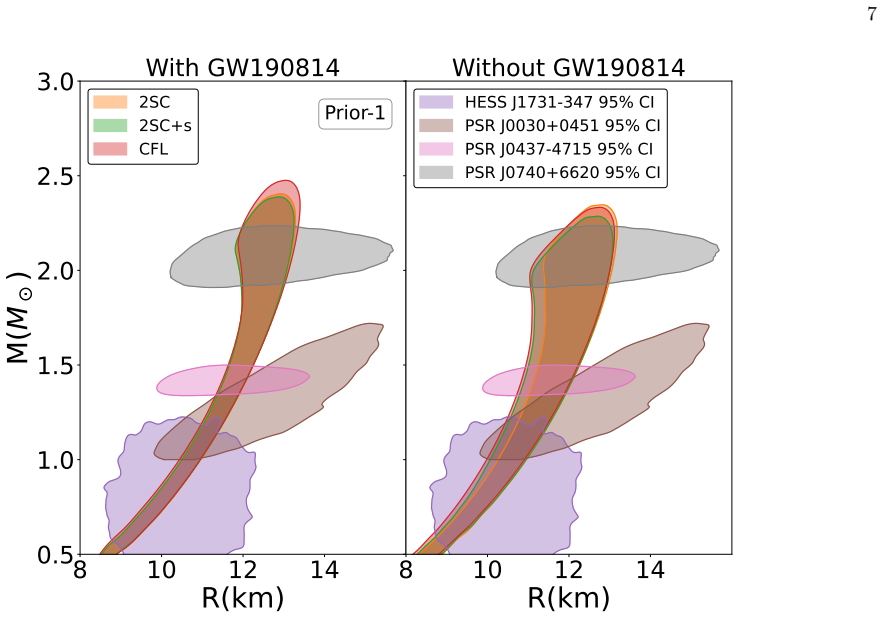
The central claim is that self-bound quark matter, described by an interacting MIT bag equation of state that includes the 2SC, 2SC+s, and CFL color-superconducting phases with perturbative QCD corrections, provides a natural home for the ultra-low-mass compact object HESS J1731-347. Because self-bound quark stars can exist at arbitrarily small masses, their mass-radius curve extends down to the measured $0.77^{+0.20}_{-0.17}\,M_\odot$ and $10.4^{+0.86}_{-0.78}$ km without fine-tuning, whereas gravity-bound neutron stars have a minimum mass. The same posteriors remain consistent with the NICER radii of PSR J0030+0451, PSR J0437-4715, and PSR J0740+6620, and with the GW170817 tidal-deformability bound $\Lambda_{1.4}\le 800$. In the high-mass regime, interpreting the $\sim 2.6\,M_\odot$ secondary of GW190814 as a quark star is found to require extremely stiff equations of state that are accessible only under broad priors; narrower priors favor a softer equation of state consistent with the ordinary pulsar population. Finally, the paper claims that current data constrain the effective bag constant and bulk stiffness tightly but cannot distinguish the three superconducting phases, that the four-parameter model reduces losslessly to two effective parameters, and that if quark stars exist their squared sound speed exceeds the conformal limit $c_s^2>1/3$ at stellar densities.
Load-bearing premise
The load-bearing premise is that HESS J1731-347 really is a compact star of about 0.77 solar masses and 10.4 km radius, as the adopted observational estimate claims; if that estimate is wrong, the paper's distinctive low-mass advantage for quark stars loses its observational anchor, because the other datasets do not reach such low masses.
Editorial extensions
If this is right
- If quark stars exist, HESS J1731-347 is the cleanest single argument for them: the self-bound mass-radius relation reaches $0.77\,M_\odot$ and $10.4$ km without tuning, while hadronic models strain to get that low.
- GW190814 should not be read as evidence for exotic matter either way: the $\sim2.6\,M_\odot$ companion is compatible with a quark star only under broad priors, and under narrow priors the inferred equation of state matches ordinary pulsar masses; the paper also cautions that a postmerger-based bound on the quark-star maximum mass near $2.35\,M_\odot$ assumes a binary quark-star merger and is not u
- The color-superconducting phase structure of quark matter is presently undetectable from masses, radii, and tidal deformabilities; all three phases (2SC, 2SC+s, CFL) fit the same data.
- A two-parameter description — the bag constant plus a stiffness parameter — captures all the information current multimessenger data carry about quark stars, which simplifies future inference.
- Inferred quark-matter sound speeds lie above the conformal limit $c_s^2 = 1/3$ at stellar densities, so non-conformal behavior is statistically favored if self-bound stars exist.
Reading between the lines
- The same logic that makes quark stars fit HESS J1731-347 predicts that other very low-mass compact objects, if they are quark stars, should also be compact; a future detection of a sub-solar-mass object with a large radius or a soft surface would test the self-bound picture directly.
- Because the data cannot distinguish pairing phases, discriminating quark phases will likely require phase-sensitive observables the paper does not model — cooling behavior, neutrino emission, or oscillation properties — rather than further mass-radius measurements.
- A direct Bayesian model comparison between the quark-star and neutron-star families on identical datasets, flagged by the authors as future work, could turn the present consistency argument into a quantitative preference.
Editorial analysis
A structured set of objections, weighed in public.
Referee Report
Summary. The paper presents a Bayesian inference of quark star equations of state within an interacting MIT bag model that includes 2SC, 2SC+s, and CFL color-superconducting phases. Using MCMC sampling, the authors combine NICER mass-radius measurements, the HESS J1731-347 object, the GW170817 tidal deformability bound, a maximum-mass constraint, and (in part of the analysis) the GW190814 secondary mass. They report that quark stars naturally accommodate HESS J1731-347, that the interpretation of GW190814 is strongly prior-dependent, that the effective bag constant is tightly constrained while phase distinctions are not, that a two-parameter reduction of the model is information-preserving, and that the inferred sound speed exceeds the conformal limit at stellar densities.
Significance. If the claims hold, the paper would provide a systematic quark-star-focused Bayesian constraint and a clear prior-sensitivity analysis in a field where prior choices are known to matter. The MCMC implementation, the consistent treatment of three color-superconducting phases, and the explicit computation of posterior mass-radius, tidal, and EOS bands are useful contributions. The two-parameter reduction is a practical simplification if properly validated. However, the headline claim of a distinct advantage for quark stars in the low-mass regime is not established by the analysis as presented: the HESS object is used as an input likelihood rather than as a prediction, and no hadronic model is included for comparison. The reliability of the HESS mass-radius measurement is also contested, so the central observational anchor needs explicit robustness testing.
major comments (4)
- [II.D, Eq. (17); Figs. 1-2] The statement that quark stars "naturally accommodate" HESS J1731-347 is in-sample: the HESS mass-radius posterior enters the likelihood p(M,R|D_HESS) in Eq. (17), so the posterior M-R bands in Figs. 1 and 2 are conditioned on that same object. To support the wording used in the abstract, the authors should provide a posterior predictive check in which HESS is excluded from the fit and the predicted low-mass band is compared with the object, or otherwise quantify the degree to which HESS adds independent support beyond the other datasets.
- [Abstract; Sec. IV] The abstract claims a "distinct advantage" over standard neutron star models, but the paper contains no hadronic EOS posterior, no model comparison, and no Bayes factor. Section IV explicitly defers the Bayesian comparison to future work. The claim should either be backed by a quantitative comparison with hadronic models under the same data and priors, or be softened to a statement that quark stars are consistent with HESS rather than that they have a demonstrated advantage.
- [Table II, entry for HESS J1731-347; Sec. III.A] The low-mass conclusion rests on a single disputed measurement from Doroshenko et al. (2022), whose mass-radius estimate depends on a carbon-atmosphere spectral model and an assumed distance. Since the low-mass regime is the only part of the parameter space that distinguishes quark stars from hadronic stars in this paper, the authors should rerun the analysis with HESS excluded and with alternative mass-radius contours (or shifted distance/atmosphere assumptions) and report whether the claimed low-mass accommodation survives.
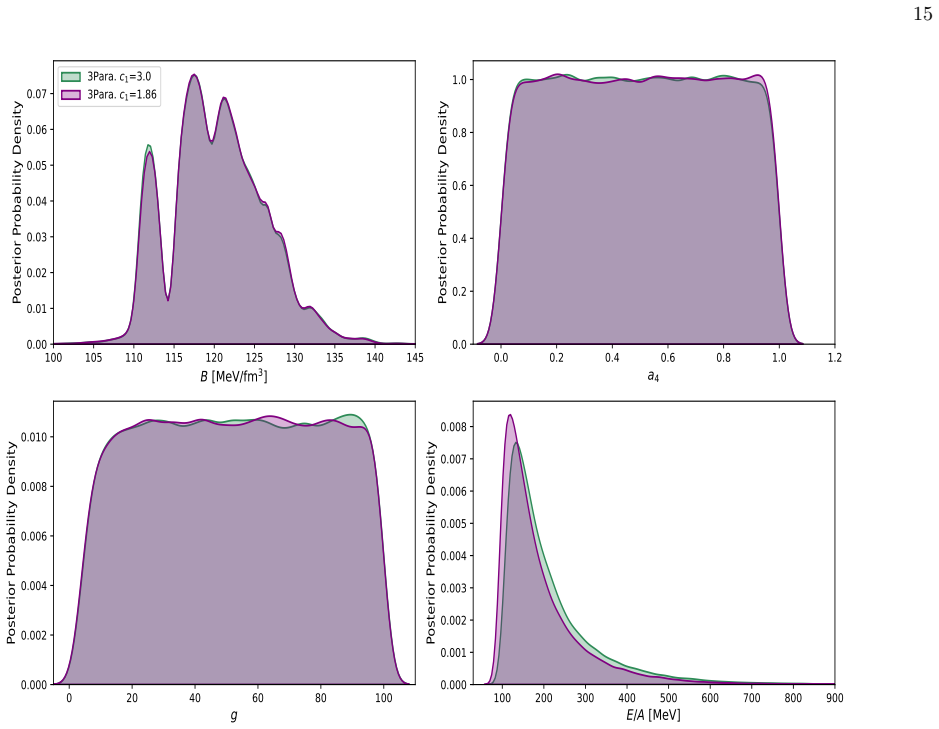
- [III.D, Figs. 9-10] The claim that the two-parameter model is validated "without loss of information" is stronger than what the figures show. Consistency of the B and g posteriors between the three- and four-parameter models does not demonstrate that a4 and other parameters are information-free; it only shows that the marginal posteriors of the retained parameters are similar. A formal comparison (e.g., a Bayes factor, leave-one-out cross-validation, or posterior predictive comparison) is needed to support the information-loss statement, or the wording should be reduced to "without significant change in the inferred macroscopic properties."
minor comments (5)
- [II.D] There is a broken cross-reference in the text: "according to Eq. (??)," which should be fixed to the relevant equation for the prior transformation from the four-parameter to the three-parameter model.
- [II.D and III.D] The prior range for g is stated inconsistently: in Sec. II.D the two-parameter model is described with a prior of 0 to 100, while Sec. III.D says the adopted prior for g is -100 to 100. The authors should clarify the actual prior used and ensure the text, Eq. (17), and Fig. 10 agree.
- [Captions of Figs. 3, 4, 7, 8, 11, and 12] Several figure captions repeat the generic sentence "Posterior probability distribution functions of the radius, tidal deformability corresponding to the quark stars...," which does not match the actual content of those figures (e.g., Fig. 12 shows sound speed, not radius or tidal deformability). Each caption should describe the plotted quantity.
- [Abstract] The sentence "their sound speeds consistently exceeds the conformal limit" contains a subject-verb agreement error; it should read "their sound speeds consistently exceed."
- [Throughout] The pulsar name "PSR 0437-4715" in Table II and the text should be "PSR J0437-4715" for consistency with the cited reference.
Circularity Check
Central HESS claim is an in-sample fit: the HESS posterior is a likelihood term in Eq. (17), and the stability-filter 'redundancy' is argued from a posterior that already enforces the filter.
-
fitted input called prediction
[Abstract; Eq. (17); Sec. III A (Figs. 1 and 2)]
"We find that quark star models exhibit a distinct advantage in naturally accommodating the ultra-low mass object HESS J1731-347, a configuration that is challenging for standard neutron star models. ... p(θ|D,M)∝p(θ|M)×p_filter×p_mass,max×p(M_max|D_GW190814)×p(M,R|D_HESS)×∏ p(M_i,R_i|D_NICER,i)"
The HESS mass-radius posterior enters as a likelihood factor p(M,R|D_HESS) in Eq. (17), so the posterior M-R bands in Figs. 1-2 are conditioned on the HESS measurement. The claim that quark stars 'naturally accommodate' HESS is thus an in-sample consistency statement, not a prediction or an independent advantage: the parameters are constrained by the very datum that is then quoted as support. No HESS-excluded predictive check or hadronic-EOS model comparison is provided to justify 'naturally' or 'distinct advantage.'
-
self definitional
[Sec. II B (two-parameter reduction); Eq. (17) p_filter condition (3)]
"As illustrated by the posterior distribution of the energy per baryon (E/A) in Fig. 9, and considering current neutron star observations, it is particularly interesting to note that under the prior ranges adopted for the four parameters of the quark star EOS model, the resulting E/A of quark matter consistently satisfies the stability condition E/A≤930 MeV. Consequently, this stability condition does not need to be imposed as an additional constraint in our Bayesian analysis."
Condition (3) of p_filter in Eq. (17) already imposes E/A≤930 MeV, so the posterior shown in Fig. 9 satisfies this inequality by construction. Using that filtered posterior to conclude that the stability condition 'does not need to be imposed' is circular; demonstrating redundancy requires an unfiltered posterior or prior-predictive check. The step is used to justify the two-parameter model, though the main astrophysical results come from the four-parameter model.
full rationale
The paper is a standard Bayesian EOS inference: the TOV equations, tidal deformability, and MCMC sampling are independent of the conclusions, and the interacting MIT bag EOS is transparently adopted from Refs. [56,57] (including co-authored prior work), which is not circular. Most reported quantities (radii, maximum mass, parameter constraints) are genuine posterior summaries of the adopted model under the specified likelihood. The main circularity issues are two self-referential presentations. First, the central claim that quark stars 'naturally accommodate' HESS J1731-347 is weakened because p(M,R|D_HESS) is a factor in the posterior (Eq. 17); the agreement is in-sample. The paper does not run a HESS-excluded analysis or compare against a hadronic EOS on the same footing, so the 'distinct advantage' wording exceeds what the derivation shows. Second, the reduction to the two-parameter model is justified by observing that the posterior E/A satisfies E/A≤930, but that constraint was already enforced by p_filter, making the 'redundancy' argument circular. Minor related issues: the Λ_1.4 ≤ 800 filter is imposed in p_filter and later described as 'compatible with current gravitational-wave constraints'; and the sound-speed statement c_s^2>1/3 follows analytically from the adopted Eq. (1) for the positive-λ branch, so it is model-inherent rather than independently inferred. These issues do not invalidate the Bayesian machinery, but they make the strongest claims partially circular.
Assumptions & free parameters
free parameters (5)
- B (effective bag constant) =
Prior-1: 52.5 ± 4.5 MeV/fm^3; Prior-2: 116.6 ± 10.4 MeV/fm^3; two-parameter model: 117.4 ± 6.3 (90% CI)
- Delta (pairing gap) =
Prior-1: 94.2 (+5.8, -73.4) MeV; Prior-2: 920.5 (+79.5, -459.4) MeV (90% CI)
- m_s (strange quark mass) =
Prior-1: 95.6 ± 4.7 MeV; Prior-2: 97.2 ± 6.3 MeV (90% CI)
- a4 (QCD correction coefficient) =
Prior-1: 0.9 ± 0.1; Prior-2: 0.1 (+0.8, -0.1) (90% CI)
- g (dimensionless combination lambda / (2 sqrt(B))) =
median 47.3, 90% CI approximately [15, 80]
assumptions (6)
- domain assumption The interacting MIT bag model free energy (Eq. 4) with parameter sets from Ref. [57] accurately describes cold deconfined quark matter in 2SC, 2SC+s, and CFL phases.
- domain assumption HESS J1731-347 is a compact star with the mass and radius reported in Doroshenko et al. (2022) and listed in Table II.
- ad hoc to paper The filter conditions (thermodynamic stability, causality, E/A <= 930 MeV, udQM nugget stability, Lambda_1.4 <= 800) are appropriate hard cuts rather than likelihoods.
- domain assumption M_max = 1.97 solar masses is a valid minimum maximum-mass constraint.
- domain assumption KDE approximations to the posterior distributions of independent analyses can be used as likelihood functions.
- standard math TOV equations and the quark-star boundary condition at r=R (large surface density) determine the stellar structure.
Cite this review
Pith. "Pith review of Bayesian constraints on quark stars from multi-messenger observations." pith.science (2026). https://pith.science/paper/EDY66NOS
@misc{pith2026250622781,
  author       = {Pith},
  title        = {Pith review of: Bayesian constraints on quark stars from multi-messenger observations},
  year         = {2026},
  howpublished = {\url{https://pith.science/paper/EDY66NOS}},
  note         = {Machine review of arXiv:2506.22781}
}
abstract
We perform a systematic Bayesian analysis of quark star equations of state under current multimessenger constraints, investigating the impact of prior assumptions and extreme-mass observations. Quark matter is modeled within an interacting MIT bag framework that consistently accommodates color-superconducting phases (2SC, 2SC+s, and CFL) and perturbative QCD corrections. We find that quark star models exhibit a distinct advantage in naturally accommodating the ultra-low mass object HESS J1731-347, a configuration that is challenging for standard neutron star models. In the high-mass regime, the interpretation of the secondary component of GW190814 is shown to be strongly prior-dependent: only broad priors allow for the substantial stiffness required to support such a massive object ($\sim$2.6 M$_\odot$), while more restrictive priors favor a softer equation of state consistent with standard pulsar populations. Microscopically, we demonstrate that current data tightly constrain the effective bag constant and the overall stiffness, but cannot distinguish between different color-superconducting phases. Furthermore, we validate a reduction of the model to two effective parameters without loss of information. Our results indicate that if quark stars exist, their sound speeds consistently exceeds the conformal limit ($c_s^2>1/3$) at stellar densities.
Figures


Figures from the paper (9 more)




Forward citations
Cited by 1 Pith paper
-
Can a Slow and Strong Phase Transition in Neutron Stars Relieve Major Compact-Star Observation Tensions?
Slow strong hadron-quark phase transitions allow stable hybrid-star branches that accommodate both high-mass and low-radius observations in two viable patterns from a parameter scan.
Reference graph
Works this paper leans on
-
[1]
J. M. Lattimer and M. Prakash, Science304, 536 (2004)
2004
-
[2]
Haensel, A
P. Haensel, A. Y. Potekhin, and D. G. Yakovlev,Neu- tron Stars 1: Equation of State and Structure(Springer, New York, 2007)
2007
-
[3]
E. R. Most, L. J. Papenfort, V. Dexheimer, M. Hanauske, S. Schramm, H. St¨ ocker, and L. Rez- zolla, Phys. Rev. Lett.122, 061101 (2019)
2019
-
[4]
Bauswein, N.-U
A. Bauswein, N.-U. F. Bastian, D. B. Blaschke, K. Chatziioannou, J. A. Clark, T. Fischer, and M. Oer- tel, Phys. Rev. Lett.122, 061102 (2019)
2019
-
[5]
Annala, T
E. Annala, T. Gorda, A. Kurkela, and J. N¨ attil¨ a, Na- ture Physics16, 907 (2020)
2020
-
[6]
L. R. Weih, M. Hanauske, and L. Rezzolla, Phys. Rev. Lett.124, 171103 (2020)
2020
-
[7]
W.-L. Yuan, B. Gao, Y. Yan, and R. Xu, Phys. Rev. D 112, 023019 (2025)
2025
-
[8]
Annala, T
E. Annala, T. Gorda, J. Hirvonen, O. Komoltsev, A. Kurkela, J. N¨ attil¨ a, and A. Vuorinen, Nat. Com- mun.14, 8451 (2023)
2023
Show all 108 references
-
[9]
Tang, Y.-J
S.-P. Tang, Y.-J. Huang, and Y.-Z. Fan, Phys. Rev. D 112, 083009 (2025)
2025
-
[10]
Witten, Phys
E. Witten, Phys. Rev. D30, 272 (1984)
1984
-
[11]
Farhi and R
E. Farhi and R. L. Jaffe, Phys. Rev. D30, 2379 (1984)
1984
-
[12]
Alcock, E
C. Alcock, E. Farhi, and A. Olinto, Astrophys. J.310, 261 (1986)
1986
-
[13]
A. R. Bodmer, Phys. Rev. D4, 1601 (1971)
1971
-
[14]
Ins-report-336,
H. Terazawa, “Ins-report-336,” (1979)
1979
-
[15]
J. C. Collins and M. J. Perry, Phys. Rev. Lett.34, 1353 (1975)
1975
-
[16]
M. G. Alford, A. Schmitt, K. Rajagopal, and T. Schafer, Rev. Mod. Phys.80, 1455 (2008)
2008
-
[17]
Doroshenko, G
V. Doroshenko, G. P¨ uhlhofer, A. Santangelo, and V. Suleimanov, Astron. Astrophys.593, A8 (2016)
2016
-
[18]
Beznogov and D
M. Beznogov and D. G. Yakovlev, Mon. Not. R. Astron. Soc.492, 1564 (2020)
2020
-
[19]
P. B. Demorest, T. Pennucci, S. M. Ransom, M. S. E. Roberts, and J. W. T. Hessels, Nature467, 1081 (2010)
2010
-
[20]
Antoniadiset al., Science340, 6131 (2013)
J. Antoniadiset al., Science340, 6131 (2013)
2013
-
[21]
H. T. Cromartieet al., Nature Astronomy4, 72 (2020)
2020
-
[22]
M. C. Milleret al., Astrophys. J. Lett.887, L24 (2019)
2019
-
[23]
T. E. Rileyet al., Astrophys. J. Lett.887, L21 (2019)
2019
-
[24]
M. C. Milleret al., Astrophys. J. Lett.918, L28 (2021)
2021
-
[25]
T. E. Rileyet al., Astrophys. J. Lett.918, L27 (2021)
2021
-
[26]
B. P. Abbottet al., Phys. Rev. Lett.119, 161101 (2017)
2017
-
[27]
B. P. Abbottet al., Phys. Rev. Lett.121, 161101 (2018)
2018
-
[28]
Abbottet al., Astrophys
R. Abbottet al., Astrophys. J. Lett.896, L44 (2020). 14 40 60 80 100 120 140 160 B [MeV/fm3] 0.00 0.02 0.04 0.06PDF 2SC w/o GW190814 2SC+s w/o GW190814 CFL w/o GW190814 2SC with GW190814 2SC+s with GW190814 CFL with GW190814 0.0 0.2 0.4 0.6 0.8 1.0 a4 0.0 0.2 0.4 0.6 0.8 1.0 1...
2020
-
[29]
A. W. Steiner, J. M. Lattimer, and E. F. Brown, As- trophys. J.722, 33 (2010)
2010
-
[30]
A. W. Steiner, J. M. Lattimer, and E. F. Brown, As- trophys. J.774, 17 (2013)
2013
-
[31]
S. De, D. Finstad, J. M. Lattimer, D. A. Brown, E. Berger, and C. M. Biwer, Phys. Rev. Lett.121, 091102 (2018)
2018
-
[32]
Xie and B.-A
W.-J. Xie and B.-A. Li, Astrophys. J.883, 174 (2019)
2019
-
[33]
Xie, Z.-W
W.-J. Xie, Z.-W. Ma, and J.-H. Guo, Nucl. Sci. Tech. 34, 91 (2023)
2023
-
[34]
Xie, B.-A
W.-J. Xie, B.-A. Li, and N.-B. Zhang, Phys. Rev. D 110, 043025 (2024)
2024
-
[35]
Lattimer and A
J. Lattimer and A. Steiner, Eur. Phys. J. A50, 40 (2014)
2014
-
[36]
Xie and B.-A
W.-J. Xie and B.-A. Li, Astrophys. J.899, 4 (2020)
2020
-
[37]
Raaijmakerset al., Astrophys
G. Raaijmakerset al., Astrophys. J. Lett.918, L29 (2021)
2021
-
[38]
Thus, this is not a universal bound considering two-family scenario where the binary is a massive quark star and a less massive neutron star
Note that recently, analyses on postmerger evolution of GW170817 indicates an upper bound on maximum mass of quark stars around 2.35M⊙ [67], which however assumes a binary quark star merger. Thus, this is not a universal bound considering two-family scenario where the binary i...
-
[39]
E. S. Fraga, A. Kurkela, and A. Vuorinen, Astrophys. J.781, L25 (2014)
2014
-
[40]
Kurkela, E
A. Kurkela, E. S. Fraga, J. Schaffner-Bielich, and A. Vuorinen, Astrophys. J.789, 127 (2014)
2014
-
[41]
J. F. Xu, G. X. Peng, F. Liu, D.-F. Hou, and L.-W. Chen, Phys. Rev. D92, 025025 (2015)
2015
-
[42]
Xia and S.-G
C.-J. Xia and S.-G. Zhou, Nucl. Phys. B916, 669 (2017)
2017
-
[43]
C.-J. Xia, T. Maruyama, N. Yasutake, and T. Tatsumi, Phys. Rev. D99, 103017 (2019)
2019
-
[44]
Holdom, J
B. Holdom, J. Ren, and C. Zhang, Phys. Rev. Lett. 120, 222001 (2018)
2018
-
[45]
E.-P. Zhou, X. Zhou, and A. Li, Phys. Rev. D97, 083015 (2018)
2018
-
[46]
Miao, J.-L
Z. Miao, J.-L. Jiang, A. Li, and L.-W. Chen, Astrophys. J.917, L22 (2021)
2021
-
[47]
C. D. Roberts and A. G. Williams, Prog. Part. Nucl. Phys.33, 477 (1994)
1994
-
[48]
Alkofer and L
R. Alkofer and L. von Smekal, Phys. Rep.353, 281 (2001)
2001
-
[49]
G. X. Peng, A. Li, and U. Lombardo, Phys. Rev. C77, 065807 (2008)
2008
-
[50]
C. J. Xia, G. X. Peng, S. W. Chen, Z. Y. Lu, and J. F. Xu, Phys. Rev. D89, 105027 (2014)
2014
-
[51]
R. D. Pisarski, Nucl. Phys. A498, 423 (1989)
1989
-
[52]
Schertler, C
K. Schertler, C. Greiner, and M. H. Thoma, J. Phys. G23, 2051 (1997)
1997
-
[53]
Schertler, C
K. Schertler, C. Greiner, and M. Thoma, Nucl. Phys. A616, 659 (1997)
1997
-
[54]
Buballa, Phys
M. Buballa, Phys. Rep.407, 205 (2005)
2005
-
[55]
Gholami, I
H. Gholami, I. A. Rather, M. Hofmann, M. Buballa, and J. Schaffner-Bielich, Phys. Rev. D111, 103034 15 100 105 110 115 120 125 130 135 140 145 B [MeV/fm3] 0.00 0.01 0.02 0.03 0.04 0.05 0.06 0.07Posterior Probability Density 3Para. c1=3.0 3Para. c1=1.86 0.0 0.2 0.4 0.6 0.8 1.0 ...
2025
-
[56]
J. P. Pereira, C. V. Flores, and G. Lugones, Astrophys. J.860, 12 (2018)
2018
-
[57]
Zhang and R
C. Zhang and R. B. Mann, Phys. Rev. D103, 063018 (2021)
2021
-
[58]
E. S. Fraga, R. D. Pisarski, and J. Schaffner-Bielich, Phys. Rev. D63, 121702 (2001)
2001
-
[59]
Alford, M
M. Alford, M. Braby, M. Paris, and S. Reddy, Astro- phys. J.629, 969 (2005)
2005
-
[60]
Bhattacharyya, I
S. Bhattacharyya, I. Bombaci, D. Logoteta, and A. V. Thampan, Mon. Not. R. Astron. Soc.457, 3101 (2016)
2016
-
[61]
Li, Z.-Y
A. Li, Z.-Y. Zhu, and X. Zhou, Astrophys. J.844, 41 (2017)
2017
-
[62]
Particle Data Group, Chin. Phys. C38, 090001 (2014)
2014
- [63]
-
[64]
Zhang, M
C. Zhang, M. Gammon, and R. B. Mann, Phys. Rev. D104, 123007 (2021), arXiv:2108.13972 [astro-ph.HE]
2021 arXiv
-
[65]
Blaschke, U
D. Blaschke, U. Shukla, O. Ivanytskyi, and S. Liebing, Phys. Rev. D107, 063034 (2023), arXiv:2212.14856 [nucl-th]
2023 arXiv
-
[66]
P. S. Koliogiannis, G. A. Tsalis, C. P. Panos, and C. C. Moustakidis, Phys. Rev. D107, 044069 (2023), arXiv:2206.12138 [gr-qc]
2023 arXiv
-
[67]
Y. Zhou, C. Zhang, J. Zhao, K. Kiuchi, S. Fu- jibayashi, and E. Zhou, Phys. Rev. D110, 103012 (2024), arXiv:2407.08544 [astro-ph.HE]
2024 arXiv
-
[68]
Zhang and J
C. Zhang and J. Ren, Phys. Rev. D108, 063012 (2023), arXiv:2211.12043 [astro-ph.HE]
2023 arXiv
-
[69]
Z. Wang, Y. Gao, D. Liang, J. Zhao, and L. Shao, J. Cosmol. Astropart. P.2024, 038 (2024)
2024
-
[70]
Banerjee, A
A. Banerjee, A. Pradhan, ˙I. Sakallı, and A. Dixit, Clas- sical and Quantum Gravity42, 025008 (2024)
2024
-
[71]
Gammon, S
M. Gammon, S. Rourke, and R. B. Mann, Phys. Rev. D109, 024026 (2024), arXiv:2309.00703 [gr-qc]
2024 arXiv
-
[72]
Gammon, R
M. Gammon, R. B. Mann, and S. Rourke, Physical Review D111, 043034 (2025)
2025
- [73]
-
[74]
J. M. Z. Pretel, T. Tangphati, A. Banerjee, and A. Pradhan, Phys. Lett. B848, 138375 (2024), arXiv:2311.18770 [gr-qc]
2024 arXiv
-
[75]
P. T. Oikonomou and C. C. Moustakidis, Phys. Rev. D 108, 063010 (2023), arXiv:2304.12209 [astro-ph.HE]
2023 arXiv
-
[76]
J. M. Z. Pretel and C. Zhang, JCAP10, 032 (2024), arXiv:2401.12519 [nucl-th]
2024 arXiv
-
[77]
Weissenborn, I
S. Weissenborn, I. Sagert, G. Pagliara, M. Hempel, and J. Schaffner-Bielich, Astrophys. J.740, L14 (2011)
2011
-
[78]
Witten, Phys
E. Witten, Phys. Rev. D30, 272 (1984). 16 B [MeV/fm3] = 117.4+6.3 6.3 100 120 140 B [MeV/fm3] 0 40 80 g 0 40 80 g g = 47.3+32.3 32.3 FIG. 10. (Color online) Posterior probability distribution functions of the two parameters for the two-parameter QS model and their correlations...
1984
-
[79]
Terazawa, J
H. Terazawa, J. Phys. Soc. Jpn.58, 3555 (1989)
1989
-
[80]
R. C. Tolman, Proc. Nat. Acad. Sci.20, 169 (1934)
1934
-
[81]
J. R. Oppenheimer and G. M. Volkoff, Phys. Rev.55, 374 (1939)
1939
-
[82]
F. J. Fattoyev, J. Carvajal, W. G. Newton, and B.-A. Li, Phys. Rev. C87, 015806 (2013)
2013
-
[83]
Malik, N
T. Malik, N. Alam, M. Fortin, C. Providˆ encia, B. K. Agrawal, T. K. Jha, B. Kumar, and S. K. Patra, Phys. Rev. C98, 035804 (2018)
2018
-
[84]
Hinderer, B
T. Hinderer, B. D. Lackey, R. N. Lang, and J. S. Read, Phys. Rev. D81, 123016 (2010)
2010
-
[85]
Hinderer, Astrophys
T. Hinderer, Astrophys. J.677, 1216 (2008)
2008
-
[86]
Damour and A
T. Damour and A. Nagar, Phys. Rev. D80, 084035 (2009)
2009
-
[87]
Postnikov, M
S. Postnikov, M. Prakash, and J. M. Lattimer, Phys. Rev. D82, 024016 (2010)
2010
-
[88]
M. G. Alford, A. Schmitt, K. Rajagopal, and T. Sch¨ afer, Rev. Mod. Phys.80, 1455 (2008)
2008
-
[89]
X. Y. Lai and R. X. Xu, Mon. Not. Roy. Astron. Soc. 398, L31 (2009)
2009
-
[90]
T. E. Riley, A. L. Watts, S. Bogdanov, P. S. Ray, R. M. Ludlam, S. Guillot, Z. Arzoumanian, C. L. Baker, A. V. Bilous, D. Chakrabarty, K. C. Gendreau, A. K. Harding, W. C. G. Ho, J. M. Lattimer, S. M. Morsink, and T. E. Strohmayer, Astrophys. J.887, L21 (2019)
2019
-
[91]
Choudhury, T
D. Choudhury, T. Salmi, S. Vinciguerra, T. E. Riley, Y. Kini, A. L. Watts, B. Dorsman, S. Bogdanov, S. Guil- lot, P. S. Ray, D. J. Reardon, R. A. Remillard, A. V. Bilous, D. Huppenkothen, J. M. Lattimer, N. Ruther- ford, Z. Arzoumanian, K. C. Gendreau, S. M. Morsink, and W. C....
2024
-
[92]
T. E. Riley, A. L. Watts, P. S. Ray, S. Bogdanov, S. Guillot, S. M. Morsink, A. V. Bilous, Z. Arzou- manian, D. Choudhury, J. S. Deneva, K. C. Gen- dreau, A. K. Harding, W. C. G. Ho, J. M. Lattimer, M. Loewenstein, R. M. Ludlam, C. B. Markwardt, T. Okajima, C. Prescod-Weinstei...
2021
-
[93]
Doroshenko, V
V. Doroshenko, V. Suleimanov, G. P¨ uhlhofer, and A. Santangelo, Nat. Astron.6, 1444 (2022)
2022
-
[94]
Abbott, T
R. Abbott, T. D. Abbott, S. Abraham, F. Acernese, and et al., Astrophys. J.896, L44 (2020)
2020
-
[95]
M. C. Miller, F. K. Lamb, A. J. Dittmann, S. Bog- danov, Z. Arzoumanian, K. C. Gendreau, S. Guillot, A. K. Harding, W. C. G. Ho, J. M. Lattimer, R. M. Ludlam, S. Mahmoodifar, S. M. Morsink, P. S. Ray, T. E. Strohmayer, K. S. Wood, T. Enoto, R. Foster, T. Okajima, G. Prigozhin,...
2019
-
[96]
M. C. Miller, F. K. Lamb, A. J. Dittmann, S. Bogdanov, Z. Arzoumanian, K. C. Gendreau, S. Guillot, W. C. G. Ho, J. M. Lattimer, M. Loewenstein, S. M. Morsink, P. S. Ray, M. T. Wolff, C. L. Baker, T. Cazeau, S. Man- thripragada, C. B. Markwardt, T. Okajima, S. Pollard, I. Cogna...
2021
-
[97]
Kurkela, K
A. Kurkela, K. Rajagopal, and R. Steinhorst, Phys. Rev. Lett.132, 262701 (2024)
2024
-
[98]
Bedaque and A
P. Bedaque and A. W. Steiner, Phys. Rev. Lett.114, 031103 (2015)
2015
-
[99]
Alsing, H
J. Alsing, H. O. Silva, and E. Berti, Mon. Not. Roy. Astron. Soc.478, 1377 (2018), arXiv:1709.07889 [astro- ph.HE]
2018 arXiv
-
[100]
Cai, B.-A
B.-J. Cai, B.-A. Li, and Z. Zhang, Phys. Rev. D108, 103041 (2023)
2023
-
[101]
I. Tews, J. Margueron, and S. Reddy, Phys. Rev. C98, 045804 (2018)
2018
-
[102]
C.-J. Xia, Z. Zhu, X. zhou, and A. Li, Chin. Phys. C 45, 055104 (2021)
2021
-
[103]
A. Li, Z. Miao, S. Han, and B. Zhang, Astrophys. J. 913, 27 (2021)
2021
-
[104]
Landry, R
P. Landry, R. Essick, and K. Chatziioannou, Phys. Rev. D101, 123007 (2020)
2020
- [105]
-
[106]
Z. Yang, T. Zeng, Y. Yan, W.-L. Yuan, C. Zhang, and E. Zhou, (2025), arXiv:2507.00776 [astro-ph.HE]
2025
-
[107]
Zhang, J
C. Zhang, J. M. Z. Pretel, and R. Xu, (2025), arXiv:2507.01371 [astro-ph.HE]. 17 250 500 750 1000 1250 1500 1750 2000 Energy density (MeV/fm3) 0 100 200 300 400 500 600 700Pressure P (MeV/fm3) Prior-1 with GW190814 2SC 2SC+s CFL 2SC 2SC+s CFL 250 500 750 1000 1250 1500 1750 20...
2025
-
[800]
In this analysis, we adopt a value ofM max = 1.97M⊙
The termp mass,max ensures that the EOS is suffi- ciently stiff to support the observational maximum mass of neutron stars,M max. In this analysis, we adopt a value ofM max = 1.97M⊙. To simulate the posterior probabil- ity density function (PDF) of the model parameters, we emp...
Reviewed August 6, 2026 · model on record in the stance chip above.
Discussion (0). Sign in to comment.