REVIEW 5 major objections 5 minor 47 references
ReasonBridge: Efficient Reasoning Transfer from Closed to Open-Source Language Models
T0 review · 5 major / 5 minor · reviewed 2026-08-06 · deepseek-v4-flash
Pith's one-line read ReasonBridge claims 1,000 curated reasoning traces and a 0.3%-parameter adapter can lift open-source models by up to 23% on benchmarks.
desk verdict A plausible s1-style extension with a genuinely new adapter hierarchy, but the headline numbers are unverifiable without data release and deduplication analysis. read the letter →
The pith
A machine-rendered reading of the paper's core claim, the machinery that carries it, and where it could break.
The reading
What carries the argument
The load-bearing mechanism is the combination of Reason1K and the three-level abstraction hierarchy. Reason1K is a dataset of 1,000 problem–reasoning–solution triplets filtered from 58,426 problems so that both a 7B and a 32B open model fail to solve them, with uniform sampling across subject categories. The hierarchy splits a reasoning trace into strategic, tactical, and operational components; each component gets its own loss term and its own adapter type (strategic adapters in early layers, tactical in middle layers, operational in later layers). Test-time scaling is handled by a guided inference intervention loop that detects whether the model is terminating early, uncertain, or unverified, and injects a short prompt such as "Wait, let me think further" or "Let me verify this solution".
What would settle it
A contamination scan of the 58,426-problem source pool and the 1,000 Reason1K traces against the 30 problems in AIME24, the 500 in MATH500, and the 198 in GPQA Diamond would settle the central claim: any near-duplicate overlap, found by paraphrase or high n-gram similarity, would require recomputing the benchmark gains on a clean held-out set. A second check would be to rerun AIME24 with several decoding seeds, since on a 30-problem test the reported small point gaps may be within noise.
Extended reading notes
Core claim
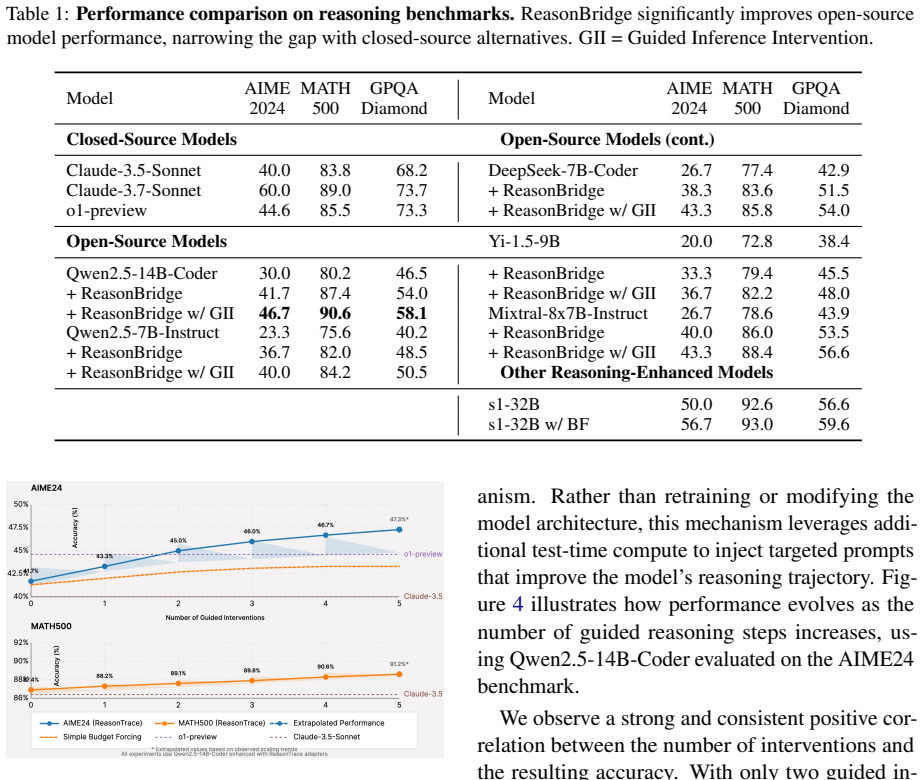
The paper's central claim is that reasoning transfers hierarchically: a model improves most when it learns strategic problem decomposition, tactical method selection, and operational calculation as separate levels, rather than simply imitating final answers. ReasonBridge encodes this in a training objective with separate losses for each level and in adapters placed at different depths of the transformer. The empirical assertion is that this recipe, applied to a 1,000-trace dataset, lifts five open models across three benchmarks, and that the best model with guided inference intervention passes a leading closed-source model on MATH500 and matches it on AIME24. The paper also claims that the same mechanism scales at test time: more guided reasoning steps yield monotonically better accuracy without retraining.
Load-bearing premise
The load-bearing premise is that the 1,000 training traces do not contain the evaluation problems or near-duplicates: the paper never checks whether its 58,426-problem source pool overlaps with AIME24, MATH500, or GPQA Diamond, so the reported gains must be read as transferred reasoning only if contamination is absent.
Editorial extensions
If this is right
- Reasoning enhancement for open models could become a data and compute bargain: 1,000 curated examples and 0.3% trainable parameters replace large-scale fine-tuning runs.
- The three-level adapter design identifies strategic reasoning as the highest-value component; removing strategic adapters costs 6.7 points on AIME24, more than removing tactical or operational adapters.
- Inference-time compute becomes an adjustable knob: adding a few guided interventions improves accuracy without retraining, which is useful for hard problems where extra latency is acceptable.
- The approach generalizes beyond the training domains, with reported gains on logic, code, and STEM tasks outside the three primary benchmarks.
Reading between the lines
- A check the paper leaves implicit: the 58,426-problem source pool is never deduplicated against AIME24, MATH500, or GPQA Diamond, so the reported gains could include memorization until a contamination check rules it out.
- The 30-problem size of AIME24 means differences of a few points can be a single question; the paper reports no variance, so small gap-closing claims on that benchmark should be treated as provisional.
- If contamination is absent, the authors' future-work suggestion of self-improving loops looks promising: an enhanced open model could generate its own traces, breaking the dependency on closed-source teachers.
- One could test whether guided interventions transfer to domains fully absent from training, which would separate better arithmetic and verification habits from better general reasoning.
Editorial analysis
A structured set of objections, weighed in public.
Referee Report
Summary. The paper introduces ReasonBridge, a pipeline that distills reasoning from a closed-source teacher (Gemini Flash Thinking) into open-source language models. It constructs Reason1K, a dataset of 1,000 reasoning traces curated from a 58,426-problem pool via quality, difficulty, and diversity filters, then trains hierarchical bottleneck adapters (strategic, tactical, and operational losses, approximately 0.3% trainable parameters) and applies test-time 'guided inference interventions.' Experiments on AIME24, MATH500, and GPQA Diamond across five open-source models report large gains, with the best Qwen2.5-14B-Coder configuration reaching 46.7%, 90.6%, and 58.1%, respectively; ablations attribute the gains to individual dataset, architecture, and intervention components.
Significance. If the reported gains are real and not due to training/evaluation overlap, the paper would make a valuable contribution: sample-efficient reasoning transfer with only 1,000 traces, parameter-efficient adapters, and a test-time scaling mechanism that goes beyond simple budget forcing. The paper includes multi-model comparisons, ablations for data selection and architecture, and reports training compute costs, all of which are useful features. However, the central empirical claim currently rests on unreleased data and code and on an AIME24 comparison where the headline difference is one problem out of 30. The evidence is promising but not yet sufficient to establish the claimed 'narrowing of the gap' without additional transparency and statistical grounding.
major comments (5)
- [§3.1.1, §4.1] The 58,426-problem source pool is said to be 'gathered from 17 diverse sources,' but the sources are never enumerated and no deduplication against AIME24, MATH500, or GPQA Diamond is reported anywhere in Section 4.1's evaluation protocol. Because Reason1K contains full teacher-generated traces, even a few overlapping AIME24 problems would change the 16.7-point AIME gain substantially; on a 30-problem set, three leaked items account for 10 percentage points. The authors must release the Reason1K items or at least provide a list of source documents and the exact deduplication procedure before the headline numbers can be distinguished from memorization.
- [§4.3, Table 1] Table 1 reports AIME24 on 30 problems, and the claimed 'outperforms o1-preview' is 46.7% versus 44.6%, which is 14 versus 13 correct problems. No confidence intervals, standard errors, multiple seeds, or per-problem breakdowns are provided. With binary pass/fail outcomes and n=30, the approximate 95% confidence interval for 46.7% is roughly ±18 percentage points, so this comparison is statistically indistinguishable; the paper should report intervals or otherwise temper the claim.
- [§3.2.3, Eqs. (4)–(6)] The hierarchical losses decompose each trace into r_strat, r_tact, and r_op, but Section 3.2.1 gives only informal descriptions of the three abstraction levels. No algorithm, prompt, annotation protocol, or automatic procedure is provided for segmenting a natural-language reasoning trace into these three components. The training objective therefore cannot be implemented from the paper, and the reported superiority of strategic over tactical over operational adapters (Section 4.5.2, Table 2) is not independently checkable; specify the decomposition mechanism or provide the annotated traces.
- [§3.3.2, Algorithm 1] The adaptive intervention policy depends on DetectReasoningState(g) and on vague phrase-based cues such as 'Presence of phrases indicating uncertainty,' but the paper gives no concrete implementation of the detector (e.g., a classifier, rule set, thresholds, or model) nor how 'partial,' 'uncertain,' and 'unverified' are operationalized. Because the test-time scaling claim in Section 4.4 is the main distinction from s1's budget forcing, this is a load-bearing detail; please provide the detector implementation or an explicit deterministic rule.
- [§4.2, Appendix C.1] No code, trained adapters, dataset, or evaluation scripts are released. Given that the central claims are empirical and rely on a custom dataset and custom intervention logic, the absence of release prevents reproduction and further scrutiny. A release (or at least a detailed reproducibility package) should accompany the final version.
minor comments (5)
- [Appendix A] Appendix A is an empty placeholder ('A Example Appendix'); either fill it or remove it before publication.
- [§3.3.1] There is a stray 'm' in the phrase '(Muennighoff et al., 2025)m'; the citation should be formatted consistently.
- [References] Several reference entries need cleanup: the Yi model entry begins 'AI, :, Alex Young...' and the AIME reference is listed as 'of America, 2024' with a placeholder journal name.
- [Figure 5] The caption in Figure 5 refers to the 'ReasonTrace-enhanced model' while the paper's method is called ReasonBridge; the naming should be consistent.
- [Abstract, §5] The abstract and conclusion state 'up to 23%' improvement, but Table 1's largest relative gain on AIME24 is over 55%; please clarify whether the 23% figure is an average, a minimum, or an absolute-difference claim.
Circularity Check
No significant circularity: ReasonBridge's improvements are an empirical train/eval result; the only self-citation (Zhong 2025) is in Related Work and is not load-bearing.
full rationale
ReasonBridge is an empirical distillation and adapter-tuning paper; there is no formal derivation whose conclusion is assumed as an input. The headline gains (Table 1: AIME24 46.7%, MATH500 90.6%, GPQA 58.1% for Qwen2.5-14B-Coder with GII) come from evaluating an adapter trained on Reason1K against standard external benchmarks, so the central claim is not definitionally forced by the training objective. The difficulty filter in Section 3.1.2 is a data-selection heuristic based on Qwen2.5-7B/32B failures; it does not make the evaluation score a fitted parameter. The guided inference intervention is explicitly positioned as an extension of s1's budget forcing (external work), and the hierarchical adapter loss terms are separate output losses, not constructed from benchmark accuracies. The self-citation to Zhong (2025) in Related Work only supports the general data-efficiency observation and is accompanied by external citations (s1, LIMA); it is not load-bearing. The 'Anonymous (2026)' Repairity reference is a related-work pointer. The absence of a reported deduplication between the 58,426-problem pool and AIME24/MATH500/GPQA is a genuine contamination/overfitting risk, but contamination is a data-provenance threat, not a circular derivation: no equation in the paper identifies the evaluation metric with a training input. Therefore the paper should not be scored as circular; the contamination concern belongs in correctness risk.
Assumptions & free parameters
free parameters (5)
- Loss weights lambda_1..lambda_4 =
1.0, 0.5, 0.3, 0.2
- Adapter bottleneck dimension r =
64
- Number of guided interventions used in Table 1 =
Not stated; Figure 4 shows 2 and 4
- Learning rate =
5e-5
- Dataset size =
1,000
assumptions (4)
- domain assumption Reasoning can be separated into strategic, tactical, and operational levels, and training to predict each level transfers better than end-to-end generation.
- domain assumption The traces produced by Gemini Flash Thinking are correct and representative enough to serve as the reasoning teacher.
- domain assumption The 58,426-problem source pool does not overlap with AIME24, MATH500, or GPQA Diamond.
- domain assumption AIME24's 30 problems give stable enough estimates for percentage-point comparisons.
invented entities (2)
-
Reasoning state detection function (DetectReasoningState)
-
Strategic, tactical, and operational adapter types
Cite this review
Pith. "Pith review of ReasonBridge: Efficient Reasoning Transfer from Closed to Open-Source Language Models." pith.science (2026). https://pith.science/paper/SP265W5C
@misc{pith2026250622865,
  author       = {Pith},
  title        = {Pith review of: ReasonBridge: Efficient Reasoning Transfer from Closed to Open-Source Language Models},
  year         = {2026},
  howpublished = {\url{https://pith.science/paper/SP265W5C}},
  note         = {Machine review of arXiv:2506.22865}
}
read the original abstract
Recent advancements in Large Language Models (LLMs) have revealed a significant performance gap between closed-source and open-source models, particularly in tasks requiring complex reasoning and precise instruction following. This paper introduces ReasonBridge, a methodology that efficiently transfers reasoning capabilities from powerful closed-source to open-source models through a novel hierarchical knowledge distillation framework. We develop a tailored dataset Reason1K with only 1,000 carefully curated reasoning traces emphasizing difficulty, diversity, and quality. These traces are filtered from across multiple domains using a structured multi-criteria selection algorithm. Our transfer learning approach incorporates: (1) a hierarchical distillation process capturing both strategic abstraction and tactical implementation patterns, (2) a sparse reasoning-focused adapter architecture requiring only 0.3% additional trainable parameters, and (3) a test-time compute scaling mechanism using guided inference interventions. Comprehensive evaluations demonstrate that ReasonBridge improves reasoning capabilities in open-source models by up to 23% on benchmark tasks, significantly narrowing the gap with closed-source models. Notably, the enhanced Qwen2.5-14B outperforms Claude-Sonnet3.5 on MATH500 and matches its performance on competition-level AIME problems. Our methodology generalizes effectively across diverse reasoning domains and model architectures, establishing a sample-efficient approach to reasoning enhancement for instruction following.
Figures


Figures from the paper (2 more)

Reference graph
Works this paper leans on
-
[1]
online" 'onlinestring :=
ENTRY address archivePrefix author booktitle chapter edition editor eid eprint eprinttype howpublished institution journal key month note number organization pages publisher school series title type volume year doi pubmed url lastchecked label extra.label sort.label short.list INTEGERS output.state before.all mid.sentence after.sentence after.block STRING...
-
[2]
write newline
" write newline "" before.all 'output.state := FUNCTION n.dashify 't := "" t empty not t #1 #1 substring "-" = t #1 #2 substring "--" = not "--" * t #2 global.max substring 't := t #1 #1 substring "-" = "-" * t #2 global.max substring 't := while if t #1 #1 substring * t #2 global.max substring 't := if while FUNCTION word.in bbl.in capitalize " " * FUNCT...
-
[3]
01. AI, :, Alex Young, Bei Chen, Chao Li, Chengen Huang, Ge Zhang, Guanwei Zhang, Guoyin Wang, Heng Li, Jiangcheng Zhu, Jianqun Chen, Jing Chang, Kaidong Yu, Peng Liu, Qiang Liu, Shawn Yue, Senbin Yang, Shiming Yang, and 14 others. 2025. https://arxiv.org/abs/2403.04652 Yi: Open foundation models by 01.ai . Preprint, arXiv:2403.04652
arXiv 2025
-
[4]
Anonymous. 2026. Boosting open-source llms for program repair via reasoning transfer and llm-guided reinforcement learning. Proceedings of the 48th International Conference on Software Engineering
work page 2026
-
[5]
Anthropic. 2023. Claude: A new ai assistant from anthropic. Retrieved from https://www.anthropic.com/claude
work page 2023
-
[6]
Jiang, Jia Deng, Stella Biderman, and Sean Welleck
Zhangir Azerbayev, Hailey Schoelkopf, Keiran Paster, Marco Dos Santos, Stephen McAleer, Albert Q. Jiang, Jia Deng, Stella Biderman, and Sean Welleck. 2024. https://arxiv.org/abs/2310.10631 Llemma: An open language model for mathematics . Preprint, arXiv:2310.10631
arXiv 2024
-
[7]
Kartikeya Bhardwaj, Nilesh Prasad Pandey, Sweta Priyadarshi, Viswanath Ganapathy, Shreya Kadambi, Rafael Esteves, Shubhankar Borse, Paul Whatmough, Risheek Garrepalli, Mart Van Baalen, Harris Teague, and Markus Nagel. 2025. https://arxiv.org/abs/2406.13175 Sparse high rank adapters . Preprint, arXiv:2406.13175
work page Pith review arXiv 2025
-
[8]
Stella Biderman, Hailey Schoelkopf, Lintang Sutawika, Leo Gao, Jonathan Tow, Baber Abbasi, Alham Fikri Aji, Pawan Sasanka Ammanamanchi, Sidney Black, Jordan Clive, Anthony DiPofi, Julen Etxaniz, Benjamin Fattori, Jessica Zosa Forde, Charles Foster, Jeffrey Hsu, Mimansa Jaiswal, Wilson Y. Lee, Haonan Li, and 11 others. 2024. https://arxiv.org/abs/2405.1478...
arXiv 2024
Show all 47 references
-
[9]
Liang Chen, Yang Deng, Yatao Bian, Zeyu Qin, Bingzhe Wu, Tat-Seng Chua, and Kam-Fai Wong. 2023. Beyond factuality: A comprehensive evaluation of large language models as knowledge generators. arXiv preprint arXiv:2310.07289
2023 arXiv
-
[10]
Lingjiao Chen, Jared Quincy Davis, Boris Hanin, Peter Bailis, Ion Stoica, Matei Zaharia, and James Zou. 2024. https://arxiv.org/abs/2403.02419 Are more llm calls all you need? towards scaling laws of compound inference systems . Preprint, arXiv:2403.02419
2024 arXiv
-
[11]
Mark Chen, Jerry Tworek, Heewoo Jun, Qiming Yuan, Henrique Ponde de Oliveira Pinto, Jared Kaplan, Harri Edwards, Yuri Burda, and et al. 2021. https://arxiv.org/abs/2107.03374 Evaluating large language models trained on code . arXiv preprint arXiv:2107.03374
2021 arXiv
-
[12]
Karl Cobbe, Vineet Kosaraju, Mohammad Bavarian, Jacob Hilton, Reiichiro Nakano, Christopher Hesse, and John Schulman. 2021. Training verifiers to solve math word problems. arXiv preprint arXiv:2110.14168
2021 arXiv
-
[13]
Wenliang Dai, Junnan Li, Dongxu Li, Anthony Meng Huat Tiong, Junqi Zhao, Weisheng Wang, Boyang Li, Pascale Fung, and Steven Hoi. 2023. https://arxiv.org/abs/2305.06500 Instructblip: Towards general-purpose vision-language models with instruction tuning . Preprint, arXiv:2305.06500
2023 arXiv
-
[14]
DeepSeek-AI. 2025. https://arxiv.org/abs/2501.12948 Deepseek-r1: Incentivizing reasoning capability in llms via reinforcement learning . Preprint, arXiv:2501.12948
2025 arXiv
-
[15]
Leo Gao, Jonathan Tow, Baber Abbasi, Stella Biderman, Sid Black, Anthony DiPofi, Charles Foster, Laurence Golding, Jeffrey Hsu, Alain Le Noac'h, Haonan Li, Kyle McDonell, Niklas Muennighoff, Chris Ociepa, Jason Phang, Laria Reynolds, Hailey Schoelkopf, Aviya Skowron, Lintang S...
2024 doi
-
[16]
Daya Guo, Qihao Zhu, Dejian Yang, Zhenda Xie, Kai Dong, Wentao Zhang, Guanting Chen, Xiao Bi, Y. Wu, Y. K. Li, Fuli Luo, Yingfei Xiong, and Wenfeng Liang. 2024. https://arxiv.org/abs/2401.14196 Deepseek-coder: When the large language model meets programming -- the rise of code...
2024 arXiv
-
[17]
Dan Hendrycks, Collin Burns, Steven Basart, Andy Zou, Mantas Mazeika, Dawn Song, and Jacob Steinhardt. 2020. Measuring massive multitask language understanding. arXiv preprint arXiv:2009.03300
2020 arXiv
-
[18]
Dan Hendrycks, Collin Burns, Saurav Kadavath, Akul Arora, Steven Basart, Eric Tang, Dawn Song, and Jacob Steinhardt. 2021. Measuring mathematical problem solving with the math dataset. arXiv preprint arXiv:2103.03874
2021 arXiv
-
[19]
Geoffrey Hinton, Oriol Vinyals, and Jeff Dean. 2015. https://arxiv.org/abs/1503.02531 Distilling the knowledge in a neural network . Preprint, arXiv:1503.02531
2015 arXiv
-
[20]
Jordan Hoffmann, Sebastian Borgeaud, Arthur Mensch, Elena Buchatskaya, Trevor Cai, Eliza Rutherford, Diego de Las Casas, Lisa Anne Hendricks, Johannes Welbl, Aidan Clark, and 1 others. 2022. Training compute-optimal large language models. arXiv preprint arXiv:2203.15556
2022 arXiv
-
[21]
Neil Houlsby, Andrei Giurgiu, Stanislaw Jastrzebski, Bruna Morrone, Quentin De Laroussilhe, Andrea Gesmundo, Mona Attariyan, and Sylvain Gelly. 2019. Parameter-efficient transfer learning for nlp. In International Conference on Machine Learning, pages 2790--2799
2019
-
[22]
Edward J Hu, Yelong Shen, Phillip Wallis, Zeyuan Allen-Zhu, Yuanzhi Li, Shean Wang, Lu Wang, and Weizhu Chen. 2021. Lora: Low-rank adaptation of large language models. arXiv preprint arXiv:2106.09685
2021 arXiv
-
[23]
Yufan Huang, Mengnan Qi, Yongqiang Yao, Maoquan Wang, Bin Gu, Colin Clement, and Neel Sundaresan. 2023. https://arxiv.org/abs/2310.11476 Program translation via code distillation . Preprint, arXiv:2310.11476
2023 arXiv
-
[24]
Aaron Jaech, Adam Kalai, Adam Lerer, Adam Richardson, Ahmed El-Kishky, Aiden Low, Alec Helyar, Aleksander Madry, Alex Beutel, Alex Carney, and 1 others. 2024. Openai o1 system card. arXiv preprint arXiv:2412.16720
2024 arXiv
-
[25]
Albert Q Jiang, Alexandre Sablayrolles, Arthur Mensch, Chris Bamford, Devendra Singh Chaplot, Diego de las Casas, Florian Bressand, Gianna Lengyel, Marie-Anne Lachaux, Naiming Gu, and 1 others. 2023. Mistral 7b. arXiv preprint arXiv:2310.06825
2023 arXiv
-
[26]
Brown, Benjamin Chess, Rewon Child, Scott Gray, Alec Radford, Jeffrey Wu, and Dario Amodei
Jared Kaplan, Sam McCandlish, Tom Henighan, Tom B. Brown, Benjamin Chess, Rewon Child, Scott Gray, Alec Radford, Jeffrey Wu, and Dario Amodei. 2020. Scaling laws for neural language models. arXiv preprint arXiv:2001.08361
2020 arXiv
-
[27]
Marco Kemmerling, Daniel L \"u tticke, and Robert H Schmitt. 2024. Beyond games: a systematic review of neural monte carlo tree search applications. Applied Intelligence, 54(1):1020--1046
2024
-
[28]
Patil, Matei Zaharia, Joseph E
Dacheng Li, Shiyi Cao, Tyler Griggs, Shu Liu, Xiangxi Mo, Eric Tang, Sumanth Hegde, Kourosh Hakhamaneshi, Shishir G. Patil, Matei Zaharia, Joseph E. Gonzalez, and Ion Stoica. 2025. https://arxiv.org/abs/2502.07374 Llms can easily learn to reason from demonstrations: Structure,...
2025 arXiv
-
[29]
Xiang Lisa Li and Percy Liang. 2021. Prefix-tuning: Optimizing continuous prompts for generation. arXiv preprint arXiv:2101.00190
2021 arXiv
-
[30]
Hunter Lightman, Vineet Kosaraju, Yura Burda, Harri Edwards, Bowen Baker, Teddy Lee, Jan Leike, John Schulman, Ilya Sutskever, and Karl Cobbe. 2023. Let's verify step by step. arXiv preprint arXiv:2305.20050
2023 arXiv
-
[31]
Jian Liu, William W Cohen, and Xiaodong Lu. 2020. Logiqa: A challenge dataset for machine reading comprehension with logical reasoning. arXiv preprint arXiv:2007.08124
2020 arXiv
-
[32]
Yingwei Ma, Yongbin Li, Yihong Dong, Xue Jiang, Rongyu Cao, Jue Chen, Fei Huang, and Binhua Li. 2025. https://arxiv.org/abs/2503.23803 Thinking longer, not larger: Enhancing software engineering agents via scaling test-time compute . Preprint, arXiv:2503.23803
2025 arXiv
-
[33]
Niklas Muennighoff, Zitong Yang, Weijia Shi, Xiang Lisa Li, Li Fei-Fei, Hannaneh Hajishirzi, Luke Zettlemoyer, Percy Liang, Emmanuel Cand \`e s, and Tatsunori Hashimoto. 2025. s1 : Simple test-time scaling. arXiv preprint arXiv:2505.01144
2025 arXiv
-
[34]
Maxwell Nye, Anders Johan Andreassen, Guy Gur-Ari, Henryk Michalewski, Jacob Austin, David Bieber, David Dohan, Aitor Lewkowycz, Maarten Bosma, David Luan, Charles Sutton, and Augustus Odena. 2021. https://arxiv.org/abs/2112.00114 Show your work: Scratchpads for intermediate c...
2021 arXiv
-
[35]
Mathematical Association of America. 2024. https://www.maa.org/math-competitions/american-invitational-mathematics-examination-aime American invitational mathematics examination . Journal Name
2024
-
[36]
Michael Rein, Zach Lotzkar, Jeffrey Bradshaw, Peter Lester, Matthew Petrov, Chris Lu, Graham Kelly, Christoffer Kuehl, David R So, Danny Hernandez, and 1 others. 2023. Gpqa: A graduate-level google-proof qa benchmark. arXiv preprint arXiv:2311.12022
2023 arXiv
-
[37]
Aarohi Srivastava, Abhinav Rastogi, Abhishek Rao, and et al. 2023. https://arxiv.org/abs/2206.04615 Beyond the imitation game: Quantifying and extrapolating the capabilities of language models . Preprint, arXiv:2206.04615
2023 arXiv
-
[38]
Zhiqing Sun, Hongkun Yu, Xiaodan Song, Renjie Liu, Yiming Yang, and Denny Zhou. 2020. https://arxiv.org/abs/2004.02984 Mobilebert: a compact task-agnostic bert for resource-limited devices . Preprint, arXiv:2004.02984
2020 arXiv
-
[39]
Wenhui Wang, Furu Wei, Li Dong, Hangbo Bao, Nan Yang, and Ming Zhou. 2020. https://proceedings.neurips.cc/paper_files/paper/2020/file/3f5ee243547dee91fbd053c1c4a845aa-Paper.pdf Minilm: Deep self-attention distillation for task-agnostic compression of pre-trained transformers ....
2020
-
[40]
Xuezhi Wang, Jason Wei, Dale Schuurmans, Quoc Le, Ed Chi, and Denny Zhou. 2022. Self-consistency improves chain of thought reasoning in language models. arXiv preprint arXiv:2203.11171
2022 arXiv
-
[41]
Jason Wei, Maarten Bosma, Vincent Y Zhao, Kelvin Guu, Adams Wei Yu, Brian Lester, Nan Du, Andrew M Dai, and Quoc V Le. 2021. Finetuned language models are zero-shot learners. arXiv preprint arXiv:2109.01652
2021 arXiv
-
[42]
Jason Wei, Xuezhi Wang, Dale Schuurmans, Maarten Bosma, Brian Ichter, Fei Xia, Ed Chi, Quoc Le, and Denny Zhou. 2022. Chain of thought prompting elicits reasoning in large language models. Advances in Neural Information Processing Systems, 35:24824--24837
2022
-
[43]
Qwen An Yang, Baosong Yang, Beichen Zhang, Binyuan Hui, Bo Zheng, Bowen Yu, Chengyuan Li, Dayiheng Liu, Fei Huang, Guanting Dong, Haoran Wei, Huan Lin, Jian Yang, Jianhong Tu, Jianwei Zhang, Jianxin Yang, Jiaxin Yang, Jingren Zhou, Junyang Lin, and 25 others. 2024. https://api...
2024 arXiv
-
[44]
Shunyu Yao, Dian Yu, Jeffrey Zhao, Izhak Shafran, Thomas L Griffiths, Yuan Cao, and Karthik Narasimhan. 2023. Tree of thoughts: Deliberate problem solving with large language models. arXiv preprint arXiv:2305.10601
2023 arXiv
-
[45]
Eric Zelikman, Yuhuai Wu, Jesse Mu, and Noah D. Goodman. 2022. https://arxiv.org/abs/2203.14465 Star: Bootstrapping reasoning with reasoning . Preprint, arXiv:2203.14465
2022 arXiv
-
[46]
Ziqi Zhong. 2025. https://doi.org/10.2139/ssrn.5255370 Ai-driven privacy policy optimisation for sustainable data strategy . SSRN Electronic Journal
2025 doi
-
[47]
Chunting Zhou, Pengfei Liu, Puxin Xu, Srinivasan Iyer, Jiao Sun, Yuning Mao, Xuezhe Ma, Avia Efrat, Ping Yu, Lili Yu, and 1 others. 2023. Lima: Less is more for alignment. arXiv preprint arXiv:2305.11206
2023 arXiv
Reviewed August 6, 2026 · model on record in the stance chip above.
Discussion (0). Sign in to comment.