REVIEW 3 major objections 5 minor 41 references
Agentic Enterprise: AI-Centric User to User-Centric AI
T0 review · 3 major / 5 minor · reviewed 2026-08-06 · deepseek-v4-flash
Pith's one-line read The paper argues that enterprise AI should shift from an 'AI-Centric User' model, where people adapt to inflexible tools, to 'User-Centric AI,' delivered by task-specific agents organized on a market-style platform.
desk verdict A clear position paper that deserves peer review as an agenda-setting synthesis, despite an asserted market mechanism that is never actually modeled. read the letter →
The pith
A machine-rendered reading of the paper's core claim, the machinery that carries it, and where it could break.
The reading
What carries the argument
The load-bearing objects are the six tenets and the Walled-Garden Platform with agent autonomy, governed by a market mechanism. The platform is the organizational device: users communicate directly with specialized agents, a planner supervises and manages agents through rewards rather than direct control, and agents are rewarded on the basis of their own claimed performance, the planner's observation, and user feedback, so that underperformers can be exited and new agents can enter cheaply. The market mechanism, borrowed by analogy from ad-bidding and mechanism design, is what is supposed to align the self-interest of agents, users, and the platform. The paper also introduces three primitives: User Agency, Agent Foresight, and User Feedback and Agent Learning, along with a running four-stage Workflow (data preparation, model selection, results evaluation, presentation) whose discrete tasks make it possible to assign a specialized agent to each step. The workflow and the primitives do the argumentative work by turning the abstract slogan 'user-centric AI' into a concrete design space with identifiable points where users and agents can cooperate or conflict.
What would settle it
A pilot or simulation would settle it: run the proposed four-step workflow with specialized agents rewarded from their own claims, the planner's observation, and user feedback, then check whether agents with inflated capability claims lose reward over time. If overclaiming agents survive or if expert users withhold data despite the privacy controls, the market-mechanism organization is not incentive-compatible as proposed.
Extended reading notes
Core claim
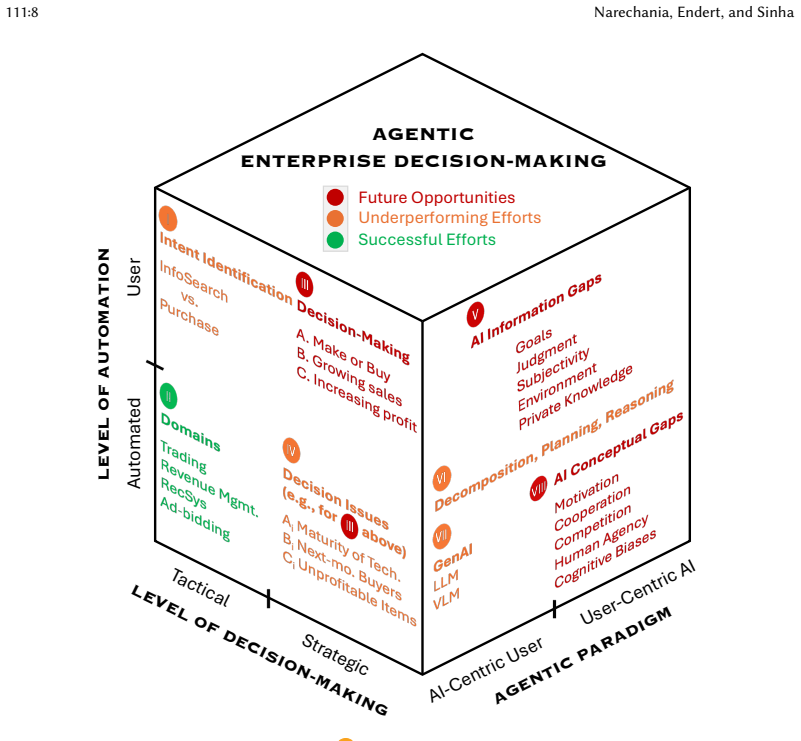
On the paper's own terms, the discovery is a re-framing: the missing ingredient in enterprise AI is not more capable models but a user-centric organization of AI delivery. The paper asserts that general-purpose LLMs and current agentic frameworks keep the human in the role of adapting to the machine, and that this explains why GenAI rollouts remain immature and strategic decision-making remains largely unautomated. The proposed alternative is a Walled-Garden Platform with direct user-agent communication, supervised by a planner, in which agents are rewarded from three sources: their own performance claims, the planner's observation, and user feedback. Incentives, not direct control, govern agent survival. On top of this market mechanism, the paper stacks six tenets specifying what user-centric AI must do: emphasize process over outcome, anticipate users' next needs, learn from user feedback with local privacy control, offer risk-reward and quality-price diversity, and keep entry and exit barriers low. The paper also distinguishes tactical decisions, where automation is already proven in trading, revenue management, recommendations, and ad-bidding, from strategic decisions, which require user goals, judgment, private knowledge, and environment, information no LLM has, and argues that user-centric agents, not bigger models or better prompting, are the path to automating those decisions.
Load-bearing premise
The argument rests on the assumption that a walled-garden market of self-interested agents can be designed so that agents disclose their capabilities truthfully, users choose well, weak agents exit, and enterprise data stays protected, all at once, and the paper asserts this by analogy to ad-bidding and mechanism design without specifying the rules that would guarantee it.
Editorial extensions
If this is right
- If the platform vision is right, enterprise users would stop engineering prompts and instead assemble their own workflows from task-specific agents that already know the surrounding steps.
- Rewarding agents from claims plus planner observation plus user feedback would make agent quality a competitive outcome: low-performing agents lose reward and exit, while better agents take their place.
- Locally privacy-preserving learning would let expert users feed their private judgment into agents without giving up the knowledge that makes them valuable, increasing the pool of high-quality training signal.
- Risk-reward and quality-price diversity would let enterprises match agent behavior to the user's risk appetite, such as choosing an exploratory new model versus a conservative proven one for the same task.
- If strategic decisions become automatable with user-in-the-loop agents, enterprises could push more decision-making toward automation without sacrificing human accountability.
Reading between the lines
- Beyond the paper's claims: the market-mechanism analogy leaves a concrete design problem open, namely what auction, pricing, or reputation rules make truthful capability disclosure an equilibrium; the paper does not specify them, so the natural next step would be simulated agent markets that test whether truthful disclosure survives.
- Beyond the paper's claims: if process-orientation is taken seriously, evaluation of enterprise AI would shift from answer correctness to process quality, such as whether an agent preserves user agency, interjects for clarification judiciously, and improves the user's own skill over time.
- Beyond the paper's claims: the walled-garden architecture suggests that the first viable agent markets will be enterprise-internal, with cross-enterprise or open agent markets only appearing after data ownership and leakage controls mature.
- Beyond the paper's claims: the distinction between tactical and strategic decisions implies a phased adoption path, automating tactical workflows first, as the paper says is already happening, then extending the same market organization to atomic pieces of strategic decisions before attempting whole strategic problems.
Editorial analysis
A structured set of objections, weighed in public.
Referee Report
Summary. This position paper argues that enterprises should move from an 'AI-Centric User' paradigm, where users adapt to inflexible AI, to a 'User-Centric AI' paradigm in which AI and agents adapt to users, their tasks, workflows, and decision-making contexts. The authors define three entities (users, agents, platforms) with explicit assumptions UA1-UA6, AA1-AA8, and PA1-PA6, propose six tenets (process orientation, forward thinking, locally privacy-preserving learning, a market-mechanism platform, risk-reward and quality-price diversity, and low entry/exit barriers), and illustrate the ideas with a four-step data-analytics workflow. The paper's main proposal is a walled-garden platform with autonomous agents governed by a market mechanism, in which agents are rewarded based on self-reported performance, planner observation, and user feedback, and underperforming agents exit.
Significance. If the framework were made precise, it could contribute a useful conceptual foundation for agentic AI in enterprises, especially in connecting user agency, privacy, and agent governance to market-mechanism thinking from economics. The paper deserves credit for making its assumptions explicit, for identifying capability overclaiming and imperfect verifiability as central problems, and for presenting a concrete workflow as a running example. At the same time, the contribution is currently a framing and a set of postulates rather than a validated design: no mechanism, equilibrium concept, or incentive-compatibility condition is specified, and the paper explicitly leaves the main implementation questions open in its conclusion. The significance is therefore conditional on later formalization and empirical evaluation.
major comments (3)
- [§3.2.4, §3.2.6, §4] The central claim that a market mechanism makes the agent platform incentive-compatible is asserted rather than derived. In §3.2.4 the paper states that public disclosure plus user feedback 'renders incentive compatible reward to the agent creator / developer to improve the agent,' and §4 proposes that agents 'are rewarded based on their own claim of performance, planner's observance of their performance and users' feedback.' However, AA8 explicitly permits agents to communicate capabilities 'whether truthful or not,' and §3.2.6 concedes the 'proclivity of agents (developers) to overclaim their capability, along with planner's imperfect verifiability of claims.' No payment rule, allocation rule, or verification structure is given that would make truthful disclosure and quality-diverse exit an equilibrium. Please either provide a concrete mechanism sketch with an incentive-compatibility argument, or explicitly re-scope this claim as an open conjecture rather than a technical result.
- [§2, §3] The six tenets are largely entailed by the assumptions in Section 2 rather than independently established. For example, Tenet 5 (risk-reward and quality-price diversity) follows directly from UA3-UA5 combined with AA6, and Tenet 3 follows from UA6 together with AA6-AA8; the rationales in §3.2 mostly re-cite these assumptions. For a framework paper this is acceptable if the assumptions are presented as normative postulates, but the current text presents the tenets as conclusions with rationales. Please state explicitly that the tenets are postulates derived from the premises and that their adequacy is to be tested by future empirical and simulation work, as the conclusion already suggests.
- [§4] Section 4 argues that LLMs fall short on strategic decision-making and that User-Centric AI agents would fill the identified gaps, but the paper does not provide evidence that process-oriented, forward-thinking, market-governed agents would actually address the 'severe gaps' in goals, judgment, subjectivity, private knowledge, and environment. The examples A-C are illustrative, not demonstrative. As written, the claim that the shift is 'attainable' (Introduction and §4) is stronger than what the paper supports; please soften the wording to a research agenda or add design-level support for how the proposed tenets close the gaps.
minor comments (5)
- [§3.1] The phrase 'and to complement (I) and (III)' appears to be a typo; it should likely read 'and to complement (I) and (II).'
- [§4, Figure 1] Figure 1 is referenced heavily through points I-VIII, but the figure itself is not reproduced in the provided version; ensure the published version includes the figure and that all labels (I-VIII) are legible and match the caption.
- [Article metadata] The article header and footer contain template leftovers that conflict with the current preprint: the copyright line says 2018, the ACM reference format says 2018, and the received/revised dates are 2007/2009, while the arXiv submission is dated June 2025. These should be corrected or removed.
- [§4] The key terms 'Walled-Garden Platform' and 'market mechanism' are used as central concepts but are not formally defined; please add concise definitions so the proposal is less ambiguous.
- [§3.2.5] In the model-selection example, the sentence 'In other cases, the risk may be worthwhile if the senior finds something useful for the future from such a model' is vague; clarify who evaluates the risk and which agent or user acts on it.
Circularity Check
No circular derivation: the six tenets are normative proposals grounded on explicitly stated assumptions, not predictions or results derived from fitted inputs; the paper's only self-citation is not load-bearing.
full rationale
This is a conceptual/position paper, not a formal derivation: it states user, agent, and platform assumptions in Section 2 and then 'offers six tenets' as normative success criteria. None of the tenets is computed, fitted, or predicted from data, so there is no equation-level reduction to flag. The tenet rationales cite the Section 2 assumptions as premises (e.g., 'Given UA1, UA3, and UA4, the sample space of outcomes is not known'), but that is ordinary argument from stated boundary conditions, not circularity: the tenets are proposals, not results claimed to be novel predictions entailed by their own definitions. The only self-citation, [24], supports a background empirical point about expectations and interaction experience; it is not a load-bearing uniqueness theorem and does not define the paper's central constructs. The paper's own caveat in Tenet 6—'proclivity of agents (developers) to overclaim their capability, along with planner's imperfect verifiability of claims'—concedes that the incentive-compatibility assertion in Tenet 4 is not secured. That is a correctness or support gap, not a circular reduction, because the assertion is not fitted into existence or made true by definition. No significant circularity found.
Assumptions & free parameters
assumptions (5)
- domain assumption UA1: Users seek agency and vary in skills; UA5: Users maximize their own utility from AI.
- domain assumption AA2: An agent is specialized for a task; AA6: Agents are endowed with varying rewards by the platform.
- domain assumption PA4: The planner manages agents to maximize its own utility; PA5: Users communicate with the planner, which communicates with agents.
- domain assumption The market mechanism literature (Akerlof, Hart, Myerson) transfers to an ecosystem of AI agents with heterogeneous users and task-specific agents.
- domain assumption Enterprise decision-making can be decomposed into atomic decision issues that agents can partially address using decomposition, planning, and reasoning.
Cite this review
Pith. "Pith review of Agentic Enterprise: AI-Centric User to User-Centric AI." pith.science (2026). https://pith.science/paper/ZLV7NIXV
@misc{pith2026250622893,
  author       = {Pith},
  title        = {Pith review of: Agentic Enterprise: AI-Centric User to User-Centric AI},
  year         = {2026},
  howpublished = {\url{https://pith.science/paper/ZLV7NIXV}},
  note         = {Machine review of arXiv:2506.22893}
}
read the original abstract
After a very long winter, the Artificial Intelligence (AI) spring is here. Or, so it seems over the last three years. AI has the potential to impact many areas of human life - personal, social, health, education, professional. In this paper, we take a closer look at the potential of AI for Enterprises, where decision-making plays a crucial and repeated role across functions, tasks, and operations. We consider Agents imbued with AI as means to increase decision-productivity of enterprises. We highlight six tenets for Agentic success in enterprises, by drawing attention to what the current, AI-Centric User paradigm misses, in the face of persistent needs of and usefulness for Enterprise Decision-Making. In underscoring a shift to User-Centric AI, we offer six tenets and promote market mechanisms for platforms, aligning the design of AI and its delivery by Agents to the cause of enterprise users.
Figures
Reference graph
Works this paper leans on
-
[1]
Deepak Bhaskar Acharya, Karthigeyan Kuppan, and B Divya. 2025. Agentic AI: Autonomous Intelligence for Complex Goals–A Comprehensive Survey. IEEE Access (2025)
work page 2025
-
[2]
George A Akerlof. 1978. The Market for “Lemons”: Quality Uncertainty and the Market Mechanism. In Uncertainty in Economics. Elsevier, 235–251
work page 1978
-
[3]
Anthropic. 2025. How We Built Our Multi-Agent Research System. https://www.anthropic.com/engineering/built- multi-agent-research-system Accessed: 2025-06-14
work page 2025
-
[4]
Albert Bandura. 2006. Toward a Psychology of Human Agency. Perspectives on Psychological Science 1, 2 (2006), 164–180
2006
-
[5]
Dibyanayan Bandyopadhyay, Soham Bhattacharjee, and Asif Ekbal. 2025. Thinking Machines: A Survey of LLM Based Reasoning Strategies. arXiv preprint arXiv:2503.10814 (2025)
arXiv 2025
-
[6]
Max H Bazerman and Don A Moore. 2012. Judgment in Managerial Decision Making . John Wiley & Sons
work page 2012
-
[7]
Zane Durante, Qiuyuan Huang, Naoki Wake, Ran Gong, Jae Sung Park, Bidipta Sarkar, Rohan Taori, Yusuke Noda, Demetri Terzopoulos, Yejin Choi, et al. 2024. Agent AI: Surveying the Horizons of Multimodal Interaction. arXiv preprint arXiv:2401.03568 (2024)
arXiv 2024
-
[8]
Mohamed Amine Ferrag, Norbert Tihanyi, and Merouane Debbah. 2025. From LLM Reasoning to Autonomous AI Agents: A Comprehensive Review. arXiv preprint arXiv:2504.19678 (2025)
arXiv 2025
Show all 41 references
-
[9]
Google LLC. 2024. Prompting Guide 101. https://services.google.com/fh/files/misc/gemini-for-google-workspace- prompting-guide-101.pdf
2024
-
[10]
Google LLC. 2025. Google Agentspace Enterprise Overview. https://cloud.google.com/agentspace/agentspace-enterprise/ docs/overview Accessed: 2025-06-14
2025
-
[11]
Oliver D Hart. 1983. The Market Mechanism as an Incentive Scheme. The Bell Journal of Economics (1983), 366–382
1983
-
[12]
Chad A Hartnell, Amy Yi Ou, and Angelo Kinicki. 2011. Organizational Culture and Organizational Effectiveness: A Meta-analytic Investigation of the Competing Values Framework’s Theoretical Suppositions. Journal of Applied Psychology 96, 4 (2011), 677
2011
-
[13]
Harvard Business Review. 2023. The New Human-Machine Relationship. https://store.hbr.org/product/the-new- human-machine-relationship/R2302B Accessed: 2025-06-14
2023
-
[14]
Jeffrey Heer. 2019. Agency Plus Automation: Designing Artificial Intelligence into Interactive Systems. Proceedings of the National Academy of Sciences 116, 6 (2019), 1844–1850
2019
-
[15]
E Tory Higgins. 1998. Promotion and Prevention: Regulatory Focus as a Motivational Principle. In Advances in Experimental Social Psychology. Vol. 30. Elsevier, 1–46
1998
-
[16]
Jonathan Ho, Ajay Jain, and Pieter Abbeel. 2020. Denoising Diffusion Probabilistic Models. Advances in Neural Information Processing Systems 33 (2020), 6840–6851
2020
-
[17]
Qiuyuan Huang, Naoki Wake, Bidipta Sarkar, Zane Durante, Ran Gong, Rohan Taori, Yusuke Noda, Demetri Terzopoulos, Noboru Kuno, Ade Famoti, et al . 2024. Position Paper: Agent AI Towards a Holistic Intelligence. arXiv preprint arXiv:2403.00833 (2024)
2024 arXiv
-
[18]
Xu Huang, Weiwen Liu, Xiaolong Chen, Xingmei Wang, Hao Wang, Defu Lian, Yasheng Wang, Ruiming Tang, and Enhong Chen. 2024. Understanding the Planning of LLM agents: A Survey. arXiv preprint arXiv:2402.02716 (2024)
2024 arXiv
-
[19]
Laurie Hughes, Yogesh K Dwivedi, Tegwen Malik, Mazen Shawosh, Mousa Ahmed Albashrawi, Il Jeon, Vincent Dutot, Mandanna Appanderanda, Tom Crick, Rahul De’, et al. 2025. AI Agents and Agentic Systems: a Multi-Expert Analysis. Journal of Computer Information Systems (2025), 1–29
2025
-
[20]
Sebastian Krakowski. 2025. Human-AI Agency in the Age of Generative AI. Information and Organization 35, 1 (2025), 100560
2025
-
[21]
Vishwajeet Kumar, Yash Gupta, Saneem Chemmengath, Jaydeep Sen, Soumen Chakrabarti, Samarth Bharadwaj, and Feifei Pan. 2023. Multi-Row, Multi-Span Distant Supervision For Table+Text Question Answering. In Proceedings of the 61st Annual Meeting of the Association for Computation...
2023 doi
-
[22]
Doris Läpple and Bradford L Barham. 2019. How do Learning Ability, Advice from Experts and Peers Shape Decision Making? Journal of Behavioral and Experimental Economics 80 (2019), 92–107
2019
-
[23]
Roger B Myerson. 2008. Perspectives on Mechanism Design in Economic Theory. American Economic Review 98, 3 (2008), 586–603
2008
-
[24]
Arpit Narechania, Alex Endert, and Atanu R Sinha. 2025. Guidance Source Matters: How Guidance from AI, Expert, or a Group of Analysts Impacts Visual Data Preparation and Analysis. In Proceedings of the 30th International Conference on Intelligent User Interfaces . 789–809
2025
-
[25]
Giang Nguyen, Ivan Brugere, Shubham Sharma, Sanjay Kariyappa, Anh Totti Nguyen, and Freddy Lecue. 2024. Interpretable Table Question Answering via Plans of Atomic Table Transformations. https://openreview.net/forum? J. ACM, Vol. 37, No. 4, Article 111. Publication date: August...
2024
-
[26]
OpenAI. 2024. AI in the Enterprise. Technical Report. OpenAI. https://cdn.openai.com/business-guides-and-resources/ ai-in-the-enterprise.pdf Accessed: 2025-06-17
2024
-
[27]
OpenAI. 2025. A Practical Guide to Building Agents. https://cdn.openai.com/business-guides-and-resources/a-practical- guide-to-building-agents.pdf Accessed: 2025-06-14
2025
-
[28]
Ansh Radhakrishnan, Karina Nguyen, Anna Chen, Carol Chen, Carson Denison, Danny Hernandez, Esin Durmus, Evan Hubinger, Jackson Kernion, Kamil˙e Lukoši¯ut˙e, et al. 2023. Question Decomposition Improves the Faithfulness of Model-Generated Reasoning. arXiv preprint arXiv:2307.11...
2023 arXiv
-
[29]
Ashay Satav. 2025. Enterprise API & Platform Strategy in the Era of Agentic AI. Journal of Computer Science and Technology Studies 7, 1 (2025), 380–385
2025
-
[30]
Yijia Shao, Humishka Zope, Yucheng Jiang, Jiaxin Pei, David Nguyen, Erik Brynjolfsson, and Diyi Yang. 2025. Future of Work with AI Agents: Auditing Automation and Augmentation Potential across the US Workforce.arXiv preprint arXiv:2506.06576 (2025)
2025
-
[31]
Shavit, Yonadav and Agarwal, Sandhini and Brundage, Miles and Adler, Steven and O’Keefe, Cullen and Campbell, Rosie and Lee, Teddy and Mishkin, Pamela and Eloundou, Tyna and Hickey, Alan and others. 2023. Practices for Governing Agentic AI Systems. Technical Report. OpenAI. ht...
2023
-
[32]
Paschal Sheeran. 2002. Intention—Behavior Relations: a Conceptual and Empirical Review. European Review of Social Psychology 12, 1 (2002), 1–36
2002
-
[33]
Chufan Shi, Yixuan Su, Cheng Yang, Yujiu Yang, and Deng Cai. 2023. Specialist or Generalist? Instruction Tuning for Specific NLP Tasks. arXiv preprint arXiv:2310.15326 (2023)
2023 arXiv
-
[34]
Ben Shneiderman. 2022. Human-Centered AI. Oxford University Press
2022
-
[35]
George J Stigler. 1974. Free Riders and Collective Action: An Appendix to Theories of Economic Regulation. The Bell Journal of Economics and Management Science (1974), 359–365
1974
-
[36]
Ashish Vaswani, Noam Shazeer, Niki Parmar, Jakob Uszkoreit, Llion Jones, Aidan N Gomez, Łukasz Kaiser, and Illia Polosukhin. 2017. Attention is All You Need. Advances in Neural Information Processing Systems 30 (2017)
2017
-
[37]
Dakuo Wang, Elizabeth Churchill, Pattie Maes, Xiangmin Fan, Ben Shneiderman, Yuanchun Shi, and Qianying Wang
-
[38]
Hui Wei, Zihao Zhang, Shenghua He, Tian Xia, Shijia Pan, and Fei Liu. 2025. PlanGenLLMs: A Modern Survey of LLM Planning Capabilities. arXiv preprint arXiv:2502.11221 (2025)
2025 arXiv
-
[39]
Shunyu Yao, Dian Yu, Jeffrey Zhao, Izhak Shafran, Tom Griffiths, Yuan Cao, and Karthik Narasimhan. 2023. Tree of Thoughts: Deliberate Problem Solving with Large Language Models. Advances in Neural Information Processing Systems 36 (2023), 11809–11822
2023
-
[40]
Kun Zhang, Jiali Zeng, Fandong Meng, Yuanzhuo Wang, Shiqi Sun, Long Bai, Huawei Shen, and Jie Zhou. 2024. Tree-of-Reasoning Question Decomposition for Complex Question Answering with Large Language Models Authors. In Proceedings of the AAAI Conference on Artificial Intelligenc...
2024
-
[2020]
In Extended Abstracts of the 2020 CHI Conference on Human Factors in Computing Systems
From Human-Human Collaboration to Human-AI Collaboration: Designing AI Systems that Can Work Together with People. In Extended Abstracts of the 2020 CHI Conference on Human Factors in Computing Systems . 1–6
2020
Reviewed August 6, 2026 · model on record in the stance chip above.
Discussion (0). Sign in to comment.