REVIEW 3 major objections 6 minor 223 references
Point Cloud Compression and Objective Quality Assessment: A Survey
T0 review · 3 major / 6 minor · reviewed 2026-08-06 · deepseek-v4-flash
Pith's one-line read The paper benchmarks point cloud codecs and quality metrics to locate the state of the art and derive design rules for both.
desk verdict A credible survey with a solid taxonomy, but the benchmark-based design insights are over-claimed because the comparisons are confounded; worth revising and then citing as a reference. read the letter →
The pith
A machine-rendered reading of the paper's core claim, the machinery that carries it, and where it could break.
The reading
What carries the argument
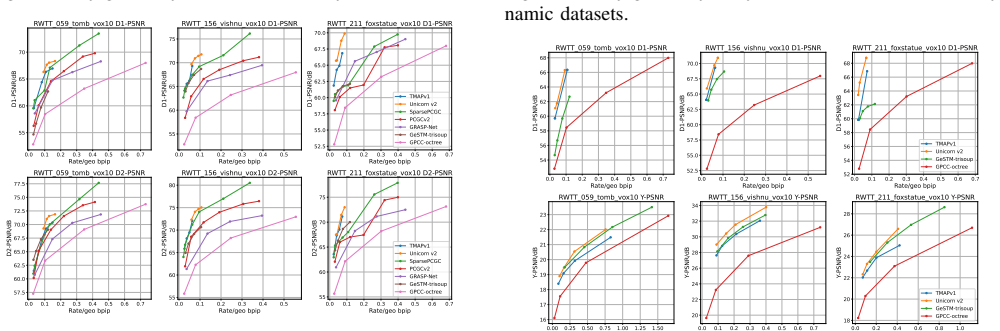
The argument is carried by a benchmark protocol rather than a single theorem. For compression it follows the MPEG AI-PCC Common Test Conditions, grouping content into dense static, sparse static, dense dynamic, and sparse LiDAR categories, measuring bits per input point and D1 (point-to-point) and D2 (point-to-plane) PSNR against three standard codecs (G-PCC, GeSTM, V-PCC) and a family of learned codecs. For quality assessment it uses four public databases with subjective scores (SJTU-PCQA, WPC, LS-PCQA, BASICS) and reports Pearson, Spearman, and RMSE alignment. Within that protocol, the objects that do the explanatory work are the 8-stage sibling-occupied probability approximation (SOPA) for lossless low-bit geometry, variable lossy coding layers for rate control, spherical-coordinate octrees for LiDAR, and multi-scale or multi-modal feature fusion in metrics.
What would settle it
Run the same three MPEG AI-PCC tracks on all publicly available codecs that satisfy the Common Test Conditions, and evaluate all FR and NR metrics from the survey on the four databases with the same train/test splits; if variable-lossy-layer codecs no longer dominate or multi-scale and multi-modal metrics no longer show the best correlations, the survey's central insights would be refuted.
Extended reading notes
Core claim
On its own terms, the paper claims that the current state of the art in point cloud compression is defined by learning-based autoencoder codecs that losslessly encode a low-resolution octree (often with the 8-stage sibling-occupied probability approximation used by SparsePCGC, TMAP, and Unicorn) and learn to code the residual at several lossy layers; methods that fix the number of lossy layers and only adjust rate-distortion weights or pre-quantization fall behind. It further claims that objective point cloud quality is best predicted by metrics that combine complementary cues—multi-scale geometry structure in full-reference methods and multi-modal (3D plus projected images plus, increasingly, language) features in no-reference methods. These claims are supported by rate-distortion curves on MPEG AI-PCC categories and by correlation tables on SJTU-PCQA, WPC, LS-PCQA, and BASICS. The survey also flags open problems—lossless dynamic coding, attribute compression that lags geometry, real-time LiDAR coding, and evaluation of AI-generated 3D content.
Load-bearing premise
The load-bearing premise is that the handful of codecs and the four quality databases chosen for the benchmarks represent the field fairly enough that the observed ranking—and the design rules drawn from it—apply beyond the specific selection.
Editorial extensions
If this is right
- Future learned point cloud codecs should treat the number and allocation of lossy coding layers as a rate-control axis rather than fixing the architecture and tuning weights alone.
- Hybrid architectures that mix voxel-based spatial regularity with point-based geometric sensitivity, and that exploit surface approximations for dense closed objects, should narrow the remaining gap to handcrafted trisoup codecs.
- Dynamic LiDAR compression should move toward interpolation-based inter-frame prediction and spherical-coordinate contexts rather than implicit temporal mapping.
- Objective quality metrics can serve directly as differentiable or near-differentiable losses in learned enhancement, completion, and compression pipelines, replacing Chamfer and Earth Mover distances.
- The surveyed evidence places multi-modal and language-aligned metrics at the top of no-reference benchmarks, so their family is the natural starting point for deployment.
Reading between the lines
- Because the compression benchmarks include only a subset of published methods, an immediate check is to add codecs released after this survey, especially ones developed outside the set of methods surveyed here; the design rules would be confirmed if the variable-lossy-layer advantage persists in that larger field.
- The findings suggest a concrete cross-field experiment: use the best multi-scale full-reference metric as the distortion term in a learned codec's rate-distortion loss and measure both subjective scores and D1/D2 PSNR, thereby joining the survey's two halves in one system.
- If spherical-coordinate octrees continue to outperform Cartesian structures on LiDAR, the same principle could be tested on other range sensors such as solid-state LiDAR or radar point clouds, where point density is also anisotropic.
- The taxonomy suggests that language-aligned quality metrics, which already target semantic misalignment and the 'Janus' multi-view inconsistency problem, may adapt to AI-generated 3D content faster than geometry-only metrics.
Editorial analysis
A structured set of objections, weighed in public.
Referee Report
Summary. The paper is a survey of point cloud compression (PCC) and point cloud quality assessment (PCQA), covering handcrafted and learning-based compression methods, full-reference and no-reference quality metrics, and selected applications. It also presents benchmark experiments: compression performance is evaluated on MPEG-style test conditions with D1/D2 PSNR and bpip, and PCQA metrics are compared on SJTU-PCQA, WPC, LS-PCQA, and BASICS. From these experiments the paper derives design insights, e.g., multi-granularity rate control via variable lossy layers for compression and multi-scale modeling for quality assessment.
Significance. If the benchmark-derived insights were rigorously supported, they would be a valuable practical contribution, since the paper goes beyond a narrative taxonomy to quantitative comparisons. The survey is timely, and the paper has notable strengths: it uses public datasets and MPEG common test conditions, cites a broad recent literature, and specifies the evaluation software (mpeg-pcc-dmetric 0.13.5). The compression and PCQA taxonomies are generally consistent with the cited literature. However, the central novel claim—the design insights drawn from the benchmarks—is not yet adequately supported because the comparisons are confounded and the experimental protocol is incompletely specified. The paper is therefore best viewed as a useful survey whose benchmark claims require substantial tightening.
major comments (3)
- [Section II.C.2, Figs. 8-9] The design insight labeled 'Multi-granularity rate control' asserts that variable lossy layers (TMAPv1, Unicorn v2, SparsePCGC) outperform fixed-layer rate control (D-DPCC, PCGCv2, GRASP-Net). This is a causal attribution drawn from comparing complete compression systems that differ in multiple dimensions simultaneously: lossless coding (8-stage SOPA vs. factorized latent coding), backbone architecture (SparseCNN, transformer, point-voxel hybrids), temporal handling (explicit ME/MC vs. implicit prediction), and training data (ShapeNet, ModelNet40, MPEG CTC). No ablation holds these factors fixed while toggling only the number of lossy layers. The same issue affects the statement in the same section that D-DPCC's D1-PSNR degradation at higher bitrates is 'attributed to its implementation of variable lossy layers.' The benchmark can support the observation that these specific systems perform differently, but it does not establish the design principle as stated.
- [Section III.C.1, Experiment Setup] The evaluation protocol is not transparent enough to support the comparative claims in Tables V and VI. The paper states that 'where possible, we retrain and evaluate the models by ourselves; for remaining cases, performance statistics are extracted directly from the original publications,' but it does not identify which rows were rerun and which were copied, nor does it report variance (e.g., error bars or significance tests). This matters particularly because several benchmarked metrics (GraphSIM, MPED, TCDM, PHM, GPA-Net, CoPA, AFQ-Net) originate from the same group as the authors, and no explicit criterion is given for selecting the 'representative' methods. The absence of this information makes it difficult for a reader to assess whether the observed ranking reflects methodological superiority or differences in experimental conditions.
- [Section III.C.2, 'Performance Comparison for FR-PCQA'] The sentence 'TCDM on LS-PCQA and MPED on M-PCCD' uses the term 'M-PCCD' without defining it anywhere in the paper. The four benchmark databases introduced in Section III.C.1 are SJTU-PCQA, WPC, LS-PCQA, and BASICS; 'M-PCCD' is not among them. The term should either be defined with a citation and experimental setup, or the reference should be removed/replaced, because as written the comparison on this database is not verifiable.
minor comments (6)
- [Abstract] The phrase 'criticals demand' should read 'critical demand'.
- [Author affiliations] The affiliation for Q. Yang is given as 'Kansa city, America'; this appears to be a typo for 'Kansas City, USA'.
- [Section III.B.1] The word 'qualtiy' in the opening sentence should be 'quality'.
- [Section III.C.2] The phrase 'multi-sale property' should be 'multi-scale property'.
- [Section II.B.2] 'V oxel-based' in the section heading contains an extra space and should be 'Voxel-based'.
- [Tables V and VI] The caption states that the top two results are marked in boldface and underline, but the formatting is not consistently visible in all rows; please ensure the typesetting conveys the intended distinction.
Circularity Check
No significant circularity: the survey's taxonomy and benchmark insights are empirical summaries, not derivations that reduce to their own inputs.
full rationale
This is a survey plus benchmark comparison, not a derivation chain. The compression and quality-assessment claims are supported by RD curves and correlation tables computed on public databases (SJTU-PCQA, WPC, LS-PCQA, BASICS) with standard MPEG metrics (D1/D2 PSNR, PSNR-YUV, SROCC/PLCC/RMSE), so the observed rankings are externally falsifiable and not defined in terms of the survey's own conclusions. The design insights, such as 'multi-granularity rate control' (Section II.C.2) or 'multi-scale modeling' (Section III.C.2), are inductive readings of those benchmarks rather than quantities fitted to the benchmarks. The paper's heavy self-citation (GraphSIM, MS-GraphSIM, MPED, TCDM, PHM, GPA-Net, CoPA, AFQ-Net, CLIP-PCQA) and its statement that some performance statistics are 'extracted directly from the original publications' (Section III.C.1) raise transparency and fairness concerns, and the variable-lossy-layer insight is confounded because complete systems rather than controlled ablations are compared; however, those are correctness and validity risks, not circular reductions. No equation, metric, or fitted parameter is shown to be equivalent by construction to another quantity, so the circularity score is 0.
Assumptions & free parameters
assumptions (3)
- domain assumption The selected PCC and PCQA methods are representative of the field.
- domain assumption D1/D2 PSNR and bpip are appropriate evaluation metrics for compression quality.
- domain assumption The subjective MOS scores in SJTU-PCQA, WPC, LS-PCQA, and BASICS are reliable ground truth.
Cite this review
Pith. "Pith review of Point Cloud Compression and Objective Quality Assessment: A Survey." pith.science (2026). https://pith.science/paper/T3OUO55J
@misc{pith2026250622902,
  author       = {Pith},
  title        = {Pith review of: Point Cloud Compression and Objective Quality Assessment: A Survey},
  year         = {2026},
  howpublished = {\url{https://pith.science/paper/T3OUO55J}},
  note         = {Machine review of arXiv:2506.22902}
}
read the original abstract
The rapid growth of 3D point cloud data, driven by applications in autonomous driving, robotics, and immersive environments, has led to criticals demand for efficient compression and quality assessment techniques. Unlike traditional 2D media, point clouds present unique challenges due to their irregular structure, high data volume, and complex attributes. This paper provides a comprehensive survey of recent advances in point cloud compression (PCC) and point cloud quality assessment (PCQA), emphasizing their significance for real-time and perceptually relevant applications. We analyze a wide range of handcrafted and learning-based PCC algorithms, along with objective PCQA metrics. By benchmarking representative methods on emerging datasets, we offer detailed comparisons and practical insights into their strengths and limitations. Despite notable progress, challenges such as enhancing visual fidelity, reducing latency, and supporting multimodal data remain. This survey outlines future directions, including hybrid compression frameworks and advanced feature extraction strategies, to enable more efficient, immersive, and intelligent 3D applications.
Figures


Figures from the paper (12 more)




Reference graph
Works this paper leans on
-
[1]
Overview of the high efficiency video coding (HEVC) standard,
G. J. Sullivan, J.-R. Ohm, W.-J. Han, and T. Wiegand, “Overview of the high efficiency video coding (HEVC) standard,” IEEE Transactions on Circuits and Systems for Video Technology , vol. 22, no. 12, pp. 1649– 1668, 2012
2012
-
[2]
Efficient projected frame padding for video-based point cloud compression,
L. Li, Z. Li, S. Liu, and H. Li, “Efficient projected frame padding for video-based point cloud compression,” IEEE Transactions on Multimedia, vol. 23, pp. 2806–2819, 2021
2021
-
[3]
Adaptive plane projec- tion for video-based point cloud coding,
E. Lopes, J. Ascenso, C. Brites, and F. Pereira, “Adaptive plane projec- tion for video-based point cloud coding,” in 2019 IEEE International Conference on Multimedia and Expo , 2019, pp. 49–54
2019
-
[4]
A regularized projection- based geometry compression scheme for lidar point cloud,
Y . Yu, W. Zhang, G. Li, and F. Yang, “A regularized projection- based geometry compression scheme for lidar point cloud,” IEEE Transactions on Circuits and Systems for Video Technology , vol. 33, no. 3, pp. 1427–1437, 2023
2023
-
[5]
Advanced 3D motion prediction for video-based dynamic point cloud compression,
L. Li, Z. Li, V . Zakharchenko, J. Chen, and H. Li, “Advanced 3D motion prediction for video-based dynamic point cloud compression,” IEEE Transactions on Image Processing , vol. 29, pp. 289–302, 2019
2019
-
[6]
View-dependent dynamic point cloud compression,
W. Zhu, Z. Ma, Y . Xu, L. Li, and Z. Li, “View-dependent dynamic point cloud compression,” IEEE Transactions on Circuits and Systems for Video Technology, vol. 31, no. 2, pp. 765–781, 2020
2020
-
[7]
Occupancy map guided fast video-based dynamic point cloud coding,
J. Xiong, H. Gao, M. Wang, H. Li, and W. Lin, “Occupancy map guided fast video-based dynamic point cloud coding,” IEEE Transactions on Circuits and Systems for Video Technology, vol. 32, no. 2, pp. 813–825, 2022
2022
-
[8]
A highly efficient compression framework for time-varying 3D facial expressions,
J. Hou, L.-P. Chau, M. Zhang, N. Magnenat-Thalmann, and Y . He, “A highly efficient compression framework for time-varying 3D facial expressions,” IEEE Transactions on Circuits and Systems for Video Technology, vol. 24, no. 9, pp. 1541–1553, 2014
2014
Show all 223 references
-
[9]
Compress- ing 3D human motions via keyframe-based geometry videos,
J. Hou, L.-P. Chau, N. Magnenat-Thalmann, and Y . He, “Compress- ing 3D human motions via keyframe-based geometry videos,” IEEE Transactions on Circuits and Systems for Video Technology , vol. 25, no. 1, pp. 51–62, 2014
2014
-
[10]
Dynamic point cloud texture video compression using the edge position difference oriented motion model,
A. Ahmmed, M. Paul, and M. Pickering, “Dynamic point cloud texture video compression using the edge position difference oriented motion model,” in 2021 Data Compression Conference , 2021, pp. 335–335
2021
-
[11]
Convolutional neural network-based occupancy map accuracy improvement for video-based point cloud compression,
W. Jia, L. Li, A. Akhtar, Z. Li, and S. Liu, “Convolutional neural network-based occupancy map accuracy improvement for video-based point cloud compression,” IEEE Transactions on Multimedia , vol. 24, pp. 2352–2365, 2022
2022
-
[12]
Video-based point cloud compression artifact removal,
A. Akhtar, W. Gao, L. Li, Z. Li, W. Jia, and S. Liu, “Video-based point cloud compression artifact removal,” IEEE Transactions on Multimedia, vol. 24, pp. 2866–2876, 2021
2021
-
[13]
Occupancy-map-based rate distortion optimization and partition for video-based point cloud compression,
L. Li, Z. Li, S. Liu, and H. Li, “Occupancy-map-based rate distortion optimization and partition for video-based point cloud compression,” IEEE Transactions on Circuits and Systems for Video Technology , vol. 31, no. 1, pp. 326–338, 2020
2020
-
[14]
Low complexity coding unit decision for video-based point cloud compression,
W. Gao, H. Yuan, G. Li, Z. Li, and H. Yuan, “Low complexity coding unit decision for video-based point cloud compression,” IEEE Transactions on Image Processing , vol. 33, pp. 149–162, 2024
2024
-
[15]
Octree-based point-cloud compression,
R. Schnabel and R. Klein, “Octree-based point-cloud compression,” in Proceedings of the 3rd Eurographics / IEEE Visualization and Graphics Technical Committee Conference on Point-Based Graphics , 2006, p. 111–121
2006
-
[16]
Implicit geometry partition for point cloud compression,
X. Zhang, W. Gao, and S. Liu, “Implicit geometry partition for point cloud compression,” in 2020 Data Compression Conference, 2020, pp. 73–82
2020
-
[17]
Adaptive geometry partition for point cloud compression,
X. Zhang and W. Gao, “Adaptive geometry partition for point cloud compression,” IEEE Transactions on Circuits and Systems for Video Technology, vol. 31, no. 12, pp. 4561–4574, 2021
2021
-
[18]
Planar mode in octree-based geometry coding,
S. Lasserre and D. Flynn, “Planar mode in octree-based geometry coding,” ISO/IEC JTC1/SC29/WG11, M48906, 2019
2019
-
[19]
Inference of a mode using point location direct coding in TMC3,
S. Lasserre and D. Flynn, “Inference of a mode using point location direct coding in TMC3,” ISO/IEC JTC1/SC29/WG11, M42239, 2019
2019
-
[20]
Report on triangle soup decoding,
O. Nakagami, “Report on triangle soup decoding,” ISO/IEC JTC1/SC29/WG11, M52279, 2020
2020
-
[21]
Part 1 - Improving TriSoup: summary, results and perspective,
S. Lasserre, “Part 1 - Improving TriSoup: summary, results and perspective,” ISO/IEC JTC1/SC29/WG7, M59288, 2022
2022
-
[22]
Predictive point- cloud compression,
S. Gumhold, Z. Kami, M. Isenburg, and H.-P. Seidel, “Predictive point- cloud compression,” in ACM Special Interest Group on Computer Graphics and Interactive Techniques 2005 Sketches , 2005, p. 137–es
2005
-
[23]
Lossless point cloud geometry compression via binary tree partition and intra prediction,
W. Zhu, Y . Xu, L. Li, and Z. Li, “Lossless point cloud geometry compression via binary tree partition and intra prediction,” 2017 IEEE 19th International Workshop on Multimedia Signal Processing , pp. 1– 6, 2017
2017
-
[24]
Predictive geometry coding,
D. Flynn, A. Tourapis, and K. Mammou, “Predictive geometry coding,” ISO/IEC JTC1/SC29/WG11, M51012, 2019
2019
-
[25]
Optimization of the predic- tive coding scheme for spinning lidars,
K. Mammou, D. Flynn, and A. Tourapis, “Optimization of the predic- tive coding scheme for spinning lidars,” ISO/IEC JTC1/SC29/WG11, M53618, 2019
2019
-
[26]
PCC Test Model Category 3 v0,
“PCC Test Model Category 3 v0,” ISO/IEC JTC1/SC29/WG11, N17249, 2017
2017
-
[27]
Lifting scheme for lossy attribute encoding in TMC1,
K. Mammou, A. Tourapis, J. Kim, F. Robinet, V . Valentin, and Y . Su, “Lifting scheme for lossy attribute encoding in TMC1,” ISO/IEC JTC1/SC29/WG11, M42640, 2018
2018
-
[28]
Weighted attribute prediction based on morton code for point cloud compression,
L. Wei, S. Wan, Z. Sun, X. Ding, and W. Zhang, “Weighted attribute prediction based on morton code for point cloud compression,” in 2020 IEEE International Conference on Multimedia Expo Workshops , 2020, pp. 1–6
2020
-
[29]
Hilbert space filling curve based scan- order for point cloud attribute compression,
J. Chen, L. Yu, and W. Wang, “Hilbert space filling curve based scan- order for point cloud attribute compression,” IEEE Transactions on Image Processing, vol. 31, pp. 4609–4621, 2022
2022
-
[30]
Compression of 3D point clouds using a region-adaptive hierarchical transform,
R. L. de Queiroz and P. A. Chou, “Compression of 3D point clouds using a region-adaptive hierarchical transform,” IEEE Transactions on Image Processing, vol. 25, no. 8, pp. 3947–3956, 2016
2016
-
[31]
Set partitioning in hierarchical trees for point cloud attribute compression,
A. L. Souto, V . F. Figueiredo, P. A. Chou, and R. L. de Queiroz, “Set partitioning in hierarchical trees for point cloud attribute compression,” IEEE Signal Processing Letters , vol. 28, pp. 1903–1907, 2021
1903
-
[32]
Integer alternative for the region-adaptive hierarchical transform,
G. P. Sandri, P. A. Chou, M. Krivoku ´ca, and R. L. de Queiroz, “Integer alternative for the region-adaptive hierarchical transform,” IEEE Signal Processing Letters, vol. 26, no. 9, pp. 1369–1372, 2019
2019
-
[33]
Early termination of dyadic region-adaptive hierarchical transform for efficient attribute compression of 3D point clouds,
R. Hooda and W. D. Pan, “Early termination of dyadic region-adaptive hierarchical transform for efficient attribute compression of 3D point clouds,” IEEE Signal Processing Letters , vol. 29, pp. 214–218, 2022
2022
-
[34]
A 3D haar wavelet transform for point cloud attribute compression based on local surface analysis,
S.-Q. Zhang, W. Zhang, F. Yang, and J. Huo, “A 3D haar wavelet transform for point cloud attribute compression based on local surface analysis,” 2019 Picture Coding Symposium , pp. 1–5, 2019
2019
-
[35]
Rate-distortion opti- mized skip coding of region adaptive hierarchical transform coefficients for MPEG G-PCC,
Z. Wang, Y . Wei, H. Yuan, W. Zhang, and P. Li, “Rate-distortion opti- mized skip coding of region adaptive hierarchical transform coefficients for MPEG G-PCC,” IEEE Transactions on Circuits and Systems for Video Technology, pp. 1–1, 2024
2024
-
[36]
Point cloud attribute compres- sion with graph transform,
C. Zhang, D. Flor ˆencio, and C. Loop, “Point cloud attribute compres- sion with graph transform,” in 2014 IEEE International Conference on Image Processing, 2014, pp. 2066–2070
2014
-
[37]
Attribute compression for sparse point clouds using graph transforms,
R. A. Cohen, D. Tian, and A. Vetro, “Attribute compression for sparse point clouds using graph transforms,” in 2016 IEEE International Conference on Image Processing , 2016, pp. 1374–1378
2016
-
[38]
Attribute compression of 3D point clouds using laplacian sparsity optimized graph transform,
Y . Shao, Z. Zhang, Z. Li, K. Fan, and G. Li, “Attribute compression of 3D point clouds using laplacian sparsity optimized graph transform,” in 2017 IEEE Visual Communications and Image Processing , 2017, pp. 1–4
2017
-
[39]
A hybrid compression framework for color attributes of static 3D point clouds,
H. Liu, H. Yuan, Q. Liu, J. Hou, H. Zeng, and S. Kwong, “A hybrid compression framework for color attributes of static 3D point clouds,” IEEE Transactions on Circuits and Systems for Video Technology , vol. 32, no. 3, pp. 1564–1577, 2022
2022
-
[40]
Laplacian matrix learning for point cloud attribute compression with ternary search-based adaptive block par- tition,
C. Peng and W. Gao, “Laplacian matrix learning for point cloud attribute compression with ternary search-based adaptive block par- tition,” in Proceedings of the 32nd ACM International Conference on Multimedia, 2024, p. 10412–10420
2024
-
[41]
End-to-end optimized image compression,
J. Ball ´e, V . Laparra, and E. P. Simoncelli, “End-to-end optimized image compression,” arXiv preprint arXiv:1611.01704 , 2016
2016 arXiv
-
[42]
Vari- ational image compression with a scale hyperprior,
J. Ball ´e, D. Minnen, S. Singh, S. J. Hwang, and N. Johnston, “Vari- ational image compression with a scale hyperprior,” arXiv preprint arXiv:1802.01436, 2018
2018 arXiv
-
[43]
Joint autoregressive and hierarchical priors for learned image compression,
D. Minnen, J. Ball ´e, and G. D. Toderici, “Joint autoregressive and hierarchical priors for learned image compression,” Advances in neural information processing systems , vol. 31, 2018
2018
-
[44]
Checkerboard context model for efficient learned image compression,
D. He, Y . Zheng, B. Sun, Y . Wang, and H. Qin, “Checkerboard context model for efficient learned image compression,” in Proceedings of the IEEE/CVF Conference on Computer Vision and Pattern Recognition , 2021, pp. 14 771–14 780. JOURNAL OF LATEX CLASS FILES, VOL. 14, NO. 8, A...
2021
-
[45]
Pointnet: Deep learning on point sets for 3D classification and segmentation,
C. R. Qi, H. Su, K. Mo, and L. J. Guibas, “Pointnet: Deep learning on point sets for 3D classification and segmentation,” in Proceedings of the IEEE Conference on Computer Vision and Pattern Recognition , 2017, pp. 652–660
2017
-
[46]
Pointnet++: Deep hierarchical feature learning on point sets in a metric space,
C. R. Qi, L. Yi, H. Su, and L. J. Guibas, “Pointnet++: Deep hierarchical feature learning on point sets in a metric space,” Advances in neural information processing systems , vol. 30, 2017
2017
-
[47]
3D point cloud geometry compression on deep learning,
T. Huang and Y . Liu, “3D point cloud geometry compression on deep learning,” in Proceedings of the 27th ACM International Conference on Multimedia, 2019, pp. 890–898
2019
-
[48]
Deep autoencoder- based lossy geometry compression for point clouds,
W. Yan, S. Liu, T. H. Li, Z. Li, G. Li et al. , “Deep autoencoder- based lossy geometry compression for point clouds,” arXiv preprint arXiv:1905.03691, 2019
1905 arXiv
-
[49]
Patch-based deep autoencoder for point cloud geometry compression,
K. You and P. Gao, “Patch-based deep autoencoder for point cloud geometry compression,” in Proceedings of the 3rd ACM International Conference on Multimedia in Asia , 2021, pp. 1–7
2021
-
[50]
Point cloud geometry compression via neural graph sampling,
L. Gao, T. Fan, J. Wan, Y . Xu, J. Sun, and Z. Ma, “Point cloud geometry compression via neural graph sampling,” in 2021 IEEE International Conference on Image Processing . IEEE, 2021, pp. 3373–3377
2021
-
[51]
Deep-PCAC: An end-to-end deep lossy compression framework for point cloud attributes,
X. Sheng, L. Li, D. Liu, Z. Xiong, Z. Li, and F. Wu, “Deep-PCAC: An end-to-end deep lossy compression framework for point cloud attributes,” IEEE Transactions on Multimedia, vol. 24, pp. 2617–2632, 2021
2021
-
[52]
Shapenet: An information-rich 3D model repository,
A. X. Chang, T. Funkhouser, L. Guibas, P. Hanrahan, Q. Huang, Z. Li, S. Savarese, M. Savva, S. Song, H. Su et al. , “Shapenet: An information-rich 3D model repository,” arXiv preprint arXiv:1512.03012, 2015
2015 arXiv
-
[53]
3D shapenets: A deep representation for volumetric shapes,
Z. Wu, S. Song, A. Khosla, F. Yu, L. Zhang, X. Tang, and J. Xiao, “3D shapenets: A deep representation for volumetric shapes,” in Proceedings of the IEEE Conference on Computer Vision and Pattern Recognition, 2015, pp. 1912–1920
2015
-
[54]
Learning convolutional transforms for lossy point cloud geometry compression,
M. Quach, G. Valenzise, and F. Dufaux, “Learning convolutional transforms for lossy point cloud geometry compression,” in 2019 IEEE International Conference on Image Processing. IEEE, 2019, pp. 4320– 4324
2019
-
[55]
Improved deep point cloud geometry compression,
M. Quach, G. Valenzise, and F. Dufaux, “Improved deep point cloud geometry compression,” in 2020 IEEE 22nd International Workshop on Multimedia Signal Processing . IEEE, 2020, pp. 1–6
2020
-
[56]
Lossy point cloud geometry compression via end-to-end learning,
J. Wang, H. Zhu, H. Liu, and Z. Ma, “Lossy point cloud geometry compression via end-to-end learning,” IEEE Transactions on Circuits and Systems for Video Technology , vol. 31, no. 12, pp. 4909–4923, 2021
2021
-
[57]
Multiscale point cloud geometry compression,
J. Wang, D. Ding, Z. Li, and Z. Ma, “Multiscale point cloud geometry compression,” in 2021 Data Compression Conference . IEEE, 2021, pp. 73–82
2021
-
[58]
4d spatio-temporal convnets: Minkowski convolutional neural networks,
C. Choy, J. Gwak, and S. Savarese, “4d spatio-temporal convnets: Minkowski convolutional neural networks,” in Proceedings of the IEEE/CVF Conference on Computer Vision and Pattern Recognition , 2019, pp. 3075–3084
2019
-
[59]
Sparse tensor- based multiscale representation for point cloud geometry compression,
J. Wang, D. Ding, Z. Li, X. Feng, C. Cao, and Z. Ma, “Sparse tensor- based multiscale representation for point cloud geometry compression,” IEEE Transactions on Pattern Analysis and Machine Intelligence , vol. 45, no. 7, pp. 9055–9071, 2022
2022
-
[60]
Efficient lidar point cloud geometry compression through neighborhood point attention,
R. Xue, J. Wang, and Z. Ma, “Efficient lidar point cloud geometry compression through neighborhood point attention,” arXiv preprint arXiv:2208.12573, 2022
2022 arXiv
-
[61]
A versatile point cloud compressor using universal multiscale conditional coding – Part I: Geometry,
J. Wang, R. Xue, J. Li, D. Ding, Y . Lin, and Z. Ma, “A versatile point cloud compressor using universal multiscale conditional coding – Part I: Geometry,” IEEE Transactions on Pattern Analysis and Machine Intelligence, vol. 47, no. 1, pp. 269–287, 2025
2025
-
[62]
Multiscale latent-guided entropy model for lidar point cloud compression,
T. Fan, L. Gao, Y . Xu, D. Wang, and Z. Li, “Multiscale latent-guided entropy model for lidar point cloud compression,” IEEE Transactions on Circuits and Systems for Video Technology , vol. 33, no. 12, pp. 7857–7869, 2023
2023
-
[63]
Inter-frame compression for dynamic point cloud geometry coding,
A. Akhtar, Z. Li, and G. Van der Auwera, “Inter-frame compression for dynamic point cloud geometry coding,” IEEE Transactions on Image Processing, vol. 33, pp. 584–594, 2024
2024
-
[64]
Intra/inter deep dynamic point cloud compression with multiple reference frames and rate adaptation,
P. Kadam, A. Zaghetto, D. Graziosi, and A. Tabatabai, “Intra/inter deep dynamic point cloud compression with multiple reference frames and rate adaptation,” ISO/IEC JTC1/SC29/WG7, M62066, 2023
2023
-
[65]
Dynamic point cloud compression using temporal representations based on basic arithmetic operations,
Y . Zhou, Y . Xu, K. Zhang, L. Zhang, and X. Zhang, “Dynamic point cloud compression using temporal representations based on basic arithmetic operations,” ISO/IEC JTC1/SC29/WG7, M65094, 2023
2023
-
[66]
Dynamic point cloud geometry compression using multiscale inter conditional coding,
J. Wang, D. Ding, H. Chen, and Z. Ma, “Dynamic point cloud geometry compression using multiscale inter conditional coding,” arXiv preprint arXiv:2301.12165, 2023
2023 arXiv
-
[67]
D-DPCC: Deep dynamic point cloud compression via 3D motion prediction,
T. Fan, L. Gao, Y . Xu, Z. Li, and D. Wang, “D-DPCC: Deep dynamic point cloud compression via 3D motion prediction,” in Proceedings of the Thirty-First International Joint Conference on Artificial Intelli- gence, 7 2022, pp. 898–904
2022
-
[68]
Learning dynamic point cloud compression via hierarchical inter-frame block matching,
S. Xia, T. Fan, Y . Xu, J.-N. Hwang, and Z. Li, “Learning dynamic point cloud compression via hierarchical inter-frame block matching,” in Proceedings of the 31st ACM International Conference on Multimedia , 2023, pp. 7993–8003
2023
-
[69]
U-Motion: Learned point cloud video compression with u-structured motion estimation,
T. Fan, Y . Hu, and Y . Wang, “U-Motion: Learned point cloud video compression with u-structured motion estimation,” arXiv preprint arXiv:2411.14501, 2024
2024 arXiv
-
[70]
Sparse tensor-based point cloud attribute com- pression,
J. Wang and Z. Ma, “Sparse tensor-based point cloud attribute com- pression,” in 2022 IEEE 5th International Conference on Multimedia Information Processing and Retrieval . IEEE, 2022, pp. 59–64
2022
-
[71]
TSC-PCAC: V oxel transformer and sparse convolution-based point cloud attribute compression for 3D broadcasting,
Z. Guo, Y . Zhang, L. Zhu, H. Wang, and G. Jiang, “TSC-PCAC: V oxel transformer and sparse convolution-based point cloud attribute compression for 3D broadcasting,”IEEE Transactions on Broadcasting, pp. 1–13, 2024
2024
-
[72]
Yoga: Yet another geometry- based point cloud compressor,
J. Zhang, T. Chen, D. Ding, and Z. Ma, “Yoga: Yet another geometry- based point cloud compressor,” in Proceedings of the 31st ACM International Conference on Multimedia , 2023, pp. 9070–9081
2023
-
[73]
A versatile point cloud compressor using universal multiscale conditional coding – Part II: Attribute,
J. Wang, R. Xue, J. Li, D. Ding, Y . Lin, and Z. Ma, “A versatile point cloud compressor using universal multiscale conditional coding – Part II: Attribute,” IEEE Transactions on Pattern Analysis and Machine Intelligence, vol. 47, no. 1, pp. 252–268, 2025
2025
-
[74]
Lossless point cloud geometry and attribute compression using a learned conditional probability model,
D. T. Nguyen and A. Kaup, “Lossless point cloud geometry and attribute compression using a learned conditional probability model,” IEEE Transactions on Circuits and Systems for Video Technology , vol. 33, no. 8, pp. 4337–4348, 2023
2023
-
[75]
Lossless point cloud attribute com- pression using cross-scale, cross-group, and cross-color prediction,
J. Wang, D. Ding, and Z. Ma, “Lossless point cloud attribute com- pression using cross-scale, cross-group, and cross-color prediction,” in 2023 Data Compression Conference . IEEE, 2023, pp. 228–237
2023
-
[76]
NF-PCAC: Normalizing flow based point cloud attribute compression,
R. B. Pinheiro, J.-E. Marvie, G. Valenzise, and F. Dufaux, “NF-PCAC: Normalizing flow based point cloud attribute compression,” in ICASSP 2023 - 2023 IEEE International Conference on Acoustics, Speech and Signal Processing, 2023, pp. 1–5
2023
-
[77]
Sparse tensor-based point cloud attribute compression using augmented nor- malizing flows,
T.-P. Lin, M. Yim, J.-C. Chiang, W.-H. Peng, and W.-N. Lie, “Sparse tensor-based point cloud attribute compression using augmented nor- malizing flows,” in 2023 Asia Pacific Signal and Information Process- ing Association Annual Summit and Conference , 2023, pp. 1739–1744
2023
-
[78]
Octsqueeze: Octree-structured entropy model for lidar compression,
L. Huang, S. Wang, K. Wong, J. Liu, and R. Urtasun, “Octsqueeze: Octree-structured entropy model for lidar compression,” in Proceed- ings of the IEEE/CVF Conference on Computer Vision and Pattern Recognition, 2020, pp. 1313–1323
2020
-
[79]
V oxelcontext-net: An octree based frame- work for point cloud compression,
Z. Que, G. Lu, and D. Xu, “V oxelcontext-net: An octree based frame- work for point cloud compression,” in Proceedings of the IEEE/CVF Conference on Computer Vision and Pattern Recognition , 2021, pp. 6042–6051
2021
-
[80]
Octattention: Octree- based large-scale contexts model for point cloud compression,
C. Fu, G. Li, R. Song, W. Gao, and S. Liu, “Octattention: Octree- based large-scale contexts model for point cloud compression,” in Proceedings of the AAAI conference on artificial intelligence , vol. 36, no. 1, 2022, pp. 625–633
2022
-
[81]
ECM-OPCC: Efficient context model for octree-based point cloud compression,
Y . Jin, Z. Zhu, T. Xu, Y . Lin, and Y . Wang, “ECM-OPCC: Efficient context model for octree-based point cloud compression,” in ICASSP 2024-2024 IEEE International Conference on Acoustics, Speech and Signal Processing. IEEE, 2024, pp. 7985–7989
2024
-
[82]
Efficient hierarchical entropy model for learned point cloud compression,
R. Song, C. Fu, S. Liu, and G. Li, “Efficient hierarchical entropy model for learned point cloud compression,” in Proceedings of the IEEE/CVF Conference on Computer Vision and Pattern Recognition , 2023, pp. 14 368–14 377
2023
-
[83]
SCP: Spherical-coordinate-based learned point cloud compression,
A. Luo, L. Song, K. Nonaka, K. Unno, H. Sun, M. Goto, and J. Katto, “SCP: Spherical-coordinate-based learned point cloud compression,” in Proceedings of the AAAI Conference on Artificial Intelligence , vol. 38, no. 4, 2024, pp. 3954–3962
2024
-
[84]
GRASP-Net: Geometric residual analysis and synthesis for point cloud compression,
J. Pang, M. A. Lodhi, and D. Tian, “GRASP-Net: Geometric residual analysis and synthesis for point cloud compression,” in Proceedings of the 1st International Workshop on Advances in Point Cloud Compres- sion, Processing and Analysis , 2022, pp. 11–19
2022
-
[85]
PIVOT-Net: Heterogeneous point- voxel-tree-based framework for point cloud compression,
J. Pang, K. Bui, and D. Tian, “PIVOT-Net: Heterogeneous point- voxel-tree-based framework for point cloud compression,” in 2024 International Conference on 3D Vision . IEEE, 2024, pp. 1270–1279
2024
-
[86]
TMAP v1 for AI-based Point Cloud Coding,
“TMAP v1 for AI-based Point Cloud Coding,” ISO/IEC JTC1/SC29/WG7, N01124, 2024
2024
-
[87]
UniFHiD Part 3: InterDigital’s answer to MPEG AI-PCC for Track 2 Geometry+Attribute,
J. Pang, M. A. Lodhi, J. Ahn, Y . Huang, G. Bhullar, and D. Tian, “UniFHiD Part 3: InterDigital’s answer to MPEG AI-PCC for Track 2 Geometry+Attribute,” ISO/IEC JTC1/SC29/WG7, M70285, 2024. JOURNAL OF LATEX CLASS FILES, VOL. 14, NO. 8, AUGUST 2015 19
2024
-
[88]
CTC on AI-based point cloud coding,
“CTC on AI-based point cloud coding,” ISO/IEC JTC1/SC29/WG7, N01122, 2024
2024
-
[89]
“RWTT,” https://texturedmesh.isti.cnr.it, accessed: 2025-03-01
2025
-
[90]
“KITTI,” http://www.semantic-kitti.org, accessed: 2025-03-01
2025
-
[91]
AI-PCC CfP Response Proposal from Nanjing University and OPPO (Track1),
T. Chen, R. Xue, J. Zhang, J. Wang, Z. Ma, S. Xia, R. Xue, Z. Sun, C. Ma, Y . Yu, H. Yu, and D. Wang, “AI-PCC CfP Response Proposal from Nanjing University and OPPO (Track1),” ISO/IEC JTC1/SC29/WG7, M70061, 2024
2024
-
[92]
AI-PCC CfP Response Proposal from Nanjing University and OPPO (Track2),
T. Chen, R. Xue, J. Zhang, J. Wang, Z. Ma, S. Xia, R. Xue, Z. Sun, C. Ma, Y . Yu, H. Yu, and D. Wang, “AI-PCC CfP Response Proposal from Nanjing University and OPPO (Track2),” ISO/IEC JTC1/SC29/WG7, M70062, 2024
2024
-
[93]
mpeg-pcc-dmetric,
MPEG Group, “mpeg-pcc-dmetric,” https://github.com/MPEGGroup/ mpeg-pcc-dmetric/releases/tag/release-v0.13.5, accessed: 2025-03-01
2025
-
[94]
mpeg-pcc-tmc13,
MPEG Group, “mpeg-pcc-tmc13,” https://git.mpeg.expert/MPEG/ 3dgh/g-pcc/software/tm/mpeg-pcc-tmc13/-/tags/release-v28.0, accessed: 2025-03-01
2025
-
[95]
mpeg-pcc-gestm,
MPEG Group, “mpeg-pcc-gestm,” https://git.mpeg.expert/MPEG/3dgh/ g-pcc/software/tm/mpeg-pcc-ges-tm/-/tags/ges-tm-v9.0-rc2, accessed: 2025-03-01
2025
-
[96]
mpeg-pcc-tmc2,
MPEG Group, “mpeg-pcc-tmc2,” https://github.com/MPEGGroup/ mpeg-pcc-tmc2/releases/tag/release-v24.0, accessed: 2025-03-01
2025
-
[97]
Inferring point cloud quality via graph similarity,
Q. Yang, Z. Ma, Y . Xu, Z. Li, and J. Sun, “Inferring point cloud quality via graph similarity,” IEEE Transactions on Pattern Analysis and Machine Intelligence , vol. 44, no. 6, pp. 3015–3029, 2020
2020
-
[98]
PCQM: A full- reference quality metric for colored 3D point clouds,
G. Meynet, Y . Nehm ´e, J. Digne, and G. Lavou ´e, “PCQM: A full- reference quality metric for colored 3D point clouds,” in 2020 Twelfth International Conference on Quality of Multimedia Experience. IEEE, 2020, pp. 1–6
2020
-
[99]
Evaluation criteria for pcc (point cloud compression),
R. Mekuria, Z. Li, C. Tulvan, and P. Chou, “Evaluation criteria for pcc (point cloud compression),” ISO/IEC JTC1/SC29/WG11 N16332, 2016
2016
-
[100]
Geometric distortion metrics for point cloud compression,
D. Tian, H. Ochimizu, C. Feng, R. Cohen, and A. Vetro, “Geometric distortion metrics for point cloud compression,” in 2017 IEEE Interna- tional Conference on Image Processing . IEEE, 2017, pp. 3460–3464
2017
-
[101]
Common test conditions for point cloud com- pression,
MPEG 3DG Group, “Common test conditions for point cloud com- pression,” ISO/IEC JTC1/SC29/WG11, N18474, 2019
2019
-
[102]
A generalized hausdorff distance based quality metric for point cloud geometry,
A. Javaheri, C. Brites, F. Pereira, and J. Ascenso, “A generalized hausdorff distance based quality metric for point cloud geometry,” in 2020 Twelfth International Conference on Quality of Multimedia Experience, 2020, pp. 1–6
2020
-
[103]
Improving PSNR- based quality metrics performance for point cloud geometry,
A. Javaheri, C. Brites, F. Pereira, and J. Ascenso, “Improving PSNR- based quality metrics performance for point cloud geometry,” in 2020 IEEE International Conference on Image Processing . IEEE, 2020, pp. 3438–3442
2020
-
[104]
Improving point cloud quality metrics with noticeable possibility maps,
Z. Wang, Y . Zhang, Q. Yang, Y . Xu, Y . Zhou, J. Sun, and S. Liu, “Improving point cloud quality metrics with noticeable possibility maps,” in 2023 IEEE International Conference on Multimedia and Expo, 2023, pp. 360–365
2023
-
[105]
Point cloud quality assessment metric based on angular similarity,
E. Alexiou and T. Ebrahimi, “Point cloud quality assessment metric based on angular similarity,” in 2018 IEEE International Conference on Multimedia and Expo . IEEE, 2018, pp. 1–6
2018
-
[106]
PC-MSDM: A quality metric for 3D point clouds,
G. Meynet, J. Digne, and G. Lavou ´e, “PC-MSDM: A quality metric for 3D point clouds,” in 2019 Eleventh International Conference on Quality of Multimedia Experience . IEEE, 2019, pp. 1–3
2019
-
[107]
Mahalanobis based point to distribution metric for point cloud geometry quality evaluation,
A. Javaheri, C. Brites, F. Pereira, and J. Ascenso, “Mahalanobis based point to distribution metric for point cloud geometry quality evaluation,” IEEE Signal Processing Letters , vol. 27, pp. 1350–1354, 2020
2020
-
[108]
A point-to- distribution joint geometry and color metric for point cloud quality assessment,
A. Javaheri, C. Brites, F. Pereira, and J. Ascenso, “A point-to- distribution joint geometry and color metric for point cloud quality assessment,” in 2021 IEEE 23rd International Workshop on Multimedia Signal Processing. IEEE, 2021, pp. 1–6
2021
-
[109]
Towards a point cloud structural simi- larity metric,
E. Alexiou and T. Ebrahimi, “Towards a point cloud structural simi- larity metric,” in 2020 IEEE International Conference on Multimedia & Expo Workshops. IEEE, 2020, pp. 1–6
2020
-
[110]
Local luminance patterns for point cloud quality assessment,
R. Diniz, v. G. Freitas, and M. C. Farias, “Local luminance patterns for point cloud quality assessment,” in 2020 IEEE 22nd International Workshop on Multimedia Signal Processing . IEEE, 2020, pp. 1–6
2020
-
[111]
Towards a point cloud quality assessment model using local binary patterns,
R. Diniz, P. G. Freitas, and M. C. Farias, “Towards a point cloud quality assessment model using local binary patterns,” in 2020 Twelfth International Conference on Quality of Multimedia Experience. IEEE, 2020, pp. 1–6
2020
-
[112]
Multi-distance point cloud quality assessment,
R. Diniz, P. G. Freitas, and M. C. Farias, “Multi-distance point cloud quality assessment,” in 2020 IEEE International Conference on Image Processing. IEEE, 2020, pp. 3443–3447
2020
-
[113]
Color and geometry texture descriptors for point-cloud quality assessment,
R. Diniz, P. G. Freitas, and M. C. Farias, “Color and geometry texture descriptors for point-cloud quality assessment,” IEEE Signal Processing Letters, vol. 28, pp. 1150–1154, 2021
2021
-
[114]
Point cloud quality assessment based on geometry-aware texture descriptors,
R. Diniz, P. G. Freitas, and v. C. Farias, “Point cloud quality assessment based on geometry-aware texture descriptors,” Computers & Graphics, vol. 103, pp. 31–44, 2022
2022
-
[115]
TCDM: Transformational complexity based distortion metric for perceptual point cloud quality assessment,
Y . Zhang, Q. Yang, Y . Zhou, X. Xu, L. Yang, and Y . Xu, “TCDM: Transformational complexity based distortion metric for perceptual point cloud quality assessment,” IEEE Transactions on Visualization and Computer Graphics , 2023
2023
-
[116]
MS-GraphSIM: Inferring point cloud quality via multiscale graph similarity,
Y . Zhang, Q. Yang, and Y . Xu, “MS-GraphSIM: Inferring point cloud quality via multiscale graph similarity,” in Proceedings of the 29th ACM International Conference on Multimedia , 2021, pp. 1230–1238
2021
-
[117]
Towards a multiscale point cloud structural similarity metric,
D. Lazzarotto and T. Ebrahimi, “Towards a multiscale point cloud structural similarity metric,” in 2023 IEEE 25th International Workshop on Multimedia Signal Processing . IEEE, 2023, pp. 1–6
2023
-
[118]
EPES: Point cloud quality modeling using elastic potential energy similarity,
Y . Xu, Q. Yang, L. Yang, and J.-N. Hwang, “EPES: Point cloud quality modeling using elastic potential energy similarity,” IEEE Transactions on Broadcasting, vol. 68, no. 1, pp. 33–42, 2021
2021
-
[119]
Compressed point cloud quality index by combining global appearance and local details,
Y . Xu, Y . Zhang, Q. Yang, X. Xu, and S. Liu, “Compressed point cloud quality index by combining global appearance and local details,” ACM Transactions on Multimedia Computing, Communications and Applications, 2024
2024
-
[120]
MPED: Quantifying point cloud distortion based on multiscale potential energy discrepancy,
Q. Yang, Y . Zhang, S. Chen, Y . Xu, J. Sun, and Z. Ma, “MPED: Quantifying point cloud distortion based on multiscale potential energy discrepancy,” IEEE Transactions on Pattern Analysis and Machine Intelligence, vol. 45, no. 5, pp. 6037–6054, 2022
2022
-
[121]
VQA-CPC: A novel visual quality assessment metric of color point clouds,
L. Hua, M. Yu, G. Jiang, Z. He, and Y . Lin, “VQA-CPC: A novel visual quality assessment metric of color point clouds,” in Optoelectronic Imaging and Multimedia Technology VII , vol. 11550. SPIE, 2020, pp. 244–252
2020
-
[122]
FQM-GC: Full-reference quality metric for colored point cloud based on graph signal features and color features,
K.-x. Zhang, G.-y. Jiang, and M. Yu, “FQM-GC: Full-reference quality metric for colored point cloud based on graph signal features and color features,” in Proceedings of the 3rd ACM International Conference on Multimedia in Asia , 2021, pp. 1–5
2021
-
[123]
CPC-GSCT: Visual quality assessment for coloured point cloud based on geometric segmentation and colour transformation,
L. Hua, M. Yu, Z. He, R. Tu, and G. Jiang, “CPC-GSCT: Visual quality assessment for coloured point cloud based on geometric segmentation and colour transformation,” IET Image Processing , vol. 16, no. 4, pp. 1083–1095, 2022
2022
-
[124]
Convolutional neural network for 3D point cloud quality assessment with reference,
A. Chetouani, M. Quach, G. Valenzise, and F. Dufaux, “Convolutional neural network for 3D point cloud quality assessment with reference,” in 2021 IEEE 23rd International Workshop on Multimedia Signal Processing. IEEE, 2021, pp. 1–6
2021
-
[125]
Point cloud qual- ity assessment using cross-correlation of deep features,
M. Tliba, A. Chetouani, G. Valenzise, and F. Dufaux, “Point cloud qual- ity assessment using cross-correlation of deep features,” in Proceedings of the 2nd Workshop on Quality of Experience in Visual Multimedia Applications, 2022, pp. 63–68
2022
-
[126]
PointPCA: Point cloud objective quality assessment using PCA-based descriptors,
E. Alexiou, X. Zhou, I. Viola, and P. Cesar, “PointPCA: Point cloud objective quality assessment using PCA-based descriptors,” EURASIP Journal on Image and Video Processing , vol. 2024, no. 1, p. 20, 2024
2024
-
[127]
PointPCA+: Extending PointPCA objective quality assessment metric,
X. Zhou, E. Alexiou, I. Viola, and P. Cesar, “PointPCA+: Extending PointPCA objective quality assessment metric,” in 2023 IEEE Inter- national Conference on Image Processing Challenges and Workshops . IEEE, 2023, pp. 1–5
2023
-
[128]
3D point cloud quality assessment method using mahalanobis distance,
A. Laazoufi, M. El Hassouni, and H. Cherifi, “3D point cloud quality assessment method using mahalanobis distance,” in 2022 16th Inter- national Conference on Signal-Image Technology & Internet-Based Systems. IEEE, 2022, pp. 616–621
2022
-
[129]
Full- reference point cloud quality assessment using spectral graph wavelets,
R. Watanabe, K. Nonaka, E. Pavez, T. Kobayashi, and A. Ortega, “Full- reference point cloud quality assessment using spectral graph wavelets,” arXiv preprint arXiv:2406.09762 , 2024
2024 arXiv
-
[130]
Full reference point cloud quality assessment using support vector regression,
R. Watanabe, S. N. Sridhara, H. Hong, E. Pavez, K. Nonaka, T. Kobayashi, and A. Ortega, “Full reference point cloud quality assessment using support vector regression,” Signal Processing: Image Communication, vol. 131, p. 117239, 2025
2025
-
[131]
Colored point cloud quality assessment using complementary features in 3D and 2D spaces,
M. Cui, Y . Zhang, C. Fan, R. Hamzaoui, and Q. Li, “Colored point cloud quality assessment using complementary features in 3D and 2D spaces,” IEEE Transactions on Multimedia , 2024
2024
-
[132]
Perception-guided quality metric of 3D point clouds using hybrid strategy,
Y . Zhang, Q. Yang, Y . Xu, and S. Liu, “Perception-guided quality metric of 3D point clouds using hybrid strategy,” IEEE Transactions on Image Processing , 2024
2024
-
[133]
Motion-compensated compression of dynamic voxelized point clouds,
R. L. de Queiroz and P. A. Chou, “Motion-compensated compression of dynamic voxelized point clouds,” IEEE Transactions on Image Processing, vol. 26, no. 8, pp. 3886–3895, 2017
2017
-
[134]
A novel methodology for quality assessment of voxelized JOURNAL OF LATEX CLASS FILES, VOL. 14, NO. 8, AUGUST 2015 20 point clouds,
E. M. Torlig, E. Alexiou, T. A. Fonseca, R. L. de Queiroz, and T. Ebrahimi, “A novel methodology for quality assessment of voxelized JOURNAL OF LATEX CLASS FILES, VOL. 14, NO. 8, AUGUST 2015 20 point clouds,” in Applications of Digital Image Processing XLI , vol. 10752. SPIE, ...
2015
-
[135]
Perceptual quality assessment of 3D point clouds,
H. Su, Z. Duanmu, W. Liu, Q. Liu, and Z. Wang, “Perceptual quality assessment of 3D point clouds,” in2019 IEEE International Conference on Image Processing , 2019, pp. 3182–3186
2019
-
[136]
Exploiting user interactivity in quality assessment of point cloud imaging,
E. Alexiou and T. Ebrahimi, “Exploiting user interactivity in quality assessment of point cloud imaging,” in 2019 Eleventh International Conference on Quality of Multimedia Experience , 2019, pp. 1–6
2019
-
[137]
Perceptual quality assessment of colored 3D point clouds,
Q. Liu, H. Su, Z. Duanmu, W. Liu, and Z. Wang, “Perceptual quality assessment of colored 3D point clouds,” IEEE Transactions on Visualization and Computer Graphics , vol. 29, no. 8, pp. 3642–3655, 2023
2023
-
[138]
Joint geometry and color projection-based point cloud quality metric,
A. Javaheri, C. Brites, F. Pereira, and J. Ascenso, “Joint geometry and color projection-based point cloud quality metric,” IEEE Access , vol. 10, pp. 90 481–90 497, 2022
2022
-
[139]
Point cloud quality assessment: unifying projection, geometry, and texture similarity,
X. G. Freitas, R. Diniz, and M. C. Farias, “Point cloud quality assessment: unifying projection, geometry, and texture similarity,” The Visual Computer, vol. 39, no. 5, pp. 1907–1914, 2023
1907
-
[140]
SISIM: statistical information similarity-based point cloud quality assessment,
S. Xiao, Y . Wang, and Y . Wang, “SISIM: statistical information similarity-based point cloud quality assessment,” The Visual Computer, pp. 1–14, 2024
2024
-
[141]
Predicting the perceptual quality of point cloud: A 3D-to-2D projection-based exploration,
Q. Yang, H. Chen, Z. Ma, Y . Xu, R. Tang, and J. Sun, “Predicting the perceptual quality of point cloud: A 3D-to-2D projection-based exploration,” IEEE Transactions on Multimedia , vol. 23, pp. 3877– 3891, 2021
2021
-
[142]
Layered projection-based quality assessment of 3D point clouds,
T. Chen, C. Long, H. Su, L. Chen, J. Chi, Z. Pan, H. Yang, and Y . Liu, “Layered projection-based quality assessment of 3D point clouds,” IEEE Access, vol. 9, pp. 88 108–88 120, 2021
2021
-
[143]
TGP-PCQA: Texture and geometry projection based quality assess- ment for colored point clouds,
“TGP-PCQA: Texture and geometry projection based quality assess- ment for colored point clouds,” Journal of Visual Communication and Image Representation, vol. 83, p. 103449, 2022
2022
-
[144]
Simple baselines for projection-based full-reference and no-reference point cloud quality assessment,
Z. Zhang, Y . Zhou, W. Sun, X. Min, and G. Zhai, “Simple baselines for projection-based full-reference and no-reference point cloud quality assessment,” arXiv preprint arXiv:2310.17147 , 2023
2023 arXiv
-
[145]
Deep learning- based quality assessment of 3D point clouds without reference,
A. Chetouani, M. Quach, G. Valenzise, and F. Dufaux, “Deep learning- based quality assessment of 3D point clouds without reference,” in2021 IEEE International Conference on Multimedia & Expo Workshops . IEEE, 2021, pp. 1–6
2021
-
[146]
No-reference quality assessment for 3d colored point cloud and mesh models,
Z. Zhang, W. Sun, X. Min, T. Wang, W. Lu, and G. Zhai, “No-reference quality assessment for 3d colored point cloud and mesh models,” IEEE Transactions on Circuits and Systems for Video Technology , vol. 32, no. 11, pp. 7618–7631, 2022
2022
-
[147]
Blind quality assessment of dense 3D point clouds with structure guided resampling,
W. Zhou, Q. Yang, W. Chen, Q. Jiang, G. Zhai, and W. Lin, “Blind quality assessment of dense 3D point clouds with structure guided resampling,” ACM Transactions on Multimedia Computing, Communi- cations and Applications , 2024
2024
-
[148]
MFE-Net: A multi-layer feature extraction network for no-reference quality assessment of 3D point clouds,
Q. Liang, Z. He, M. Yu, T. Luo, and H. Xu, “MFE-Net: A multi-layer feature extraction network for no-reference quality assessment of 3D point clouds,” IEEE Transactions on Broadcasting , 2023
2023
-
[149]
Point cloud quality assessment: Dataset construction and learning-based no-reference metric,
Y . Liu, Q. Yang, Y . Xu, and L. Yang, “Point cloud quality assessment: Dataset construction and learning-based no-reference metric,” ACM Transactions on Multimedia Computing Communications and Appli- cations, 2022
2022
-
[150]
Representation learning optimization for 3D point cloud quality assessment without reference,
M. Tliba, A. Chetouani, G. Valenzise, and F. Dufaux, “Representation learning optimization for 3D point cloud quality assessment without reference,” in 2022 IEEE International Conference on Image Process- ing. IEEE, 2022, pp. 3702–3706
2022
-
[151]
No-reference point cloud geometry quality assessment based on pairwise rank learning,
Z. Su, C. Chu, L. Chen, Y . Li, and W. Li, “No-reference point cloud geometry quality assessment based on pairwise rank learning,” arXiv preprint arXiv:2211.01205, 2022
2022 arXiv
-
[152]
ψ-net: Point structural information network for no-reference point cloud quality assessment,
J. Xiong, S. Wu, W. Luo, J. Suo, and H. Gao, “ ψ-net: Point structural information network for no-reference point cloud quality assessment,” in ICASSP 2023 - 2023 IEEE International Conference on Acoustics, Speech and Signal Processing . IEEE, 2023, pp. 1–5
2023
-
[153]
3DTA: No-reference 3D point cloud quality assessment with twin attention,
L. Zhu, J. Cheng, X. Wang, H. Su, H. Yang, H. Yuan, and J. Korhonen, “3DTA: No-reference 3D point cloud quality assessment with twin attention,” IEEE Transactions on Multimedia , 2024
2024
-
[154]
GPA-Net: No-reference point cloud quality assessment with multi-task graph convolutional network,
Z. Shan, Q. Yang, R. Ye, Y . Zhang, Y . Xu, X. Xu, and S. Liu, “GPA-Net: No-reference point cloud quality assessment with multi-task graph convolutional network,” IEEE Transactions on Visualization and Computer Graphics, 2023
2023
-
[155]
A novel no-reference point clouds quality metric using transformer similar architecture,
M. Tliba, A. Chetouani, G. Valenzise, and F. Dufaux, “A novel no-reference point clouds quality metric using transformer similar architecture,” in GRETSI 2023-XXIX ´eme Colloque Francophone de Traitement du Signal et des Images , 2023
2023
-
[156]
No-reference point cloud quality assessment through structure sampling and cluster- ing based on graph,
X. Wu, Z. He, G. Jiang, M. Yu, Y . Song, and T. Luo, “No-reference point cloud quality assessment through structure sampling and cluster- ing based on graph,” IEEE Transactions on Broadcasting , 2024
2024
-
[157]
Progressive knowledge transfer based on human visual perception mechanism for perceptual quality assessment of point clouds,
Q. Liu, Y . Liu, H. Su, H. Yuan, and R. Hamzaoui, “Progressive knowledge transfer based on human visual perception mechanism for perceptual quality assessment of point clouds,” arXiv preprint arXiv:2211.16646, 2022
2022 arXiv
-
[158]
Non-local geometry and color gradient aggregation graph model for no-reference point cloud quality assessment,
S. Wang, X. Wang, H. Gao, and J. Xiong, “Non-local geometry and color gradient aggregation graph model for no-reference point cloud quality assessment,” in Proceedings of the 31st ACM International Conference on Multimedia , 2023, pp. 6803–6810
2023
-
[159]
PQA-Net: Deep no reference point cloud quality assessment via multi- view projection,
Q. Liu, H. Yuan, H. Su, H. Liu, Y . Wang, H. Yang, and J. Hou, “PQA-Net: Deep no reference point cloud quality assessment via multi- view projection,” IEEE Transactions on Circuits and Systems for Video Technology, vol. 31, no. 12, pp. 4645–4660, 2021
2021
-
[160]
Blind projection-based 3D point cloud quality assessment method using a convolutional neural network
S. Bourbia, A. Karine, A. Chetouani, and M. El Hassouni, “Blind projection-based 3D point cloud quality assessment method using a convolutional neural network.” in 17th International Joint Conference on Computer Vision, Imaging and Computer Graphics Theory and Applications, 20...
2022
-
[161]
No-reference 3D point cloud quality assessment using multi-view projection and deep convolutional neural network,
S. Bourbia, A. Karine, A. Chetouani, M. El Hassouni, and M. Jridi, “No-reference 3D point cloud quality assessment using multi-view projection and deep convolutional neural network,” IEEE Access , vol. 11, pp. 26 759–26 772, 2023
2023
-
[162]
A no-reference quality assessment metric for point cloud based on captured video sequences,
Y . Fan, Z. Zhang, W. Sun, X. Min, N. Liu, Q. Zhou, J. He, Q. Wang, and G. Zhai, “A no-reference quality assessment metric for point cloud based on captured video sequences,” in 2022 IEEE 24th International Workshop on Multimedia Signal Processing . IEEE, 2022, pp. 1–5
2022
-
[163]
Evaluating point cloud from moving camera videos: A no-reference metric,
Z. Zhang, W. Sun, Y . Zhu, X. Min, W. Wu, Y . Chen, and G. Zhai, “Evaluating point cloud from moving camera videos: A no-reference metric,” IEEE Transactions on Multimedia , 2023
2023
-
[164]
Multi- view aggregation transformer for no-reference point cloud quality assessment,
B. Mu, F. Shao, X. Chai, Q. Liu, H. Chen, and Q. Jiang, “Multi- view aggregation transformer for no-reference point cloud quality assessment,” Displays, vol. 78, p. 102450, 2023
2023
-
[165]
No- reference point cloud quality assessment via graph convolutional net- work,
W. Chen, Q. Jiang, W. Zhou, F. Shao, G. Zhai, and W. Lin, “No- reference point cloud quality assessment via graph convolutional net- work,” IEEE Transactions on Multimedia , 2024
2024
-
[166]
Uncertainty-aware no-reference point cloud quality assessment,
S. Fan, Z. Guo, W. Gao, and G. Li, “Uncertainty-aware no-reference point cloud quality assessment,” arXiv preprint arXiv:2401.08926 , 2024
2024 arXiv
-
[167]
Optimizing projection-based point cloud quality assessment with human preferred viewpoints selection,
Z. Zhang, Y . Fan, W. Sun, X. Min, X. Liu, C. Li, H. Wu, W. Lin, N. Liu, and G. Zhai, “Optimizing projection-based point cloud quality assessment with human preferred viewpoints selection,” in 2024 IEEE International Conference on Multimedia and Expo . IEEE, 2024, pp. 1–6
2024
-
[168]
EEP-3DQA: Efficient and effective projection-based 3D model quality assessment,
Z. Zhang, W. Sun, Y . Zhou, W. Lu, Y . Zhu, X. Min, and G. Zhai, “EEP-3DQA: Efficient and effective projection-based 3D model quality assessment,” in 2023 IEEE International Conference on Multimedia and Expo. IEEE, 2023, pp. 2483–2488
2023
-
[169]
GMS-3DQA: Projection-based grid mini-patch sampling for 3D model quality assessment,
Z. Zhang, W. Sun, H. Wu, Y . Zhou, C. Li, Z. Chen, X. Min, G. Zhai, and W. Lin, “GMS-3DQA: Projection-based grid mini-patch sampling for 3D model quality assessment,” ACM Transactions on Multimedia Computing, Communications and Applications, vol. 20, no. 6, pp. 1–19, 2024
2024
-
[170]
Zoom to perceive better: No-reference point cloud quality assessment via exploring effective multiscale fea- ture,
J. Wang, W. Gao, and G. Li, “Zoom to perceive better: No-reference point cloud quality assessment via exploring effective multiscale fea- ture,” IEEE Transactions on Circuits and Systems for Video Technology, 2024
2024
-
[171]
MS-PCQE: Efficient no-reference point cloud quality evaluation via multi-scale interaction module in immersive communications,
X. Chai and F. Shao, “MS-PCQE: Efficient no-reference point cloud quality evaluation via multi-scale interaction module in immersive communications,” IEEE Transactions on Consumer Electronics , 2024
2024
-
[172]
No-reference point cloud quality assessment based on multi-projection and hierarchical pyramid network,
Y . Miao, S. Xiao, L. Pan, L. Zhang, and Z. Yang, “No-reference point cloud quality assessment based on multi-projection and hierarchical pyramid network,” Signal, Image and Video Processing, vol. 18, no. 11, pp. 7969–7980, 2024
2024
-
[173]
Point cloud projection and multi-scale feature fusion network based blind quality assessment for colored point clouds,
W.-x. Tao, G.-y. Jiang, Z.-d. Jiang, and M. Yu, “Point cloud projection and multi-scale feature fusion network based blind quality assessment for colored point clouds,” inProceedings of the 29th ACM International Conference on Multimedia , 2021, pp. 5266–5272
2021
-
[174]
V-PCC projection based blind point cloud quality assessment for compression distortion,
R. Tu, G. Jiang, M. Yu, T. Luo, Z. Peng, and F. Chen, “V-PCC projection based blind point cloud quality assessment for compression distortion,” IEEE Transactions on Emerging Topics in Computational Intelligence, vol. 7, no. 2, pp. 462–473, 2022
2022
-
[175]
No-reference point clouds quality assessment using transformer and visual saliency,
S. Bourbia, A. Karine, A. Chetouani, M. El Hassouni, and M. Jridi, “No-reference point clouds quality assessment using transformer and visual saliency,” in Proceedings of the 2nd Workshop on Quality of Experience in Visual Multimedia Applications , 2022, pp. 57–62. JOURNAL OF ...
2022
-
[176]
Visual-saliency guided multi- modal learning for no reference point cloud quality assessment,
X. Zhou, I. Viola, R. Yin, and P. Cesar, “Visual-saliency guided multi- modal learning for no reference point cloud quality assessment,” in Proceedings of the 3rd Workshop on Quality of Experience in Visual Multimedia Applications, 2024, pp. 39–47
2024
-
[177]
BPQA: A blind point cloud quality assessment method,
Q. Zhou, A. Feng, T.-S. Yang, S. Liu, and C.-C. J. Kuo, “BPQA: A blind point cloud quality assessment method,” in 2023 IEEE Interna- tional Conference on Image Processing Challenges and Workshops . IEEE, 2023, pp. 1–5
2023
-
[178]
Pmbqa: Projection-based blind point cloud quality assessment via multimodal learning,
W. Xie, K. Wang, Y . Ju, and M. Wang, “Pmbqa: Projection-based blind point cloud quality assessment via multimodal learning,” in Proceedings of the 31st ACM International Conference on Multimedia , 2023, pp. 3250–3258
2023
-
[179]
Asynchronous feedback net- work for perceptual point cloud quality assessment,
Y . Zhang, Q. Yang, Z. Shan, and Y . Xu, “Asynchronous feedback net- work for perceptual point cloud quality assessment,”IEEE Transactions on Circuits and Systems for Video Technology , 2024
2024
-
[180]
No-reference point cloud quality assessment via domain adaptation,
Q. Yang, Y . Liu, S. Chen, Y . Xu, and J. Sun, “No-reference point cloud quality assessment via domain adaptation,” in Proceedings of the IEEE/CVF Conference on Computer Vision and Pattern Recognition , 2022, pp. 21 179–21 188
2022
-
[181]
Balancing representation abstractions and local details preservation for 3D point cloud quality assessment,
M. Tliba, A. Chetouani, G. Valenzise, and F. Dufaux, “Balancing representation abstractions and local details preservation for 3D point cloud quality assessment,” in ICASSP 2024 - 2024 IEEE International Conference on Acoustics, Speech and Signal Processing . IEEE, 2024, pp. 4335–4339
2024
-
[182]
Contrastive pre-training with multi-view fusion for no- reference point cloud quality assessment,
Z. Shan, Y . Zhang, Q. Yang, H. Yang, Y . Xu, J.-N. Hwang, X. Xu, and S. Liu, “Contrastive pre-training with multi-view fusion for no- reference point cloud quality assessment,” in Proceedings of the IEEE/CVF Conference on Computer Vision and Pattern Recognition , 2024, pp. 25...
2024
-
[183]
PAME: Self- supervised masked autoencoder for no-reference point cloud quality assessment,
Z. Shan, Y . Zhang, Q. Yang, H. Yang, Y . Xu, and S. Liu, “PAME: Self- supervised masked autoencoder for no-reference point cloud quality assessment,” arXiv preprint arXiv:2403.10061 , 2024
2024 arXiv
-
[184]
Learning disentangled rep- resentations for perceptual point cloud quality assessment via mutual information minimization,
Z. Shan, Y . Zhang, Y . Liu, and Y . Xu, “Learning disentangled rep- resentations for perceptual point cloud quality assessment via mutual information minimization,” Advances in Neural Information Processing Systems, vol. 37, pp. 84 060–84 080, 2025
2025
-
[185]
Once-training-all-fine: No-reference point cloud quality as- sessment via domain-relevance degradation description,
Y . Liu, Q. Yang, Y . Zhang, Y . Xu, L. Yang, X. Xu, and S. Liu, “Once-training-all-fine: No-reference point cloud quality as- sessment via domain-relevance degradation description,” arXiv preprint arXiv:2307.01567, 2023
2023 arXiv
-
[186]
BQE-CVP: Blind quality evaluator for colored point cloud based on visual perception,
L. Hua, G. Jiang, M. Yu, and Z. He, “BQE-CVP: Blind quality evaluator for colored point cloud based on visual perception,” in 2021 IEEE International Symposium on Broadband Multimedia Systems and Broadcasting. IEEE, 2021, pp. 1–6
2021
-
[187]
Pseudo- reference point cloud quality measurement based on joint 2D and 3D distortion description,
R. Tu, G. Jiang, M. Yu, Y . Zhang, T. Luo, and Z. Zhu, “Pseudo- reference point cloud quality measurement based on joint 2D and 3D distortion description,” IEEE Transactions on Instrumentation and Measurement, 2023
2023
-
[188]
A robust assessment method of point cloud quality for enhancing 3D robotic scanning,
L. Li and X. Zhang, “A robust assessment method of point cloud quality for enhancing 3D robotic scanning,” Robotics and Computer-Integrated Manufacturing, vol. 92, p. 102863, 2025
2025
-
[189]
MM-PCQA: Multi-modal learning for no-reference point cloud qual- ity assessment,
Z. Zhang, W. Sun, X. Min, Q. Zhou, J. He, Q. Wang, and G. Zhai, “MM-PCQA: Multi-modal learning for no-reference point cloud qual- ity assessment,” arXiv preprint arXiv:2209.00244 , 2022
2022 arXiv
-
[190]
BASICS: Broad quality assessment of static point clouds in a compression scenario,
A. Ak, E. Zerman, M. Quach, A. Chetouani, A. Smolic, G. Valenzise, and P. Le Callet, “BASICS: Broad quality assessment of static point clouds in a compression scenario,” IEEE Transactions on Multimedia , 2024
2024
-
[191]
Dynamic hypergraph convolutional network for no-reference point cloud quality assessment,
W. Chen, Q. Jiang, W. Zhou, L. Xu, and W. Lin, “Dynamic hypergraph convolutional network for no-reference point cloud quality assessment,” IEEE Transactions on Circuits and Systems for Video Technology , 2024
2024
-
[192]
Deciphering per- ceptual quality in colored point cloud: Prioritizing geometry or texture distortion?
X. Zhou, I. Viola, Y . Chen, J. Pei, and P. Cesar, “Deciphering per- ceptual quality in colored point cloud: Prioritizing geometry or texture distortion?” in Proceedings of the 32nd ACM International Conference on Multimedia, 2024, pp. 7813–7822
2024
-
[193]
LMM-PCQA: Assisting point cloud quality assessment with LMM,
Z. Zhang, H. Wu, Y . Zhou, C. Li, W. Sun, C. Chen, X. Min, X. Liu, W. Lin, and G. Zhai, “LMM-PCQA: Assisting point cloud quality assessment with LMM,” in Proceedings of the 32nd ACM International Conference on Multimedia , 2024, pp. 7783–7792
2024
-
[194]
CLIP-PCQA: Exploring subjective-aligned vision-language modeling for point cloud quality assessment,
Y . Liu, Y . Zhang, Z. Shan, and Y . Xu, “CLIP-PCQA: Exploring subjective-aligned vision-language modeling for point cloud quality assessment,” arXiv preprint arXiv:2501.10071 , 2025
2025 arXiv
-
[195]
Rating-augmented no- reference point cloud quality assessment using multi-task learning,
X. Wang, X. Wang, R. Liu, and X. Huang, “Rating-augmented no- reference point cloud quality assessment using multi-task learning,” in ICASSP 2024 - 2024 IEEE International Conference on Acoustics, Speech and Signal Processing . IEEE, 2024, pp. 4320–4324
2024
-
[196]
MHyNet- PC: A multi-modal hybrid no-reference framework for point cloud quality assessment,
J. Chatterjee, M. Creemers, J. Coosemans, and M. T. Vega, “MHyNet- PC: A multi-modal hybrid no-reference framework for point cloud quality assessment,” in 2024 IEEE Thirteenth International Conference on Image Processing Theory, Tools and Applications . IEEE, 2024, pp. 01–06
2024
-
[197]
Hallucinated- PQA: No reference point cloud quality assessment via injecting pseudo- reference features,
B. Mu, F. Shao, H. Chen, Q. Jiang, L. Xu, and Y .-S. Ho, “Hallucinated- PQA: No reference point cloud quality assessment via injecting pseudo- reference features,” Expert Systems with Applications , vol. 243, p. 122953, 2024
2024
-
[198]
MFT-PCQA: Multi-modal fusion transformer for no-reference point cloud quality assessment,
Y . Liu, Z. Shan, Y . Zhang, and Y . Xu, “MFT-PCQA: Multi-modal fusion transformer for no-reference point cloud quality assessment,” in ICASSP 2024 - 2024 IEEE International Conference on Acoustics, Speech and Signal Processing . IEEE, 2024, pp. 7965–7969
2024
-
[199]
Point cloud quality assessment based on cross-modal de-redundancy,
X. Ding, B. Luo, H. Xiong, D. Jin, J. Wan, and L. Jiang, “Point cloud quality assessment based on cross-modal de-redundancy,”IEEE Access, 2024
2024
-
[200]
Applying collaborative adversarial learning to blind point cloud quality measurement,
J. Wang, W. Gao, and G. Li, “Applying collaborative adversarial learning to blind point cloud quality measurement,” IEEE Transactions on Instrumentation and Measurement , 2023
2023
-
[201]
Wave-PCT: Wavelet point cloud transformer for point cloud quality assessment,
Z. Guo, Z. Huang, W. Gong, and T. Wu, “Wave-PCT: Wavelet point cloud transformer for point cloud quality assessment,” Expert Systems with Applications, vol. 257, p. 125039, 2024
2024
-
[202]
Plain- PCQA: No-reference point cloud quality assessment by analysis of plain visual and geometrical components,
X. Chai, F. Shao, B. Mu, H. Chen, Q. Jiang, and Y .-S. Ho, “Plain- PCQA: No-reference point cloud quality assessment by analysis of plain visual and geometrical components,” IEEE Transactions on Circuits and Systems for Video Technology , 2024
2024
-
[203]
CMDC- PCQA: No-reference point cloud quality assessment via a cross-modal deep-coupling framework,
B. Wu, X. Shang, X. Zhao, L. Shen, P. An, and S. Ma, “CMDC- PCQA: No-reference point cloud quality assessment via a cross-modal deep-coupling framework,” IEEE Transactions on Instrumentation and Measurement, 2025
2025
-
[204]
LLM-guided cross-modal point cloud quality assessment: A graph learning approach,
W. Xie, Y . Liu, K. Wang, and M. Wang, “LLM-guided cross-modal point cloud quality assessment: A graph learning approach,” IEEE Signal Processing Letters , 2024
2024
-
[205]
PIT-QMM: A large multimodal model for no-reference point cloud quality assessment
S. Gupta, G. Phillips, and A. Bovik, “PIT-QMM: A large multimodal model for no-reference point cloud quality assessment.”
-
[206]
Comparing the quality of highly realistic digital humans in 3DoF and 6DoF: A volumetric video case study,
S. Subramanyam, J. Li, I. Viola, and P. Cesar, “Comparing the quality of highly realistic digital humans in 3DoF and 6DoF: A volumetric video case study,” in 2020 IEEE Conference on Virtual Reality and 3D User Interfaces, March 2020, pp. 127–136
2020
-
[207]
ROI-guided point cloud geom- etry compression towards human and machine vision,
L. Xie, W. Gao, H. Zheng, and G. Li, “ROI-guided point cloud geom- etry compression towards human and machine vision,” in Proceedings of the 32nd ACM International Conference on Multimedia , 2024, pp. 3741–3750
2024
-
[208]
Geomet- ric prior based deep human point cloud geometry compression,
X. Wu, P. Zhang, M. Wang, P. Chen, S. Wang, and S. Kwong, “Geomet- ric prior based deep human point cloud geometry compression,” IEEE Transactions on Circuits and Systems for Video Technology , 2024
2024
-
[209]
Real-time spatio-temporal lidar point cloud compression,
Y . Feng, S. Liu, and Y . Zhu, “Real-time spatio-temporal lidar point cloud compression,” in 2020 IEEE/RSJ International Conference on Intelligent Robots and Systems , 2020, pp. 10 766–10 773
2020
-
[210]
Real-time lidar point cloud compression using bi-directional prediction and range- adaptive floating-point coding,
L. Zhao, K.-K. Ma, X. Lin, W. Wang, and J. Chen, “Real-time lidar point cloud compression using bi-directional prediction and range- adaptive floating-point coding,” IEEE Transactions on Broadcasting , vol. 68, no. 3, pp. 620–635, 2022
2022
-
[211]
Bal- anced chamfer distance as a comprehensive metric for point cloud completion,
T. Wu, L. Pan, J. Zhang, T. W ANG, Z. Liu, and D. Lin, “Bal- anced chamfer distance as a comprehensive metric for point cloud completion,” in Advances in Neural Information Processing Systems , M. Ranzato, A. Beygelzimer, Y . Dauphin, P. Liang, and J. W. Vaughan, Eds., vol. 34...
2021
-
[212]
Morphing and sampling network for dense point cloud completion,
M. Liu, L. Sheng, S. Yang, J. Shao, and S.-M. Hu, “Morphing and sampling network for dense point cloud completion,” in Proceedings of the AAAI conference on artificial intelligence , vol. 34, no. 07, 2020, pp. 11 596–11 603
2020
-
[213]
DPDist: Comparing point clouds using deep point cloud distance,
D. Urbach, Y . Ben-Shabat, and M. Lindenbaum, “DPDist: Comparing point clouds using deep point cloud distance,” in European Conference on Computer Vision . Springer, 2020, pp. 545–560
2020
-
[214]
A comprehensive survey on 3D content generation,
J. Liu, X. Huang, T. Huang, L. Chen, Y . Hou, S. Tang, Z. Liu, W. Ouyang, W. Zuo, J. Jiang et al. , “A comprehensive survey on 3D content generation,” arXiv preprint arXiv:2402.01166 , 2024
2024 arXiv
-
[215]
Gpt-4v(ision) is a human-aligned evaluator for text- to-3D generation,
T. Wu, G. Yang, Z. Li, K. Zhang, Z. Liu, L. Guibas, D. Lin, and G. Wetzstein, “Gpt-4v(ision) is a human-aligned evaluator for text- to-3D generation,” in Proceedings of the IEEE/CVF Conference on Computer Vision and Pattern Recognition , 2024
2024
-
[216]
Benchmarking and learning multi-dimensional quality evaluator for text-to-3D generation,
Y . Zhang, B. Cui, Q. Yang, Z. Li, and Y . Xu, “Benchmarking and learning multi-dimensional quality evaluator for text-to-3D generation,” arXiv preprint arXiv:2412.11170 , 2024. JOURNAL OF LATEX CLASS FILES, VOL. 14, NO. 8, AUGUST 2015 22
2024 arXiv
-
[217]
T 3Bench: Benchmarking current progress in text-to-3D generation,
Y . He, Y . Bai, M. Lin, W. Zhao, Y . Hu, J. Sheng, R. Yi, J. Li, and Y .-J. Liu, “T 3Bench: Benchmarking current progress in text-to-3D generation,” arXiv preprint arXiv:2310.02977 , 2023
2023 arXiv
-
[218]
3DGCQA: A quality assessment database for 3D ai-generated contents,
Y . Zhou, Z. Zhang, F. Wen, J. Jia, Y . Jiang, X. Liu, X. Min, and G. Zhai, “3DGCQA: A quality assessment database for 3D ai-generated contents,” arXiv preprint arXiv:2409.07236 , 2024
2024 arXiv
-
[219]
DreamReward: Text-to-3D generation with human preference,
J. Ye, F. Liu, Q. Li, Z. Wang, Y . Wang, X. Wang, Y . Duan, and J. Zhu, “DreamReward: Text-to-3D generation with human preference,” in European Conference on Computer Vision , 2024
2024
-
[220]
DreamDPO: Aligning text-to-3D generation with human preferences via direct preference optimization,
Z. Zhou, X. Xia, F. Ma, H. Fan, Y . Yang, and T.-S. Chua, “DreamDPO: Aligning text-to-3D generation with human preferences via direct preference optimization,” arXiv preprint arXiv:2502.04370 , 2025
2025 arXiv
-
[221]
Improving video generation with human feedback,
J. Liu, G. Liu, J. Liang, Z. Yuan, X. Liu, M. Zheng, X. Wu, Q. Wang, W. Qin, M. Xia et al. , “Improving video generation with human feedback,” arXiv preprint arXiv:2501.13918 , 2025
2025 arXiv
-
[222]
Debiasing scores and prompts of 2D diffusion for view-consistent text-to-3D generation,
S. Hong, D. Ahn, and S. Kim, “Debiasing scores and prompts of 2D diffusion for view-consistent text-to-3D generation,” in Advances in Neural Information Processing Systems , 2023
2023
-
[223]
Dreamfusion: Text- to-3D using 2D diffusion,
B. Poole, A. Jain, J. T. Barron, and B. Mildenhall, “Dreamfusion: Text- to-3D using 2D diffusion,” in International Conference on Learning Representations, 2023
2023
Reviewed August 6, 2026 · model on record in the stance chip above.
Discussion (0). Sign in to comment.