REVIEW 5 major objections 5 minor 1 cited by
Resilient-Native and Intelligent Next-Generation Wireless Systems: Key Enablers, Foundations, and Applications
T0 review · 5 major / 5 minor · reviewed 2026-08-06 · deepseek-v4-flash
Pith's one-line read Resilient wireless networks can be designed to recover from disruptions never seen before.
desk verdict Useful map of the resilience landscape, but the 'unified foundation' label overshoots; the STL core only handles elasticity, and the paper half-concedes it. read the letter →
The pith
A machine-rendered reading of the paper's core claim, the machinery that carries it, and where it could break.
The reading
What carries the argument
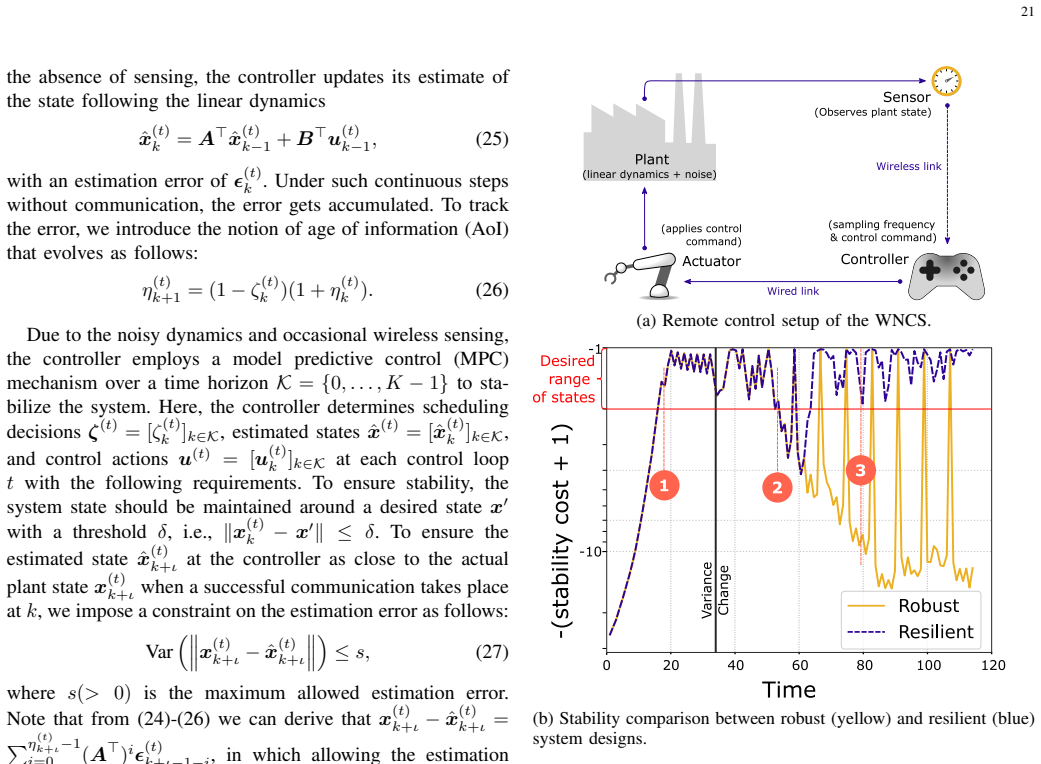
The load-bearing mechanism is STL-based resilience, defined by the formula $R_{\alpha,\beta}(\varphi) = \neg\varphi\,\mathcal{U}_{[0,\alpha]}\,\mathcal{G}_{[0,\beta]}\,\varphi$, where $\mathcal{U}_{[0,\alpha]}$ means 'until within $\alpha$ time units' and $\mathcal{G}_{[0,\beta]}$ means 'always for $\beta$ time units.' This formula turns recoverability and durability into quantitative optimization objectives that can be compiled into control and scheduling constraints. The paper also relies on a set of agent primitives—sensing, computation and storage, reasoning/planning, and communication—and on abstraction, anticipation, and adaptation as the loop that keeps world models aligned with reality; compositionality provides the algebraic rules by which individual non-resilient agents combine into a resilient network.
What would settle it
A concrete test: run the STL-based remote control use case of Section V-A under a stressor that alternates between two modes on a timescale shorter than any feasible recovery window $\alpha$; if no fixed $(\alpha,\beta)$ keeps the violation probability below the promised $\epsilon$, then the fixed-window formula is not a complete description of resilience.
Extended reading notes
Core claim
The paper's central claim is that resilience is a distinct and formalizable system property: the ability to violate a required behavior for at most $\alpha$ time units and then comply with it for at least $\beta$ time units, written $R_{\alpha,\beta}(\varphi) = \neg\varphi\,\mathcal{U}_{[0,\alpha]}\,\mathcal{G}_{[0,\beta]}\,\varphi$. The authors assert that robustness and reliability only cover known unknowns, while resilience covers unknown unknowns through online detection, world-model updating, and reconfiguration. They define the minimal agent primitives and claim that resilient behavior emerges from composing heterogeneous agents via belief alignment, sheaf-theoretic consistency, or motif-level structure. The eight use cases are offered as demonstrations that such resilient designs outperform robustness-oriented designs when stressors change type, become correlated, or attack adaptively.
Load-bearing premise
The framework assumes that every network element is an agent with sensing, computation, storage, reasoning/planning, and communication, and that any disruption can be described as a bounded-time violation followed by a required good-behavior window; if a real node lacks a primitive or a real stressor does not fit that temporal shape, the formalization and the use-case conclusions do not transfer.
Editorial extensions
If this is right
- 6G capability targets could be expressed as (recoverability, durability) operating points, just as the paper maps resilience-oriented and robustness-oriented designs onto IMT-2030 capabilities.
- A fixed energy budget would shift from static over-provisioning toward detection, estimation, and reconfiguration resources, changing how redundancy and adaptability are traded off.
- Resilience guarantees could be made checkable: STL formulas turn informal 'bounce back' promises into constraints that a controller or scheduler must satisfy with a given probability.
- Network topology would enter the design loop as a first-class variable, since motif distributions, connectivity density, and replication thresholds determine whether a distributed learning system recovers after node or link loss.
- Cooperation between agents can make the whole more resilient than its parts: composing heterogeneous beliefs or learning sheaf restriction maps lets the network survive sensor loss that defeats each agent individually.
Reading between the lines
- Beyond the paper's wireless use cases, the same recover-within-$\alpha$, sustain-for-$\beta$ specification could be ported to power grids, transport, or cloud infrastructure, where recovery time objectives already exist but are rarely tied to a formal logic.
- A testable extension would be to benchmark how recovery time scales with the number of composed agents under correlated sensory failures, comparing geometric-mean belief composition against plain averaging.
- The framework implies a resource law that an experiment could check: for a fixed energy budget, resilient design should beat robust design once the probability of unmodeled stressor changes exceeds the ratio of reconfiguration cost to over-provisioning cost.
- One could extend the STL semantics to adaptive windows $(\alpha_t,\beta_t)$ that shrink as detection improves, which the paper does not develop but which would handle stressors that keep shifting over time.
Editorial analysis
A structured set of objections, weighed in public.
Referee Report
Summary. This manuscript is a survey/position paper arguing that resilience should be a first-class design objective for next-generation (6G and beyond) wireless systems, distinct from reliability and robustness. It conceptualizes resilience along two axes, elasticity (bouncing back to a preferred state) and plasticity (reconfiguring internal structures and world models under unknown stressors), and proposes four foundational questions concerning abstraction/anticipation/adaptation, compositional emergence, formal verification, and higher-order network interactions. The paper then catalogues resilience metrics and trade-offs, reviews eight mathematical tools (signal temporal logic, epistemic logic, network motifs, replication-based distributed learning, copulas, persistence diagrams, compositional active inference, and sheaf theory), and reports numerical use cases that compare robust and resilient designs in remote control, distributed learning, drone swarms, network reconfiguration, link-level inference, multi-agent bandits, mmWave beam prediction, and multi-agent exploration. The stated goal is to establish a unified foundation for understanding, modeling, and engineering resilience in wireless communication systems.
Significance. If the technical content were fully supported, the paper would provide a valuable synthesis of a fragmented literature and a useful roadmap for resilient-by-design 6G. Its strengths are the clear conceptual disambiguation of resilience from robustness and reliability, the explicit mapping of mathematical tools to resilience dimensions, the concrete use cases that connect abstract formalisms to wireless problems, and the candid identification of open problems, notably in Section II-B1. The paper does not ship code or machine-checked proofs, so the burden falls on the clarity and correctness of its formal statements and on the statistical support for its numerical comparisons. As it stands, the paper is best viewed as an agenda and toolbox rather than a rigorous unified foundation; its significance as a foundational contribution is conditional on substantial revision.
major comments (5)
- [IV-A, Eq. (4); V-A, Eq. (29)] The formal definition R_{α,β}(φ) = ¬φ U_{[0,α]} G_{[0,β]} φ is false at every time t at which φ already holds, because the leading ¬φ is evaluated at the current time. Thus Eq. (4) does not express “if a violation occurs, the system recovers within α and then remains durable for β”; it only detects a violation that is currently underway. This is not a purely cosmetic issue: in the WNCS use case, the constraint P[x̂_k^{(t)} ⊭ R_{α,β}(|x̂_k^{(t)}−x′| ≤ δ)] ≤ ε in Eq. (29) is violated with probability 1 whenever the estimated state lies inside the desired bound, making the resilient formulation unsatisfiable in nominal operation. The authors should replace Eq. (4) with an implication- or always-based formulation, or explicitly restrict evaluation to violation epochs, and then re-derive the use-case constraint.
- [II-B1, IV-A, V-A, V-H] Eq. (4) and the associated optimization in Eq. (29) formalize only elastic recovery under a fixed specification φ and fixed windows α, β. The abstract and Section II-A3 make plasticity central: agents are supposed to expand their states, hypotheses, and world models through real-time adaptation and reconfiguration under unknown stressors. Eq. (4) supplies no mechanism or semantics for revising φ, α, or β online. The paper itself concedes in Section II-B1 that standard STL formulations assume a known stressor and that “frameworks must be extended to address A3.” Use case V-A (stressor-model change) and use case V-H (environmental label permutation) require exactly this extension, yet they are presented as if they instantiate the formal framework. The authors should either restrict the unified-foundation claim to elasticity and treat plasticity as an explicitly open problem, or extend the STL semantics (e.g., with dynamic/adaptive specifications) and show how the plasticity use cases instantiate that extension.
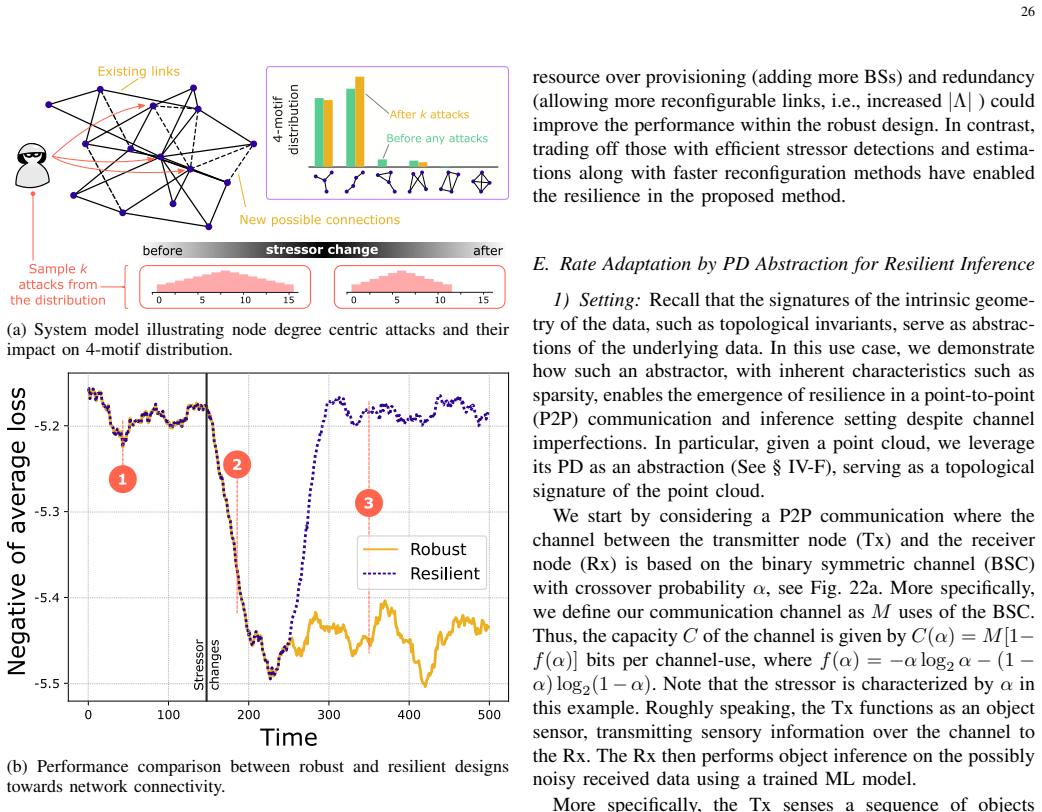
- [Abstract, I-B, IV, V] The abstract and Section I-B promise a “unified foundation for understanding, modeling, and engineering resilience,” but Sections IV and V present eight largely independent tools with no formal integration between them. There is no common ontology, no interface specification, and no composition rule connecting STL, Kripke models, motifs, replication, copulas, persistence diagrams, active inference, and sheaves; each use case applies exactly one tool. As it stands, the contribution is a taxonomy and a toolbox, not a unified foundation. The authors should either clearly state that the paper provides complementary foundations rather than a unified one, or add a section showing how the formalisms compose, for example by defining how a sheaf of STL specifications or a copula-based active-inference model fits into a single framework.
- [IV-G, V-H] The claim in Section IV-G that “resilience emerges as a property of the system through this structured composition of diverse beliefs” is asserted rather than derived. Eq. (21) is a geometric-mean gossip update; the paper gives no theorem, counterexample, or precise condition under which composing non-resilient agents yields a resilient system, even though Q2 explicitly asks “Under which conditions does network resilience emerge out of its individual (and possibly non-resilient) components?” The experiment in Fig. 25 illustrates one favorable instance, but it does not establish the general compositionality claim. The authors should either provide a formal compositionality result (or a precise conjecture with stated conditions) or soften the emergence claim to an empirically demonstrated phenomenon.
- [I-B, V (Figs. 20, 22, 23, 24, 25)] The claim of “detailed numerical validations” in Section I-B is not supported by the reporting. Several robust-versus-resilient comparisons are shown as single curves without error bars or repetitions: Fig. 20b (coverage ratio), Fig. 22b (inference accuracy), Fig. 23b (average reward), Fig. 24 (test accuracy), and Fig. 25b (belief accuracy). In stochastic settings involving random channel errors, random failures, and random attacks, single trajectories can be misleading and the reported advantage of resilient designs may not be statistically significant. The authors should report means and variances over repeated seeds, or explicitly label the figures as illustrative single runs; without this, the quantitative comparison between robust and resilient designs is not established.
minor comments (5)
- [III, III-B3, IV-F, V-D, V-E] There are several typographical errors: “as as well” in the introduction to Section III, “tigger” in Section III-B3, “disucss” in Section IV-F, “choice os” in Section V-D, and “a the minimum classification accuracy” in Section V-E.
- [IV-D] The notation in the replication-based learning section is confusing: the random variable is defined as R_i, but the text later says “using Ri” without subscript formatting; the variable N_t for the number of active random walks is used before it is properly introduced; and the threshold ε is described only qualitatively, with no guidance on how to set it beyond the trade-off discussion.
- [Fig. 11 caption] The caption “N=50, p=0.1 N=200, p=0.1 N=50, p=0.8” should separate the three settings with commas or semicolons, and the order of the panels should match the order in the caption.
- [V-H] The accuracy metric in Fig. 25b is not defined; the authors should state whether it is per-cell classification accuracy of the belief distribution and how the categorical belief is scored against the ground-truth label.
- [IV-A] In Eq. (4), the interval semantics of G_{[0,β]} relative to the time at which the until condition becomes true should be stated explicitly, so that the reader can relate the recovery time t_r to the start of the durability interval without ambiguity.
Circularity Check
No circularity: the paper is a survey/toolkit paper whose formal results are standard definitions and whose use cases are externally validated demonstrations.
full rationale
The paper does not derive a central new result from assumptions that contain it. Equation (4), R_{α,β}(φ) = ¬φ U_{[0,α]} G_{[0,β]} φ, is explicitly adopted from prior work [92] as a formal definition of recoverability and durability, not derived from the paper's own framework. The use cases apply known tools—STL, active inference, copulas, persistence diagrams, sheaf theory, epistemic logic—to concrete settings with external datasets (MNIST, CIFAR-10, DeepSense) and compare resilient against robust baselines in simulation; no fitted parameter is relabeled as a prediction and no result is forced by construction. Self-citations such as [19], [55], [58], and [68] appear as contextual or technique references, but they are not invoked as uniqueness theorems, not used to forbid alternatives, and the paper's conclusions do not reduce to those citations. The paper also explicitly concedes in Section II-B1 that standard STL formulations assume a known stressor and that frameworks must be extended to address A3, and Section II repeatedly flags open problems; these are honest limitations rather than circular maneuvers. The claim of a unified foundation is a conceptual synthesis, not a derivation whose output equals its input. Accordingly, no significant circularity is present.
Assumptions & free parameters
free parameters (6)
- STL recovery and durability windows α, β =
α=20, β=10
- Replication threshold ε =
1.6
- Drone swarm redundancy factor α =
0.3
- Drone swarm worst-case failures K =
5
- Safety weight β =
0.7
- BSC uses M =
6035
assumptions (5)
- domain assumption Agents are endowed with sensing, computation, storage, reasoning/planning, and communication primitives.
- ad hoc to paper Resilience can be characterized by recoverability and durability relative to a specification φ.
- standard math Standard mathematical background in Sklar's theorem, STL semantics, Kripke semantics, copula properties, persistent homology, sheaf theory, and active inference.
- domain assumption Composing local beliefs via geometric mean yields globally resilient inference.
- domain assumption Stressors can be detected through hypothesis testing on observable errors.
Cite this review
Pith. "Pith review of Resilient-Native and Intelligent Next-Generation Wireless Systems: Key Enablers, Foundations, and Applications." pith.science (2026). https://pith.science/paper/TFV3P775
@misc{pith2026250622991,
  author       = {Pith},
  title        = {Pith review of: Resilient-Native and Intelligent Next-Generation Wireless Systems: Key Enablers, Foundations, and Applications},
  year         = {2026},
  howpublished = {\url{https://pith.science/paper/TFV3P775}},
  note         = {Machine review of arXiv:2506.22991}
}
read the original abstract
Just like power, water, and transportation systems, wireless networks are a crucial societal infrastructure. As natural and human-induced disruptions continue to grow, wireless networks must be resilient. This requires them to withstand and recover from unexpected adverse conditions, shocks, unmodeled disturbances and cascading failures. Unlike robustness and reliability, resilience is based on the understanding that disruptions will inevitably happen. Resilience, as elasticity, focuses on the ability to bounce back to favorable states, while resilience as plasticity involves agents and networks that can flexibly expand their states and hypotheses through real-time adaptation and reconfiguration. This situational awareness and active preparedness, adapting world models and counterfactually reasoning about potential system failures and the best responses, is a core aspect of resilience. This article will first disambiguate resilience from reliability and robustness, before delving into key mathematical foundations of resilience grounded in abstraction, compositionality and emergence. Subsequently, we focus our attention on a plethora of techniques and methodologies pertaining to the unique characteristics of resilience, as well as their applications through a comprehensive set of use cases. Ultimately, the goal of this paper is to establish a unified foundation for understanding, modeling, and engineering resilience in wireless communication systems, while laying a roadmap for the next-generation of resilient-native and intelligent wireless systems.
Figures


Figures from the paper (22 more)










Forward citations
Cited by 1 Pith paper
-
From Metric to Mechanism: Designing Wireless Resilience through Finite Blocklength Dynamics
A virtual-queue resilience metric and a two-phase beamforming/RIS/blocklength optimizer that make transmission time a resource for recovering from wireless disruptions.
Reference graph
Works this paper leans on
-
[1]
Resilience-by-design in 6G networks: Literature review and novel enabling concepts,
L. Khaloopour, Y . Su, F. Raskob, T. Meuser, R. Bless, L. Janzen, K. Abedi, M. Andjelkovic, H. Chaari, P. Chakraborty, et al. , “Resilience-by-design in 6G networks: Literature review and novel enabling concepts,” IEEE access, 2024
2024
-
[2]
Universal resilience patterns in complex networks—analysis of the paper by Gao, Barzel, and Barab ´asi,
V . Vesterby, “Universal resilience patterns in complex networks—analysis of the paper by Gao, Barzel, and Barab ´asi,” Oct 2022
2022
-
[3]
Toward resilience in mixed critical industrial control systems: A multi-disciplinary view,
R.-J. Reifert, M. Krawczyk-Becker, L. Prenzel, S. Pavlichkov, M. A. Khatib, S. A. Hiremath, M. Al-Askary, N. Bajcinca, S. Steinhorst, and A. Sezgin, “Toward resilience in mixed critical industrial control systems: A multi-disciplinary view,”IEEE Access, vol. 10, pp. 124563– 124581, 2022
2022
-
[4]
IMT framework for 2030 and beyond
A. Weissberger, “IMT framework for 2030 and beyond.” https://techblog.comsoc.org/tag/imt-framework-for-2030-and-beyond/,
-
[5]
China’s MIIT to prioritize 6G project, accelerate 5G and gigabit optical network deployments
China MIIT, “China’s MIIT to prioritize 6G project, accelerate 5G and gigabit optical network deployments.” https://techblog.comsoc.org/2023/01/17/chinas-miit-to-prioritize- 6g-project-accelerate-5g-and-gigabit-optical-network-deployments/,
2023
-
[6]
Resiliency for 6G will be crucial, once it’s defined
“Resiliency for 6G will be crucial, once it’s defined.” https://spectrum. ieee.org/6g-resiliency
-
[7]
IEEE ComSoc Technology Blog, posted January 17, 2023
2023
-
[8]
A metric and frameworks for resilience anal- ysis of engineered and infrastructure systems,
R. Francis and B. Bekera, “A metric and frameworks for resilience anal- ysis of engineered and infrastructure systems,” Reliability Engineering & System Safety , vol. 121, p. 90–103, 01 2014
2014
Show all 133 references
-
[9]
Ultrareliable and low-latency wireless communication: Tail, risk, and scale,
M. Bennis, M. Debbah, and H. V . Poor, “Ultrareliable and low-latency wireless communication: Tail, risk, and scale,” Proceedings of the IEEE, vol. 106, no. 10, pp. 1834–1853, 2018
2018
-
[10]
Early-warning signals for critical transitions,
M. Scheffer, J. Bascompte, W. A. Brock, V . Brovkin, S. R. Carpenter, V . Dakos, H. Held, E. H. Van Nes, M. Rietkerk, and G. Sugi- hara, “Early-warning signals for critical transitions,” Nature, vol. 461, no. 7260, pp. 53–59, 2009
2009
-
[11]
Venkatesh ramaswamy,
“Venkatesh ramaswamy, ”keynote speech - a look at future network design through the eyes of the phoenix,” 2nd future network security: Challenges and opportunities workshop, virtual, 14-15 march 2023..”
2023
-
[12]
Resilience-based network component importance measures,
K. Barker, J. E. Ramirez-Marquez, and C. M. Rocco, “Resilience-based network component importance measures,” Reliability Engineering & System Safety, vol. 117, pp. 89–97, 2013
2013
-
[13]
Generic indicators for loss of resilience before a tipping point leading to population collapse,
L. Dai, D. V orselen, K. S. Korolev, and J. Gore, “Generic indicators for loss of resilience before a tipping point leading to population collapse,” Science, vol. 336, no. 6085, pp. 1175–1177, 2012
2012
-
[14]
A resilience optimization model for transportation networks under disasters,
T.-Y . Liao, T.-Y . Hu, and Y .-N. Ko, “A resilience optimization model for transportation networks under disasters,” Natural hazards, vol. 93, pp. 469–489, 2018
2018
-
[15]
Resilience-based component importance measures for critical infrastructure network systems,
Y .-P. Fang, N. Pedroni, and E. Zio, “Resilience-based component importance measures for critical infrastructure network systems,” IEEE Transactions on Reliability , vol. 65, no. 2, pp. 502–512, 2016
2016
-
[16]
Universal resilience patterns in complex networks,
J. Gao, B. Barzel, and A.-L. Barab ´asi, “Universal resilience patterns in complex networks,” Nature, vol. 530, no. 7590, pp. 307–312, 2016
2016
-
[17]
Resilience and survivability in commu- nication networks: Strategies, principles, and survey of disciplines,
J. P. Sterbenz, D. Hutchison, E. K. C ¸ etinkaya, A. Jabbar, J. P. Rohrer, M. Sch ¨oller, and P. Smith, “Resilience and survivability in commu- nication networks: Strategies, principles, and survey of disciplines,” Computer Networks , vol. 54, no. 8, pp. 1245–1265, 2010. Resil...
2010
-
[18]
Towards resilience: Primal large-scale re-optimization,
Y . Wu, I. El Hallaoui, F. Soumis, et al. , “Towards resilience: Primal large-scale re-optimization,” Transportation Research Part E: Logistics and Transportation Review, vol. 192, p. 103819, 2024
2024
-
[19]
Understanding resilience optimization archi- tectures: Alignment and coupling in multilevel decomposition strate- gies,
D. Hulse and C. Hoyle, “Understanding resilience optimization archi- tectures: Alignment and coupling in multilevel decomposition strate- gies,” Journal of Mechanical Design, vol. 144, no. 11, p. 111704, 2022
2022
-
[20]
Resilience and criticality: Brothers in arms for 6G,
R.-J. Reifert, Y . Karacora, C. Chaccour, A. Sezgin, and W. Saad, “Resilience and criticality: Brothers in arms for 6G,” 2024
2024
-
[21]
Resilient-by-design: A resiliency framework for future wireless networks,
N. H. Mahmood, S. Samarakoon, P. Porambage, M. Bennis, and M. Latva-aho, “Resilient-by-design: A resiliency framework for future wireless networks,” 2024
2024
-
[22]
Resilience and active inference,
M. Miller, M. Albarracin, R. J. Pitliya, A. Kiefer, J. Mago, C. Gorman, K. J. Friston, and M. J. Ramstead, “Resilience and active inference,” Frontiers in psychology, vol. 13, p. 1059117, 2022
2022
-
[23]
Rings II report
“Rings II report.” https://rings-vo.org/wp-content/uploads/2024/12/ NSF-RINGS-Virtual-Organization-PI-Meeting-Report July2024 Yorktown-Heights NY .pdf
2024
-
[24]
Security and resilience in 5G: Current challenges and future directions,
G. Arfaoui, J. M. S. Vilchez, and J.-P. Wary, “Security and resilience in 5G: Current challenges and future directions,” in 2017 IEEE Trust- com/BigDataSE/ICESS, pp. 1010–1015, IEEE, 2017
2017
-
[25]
B. J. Cottam, E. A. Specking, C. A. Small, E. Pohl, G. S. Parnell, and R. K. Buchanan, Defining resilience for engineered systems , vol. 8. Canadian Center of Science and Education Toronto, ON, Canada, 2019
2019
-
[26]
How physicality enables trust: A new era of trust-centered cyberphysical systems,
S. Gil, M. Yemini, A. Chorti, A. Nedi ´c, H. V . Poor, and A. J. Goldsmith, “How physicality enables trust: A new era of trust-centered cyberphysical systems,” arXiv preprint arXiv:2311.07492 , 2023
2023 arXiv
-
[27]
Context-aware security for 6G wireless: The role of physical layer security,
A. Chorti, A. N. Barreto, S. K ¨opsell, M. Zoli, M. Chafii, P. Sehier, G. Fettweis, and H. V . Poor, “Context-aware security for 6G wireless: The role of physical layer security,” IEEE Communications Standards Magazine, vol. 6, no. 1, pp. 102–108, 2022
2022
-
[28]
Resilient critical infras- tructure: Bayesian network analysis and contract-based optimization,
A. Eldosouky, W. Saad, and N. Mandayam, “Resilient critical infras- tructure: Bayesian network analysis and contract-based optimization,” Reliability Engineering & System Safety , vol. 205, p. 107243, 2021
2021
-
[29]
Design and assessment methodology for system resilience metrics,
M. Najarian and G. J. Lim, “Design and assessment methodology for system resilience metrics,” Risk Analysis, vol. 39, no. 9, pp. 1885–1898, 2019
2019
-
[30]
A vision of 6G wireless systems: Applications, trends, technologies, and open research problems,
W. Saad, M. Bennis, and M. Chen, “A vision of 6G wireless systems: Applications, trends, technologies, and open research problems,” IEEE Network, vol. 34, no. 3, pp. 134–142, 2020
2020
-
[31]
A resilience perspective on c- v2x communication networks under imperfect csi,
T. Shui, W. Saad, and M. Chen, “A resilience perspective on c- v2x communication networks under imperfect csi,” arXiv preprint arXiv:2411.10925, 2024
2024 arXiv
-
[32]
AI-native wireless networks,
Next G Alliance, “AI-native wireless networks,” tech. rep., The Al- liance for Telecommunications Industry Solutions (ATIS), 04 2023
2023
-
[33]
The roadmap to 6G: AI empowered wireless networks,
K. B. Letaief, W. Chen, Y . Shi, J. Zhang, and Y .-J. A. Zhang, “The roadmap to 6G: AI empowered wireless networks,” IEEE communica- tions magazine, vol. 57, no. 8, pp. 84–90, 2019. 33
2019
-
[34]
Defining AI native: A key enabler for advanced intelligent telecom networks,
M. Iovene, L. Jonsson, D. Roeland, M. D’Angelo, G. Hall, M. Erol- Kantarci, and J. Manocha, “Defining AI native: A key enabler for advanced intelligent telecom networks,” tech. rep., Ericsson, 2023
2023
-
[35]
Toward a 6G AI-native air interface,
J. Hoydis, F. A. Aoudia, A. Valcarce, and H. Viswanathan, “Toward a 6G AI-native air interface,” tech. rep., Nokia Bell Labs, 2021
2021
-
[36]
Path integrals, particular kinds, and strange things,
K. Friston, L. Da Costa, D. A. Sakthivadivel, C. Heins, G. A. Pavliotis, M. Ramstead, and T. Parr, “Path integrals, particular kinds, and strange things,” Physics of Life Reviews , vol. 47, pp. 35–62, 2023
2023
-
[37]
A free energy principle for the brain,
K. Friston, J. Kilner, and L. Harrison, “A free energy principle for the brain,” Journal of Physiology-Paris , vol. 100, no. 1, pp. 70–87,
-
[38]
On the principles of parsimony and self-consistency for the emergence of intelligence,
Y . Ma, D. Tsao, and H.-Y . Shum, “On the principles of parsimony and self-consistency for the emergence of intelligence,” 2022
2022
-
[39]
Closed-loop data transcription to an ldr via minimaxing rate reduction,
X. Dai, S. Tong, M. Li, Z. Wu, M. Psenka, K. H. R. Chan, P. Zhai, Y . Yu, X. Yuan, H. Y . Shum,et al., “Closed-loop data transcription to an ldr via minimaxing rate reduction,” arXiv preprint arXiv:2111.06636 , 2021
2021 arXiv
-
[40]
An internal model principle for robots,
V . K. Weinstein, T. Alshammari, K. G. Timperi, M. Bennis, and S. M. LaValle, “An internal model principle for robots,” CoRR, vol. abs/2406.11237, 2024
2024 arXiv
-
[41]
Semantic compression with information lattice learning,
H. Yu and L. R. Varshney, “Semantic compression with information lattice learning,” in 2024 IEEE International Symposium on Informa- tion Theory Workshops (ISIT-W) , pp. 1–6, 2024
2024
-
[42]
Human-level concept learning through probabilistic program induction,
B. M. Lake, R. Salakhutdinov, and J. B. Tenenbaum, “Human-level concept learning through probabilistic program induction,” Science, vol. 350, no. 6266, pp. 1332–1338, 2015
2015
-
[43]
Diffusion of information on networked lattices by gossip,
H. Riess and R. Ghrist, “Diffusion of information on networked lattices by gossip,” in 2022 IEEE 61st Conference on Decision and Control (CDC), pp. 5946–5952, 2022
2022
-
[44]
Gflownet foundations,
Y . Bengio, S. Lahlou, T. Deleu, E. J. Hu, M. Tiwari, and E. Bengio, “Gflownet foundations,” 2023
2023
-
[45]
R. S. Sutton, A. G. Barto, et al., Reinforcement learning: An introduc- tion. MIT press Cambridge, 2nd ed., 2018
2018
-
[46]
Discrete, compositional, and symbolic representations through attractor dynamics,
A. Nam, E. Elmoznino, N. Malkin, J. McClelland, Y . Bengio, and G. Lajoie, “Discrete, compositional, and symbolic representations through attractor dynamics,” arXiv:2310.01807, 2024
2024 arXiv
- [47]
-
[48]
A path towards autonomous machine intelligence version 0.9. 2, 2022-06-27,
Y . LeCun, “A path towards autonomous machine intelligence version 0.9. 2, 2022-06-27,” Open Review, vol. 62, 2022
2022
-
[50]
V-jepa 2: Self- supervised video models enable understanding, prediction and plan- ning,
M. Assran, A. Bardes, D. Fan, Q. Garrido, R. Howes, M. Muckley, A. Rizvi, C. Roberts, K. Sinha, A. Zholus, et al. , “V-jepa 2: Self- supervised video models enable understanding, prediction and plan- ning,” arXiv preprint arXiv:2506.09985 , 2025
2025 arXiv
-
[51]
Planning as theorem proving with heuristics,
M. Soutchanski and R. Young, “Planning as theorem proving with heuristics,” arXiv:2303.13638, 2023
2023 arXiv
-
[52]
Self-supervised learning from images with a joint-embedding predictive architecture,
M. Assran, Q. Duval, I. Misra, P. Bojanowski, P. Vincent, M. Rabbat, Y . LeCun, and N. Ballas, “Self-supervised learning from images with a joint-embedding predictive architecture,” in Proceedings of the IEEE/CVF Conference on Computer Vision and Pattern Recognition , pp. 1561...
2023
-
[53]
Semantic composition with quotient algebras,
D. Clarke, R. Lutz, and D. Weir, “Semantic composition with quotient algebras,” in Proceedings of the 2010 Workshop on GEometrical Models of Natural Language Semantics , pp. 38–44, 2010
2010
-
[54]
G. E. Bredon, Sheaf Theory, vol. 170 of Graduate Texts in Mathemat- ics. New York: Springer-Verlag, second ed., 1997
1997
-
[55]
Fully abstract compositional semantics for an algebra of logic programs,
A. Brogi and F. Turini, “Fully abstract compositional semantics for an algebra of logic programs,” Theoretical Computer Science , vol. 149, no. 2, pp. 201–229, 1995
1995
-
[56]
Shared protentions in multi-agent active inference,
M. Albarracin, R. J. Pitliya, T. St. Clere Smithe, D. A. Friedman, K. Friston, and M. J. D. Ramstead, “Shared protentions in multi-agent active inference,” Entropy, vol. 26, no. 4, 2024
2024
-
[57]
An STL-based approach to resilient control for cyber-physical systems,
H. Chen, S. A. Smolka, N. Paoletti, and S. Lin, “An STL-based approach to resilient control for cyber-physical systems,” in Proceed- ings of the 26th ACM International Conference on Hybrid Systems: Computation and Control , pp. 1–12, 2023
2023
-
[58]
Tackling feature and sample heterogeneity in decentralized multi-task learning: A sheaf- theoretic approach,
C. B. Issaid, P. Vepakomma, and M. Bennis, “Tackling feature and sample heterogeneity in decentralized multi-task learning: A sheaf- theoretic approach,” 2025
2025
-
[59]
Can large language models reason and plan?,
S. Kambhampati, “Can large language models reason and plan?,” Annals of the New York Academy of Sciences , vol. 1534, p. 15–18, Mar. 2024
2024
-
[60]
Category-theoretical and topos- theoretical frameworks in machine learning: A survey,
Y . Jia, G. Peng, Z. Yang, and T. Chen, “Category-theoretical and topos- theoretical frameworks in machine learning: A survey,” arXiv preprint arXiv:2408.14014, 2024
2024 arXiv
-
[61]
Semantic and logical communication-control codesign for correlated dynamical systems,
A. M. Girgis, H. Seo, J. Park, and M. Bennis, “Semantic and logical communication-control codesign for correlated dynamical systems,” IEEE Internet of Things Journal , vol. 11, no. 7, pp. 12631–12648, 2024
2024
-
[62]
Network motifs: simple building blocks of complex net- works,
R. Milo, S. Shen-Orr, S. Itzkovitz, N. Kashtan, D. Chklovskii, and U. Alon, “Network motifs: simple building blocks of complex net- works,” Science, vol. 298, no. 5594, pp. 824–827, 2002
2002
-
[63]
Copula theory: an introduction,
F. Durante and C. Sempi, “Copula theory: an introduction,” in Copula Theory and Its Applications: Proceedings of the Workshop Held in Warsaw, 25-26 September 2009, pp. 3–31, Springer, 2010
2009
-
[64]
What network motifs tell us about resilience and reliability of complex networks,
A. K. Dey, Y . R. Gel, and H. V . Poor, “What network motifs tell us about resilience and reliability of complex networks,” Proceedings of the National Academy of Sciences , vol. 116, no. 39, pp. 19368–19373, 2019
2019
-
[65]
Extracting insights from the shape of complex data using topology,
P. Y . Lum, G. Singh, A. Lehman, T. Ishkanov, M. Vejdemo-Johansson, M. Alagappan, J. Carlsson, and G. Carlsson, “Extracting insights from the shape of complex data using topology,” Scientific reports, vol. 3, no. 1, p. 1236, 2013
2013
-
[66]
Persistence homology of networks: methods and applications,
M. E. Aktas, E. Akbas, and A. E. Fatmaoui, “Persistence homology of networks: methods and applications,” Applied Network Science, vol. 4, no. 1, pp. 1–28, 2019
2019
-
[67]
An introduction to topological data analysis: fundamental and practical aspects for data scientists,
F. Chazal and B. Michel, “An introduction to topological data analysis: fundamental and practical aspects for data scientists,” Frontiers in artificial intelligence, vol. 4, p. 667963, 2021
2021
-
[68]
From raw data to structural semantics: Trade-offs among distortion, rate, and inference accuracy,
C. Asirimath, C. Weeraddana, S. Samarakoon, J. Ratnayake, and M. Bennis, “From raw data to structural semantics: Trade-offs among distortion, rate, and inference accuracy,” 2024
2024
-
[69]
Computational bifurcation analysis of multiparameter dynamical systems,
N. Ananthkrishnan, N. K. Gupta, and N. K. Sinha, “Computational bifurcation analysis of multiparameter dynamical systems,” Journal of guidance, control, and dynamics , vol. 32, no. 5, pp. 1651–1653, 2009
2009
-
[70]
Persistent homology of NBA lineups usage,
J. Wiseman, “Persistent homology of NBA lineups usage,” Journal of Sports Analytics, vol. 11, p. 22150218251324877, 2025
2025
-
[71]
T. M. Cover, Elements of information theory . John Wiley & Sons, 1999
1999
-
[72]
Basseville, I
M. Basseville, I. V . Nikiforov, et al. , Detection of abrupt changes: theory and application, vol. 104. Prentice hall Englewood Cliffs, 1993
1993
-
[73]
Multi-parametric optimization for controlling bifurcation structures,
A. M ´elot, E. Denimal, and L. Renson, “Multi-parametric optimization for controlling bifurcation structures,” Proceedings of the Royal Society A, vol. 480, no. 2283, p. 20230505, 2024
2024
-
[74]
A mathematical theory of communication,
C. E. Shannon, “A mathematical theory of communication,” The Bell system technical journal , vol. 27, no. 3, pp. 379–423, 1948
1948
-
[75]
Predictability, complexity, and learning,
W. Bialek, I. Nemenman, and N. Tishby, “Predictability, complexity, and learning,” Neural computation , vol. 13, no. 11, pp. 2409–2463, 2001
2001
-
[76]
R. B. Nelsen, An introduction to copulas . Springer, 2006
2006
-
[77]
Barcodes: the persistent topology of data,
R. Ghrist, “Barcodes: the persistent topology of data,” Bulletin of the American Mathematical Society , vol. 45, no. 1, pp. 61–75, 2008
2008
-
[78]
Chazal, V
F. Chazal, V . De Silva, M. Glisse, and S. Oudot, The structure and stability of persistence modules , vol. 10. Springer, 2016
2016
-
[79]
Topology and data,
G. Carlsson, “Topology and data,” Bulletin of the American Mathemat- ical Society, vol. 46, no. 2, pp. 255–308, 2009
2009
-
[80]
S. H. Strogatz, Nonlinear dynamics and chaos: with applications to physics, biology, chemistry, and engineering. Chapman and Hall/CRC, 2024
2024
-
[81]
Truhlar, Potential energy surfaces and dynamics calculations: For chemical reactions and molecular energy transfer
D. Truhlar, Potential energy surfaces and dynamics calculations: For chemical reactions and molecular energy transfer . Springer Science & Business Media, 2013
2013
-
[82]
Distributed function calculation via linear iterative strategies in the presence of malicious agents,
S. Sundaram and C. N. Hadjicostis, “Distributed function calculation via linear iterative strategies in the presence of malicious agents,” IEEE Transactions on Automatic Control , vol. 56, no. 7, pp. 1495–1508, 2010
2010
-
[83]
Guckenheimer and P
J. Guckenheimer and P. Holmes, Nonlinear oscillations, dynamical systems, and bifurcations of vector fields , vol. 42. Springer Science & Business Media, 2013
2013
-
[84]
Baier and J.-P
C. Baier and J.-P. Katoen, Principles of model checking . MIT press, 2008
2008
-
[85]
Levins, Evolution in changing environments: some theoretical explorations
R. Levins, Evolution in changing environments: some theoretical explorations. No. 2 in Monographs in Population Biology, Princeton University Press, 1968
1968
-
[86]
Common knowledge and update in finite environments,
R. Van Der Meyden, “Common knowledge and update in finite environments,” Information and Computation, vol. 140, no. 2, pp. 115– 157, 1998
1998
-
[87]
ITU-R framework for IMT-2030: Review and future direction,
NGMN Alliance, “ITU-R framework for IMT-2030: Review and future direction,” tech. rep., NGMN Alliance, 02 2024
2024
-
[88]
Monitoring temporal properties of con- tinuous signals,
O. Maler and D. Nickovic, “Monitoring temporal properties of con- tinuous signals,” in International Symposium on Formal Techniques in Real-Time and Fault-Tolerant Systems, pp. 152–166, Springer, 2004. 34
2004
-
[89]
Framework and overall objectives of the future development of IMT for 2030 and beyond,
ITU Radiocommunication Sector (ITU-R), “Framework and overall objectives of the future development of IMT for 2030 and beyond,” Tech. Rep. ITU-R M.2160-0, International Telecommunication Union, 2023
2023
-
[90]
Future technology trends of terrestrial international mobile telecommunications systems towards 2030 and beyond,
ITU Radio Communication Sector (ITU-R), “Future technology trends of terrestrial international mobile telecommunications systems towards 2030 and beyond,” Tech. Rep. ITU-R M.2516-0, International Telecom- munication Union, 2022
2022
-
[91]
Proceedings of the World Telecommunication Standardization Assembly WTSA- 24,
ITU Telecommunication Standardization Sector (ITU-T), “Proceedings of the World Telecommunication Standardization Assembly WTSA- 24,” tech. rep., International Telecommunication Union, New Delhi, India, 15-24 October 2024
2024
-
[92]
An STL-based formulation of resilience in cyber-physical systems,
H. Chen, S. Lin, S. A. Smolka, and N. Paoletti, “An STL-based formulation of resilience in cyber-physical systems,” in International Conference on Formal Modeling and Analysis of Timed Systems , pp. 117–135, Springer, 2022
2022
-
[93]
Model checking temporal epistemic logic,
A. Lomuscio and W. Penczek, “Model checking temporal epistemic logic,” van Ditmarsch et al.[29] , pp. 397–441, 2015
2015
-
[94]
Robust satisfaction of temporal logic over real-valued signals,
A. Donz ´e and O. Maler, “Robust satisfaction of temporal logic over real-valued signals,” in International Conference on Formal Modeling and Analysis of Timed Systems , pp. 92–106, Springer, 2010
2010
-
[95]
Dynamic properties of network motifs contribute to biological network organization,
R. J. Prill, P. A. Iglesias, and A. Levchenko, “Dynamic properties of network motifs contribute to biological network organization,” PLoS biology, vol. 3, no. 11, p. e343, 2005
2005
-
[96]
Improve the product structural robustness based on network motifs in product development,
Y . Ni, Y . Ou, Y . Li, and N. Zhang, “Improve the product structural robustness based on network motifs in product development,” Scientific Reports, vol. 12, no. 1, p. 10916, 2022
2022
-
[97]
Motifs enable com- munication efficiency and fault-tolerance in transcriptional networks,
S. Roy, P. Ghosh, D. Barua, and S. K. Das, “Motifs enable com- munication efficiency and fault-tolerance in transcriptional networks,” Scientific reports, vol. 10, no. 1, p. 9628, 2020
2020
-
[98]
Superfamilies of evolved and designed networks,
R. Milo, S. Itzkovitz, N. Kashtan, R. Levitt, S. Shen-Orr, I. Ayzenshtat, M. Sheffer, and U. Alon, “Superfamilies of evolved and designed networks,” Science, vol. 303, no. 5663, pp. 1538–1542, 2004
2004
-
[99]
Biological network comparison using graphlet degree distribution,
N. Pr ˇzulj, “Biological network comparison using graphlet degree distribution,” Bioinformatics, vol. 23, no. 2, pp. e177–e183, 2007
2007
-
[100]
Biological network motif detection: principles and practice,
E. Wong, B. Baur, S. Quader, and C.-H. Huang, “Biological network motif detection: principles and practice,” Briefings in bioinformatics , vol. 13, no. 2, pp. 202–215, 2012
2012
-
[101]
Distributed learn- ing over networks with graph-attention-based personalization,
Z. Tian, Z. Zhang, Z. Yang, R. Jin, and H. Dai, “Distributed learn- ing over networks with graph-attention-based personalization,” IEEE Transactions on Signal Processing , vol. 71, pp. 2071–2086, 2023
2023
-
[102]
Walk for learning: A random walk approach for federated learning from heterogeneous data,
G. Ayache, V . Dassari, and S. El Rouayheb, “Walk for learning: A random walk approach for federated learning from heterogeneous data,” IEEE Journal on Selected Areas in Communications , vol. 41, no. 4, pp. 929–940, 2023
2023
-
[103]
Distributed learning in wireless networks: Recent progress and future challenges,
M. Chen, D. G ¨und¨uz, K. Huang, W. Saad, M. Bennis, A. V . Feljan, and H. V . Poor, “Distributed learning in wireless networks: Recent progress and future challenges,” IEEE Journal on Selected Areas in Communications, vol. 39, no. 12, pp. 3579–3605, 2021
2021
-
[104]
Joe, Multivariate models and multivariate dependence concepts
H. Joe, Multivariate models and multivariate dependence concepts . CRC press, 1997
1997
-
[105]
A. J. McNeil, R. Frey, and P. Embrechts, Quantitative risk man- agement: concepts, techniques and tools-revised edition . Princeton university press, 2015
2015
-
[106]
Self-duplicating random walks for resilient decentralized learning on graphs,
M. Egger, G. Ayache, R. Bitar, A. Wachter-Zeh, and S. E. Rouayheb, “Self-duplicating random walks for resilient decentralized learning on graphs,” in GLOBECOM 2024 - 2024 IEEE Global Communications Conference, pp. 2960–2965, 2024
2024
-
[107]
Sur les tableaux de corr ´elation dont les marges sont donn´ees,
M. Fr ´echet, “Sur les tableaux de corr ´elation dont les marges sont donn´ees,” Ann. Univ. Lyon, 3ˆ e serie, Sciences, Sect. A, vol. 14, pp. 53– 77, 1951
1951
-
[108]
Masstabinvariante korrelationstheorie,
W. Hoeffding, “Masstabinvariante korrelationstheorie,” Schriften des Mathematischen Instituts und Instituts fur Angewandte Mathematik der Universitat Berlin, vol. 5, pp. 181–233, 1940
1940
-
[109]
Fonctions de r ´epartition `a n dimensions et leurs marges,
M. Sklar, “Fonctions de r ´epartition `a n dimensions et leurs marges,” in Annales de l’ISUP , vol. 8, pp. 229–231, 1959
1959
-
[110]
A semiparametric estimation procedure of dependence parameters in multivariate families of distri- butions,
C. Genest, K. Ghoudi, and L.-P. Rivest, “A semiparametric estimation procedure of dependence parameters in multivariate families of distri- butions,” Biometrika, vol. 82, no. 3, pp. 543–552, 1995
1995
-
[111]
Copula–based models for financial time series,
A. J. Patton, “Copula–based models for financial time series,” in Handbook of financial time series , pp. 767–785, Springer, 2009
2009
-
[112]
The estimation method of inference functions for margins for multivariate models,
H. Joe and J. J. Xu, “The estimation method of inference functions for margins for multivariate models,” Oct 1996
1996
-
[113]
The t copula and related copulas,
S. Demarta and A. J. McNeil, “The t copula and related copulas,” International statistical review , vol. 73, no. 1, pp. 111–129, 2005
2005
-
[114]
A model for association in bivariate life tables and its application in epidemiological studies of familial tendency in chronic disease incidence,
D. G. Clayton, “A model for association in bivariate life tables and its application in epidemiological studies of familial tendency in chronic disease incidence,” Biometrika, vol. 65, no. 1, pp. 141–151, 1978
1978
-
[115]
On default correlation: A copula function approach.,
D. Li, “On default correlation: A copula function approach.,” Journal of Fixed Income , vol. 9, no. 4, pp. 43–54, 2000
2000
-
[116]
On the simultaneous associativity of F (x, y) and x + y − F (x, y),
M. J. Frank, “On the simultaneous associativity of F (x, y) and x + y − F (x, y),” Aequationes mathematicae, vol. 19, pp. 194–226, 1979
1979
-
[117]
Probability density decomposition for conditionally dependent random variables modeled by vines,
T. Bedford and R. M. Cooke, “Probability density decomposition for conditionally dependent random variables modeled by vines,” Annals of Mathematics and Artificial intelligence , vol. 32, pp. 245–268, 2001
2001
-
[118]
Bivariate exponential distributions,
E. J. Gumbel, “Bivariate exponential distributions,” Journal of the American Statistical Association , vol. 55, no. 292, pp. 698–707, 1960
1960
-
[119]
Pair-copula construc- tions of multiple dependence,
K. Aas, C. Czado, A. Frigessi, and H. Bakken, “Pair-copula construc- tions of multiple dependence,” Insurance: Mathematics and economics, vol. 44, no. 2, pp. 182–198, 2009
2009
-
[120]
Czado, Analyzing Dependent Data with Vine Copulas: A Practical Guide With R
C. Czado, Analyzing Dependent Data with Vine Copulas: A Practical Guide With R . Springer, 2019
2019
-
[121]
Vines–a new graphical model for dependent random variables,
T. Bedford and R. M. Cooke, “Vines–a new graphical model for dependent random variables,” The Annals of Statistics , vol. 30, no. 4, pp. 1031–1068, 2002
2002
-
[122]
Edelsbrunner and J
H. Edelsbrunner and J. Harer, Computational topology: an introduction. American Mathematical Soc., 2010
2010
-
[123]
S. Y . Oudot, Persistence theory: from quiver representations to data analysis, vol. 209. American Mathematical Society Providence, 2015
2015
-
[124]
Topological estimation using witness complexes.,
V . De Silva and G. E. Carlsson, “Topological estimation using witness complexes.,” in PBG, pp. 157–166, 2004
2004
-
[125]
On distributionally robust chance- constrained linear programs,
G. C. Calafiore and L. E. Ghaoui, “On distributionally robust chance- constrained linear programs,” Journal of Optimization Theory and Applications, vol. 130, pp. 1–22, 2006
2006
-
[126]
Deep residual learning for image recognition,
K. He, X. Zhang, S. Ren, and J. Sun, “Deep residual learning for image recognition,” in Proc. IEEE CVPR , (Las Vegas, NV , USA), pp. 770– 778, June 2016
2016
-
[127]
Control design for risk-based signal temporal logic speci- fications,
S. Safaoui, L. Lindemann, D. V . Dimarogonas, I. Shames, and T. H. Summers, “Control design for risk-based signal temporal logic speci- fications,” IEEE Control Systems Letters, vol. 4, no. 4, pp. 1000–1005, 2020
2020
-
[128]
Multi-agent multi-armed bandits with limited communication,
M. Agarwal, V . Aggarwal, and K. Azizzadenesheli, “Multi-agent multi-armed bandits with limited communication,” Journal of Machine Learning Research, vol. 23, no. 212, pp. 1–24, 2022
2022
-
[129]
Analysis of thompson sampling for the multi-armed bandit problem,
S. Agrawal and N. Goyal, “Analysis of thompson sampling for the multi-armed bandit problem,” in Proceedings of the 25th Annual Conference on Learning Theory (S. Mannor, N. Srebro, and R. C. Williamson, eds.), vol. 23 of Proceedings of Machine Learning Re- search, (Edinburgh, S...
2012
-
[130]
The MNIST database of handwritten digit images for machine learning research,
L. Deng, “The MNIST database of handwritten digit images for machine learning research,” IEEE Signal Processing Magazine, vol. 29, no. 6, pp. 141–142, 2012
2012
-
[131]
Towards real-world 6G drone communication: Position and camera aided beam prediction,
G. Charan, A. Hredzak, C. Stoddard, B. Berrey, M. Seth, H. Nunez, and A. Alkhateeb, “Towards real-world 6G drone communication: Position and camera aided beam prediction,” in GLOBECOM 2022-2022 IEEE Global Communications Conference , pp. 2951–2956, IEEE, 2022
2022
-
[133]
Introduction to multi-armed bandits,
A. Slivkins, “Introduction to multi-armed bandits,” 2024
2024
-
[2006]
Theoretical and Computational Neuroscience: Understanding Brain Functions
-
[2023]
IEEE ComSoc Technology Blog, posted July 9, 2023
2023
Reviewed August 6, 2026 · model on record in the stance chip above.
Discussion (0). Continue with ORCID to comment.