REVIEW 3 major objections 5 minor 48 references
Boosting LLM's Molecular Structure Elucidation with Knowledge Enhanced Tree Search Reasoning
T0 review · 3 major / 5 minor · reviewed 2026-08-06 · deepseek-v4-flash
Pith's one-line read The paper claims that augmenting an LLM with a molecular substructure knowledge base, a contrastively trained molecule–spectrum scorer, and Monte Carlo Tree Search raises exact-match structural accuracy on MolPuzzle from 3.7% to 27.3%…
desk verdict A well-built integration of knowledge base, learned scorer, and MCTS for structure elucidation that reports large gains, but the headline numbers rest on test-set hyperparameter selection, so they need out-of-sample verification before being taken at face value. read the letter →
The pith
A machine-rendered reading of the paper's core claim, the machinery that carries it, and where it could break.
The reading
What carries the argument
The load-bearing mechanism is the molecule–spectrum scorer, a dual-encoder model whose cosine similarity $\mathrm{sim}(g_m(m), g_s(n))$ serves double duty: as the reward $R(a')$ that evaluates each new tree node (Eq. 12), and as the retrieval score that selects top-$k$ substructures from the knowledge base given the query spectrum (Eq. 8). The spectrum encoder $g_s$ discretizes the chemical shift, splitting pattern, and coupling constant of each carbon and hydrogen signal into token embeddings and runs them through a two-layer Transformer (Eqs. 5–6); the molecule encoder $g_m$ embeds the molecular graph with a 5-layer GIN and the Morgan+MACCS+RDK fingerprint with an MLP, then fuses them (Eq. 4). Training on 9,000 ZINC molecules with simulated C-NMR and H-NMR spectra uses the NT-Xent loss (Eq. 7). This scorer is the component that converts a generic self-refine loop into guided search, and the paper's ablations show that removing any of its inputs (graph, fingerprint, splitting pattern, or coupling constant) raises validation loss.
What would settle it
Measure the rank correlation between the K-MSE reward score and the ground-truth fingerprint similarity on all candidate molecules the search generates across the full MolPuzzle set; if the correlation drops to near zero on novel structures, as the authors find for the LLM-based scorer (0.03), the gains should vanish. A direct ablation that replaces R(a') with random or inverted scores, while keeping the search structure, knowledge base, and rewrite steps intact, would show whether the scorer's signal actually causes the 0.236/0.300 ACC jumps.
Extended reading notes
Core claim
On its own terms, the paper's discovery is that the bottleneck for LLMs in molecular structure elucidation is not reasoning effort but two specific knowledge deficits, and that both can be patched at inference time. First, an automatically constructed molecular substructure knowledge base, extracted from a 4M-molecule database with LLM-generated descriptions, widens the model's coverage of chemical space. Second, a specialized molecule–spectrum scorer—a molecule encoder (GIN over the molecular graph plus MLP over concatenated fingerprints) and a spectrum encoder (Transformer over tokenized chemical shifts, splitting patterns, and coupling constants)—is trained with the NT-Xent contrastive loss on 9,000 simulated NMR spectra from ZINC. The cosine similarity between molecule and spectrum embeddings becomes the reward in a Monte Carlo Tree Search whose expansion step critiques the current candidate using its rendered image and formula, then rewrites it. The paper reports that this combined system outperforms CoT, Self-Refine, Self-Consistency, multi-agent debate, and a prior MCTS self-refine method on the MolPuzzle benchmark, with the scorer's reward correlating at 0.53 with ground-truth fingerprint similarity, versus 0.03 for an LLM-based scorer. The knowledge base alone also improves every baseline method it is added to, indicating the components are independently useful.
Load-bearing premise
The entire gain rests on the molecule-spectrum scorer's cosine similarity being a trustworthy proxy for structural correctness on molecules the search encounters; if the scorer, trained only on simulated ZINC spectra, does not transfer to the benchmark's measured spectra, both knowledge retrieval and final answer selection are guided by noise and the reported improvements should disappear.
Editorial extensions
If this is right
- The same plugin lifts weaker open models: Llama-3.2-11B's exact-match ACC goes from 0.014 to 0.111, showing the gains are not exclusive to frontier LLMs.
- The knowledge base alone is a transferable ingredient: adding it to CoT, Self-Refine, Self-Consistency, MAD, and MCTSr on GPT-4o-mini improves every one of them, with CoT+KB more than tripling baseline ACC (0.037→0.111).
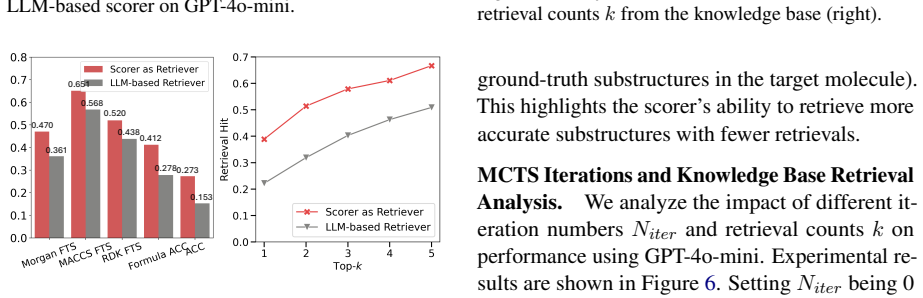
- Test-time compute is a direct dial: increasing MCTS iterations from 0 to 8 steadily improves accuracy before saturating, while retrieval count k has an optimum (k=1 on GPT-4o-mini, k=2 on GPT-4o) beyond which irrelevant substructures add noise.
- The specialized scorer beats an LLM-based retriever (BM25 over generated descriptions) by 0.120 ACC and 0.169 retrieval hit rate, so a learned spectrum–molecule embedding is also a better knowledge-base bridge.
- Since the scorer's reward correlates with oracle similarity at 0.53 while the LLM scorer is at 0.03, the paper ties its gains to fixing a self-affirmation bias in LLM self-evaluation.
Reading between the lines
- A natural extension is to treat the scorer's differentiable spectrum–molecule similarity as a training signal for the LLM itself (e.g., reinforcement learning or best-of-n distillation), which could compound the reported gains; the paper only uses the scorer at inference.
- The retrieval-plus-verifier pattern should transfer to other spectroscopic modalities (MS, UV-Vis, crystallography) wherever a simulator can generate paired spectra and structures, reusing the same two-encoder scorer and MCTS plugin without changing the LLM.
- The non-monotonic effect of retrieval count k hints that retrieved substructures can mislead the LLM when they conflict with the evidence; a testable refinement is to gate how many substructures the model sees by the scorer's retrieval confidence, or to allow a 'none of these' option.
- The near-zero correlation (0.03) between LLM self-evaluation and oracle similarity suggests that, without an external verifier, self-guided spectral reasoning by LLMs is close to its ceiling; beating the paper's 0.53 scorer correlation becomes a concrete benchmark for future verifiers.
Editorial analysis
A structured set of objections, weighed in public.
Referee Report
Summary. The manuscript introduces K-MSE, a plug-in reasoning framework for molecular structure elucidation. It combines a molecular substructure knowledge base, a learned molecule-spectrum scorer used as both retriever and reward model, and Monte Carlo Tree Search with Self-Refine. Experiments on the MolPuzzle benchmark with four base LLMs report large gains, notably ACC increases of 0.236 for GPT-4o-mini and 0.300 for GPT-4o. The paper also provides ablations of the knowledge base, the critique inputs, and scorer components, plus an analysis of token consumption.
Significance. If the reported gains are robust, the work is a useful contribution to test-time scaling for scientific reasoning: it demonstrates a concrete way to inject domain knowledge and a trained reward model into LLM inference, and it releases code and detailed implementation details that support reproducibility. The paper is also careful to include a Limitations section and extensive appendices with prompts and hyperparameters. However, the central quantitative claim currently rests on an evaluation protocol with no held-out hyperparameter selection and no statistical significance testing, which limits confidence in the headline improvements.
major comments (3)
- [§5.3, Appendix A.3, Figure 6] The hyperparameters Niter and k appear to be selected on the MolPuzzle test set itself. Section 5.3 states that the best performance on GPT-4o-mini occurs at k=1 and on GPT-4o at k=2, and Appendix A.3 then fixes these values for the main results in Table 1. Because MolPuzzle contains only 216 molecules, tuning even two hyperparameters on the evaluation set can fit noise rather than real signal, and the headline ACC gains (e.g., 0.037 to 0.273 for GPT-4o-mini) may be inflated by selection bias. The paper should either use a held-out validation split or cross-validation for hyperparameter selection, or report the full sensitivity grid over Niter and k for all models and show that the conclusions are stable across reasonable choices.
- [Table 1, §5.2] The abstract and Section 5.2 use the word "significantly" to describe the performance gains, but the evaluation reports no error bars, confidence intervals, or significance tests. With only 216 benchmark molecules, a single-run point estimate does not support the claim of statistical significance. The authors should report bootstrap confidence intervals for the metrics, a paired significance test (e.g., McNemar for ACC), or at least variance across multiple runs or random seeds. This is load-bearing because the central assertion is precisely that the gains are substantial and reliable.
- [§4.2, Appendix A.2, Eq. (12)] The molecule-spectrum scorer is trained on 9,000 simulated ZINC spectra and then used for both knowledge-base retrieval (Eq. 8) and MCTS reward (Eq. 12). The manuscript's evidence that this scorer transfers to real MolPuzzle spectra is limited to a validation-loss curve and the correlation shown in Figure 4 for GPT-4o-mini. Since the same scorer drives both retrieval and answer selection, a systematic bias in the scorer could be reinforced through the search. The authors should provide a more direct evaluation of scorer quality on MolPuzzle, such as the correlation between scorer reward and structural correctness for the candidate molecules actually encountered during MCTS, or an ablation replacing the scorer reward with an oracle similarity measure. This would strengthen the causal interpretation of the gains.
minor comments (5)
- [Eq. (7)] The loss in Eq. (7) is labeled NT-Xent, but the denominator as written sums only over negative cross-modal pairs and omits the positive pair; the standard NT-Xent form includes the positive in the denominator. Please clarify whether this is a typo or an intentional variant, and define the exact loss used in training.
- [Abstract, §5.2] The phrase "more than 20% improvement" is ambiguous because it could mean absolute percentage points or relative improvement. The reported numbers (e.g., ACC from 0.278 to 0.578) are absolute increases; please state this explicitly.
- [Table 1] For GPT-o1, the table reports only CoT and K-MSE, omitting the Self-R, Self-C, MAD, and MCTSr baselines that are shown for the other models. This makes the comparison incomplete for the strongest base model.
- [Figures 4 and 5] The left panels of Figures 4 and 5 display numeric values without labeled axes or a clear description of which metric is shown. Adding axis labels and a legend would make the figures interpretable without referring to the caption multiple times.
- [§4.2, §3] The problem formulation includes IR spectra as input, but the scorer uses only C-NMR and H-NMR. The manuscript should clarify that IR is handled by the LLM prompt only and is not part of the scorer's reward or retrieval signal.
Circularity Check
No significant circularity: the reported ACC gains are checked against external MolPuzzle ground truth; self-citations are background, and sharing one scorer for retrieval and reward is a design property, not a derivation loop.
full rationale
K-MSE's central claim is empirical: on the MolPuzzle benchmark, the KB-augmented MCTS pipeline raises exact-match ACC relative to CoT. The benchmark ground-truth SMILES are external to the method, and none of Eqs. (2)-(13) defines ACC or correctness in terms of K-MSE's own parameters. The molecule-spectrum scorer is trained contrastively on 9,000 ZINC molecules with simulated NMR (Appendix A.2), not on MolPuzzle labels, so the reward in Eq. (12) is not fitted to the target answer. The same scorer is used for KB retrieval (Eq. 8) and reward (Eq. 12), which creates a self-referential feedback loop, but this is a system-design property rather than logical circularity: retrieved substructures can still lead to wrong, low-reward molecules, and the external ACC measurement is an independent check. Self-citations (Zhuang et al., 2024; Zhang et al., 2025; Fang et al., 2023; Feng et al., 2024; Jiang et al., 2024) appear only in related work and background and are not load-bearing for the derivation. The manuscript's own Limitations section concedes that evaluation is confined to MolPuzzle, and Section 5.3/Appendix A.3 show that k and Niter were selected for best performance on that benchmark; this is a genuine out-of-sample validity risk (test-set tuning, no held-out split), but it is an evaluation flaw, not a circular derivation. No step meets the quoting-and-specific-reduction bar for circularity.
Assumptions & free parameters
free parameters (5)
- Niter (MCTS iterations per model) =
8 for Llama-3.2-11B, GPT-4o-mini, GPT-4o; 2 for GPT-o1
- k (knowledge base retrieval count) =
1 for Llama-3.2-11B and GPT-4o-mini; 2 for GPT-4o and GPT-o1
- c and epsilon (UCT exploration parameters) =
c = 1, epsilon = 0.1
- max children per node =
2
- NT-Xent temperature tau =
0.07
assumptions (5)
- domain assumption The contrastively learned cosine similarity between molecule and spectrum embeddings is a reliable reward signal for structural correctness.
- domain assumption Simulated C-NMR and H-NMR spectra from ZINC molecules are representative of the spectra in MolPuzzle and of real experimental spectra.
- domain assumption LLM-generated natural language descriptions of the 593 substructures in the knowledge base are accurate enough to help reasoning.
- domain assumption Critique with molecular image and formula improves self-correction over text-only critique.
- domain assumption The MolPuzzle benchmark of 216 molecules is representative of molecular structure elucidation tasks.
Cite this review
Pith. "Pith review of Boosting LLM's Molecular Structure Elucidation with Knowledge Enhanced Tree Search Reasoning." pith.science (2026). https://pith.science/paper/VALGTEMQ
@misc{pith2026250623056,
  author       = {Pith},
  title        = {Pith review of: Boosting LLM's Molecular Structure Elucidation with Knowledge Enhanced Tree Search Reasoning},
  year         = {2026},
  howpublished = {\url{https://pith.science/paper/VALGTEMQ}},
  note         = {Machine review of arXiv:2506.23056}
}
read the original abstract
Molecular structure elucidation involves deducing a molecule's structure from various types of spectral data, which is crucial in chemical experimental analysis. While large language models (LLMs) have shown remarkable proficiency in analyzing and reasoning through complex tasks, they still encounter substantial challenges in molecular structure elucidation. We identify that these challenges largely stem from LLMs' limited grasp of specialized chemical knowledge. In this work, we introduce a Knowledge-enhanced reasoning framework for Molecular Structure Elucidation (K-MSE), leveraging Monte Carlo Tree Search for test-time scaling as a plugin. Specifically, we construct an external molecular substructure knowledge base to extend the LLMs' coverage of the chemical structure space. Furthermore, we design a specialized molecule-spectrum scorer to act as a reward model for the reasoning process, addressing the issue of inaccurate solution evaluation in LLMs. Experimental results show that our approach significantly boosts performance, particularly gaining more than 20% improvement on both GPT-4o-mini and GPT-4o. Our code is available at https://github.com/HICAI-ZJU/K-MSE.
Figures


Figures from the paper (7 more)



Reference graph
Works this paper leans on
-
[1]
online" 'onlinestring :=
ENTRY address archivePrefix author booktitle chapter edition editor eid eprint eprinttype howpublished institution journal key month note number organization pages publisher school series title type volume year doi pubmed url lastchecked label extra.label sort.label short.list INTEGERS output.state before.all mid.sentence after.sentence after.block STRING...
-
[2]
write newline
" write newline "" before.all 'output.state := FUNCTION n.dashify 't := "" t empty not t #1 #1 substring "-" = t #1 #2 substring "--" = not "--" * t #2 global.max substring 't := t #1 #1 substring "-" = "-" * t #2 global.max substring 't := while if t #1 #1 substring * t #2 global.max substring 't := if while FUNCTION word.in bbl.in capitalize " " * FUNCT...
-
[3]
Damiano Banfi and Luc Patiny. 2008. www. nmrdb. org: Resurrecting and processing nmr spectra on-line. Chimia, 62(4):280--280
work page 2008
-
[4]
Guoxin Chen, Minpeng Liao, Chengxi Li, and Kai Fan. 2024. Step-level value preference optimization for mathematical reasoning. In EMNLP (Findings) , pages 7889--7903. Association for Computational Linguistics
work page 2024
-
[5]
Huajun Chen. 2024. Large knowledge model: Perspectives and challenges. Data Intelligence, 6(3):587--620
work page 2024
-
[6]
Ting Chen, Simon Kornblith, Mohammad Norouzi, and Geoffrey E. Hinton. 2020. A simple framework for contrastive learning of visual representations. In ICML , volume 119 of Proceedings of Machine Learning Research, pages 1597--1607. PMLR
work page 2020
-
[7]
Tianwei Dai, Sriram Vijayakrishnan, Filip T Szczypi \'n ski, Jean-Fran c ois Ayme, Ehsan Simaei, Thomas Fellowes, Rob Clowes, Lyubomir Kotopanov, Caitlin E Shields, Zhengxue Zhou, et al. 2024. Autonomous mobile robots for exploratory synthetic chemistry. Nature, pages 1--8
work page 2024
-
[8]
Abhimanyu Dubey, Abhinav Jauhri, Abhinav Pandey, Abhishek Kadian, Ahmad Al-Dahle, Aiesha Letman, Akhil Mathur, Alan Schelten, Amy Yang, Angela Fan, et al. 2024. The llama 3 herd of models. arXiv preprint arXiv:2407.21783
arXiv 2024
Show all 48 references
-
[9]
Yin Fang, Qiang Zhang, Ningyu Zhang, Zhuo Chen, Xiang Zhuang, Xin Shao, Xiaohui Fan, and Huajun Chen. 2023. Knowledge graph-enhanced molecular contrastive learning with functional prompt. Nature Machine Intelligence, 5(5):542--553
2023
-
[10]
Kehua Feng, Keyan Ding, Weijie Wang, Xiang Zhuang, Zeyuan Wang, Ming Qin, Yu Zhao, Jianhua Yao, Qiang Zhang, and Huajun Chen. 2024. Sciknoweval: Evaluating multi-level scientific knowledge of large language models. CoRR, abs/2406.09098
2024
-
[11]
Leslie D Field, Hsiu Lin Li, and Alison M Magill. 2020. Organic structures from spectra. John Wiley & Sons
2020
-
[12]
Kehan Guo, Bozhao Nan, Yujun Zhou, Taicheng Guo, Zhichun Guo, Mihir Surve, Zhenwen Liang, Nitesh V Chawla, Olaf Wiest, and Xiangliang Zhang. 2024. https://openreview.net/forum?id=t1mAXb4Cop Can LLM s solve molecule puzzles? a multimodal benchmark for molecular structure elucid...
2024
-
[13]
Shibo Hao, Yi Gu, Haodi Ma, Joshua Jiahua Hong, Zhen Wang, Daisy Zhe Wang, and Zhiting Hu. 2023. Reasoning with language model is planning with world model. In EMNLP , pages 8154--8173. Association for Computational Linguistics
2023
-
[14]
Pande, and Jure Leskovec
Weihua Hu, Bowen Liu, Joseph Gomes, Marinka Zitnik, Percy Liang, Vijay S. Pande, and Jure Leskovec. 2020. Strategies for pre-training graph neural networks. In ICLR . OpenReview.net
2020
-
[15]
Yinuo Jiang, Xiang Zhuang, Keyan Ding, Qiang Zhang, and Huajun Chen. 2024. Enhancing cross text-molecule learning by self-augmentation. In ACL (Findings) , pages 9551--9565. Association for Computational Linguistics
2024
-
[16]
Jikun Kang, Xin Zhe Li, Xi Chen, Amirreza Kazemi, and Boxing Chen. 2024. Mindstar: Enhancing math reasoning in pre-trained llms at inference time. CoRR, abs/2405.16265
2024 arXiv
-
[17]
Tian Liang, Zhiwei He, Wenxiang Jiao, Xing Wang, Yan Wang, Rui Wang, Yujiu Yang, Shuming Shi, and Zhaopeng Tu. 2024. Encouraging divergent thinking in large language models through multi-agent debate. In EMNLP , pages 17889--17904. Association for Computational Linguistics
2024
-
[18]
Shengchao Liu, Jiongxiao Wang, Yijin Yang, Chengpeng Wang, Ling Liu, Hongyu Guo, and Chaowei Xiao. 2024. Conversational drug editing using retrieval and domain feedback. In ICLR . OpenReview.net
2024
-
[19]
Liangchen Luo, Yinxiao Liu, Rosanne Liu, Samrat Phatale, Harsh Lara, Yunxuan Li, Lei Shu, Yun Zhu, Lei Meng, Jiao Sun, and Abhinav Rastogi. 2024. Improve mathematical reasoning in language models by automated process supervision. CoRR, abs/2406.06592
2024 arXiv
-
[20]
Bran, Sam Cox, Oliver Schilter, Carlo Baldassari, Andrew D White, and Philippe Schwaller
Andres M. Bran, Sam Cox, Oliver Schilter, Carlo Baldassari, Andrew D White, and Philippe Schwaller. 2024. Augmenting large language models with chemistry tools. Nature Machine Intelligence, pages 1--11
2024
-
[21]
Aman Madaan, Niket Tandon, Prakhar Gupta, Skyler Hallinan, Luyu Gao, Sarah Wiegreffe, Uri Alon, Nouha Dziri, Shrimai Prabhumoye, Yiming Yang, Shashank Gupta, Bodhisattwa Prasad Majumder, Katherine Hermann, Sean Welleck, Amir Yazdanbakhsh, and Peter Clark. 2023. Self-refine: It...
2023
-
[22]
OpenAI. 2023. GPT-4 technical report. CoRR, abs/2303.08774
2023 arXiv
-
[23]
OpenAI. 2024 a . https://openai.com/index/gpt-4o-mini-advancing-cost-efficient-intelligence/ Gpt-4o mini: advancing cost-efficient intelligence . OpenAI
2024
-
[24]
OpenAI. 2024 b . https://openai.com/index/hello-gpt-4o/ Hello gpt-4o . OpenAI
2024
-
[25]
OpenAI. 2024 c . https://openai.com/index/learning-to-reason-with-llms/ Learning to reason with llms . OpenAI
2024
-
[26]
Siru Ouyang, Zhuosheng Zhang, Bing Yan, Xuan Liu, Yejin Choi, Jiawei Han, and Lianhui Qin. 2024. Structured chemistry reasoning with large language models. In ICML . OpenReview.net
2024
-
[27]
Pavel G Polishchuk, Timur I Madzhidov, and Alexandre Varnek. 2013. Estimation of the size of drug-like chemical space based on gdb-17 data. Journal of computer-aided molecular design, 27:675--679
2013
-
[28]
Daniil Polykovskiy, Alexander Zhebrak, Benjamin Sanchez-Lengeling, Sergey Golovanov, Oktai Tatanov, Stanislav Belyaev, Rauf Kurbanov, Aleksey Artamonov, Vladimir Aladinskiy, Mark Veselov, et al. 2020. Molecular sets (moses): a benchmarking platform for molecular generation mod...
2020
-
[29]
Zhenting Qi, Mingyuan Ma, Jiahang Xu, Li Lyna Zhang, Fan Yang, and Mao Yang. 2024. Mutual reasoning makes smaller llms stronger problem-solvers. CoRR, abs/2408.06195
2024 arXiv
-
[30]
Stephen Robertson, Hugo Zaragoza, et al. 2009. The probabilistic relevance framework: Bm25 and beyond. Foundations and Trends in Information Retrieval , 3(4):333--389
2009
-
[31]
David Rogers and Mathew Hahn. 2010. Extended-connectivity fingerprints. Journal of chemical information and modeling, 50(5):742--754
2010
-
[32]
Charlie Snell, Jaehoon Lee, Kelvin Xu, and Aviral Kumar. 2024. Scaling LLM test-time compute optimally can be more effective than scaling model parameters. CoRR, abs/2408.03314
2024 arXiv
-
[33]
Kaya Stechly, Karthik Valmeekam, and Subbarao Kambhampati. 2024. On the self-verification limitations of large language models on reasoning and planning tasks. CoRR, abs/2402.08115
2024 arXiv
-
[34]
Teague Sterling and John J Irwin. 2015. Zinc 15--ligand discovery for everyone. Journal of chemical information and modeling, 55(11):2324--2337
2015
-
[35]
Taffee T Tanimoto. 1958. Elementary mathematical theory of classification and prediction
1958
-
[36]
Francis Song, Noah Y
Jonathan Uesato, Nate Kushman, Ramana Kumar, H. Francis Song, Noah Y. Siegel, Lisa Wang, Antonia Creswell, Geoffrey Irving, and Irina Higgins. 2022. Solving math word problems with process- and outcome-based feedback. CoRR, abs/2211.14275
2022 arXiv
-
[37]
Gomez, Lukasz Kaiser, and Illia Polosukhin
Ashish Vaswani, Noam Shazeer, Niki Parmar, Jakob Uszkoreit, Llion Jones, Aidan N. Gomez, Lukasz Kaiser, and Illia Polosukhin. 2017. Attention is all you need. In NIPS , pages 5998--6008
2017
-
[38]
Ziyu Wan, Xidong Feng, Muning Wen, Stephen Marcus McAleer, Ying Wen, Weinan Zhang, and Jun Wang. 2024. Alphazero-like tree-search can guide large language model decoding and training. In ICML . OpenReview.net
2024
-
[39]
Le, Ed H
Xuezhi Wang, Jason Wei, Dale Schuurmans, Quoc V. Le, Ed H. Chi, Sharan Narang, Aakanksha Chowdhery, and Denny Zhou. 2023. Self-consistency improves chain of thought reasoning in language models. In ICLR . OpenReview.net
2023
-
[40]
Chi, Quoc V
Jason Wei, Xuezhi Wang, Dale Schuurmans, Maarten Bosma, Brian Ichter, Fei Xia, Ed H. Chi, Quoc V. Le, and Denny Zhou. 2022. Chain-of-thought prompting elicits reasoning in large language models. In NeurIPS
2022
-
[41]
David Weininger. 1988. Smiles, a chemical language and information system. 1. introduction to methodology and encoding rules. Journal of chemical information and computer sciences, 28(1):31--36
1988
-
[42]
Keyulu Xu, Weihua Hu, Jure Leskovec, and Stefanie Jegelka. 2019. How powerful are graph neural networks? In ICLR . OpenReview.net
2019
-
[43]
Xi Xue, Hanyu Sun, Minjian Yang, Xue Liu, Hai-Yu Hu, Yafeng Deng, and Xiaojian Wang. 2023. Advances in the application of artificial intelligence-based spectral data interpretation: A perspective. Analytical Chemistry, 95(37):13733--13745
2023
-
[44]
Shunyu Yao, Dian Yu, Jeffrey Zhao, Izhak Shafran, Tom Griffiths, Yuan Cao, and Karthik Narasimhan. 2023. Tree of thoughts: Deliberate problem solving with large language models. In NeurIPS
2023
-
[45]
Di Zhang, Xiaoshui Huang, Dongzhan Zhou, Yuqiang Li, and Wanli Ouyang. 2024 a . Accessing GPT-4 level mathematical olympiad solutions via monte carlo tree self-refine with llama-3 8b. CoRR, abs/2406.07394
2024 arXiv
-
[46]
Di Zhang, Jianbo Wu, Jingdi Lei, Tong Che, Jiatong Li, Tong Xie, Xiaoshui Huang, Shufei Zhang, Marco Pavone, Yuqiang Li, Wanli Ouyang, and Dongzhan Zhou. 2024 b . Llama-berry: Pairwise optimization for o1-like olympiad-level mathematical reasoning. CoRR, abs/2410.02884
2024 arXiv
-
[47]
Qiang Zhang, Keyan Ding, Tianwen Lv, Xinda Wang, Qingyu Yin, Yiwen Zhang, Jing Yu, Yuhao Wang, Xiaotong Li, Zhuoyi Xiang, et al. 2025. Scientific large language models: A survey on biological & chemical domains. ACM Computing Surveys, 57(6):1--38
2025
-
[48]
Xiang Zhuang, Keyan Ding, Tianwen Lyu, Yinuo Jiang, Xiaotong Li, Zhuoyi Xiang, Zeyuan Wang, Ming Qin, Kehua Feng, Jike Wang, Qiang Zhang, and Huajun Chen. 2024. Instructbiomol: Advancing biomolecule understanding and design following human instructions. CoRR, abs/2410.07919
2024 arXiv
Reviewed August 6, 2026 · model on record in the stance chip above.
Discussion (0). Sign in to comment.