REVIEW 3 major objections 5 minor 44 references
Event-based Stereo Visual-Inertial Odometry with Voxel Map
T0 review · 3 major / 5 minor · reviewed 2026-08-06 · deepseek-v4-flash
Pith's one-line read Voxel-organized map points cut event-camera odometry error and runtime below existing systems.
desk verdict Credible fast event-based VIO with strong benchmark numbers, but the paper's causal story for the two voxel mechanisms is contradicted by its own ablation table and needs a careful revision. read the letter →
The pith
A machine-rendered reading of the paper's core claim, the machinery that carries it, and where it could break.
The reading
What carries the argument
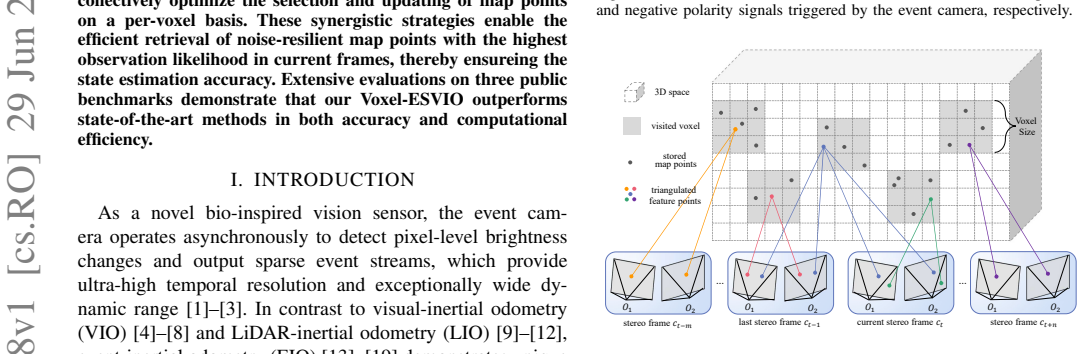
The central machinery is the voxel map: 3D space is partitioned into voxels, each storing map points that carry a feature ID, a global 3D position, a host keyframe, and a host voxel. Two strategies run on this structure. Voxel-based point selection takes triangulated 3D points from the current stereo frame, indexes their voxels, restricts access to voxels intersecting the current camera frustum, and also pulls points from second-order topological neighbors, so the optimizer receives spatially diverse points with high expected observation likelihood. Voxel-aware point management registers new points through three cascaded filters: keep only the most frequently tracked points per voxel (temporal consistency), cull points that fall too close to existing ones (spatial proximity), and cap each voxel at five points (voxel capacity). This per-voxel bookkeeping is what lets the system discard noise-generated points without an explicit outlier-removal stage.
What would settle it
Run Voxel-ESVIO on a sequence where a large foreground object occludes most of the frustum-intersecting voxels; if the system's ATE stays low even though many selected map points are behind the occluder, or if a version that explicitly checks point visibility gives the same accuracy, the claimed selection mechanism is not the cause of the reported gains.
Extended reading notes
Core claim
The paper's central claim is that a voxel-based map representation solves the map-point quality bottleneck in event-based stereo VIO. Event streams contain spurious points triggered by noise; naive global map management lets those false correspondences enter the optimizer and corrupt pose estimates. Voxel-ESVIO instead triangulates current feature correspondences, indexes the containing voxels, and feeds the state update only with points from frustum-intersecting voxels and their second-order topological neighbors, arguing that these are the points most likely to be observable and noise-resilient. It then registers new points through a three-stage cascade—temporal consistency validation, spatial proximity culling, and a five-point voxel capacity limit—so the map stays sparse, uniform, and free of transient artifacts. On all 19 sequences across the three benchmarks, it reports the lowest ATE, and its per-event-pair runtime stays between 15 and 30 ms, indicating that the voxel bookkeeping adds negligible overhead.
Load-bearing premise
The load-bearing assumption is that a map point is worth using for state updates simply because its voxel intersects the current camera frustum (or touches a voxel that does), and that this spatial proxy reliably stands in for true observability and noise resistance; the system never checks whether the point is actually visible or well triangulated.
Editorial extensions
If this is right
- Voxel-level spatial organization is sufficient to make event-based stereo VIO accurate enough to outperform existing direct and indirect event systems on public benchmarks.
- The reported 15-30 ms per stereo event pair means the voxel map adds little overhead, so noise filtering through spatial discretization is compatible with real-time operation.
- The two-stage update—first estimating poses without map points, then refining with selected map points—benefits measurably from restricting the second update to frustum-relevant voxels.
- Ablations show that removing either the voxel-based selection or the voxel-aware management increases ATE on most sequences, implying both strategies contribute to the gain.
Reading between the lines
- The selection rule is a proxy for observability, not a measurement; a direct visibility check on selected points would be a natural next step and might matter most on occluded driving sequences.
- The five-point-per-voxel cap is a fixed number; an adaptive cap that scales with scene density or voxel size could generalize better across indoor and automotive environments.
- The voxel map idea should port to monocular event-inertial systems, where false triangulations are even harder to detect without a second camera; the paper tests only the stereo configuration.
- One could test the noise-resilience claim directly by comparing the fraction of selected points that survive to a later frame against a random-selection baseline; a higher survival rate would confirm the temporal-consistency filter is doing the work.
Editorial analysis
A structured set of objections, weighed in public.
Referee Report
Summary. The paper proposes Voxel-ESVIO, an event-based stereo visual-inertial odometry system built on an MSCKF backend and a voxel map. The two claimed contributions are voxel-based point selection, which picks map points from frustum-intersecting voxels and their second-order neighbors, and voxel-aware point management, which applies temporal consistency, spatial proximity culling, and voxel capacity limits when registering new map points. The authors evaluate ATE against five baselines on VECtor, DSEC, and RPG, report per-module runtimes, and provide an ablation study. They claim the lowest ATE on all evaluated sequences and real-time processing of each stereo event pair in 15 to 30 ms.
Significance. If the empirical results hold, the paper offers a practically meaningful improvement: it reports the best ATE on all 19 tested sequences and substantially lower runtime than two open baselines. The voxel map organization is a plausible engineering contribution, and the evaluation across three public datasets is a strength. However, the paper's causal explanation for the accuracy gain is not supported by the reported ablation, and the central 'observation likelihood' claim is asserted rather than validated. The significance therefore depends on whether the authors can repair the ablation evidence and either justify the voxel heuristic with point-level validation or revise the claims to match the evidence.
major comments (3)
- [Sec. IV-D, Table V] The ablation table contradicts the claim that both proposed strategies yield consistent improvements. On hdr normal, the full system (0.059 m) is worse than the variant without voxel-aware point management (0.056 m); on City04 b, the full system (0.46 m) is worse than the variant without voxel-based point selection (0.43 m); on bin, disabling voxel-aware management ties the full system (0.020 m). The text in Sec. IV-D.1 and IV-D.2 states that each strategy improves accuracy across all test scenarios, which these rows falsify. The authors should report per-sequence differences, repeat runs with dispersion or significance measures, and explain the negative cases rather than asserting consistency.
- [Sec. III-E.3] The central attribution of accuracy to retrieving 'noise-resilient map points with the highest observation likelihood' is not established. The selection rule is purely geometric: a point is selected if its voxel intersects the current frustum or is a second-order neighbor of such a voxel, and no per-point frustum check, occlusion test, or triangulation-quality metric is computed. The 'w/o voxel-based point selection' control keeps the same point count but selects points sequentially from storage, so it does not isolate observability. The authors should either add a point-level validation or moderate the claim to a spatial-distribution heuristic and provide evidence that the distribution, rather than observability, drives the accuracy gain.
- [Sec. III-E.5] The voxel-aware point management pipeline introduces several unspecified thresholds and a fixed voxel capacity of five points, yet the ablation shows that this module can hurt accuracy on hdr normal. Without reporting the temporal-consistency criterion, the minimum spatial distance for culling, and a sensitivity analysis of the capacity limit, it is difficult to know whether the reported gains are robust or artifacts of particular parameter choices. The authors should disclose these thresholds and show how the results vary when each is changed.
minor comments (5)
- [Abstract and throughout] There are several typos and inconsistencies, including 'ensureing' in the abstract, 'datatests' in Sec. I, 'Ablation Stuty' in Sec. IV-D, 'frist' in Sec. II-B, and inconsistent capitalization of the RPG dataset name.
- [Table III and Sec. IV-C] The text says the maximum total processing time is 30 ms, but Table III reports 30.12 ms for City11 b; the rounding should be stated explicitly or the bound should be corrected to 31 ms.
- [Sec. II-B and Table II] The baseline naming is confusing: reference [15] and reference [16] are both titled 'ESVIO,' yet one is labeled ESIO and the other ESVIO in the tables. Please clarify the naming to avoid ambiguity.
- [Sec. IV-E] Fig. 4 is described as a 'quantitative evaluation,' but it is a trajectory visualization; the text should say 'qualitative visualization' unless quantitative metrics are overlaid.
- [Sec. III-E.3] The measurement model in Eq. (13) is written as a function from R^3 to R^2, but the argument is the full state sub-vector; please make the notation consistent with the Jacobian H used in Eqs. (14)-(16).
Circularity Check
No significant circularity: the system is validated against external benchmarks and no load-bearing claim reduces to its own inputs.
full rationale
The paper's derivation chain is self-contained. The voxel-based point selection (Sec. III-E.3) and voxel-aware point management (Sec. III-E.5) are implemented mechanisms, not quantities defined in terms of the ATE outcomes they are used to explain. The state updates in Secs. III-E.2 through III-E.4 follow a standard MSCKF-style formulation; the second update uses map points as additional measurements, and no equation defines the output trajectory as an input. Accuracy is evaluated with the external evo toolkit [41] against ground truth on VECtor, DSEC, and RPG, so the reported ATE values are externally measured rather than constructed by the method. Reference [6] (Voxel-SVIO) shares authors with this paper, but it is cited only as an example of conventional VIO and is not invoked as the justification for the proposed voxel strategies or to exclude alternatives; accordingly it is not load-bearing. The ablation study in Table V does not uniformly support the text's claim of 'consistent improvements' (e.g., hdr normal: 0.056 without voxel-aware management vs. 0.059 full; City04 b: 0.43 without voxel-based selection vs. 0.46 full), but this is an internal-support/consistency issue rather than circular reasoning. No fitted parameter is renamed as a prediction, and no result is obtained by definition.
Assumptions & free parameters
free parameters (6)
- Voxel size =
unspecified
- Voxel capacity =
5 points per voxel
- Spatial proximity culling minimum distance =
unspecified
- Temporal consistency threshold =
unspecified
- Keyframe parallax threshold =
20 pixels
- Time-surface decay constant eta =
unspecified
assumptions (4)
- standard math MSCKF measurement model and perspective projection (from [39], [40])
- domain assumption Event noise is temporally inconsistent
- domain assumption Time-surface maps with exponential decay preserve feature trackability
- ad hoc to paper Frustum membership plus second-order neighbor voxels is a valid proxy for observation likelihood
Cite this review
Pith. "Pith review of Event-based Stereo Visual-Inertial Odometry with Voxel Map." pith.science (2026). https://pith.science/paper/RXJVTS2T
@misc{pith2026250623078,
  author       = {Pith},
  title        = {Pith review of: Event-based Stereo Visual-Inertial Odometry with Voxel Map},
  year         = {2026},
  howpublished = {\url{https://pith.science/paper/RXJVTS2T}},
  note         = {Machine review of arXiv:2506.23078}
}
read the original abstract
The event camera, renowned for its high dynamic range and exceptional temporal resolution, is recognized as an important sensor for visual odometry. However, the inherent noise in event streams complicates the selection of high-quality map points, which critically determine the precision of state estimation. To address this challenge, we propose Voxel-ESVIO, an event-based stereo visual-inertial odometry system that utilizes voxel map management, which efficiently filter out high-quality 3D points. Specifically, our methodology utilizes voxel-based point selection and voxel-aware point management to collectively optimize the selection and updating of map points on a per-voxel basis. These synergistic strategies enable the efficient retrieval of noise-resilient map points with the highest observation likelihood in current frames, thereby ensureing the state estimation accuracy. Extensive evaluations on three public benchmarks demonstrate that our Voxel-ESVIO outperforms state-of-the-art methods in both accuracy and computational efficiency.
Figures


Figures from the paper (1 more)

Reference graph
Works this paper leans on
-
[1]
A 128×128 120 db 15 us latency asynchronous temporal contrast vision sensor,
P. Lichtsteiner, C. Posch, and T. Delbruck, “A 128×128 120 db 15 us latency asynchronous temporal contrast vision sensor,” IEEE journal of solid-state circuits , vol. 43, no. 2, pp. 566–576, 2008
work page 2008
-
[2]
Event- based vision: A survey,
G. Gallego, T. Delbr ¨uck, G. Orchard, C. Bartolozzi, B. Taba, A. Censi, S. Leutenegger, A. J. Davison, J. Conradt, K. Daniilidis et al., “Event- based vision: A survey,” IEEE transactions on pattern analysis and machine intelligence, vol. 44, no. 1, pp. 154–180, 2020
2020
-
[3]
Recent event camera innovations: A survey,
B. Chakravarthi, A. A. Verma, K. Daniilidis, C. Fermuller, and Y . Yang, “Recent event camera innovations: A survey,”arXiv preprint arXiv:2408.13627, 2024
arXiv 2024
-
[4]
Vins-mono: A robust and versatile monoc- ular visual-inertial state estimator,
T. Qin, P. Li, and S. Shen, “Vins-mono: A robust and versatile monoc- ular visual-inertial state estimator,” IEEE transactions on robotics , vol. 34, no. 4, pp. 1004–1020, 2018
work page 2018
-
[5]
Orb-slam3: An accurate open-source library for visual, visual–inertial, and multimap slam,
C. Campos, R. Elvira, J. J. G. Rodr ´ıguez, J. M. Montiel, and J. D. Tard ´os, “Orb-slam3: An accurate open-source library for visual, visual–inertial, and multimap slam,” IEEE transactions on robotics , vol. 37, no. 6, pp. 1874–1890, 2021
work page 2021
-
[6]
V oxel-svio: Stereo visual-inertial odometry based on voxel map,
Z. Yuan, F. Lang, J. Deng, H. Luo, and X. Yang, “V oxel-svio: Stereo visual-inertial odometry based on voxel map,” IEEE Robotics and Automation Letters, 2025
work page 2025
-
[7]
Orb-slam: A versatile and accurate monocular slam system,
R. Mur-Artal, J. M. M. Montiel, and J. D. Tardos, “Orb-slam: A versatile and accurate monocular slam system,” IEEE transactions on robotics, vol. 31, no. 5, pp. 1147–1163, 2015
2015
-
[8]
Openvins: A research platform for visual-inertial estimation,
P. Geneva, K. Eckenhoff, W. Lee, Y . Yang, and G. Huang, “Openvins: A research platform for visual-inertial estimation,” in 2020 IEEE International Conference on Robotics and Automation (ICRA). IEEE, 2020, pp. 4666–4672
work page 2020
Show all 44 references
-
[9]
Sr-lio: Lidar-inertial odometry with sweep reconstruction,
Z. Yuan, F. Lang, T. Xu, and X. Yang, “Sr-lio: Lidar-inertial odometry with sweep reconstruction,” in 2024 IEEE/RSJ International Confer- ence on Intelligent Robots and Systems (IROS) . IEEE, 2024, pp. 7862–7869
2024
-
[10]
Sr-livo: Lidar- inertial-visual odometry and mapping with sweep reconstruction,
Z. Yuan, J. Deng, R. Ming, F. Lang, and X. Yang, “Sr-livo: Lidar- inertial-visual odometry and mapping with sweep reconstruction,” IEEE Robotics and Automation Letters , 2024
2024
-
[11]
Sdv-loam: Semi- direct visual–lidar odometry and mapping,
Z. Yuan, Q. Wang, K. Cheng, T. Hao, and X. Yang, “Sdv-loam: Semi- direct visual–lidar odometry and mapping,” IEEE Transactions on Pattern Analysis and Machine Intelligence, vol. 45, no. 9, pp. 11 203– 11 220, 2023
2023
-
[12]
Semi-elastic lidar-inertial odometry,
Z. Yuan, F. Lang, T. Xu, R. Ming, C. Zhao, and X. Yang, “Semi-elastic lidar-inertial odometry,” arXiv preprint arXiv:2307.07792 , 2023
2023 arXiv
-
[13]
Evo: A geometric approach to event-based 6-dof parallel tracking and mapping in real time,
H. Rebecq, T. Horstsch ¨afer, G. Gallego, and D. Scaramuzza, “Evo: A geometric approach to event-based 6-dof parallel tracking and mapping in real time,” IEEE Robotics and Automation Letters , vol. 2, no. 2, pp. 593–600, 2016
2016
-
[14]
Feature-based event stereo visual odometry,
A. Hadviger, I. Cvi ˇsi´c, I. Markovi ´c, S. Vra ˇzi´c, and I. Petrovi ´c, “Feature-based event stereo visual odometry,” in 2021 European Conference on Mobile Robots (ECMR) . IEEE, 2021, pp. 1–6
2021
-
[15]
Esvio: Event-based stereo visual inertial odometry,
P. Chen, W. Guan, and P. Lu, “Esvio: Event-based stereo visual inertial odometry,” IEEE Robotics and Automation Letters , vol. 8, no. 6, pp. 3661–3668, 2023
2023
-
[16]
Esvio: Event-based stereo visual- inertial odometry,
Z. Liu, D. Shi, R. Li, and S. Yang, “Esvio: Event-based stereo visual- inertial odometry,” Sensors, vol. 23, no. 4, p. 1998, 2023
1998
-
[17]
Event-based stereo visual odom- etry,
Y . Zhou, G. Gallego, and S. Shen, “Event-based stereo visual odom- etry,” IEEE Transactions on Robotics , vol. 37, no. 5, pp. 1433–1450, 2021
2021
-
[18]
Imu-aided event-based stereo visual odometry,
J. Niu, S. Zhong, and Y . Zhou, “Imu-aided event-based stereo visual odometry,” in 2024 IEEE International Conference on Robotics and Automation (ICRA). IEEE, 2024, pp. 11 977–11 983
2024
-
[19]
Esvo2: Direct visual-inertial odometry with stereo event cameras,
J. Niu, S. Zhong, X. Lu, S. Shen, G. Gallego, and Y . Zhou, “Esvo2: Direct visual-inertial odometry with stereo event cameras,” arXiv preprint arXiv:2410.09374, 2024
2024 arXiv
-
[20]
Event-based visual in- ertial odometry,
A. Zihao Zhu, N. Atanasov, and K. Daniilidis, “Event-based visual in- ertial odometry,” in Proceedings of the IEEE Conference on Computer Vision and Pattern Recognition , 2017, pp. 5391–5399
2017
-
[21]
Low-latency visual odometry using event-based feature tracks,
B. Kueng, E. Mueggler, G. Gallego, and D. Scaramuzza, “Low-latency visual odometry using event-based feature tracks,” in 2016 IEEE/RSJ International Conference on Intelligent Robots and Systems (IROS) . IEEE, 2016, pp. 16–23
2016
-
[22]
Speed invariant time surface for learning to detect corner points with event-based cameras,
J. Manderscheid, A. Sironi, N. Bourdis, D. Migliore, and V . Lepetit, “Speed invariant time surface for learning to detect corner points with event-based cameras,” in Proceedings of the IEEE/CVF Conference on Computer Vision and Pattern Recognition , 2019, pp. 10 245–10 254
2019
-
[23]
luvharris: A practical corner detector for event-cameras,
A. Glover, A. Dinale, L. D. S. Rosa, S. Bamford, and C. Bartolozzi, “luvharris: A practical corner detector for event-cameras,”IEEE Trans- actions on Pattern Analysis and Machine Intelligence , vol. 44, no. 12, pp. 10 087–10 098, 2021
2021
-
[24]
Pl-evio: Robust monocular event-based visual inertial odometry with point and line features,
W. Guan, P. Chen, Y . Xie, and P. Lu, “Pl-evio: Robust monocular event-based visual inertial odometry with point and line features,” IEEE Transactions on Automation Science and Engineering , vol. 21, no. 4, pp. 6277–6293, 2023
2023
-
[25]
Asynchronous corner detection and track- ing for event cameras in real time,
I. Alzugaray and M. Chli, “Asynchronous corner detection and track- ing for event cameras in real time,” IEEE Robotics and Automation Letters, vol. 3, no. 4, pp. 3177–3184, 2018
2018
-
[26]
Ace: An efficient asynchronous corner tracker for event cam- eras,
——, “Ace: An efficient asynchronous corner tracker for event cam- eras,” in 2018 International Conference on 3D Vision (3DV) . IEEE, 2018, pp. 653–661
2018
-
[27]
Ul- timate slam? combining events, images, and imu for robust visual slam in hdr and high-speed scenarios,
A. R. Vidal, H. Rebecq, T. Horstschaefer, and D. Scaramuzza, “Ul- timate slam? combining events, images, and imu for robust visual slam in hdr and high-speed scenarios,” IEEE Robotics and Automation Letters, vol. 3, no. 2, pp. 994–1001, 2018
2018
-
[28]
Parallel tracking and mapping for small ar workspaces,
G. Klein and D. Murray, “Parallel tracking and mapping for small ar workspaces,” in 2007 6th IEEE and ACM international symposium on mixed and augmented reality . IEEE, 2007, pp. 225–234
2007
-
[29]
Real-time 3d reconstruc- tion and 6-dof tracking with an event camera,
H. Kim, S. Leutenegger, and A. J. Davison, “Real-time 3d reconstruc- tion and 6-dof tracking with an event camera,” in European conference on computer vision . Springer, 2016, pp. 349–364
2016
-
[30]
evo: Python package for the evaluation of odometry and slam
M. Grupp, “evo: Python package for the evaluation of odometry and slam.” https://github.com/MichaelGrupp/evo, 2017
2017
-
[31]
Emvs: Event-based multi-view stereo,
H. Rebecq, G. Gallego, and D. Scaramuzza, “Emvs: Event-based multi-view stereo,” 2016
2016
-
[32]
Fast event-based harris corner detection exploiting the advantages of event-driven cameras,
V . Vasco, A. Glover, and C. Bartolozzi, “Fast event-based harris corner detection exploiting the advantages of event-driven cameras,” in 2016 IEEE/RSJ international conference on intelligent robots and systems (IROS). IEEE, 2016, pp. 4144–4149
2016
-
[33]
Fa-harris: A fast and asynchronous corner detector for event cameras,
R. Li, D. Shi, Y . Zhang, K. Li, and R. Li, “Fa-harris: A fast and asynchronous corner detector for event cameras,” in 2019 IEEE/RSJ International Conference on Intelligent Robots and Systems (IROS) . IEEE, 2019, pp. 6223–6229
2019
-
[34]
Monocular event visual inertial odometry based on event-corner using sliding windows graph-based optimization,
W. Guan and P. Lu, “Monocular event visual inertial odometry based on event-corner using sliding windows graph-based optimization,” in 2022 IEEE/RSJ International Conference on Intelligent Robots and Systems (IROS). IEEE, 2022, pp. 2438–2445
2022
-
[35]
Real-time visual- inertial odometry for event cameras using keyframe-based nonlinear optimization,
H. Rebecq, T. Horstschaefer, and D. Scaramuzza, “Real-time visual- inertial odometry for event cameras using keyframe-based nonlinear optimization,” 2017
2017
-
[36]
Hots: a hierarchy of event-based time-surfaces for pattern recogni- tion,
X. Lagorce, G. Orchard, F. Galluppi, B. E. Shi, and R. B. Benosman, “Hots: a hierarchy of event-based time-surfaces for pattern recogni- tion,” IEEE transactions on pattern analysis and machine intelligence , vol. 39, no. 7, pp. 1346–1359, 2016
2016
-
[37]
An iterative image registration technique with an application to stereo vision,
B. D. Lucas and T. Kanade, “An iterative image registration technique with an application to stereo vision,” in IJCAI’81: 7th international joint conference on Artificial intelligence , vol. 2, 1981, pp. 674–679
1981
-
[38]
Good features to track,
J. Shi and Tomasi, “Good features to track,” in 1994 Proceedings of IEEE Conference on Computer Vision and Pattern Recognition , 1994, pp. 593–600
1994
-
[39]
A multi-state constraint kalman filter for vision-aided inertial navigation,
A. I. Mourikis and S. I. Roumeliotis, “A multi-state constraint kalman filter for vision-aided inertial navigation,” in Proceedings 2007 IEEE international conference on robotics and automation . IEEE, 2007, pp. 3565–3572
2007
-
[40]
Indirect kalman filter for 3d attitude estimation,
N. Trawny and S. I. Roumeliotis, “Indirect kalman filter for 3d attitude estimation,” University of Minnesota, Dept. of Comp. Sci. & Eng., Tech. Rep, vol. 2, p. 2005, 2005
2005
-
[41]
A benchmark for the evaluation of rgb-d slam systems,
J. Sturm, N. Engelhard, F. Endres, W. Burgard, and D. Cremers, “A benchmark for the evaluation of rgb-d slam systems,” in 2012 IEEE/RSJ international conference on intelligent robots and systems . IEEE, 2012, pp. 573–580
2012
-
[42]
Vector: A versatile event-centric benchmark for multi-sensor slam,
L. Gao, Y . Liang, J. Yang, S. Wu, C. Wang, J. Chen, and L. Kneip, “Vector: A versatile event-centric benchmark for multi-sensor slam,” IEEE Robotics and Automation Letters , vol. 7, no. 3, pp. 8217–8224, 2022
2022
-
[43]
Dsec: A stereo event camera dataset for driving scenarios,
M. Gehrig, W. Aarents, D. Gehrig, and D. Scaramuzza, “Dsec: A stereo event camera dataset for driving scenarios,” IEEE Robotics and Automation Letters, vol. 6, no. 3, pp. 4947–4954, 2021
2021
-
[44]
Semi-dense 3d reconstruction with a stereo event camera,
Y . Zhou, G. Gallego, H. Rebecq, L. Kneip, H. Li, and D. Scara- muzza, “Semi-dense 3d reconstruction with a stereo event camera,” in Proceedings of the European conference on computer vision (ECCV) , 2018, pp. 235–251
2018
Reviewed August 6, 2026 · model on record in the stance chip above.
Discussion (0). Sign in to comment.