REVIEW 4 major objections 6 minor 2 cited by
Where, What, Why: Towards Explainable Driver Attention Prediction
T0 review · 4 major / 6 minor · reviewed 2026-08-06 · deepseek-v4-flash
Pith's one-line read The paper argues that driver attention should be predicted as a triple — where, what, and why — and that a single model jointly trained on all three outperforms models trained on each separately.
desk verdict A useful new benchmark and a plausible joint model, but the headline SOTA claims rest on an unstated baseline training protocol and LLM-generated 'why' labels. read the letter →
The pith
A machine-rendered reading of the paper's core claim, the machinery that carries it, and where it could break.
The reading
What carries the argument
The load-bearing mechanism is the joint training objective together with the [ATTN] attention token. [ATTN] is a special token added to the language model's vocabulary that carries high-level cognitive cues; its output embedding is projected into a cognitive-aware attention decoder, which cross-attends to visual features to produce the pixel-wise attention map, while the same language model generates the what and why text. The W3DA annotation pipeline supplies the third necessary component: a key-sample selector that keeps only frames with significant scene or attention changes, a chain-of-thought prompt that makes a multimodal LLM first count attended regions, then describe them, then explain them, and a human verification step that removes hallucinations and enforces traffic-rule consistency. These three pieces are what let the model treat where, what, and why as one problem.
What would settle it
Take a set of driving videos where drivers' gaze and retrospective verbal reports are recorded under deliberately different task instructions (e.g., 'prepare to turn' vs. 'maintain lane'); if LLada, trained on W3DA, cannot predict the task-driven shift in the attention map and cannot produce why explanations that match the drivers' stated reasons, then the claim that the model captures cognitive motivation rather than scene salience is refuted.
Extended reading notes
Core claim
The claim is that explanation is not a post-hoc add-on to driver attention prediction but a learnable output that improves the prediction itself. The paper defines the task as estimating an attention map A, a set of semantic descriptions S, and a set of causal explanations E from a driving image and context. W3DA provides those labels across normal driving, safety-critical situations, and traffic accidents. LLada attaches a special [ATTN] token to a language model, decodes a spatial map from that token through a small convolutional decoder, and generates the semantic and causal text autoregressively; training jointly on the map loss and the text loss leads to better maps and better explanations than training either alone. The result is a unified, explainable model of driver attention that transfers across domains without per-dataset retraining.
Load-bearing premise
The 'why' labels in W3DA are produced by prompting a large language model and then corrected by human experts; the paper treats these explanations as ground truth for real drivers' cognitive reasoning, and if they do not match actual driver cognition, the explainability claim measures the annotation model's style rather than human attention.
Editorial extensions
If this is right
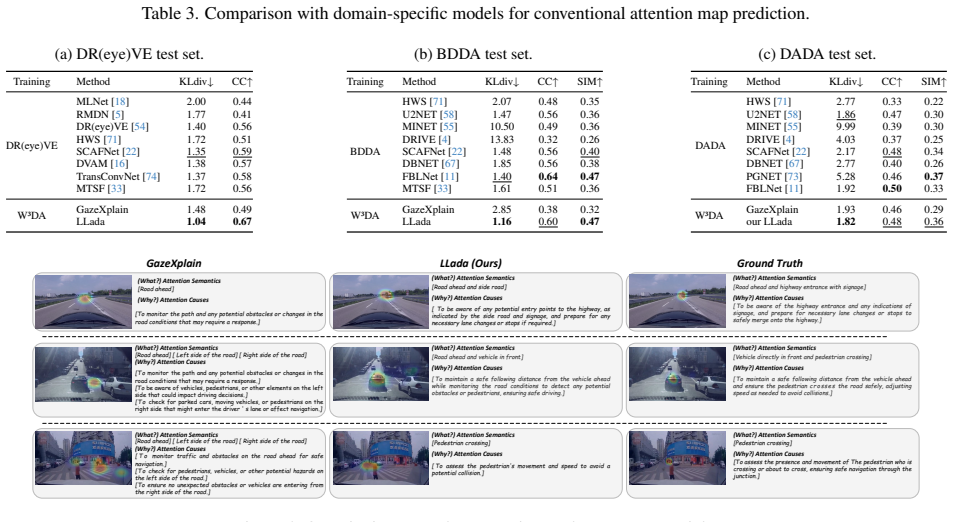
- A model trained on W3DA can be evaluated on and transferred to DR(eye)VE, BDDA, and DADA-2000 test sets, outperforming most specialized models trained independently on those datasets.
- Jointly optimizing the attention map and textual explanations improves both: removing the map lowers text quality, and removing the what/why text lowers map quality in the ablation results.
- The [ATTN]-token mechanism gives a general recipe for decoding spatial outputs from a language model's token embeddings, enabling pixel grounding without a task-specific head outside the LLM.
- The human-corrected multimodal-LLM annotation pipeline provides a scalable template for adding semantic and causal labels to other gaze or attention datasets.
- Explainable Driver Attention Prediction supplies a first benchmark, W3DA, with metrics for all three outputs, so future work can be compared on where, what, and why simultaneously.
Reading between the lines
- The paper does not report inter-annotator agreement for the human correction step, so the degree to which W3DA's why labels reflect consensus driver cognition rather than individual expert style is unmeasured; a published agreement study would sharpen the benchmark's validity.
- If the joint where/what/why training genuinely causes mutual improvement, then feeding predicted semantic and causal labels at inference time could improve gaze prediction in novel scenarios, a testable extension beyond the paper's experiments.
- The W3DA why annotations could be repurposed as explanations for an autonomous driving policy, letting a system justify its attentional allocation to passengers; that application is not tested here.
- The key-sample selection thresholds (vision-encoder similarity score ≤ 0.9, spatial KL divergence ≥ 5) are tuned on driving data; applying the same pipeline to other video annotation tasks would likely need recalibration, and the paper does not investigate that transfer.
Editorial analysis
A structured set of objections, weighed in public.
Referee Report
Summary. The paper introduces Explainable Driver Attention Prediction, a paradigm that extends conventional heatmap-based driver attention modeling by jointly predicting where a driver looks, what semantic region is attended, and why attention is allocated there. To support this, the authors assemble W3DA, a dataset of 69,980 keyframes drawn from DR(eye)VE, LBW, BDDA, and DADA-2000, with semantic and causal annotations generated by Qwen-VL-Max and subsequently human-refined. They also propose LLada, an LLM-driven architecture with a special [ATTN] token and a cognitive-aware attention decoder, trained end-to-end to output attention maps, semantic descriptions, and causal explanations. Experiments compare LLada against ten attention-prediction methods on W3DA, against two-stage baselines for textual explanation generation, and against domain-specific models on DR(eye)VE, BDDA, and DADA; ablations are used to claim that the where, what, and why tasks mutually reinforce each other.
Significance. If the headline results hold, the paper makes a useful contribution: W3DA is a large, multi-scenario benchmark that goes beyond spatial heatmaps, and LLada is a unified end-to-end architecture for joint spatial, semantic, and causal reasoning about driver attention. The dataset construction effort, the cross-domain training setup, and the public code release are strengths. However, the main SOTA comparisons are weakened by an unspecified baseline training protocol, and the cognitive-reasoning annotations are LLM-generated and human-polished without validation against actual drivers' stated reasons, so the 'why' evaluation may partly measure imitation of the annotation model rather than human cognition. These issues are load-bearing for the paper's central claims and require substantial clarification or additional experiments, but they are fixable within the manuscript's scope.
major comments (4)
- [Section 5.2, Table 1] The training protocol for the learning-based attention baselines is not stated. For MLNet, CDNN, FBNet, ConvNeXt, and ERFNet, the text says only that they are 'specialized attention prediction models optimized solely for this task'; it does not say whether they were retrained on the W3DA train split or evaluated from their original released weights. Since LLada is trained on 39,642 W3DA keyframes (Section 5.3), the reported KLdiv gains (e.g., 38.40% over ERFNet in normal driving) could reflect training-set familiarity rather than the benefit of the where/what/why joint formulation. Please state the protocol explicitly and, if the baselines were not retrained on W3DA, add comparisons with baselines fine-tuned on the W3DA train split under the same protocol, with standard deviations across at least three random seeds.
- [Section 5.2, Table 2] The same ambiguity affects the two-stage baselines. The text states only that the second-stage LLaVA is fine-tuned on W3DA; the training status of the first-stage predictors (DeepGaze I, DeepGaze IIE, MLNet, CDNN, ConvNeXt, ERFNet) is unstated. If those predictors are used with source-dataset weights, the baselines are evaluated on W3DA keyframes they have never seen, while LLada is trained on that distribution. Please specify the first-stage training protocol and, ideally, retrain the first-stage predictors on W3DA so that the comparison isolates the contribution of the end-to-end joint formulation rather than a train/test distribution mismatch.
- [Sections 3.1 and 7.3.3] The 'why' ground truth is produced by prompting Qwen-VL-Max and then correcting the outputs by human experts, but no evidence is provided that these explanations correspond to the actual cognitive reasoning of the drivers whose gaze was recorded. These labels are used both as training targets and as evaluation references for LLada, which is itself an LLM; the strong textual metrics may therefore reflect imitation of the annotation LLM's style rather than human attention mechanisms. To support the cognitive-reasoning claim, please provide at least one of the following: (a) inter-annotator agreement statistics on a sample of the why labels, (b) a human study comparing LLada's explanations with explanations elicited from drivers viewing the same scenes, or (c) an analysis demonstrating that the why labels contain information beyond generic, template-like completions. Without such validation, the statements in Sections 5.4 and 6 about 'alignment with human driver attention' and 'cognitive reasoning' are not yet supported.
- [Section 5.5, Figures 5 and 6] The ablation results are reported as single values without variance or significance testing. Some of the reported differences are small (e.g., KLdiv of 1.500 versus 1.498 in Figure 6), and for a 7B-parameter model these differences could easily fall within run-to-run noise. Please report means and standard deviations over multiple seeds and, where possible, significance tests, so that the central claim that the three tasks mutually reinforce one another rests on a statistically solid foundation.
minor comments (6)
- [Figure 4] The caption reads 'Quantitative examples' but the section is a qualitative analysis; the caption should read 'Qualitative examples'.
- [Figure 5] The first panel of Figure 5 labels the metric as 'BLUE'; this should be 'BLEU'.
- [Table 4] The row for ETOD contains an unresolved citation '[?]'; please provide the full reference or remove the row.
- [Section 4.2] The sentence 'we set the scaling factors Lmap, Ltxt, Lbce, Lkl, Lwhat, and Lwhy to 2, 1, 1, 0.1, 1, and 1' mixes loss names and scaling factors; Equations (4)-(6) use lambda notation, so the notation should be aligned for clarity.
- [Sections 3.2 and 5.3] Section 3.2 reports 69,980 total key samples, while Section 5.3 says W3DA provides 39,642 keyframes for training; please clarify the train/validation/test split sizes so that the discrepancy is resolved.
- [Figure 5] Figure 5 appears to contain duplicate METEOR panels; please verify that the panels correspond to the intended metrics.
Circularity Check
No significant circularity: LLada is trained and evaluated against fixed W3DA annotations, and its 'why' targets are externally produced (Qwen-VL-Max plus human correction), not derived from LLada itself.
full rationale
The derivation chain is supervised learning rather than circular reasoning. W3DA's 'where' labels come from eye-tracking in DR(eye)VE/BDDA/DADA-2000, and its 'what'/'why' labels are produced by a semi-automatic pipeline (Qwen-VL-Max prompted with attention-masked frames, then human experts correct outputs; Sec. 3.1 and Sec. 7.3.3). LLada (Vicuna-7B + CLIP-ViT-L + attention decoder) is trained with Eq. (4)-(6), where the ground-truth S and E are these fixed dataset labels. Nothing in the paper constructs S or E from LLada's own outputs, and LLada does not use Qwen-VL-Max at inference, so there is no equation-level reduction of a prediction to its input. Evaluation on W3DA held-out splits (Sec. 5.2) and on the original DR(eye)VE/BDDA/DADA test sets (Sec. 5.3) is standard supervised evaluation. The concern that MLLM-generated 'why' labels may not reflect actual driver cognition is a construct-validity threat, not circularity: it questions whether the labels measure the intended construct, not whether the model's predictions are derived from those labels by construction. The paper's self-citations (e.g., refs. 23, 24, 30, 31, 85-89) appear only as background on prior driver-attention work and are not load-bearing for the architecture or the empirical claims. The unstated baseline training protocol in Table 1 is a fairness/reproducibility gap, but it does not make LLada's numbers equivalent to its inputs. I therefore find no significant circularity.
Assumptions & free parameters
free parameters (3)
- Key sample selection thresholds =
Sscene <= 0.9, DKL >= 5, Sattn <= 0.9
- Loss weights =
lambda_map=2, lambda_txt=1, lambda_bce=1, lambda_kl=0.1, lambda_what=1, lambda_why=1
- Attention region count =
1 to 3 per frame
assumptions (3)
- domain assumption Existing driver attention datasets provide valid where ground truth
- ad hoc to paper LLM-generated and human-refined why annotations are a valid proxy for real driver cognitive reasoning
- domain assumption CLIP embeddings capture semantic similarity relevant to attention shifts
invented entities (1)
-
[ATTN] token
Cite this review
Pith. "Pith review of Where, What, Why: Towards Explainable Driver Attention Prediction." pith.science (2026). https://pith.science/paper/LQ2UBM3S
@misc{pith2026250623088,
  author       = {Pith},
  title        = {Pith review of: Where, What, Why: Towards Explainable Driver Attention Prediction},
  year         = {2026},
  howpublished = {\url{https://pith.science/paper/LQ2UBM3S}},
  note         = {Machine review of arXiv:2506.23088}
}
read the original abstract
Modeling task-driven attention in driving is a fundamental challenge for both autonomous vehicles and cognitive science. Existing methods primarily predict where drivers look by generating spatial heatmaps, but fail to capture the cognitive motivations behind attention allocation in specific contexts, which limits deeper understanding of attention mechanisms. To bridge this gap, we introduce Explainable Driver Attention Prediction, a novel task paradigm that jointly predicts spatial attention regions (where), parses attended semantics (what), and provides cognitive reasoning for attention allocation (why). To support this, we present W3DA, the first large-scale explainable driver attention dataset. It enriches existing benchmarks with detailed semantic and causal annotations across diverse driving scenarios, including normal conditions, safety-critical situations, and traffic accidents. We further propose LLada, a Large Language model-driven framework for driver attention prediction, which unifies pixel modeling, semantic parsing, and cognitive reasoning within an end-to-end architecture. Extensive experiments demonstrate the effectiveness of LLada, exhibiting robust generalization across datasets and driving conditions. This work serves as a key step toward a deeper understanding of driver attention mechanisms, with significant implications for autonomous driving, intelligent driver training, and human-computer interaction.
Figures


Figures from the paper (12 more)




Forward citations
Cited by 2 Pith papers
-
LaP-Forensics: Latent-Pixel Consistency Guided Multimodal Reasoning for Deepfake Detection
A dual-stream deepfake forensic model that adds DDIM reconstruction residuals to RGB features improves artifact localization and cross-generator detection in evaluations, with honest caveats about text faithfulness.
-
RAMA: Retrieval-Augmented Multi-Agent Framework for Misinformation Detection in Multimodal Fact-Checking
RAMA, a retrieval-augmented multi-agent detector, reports 0.910 accuracy and F1 on the ICMR 2024 public test set, placing it behind the top published method on the same benchmark.
Reference graph
Works this paper leans on
-
[1]
Hammerdrive: A task-aware driving visual attention model
Pierluigi Vito Amadori, Tobias Fischer, and Yiannis Demiris. Hammerdrive: A task-aware driving visual attention model. IEEE T-ITS, 23(6):5573–5585, 2021. 3
2021
-
[2]
Aragan: A driver attention estimation model based on conditional gen- erative adversarial network
Javier Araluce, Luis M Bergasa, Manuel Oca ˜na, Rafael Barea, Elena L´opez-Guill´en, and Pedro Revenga. Aragan: A driver attention estimation model based on conditional gen- erative adversarial network. In IV, pages 1066–1072. IEEE,
-
[3]
Medirl: Predicting the visual attention of drivers via maximum entropy deep inverse re- inforcement learning
Sonia Baee, Erfan Pakdamanian, Inki Kim, Lu Feng, Vicente Ordonez, and Laura Barnes. Medirl: Predicting the visual attention of drivers via maximum entropy deep inverse re- inforcement learning. In ICCV, pages 13178–13188, 2021. 3
2021
-
[4]
Drive: Deep reinforced accident anticipation with visual explanation
Wentao Bao, Qi Yu, and Yu Kong. Drive: Deep reinforced accident anticipation with visual explanation. In ICCV, pages 7619–7628, 2021. 8
2021
-
[5]
Re- current mixture density network for spatiotemporal visual at- tention
Loris Bazzani, Hugo Larochelle, and Lorenzo Torresani. Re- current mixture density network for spatiotemporal visual at- tention. In ICLR, 2017. 8
2017
-
[6]
The devil is in the fine- grained details: Evaluating open-vocabulary object detec- tors for fine-grained understanding
Lorenzo Bianchi, Fabio Carrara, Nicola Messina, Claudio Gennaro, and Fabrizio Falchi. The devil is in the fine- grained details: Evaluating open-vocabulary object detec- tors for fine-grained understanding. In CVPR, pages 22520– 22529, 2024. 3
2024
-
[7]
Trends, applications, and challenges in human attention modelling
Giuseppe Cartella, Marcella Cornia, Vittorio Cuculo, Alessandro D’Amelio, Dario Zanca, Giuseppe Boccignone, and Rita Cucchiara. Trends, applications, and challenges in human attention modelling. In IJCAI, pages 7971–7979,
-
[8]
Sharegpt4video: Improving video understand- ing and generation with better captions.NeurIPS, 37:19472– 19495, 2025
Lin Chen, Xilin Wei, Jinsong Li, Xiaoyi Dong, Pan Zhang, Yuhang Zang, Zehui Chen, Haodong Duan, Zhenyu Tang, Li Yuan, et al. Sharegpt4video: Improving video understand- ing and generation with better captions.NeurIPS, 37:19472– 19495, 2025. 3
2025
Show all 102 references
-
[9]
Air: At- tention with reasoning capability
Shi Chen, Ming Jiang, Jinhui Yang, and Qi Zhao. Air: At- tention with reasoning capability. In ECCV, pages 91–107. Springer, 2020. 1
2020
-
[10]
Gazexplain: Learn- ing to predict natural language explanations of visual scan- paths
Xianyu Chen, Ming Jiang, and Qi Zhao. Gazexplain: Learn- ing to predict natural language explanations of visual scan- paths. In ECCV, pages 314–333. Springer, 2024. 3, 6, 7
2024
-
[11]
Fblnet: Feed- back loop network for driver attention prediction
Yilong Chen, Zhixiong Nan, and Tao Xiang. Fblnet: Feed- back loop network for driver attention prediction. In ICCV, pages 13371–13380, 2023. 1, 3, 6, 8
2023
-
[12]
What do you see in vehicle? comprehensive vi- sion solution for in-vehicle gaze estimation
Yihua Cheng, Yaning Zhu, Zongji Wang, Hongquan Hao, Yongwei Liu, Shiqing Cheng, Xi Wang, and Hyung Jin Chang. What do you see in vehicle? comprehensive vi- sion solution for in-vehicle gaze estimation. In CVPR, pages 1556–1565, 2024. 2
2024
-
[13]
Gonzalez, Ion Stoica, and Eric P
Wei-Lin Chiang, Zhuohan Li, Zi Lin, Ying Sheng, Zhang- hao Wu, Hao Zhang, Lianmin Zheng, Siyuan Zhuang, Yong- hao Zhuang, Joseph E. Gonzalez, Ion Stoica, and Eric P. Xing. Vicuna: An open-source chatbot impressing gpt-4 with 90%* chatgpt quality, 2023. 5, 7
2023
-
[14]
A survey on multimodal large language models for autonomous driving
Can Cui, Yunsheng Ma, Xu Cao, Wenqian Ye, Yang Zhou, Kaizhao Liang, Jintai Chen, Juanwu Lu, Zichong Yang, Kuei-Da Liao, et al. A survey on multimodal large language models for autonomous driving. In WACV, pages 958–979,
-
[15]
Tao Deng, Hongmei Yan, Long Qin, Thuyen Ngo, and B. S. Manjunath. How do drivers allocate their potential atten- tion? driving fixation prediction via convolutional neural net- works. IEEE T-ITS, 21(5):2146–2154, 2020. 3, 6, 7
2020
-
[16]
Driving vi- sual saliency prediction of dynamic night scenes via a spatio- temporal dual-encoder network
Tao Deng, Lianfang Jiang, Yi Shi, Jiang Wu, Zhangbi Wu, Shun Yan, Xianshi Zhang, and Hongmei Yan. Driving vi- sual saliency prediction of dynamic night scenes via a spatio- temporal dual-encoder network. IEEE T-ITS, 25(3):2413– 2423, 2023. 8
2023
-
[17]
Fbnet: Feedback- recursive cnn for saliency detection
Guanqun Ding, Nevrez ˙Imamo˘glu, Ali Caglayan, Masahiro Murakawa, and Ryosuke Nakamura. Fbnet: Feedback- recursive cnn for saliency detection. In MVA, pages 1–5. IEEE, 2021. 6, 7
2021
-
[18]
Visual saliency predic- tion using a mixture of deep neural networks
Samuel F Dodge and Lina J Karam. Visual saliency predic- tion using a mixture of deep neural networks. IEEE T-IP, 27 (8):4080–4090, 2018. 6, 7, 8
2018
-
[19]
An image is worth 16x16 words: Transformers for image recognition at scale
Alexey Dosovitskiy, Lucas Beyer, Alexander Kolesnikov, Dirk Weissenborn, Xiaohua Zhai, Thomas Unterthiner, Mostafa Dehghani, Matthias Minderer, Georg Heigold, Syl- vain Gelly, Jakob Uszkoreit, and Neil Houlsby. An image is worth 16x16 words: Transformers for image recognition ...
2021
-
[20]
Dgaze: Driver gaze mapping on road
Isha Dua, Thrupthi Ann John, Riya Gupta, and CV Jawahar. Dgaze: Driver gaze mapping on road. In IROS, pages 5946–
-
[21]
Dada-2000: Can driving accident be predicted by driver attentionƒ analyzed by a benchmark
Jianwu Fang, Dingxin Yan, Jiahuan Qiao, Jianru Xue, He Wang, and Sen Li. Dada-2000: Can driving accident be predicted by driver attentionƒ analyzed by a benchmark. In ITSC, pages 4303–4309. IEEE, 2019. 2, 3, 7, 12, 13
2000
-
[22]
Dada: Driver attention prediction in driving accident scenarios
Jianwu Fang, Dingxin Yan, Jiahuan Qiao, Jianru Xue, and Hongkai Yu. Dada: Driver attention prediction in driving accident scenarios. IEEE T-ITS, 23(6):4959–4971, 2022. 1, 3, 6, 7, 8, 12, 13
2022
-
[23]
Driver attention pre- diction based on convolution and transformers
Chao Gou, Yuchen Zhou, and Dan Li. Driver attention pre- diction based on convolution and transformers. The Journal of Supercomputing, 78(6):8268–8284, 2022. 3
2022
-
[24]
Cascade learning for driver facial monitoring
Chao Gou, Yuchen Zhou, Yao Xiao, Xiao Wang, and Hui Yu. Cascade learning for driver facial monitoring. IEEE T-IV, 8 (1):404–412, 2023. 1
2023
-
[25]
Graph- based visual saliency
Jonathan Harel, Christof Koch, and Pietro Perona. Graph- based visual saliency. NeurIPS, 19, 2006. 2, 6, 7
2006
-
[26]
Lora: Low-rank adaptation of large language models
Edward J Hu, Yelong Shen, Phillip Wallis, Zeyuan Allen- Zhu, Yuanzhi Li, Shean Wang, Lu Wang, Weizhu Chen, et al. Lora: Low-rank adaptation of large language models. ICLR, 1(2):3, 2022. 6, 7
2022
-
[27]
Data-driven estimation of driver attention us- ing calibration-free eye gaze and scene features
Zhongxu Hu, Chen Lv, Peng Hang, Chao Huang, and Yang Xing. Data-driven estimation of driver attention us- ing calibration-free eye gaze and scene features. IEEE T-IE, 69(2):1800–1808, 2021. 3
2021
-
[28]
A novel heterogeneous network for modeling driver attention with multi-level visual content
Zhongxu Hu, Yiran Zhang, Qinghua Li, and Chen Lv. A novel heterogeneous network for modeling driver attention with multi-level visual content. IEEE T-ITS, 23(12):24343– 24354, 2022. 3
2022
-
[29]
Predicting gaze in egocentric video by learning task- dependent attention transition
Yifei Huang, Minjie Cai, Zhenqiang Li, and Yoichi Sato. Predicting gaze in egocentric video by learning task- dependent attention transition. In ECCV, pages 754–769,
-
[30]
Task-oriented scanpath prediction with spatial-temporal information in driving scenarios
Zhixin Huang, Yuchen Zhou, and Chao Gou. Task-oriented scanpath prediction with spatial-temporal information in driving scenarios. In PRCV, pages 177–191. Springer, 2024. 1
2024
-
[31]
Driver scanpath prediction based on inverse reinforcement learning
Zhixin Huang, Yuchen Zhou, Jie Zhu, and Chao Gou. Driver scanpath prediction based on inverse reinforcement learning. In ICASSP, pages 8306–8310, 2024. 1
2024
-
[32]
A model of saliency-based visual attention for rapid scene analysis
Laurent Itti, Christof Koch, and Ernst Niebur. A model of saliency-based visual attention for rapid scene analysis. IEEE T-PAMI, 20(11):1254–1259, 1998. 2, 6, 7
1998
-
[33]
Mtsf: Multi-scale temporal–spatial fusion network for driver attention predic- tion
Lisheng Jin, Bingdong Ji, Baicang Guo, Huanhuan Wang, Zhuotong Han, and Xingchen Liu. Mtsf: Multi-scale temporal–spatial fusion network for driver attention predic- tion. IEEE T-ITS, 2024. 8
2024
-
[34]
Look both ways: Self-supervising driver gaze estimation and road scene saliency
Isaac Kasahara, Simon Stent, and Hyun Soo Park. Look both ways: Self-supervising driver gaze estimation and road scene saliency. In ECCV. Springer Nature Switzerland,
-
[35]
Attention for vision- based assistive and automated driving: A review of al- gorithms and datasets
Iuliia Kotseruba and John K Tsotsos. Attention for vision- based assistive and automated driving: A review of al- gorithms and datasets. IEEE T-ITS, 23(11):19907–19928,
-
[36]
Iuliia Kotseruba and John K. Tsotsos. Understanding and modeling the effects of task and context on drivers’ gaze al- location. In IV, 2024. 12
2024
-
[37]
Iuliia Kotseruba and John K. Tsotsos. Data limitations for modeling top-down effects on drivers’ attention. InIV, 2024. 1, 12
2024
-
[38]
Deep gaze I: boosting saliency prediction with feature maps trained on imagenet
Matthias K ¨ummerer, Lucas Theis, and Matthias Bethge. Deep gaze I: boosting saliency prediction with feature maps trained on imagenet. In ICLRW, 2015. 6, 7
2015
-
[39]
Lisa: Reasoning segmenta- tion via large language model
Xin Lai, Zhuotao Tian, Yukang Chen, Yanwei Li, Yuhui Yuan, Shu Liu, and Jiaya Jia. Lisa: Reasoning segmenta- tion via large language model. In CVPR, pages 9579–9589,
-
[40]
Blip: Bootstrapping language-image pre-training for unified vision-language understanding and generation
Junnan Li, Dongxu Li, Caiming Xiong, and Steven Hoi. Blip: Bootstrapping language-image pre-training for unified vision-language understanding and generation. In Interna- tional conference on machine learning, pages 12888–12900. PMLR, 2022. 3
2022
-
[41]
Adaptive short-temporal induced aware fusion network for predicting attention regions like a driver
Qiang Li, Chunsheng Liu, Faliang Chang, Shuang Li, Hui Liu, and Zehao Liu. Adaptive short-temporal induced aware fusion network for predicting attention regions like a driver. IEEE T-ITS, 23(10):18695–18706, 2022. 3
2022
-
[42]
Lmeye: An interactive perception network for large language models.IEEE T-MM, 26:10952–10964, 2024
Yunxin Li, Baotian Hu, Xinyu Chen, Lin Ma, Yong Xu, and Min Zhang. Lmeye: An interactive perception network for large language models.IEEE T-MM, 26:10952–10964, 2024. 3
2024
-
[43]
Perception, reason, think, and plan: A survey on large multimodal reasoning models
Yunxin Li, Zhenyu Liu, Zitao Li, Xuanyu Zhang, Zhenran Xu, Xinyu Chen, Haoyuan Shi, Shenyuan Jiang, Xintong Wang, Jifang Wang, et al. Perception, reason, think, and plan: A survey on large multimodal reasoning models. arXiv preprint arXiv:2505.04921, 2025. 3
2025 arXiv
-
[44]
Airvista: Empowering uavs with 3d spatial reasoning abilities through a multimodal large language model agent
Fei Lin, Yonglin Tian, Yunzhe Wang, Tengchao Zhang, Xinyuan Zhang, and Fei-Yue Wang. Airvista: Empowering uavs with 3d spatial reasoning abilities through a multimodal large language model agent. In ITSC, pages 476–481. IEEE,
-
[45]
Deepgaze iie: Calibrated prediction in and out- of-domain for state-of-the-art saliency modeling
Akis Linardos, Matthias K ¨ummerer, Ori Press, and Matthias Bethge. Deepgaze iie: Calibrated prediction in and out- of-domain for state-of-the-art saliency modeling. In ICCV, pages 12919–12928, 2021. 6, 7
2021
-
[46]
Visual instruction tuning
Haotian Liu, Chunyuan Li, Qingyang Wu, and Yong Jae Lee. Visual instruction tuning. NeurIPS, 36:34892–34916, 2023. 3, 5, 7
2023
-
[47]
Improved baselines with visual instruction tuning
Haotian Liu, Chunyuan Li, Yuheng Li, and Yong Jae Lee. Improved baselines with visual instruction tuning. In CVPR, pages 26296–26306, 2024. 3
2024
-
[48]
Goal-oriented gaze estimation for zero-shot learning
Yang Liu, Lei Zhou, Xiao Bai, Yifei Huang, Lin Gu, Jun Zhou, and Tatsuya Harada. Goal-oriented gaze estimation for zero-shot learning. In CVPR, pages 3794–3803, 2021. 1
2021
-
[49]
A convnet for the 2020s
Zhuang Liu, Hanzi Mao, Chao-Yuan Wu, Christoph Feicht- enhofer, Trevor Darrell, and Saining Xie. A convnet for the 2020s. In CVPR, pages 11976–11986, 2022. 6, 7
2022
-
[50]
Robollm: Robotic vision tasks grounded on multimodal large language models
Zijun Long, George Killick, Richard McCreadie, and Ger- ardo Aragon-Camarasa. Robollm: Robotic vision tasks grounded on multimodal large language models. In ICRA, pages 12428–12435. IEEE, 2024. 3
2024
-
[51]
Decoupled weight decay regularization
Ilya Loshchilov and Frank Hutter. Decoupled weight decay regularization. arXiv preprint arXiv:1711.05101, 2017. 6
2017 arXiv
-
[52]
Gaze and eye- tracking solutions for psychological research
Maria Laura Mele and Stefano Federici. Gaze and eye- tracking solutions for psychological research. Cognitive pro- cessing, 13:261–265, 2012. 1
2012
-
[53]
” looking at the right stuff”-guided semantic-gaze for au- tonomous driving
Anwesan Pal, Sayan Mondal, and Henrik I Christensen. ” looking at the right stuff”-guided semantic-gaze for au- tonomous driving. In CVPR, pages 11883–11892, 2020. 1
2020
-
[54]
Predicting the driver’s focus of attention: The dr(eye)ve project
Andrea Palazzi, Davide Abati, simone Calderara, Francesco Solera, and Rita Cucchiara. Predicting the driver’s focus of attention: The dr(eye)ve project. IEEE T-PAMI, 41(7):1720– 1733, 2019. 1, 2, 3, 7, 8, 12, 13
2019
-
[55]
Multi-scale interactive network for salient object detection
Youwei Pang, Xiaoqi Zhao, Lihe Zhang, and Huchuan Lu. Multi-scale interactive network for salient object detection. In CVPR, pages 9413–9422, 2020. 8
2020
-
[56]
Human generalization of in- ternal representations through prototype learning with goal- directed attention
Warren Woodrich Pettine, Dhruva Venkita Raman, A David Redish, and John D Murray. Human generalization of in- ternal representations through prototype learning with goal- directed attention. Nature Human Behaviour, 7(3):442–463,
-
[57]
The attention sys- tem of the human brain
Michael I Posner and Steven E Petersen. The attention sys- tem of the human brain. Annual Review of Neuroscience, 13 (1):25–42, 1990. 1
1990
-
[58]
U2-net: Go- ing deeper with nested u-structure for salient object detec- tion
Xuebin Qin, Zichen Zhang, Chenyang Huang, Masood De- hghan, Osmar R Zaiane, and Martin Jagersand. U2-net: Go- ing deeper with nested u-structure for salient object detec- tion. Pattern Recognition, 106:107404, 2020. 8
2020
-
[59]
Learn- ing transferable visual models from natural language super- vision
Alec Radford, Jong Wook Kim, Chris Hallacy, Aditya Ramesh, Gabriel Goh, Sandhini Agarwal, Girish Sastry, Amanda Askell, Pamela Mishkin, Jack Clark, et al. Learn- ing transferable visual models from natural language super- vision. In ICML, pages 8748–8763. PMLR, 2021. 4, 5, 7, 14
2021
-
[60]
Deepspeed: System optimizations enable train- ing deep learning models with over 100 billion parameters
Jeff Rasley, Samyam Rajbhandari, Olatunji Ruwase, and Yuxiong He. Deepspeed: System optimizations enable train- ing deep learning models with over 100 billion parameters. In ACM SIGKDD, pages 3505–3506, 2020. 6
2020
-
[61]
Pixellm: Pixel reasoning with large multimodal model
Zhongwei Ren, Zhicheng Huang, Yunchao Wei, Yao Zhao, Dongmei Fu, Jiashi Feng, and Xiaojie Jin. Pixellm: Pixel reasoning with large multimodal model. In CVPR, pages 26374–26383, 2024. 3
2024
-
[62]
Weakly supervised fixated object de- tection in traffic videos based on driver’s selective attention mechanism
Yi Shi, Long Qin, Shixuan Zhao, Kaifu Yang, Yuyong Cui, and Hongmei Yan. Weakly supervised fixated object de- tection in traffic videos based on driver’s selective attention mechanism. IEEE T-CSVT, 34(11):11478–11492, 2024. 3
2024
-
[63]
Fixated object detection based on saliency prior in traffic scenes
Yi Shi, Shixuan Zhao, Jiang Wu, Zhangbi Wu, and Hong- mei Yan. Fixated object detection based on saliency prior in traffic scenes. IEEE T-CSVT, 34(3):1413–1426, 2024. 3
2024
-
[64]
Drivelm: Driving with graph visual question answering
Chonghao Sima, Katrin Renz, Kashyap Chitta, Li Chen, Hanxue Zhang, Chengen Xie, Jens Beißwenger, Ping Luo, Andreas Geiger, and Hongyang Li. Drivelm: Driving with graph visual question answering. In ECCV, pages 256–274. Springer, 2024. 3
2024
-
[65]
Vitgaze: gaze following with interaction features in vision transformers
Yuehao Song, Xinggang Wang, Jingfeng Yao, Wenyu Liu, Jinglin Zhang, and Xiangmin Xu. Vitgaze: gaze following with interaction features in vision transformers. Visual Intel- ligence, 2(1):1–15, 2024. 1
2024
-
[66]
From gaze perception to social cognition: The shared- attention system
Lisa J Stephenson, S Gareth Edwards, and Andrew P Bayliss. From gaze perception to social cognition: The shared- attention system. Perspectives on Psychological Science, 16 (3):553–576, 2021. 1
2021
-
[67]
Driving as well as on a sunny day? predicting driver’s fixation in rainy weather conditions via a dual-branch visual model
Han Tian, Tao Deng, and Hongmei Yan. Driving as well as on a sunny day? predicting driver’s fixation in rainy weather conditions via a dual-branch visual model. IEEE/CAA Jour- nal of Automatica Sinica, 9(7):1335–1338, 2022. 8
2022
-
[68]
Drivevlm: The convergence of autonomous driving and large vision-language models
Xiaoyu Tian, Junru Gu, Bailin Li, Yicheng Liu, Yang Wang, Zhiyong Zhao, Kun Zhan, Peng Jia, Xianpeng Lang, and Hang Zhao. Drivevlm: The convergence of autonomous driving and large vision-language models. In CoRL, 2024. 3
2024
-
[69]
Uavs meet llms: Overviews and perspectives toward agentic low-altitude mobility
Yonglin Tian, Fei Lin, Yiduo Li, Tengchao Zhang, Qiyao Zhang, Xuan Fu, Jun Huang, Xingyuan Dai, Yutong Wang, Chunwei Tian, et al. Uavs meet llms: Overviews and perspectives toward agentic low-altitude mobility. arXiv preprint arXiv:2501.02341, 2025. 3
2025 arXiv
-
[70]
Next-gpt: Any-to-any multimodal llm
Shengqiong Wu, Hao Fei, Leigang Qu, Wei Ji, and Tat-Seng Chua. Next-gpt: Any-to-any multimodal llm. In ICML,
-
[71]
Predicting driver attention in critical situations
Ye Xia, Danqing Zhang, Jinkyu Kim, Ken Nakayama, Karl Zipser, and David Whitney. Predicting driver attention in critical situations. In ACCV, pages 658–674. Springer, 2019. 1, 2, 3, 7, 8, 12, 13
2019
-
[72]
Gsva: Generalized segmentation via multimodal large language models
Zhuofan Xia, Dongchen Han, Yizeng Han, Xuran Pan, Shiji Song, and Gao Huang. Gsva: Generalized segmentation via multimodal large language models. In CVPR, pages 3858– 3869, 2024. 3
2024
-
[73]
Pyramid grafting network for one- stage high resolution saliency detection
Chenxi Xie, Changqun Xia, Mingcan Ma, Zhirui Zhao, Xi- aowu Chen, and Jia Li. Pyramid grafting network for one- stage high resolution saliency detection. In CVPR, pages 11717–11726, 2022. 8
2022
-
[74]
Transconvnet: Perform perceptually relevant driver’s visual attention predictions
Chuan Xu, Bo Jiang, and Yan Su. Transconvnet: Perform perceptually relevant driver’s visual attention predictions. Computers and Electrical Engineering , 115:109104, 2024. 8
2024
-
[75]
V oila-a: Aligning vision-language models with user’s gaze attention
Kun Yan, Zeyu Wang, Lei Ji, Yuntao Wang, Nan Duan, and Shuai Ma. V oila-a: Aligning vision-language models with user’s gaze attention. NeurIPS, 37:1890–1918, 2025. 3
1918
-
[76]
An Yang, Baosong Yang, Beichen Zhang, Binyuan Hui, Bo Zheng, Bowen Yu, Chengyuan Li, Dayiheng Liu, Fei Huang, Haoran Wei, et al. Qwen2. 5 technical report. arXiv preprint arXiv:2412.15115, 2024. 3
2024 arXiv
-
[77]
Progres- sive adapting and pruning: Domain-incremental learning for saliency prediction
Kaihui Yang, Junwei Han, Guangyu Guo, Chaowei Fang, Yingzi Fan, Lechao Cheng, and Dingwen Zhang. Progres- sive adapting and pruning: Domain-incremental learning for saliency prediction. ACM Transactions on Multimedia Com- puting, Communications and Applications, 2024. 6, 7
2024
-
[78]
Continual learning with bayesian model based on a fixed pre-trained feature extrac- tor
Yang Yang, Zhiying Cui, Junjie Xu, Changhong Zhong, Wei- Shi Zheng, and Ruixuan Wang. Continual learning with bayesian model based on a fixed pre-trained feature extrac- tor. Visual Intelligence, 1(1):5, 2023. 3
2023
-
[79]
From seeing to doing: Bridging reasoning and decision for robotic manipulation
Yifu Yuan, Haiqin Cui, Yibin Chen, Zibin Dong, Fei Ni, Longxin Kou, Jinyi Liu, Pengyi Li, Yan Zheng, and Jianye Hao. From seeing to doing: Bridging reasoning and decision for robotic manipulation. arXiv preprint arXiv:2505.08548,
-
[80]
Contextual object detection with mul- timodal large language models
Yuhang Zang, Wei Li, Jun Han, Kaiyang Zhou, and Chen Change Loy. Contextual object detection with mul- timodal large language models. IJCV, pages 1–19, 2024. 3
2024
-
[81]
Da-bev: Depth aware bev transformer for 3d object detection
Hao Zhang, Hongyang Li, Xingyu Liao, Feng Li, Shilong Liu, Lionel M Ni, and Lei Zhang. Da-bev: Depth aware bev transformer for 3d object detection. CoRR, 2023. 3
2023
-
[82]
Llava-grounding: Grounded visual chat with large multimodal models
Hao Zhang, Hongyang Li, Feng Li, Tianhe Ren, Xueyan Zou, Shilong Liu, Shijia Huang, Jianfeng Gao, Leizhang, Chunyuan Li, et al. Llava-grounding: Grounded visual chat with large multimodal models. In ECCV, pages 19–35. Springer, 2024. 3
2024
-
[83]
Human gaze assisted artificial intelligence: A review
Ruohan Zhang, Akanksha Saran, Bo Liu, Yifeng Zhu, Si- hang Guo, Scott Niekum, Dana Ballard, and Mary Hayhoe. Human gaze assisted artificial intelligence: A review. In IJ- CAI, page 4951. NIH Public Access, 2020. 1
2020
-
[84]
Salm 2: An extremely lightweight saliency mamba model for real-time cognitive awareness of driver at- tention
Chunyu Zhao, Wentao Mu, Xian Zhou, Wenbo Liu, Fei Yan, and Tao Deng. Salm 2: An extremely lightweight saliency mamba model for real-time cognitive awareness of driver at- tention. In AAAI, pages 1647–1655, 2025. 1
2025
-
[85]
Learning from easy to hard pairs: Multi-step reasoning net- work for human-object interaction detection
Yuchen Zhou, Guang Tan, Mengtang Li, and Chao Gou. Learning from easy to hard pairs: Multi-step reasoning net- work for human-object interaction detection. In ACM MM, pages 4368–4377, 2023. 1
2023
-
[86]
Pit: Progressive interaction transformer for pedestrian crossing intention prediction
Yuchen Zhou, Guang Tan, Rui Zhong, Yaokun Li, and Chao Gou. Pit: Progressive interaction transformer for pedestrian crossing intention prediction. IEEE T-ITS, 24(12):14213– 14225, 2023. 1
2023
-
[87]
Learning from observer gaze: Zero-shot attention prediction oriented by human-object interaction recognition
Yuchen Zhou, Linkai Liu, and Chao Gou. Learning from observer gaze: Zero-shot attention prediction oriented by human-object interaction recognition. In CVPR, pages 28390–28400, 2024. 1
2024
-
[88]
Hktsg: A hierarchical knowledge-guided traffic scene graph representation learning framework for intelligent vehi- cles
Yuchen Zhou, Xinxin Liu, Zipeng Guo, Ming Cai, and Chao Gou. Hktsg: A hierarchical knowledge-guided traffic scene graph representation learning framework for intelligent vehi- cles. IEEE T-IV, 2024. 1
2024
-
[89]
Behavior-aware knowledge-embedded model for driver attention prediction
Yuchen Zhou, Chao Gou, Zipeng Guo, Yihua Cheng, and Hyung Jin Chang. Behavior-aware knowledge-embedded model for driver attention prediction. IEEE T-CSVT, 2025. 1
2025
-
[90]
Unsupervised self-driving attention prediction via un- certainty mining and knowledge embedding
Pengfei Zhu, Mengshi Qi, Xia Li, Weijian Li, and Huadong Ma. Unsupervised self-driving attention prediction via un- certainty mining and knowledge embedding. In ICCV, pages 8524–8534, 2023. 1, 3
2023
-
[91]
Dataset Comparisons To highlight the advantages of W³DA, we compare it with existing driving attention datasets, as shown in Table 4
More Details about W³DA Dataset 7.1. Dataset Comparisons To highlight the advantages of W³DA, we compare it with existing driving attention datasets, as shown in Table 4. Un- like previous datasets that focus on single-domain scenarios with limited annotations, W³DA is the fir...
-
[92]
road ahead
primarily focus on normal driving, while BDD-A [71] and DADA-2000 [21, 22], despite covering safety-critical and accident scenarios, are collected in controlled environ- ments. Moreover, previous datasets typically rely on uni- form frame sampling (3 frames per second) to trai...
2000
-
[93]
The image shows your visual attention distribution
More Details about LLada model In this section, we provide details on the prompt templates used in LLada, as illustrated in Fig. 15. While LLada’s input prompts share similarities with those used for dataset annotation, they differ in several key aspects. First, LLada takes ra...
-
[96]
Why is the driver focusing on these regions? - For each reason, consider the impact on upcoming driving decisions, start with 'To ... ', and format your response as follows: - 'Reason 1: [Explanation for the first region]' - - (If applicable) 'Reason 2: [Explanation for the se...
-
[99]
Why is the driver focusing on these regions? - For each reason, consider the impact on upcoming driving decisions, start with 'To ... ', and format your response as follows: - 'Reason 1: [Explanation for the first region]' - - (If applicable) 'Reason 2: [Explanation for the se...
-
[100]
'The driving environment is normal, and no abnormal events have occurred.'
-
[101]
{context_description}
'An abnormal event is occurring, which may lead to an accident of {accident_name}. {context_description}. {accident_cause}.'
-
[102]
'An accident of {accident_name} has just occurred.'
-
[103]
Prompt templates for MLLM annotation in traffic accident scenarios
'The driving environment has returned to normal.' Figure 13. Prompt templates for MLLM annotation in traffic accident scenarios. Qwen-VL-MAX API Human Correction-Ground Truth (What?) Attention Semantics [Road ahead] [Pedestrian crossing] [ To monitor the road conditions and an...
-
[104]
How many regions of attention are present in the image? - Format your response as: 'Number of regions: [number]'
-
[105]
What are the specific regions where the driver’s attention is focused? - For each region, format your response as follows: - 'Region 1: [Name of the first region]' - - (If applicable) 'Region 2: [Name of the second region]' - - (If applicable) 'Region 3: [Name of the third region]'
-
[106]
Why is the driver focusing on these regions? - For each reason, consider the impact on upcoming driving decisions, start with 'To ... ', and format your response as follows: - 'Reason 1: [Explanation for the first region]' - - (If applicable) 'Reason 2: [Explanation for the se...
Reviewed August 6, 2026 · model on record in the stance chip above.
Discussion (0). Sign in to comment.