REVIEW 3 major objections 4 minor 3 cited by
Analysis of the strong vertices $\Lambda_cD^{(*)}N^*(1535)$ and $\Lambda_bB^{(*)}N^*(1535)$ in QCD sum rules
T0 review · 3 major / 4 minor · reviewed 2026-08-06 · deepseek-v4-flash
Pith's one-line read The paper predicts six strong coupling constants for vertices that connect charmed and bottom hadrons with the negative-parity nucleon resonance N*(1535), obtained by extrapolating QCD sum-rule results from spacelike momenta to the meson…
desk verdict A useful sum-rule extension whose printed on-shell couplings do not match its own fit parameters; the central numbers need reconciliation before they can be used. read the letter →
The pith
A machine-rendered reading of the paper's core claim, the machinery that carries it, and where it could break.
The reading
What carries the argument
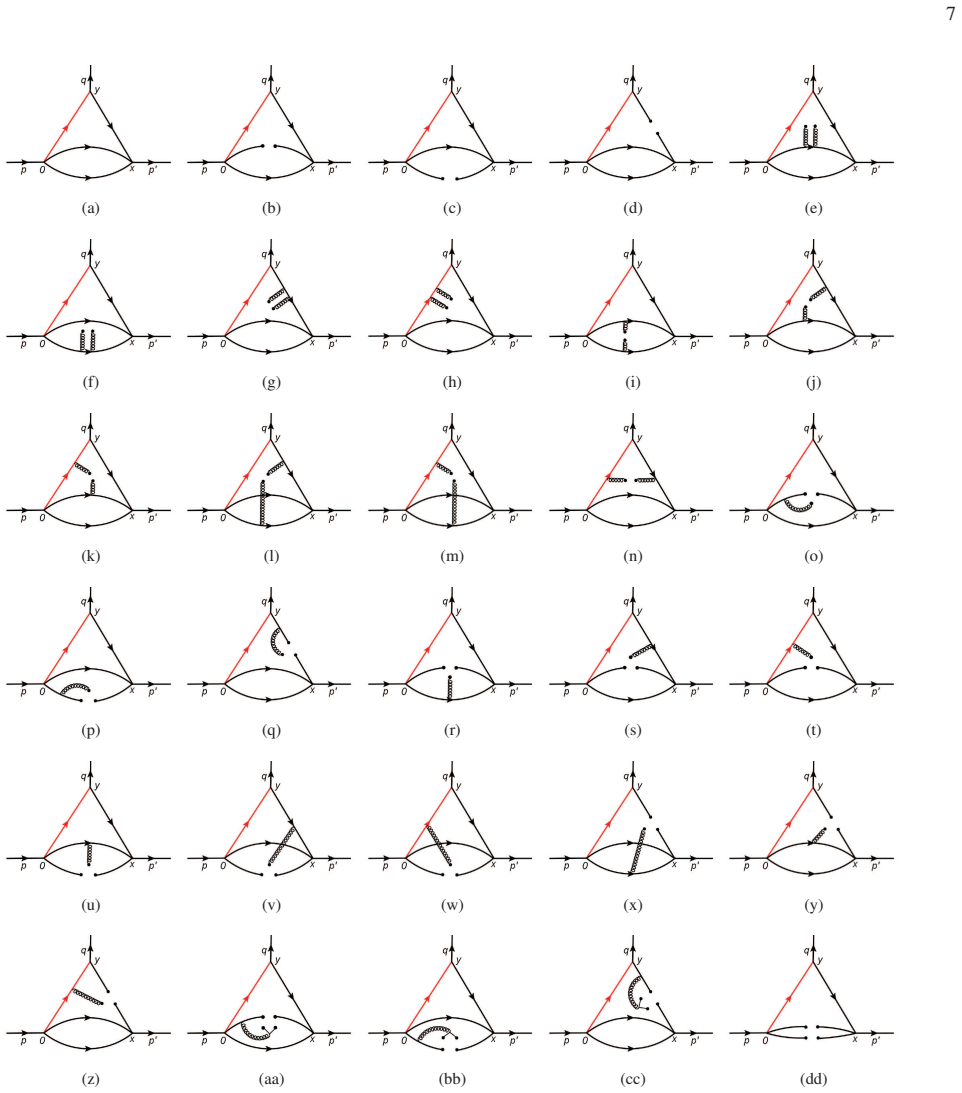
The machinery is a set of three-point correlation functions constructed from interpolating currents for the $\Lambda_{c[b]}$ baryon, the $D^{(*)}[B^{(*)}]$ meson, and the nucleon current $J(x)=\varepsilon_{ijk}(u^T C\gamma_\beta u_j)\gamma^\beta d_k$ for $N^*(1535)$. On the QCD side the operator product expansion is evaluated including perturbative, quark condensate, gluon condensate, mixed condensate, and four-quark condensate contributions, with spectral densities obtained by Cutkosky cutting rules; on the hadronic side all couplings of the currents to both positive- and negative-parity baryon states are kept. A double Borel transformation and quark-hadron duality convert the two descriptions into expressions for the momentum-dependent couplings $G(Q^2)$, $f(Q^2)$, and $g(Q^2)$. The final load-bearing object is the four-parameter fit $G(Q^2)=G_0(1+\delta_1 Q^2/m_{\Lambda_{c[b]}}^2+\delta_2(Q^2/m_{\Lambda_{c[b]}}^2)^2)\exp(\delta_3 Q^2/m_{\Lambda_{c[b]}}^2)$, fitted in the spacelike window and continued to the timelike on-shell points $Q^2=-m_{D^{(*)}[B^{(*)}]}^2$.
What would settle it
A lattice QCD computation of one of the couplings, for example $G_{\Lambda_c D N^*}(Q^2)$ at $Q^2=0$ and at one or two nearby timelike points, compared with the fitted curve evaluated at the same $Q^2$, would settle whether the analytic continuation is trustworthy; a disagreement larger than the quoted error bars would invalidate the on-shell values in Eq. (40).
Extended reading notes
Core claim
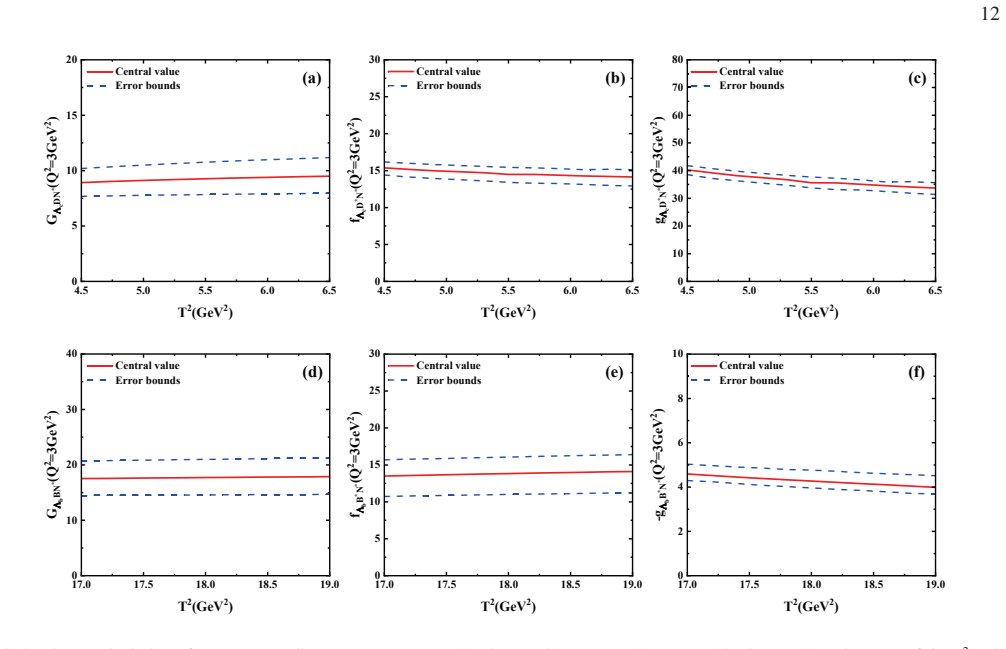
On the paper's own terms, the central result is a set of six numbers for the on-shell strong couplings: $G_{\Lambda_c D N^*}(-m_D^2)=4.06^{+0.96}_{-0.75}$, $f_{\Lambda_c D^* N^*}(-m_{D^*}^2)=3.73^{+0.68}_{-0.16}$, $g_{\Lambda_c D^* N^*}(-m_{D^*}^2)=9.22^{+3.16}_{-0.36}$, $G_{\Lambda_b B N^*}(-m_B^2)=9.11^{+1.54}_{-1.61}$, $f_{\Lambda_b B^* N^*}(-m_{B^*}^2)=8.55^{+2.69}_{-2.21}$, and $g_{\Lambda_b B^* N^*}(-m_{B^*}^2)=-0.25^{+0.16}_{-0.01}$. The authors would emphasize that these numbers are obtained while including all positive- and negative-parity baryon contributions on the hadronic side and the main vacuum condensate terms in the operator product expansion. The paper also reports a consistency check with the heavy-quark limit: the relation $G=f$ is satisfied in both the charmed and bottom sectors, while $g=0$ is satisfied in the bottom sector but not cleanly in the charmed sector, which it reads as evidence that the heavy-quark limit works well for $b$ quarks and less well for $c$ quarks.
Load-bearing premise
Everything rests on the assumption that the four-parameter fit made at spacelike $Q^2$ between 3 and 9 GeV$^2$ (or 3 and 29 GeV$^2$ for the bottom vertices) describes the true coupling all the way down to the timelike on-shell points $Q^2=-m_D^2$, $-m_{D^*}^2$, $-m_B^2$, and $-m_{B^*}^2$.
Editorial extensions
If this is right
- The six on-shell couplings can be inserted directly into the effective Lagrangians for $\Lambda_c D^{(*)}N^*$ and $\Lambda_b B^{(*)}N^*$ vertices to compute strong decay widths and production cross sections involving these hadrons.
- They supply missing inputs for final-state rescattering loop calculations of heavy-flavor decays, where long-distance dynamics has been the main source of uncertainty.
- The two-point sum-rule results $m_{N^*}=1.53$ GeV and $\lambda_{N^*}=0.026$ GeV$^3$ are usable inputs for other hadron analyses involving $N^*(1535)$.
- The pattern $G=f$ in both sectors and $g\approx 0$ in the bottom sector supports treating bottom hadrons with heavy-quark spin symmetry, while implying noticeable spin-symmetry breaking in charmed systems.
Reading between the lines
- A reader extending the paper would expect the main numerical uncertainty to sit in the functional extrapolation rather than in the operator product expansion; comparing the four-parameter ansatz with a simple monopole or dipole fit over the same spacelike window would directly show how stable the on-shell values are.
- If the near-zero $g_{\Lambda_b B^* N^*}$ survives further checks, it provides a quantitative measure of heavy-quark spin symmetry in bottom systems and could be used to tune spin-symmetry-breaking terms in effective Lagrangians.
- The same two-point-plus-three-point sum-rule pipeline, including the same extrapolation ansatz, could be applied to other negative-parity baryon resonances, and the resulting couplings could be compared with lattice or quark-model predictions as a test of the method.
Editorial analysis
A structured set of objections, weighed in public.
Referee Report
Summary. The manuscript presents a QCD sum-rule analysis of the negative-parity nucleon resonance N*(1535) and of the strong vertices Λ_c D^(*) N*, Λ_b B^(*) N*. In the two-point part the authors extract the mass and pole residue of N*(1535) using a γ5-modified Ioffe current and include both positive- and negative-parity baryon contributions. In the three-point part they set the D^(*)/B^(*) meson off-shell, compute the couplings from three-point correlation functions in the spacelike region, fit the resulting Q²-dependence with the four-parameter ansatz of Eq. (39), and extrapolate to the timelike on-shell points Q² = -m_{D^(*)}², -m_{B^(*)}². The headline results are the six couplings listed in Eq. (40), with errors obtained from the Borel windows and input parameter variations.
Significance. If the reported numbers are correct, they provide useful inputs for hadronic rescattering and decay calculations involving N*(1535), and they offer a test of heavy-quark symmetry through the expected relations G ≈ f, g ≈ 0. The paper is careful in several respects: it includes positive- and negative-parity baryon couplings on the hadronic side, treats the projection needed to remove scalar-meson contamination, performs standard pole-dominance and OPE-convergence checks, and reports Borel windows. It is also a strength that the spacelike coupling points are computed from the sum rules rather than fitted to the on-shell values, so the procedure is not circular. However, the central numerical claim fails a direct check: evaluating Eq. (39) with Table II does not reproduce any of the six on-shell values in Eq. (40), and the QCD spectral densities needed to evaluate Eq. (35) are not shown. The reader's extrapolation concern is legitimate; the numerical traceability issue, however, is even more decisive. The significance of the paper is therefore conditional on correcting these issues.
major comments (3)
- [§IV.B, Eq. (39), Table II, Eq. (40)] The on-shell couplings are not traceable to the stated fit. Using Table I masses and Table II central parameters, I evaluate Eq. (39) at x = -m_{D(*)}²/m_{Λ_c}² and x = -m_{B(*)}²/m_{Λ_b}². For G_{Λ_c D N^*}: x = -0.662, 1 + δ1 x + δ2 x² = 1.139, exp(δ3 x) = 0.690, so G = 6.76 × 1.139 × 0.690 = 5.31, whereas Eq. (40) quotes 4.06. The analogous values for the six quantities G_{Λ_c D N^*}, f_{Λ_c D^* N^*}, g_{Λ_c D^* N^*}, G_{Λ_b B N^*}, f_{Λ_b B^* N^*}, and -g_{Λ_b B^* N^*} are (5.31, 6.72, 16.15, 10.38, 11.12, 1.42), compared with the quoted values (4.06, 3.73, 9.22, 9.11, 8.55, 0.25). The ratios range from 1.14 to 5.66 and are not uniform, so rounding or a sign convention cannot explain the discrepancy. Since Eq. (40) is the central result of the paper, the authors must either correct Eq. (40) or replace Table II with parameters that actually reproduce it, and verify every on-shell number.
- [§III.C, Eq. (35)] The full QCD spectral densities ρ̂(s,u,Q²), ρ̄1(s,u,Q²), and ρ̄2(s,u,Q²) are not given; the text says they are 'too complex to be shown here for simplicity.' These densities are the essential content of the QCD side: without them no reader can check the spacelike points in Fig. 4 or the final couplings. Please include the complete expressions in an appendix, or make an ancillary file available, and define the symbols used in Eq. (35).
- [§IV.B, Fig. 4 and Eq. (39)] The four-parameter ansatz is fitted only to spacelike points (3–9 GeV² for the charmed vertices, 3–29 GeV² for the bottom vertices) and then evaluated at timelike Q² = -m_{D(*)}² or -m_{B(*)}². A high R² in the fitted region does not validate the extrapolation. In particular, the D(*) on-shell points are just outside the fitted interval (Q² ≈ -3.5 and -4.0 GeV², compared with Q² > 3 GeV²), and the B(*) points lie near the edge of the fitted interval in magnitude (Q² ≈ -27.9 and -28.3 GeV², compared with Q² up to 29 GeV²). Because no alternative functional form is tried and no systematic uncertainty for the extrapolation is assigned, the quoted errors in Eq. (40) understate the model dependence. The authors should test at least one other ansatz and report the spread of the on-shell results.
minor comments (4)
- [Table II] The row labelled 'G_{Λ_b B* N^*}' is inconsistent with the notation in Eq. (14) and Eq. (40), where the pseudoscalar coupling is G_{Λ_b B N^*}; please correct the label.
- [Fig. 4] The axis labels and tick labels contain renderings such as '/s8722' instead of minus signs; in the published version the axes must be legible.
- [After Eq. (33)] The sentence after Eq. (33) says the denominator power can be reduced 'by using derivative formula in Eq. (33)'; the intended reference appears to be Eq. (32), where the derivative trick is displayed.
- [§IV.B] The text does not specify how the asymmetric errors in Eq. (40) are propagated from the Borel windows, condensate uncertainties, threshold parameters, and fit parameters; please describe the error budget explicitly.
Circularity Check
The headline on-shell couplings in Eq. (40) are, by the paper's own construction, evaluations of the four-parameter fit Eq. (39) with Table II; explicit evaluation at Q² = -m²_D(*)/-m²_B(*) does not reproduce the quoted values (computed 1.14-5.7x larger), so the central claim reduces to an unverifiable fitted ansatz.
-
fitted input called prediction
[Sec. IV.B, Eqs. (39)-(40) and Table II]
"Finally, we obtain the on-shell values of these coupling constants by setting Q2 = −m2 D(∗)[B(∗)] in Eq. (39). The final results are shown as, GΛcDN∗ (Q2 = −m2 D) = 4.06+0.96 −0.75"
The headline numbers are, by the paper's own statement, the four-parameter ansatz of Eq. (39) evaluated at the meson pole; no QCD-side input constrains Q² < 0 except the chosen fitting form, so the 'predictions' in Eq. (40) reduce to the fit by construction. The stated reduction also fails its own check: with Table II central values and Table I masses, x = Q²/m²_Λ = -m²_D/m²_Λc = -0.662 gives G = 6.76×(1.138)×exp(-0.371) ≈ 5.3, not 4.06; similarly ≈ 6.7 vs 3.73, ≈ 16.2 vs 9.22, ≈ 10.4 vs 9.11, ≈ 11.1 vs 8.55, and ≈ -1.42 vs -0.25. All six quoted values are 1.14-5.7x smaller than the fit evaluation. Since Sec. III.C withholds the spectral densities ('too complex to be shown here'), the central results are either fit-forced or untraceable.
-
other
[Sec. II.D and Sec. IV.A (threshold choice for N*(1535))]
"u0 is the threshold parameter which is introduced to eliminate the contributions of higher resonances and continuum states. It commonly fulfills the relation √u0 = m_ground+δ, where the m_ground denotes the mass of ground state hadron, δ is the energy gap between the ground and first excited states and commonly taken as a value of 0.3 − 0.7 GeV which is based on experimental data"
Weak self-anchoring: the continuum threshold window u0 = 4.35–5.22 GeV² corresponds to √u0 ≈ 2.09–2.28 GeV, i.e. effectively m_Ν*(experimental) + δ with δ ≈ 0.55–0.75 GeV, so the input spectral window is anchored to the experimental mass of the very state being extracted; the output m_N* = 1.53±0.16 GeV then reproduces that input. The Borel-ratio extraction is genuine, so this is not definitional, but the 'prediction' of the N*(1535) mass is partially anchored to its own target and is not independent first-principles evidence.
full rationale
The genuinely QCD-based content is the two-point sum rule (Eq. 13) and the three-point spacelike couplings (Eq. 35), which are computed from a real OPE with condensates; that part is self-contained, not circular. The central claim, however, is the on-shell set in Eq. (40), and the paper itself states these are obtained by 'setting Q² = −m²_D(∗)[B(∗)] in Eq. (39)' - i.e. the headline couplings are the fitted four-parameter ansatz evaluated in the timelike region. That is the fit-then-predict pattern applied to the paper's own most prominent output: everything not already fixed by the spacelike QCDSR points is fixed by the arbitrarily chosen polynomial-times-exponential form, so the prediction reduces to the fit. The reduction is also numerically broken: evaluating Eq. (39) with Table II central parameters and Table I masses at the stated pole positions gives about 5.3, 6.7, 16.2, 10.4, 11.1 and −1.42 instead of the quoted 4.06, 3.73, 9.22, 9.11, 8.55 and −0.25 - every value 1.14–5.7× larger - so the printed numbers are not even the value of the printed fit. With the QCD spectral densities withheld ('too complex to be shown here') and the Borel-window procedure deferred to self-citation [49], the central results are neither independently derivable nor reproducible from the equations as written. Secondary matters: f_D/B(∗) and λ_Λc/Λb inputs, s0, and the N* threshold are borrowed from the authors' own previous sum-rule papers [36, 37], and the N* mass extraction is softly anchored to the experimental mass through u0; these are normal parameter borrowing rather than definitional circularity, though the headline couplings scale directly with those self-cited values. No uniqueness theorem is imported and no ansatz is smuggled via citation (the fit form is presented as the authors' own trial-and-error choice). Verdict: partial circularity - the central on-shell couplings reduce to an unverified fitted ansatz that fails the paper's own check - score 6.
Assumptions & free parameters
free parameters (6)
- u0 (N* threshold) =
4.35 to 5.22 GeV^2
- Borel parameter T^2 (two-point) =
1.4 to 1.8 GeV^2
- s0 (Λc and Λb thresholds) =
7.02 to 8.12 GeV^2 and 36.00 to 38.44 GeV^2
- Borel parameters T^2 (three-point) =
4.5 to 6.5 GeV^2 (charmed), 17 to 19 GeV^2 (bottom)
- Fit parameters G0, δ1, δ2, δ3 (six couplings) =
Table II values
- m_p input =
0.983 GeV
assumptions (6)
- domain assumption Quark-hadron duality
- domain assumption Interpolating current choice
- domain assumption Vacuum saturation for four-quark condensates
- domain assumption Neglect of higher-dimensional condensates
- domain assumption Borel parameter ratio k
- domain assumption Separation of parities using input m_p
Cite this review
Pith. "Pith review of Analysis of the strong vertices $\Lambda_cD^{(*)}N^*(1535)$ and $\Lambda_bB^{(*)}N^*(1535)$ in QCD sum rules." pith.science (2026). https://pith.science/paper/B65JFRHX
@misc{pith2026250623095,
  author       = {Pith},
  title        = {Pith review of: Analysis of the strong vertices $\Lambda_cD^(*)N^*(1535)$ and $\Lambda_bB^(*)N^*(1535)$ in QCD sum rules},
  year         = {2026},
  howpublished = {\url{https://pith.science/paper/B65JFRHX}},
  note         = {Machine review of arXiv:2506.23095}
}
abstract
In this article, we firstly analyze the mass and pole residue of negative parity nucleon $N^*(1535)$ within the two-point QCD sum rules. Basing on these results, we continuously study the strong coupling constants of vertices $\Lambda_cDN^*$, $\Lambda_cD^*N^*$, $\Lambda_bBN^*$ and $\Lambda_bB^*N^*$ in the framework of three-point QCD sum rules. At hadron side, all possible couplings of interpolating current to hadronic states are considered. At QCD side, the contributions of vacuum condensate terms $\langle\bar{q}q\rangle$, $\langle g_s^2GG\rangle$, $\langle\bar{q} g_s\sigma Gq\rangle$, $\langle\bar{q}q\rangle^2$ and $g_s^2\langle\bar{q}q\rangle^2$ are also considered. By setting the four momentum of $D^{(*)}[B^{(*)}]$ mesons off-shell, the strong coupling constants in deep space-like regions ($Q^2=-q^2\gg\Lambda_{QCD}^2$) are obtained. Then, the momentum dependent coupling constants in space-like regions are fitted into analytical function $G(Q^2)$ and are extrapolated into time-like regions ($Q^2<0$). Finally, the on-shell values of strong coupling constants are obtained by taking $Q^{2}=-m_{D^{(*)}[B^{(*)}]}^2$. The results are $G_{\Lambda_cDN^*}(Q^2=-m_D^2)=4.06^{+0.96}_{-0.75}$, $f_{\Lambda_cD^*N^*}(Q^2=-m_{D^*}^2)=3.73^{+0.68}_{-0.16}$, $g_{\Lambda_cD^*N^*}(Q^2=-m_{D^*}^2)=9.22^{+3.16}_{-0.36}$, $G_{\Lambda_bBN^*}(Q^2=-m_B^2)=9.11^{+1.54}_{-1.61}$, $f_{\Lambda_bB^*N^*}(Q^2=-m_{B^*}^2)=8.55^{+2.69}_{-2.21}$ and $g_{\Lambda_bB^*N^*}(Q^2=-m_{B^*}^2)=-0.25^{+0.16}_{-0.01}$.
Figures

Figures from the paper (1 more)

Forward citations
Cited by 3 Pith papers
-
Analysis of the semileptonic decays $\Sigma_b\to\Sigma_cl\bar{\nu}_l$, $\Xi'_b\to\Xi'_cl\bar{\nu}_l$ and $\Omega_b\to\Omega_cl\bar{\nu}_l$ in QCD sum rules
QCD sum-rule calculations predict Σ_b→Σ_c, Ξ'_b→Ξ'_c and Ω_b→Ω_c semileptonic widths that differ by less than 13%, supporting approximate SU(3) flavor symmetry.
-
Analysis of the semileptonic decays $\Lambda_b\to\Lambda_cl\bar{\nu}_l$ and $\Xi_b\to\Xi_cl\bar{\nu}_l$ in QCD sum rules
A QCD sum rule analysis that includes negative parity baryon states and condensates up to dimension 8 obtains Lambda_b semileptonic branching ratios near 8 percent and predicts Xi_b rates near 14 percent.
-
Analysis of the semileptonic decays $\Sigma_b\to\Sigma_cl\bar{\nu}_l$, $\Xi'_b\to\Xi'_cl\bar{\nu}_l$ and $\Omega_b\to\Omega_cl\bar{\nu}_l$ in QCD sum rules
Electroweak form factors for Σ_b→Σ_c, Ξ'_b→Ξ'_c and Ω_b→Ω_c transitions are computed in QCD sum rules, producing decay widths that approximately obey SU(3) flavor symmetry along with branching ratios and new-physics p...
Reference graph
Works this paper leans on
-
[1]
also couples to negative parity baryon Λ∗ c[b]. In ad- dition, the vector current JD∗[B∗]µ can also couple to the scalar charmed (bottom) meson D0[B0], its contribution can be elim- inated by introducing the projection operator (gµν − qµqν q2 ) in the correlation function. Substituting the matrix elements in Eq. ( 18) with Eqs. ( 5), (15) and ( 19) and mu...
- [2]
-
[3]
( 2), and do the operator product expansion (OPE) by contracting the quark filed with Wick’s theorem
with Eq. ( 2), and do the operator product expansion (OPE) by contracting the quark filed with Wick’s theorem. After these processes, the correlation function in QCD side can be expressed as, ΠQCD(p′) = 2iεi jkεi′ j′k′ ∫ d4xeip′ x ×T r[U jk′ (x)γαCU j′iT (x)Cγβ]γβDki′ (x)γα (8) where, U ki′ (x) and Dk′ j(x) are u and d quark full propagators and they can b...
-
[4]
C.-J. Xiao, Y . Huang, Y .-B. Dong, L.-S. Geng, and D.-Y . Chen, Phys. Rev. D 100, 014022 (2019), 1904.00872
arXiv 2019
- [5]
- [6]
- [7]
-
[8]
M. E. Bracco, F. S. Navarra, and M. Nielsen, Phys. Lett. B 454, 346 (1999), nucl-th/9902007
work page Pith review arXiv 1999
Show all 64 references
-
[9]
and can be calculated by doing vari- able replacement xµ → i∂/∂p′ µ. Fig. 1 (dd) describes that each of two light quark lines contribute a quark-antiquark p air to produce four quark condensation. This contribution play s a key role to the final results and can be expressed as ...
2024
-
[10]
Hu, C.-P
X.-H. Hu, C.-P . Jia, Y . Xing, and F.-S. Y u, Phys. Rev. D 111, 076002 (2025), 2403.09511
2025 arXiv
-
[11]
R. L. Altmeyer, M. Gockeler, R. Horsley, E. Laermann, G. Schierholz, and P . M. Zerwas, Z. Phys. C 68, 443 (1995), hep-lat/9504003
1995 arXiv
-
[12]
M. E. Bracco and M. Nielsen, Phys. Rev. D 82, 034012 (2010), 1002.4990
2010 arXiv
-
[13]
M. E. Bracco, M. Chiapparini, F. S. Navarra, and M. Niels en, Prog. Part. Nucl. Phys. 67, 1019 (2012), 1104.2864
2012 arXiv
-
[14]
Cui, Y .-L
C.-Y . Cui, Y .-L. Liu, and M.-Q. Huang, Phys. Lett. B 711, 317 (2012), 1204.3979
2012 arXiv
- [15]
-
[16]
Y u, Z.-Y
G.-L. Y u, Z.-Y . Li, and Z.-G. Wang, Eur. Phys. J. C 75, 243 (2015), 1502.01698
2015 arXiv
- [17]
-
[18]
Lu, G.-L
J. Lu, G.-L. Y u, Z.-G. Wang, and B. Wu, Chin. Phys. C 48, 013102 (2024), 2307.05090
2024 arXiv
-
[19]
Colangelo and F
P . Colangelo and F. De Fazio, Eur. Phys. J. C 4, 503 (1998), hep-ph/9706271
1998 arXiv
-
[20]
Zhu and Y .-B
S.-L. Zhu and Y .-B. Dai, Phys. Rev. D 58, 094033 (1998), hep- ph/9802225
1998
-
[21]
Khodjamirian, R
A. Khodjamirian, R. Ruckl, S. Weinzierl, and O. I. Yakov lev, Phys. Lett. B 457, 245 (1999), hep-ph /9903421
1999
-
[22]
Z. G. Wang and S. L. Wan, Phys. Rev. D 73, 094020 (2006), hep-ph/0603007
2006 arXiv
- [23]
-
[24]
Khodjamirian, C
A. Khodjamirian, C. Klein, T. Mannel, and Y . M. Wang, JHE P 09, 106 (2011), 1108.2971
2011 arXiv
-
[25]
Khodjamirian, B
A. Khodjamirian, B. Meli´ c, Y .-M. Wang, and Y .-B. Wei, JHEP 03, 016 (2021), 2011.11275
2021 arXiv
-
[26]
T. M. Aliev and K. S ¸ ims ¸ek, Phys. Rev. D103, 054044 (2021), 2011.07150
2021 arXiv
-
[27]
T. M. Aliev, T. Barakat, and K. S ¸ ims ¸ek, Eur. Phys. J. A57, 160 (2021), 2101.10264
2021 arXiv
-
[28]
T. M. Aliev, S. Bilmis, and M. Savci, Phys. Rev. D 106, 074022 (2022), 2208.10365
2022 arXiv
-
[29]
Y .-s. Oh, T. Song, and S. H. Lee, Phys. Rev. C 63, 034901 (2001), nucl-th/0010064
2001 arXiv
-
[30]
Z.-H. Li, T. Huang, J.-Z. Sun, and Z.-H. Dai, Phys. Rev. D 65, 14 076005 (2002), hep-ph/0208168
2002 arXiv
-
[31]
Deandrea, G
A. Deandrea, G. Nardulli, and A. D. Polosa, Phys. Rev. D 68, 034002 (2003), hep-ph/0302273
2003 arXiv
-
[32]
M. A. Shifman, A. I. V ainshtein, and V . I. Zakharov, Nucl. Phys. B 147, 385 (1979)
1979
-
[33]
M. A. Shifman, A. I. V ainshtein, and V . I. Zakharov, Nucl. Phys. B 147, 448 (1979)
1979
-
[34]
V . A. Novikov, L. B. Okun, M. A. Shifman, A. I. V ainshtein , M. B. V oloshin, and V . I. Zakharov, Phys. Rept.41, 1 (1978)
1978
-
[35]
B. L. Io ffe, Nucl. Phys. B 188, 317 (1981), [Erratum: Nucl.Phys.B 191, 591–592 (1981)]
1981
-
[36]
Narison, Phys
S. Narison, Phys. Lett. B 198, 104 (1987)
1987
-
[37]
R. D. Matheus, F. S. Navarra, M. Nielsen, and C. M. Zanett i, Phys. Rev. D 80, 056002 (2009), 0907.2683
2009 arXiv
-
[38]
Mo, C.-Y
Z. Mo, C.-Y . Cui, Y .-L. Liu, and M.-Q. Huang, Commun. Theor. Phys. 61, 501 (2014), 1403.6906
2014 arXiv
- [39]
- [40]
- [41]
-
[42]
Zeng, X.-G
L. Zeng, X.-G. Wu, D.-D. Hu, H.-B. Fu, and T. Zhong, Phys. Rev. D 111, 056030 (2025), 2501.06737
2025 arXiv
-
[43]
Y .-M. Wang, H. Zou, Z.-T. Wei, X.-Q. Li, and C.-D. Lu, Eur . Phys. J. C 54, 107 (2008), 0707.1138
2008 arXiv
- [44]
- [45]
-
[46]
G. L. Y u, Z. G. Wang, and Z. Y . Li, Chin. Phys. C 41, 083104 (2017), 1608.03460
2017 arXiv
-
[47]
Y u, R.-H
G.-L. Y u, R.-H. Guan, and Z.-G. Wang, Int. J. Mod. Phys. A 33, 1850217 (2019), 1810.05970
2019 arXiv
-
[48]
Y .-J. Shi, W. Wang, and Z.-X. Zhao, Eur. Phys. J. C 80, 568 (2020), 1902.01092
2020 arXiv
-
[49]
Zhao, R.-H
Z.-X. Zhao, R.-H. Li, Y .-L. Shen, Y .-J. Shi, and Y .-S. Yang, Eur. Phys. J. C 80, 1181 (2020), 2010.07150
2020 arXiv
-
[50]
Zhao, X.-Y
Z.-X. Zhao, X.-Y . Sun, F.-W. Zhang, Y .-P . Xing, and Y .-T. Yang, Phys. Rev. D 108, 116008 (2023), 2103.09436
2023 arXiv
- [51]
-
[52]
Lu, G.-L
J. Lu, G.-L. Y u, Z.-G. Wang, and B. Wu, Eur. Phys. J. C 83, 907 (2023), 2308.06705
2023 arXiv
-
[53]
Wu, G.-L
B. Wu, G.-L. Y u, J. Lu, and Z.-G. Wang, Phys. Lett. B 859, 139118 (2024), 2406.08181
2024 arXiv
- [54]
-
[55]
Lu, D.-Y
J. Lu, D.-Y . Chen, G.-L. Y u, Z.-G. Wang, and B. Wu, Phys. Rev. D 111, 114037 (2025), 2501.15534
2025
-
[56]
Pascual and R
P . Pascual and R. Tarrach, QCD: RENORMALIZATION FOR THE PRACTITIONER, vol. 194 (1984)
1984
-
[57]
L. J. Reinders, H. Rubinstein, and S. Yazaki, Phys. Rept . 127, 1 (1985)
1985
-
[58]
Navas et al
S. Navas et al. (Particle Data Group), Phys. Rev. D 110, 030001 (2024)
2024
-
[59]
Y u, Z.-G
G.-L. Y u, Z.-G. Wang, X.-W. Wang, and H.-J. Wang, Int. J. Mod. Phys. A 36, 2150197 (2021), 2102.11078
2021 arXiv
-
[60]
R. E. Cutkosky, J. Math. Phys. 1, 429 (1960)
1960
- [61]
-
[62]
Narison, Phys
S. Narison, Phys. Lett. B 693, 559 (2010), [Erratum: Phys.Lett.B 705, 544–544 (2011)], 1004.5333
2010 arXiv
- [63]
- [64]
Reviewed August 6, 2026 · model on record in the stance chip above.
Discussion (0). Sign in to comment.