REVIEW 4 major objections 5 minor 19 references
Computer-Aided Multi-Stroke Character Simplification by Stroke Removal
T0 review · 4 major / 5 minor · reviewed 2026-08-06 · deepseek-v4-flash
Pith's one-line read Removing up to about one-third of a multi-stroke character's strokes leaves computed legibility nearly unchanged, the paper claims, so stroke removal can yield simplified characters without losing recognizability.
desk verdict A clean, reproducible computational study of stroke removal in kanji, but the headline 'legibility' is classifier confidence, not human reading; worth reviewing, with the human-facing claims treated as conditional. read the letter →
The pith
A machine-rendered reading of the paper's core claim, the machinery that carries it, and where it could break.
The reading
What carries the argument
The central object is the optimal k-stroke removal x*_-k, defined by x*_-k = argmax_{x_-k} Pθ(cx | x_-k), where θ is the pretrained DaKanji classifier (an EfficientNet Lite-0 network) and x_-k ranges over all C(K,k) ways to delete k strokes from a K-stroke character. This argmax turns an intractable human-legibility judgment into a reproducible score, and the sequence x*_-1, ..., x*_{-(K-1)} (the optimal removal sequence) is what the paper analyzes. A second quantity, removal tolerance T_x = sum_k Pθ(cx | x*_-k), ranks characters by how fast their computed legibility collapses as strokes are removed.
What would settle it
Conduct a human identification experiment: show native readers the optimal removal sequences for the 1,256 characters (or a sample of the K=10, 15, and 20 classes) and measure how many strokes can be removed before identification accuracy drops below a threshold such as 80%. If human accuracy collapses far before the classifier's score leaves 1.0, the central robustness claim is false; the paper's own observation of unreadability before classifier failure suggests this outcome is plausible.
Extended reading notes
Core claim
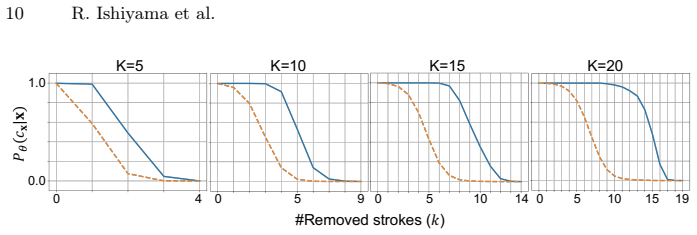
The central claim is that stroke removal can be optimized by choosing, for each k, the subset of k strokes whose removal leaves Pθ(cx | x_-k), the classifier's posterior probability for the original class, as large as possible. With that optimal choice, the paper reports that computed legibility stays at 1.0 for all characters with K=10 up to two removals, K=15 up to five removals, and K=20 up to eight removals, and that on average legibility remains high until roughly one-third of strokes are gone. Some characters even become more legible to the classifier after one or two strokes are removed. The paper further claims that the optimal removal sequence is not greedy (the best way to remove k+1 strokes is not always an extension of the best way to remove k), that random removal is far more damaging than optimal removal, and that strokes are removed in a balanced way across the character so that no radical disappears entirely.
Load-bearing premise
The entire conclusion depends on treating DaKanji's posterior probability as equivalent to human legibility, and the paper provides no human reading test to confirm that equivalence.
Editorial extensions
If this is right
- If the claim holds, font designers can use the same search to produce simplified typefaces (like highway or low-resolution fonts) whose stroke deletions are guaranteed to keep a classifier's recognition intact.
- The one-third removal threshold gives a concrete target for textbook and learning-material simplification: keep at least two-thirds of strokes, distributed across radicals, to preserve character identity.
- The non-monotonic removal sequence implies simplification is not a greedy process, so software tools should search combinations rather than remove strokes one at a time.
- The balanced-removal rule (never erase an entire radical) can be stated as a design guideline from the optimal sequences.
- The framework extends to any script where strokes are available as vector data, so it can serve as a benchmark for future simplification algorithms.
Reading between the lines
- The paper's robustness result resembles error-correcting-code redundancy; a natural extension is to quantify the minimum number of strokes needed for unique identification of each character class as an information-theoretic capacity.
- Because the classifier's score can increase after removing a stroke, some original strokes are actually noise for recognition; a testable extension is to check whether native readers also prefer the cleaned forms.
- The paper's own admission that native speakers find shapes unreadable just before classifier failure suggests a human-legibility experiment would likely shift the one-third threshold downward, perhaps much more for low-K characters.
- The framework could be inverted to help learners: instead of simplifying to the classifier's optimum, use removal tolerance as a measure of which strokes are essential, and prioritize teaching those strokes first.
Signed reviews
Editorial analysis
A structured set of objections, weighed in public.
Referee Report
Summary. The paper proposes a computational framework for simplifying multi-stroke CJK characters by deleting strokes. For each character x with K strokes, the method enumerates all C(K,k) removal patterns, renders them as 64x64 images from KanjiVG vector data, and uses the softmax posterior P_theta(c_x | x_-k) of a pretrained DaKanji classifier as a measure of "computed legibility." The pattern maximizing this posterior is selected as the optimal k-stroke removal. Experiments on 1,256 characters with K = 5, 10, 15, and 20 report average and minimum computed-legibility curves, a random-removal baseline, per-character removal tolerance, example optimal removal sequences, and an analysis of whether short or long strokes tend to be removed first. The headline observations are that computed legibility often stays near 1.0 until approximately one-third of the strokes are removed, that removal tolerance varies strongly across characters, and that optimal removals are spatially balanced across radicals. The authors acknowledge in Sections 5.4 and 6 that the classifier is only an approximation of human legibility and can overestimate readability.
Significance. If read as a study of a specific recognizer's robustness to stroke deletion, this is a solid and clearly written contribution: exhaustive enumeration over removal patterns is appropriate, the random-removal control is well designed, and the use of a publicly available pretrained model aids reproducibility. The observations about structural redundancy, radical preservation, and stroke length are plausible and potentially useful for font design and for teaching materials. However, the paper repeatedly frames the results in terms of human legibility, while the evidence is entirely classifier confidence. Because the same posterior is used both to select and to score the simplified characters, and because no human reading experiment or perceptual rating is reported, the human-facing significance is not established. The paper's value would remain substantial if the claims were explicitly scoped to computed legibility, or if a human validation study were added.
major comments (4)
- [Section 3.1, Eq. (1), Section 5.4] The headline claim of the abstract and introduction, namely that simplification by stroke removal preserves legibility and that up to about one-third of strokes can be removed, is worded in terms of human legibility, but the evidence is entirely the posterior P_theta(c_x | x*_-k) of DaKanji. The same posterior is used to select the optimal removal in Eq. (1) and to score it in Eq. (2) and Fig. 6, so the reported "minimum computed legibility stays 1.0" result is partly by construction. The manuscript itself concedes in Section 5.4 that native speakers find some shapes unreadable just before the classifier stops recognizing them, and the conclusion lists human-centered validation only as future work. Because no human reading experiment or perceptual rating of the generated stimuli is reported, the human-facing interpretation is unsupported. The computational results would remain a meaningful contribution if the abstract, introduction, and conclusion were respecified as claims about recognizability by DaKanji, or if a human validation study were added, even on a stratified sample around the threshold region.
- [Section 3.3, Eq. (2), Fig. 10] The definition T_x = sum_{k=1}^{K-1} P_theta(c_x | x*_-k) is inconsistent with the plotted range in Fig. 10 and with the text in Section 5.3 stating that T_x is around 0.5 even for the least tolerant characters. For K = 20, Section 5.1 reports that the minimum computed legibility is 1.0 for all characters for k = 1,...,8, so Eq. (2) would give T_x at least 8 for those characters, far above the Fig. 10 axis that ends at 1.0. If the figure and the text actually use a normalized value such as T_x/(K-1), the definition must say so; if Eq. (2) is intended as written, the y-axis, the "T_x ~ 0.5" statement, and the ranking in Fig. 11 need to be corrected. This issue is load-bearing for the tolerant-versus-intolerant characterization.
- [Section 4.2 and Section 5.1] DaKanji is pretrained on intact KanjiVG characters, so the simplified images produced by stroke removal are out-of-distribution for the classifier, and softmax confidence on out-of-distribution inputs is not automatically a proxy for human readability. The paper reports only the model's 99.8% accuracy on intact images and the 98% accuracy on a second font, but no calibration or reliability check on simplified inputs. Section 5.1's observation that removing a stroke can raise computed legibility from 0.90 to 1.00 for the same character illustrates that the metric behaves in a way that is not obviously perceptual. The random-removal baseline is a good control for the relative benefit of selection, but it does not anchor the absolute scale of P_theta for human legibility. The authors should report the distribution of posterior values over all C(K,k) candidates for a subset of characters and, ideally, compare model confidence with human ratings on the same stimuli.
- [Section 5.3 and Fig. 11] The conclusions that tolerant characters often contain distinctive hook-like strokes and that intolerant characters tend to have more horizontal strokes are based on visual inspection of only five characters per stroke count, with no quantitative feature analysis or statistical comparison against the full set of 1,256 characters. Since this underlies the paper's finding about tolerance and stroke complexity, the claim should be supported by counts of stroke-shape types, by a comparison with the overall distribution, or by a statistical test.
minor comments (5)
- [Section 4.1] The notation K C k is used without a formal definition; write binomial coefficient notation or explicitly define it as "K choose k."
- [Fig. 11] The caption uses N in {5, 10, 15, 20} while the text uses K for the number of strokes; be consistent throughout.
- [Section 5.1] The observation that removing a stroke can increase computed legibility from 0.90 to 1.00 is surprising and deserves more than a parenthetical remark; it highlights the non-monotonic behavior of the proxy and should be discussed explicitly.
- [Section 5.2 and Fig. 9] State explicitly that the random baseline averages over all C(K,k) patterns while the proposed method selects the maximum; the comparison is valid, but the difference includes a max-versus-mean effect.
- [Section 6] A short reproducibility statement about releasing the generated simplified-character images and the exact KanjiVG subset would strengthen the paper.
Circularity Check
No significant circularity: the central legibility magnitudes are empirical and independently grounded; only a minor non-load-bearing self-citation (ref. [2]) is present.
full rationale
The derivation chain is: define computed legibility as the posterior of an externally pretrained classifier, DaKanji, used as-is without fine-tuning (Secs. 3.1, 4.2); define optimal k-stroke removal as the argmax of that posterior over all C(K,k) removal patterns (Eq. 1, Sec. 3.2); and then report the posterior values at the optima (Sec. 5.1, Fig. 6), the removal tolerance (Eq. 2), and emergent structural patterns. The only by-construction element is the meaning of 'optimal': the selected pattern is, by definition, the best-scoring removal under the reported metric, so 'the optimal removal preserves computed legibility relative to every alternative' is definitional. The substantive findings, however, are empirical magnitudes and properties that the argmax definition does not force: the minimum over characters of the maximized posterior stays at 1.0 only for certain K and k (it fails for K=5 beyond k=1), the posterior exhibits a sigmoid-like threshold, removals are spread across radicals rather than concentrated, and shorter strokes tend to be removed first. The random-removal baseline (Sec. 5.2) provides an independent counterfactual, showing that the same metric applied to unselected removals drops sharply (e.g., halved for K=10 at k=3), so the high optimal values are not a tautology of the metric. No parameter is fitted to the dataset and then renamed a prediction; the classifier is pretrained externally and its 99.8% KanjiVG and ~98% Hiragino accuracies are reported as independent support. The paper itself flags the main validity gap in Sec. 5.4 ('computed legibility is merely an approximation of human legibility and can, at times, overestimate actual readability') and repeats it in the Conclusion; that is a construct-validity limitation on the human-facing gloss, not a circular step. The only overlap with the authors' prior work is ref. [2] (Cai-Uchida-Sakoe), cited in Sec. 2.2 as background on stroke-order variability; it is not load-bearing for any claim. Score 2 reflects this single minor, non-load-bearing self-citation; the central results stand on external, falsifiable evidence.
Assumptions & free parameters
assumptions (3)
- domain assumption DaKanji's posterior probability approximates human legibility for simplified characters.
- domain assumption Vector stroke decomposition in KanjiVG permits arbitrary stroke removal without changing stroke shapes or introducing rendering artifacts.
- domain assumption The argmax over classifier posterior defines the optimal k-stroke removal; legibility is measured only through this acceptance criterion.
Cite this review
Pith. "Pith review of Computer-Aided Multi-Stroke Character Simplification by Stroke Removal." pith.science (2026). https://pith.science/paper/XRYUXA7C
@misc{pith2026250623106,
  author       = {Pith},
  title        = {Pith review of: Computer-Aided Multi-Stroke Character Simplification by Stroke Removal},
  year         = {2026},
  howpublished = {\url{https://pith.science/paper/XRYUXA7C}},
  note         = {Machine review of arXiv:2506.23106}
}
read the original abstract
Multi-stroke characters in scripts such as Chinese and Japanese can be highly complex, posing significant challenges for both native speakers and, especially, non-native learners. If these characters can be simplified without degrading their legibility, it could reduce learning barriers for non-native speakers, facilitate simpler and legible font designs, and contribute to efficient character-based communication systems. In this paper, we propose a framework to systematically simplify multi-stroke characters by selectively removing strokes while preserving their overall legibility. More specifically, we use a highly accurate character recognition model to assess legibility and remove those strokes that minimally impact it. Experimental results on 1,256 character classes with 5, 10, 15, and 20 strokes reveal several key findings, including the observation that even after removing multiple strokes, many characters remain distinguishable. These findings suggest the potential for more formalized simplification strategies.
Figures


Figures from the paper (11 more)




Reference graph
Works this paper leans on
-
[1]
Berio, D., Leymarie, F.F., Asente, P., Echevarria, J.: Strokestyles: Stroke-based segmentationandstylizationoffonts.ACMTransactionsonGraphics(TOG) 41(3) (2022)
work page 2022
-
[2]
In: Proceedings of the 18th Interna- tional Conference on Pattern Recognition (ICPR)
Cai, W., Uchida, S., Sakoe, H.: An efficient radical-based algorithm for stroke- order-free online kanji character recognition. In: Proceedings of the 18th Interna- tional Conference on Pattern Recognition (ICPR). vol. 2, pp. 986–989 (2006)
work page 2006
-
[3]
Pattern Recognition107, 107488 (2020)
Cao,Z.,Lu,J.,Cui,S.,Zhang,C.:Zero-shothandwrittenchinesecharacterrecogni- tion with hierarchical decomposition embedding. Pattern Recognition107, 107488 (2020)
work page 2020
-
[4]
Han, S.J., Kelly, P., Winters, J., Kemp, C.: Simplification is not dominant in the evolution of chinese characters. Open Mind6, 264–279 (2022)
work page 2022
-
[5]
International Journal of Computer Vision (IJCV) 132(11), 5372–5386 (2024)
He, H., Chen, X., Wang, C., Liu, J., Du, B., Tao, D., Yu, Q.: Diff-font: Diffu- sion model for robust one-shot font generation. International Journal of Computer Vision (IJCV) 132(11), 5372–5386 (2024)
work page 2024
-
[6]
In: Proceedings of the AAAI Conference on Artificial Intelligence (AAAI)
Li,M.,Yu,Y.,Yang,Y.,Ren,G.,Wang,J.:StrokeExtractionofChineseCharacter Based on Deep Structure Deformable Image Registration. In: Proceedings of the AAAI Conference on Artificial Intelligence (AAAI). vol. 37, pp. 1360–1367 (2023)
work page 2023
-
[7]
Liu, C.L., Kim, I.J., Kim, J.H.: Model-based stroke extraction and matching for handwritten chinese character recognition. Pattern Recogn. 34(12), 2339–2352 (2001)
work page 2001
-
[8]
Proceedings of the AAAI Conference on Artificial Intelligence (AAAI) (2024)
Liu, Y., Lian, Z.: DeepCalliFont: Few-shot Chinese calligraphy font synthesis by integrating dual-modality generative models. Proceedings of the AAAI Conference on Artificial Intelligence (AAAI) (2024)
work page 2024
Show all 19 references
-
[9]
In: Proc
Ota, I., Yamamoto, R., Sako, S., Sagayama, S.: Online handwritten kanji recogni- tion based on inter-stroke grammar. In: Proc. 9th Int. Conf. on Document Analysis and Recognition (ICDAR). pp. 1188–1192. IEEE Computer Society (2007)
2007
-
[10]
Xinhua Publishing House, Beijing, China (1956)
State Council of the People’s Republic of China: The Chinese Character Simplifi- cation Scheme. Xinhua Publishing House, Beijing, China (1956)
1956
-
[11]
American Journal of Psychology133(1), 31–42 (2020)
Teng, X., Yamada, J.: Position, visual complexity, and semantic radicals in left- right structured chinese characters: A naturalistic experiment on character simpli- fication. American Journal of Psychology133(1), 31–42 (2020)
2020
-
[12]
Pattern Recognition 123, 108416 (2022)
Wang, T.Q., Jiang, X., Liu, C.L.: Query pixel guided stroke extraction with model- based matching for offline handwritten chinese characters. Pattern Recognition 123, 108416 (2022)
2022
-
[13]
2017 14th IAPR International Conference on Document Analysis and Recognition (ICDAR)01, 579–584 (2017)
Wang, T.Q., Yin, F., Liu, C.L.: Radical-based chinese character recognition via multi-labeled learning of deep residual networks. 2017 14th IAPR International Conference on Document Analysis and Recognition (ICDAR)01, 579–584 (2017)
2017
-
[14]
arXiv preprint arXiv:2501.08062 (2025)
Xue, M., Du, J., Zhang, Z., Ma, J., Chang, Q., Hu, P., Zhang, J., Hu, Y.: Skeleton and Font Generation Network for zero-shot chinese character generation. arXiv preprint arXiv:2501.08062 (2025)
2025 arXiv
-
[15]
Reading and Writing25, 951–979 (2011)
Yan, G., Bai, X., Zang, C., Bian, Q., Cui, L., Qi, W., Rayner, K., Liversedge, S.: Using stroke removal to investigate chinese character identification during reading: Evidence from eye movements. Reading and Writing25, 951–979 (2011)
2011
-
[16]
Machine Learning113(6), 3807–3827 (2024)
Yu, H., Chen, J., Li, B., Xue, X.: Chinese character recognition with radical- structured stroke trees. Machine Learning113(6), 3807–3827 (2024)
2024
-
[17]
In: Proceedings of the AAAI Conference on Artificial Intelligence (AAAI)
Zeng, J., Chen, Q., Liu, Y., Wang, M., Yao, Y.: StrokeGAN: Reducing mode col- lapse in chinese font generation via stroke encoding. In: Proceedings of the AAAI Conference on Artificial Intelligence (AAAI). vol. 35, pp. 3270–3277 (2021) Computer-Aided Multi-Stroke Character Sim...
2021
-
[18]
Pattern Recognition103, 107305 (2020)
Zhang, J., Du, J., Dai, L.: Radical analysis network for learning hierarchies of chinese characters. Pattern Recognition103, 107305 (2020)
2020
-
[19]
In: Proceedings of the 30th ACM International Conference on Multimedia (ACM-MM)
Zu, X., Yu, H., Li, B., Xue, X.: Chinese character recognition with augmented char- acter profile matching. In: Proceedings of the 30th ACM International Conference on Multimedia (ACM-MM). pp. 6094–6102 (2022)
2022
Reviewed August 6, 2026 · model on record in the stance chip above.
Discussion (0). Continue with ORCID to comment.