REVIEW 3 major objections 6 minor 22 references
Belief Propagation-based Target Handover in Distributed Integrated Sensing and Communication
T0 review · 3 major / 6 minor · reviewed 2026-08-06 · deepseek-v4-flash
Pith's one-line read Distributed base stations can hand target tracks between overlapping fields of view using belief propagation, matching centralized tracking accuracy in simulation at lower communication cost.
desk verdict A clean, incremental BP-based handover scheme with released code; the accuracy claim is supported only for the tested scenario, and the unaddressed duplicate-track risk at the receiving BS plus unmeasured communication costs leave the headline under-supported. read the letter →
The pith
A machine-rendered reading of the paper's core claim, the machinery that carries it, and where it could break.
The reading
What carries the argument
The machinery is a factor-graph representation of the multi-target posterior, a graphical model of how the joint probability factors into local terms, in which each potential target is an augmented state (kinematic state plus an existence variable) and data association is encoded by compatible track-oriented and measurement-oriented association variables. Belief propagation computes approximate marginal beliefs for existence and kinematic state with complexity that scales linearly in the number of targets and measurements. The handover-specific piece is the criterion in Eq. (5): for each potential target, the transmitting station checks whether the prior existence probability exceeds $P_{\mathrm{th}}$ and whether the integral of the receiving station's detection probability over the predicted kinematic state exceeds a threshold $\Gamma$. If both hold, the prior is handed over once, tracked by label lists, and the associated measurement is additionally handed over when one is likely; the receiving station appends these priors to its factor graph and runs BP sequentially over its own then handed-over measurements.
What would settle it
In a two-base-station simulation with a long overlap region, let the receiving station track a target for several time steps before the handover prior arrives, then compare the GOSPA false-alarm and localization components against the centralized baseline; if duplicate tracks appear, for example two potential targets with posterior existence above the detection threshold near the same location, or the GOSPA divergence exceeds centralized, the no-duplicate assumption fails.
Extended reading notes
Core claim
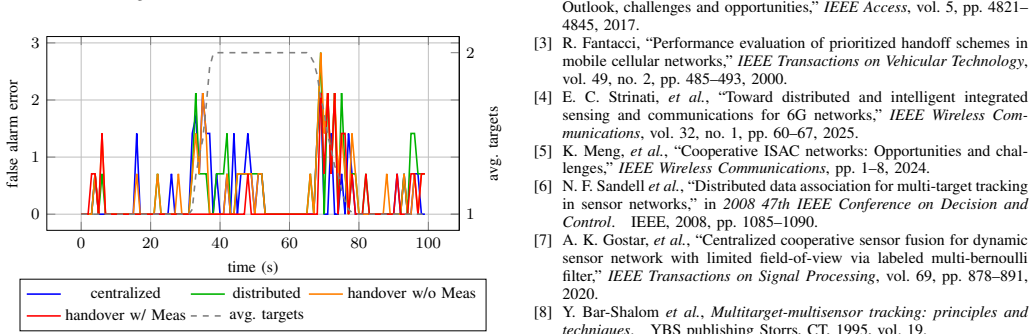
The central claim is that target handover in a distributed multi-base-station tracking system can be folded directly into a belief-propagation factor graph without a fusion center. Each base station runs BP multi-target tracking locally; when a potential target's prior existence probability exceeds a threshold and its predicted state is likely detectable by a neighbouring base station, the first base station sends that target's prior, and optionally the associated measurement, to the neighbour. The receiving station appends the received prior to its own set of legacy potential targets and processes handed-over measurements sequentially after its local measurements. A per-target label list prevents repeated transmission of the same prior, so information is shared once. In the paper's two-station urban simulation, this handover-with-measurements scheme yields GOSPA curves for BS1 comparable to centralized processing, with missed-detection and false-alarm components close to centralized, while requiring far less data exchange; handover without measurement exchange performs only slightly better than fully distributed processing.
Load-bearing premise
The load-bearing premise is that the receiving base station does not already have its own track of the handed-over target, because received priors are inserted as additional potential targets with no track-to-track association or merging step, so overlapping fields of view could lead to duplicate tracks and double-counted information.
Editorial extensions
If this is right
- A DISAC network can maintain track continuity across field-of-view boundaries without a central fusion unit, because handed-over priors let the receiving base station keep the target's track alive from the first time step it enters the field of view.
- Communication load scales with the number of handed-over targets and their associated measurements, not with raw measurement streams, so the protocol is a candidate for bandwidth-constrained dense urban deployments.
- Exchanging measurements during handover is what buys the accuracy gain: in the simulations, handover without measurements converges to fully distributed performance, while handover with measurements tracks centralized GOSPA.
- Because the handover machinery is built on the same factor graph as existing BP-based multi-target tracking, it can be added to an installed BP tracker without changing the local tracking core.
Reading between the lines
- Editorial inference: the same pairwise handover rule could be applied to more than two base stations by treating each ordered pair independently, but the paper only demonstrates a two-station case; multi-station behavior with a target crossing several fields of view in sequence remains untested.
- Editorial inference: because received priors are appended without a track-to-track association or merging step, performance in scenarios where the receiving base station already tracks the same target, such as a long overlap region, may degrade through double-counting; a labelled merge or track-confirmation step would be a natural extension.
- Editorial inference: the handover threshold $\Gamma$ effectively controls the false-alarm versus missed-detection trade-off at field-of-view boundaries, so adapting $\Gamma$ to local clutter density or target speed could reduce boundary false alarms.
Signed reviews
Editorial analysis
A structured set of objections, weighed in public.
Referee Report
Summary. The paper proposes a belief-propagation-based target handover mechanism for distributed integrated sensing and communication (DISAC) networks. A transmitting base station (BS-Tx) evaluates a handover criterion based on the predicted target state and the receiving BS's field of view, then sends the target prior and, optionally, the associated measurement to the receiving BS (BS-Rx). BS-Rx appends the received priors to its local set of legacy potential targets and runs sequential BP with its local measurements followed by the handed-over measurements. The authors compare four architectures (centralized, distributed, handover with measurements, and handover without measurements) in a two-BS, two-target urban scenario, reporting GOSPA curves for BS1. The main claim is that the handover-with-measurements variant tracks centralized accuracy while reducing communication and processing overhead.
Significance. If the central claim holds, the paper offers a practical, low-complexity alternative to centralized multisensor multi-target tracking in 6G DISAC systems. The authors explicitly release open-source simulation code, which is a clear strength for reproducibility. The factor-graph formulation builds on a well-established BP-MTT framework, and the handover criterion is a simple, concrete rule that could be useful for further study. However, the headline claim of centralized-comparable accuracy is currently supported by a single simulated scenario, with only BS1 results shown and no uncertainty quantification. The absence of track-to-track association at BS-Rx creates a risk of duplicate tracks in overlapping fields of view, which is exactly the regime the paper targets. The claimed communication-overhead reduction is also not quantified in the paper.
major comments (3)
- [Section IV.B.1 and Eq. (4)] Section IV.B.1 states that received handover priors are appended to the local priors, effectively increasing the number of legacy potential targets. There is no track-to-track association or merging step at BS-Rx. In overlapping fields of view, BS-Rx may already have a legacy PT for the same physical target, and the received prior becomes a second PT. The compatibility function Ψ(a_k,b_k) in Eq. (4) only ensures that each measurement is associated with at most one PT; it does not prevent two PTs from representing the same target. Both PTs can therefore be associated with different measurements (one local, one handed over), both can exceed the existence threshold P_th=0.5, and both are declared as targets. GOSPA penalizes the extra declaration as a false track. In the simulated scenario, BS separation is 150 m, FoV radius is 120 m, and the tracker uses p_d=0.9 inside the FoV with Γ=0.5, so the handover criterion in Eq. (5) will typically trigger whenever the predicted state is well inside BS-Rx's FoV, including when BS-Rx already has a track. This directly threatens the Section V.C claim that handover with measurements matches centralized performance. Please add an explicit merge or association step before appending received priors, gate the handover on the target not already being tracked locally, or provide track-cardinality evidence showing that no duplicate tracks occur in the overlapping-FoV regime.
- [Section V.C] The quantitative evidence for the central claim consists of one scenario with two BSs and two targets, and the paper plots only BS1 results. No error bars, confidence intervals, or per-run variability are reported for the 100 Monte Carlo trials, so the difference between handover with measurements and centralized processing could be within Monte Carlo noise. Since the abstract claims 'performance comparable to centralized processing,' the authors should report both BS1 and BS2 results (or a principled aggregation), and should quantify uncertainty on the main GOSPA curves. Additional variation of target density or FoV overlap would also substantiate the word 'extensive simulations' used in the abstract.
- [Abstract and Section V] The abstract and the introduction claim that the proposed procedure 'significantly reduces data exchange and processing overhead,' but the numerical section contains no communication-cost or runtime metric. The only support is the qualitative design argument that a prior and one associated measurement are exchanged rather than all raw measurements. Please quantify the overhead, for example by reporting bits exchanged per time step, number of messages, or wall-clock time, for centralized, distributed, and handover architectures. Without such a metric, the overhead-reduction claim is not established.
minor comments (6)
- [Eq. (3)] The pseudo-likelihood for a new PT v(x^m_k, r^m_k, b^m_k; z^m_k) uses the index j on r in its case conditions (r^j_k = 1 and r^j_k = 0); this should be r^m_k for consistency with the variable names.
- [Section III.C] There is a typo in the sentence extending MTT to n_s > 1: 'BPs' should be 'BSs.'
- [Section V.A] The measurement-noise parameters are listed as 'σ_r = 1 m and σ_θ = 1°' and later repeated as 'σ_r, σ_θ, σ_r, μ_c'; the duplicated σ_r is confusing and should be corrected.
- [Section V.B] The generative model uses p_d(x) = 1 inside the FoV, whereas the tracker sets p_d(x) = 0.9 inside the FoV. This model mismatch is not discussed; a sentence explaining this choice (e.g., as a robustness consideration) would help the reader interpret the results.
- [Section V.C] The GOSPA implementation parameters are only provided in the code. Since GOSPA parameters (e.g., cut-off c and order p) affect the decomposition into localization, missed-detection, and false-alarm errors, the main text should state the values used.
- [Section IV.A.2] Equation (5) is called a 'principled' criterion, but it is a heuristic threshold on the predicted detection probability integrated over BS-Rx's FoV. The paper does not derive it from a tracking-error or communication-cost objective. This is acceptable as a design choice, but the language should be softened or a brief justification should be added.
Circularity Check
No significant circularity: the handover criterion is a proposed control rule evaluated by simulation, and the central result does not reduce to its inputs.
full rationale
The paper's central claim is that the proposed BP-based handover procedure matches centralized tracking accuracy at lower communication cost. This claim is supported by Monte Carlo simulation against centralized and distributed baselines (Section V), not by deriving the result from the handover rule itself. The handover criterion in Eq. (5) is an explicit heuristic threshold test on the transmitting BS's existence belief and predicted detection probability at the receiving BS; it is not fitted to the GOSPA outcome, nor is the simulated accuracy a re-statement of the criterion. The BP-MTT machinery is taken from an external reference [17], and the only self-citation, [15], is cited as an alternative RFS-based method with poor scalability, not as a load-bearing justification for the proposed algorithm. No equation in the paper reduces to another by construction, no fitted parameter is renamed as a prediction, and no uniqueness or ansatz is imported through self-citation. The absence of track-to-track association at the receiving BS is a robustness concern, not a circularity concern, because the claimed performance is an empirical simulation result rather than a quantity forced by the algorithm's definitions.
Assumptions & free parameters
free parameters (5)
- Handover threshold Gamma =
0.5
- Existence threshold P_th =
0.5
- Pruning threshold P_prune =
1e-5
- New target birth mean mu_n =
0.01
- Tracker detection probability p_d(x) inside FoV =
0.9
assumptions (5)
- domain assumption BP on loopy factor graphs provides approximate marginal posteriors.
- domain assumption Targets follow a constant-velocity Gaussian kinematic model.
- domain assumption Measurements are conditionally independent given target states, and clutter is a Poisson point process.
- domain assumption Detection probability and FoV are known exactly.
- ad hoc to paper Handed-over priors can be appended as new legacy potential targets without creating duplicate tracks.
Cite this review
Pith. "Pith review of Belief Propagation-based Target Handover in Distributed Integrated Sensing and Communication." pith.science (2026). https://pith.science/paper/QHLRHPWT
@misc{pith2026250623118,
  author       = {Pith},
  title        = {Pith review of: Belief Propagation-based Target Handover in Distributed Integrated Sensing and Communication},
  year         = {2026},
  howpublished = {\url{https://pith.science/paper/QHLRHPWT}},
  note         = {Machine review of arXiv:2506.23118}
}
read the original abstract
Distributed integrated sensing and communication (DISAC) systems are key enablers for 6G networks, offering the capability to jointly track multiple targets using spatially distributed base stations (BSs). A fundamental challenge in DISAC is the seamless and efficient handover of target tracks between BSs with partially overlapping fields of view, especially in dense and dynamic environments. In this paper, we propose a novel target handover framework based on belief propagation (BP) for multi-target tracking in DISAC systems. By representing the probabilistic data association and tracking problem through a factor graph, the proposed method enables efficient marginal inference with reduced computational complexity. Our framework introduces a principled handover criterion and message-passing strategy that minimizes inter-BS communication while maintaining tracking continuity and accuracy. We demonstrate that the proposed handover procedure achieves performance comparable to centralized processing, yet significantly reduces data exchange and processing overhead. Extensive simulations validate the robustness of the approach in urban tracking scenarios with closely spaced targets.
Figures


Figures from the paper (4 more)


Reference graph
Works this paper leans on
-
[1]
The integrated sensing and communication revolution for 6G: Vision, techniques, and applications,
N. Gonz ´alez-Prelcic,et al., “The integrated sensing and communication revolution for 6G: Vision, techniques, and applications,”Proceedings of the IEEE, vol. 112, no. 7, pp. 676–723, 2024
2024
-
[2]
Planning wireless cellular networks of future: Outlook, challenges and opportunities,
A. Taufique,et al., “Planning wireless cellular networks of future: Outlook, challenges and opportunities,”IEEE Access, vol. 5, pp. 4821– 4845, 2017
work page 2017
-
[3]
Performance evaluation of prioritized handoff schemes in mobile cellular networks,
R. Fantacci, “Performance evaluation of prioritized handoff schemes in mobile cellular networks,”IEEE Transactions on Vehicular Technology, vol. 49, no. 2, pp. 485–493, 2000
work page 2000
-
[4]
Toward distributed and intelligent integrated sensing and communications for 6G networks,
E. C. Strinati,et al., “Toward distributed and intelligent integrated sensing and communications for 6G networks,”IEEE Wireless Com- munications, vol. 32, no. 1, pp. 60–67, 2025
work page 2025
-
[5]
Cooperative ISAC networks: Opportunities and chal- lenges,
K. Meng,et al., “Cooperative ISAC networks: Opportunities and chal- lenges,”IEEE Wireless Communications, pp. 1–8, 2024
work page 2024
-
[6]
Distributed data association for multi-target tracking in sensor networks,
N. F. Sandellet al., “Distributed data association for multi-target tracking in sensor networks,” in2008 47th IEEE Conference on Decision and Control. IEEE, 2008, pp. 1085–1090
work page 2008
-
[7]
A. K. Gostar,et al., “Centralized cooperative sensor fusion for dynamic sensor network with limited field-of-view via labeled multi-bernoulli filter,”IEEE Transactions on Signal Processing, vol. 69, pp. 878–891, 2020
work page 2020
-
[8]
Bar-Shalomet al.,Multitarget-multisensor tracking: principles and techniques
Y . Bar-Shalomet al.,Multitarget-multisensor tracking: principles and techniques. YBS publishing Storrs, CT, 1995, vol. 19
work page 1995
Show all 22 references
-
[9]
Multi-Sensor Multi-Object Tracking with the Gen- eralized Labeled Multi-Bernoulli Filter,
B.-N. V o,et al., “Multi-Sensor Multi-Object Tracking with the Gen- eralized Labeled Multi-Bernoulli Filter,”IEEE Transactions on Signal Processing, vol. 67, no. 23, pp. 5952–5967, 2019
2019
-
[10]
A scalable method for group target tracking using multisensor with limited field of views,
W. Zhou,et al., “A scalable method for group target tracking using multisensor with limited field of views,”Journal of Radars, vol. 12, no. 2, pp. 215–226, 2023
2023
-
[11]
Distributed multi-object tracking under limited field of view sensors,
H. Van Nguyen,et al., “Distributed multi-object tracking under limited field of view sensors,”IEEE Transactions on Signal Processing, vol. 69, pp. 5329–5344, 2021
2021
-
[12]
Optimal target assignment with seamless handovers for networked radars,
J. Kim,et al., “Optimal target assignment with seamless handovers for networked radars,”Sensors, vol. 19, no. 20, p. 4555, 2019
2019
-
[13]
Mobility management in integrated sensing and communications networks,
Y . S. Ribeiro,et al., “Mobility management in integrated sensing and communications networks,”arXiv preprint arXiv:2501.08159, 2025
2025 arXiv
-
[14]
Networked ISAC based UA V tracking and handover towards low-altitude economy,
Y . Feng,et al., “Networked ISAC based UA V tracking and handover towards low-altitude economy,”IEEE Transactions on Wireless Com- munications, pp. 1–1, 2025
2025
-
[15]
Target handover in distributed integrated sensing and communication,
Y . Ge,et al., “Target handover in distributed integrated sensing and communication,”arXiv preprint arXiv:2411.01871, 2024
2024 arXiv
-
[16]
Poisson multi-Bernoulli mixture filter: Direct derivation and implementation,
´A. F. Garc ´ıa-Fern´andez,et al., “Poisson multi-Bernoulli mixture filter: Direct derivation and implementation,”IEEE Transactions on Aerospace and Electronic Systems, vol. 54, no. 4, pp. 1883–1901, 2018
1901
-
[17]
Message passing algorithms for scalable multitarget tracking,
F. Meyer,et al., “Message passing algorithms for scalable multitarget tracking,”Proceedings of the IEEE, vol. 106, no. 2, pp. 221–259, 2018
2018
-
[18]
Bar-Shalom,et al.,Estimation with applications to tracking and navigation: theory algorithms and software
Y . Bar-Shalom,et al.,Estimation with applications to tracking and navigation: theory algorithms and software. John Wiley & Sons, 2004
2004
-
[19]
Channel estimation for hybrid architecture-based wideband millimeter wave systems,
K. Venugopal,et al., “Channel estimation for hybrid architecture-based wideband millimeter wave systems,”IEEE Journal on Selected Areas in Communications, vol. 35, no. 9, pp. 1996–2009, 2017
1996
-
[20]
Beamspace multidimensional ESPRIT approaches for simultaneous localization and communications,
F. Jiang,et al., “Beamspace multidimensional ESPRIT approaches for simultaneous localization and communications,”arXiv preprint arXiv:2111.07450, 2021
2021 arXiv
-
[21]
Factor graphs and the sum-product algorithm,
F. Kschischang,et al., “Factor graphs and the sum-product algorithm,” IEEE Transactions on Information Theory, vol. 47, no. 2, pp. 498–519, 2001
2001
-
[22]
Generalized optimal sub-pattern assignment metric,
A. S. Rahmathullah,et al., “Generalized optimal sub-pattern assignment metric,” in2017 20th International Conference on Information Fusion (Fusion), 2017, pp. 1–8
2017
Reviewed August 6, 2026 · model on record in the stance chip above.
Discussion (0). Continue with ORCID to comment.