Threshold Signatures for Central Bank Digital Currencies
Pith reviewed 2026-05-19 07:40 UTC · model grok-4.3
The pith
Threshold signatures let CBDCs distribute signing keys to cut compromise risks while keeping transaction speeds practical.
A machine-rendered reading of the paper's core claim, the machinery that carries it, and where it could break.
Core claim
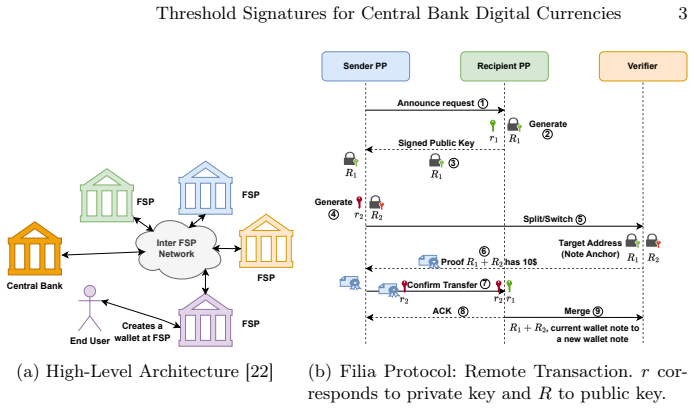
Threshold signature schemes allow distributed key management and signing in CBDCs, reducing the risk of a compromised key. Using the Filia CBDC solution as a base and focusing on ECDSA-based TSS libraries, the performance evaluation measures computational and communication complexity as well as throughput and latency of end-to-end transactions, confirming that TSS can enhance security while maintaining acceptable performance for real-world deployments.
What carries the argument
Threshold signature schemes that split private-key material across multiple independent parties so that a valid signature requires a quorum but no party ever holds the full key.
If this is right
- CBDC operators can replace single private keys with distributed TSS setups to limit damage from any one breach.
- Existing ECDSA-based CBDC codebases can adopt TSS libraries without changing the public-key format or transaction format.
- Measured overhead in key generation, signing rounds, and verification stays small enough that overall transaction rates remain viable for retail payment volumes.
- Security improvements from TSS apply directly to both issuance and transfer steps inside the same CBDC architecture.
Where Pith is reading between the lines
- The same TSS pattern could be tested on non-CBDC payment rails that already use ECDSA, such as certain stablecoin networks.
- Regulators might later require a minimum number of signers or geographic separation of TSS parties as a condition for operating large-scale digital currency systems.
- Hardware security modules could be combined with the software TSS libraries evaluated here to add physical isolation without changing the performance picture much.
Load-bearing premise
That performance numbers recorded on the Filia testbed with chosen ECDSA TSS libraries will remain acceptable once the system faces live network delays, regulatory rules, and real adversaries.
What would settle it
A production CBDC deployment that records end-to-end transaction latencies or throughput values more than double those measured on Filia under similar load would falsify the claim of acceptable real-world performance.
Figures


read the original abstract
Digital signatures are crucial for securing Central Bank Digital Currencies (CBDCs) transactions. Like most forms of digital currencies, CBDC solutions rely on signatures for transaction authenticity and integrity, leading to major issues in the case of private key compromise. Our work explores threshold signature schemes (TSSs) in the context of CBDCs. TSSs allow distributed key management and signing, reducing the risk of a compromised key. We analyze CBDC-specific requirements, considering the applicability of TSSs, and use Filia CBDC solution as a base for a detailed evaluation. As most of the current solutions rely on ECDSA for compatibility, we focus on ECDSA-based TSSs and their supporting libraries. Our performance evaluation measured the computational and communication complexity across key processes, as well as the throughput and latency of end-to-end transactions. The results confirm that TSS can enhance the security of CBDC implementations while maintaining acceptable performance for real-world deployments.
Editorial analysis
A structured set of objections, weighed in public.
Referee Report
Summary. The manuscript explores threshold signature schemes (TSS) for Central Bank Digital Currencies (CBDCs) to mitigate risks from single private-key compromise. It analyzes CBDC requirements, focuses on ECDSA-based TSS libraries, uses the Filia CBDC solution as the evaluation platform, and reports measurements of computational/communication complexity, throughput, and latency, concluding that TSS enhances security while preserving acceptable performance for real-world deployments.
Significance. If the reported performance figures hold under production-like conditions, the work supplies concrete empirical data on integrating distributed signing into CBDC transaction flows, thereby offering implementers a practical reference for trading off key-management security against latency and throughput.
major comments (3)
- [Abstract and §5] Abstract and §5 (Performance Evaluation): the central claim that TSS 'maintain[s] acceptable performance for real-world deployments' is not supported by any concrete latency, throughput, or end-to-end transaction numbers, nor by any comparison against a baseline single-key ECDSA implementation on the same testbed.
- [§5] §5: the Filia testbed results are presented without reported network latency, fault-injection, or adversarial-share-refresh scenarios; therefore the measurements do not establish robustness once the system encounters typical CBDC-scale WAN delays or partial synchrony.
- [§4–5] §4–5: no quantitative overhead figures (e.g., signing time ratio or communication volume ratio) relative to non-threshold ECDSA are supplied, leaving the magnitude of the performance penalty unquantified.
minor comments (2)
- [§5] Table captions and axis labels in the performance figures should explicitly state the number of participating nodes and the network topology used.
- [§3] A short paragraph comparing the chosen ECDSA TSS libraries (e.g., key-generation round complexity) would help readers assess why particular implementations were selected.
Simulated Author's Rebuttal
We thank the referee for the detailed and constructive comments. We agree that strengthening the empirical support and clarifying the evaluation scope will improve the manuscript. We address each major comment below and indicate the planned revisions.
read point-by-point responses
-
Referee: [Abstract and §5] Abstract and §5 (Performance Evaluation): the central claim that TSS 'maintain[s] acceptable performance for real-world deployments' is not supported by any concrete latency, throughput, or end-to-end transaction numbers, nor by any comparison against a baseline single-key ECDSA implementation on the same testbed.
Authors: We acknowledge that the abstract and §5 would be strengthened by explicit numerical values and a direct baseline comparison. The full manuscript does report throughput and latency for end-to-end transactions along with computational and communication measurements, but we agree these should be presented more prominently with concrete figures and a side-by-side comparison to single-key ECDSA on the identical testbed. We will revise the abstract and §5 to include these details. revision: yes
-
Referee: [§5] §5: the Filia testbed results are presented without reported network latency, fault-injection, or adversarial-share-refresh scenarios; therefore the measurements do not establish robustness once the system encounters typical CBDC-scale WAN delays or partial synchrony.
Authors: The current evaluation focuses on computational and communication overhead within the Filia testbed under controlled conditions. We recognize that WAN delays, partial synchrony, and fault scenarios are relevant for production CBDC deployments. In the revision we will add an explicit discussion of these limitations and, where feasible, include additional measurements or analysis for network latency and basic fault tolerance. Full adversarial share-refresh experiments would require substantial new implementation and are beyond the scope of the present study. revision: partial
-
Referee: [§4–5] §4–5: no quantitative overhead figures (e.g., signing time ratio or communication volume ratio) relative to non-threshold ECDSA are supplied, leaving the magnitude of the performance penalty unquantified.
Authors: We will revise §§4 and 5 to supply explicit quantitative overhead ratios, including signing-time and communication-volume comparisons between the threshold ECDSA implementation and a standard single-key ECDSA baseline on the same platform. revision: yes
Circularity Check
No circularity in empirical evaluation of TSS for CBDC
full rationale
The paper reports direct experimental measurements of computational and communication costs, throughput, and latency for ECDSA-based threshold signature schemes integrated with the Filia CBDC prototype. No mathematical derivation chain, equations, or predictions are present that reduce reported results to parameters fitted or defined inside the paper itself. Security enhancement claims follow from standard TSS properties (distributed key shares), while performance numbers are observed outputs from the testbed rather than constructed equivalences. The work is therefore self-contained against external benchmarks with no load-bearing self-citation or self-definitional steps.
Axiom & Free-Parameter Ledger
axioms (2)
- domain assumption Security of the underlying ECDSA threshold signature scheme holds under standard assumptions (e.g., honest majority or dishonest majority model depending on the library).
- domain assumption The Filia CBDC architecture and chosen network conditions are representative of production deployments.
Lean theorems connected to this paper
-
IndisputableMonolith/Cost/FunctionalEquation.leanwashburn_uniqueness_aczel unclear?
unclearRelation between the paper passage and the cited Recognition theorem.
Our performance evaluation measured the computational and communication complexity across key processes, as well as the throughput and latency of end-to-end transactions.
-
IndisputableMonolith/Foundation/AlexanderDuality.leanalexander_duality_circle_linking unclear?
unclearRelation between the paper passage and the cited Recognition theorem.
We focus on ECDSA-based TSSs and their supporting libraries.
What do these tags mean?
- matches
- The paper's claim is directly supported by a theorem in the formal canon.
- supports
- The theorem supports part of the paper's argument, but the paper may add assumptions or extra steps.
- extends
- The paper goes beyond the formal theorem; the theorem is a base layer rather than the whole result.
- uses
- The paper appears to rely on the theorem as machinery.
- contradicts
- The paper's claim conflicts with a theorem or certificate in the canon.
- unclear
- Pith found a possible connection, but the passage is too broad, indirect, or ambiguous to say the theorem truly supports the claim.
Reference graph
Works this paper leans on
-
[1]
Low-Bandwidth Threshold ECDSA via Pseudoran- dom Correlation Generators
Damiano Abram et al. Low-Bandwidth Threshold ECDSA via Pseudoran- dom Correlation Generators. 2021. url: https : / / eprint . iacr . org / 2021/1587. 16 M. Abdelrahman et al
work page 2021
-
[2]
ElliAndroulakietal. A Framework for Resilient, Transparent, High-throughput, Privacy-Enabled Central Bank Digital Currencies. 2023. url: https:// eprint.iacr.org/2023/1717
work page 2023
-
[3]
2020.url: https://eprint.iacr.org/ 2020/1390
Jean-Philippe Aumasson, Adrian Hamelink, and Omer Shlomovits.A Sur- vey of ECDSA Threshold Signing. 2020.url: https://eprint.iacr.org/ 2020/1390
work page 2020
-
[4]
Central Bank Digital Currencies: System Design
Bank of Canada et al. Central Bank Digital Currencies: System Design. Nov. 2024. url: https://www.bis.org/publ/othp88_system_design. pdf
work page 2024
-
[5]
Universally Composable Security: A New Paradigm for Cryp- tographic Protocols
Ran Canetti. Universally Composable Security: A New Paradigm for Cryp- tographic Protocols. 2000. url: https://eprint.iacr.org/2000/067
work page 2000
-
[6]
Maintaining Authenti- cated Communication in the Presence of Break-ins
Ran Canetti, Shai Halevi, and Amir Herzberg. Maintaining Authenti- cated Communication in the Presence of Break-ins. 1998. url: https : //eprint.iacr.org/1998/012
work page 1998
-
[7]
Ran Canetti, Nikolaos Makriyannis, and Udi Peled.UC Non-Interactive, Proactive, Threshold ECDSA. 2020. url: https://eprint.iacr.org/ 2020/492
work page 2020
-
[8]
Ran Canetti et al.UC Non-Interactive, Proactive, Threshold ECDSA with Identifiable Aborts. 2021. doi: 10.1145/3372297.3423367
-
[9]
Fairness versus Guaranteed Output De- livery in Secure Multiparty Computation
Ran Cohen and Yehuda Lindell. Fairness versus Guaranteed Output De- livery in Secure Multiparty Computation. 2014. url: https://eprint. iacr.org/2014/668
work page 2014
-
[10]
Consultative Group on Risk Management.Central Bank Digital Currency (CBDC) Information Security and Operational Risks to Central Banks. Nov. 2023. url: https://www.bis.org/publ/othp81.pdf
work page 2023
-
[11]
In: International Conference on Social Robotics
Ronald Cramer, Ivan Damgård, and Yuval Ishai. “Share conversion, pseu- dorandom secret-sharing and applications to secure computation”. In:Pro- ceedings of the Second International Conference on Theory of Cryptogra- phy. TCC’05. Cambridge, MA: Springer-Verlag, 2005, pp. 342–362.doi: 10.1007/978- 3- 540- 30576- 7_19 . url: https://doi.org/10.1007/ 978-3-54...
- [12]
- [13]
-
[14]
Threshold ECDSA from ECDSA Assumptions: The Multiparty Case
Jack Doerner, Yashvanth Kondi, Eysa Lee, and abhi shelat. Threshold ECDSA from ECDSA Assumptions: The Multiparty Case. 2019. doi: 10. 1109/SP.2019.00024. url: https://eprint.iacr.org/2019/523
-
[15]
Threshold ECDSA in Three Rounds
Jack Doerner, Yashvanth Kondi, Eysa Lee, and abhi shelat. Threshold ECDSA in Three Rounds. 2023. url: https://eprint.iacr.org/2023/ 765
work page 2023
-
[16]
SoK: Design, Vulnerabilities, and Security Measures of Cryptocurrency Wallets
Yimika Erinle,YathinKethepalli, YeboFeng, andJiahuaXu. SoK: Design, Vulnerabilities, and Security Measures of Cryptocurrency Wallets. 2025. url: https://arxiv.org/abs/2307.12874. Threshold Signatures for Central Bank Digital Currencies 17
-
[17]
An Introduction to Secret-Sharing-Based Secure Multi- party Computation
Daniel Escudero. An Introduction to Secret-Sharing-Based Secure Multi- party Computation. 2022. url: https://eprint.iacr.org/2022/062
work page 2022
-
[18]
Qi Feng et al.Stateless Deterministic Multi-Party EdDSA Signatures with Low Communication. 2024. url: https://eprint.iacr.org/2024/358
work page 2024
-
[19]
Fireblocks - #1 Institutional Digital Asset Custody, Settlement & Issuance
Fireblocks. Fireblocks - #1 Institutional Digital Asset Custody, Settlement & Issuance. [Online]. Available: https : / / www . fireblocks . com/. [Ac- cessed: Nov. 12, 2024]. 2024
work page 2024
-
[20]
Rosario Gennaro and Steven Goldfeder.Fast Multiparty Threshold ECDSA with Fast Trustless Setup. 2019. url: https://eprint.iacr.org/2019/ 114
work page 2019
-
[21]
One Round Threshold ECDSA with Identifiable Abort
Rosario Gennaro and Steven Goldfeder. One Round Threshold ECDSA with Identifiable Abort. 2020.url: https://eprint.iacr.org/2020/540
work page 2020
-
[22]
Central Bank Digital Currency G+D Filia Whitepa- per
Giesecke+Devrient. Central Bank Digital Currency G+D Filia Whitepa- per. 2024. url: https://pages.gi-de.com/whitepaper-filia
work page 2024
-
[23]
Evaluation of Distributed Key Generation Approaches for Threshold ECDSA Signature Systems
Kilian Glas. “Evaluation of Distributed Key Generation Approaches for Threshold ECDSA Signature Systems”. Master’s Thesis. Technical Uni- versity of Munich, May 2022
work page 2022
-
[24]
The knowledge complexity of interactive proof-systems
S Goldwasser, S Micali, and C Rackoff. “The knowledge complexity of interactive proof-systems”. In:Proceedings of the Seventeenth Annual ACM Symposium on Theory of Computing.STOC’85.Providence,RhodeIsland, USA: Association for Computing Machinery, 1985, pp. 291–304.doi: 10. 1145/22145.22178. url: https://doi.org/10.1145/22145.22178
-
[25]
Iftach Haitner, Yehuda Lindell, Ariel Nof, and Samuel Ranellucci. Fast Secure Multiparty ECDSA with Practical Distributed Key Generation and Applications to Cryptocurrency Custody. 2018. doi: 10.1145/3243734. 3243788. url: https://eprint.iacr.org/2018/987
-
[26]
FROST: Flexible Round-Optimized Schnorr Threshold Signatures
ChelseaKomloandIanGoldberg. FROST: Flexible Round-Optimized Schnorr Threshold Signatures. 2020. url: https://eprint.iacr.org/2020/852
work page 2020
-
[27]
Simple Three-Round Multiparty Schnorr Signing with Full Simulatability
Yehuda Lindell. Simple Three-Round Multiparty Schnorr Signing with Full Simulatability. 2022. url: https://eprint.iacr.org/2022/374
work page 2022
-
[28]
MPC Alliance. 2024. url: https://www.mpcalliance.org/
work page 2024
-
[29]
Public-keycryptosystemsbasedoncompositedegreeresid- uosity classes
PascalPaillier.“Public-keycryptosystemsbasedoncompositedegreeresid- uosity classes”. In:Proceedings of the 17th International Conference on Theory and Application of Cryptographic Techniques. EUROCRYPT’99. Prague, Czech Republic: Springer-Verlag, 1999, pp. 223–238
work page 1999
-
[30]
libp2p: A modular network stack for peer-to-peer protocols in Rust
libp2p Project. libp2p: A modular network stack for peer-to-peer protocols in Rust. https://libp2p.io. Accessed: 2023-09-14. 2023
work page 2023
-
[31]
EnGINE: Flexible Research Infrastructure for Reli- able and Scalable Time Sensitive Networks
Filip Rezabek et al. “EnGINE: Flexible Research Infrastructure for Reli- able and Scalable Time Sensitive Networks”. In:Journal of Network and Systems Management 30.4 (Sept. 2022), p. 74. doi: 10 . 1007 / s10922 - 022-09686-0
work page 2022
-
[32]
Multilayer Environment and Toolchain for Holistic NetwOrk Design and Analysis
Filip Rezabek et al. “Multilayer Environment and Toolchain for Holistic NetwOrk Design and Analysis”. In: Nov. 2023. 18 M. Abdelrahman et al
work page 2023
-
[33]
ROAST: Robust Asynchronous Schnorr Threshold Sig- natures
Tim Ruffing et al. ROAST: Robust Asynchronous Schnorr Threshold Sig- natures. 2022. doi: 10.1145/3548606.3560583 . url: https://eprint. iacr.org/2022/550
-
[34]
PEReDi: Privacy-Enhanced, Regulated and Distributed Central Bank Digital Cur- rencies
Amirreza Sarencheh, Aggelos Kiayias, and Markulf Kohlweiss. PEReDi: Privacy-Enhanced, Regulated and Distributed Central Bank Digital Cur- rencies. 2022. url: https://eprint.iacr.org/2022/974
work page 2022
- [35]
-
[36]
Adi Shamir. “How to share a secret”. In:Commun. ACM 22.11 (Nov. 1979), pp. 612–613.doi: 10.1145/359168.359176 . url: https://doi. org/10.1145/359168.359176
-
[37]
“silence-laboratories”.In:url: https://github.com/silence-laboratories/ silent-shard-dkls23-ll
-
[38]
Dmitry Varlakov and Jonathan Katz.CGGMP21 In Rust, At Last. Dfns. [Online]. Available:https://www.dfns.co/article/cggmp21-in-rust- at-last. Mar. 2024
work page 2024
discussion (0)
Sign in with ORCID, Apple, or X to comment. Anyone can read and Pith papers without signing in.