REVIEW 4 major objections 5 minor 78 references
Data-Driven Self-Supervised Learning for the Discovery of Solution Singularity for Partial Differential Equations
T0 review · 4 major / 5 minor · reviewed 2026-08-06 · deepseek-v4-flash
Pith's one-line read A self-supervised pipeline that filters mesh nodes by local density and then fits a zero set can locate PDE solution singularities from unlabeled data alone.
desk verdict A modest but honest paper: density filtering plus level-set fitting recovers known singularities from AMR meshes, and the authors openly admit the density-proximity assumption they never test. read the letter →
The pith
A machine-rendered reading of the paper's core claim, the machinery that carries it, and where it could break.
The reading
What carries the argument
The central mechanism is the filtering step feeding a constrained quadratic loss. The filter keeps only nodes in high-density regions, operating on the premise that adaptive mesh refinement with a robust error estimator concentrates nodes near the singularity; density is measured either by kernel density estimation with a standard bandwidth rule or by the sum of squared distances to a node's k nearest neighbors. The downstream task then minimizes the sum of squared evaluations of the detection function f over the filtered set, subject to $\|c\|=1$ to rule out the trivial zero function. This converts singularity detection into a unit-norm quadratic program solvable by standard sequential quadratic programming.
What would settle it
Take a mesh generated by an adaptive estimator known to over-refine a smooth region, or artificially coarsen the mesh near the true singularity while refining elsewhere, run Algorithm 4 with both kernel-density and k-nearest-neighbor filtering, and check whether the fitted zero set still approximates the true singularity; if it follows the over-refined smooth region instead, the density-proximity premise is refuted.
Extended reading notes
Core claim
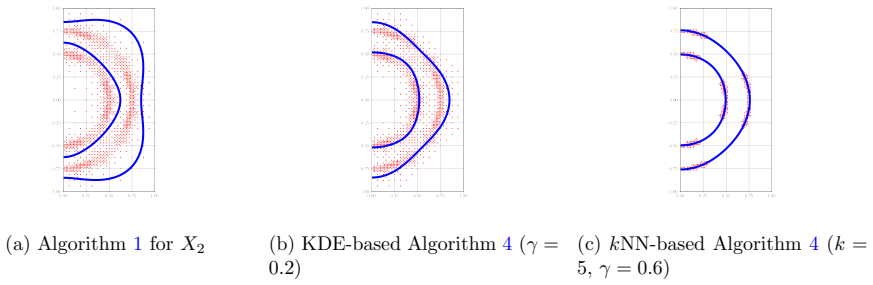
The paper proposes that singularity detection can be posed as a constrained least-squares problem on a density-filtered point cloud: given the node set X of an adaptive mesh, drop the low-density outliers to obtain $\tilde{X}$, then solve $\min_{\|c\|=1} \sum_{x\in\tilde{X}} f(x)^2$ for $f = \sum_i c_i \phi_i$, where the $\phi_i$ are polynomial or Fourier basis functions. The zero set $\{x : f(x)=0\}$ is the estimated singularity set. The claim is that after this filtering, the simple quadratic program approximates the true singularity set accurately even when the raw node count is small, when the data is unlabeled, and when pseudo-labels or input nodes are perturbed. The paper supports this with experiments on an interior circle, a boundary layer, an X-shaped curve, and concentric semicircles, comparing both filtering methods against the unfiltered baseline.
Load-bearing premise
The method assumes that the adaptive mesh is refined exactly where the singularity lies, so that high node density marks the singularity; on a mesh produced by a poor error estimator that over-refines smooth regions, the density filter keeps the wrong points and the fitted zero set will not locate the singularity.
Editorial extensions
If this is right
- On small datasets of a few hundred nodes, filtering before fitting corrects the pathological zero sets that the unfiltered baseline produces.
- The approach tolerates input perturbation and corrupted pseudo-labels because the density filter discards the points carrying most of the noise.
- Using a Fourier basis in polar coordinates lets the same framework handle singularities that polynomial bases fit poorly, such as X-shaped curves and concentric semicircles.
- Filtering both improves accuracy and reduces training cost, since the optimization runs on a smaller, more concentrated subset.
- The paper states that extending the approach to three dimensions is straightforward.
Reading between the lines
- A natural stress test the paper leaves untried: run the method on a mesh produced by a non-robust error estimator that over-refines a smooth region; if the fitted zero set tracks the over-refined region instead of the true singularity, the density-proximity premise would be directly refuted.
- The same density-filter-plus-fit recipe could plausibly be applied to point clouds from other sources, such as scattered sensor data or particle methods, whenever point density is known to concentrate at the feature of interest.
- The unit-norm constraint only rules out the identically zero function; weighting the loss by the local density estimate, or using other normalizations, might change the bias-variance trade-off, but the paper does not test these variants.
Editorial analysis
A structured set of objections, weighed in public.
Referee Report
Summary. The paper proposes a self-supervised learning framework for detecting solution singularities of PDEs from unlabeled mesh node sets. The method represents the singularity as the zero set of a detection function f, which is a polynomial or Fourier series, and fits its coefficients by minimizing the sum of squared values over pseudo-labeled points with a unit-norm constraint (Algorithm 1). To overcome the fact that mesh nodes away from the singularity make naive fitting unreliable, the authors introduce filtering as a pretext task: Algorithm 2 keeps points with high kernel density estimates, and Algorithm 3 keeps points with small k-nearest-neighbor distances. Algorithm 4 applies such filtering before the constrained least-squares fit. Experiments on reaction-diffusion and advection-diffusion problems with interior circle, boundary layer, X-shaped, and concentric-semicircle singularities compare the filtered algorithm with the unfiltered baseline and report polynomial or Fourier coefficients against exact expressions. The main conclusion is that filtering dramatically improves detection, especially for small datasets, and that more concentrated filtered subsets tend to give better accuracy.
Significance. If the empirical claims hold, the method is a useful preprocessing tool for adaptive mesh generation and for numerical methods that need singularity locations from mesh data alone. The paper is clearly written, the algorithms are simple to implement, and the experiments cover several distinct singularity geometries. A notable strength is that the authors explicitly acknowledge the load-bearing assumption that high mesh density implies proximity to the singularity, both in Remark 4.1 and in the Conclusion. The coefficient tables provide a quantitative check of the fitted representations, and the Fourier-basis experiment demonstrates flexibility of the ansatz. However, the central claim is currently supported only on meshes produced by robust error estimators or standard mesh generators; the failure mode identified by the authors themselves is not tested, and the empirical evaluation lacks uncertainty quantification, sensitivity analysis, and geometric error measures. These gaps limit the strength of the conclusions as stated.
major comments (4)
- [Section 4.2 and Section 6] The central premise of Algorithm 4 is that high node density marks proximity to the singularity set S; Section 4.2 states this explicitly, Remark 4.1 concedes that non-robust error estimators can over-refine smooth regions away from S, and the Conclusion repeats the same caveat. Because every experiment uses meshes generated by the robust hybrid estimator of [20] or by Netgen/NGSolve refinement, the failure case identified by the authors is never tested. The claimed generality, namely that the framework works for unlabeled data and the small-data regime and is insensitive to perturbation, is therefore not established for meshes where high density occurs in a smooth subdomain. Please add at least one controlled experiment with a dense region away from S, for example a synthetic mesh with an over-refined smooth patch or an AMR run with a non-robust estimator, and document whether Algorithm 4 tracks the spurious dense region instead of the true singularity.
- [Section 5] All quantitative claims are based on single runs and coefficient tables; none of Tables 1-6 report error bars, multiple trials, or sensitivity to the hyperparameters gamma, k, h, and sigma_i, even though Algorithm 4 depends on gamma and k (or h) and the paper lists hyperparameter impact as future work. Since the abstract claims insensitivity to label corruption and input perturbation, the manuscript should either provide direct experiments with injected label corruption and perturbed node coordinates or temper the claim. At minimum, please report how the detected singularity error varies over a range of gamma and k on at least one representative example.
- [Section 5.3, Tables 1-4] The paper evaluates accuracy by comparing polynomial coefficients with the exact F*, but the stated objective is approximation of the zero set S. Coefficient proximity is neither necessary nor sufficient for zero-set proximity: any nonzero scalar multiple or positive power of F* has the same zero set, and small coefficient errors can shift roots substantially, especially near near-degenerate configurations. The coefficient tables are suggestive, but they do not directly support geometric claims such as 'quite close to the true singularity' or the radius comparisons in Figure 8. Please include a geometric error measure, for example the symmetric Hausdorff distance between the detected curve and S sampled on the domain, for the key experiments.
- [Section 5] The experimental comparison is limited to Algorithm 4 versus Algorithm 1. Since the filtering step is essentially a density-based selection, the contribution would be stronger with baselines such as simple thresholding by local density followed by the same constrained least-squares fit, or standard contour extraction from the density field. Without such comparisons, it is difficult to attribute the observed improvement specifically to the SSL/MLE formulation rather than to the generic effect of discarding low-density points. Adding at least one such baseline would clarify the marginal value of the proposed framework.
minor comments (5)
- [Theorem 3.1 proof] In the proof of Theorem 3.1, the first sentence says 'We first prove that (5) ... is equivalent to (8)', but the Type I formulation (5) was shown equivalent to (7); the displayed equation in the proof correctly concludes with (7), so this appears to be a typo.
- [Algorithm 2] In the Output line of Algorithm 2, 'threhold' should be 'threshold', and the wording 'with threhold parameter gamma' could be clarified to 'with threshold parameter gamma'.
- [Section 5.3.3] The sentence 'The filtering-based Algorithm 4 ... gives a lot more reliable estimation of the singularity according to Table 4' refers to the small-scale dataset X2, but immediately before it says 'see also Figure 11a'; this should likely be Figure 12a, since Figure 11 corresponds to X1.
- [References] References [30] and [31] appear to be duplicate entries for the same work by Garmanjani et al.; one should be removed or replaced with the intended distinct citation.
- [Algorithm 4] For Type II data, Algorithm 4 merges all batches into one set and discards the batch-dependent variance weighting used in Algorithm 1; the text explains that filtering removes the need to distinguish Type I and Type II, but it would be helpful to comment explicitly on whether the batch information could still be useful when filtering is not perfectly selective.
Circularity Check
No significant circularity: the fitted polynomial's zero set is tested against, not derived from, the singularity set.
full rationale
The derivation chain is self-contained in the sense that the target singularity set S is never used to construct the filtered training set or to fit coefficients. The method takes mesh nodes, filters by local density (KDE or kNN), assigns pseudo-label 0 to all surviving nodes, and minimizes sum f(x)^2 under ||c||=1. The zero set of the resulting f is then compared against S in experiments. No equation defines S in terms of f, and no fitted parameter is renamed as a prediction: the baseline Algorithm 1 can produce pathological results (Figures 6-7), which shows the output is not forced by construction. The self-citations to [16], [19], [20] supply the AMR meshes used in the examples, but the cited hybrid estimator is an external, published numerical-analysis result; the method's central premise that high node density correlates with proximity to S is explicitly stated as an assumption and its failure mode is admitted in Remark 4.1 and the Conclusion. That limitation is a correctness risk, not a circularity. The paper does not invoke a uniqueness theorem from the authors' prior work, and the filtering/least-squares pipeline is not an ansatz smuggled in via citation: the choice of density filtering is motivated and tested independently against known singularity sets. Accordingly, no circular step is exhibited.
Assumptions & free parameters
free parameters (5)
- KDE threshold gamma =
0.6 (Example 2), 0.4 and 0.2 (Example 3)
- kNN neighbor count k =
5 (Example 3)
- KDE bandwidth h =
Silverman's rule: h=(N(d+2))^{-1/(d+4)}
- Type II variance parameters sigma_i =
1, 1/(2*2^{2(R-i)}), 1/(2*4^{2(R-i)}) in Eq. (14)
- Polynomial degree n =
2 (circle, boundary layer, X shape), 4 (concentric semicircles)
assumptions (4)
- domain assumption Mesh node density reflects proximity to the singularity set S when AMR uses a robust a posteriori error estimator.
- domain assumption The singularity set S is the zero set of a continuous function F*.
- domain assumption The chosen basis (polynomial or Fourier) can approximate F* well.
- standard math Standard results of MLE, KDE, and kNN are correct.
Cite this review
Pith. "Pith review of Data-Driven Self-Supervised Learning for the Discovery of Solution Singularity for Partial Differential Equations." pith.science (2026). https://pith.science/paper/ME3RVPRA
@misc{pith2026250623344,
  author       = {Pith},
  title        = {Pith review of: Data-Driven Self-Supervised Learning for the Discovery of Solution Singularity for Partial Differential Equations},
  year         = {2026},
  howpublished = {\url{https://pith.science/paper/ME3RVPRA}},
  note         = {Machine review of arXiv:2506.23344}
}
abstract
The appearance of singularities in the function of interest constitutes a fundamental challenge in scientific computing. It can significantly undermine the effectiveness of numerical schemes for function approximation, numerical integration, and the solution of partial differential equations (PDEs), etc. The problem becomes more sophisticated if the location of the singularity is unknown, which is often encountered in solving PDEs. Detecting the singularity is therefore critical for developing efficient adaptive methods to reduce computational costs in various applications. In this paper, we consider singularity detection in a purely data-driven setting. Namely, the input only contains given data, such as the vertex set from a mesh. To overcome the limitation of the raw unlabeled data, we propose a self-supervised learning (SSL) framework for estimating the location of the singularity. A key component is a filtering procedure as the pretext task in SSL, where two filtering methods are presented, based on $k$ nearest neighbors and kernel density estimation, respectively. We provide numerical examples to illustrate the potential pathological or inaccurate results due to the use of raw data without filtering. Various experiments are presented to demonstrate the ability of the proposed approach to deal with input perturbation, label corruption, and different kinds of singularities such interior circle, boundary layer, concentric semicircles, etc.
Figures


Figures from the paper (10 more)



Reference graph
Works this paper leans on
-
[20]
Difeng Cai and Zhiqiang Cai. Hybrid a posteriori error estimators for conforming finite element approximations to stationary convection-diffusion-reaction equations. Numerische Mathematik, 157:477–504, 2025
work page 2025
- [1]
-
[2]
M. Ainsworth and I. Babuˇ ska. Reliable and robust a posteriori error estimation for singularly perturbed reaction-diffusion problems. SIAM Journal on Numerical Analysis , 36(2):331–353, 1999
work page 1999
-
[3]
M. Ainsworth and J.T. Oden. A Posteriori Error Estimation in Finite Element Analysis , volume 37. John Wiley & Sons, 2000
work page 2000
-
[4]
M. Ainsworth and T. Vejchodsk´ y. Fully computable robust a posteriori error bounds for singularly perturbed reaction–diffusion problems. Numerische Mathematik, 119(2):219–243, 2011
work page 2011
-
[5]
Galerkin neural networks: A framework for approxi- mating variational equations with error control
Mark Ainsworth and Justin Dong. Galerkin neural networks: A framework for approxi- mating variational equations with error control. SIAM Journal on Scientific Computing , 43(4):A2474–A2501, 2021
work page 2021
-
[6]
S. Arya, D. M. Mount, N. S. Netanyahu, R. Silverman, and A. Y. Wu. An optimal algorithm for approximate nearest neighbor searching fixed dimensions. Journal of the ACM (JACM) , 45(6):891–923, 1998
work page 1998
-
[7]
Data2vec: A general framework for self-supervised learning in speech, vision and language
Alexei Baevski, Wei-Ning Hsu, Qiantong Xu, Arun Babu, Jiatao Gu, and Michael Auli. Data2vec: A general framework for self-supervised learning in speech, vision and language. In International Conference on Machine Learning , pages 1298–1312. PMLR, 2022
work page 2022
Show all 78 references
-
[8]
wav2vec 2.0: A framework for self-supervised learning of speech representations
Alexei Baevski, Yuhao Zhou, Abdelrahman Mohamed, and Michael Auli. wav2vec 2.0: A framework for self-supervised learning of speech representations. Advances in neural information processing systems, 33:12449–12460, 2020
2020
-
[9]
Randall Balestriero, Mark Ibrahim, Vlad Sobal, Ari S. Morcos, Shashank Shekhar, Tom Goldstein, Florian Bordes, Adrien Bardes, Gr´ egoire Mialon, Yuandong Tian, Avi 24 Schwarzschild, Andrew Gordon Wilson, Jonas Geiping, Quentin Garrido, Pierre Fernan- dez, Amir Bar, Hamed Pirsi...
2023 arXiv
-
[10]
On the role of polynomials in RBF-FD approximations: II
Victor Bayona, Natasha Flyer, Bengt Fornberg, and Gregory A Barnett. On the role of polynomials in RBF-FD approximations: II. Numerical solution of elliptic PDEs. Journal of Computational Physics , 332:257–273, 2017
2017
-
[11]
Bernardi and R
C. Bernardi and R. Verf¨ urth. Adaptive finite element methods for elliptic equations with non-smooth coefficients. Numerische Mathematik , 85(4):579–608, 2000
2000
-
[12]
Bernhardsson
E. Bernhardsson. ANNOY C++ library. https://github.com/spotify/annoy
-
[13]
Christopher M. Bishop. Pattern Recognition and Machine Learning . Springer-Verlag, Berlin, Heidelberg, 2006
2006
-
[14]
Convex optimization
Stephen P Boyd and Lieven Vandenberghe. Convex optimization . Cambridge university press, 2004
2004
-
[15]
The neural network colloca- tion method for solving partial differential equations
Adam R Brink, David A Najera-Flores, and Cari Martinez. The neural network colloca- tion method for solving partial differential equations. Neural Computing and Applications , 33(11):5591–5608, 2021
2021
-
[16]
Cai and Z
D. Cai and Z. Cai. A hybrid a posteriori error estimator for conforming finite element approximations. Computer Methods in Applied Mechanics and Engineering , 339:320 – 340, 2018
2018
-
[17]
D. Cai, E. Chow, L. Erlandson, Y. Saad, and Y. Xi. SMASH: Structured matrix approxima- tion by separation and hierarchy. Numerical Linear Algebra with Applications, 25(6):e2204, 2018
2018
-
[18]
D. Cai, H. Huang, E. Chow, and Y. Xi. Data-driven construction of hierarchical matrices with nested bases. SIAM Journal on Scientific Computing , 46(2):S24–S50, 2024
2024
-
[19]
Robust and Explicit a posteriori Error Estimation Techniques in Adaptive Finite Element Method
Difeng Cai. Robust and Explicit a posteriori Error Estimation Techniques in Adaptive Finite Element Method. PhD thesis, Purdue University, 2019
2019
-
[21]
Posterior covariance structures in gaussian processes
Difeng Cai, Edmond Chow, and Yuanzhe Xi. Posterior covariance structures in gaussian processes. SIAM Journal on Matrix Analysis and Applications , to appear
-
[22]
Cai and S
Z. Cai and S. Zhang. Recovery-based error estimator for interface problems: Conforming linear elements. SIAM Journal on Numerical Analysis , 47(3):2132–2156, 2009
2009
-
[23]
Flux recovery and a posteriori error estimators: conforming elements for scalar elliptic equations
Zhiqiang Cai and Shun Zhang. Flux recovery and a posteriori error estimators: conforming elements for scalar elliptic equations. SIAM journal on numerical analysis , 48(2):578–602, 2010. 25
2010
-
[24]
Adaptive radial basis function partition of unity interpolation: A bivariate algorithm for unstructured data
Roberto Cavoretto. Adaptive radial basis function partition of unity interpolation: A bivariate algorithm for unstructured data. Journal of Scientific Computing , 87(2):41, 2021
2021
-
[25]
Davydov, D
O. Davydov, D. T. Oanh, and N. M. Tuong. Improved stencil selection for meshless finite difference methods in 3d. Journal of Computational and Applied Mathematics , 425:115031, 2023
2023
-
[26]
Deng and H
H. Deng and H. Wickham. Density estimation in r. Electronic publication, 2011
2011
-
[27]
BERT: Pre-training of deep bidirectional transformers for language understanding
Jacob Devlin, Ming-Wei Chang, Kenton Lee, and Kristina Toutanova. BERT: Pre-training of deep bidirectional transformers for language understanding. In Jill Burstein, Christy Do- ran, and Thamar Solorio, editors, Proceedings of the 2019 Conference of the North American Chapter ...
2019
-
[28]
Efficient k-nearest neighbor graph construction for generic similarity measures
Wei Dong, Charikar Moses, and Kai Li. Efficient k-nearest neighbor graph construction for generic similarity measures. In Proceedings of the 20th international conference on World wide web , pages 577–586, 2011
2011
-
[29]
Dosovitskiy, L
A. Dosovitskiy, L. Beyer, A. Kolesnikov, D. Weissenborn, X. Zhai, T. Unterthiner, M. De- hghani, M. Minderer, G. Heigold, S. Gelly, J. Uszkoreit, and N. Houlsby. An image is worth 16x16 words: Transformers for image recognition at scale. In 9th International Conference on Lear...
2021
-
[30]
Adaptive residual refinement in an RBF finite difference scheme for 2D time-dependent problems
G Garmanjani, Mohsen Esmaeilbeigi, and Roberto Cavoretto. Adaptive residual refinement in an RBF finite difference scheme for 2D time-dependent problems. Computational and Applied Mathematics, 43(1):39, 2024
2024
-
[31]
Adaptive residual refinement in an rbf finite difference scheme for 2d time-dependent problems
G Garmanjani, Mohsen Esmaeilbeigi, and Roberto Cavoretto. Adaptive residual refinement in an rbf finite difference scheme for 2d time-dependent problems. Computational and Applied Mathematics, 43(1):39, 2024
2024
-
[32]
Goyal, Q
P. Goyal, Q. Duval, I. Seessel, M. Caron, I. Misra, L. Sagun, A. Joulin, and P. Bojanowski. Vision models are more robust and fair when pretrained on uncurated images without supervision. arXiv preprint arXiv:2202.08360 , 2022
2022 arXiv
-
[33]
Gray and A
A. Gray and A. Moore. N-body problems in statistical learning. Advances in neural infor- mation processing systems, 13, 2000
2000
-
[34]
Gray and A
A. Gray and A. Moore. Nonparametric density estimation: Toward computational tractabil- ity. In Proceedings of the 2003 SIAM International Conference on Data Mining , pages 203–211. SIAM, 2003
2003
-
[35]
Greengard and J
L. Greengard and J. Strain. The fast gauss transform. SIAM J. Sci. Statist. Comput. , 12(1):79–94, 1991
1991
-
[36]
Bootstrap your own latent-a new approach to self-supervised learning
Jean-Bastien Grill, Florian Strub, Florent Altch´ e, Corentin Tallec, Pierre Richemond, Elena Buchatskaya, Carl Doersch, Bernardo Avila Pires, Zhaohan Guo, Mohammad Ghesh- laghi Azar, et al. Bootstrap your own latent-a new approach to self-supervised learning. Advances in neur...
2020
-
[37]
Hackbusch
W. Hackbusch. Hierarchical Matrices: Algorithms and Analysis . Springer Series in Com- putational Mathematics. Springer Berlin Heidelberg, 2015
2015
-
[38]
Tetgen, a delaunay-based quality tetrahedral mesh generator
Si Hang. Tetgen, a delaunay-based quality tetrahedral mesh generator. ACM Trans. on Mathematical Software, 41(2):11, 2015
2015
-
[39]
K. He, X. Chen, S. Xie, Y. Li, P. Dollar, and R. Girshick. Masked autoencoders are scalable vision learners. In Proceedings - 2022 IEEE/CVF Conference on Computer Vision and Pattern Recognition, CVPR 2022 , Proceedings of the IEEE Computer Society Conference on Computer Vision...
2022
-
[40]
Masked autoencoders are scalable vision learners
Kaiming He, Xinlei Chen, Saining Xie, Yanghao Li, Piotr Doll´ ar, and Ross Girshick. Masked autoencoders are scalable vision learners. In Proceedings of the IEEE/CVF conference on computer vision and pattern recognition , pages 16000–16009, 2022
2022
-
[41]
Hendrycks, M
D. Hendrycks, M. Mazeika, S. Kadavath, and D. Song. Using self-supervised learning can improve model robustness and uncertainty. Advances in neural information processing systems, 32, 2019
2019
-
[42]
D. P. Kingma and M. Welling. Auto-Encoding Variational Bayes. In 2nd International Conference on Learning Representations, ICLR 2014, Banff, AB, Canada, April 14-16, 2014, 2014
2014
-
[43]
A software package for sequential quadratic programming
Dieter Kraft. A software package for sequential quadratic programming. Forschungsbericht- Deutsche Forschungs- und Versuchsanstalt fur Luft- und Raumfahrt , 1988
1988
-
[44]
Empirical testing of fast kernel density estimation algorithms
Dustin Lang, Mike Klaas, and Nando de Freitas. Empirical testing of fast kernel density estimation algorithms. 2005
2005
-
[45]
Z. Li, N. B. Kovachki, K. Azizzadenesheli, B. Liu, K. Bhattacharya, A. M. Stuart, and A. Anandkumar. Fourier neural operator for parametric partial differential equations. In 9th International Conference on Learning Representations, ICLR , 2021
2021
-
[46]
Stable high order FD methods for interface and internal layer problems based on non-matching grids
Zhilin Li, Kejia Pan, and Juan Ruiz-´Alvarez. Stable high order FD methods for interface and internal layer problems based on non-matching grids. Numerical Algorithms, 96(4):1647– 1674, 2024
2024
-
[47]
An explicit link between gaussian fields and gaussian markov random fields: The stochastic partial differential equation approach
Finn Lindgren, H ˚ avard Rue, and Johan Lindstr¨ om. An explicit link between gaussian fields and gaussian markov random fields: The stochastic partial differential equation approach. Journal of the Royal Statistical Society Series B: Statistical Methodology , 73(4):423–498, 08 2011
2011
-
[48]
CPAFT: A consistent parallel advanc- ing front technique for unstructured triangular/tetrahedral mesh generation
Chengdi Ma, Jizu Huang, Hao Luo, and Chao Yang. CPAFT: A consistent parallel advanc- ing front technique for unstructured triangular/tetrahedral mesh generation. Computer Physics Communications, 310:109535, 2025
2025
-
[49]
Y. A. Malkov and D. A. Yashunin. Efficient and robust approximate nearest neighbor search using hierarchical navigable small world graphs. IEEE transactions on pattern analysis and machine intelligence , 42(4):824–836, 2018. 27
2018
-
[50]
An artificial neural network based deep collocation method for the solution of transient linear and nonlinear partial differen- tial equations
Abhishek Mishra, Cosmin Anitescu, Pattabhi Ramaiah Budarapu, Sundararajan Natara- jan, Pandu Ranga Vundavilli, and Timon Rabczuk. An artificial neural network based deep collocation method for the solution of transient linear and nonlinear partial differen- tial equations. Fro...
2024
-
[51]
W. F. Mitchell. 30 years of newest vertex bisection. In AIP Conference Proceedings, volume
-
[52]
Mitchell
William F. Mitchell. A collection of 2d elliptic problems for testing adaptive grid refinement algorithms. Applied Mathematics and Computation , 220:350–364, 2013
2013
-
[53]
Muja and D
M. Muja and D. G. Lowe. Fast approximate nearest neighbors with automatic algorithm configuration. In International Conference on Computer Vision Theory and Application VISSAPP’09), pages 331–340. INSTICC Press, 2009
2009
-
[54]
Adaptive RBF-FD method for elliptic problems with point singularities in 2D
Dang Thi Oanh, Oleg Davydov, and Hoang Xuan Phu. Adaptive RBF-FD method for elliptic problems with point singularities in 2D. Applied Mathematics and Computation , 313:474–497, 2017
2017
-
[55]
A multilevel, hierarchical sam- pling technique for spatially correlated random fields
Sarah Osborn, Panayot S Vassilevski, and Umberto Villa. A multilevel, hierarchical sam- pling technique for spatially correlated random fields. SIAM Journal on Scientific Com- puting, 39(5):S543–S562, 2017
2017
-
[56]
E. Parzen. On estimation of a probability density function and mode. The annals of mathematical statistics, 33(3):1065–1076, 1962
1962
-
[57]
Adaptive mesh refinement: Quantitative computation of a rising bubble using comsol multiphysics ®
T Preney, P Namy, and JD Wheeler. Adaptive mesh refinement: Quantitative computation of a rising bubble using comsol multiphysics ®. In COMSOL Conf , 2016
2016
-
[58]
Raffel, N
C. Raffel, N. Shazeer, A. Roberts, K. Lee, S. Narang, M. Matena, Y. Zhou, W. Li, and P. J. Liu. Exploring the limits of transfer learning with a unified text-to-text transformer. Journal of Machine Learning Research , 21(140):1–67, 2020
2020
-
[59]
Physics informed deep learn- ing (part i): Data-driven solutions of nonlinear partial differential equations
Maziar Raissi, Paris Perdikaris, and George Em Karniadakis. Physics informed deep learn- ing (part i): Data-driven solutions of nonlinear partial differential equations. arXiv preprint arXiv:1711.10561, 2017
2017 arXiv
-
[60]
Rosenblatt
M. Rosenblatt. Remarks on Some Nonparametric Estimates of a Density Function. The Annals of Mathematical Statistics , 27(3):832 – 837, 1956
1956
-
[61]
H. Samet. The quadtree and related hierarchical data structures. ACM Computing Surveys (CSUR), 16(2):187–260, 1984
1984
-
[62]
Netgen an advancing front 2d/3d-mesh generator based on abstract rules
Joachim Sch¨ oberl. Netgen an advancing front 2d/3d-mesh generator based on abstract rules. Computing and visualization in science , 1(1):41–52, 1997
1997
-
[63]
E. G. Sewell. Automatic generation of triangulations for piecewise polynomial approxima- tion. PhD thesis, Purdue University, West Lafayette, IN, 1972
1972
-
[64]
B. W. Silverman. Density Estimation for Statistics and Data Analysis . Chapman & Hall, London, 1986. 28
1986
-
[65]
Density estimation for statistics and data analysis
Bernard W Silverman. Density estimation for statistics and data analysis . Routledge, 2018
2018
-
[66]
Slak and G
J. Slak and G. Kosec. Adaptive radial basis function–generated finite differences method for contact problems. International Journal for Numerical Methods in Engineering, 119(7):661– 686, 2019
2019
-
[67]
M. Stynes. Steady-state convection-diffusion problems. Acta Numerica, 14:445–508, 2005
2005
-
[68]
Adaptive mesh methods for one- and two-dimensional hyperbolic conservation laws
Huazhong Tang and Tao Tang. Adaptive mesh methods for one- and two-dimensional hyperbolic conservation laws. SIAM Journal on Numerical Analysis , 41(2):487–515, 2003
2003
-
[69]
Variable kernel density estimation
George R Terrell and David W Scott. Variable kernel density estimation. The Annals of Statistics, pages 1236–1265, 1992
1992
-
[70]
Verf¨ urth
R. Verf¨ urth. Robust a posteriori error estimators for a singularly perturbed reaction- diffusion equation. Numerische Mathematik , 78(3):479–493, 1998
1998
-
[71]
Verf¨ urth
R. Verf¨ urth. Robust a posteriori error estimates for stationary convection-diffusion equa- tions. SIAM Journal on Numerical Analysis , 43(4):1766–1782, 2005
2005
-
[72]
Verf¨ urth.A Posteriori Error Estimation Techniques for Finite Element Methods
R. Verf¨ urth.A Posteriori Error Estimation Techniques for Finite Element Methods . Nu- merical Mathematics and Scientific Computation. OUP Oxford, 2013
2013
-
[73]
Wald and V
I. Wald and V. Havran. On building fast kd-trees for ray tracing, and on doing that in O(N log N ). In 2006 IEEE Symposium on Interactive Ray Tracing , pages 61–69. IEEE, 2006
2006
-
[74]
Optimal smoothing parameters for multivariate fized and adaptive kernel methods
Bruce J Worton. Optimal smoothing parameters for multivariate fized and adaptive kernel methods. Journal of Statistical Computation and Simulation , 32(1-2):45–57, 1989
1989
-
[75]
C. Yang, R. Duraiswami, N. A. Gumerov, and L. Davis. Improved fast Gauss transform and efficient kernel density estimation. In Computer Vision, 2003. Proceedings. Ninth IEEE International Conference on , pages 664–671. IEEE, 2003
2003
-
[76]
Yu and W
B. Yu and W. E. The deep ritz method: a deep learning-based numerical algorithm for solving variational problems. Communications in Mathematics and Statistics , 6(1):1–12, 2018
2018
-
[77]
Amrex: a framework for block- structured adaptive mesh refinement
Weiqun Zhang, Ann Almgren, Vince Beckner, John Bell, Johannes Blaschke, Cy Chan, Marcus Day, Brian Friesen, Kevin Gott, Daniel Graves, et al. Amrex: a framework for block- structured adaptive mesh refinement. The Journal of Open Source Software , 4(37):1370, 2019. 29
2019
-
[1738]
AIP Publishing, 2016
2016
Reviewed August 6, 2026 · model on record in the stance chip above.
Discussion (0). Continue with ORCID to comment.