REVIEW 5 major objections 6 minor 85 references
Why Settle for Mid: A Probabilistic Viewpoint to Spatial Relationship Alignment in Text-to-image Models
T0 review · 5 major / 6 minor · reviewed 2026-08-06 · deepseek-v4-flash
Pith's one-line read The paper claims that replacing bounding-box-center comparisons with a whole-object probabilistic measure, Probability of Superiority, both evaluates and improves spatial relationship accuracy in text-to-image models.
desk verdict PSE is a credible, well-motivated evaluation metric and the core idea is worth taking seriously, but the headline PSG gains are oversold by a prompt-simplified variant and the gradient guidance lacks causal evidence. read the letter →
The pith
A machine-rendered reading of the paper's core claim, the machinery that carries it, and where it could break.
The reading
What carries the argument
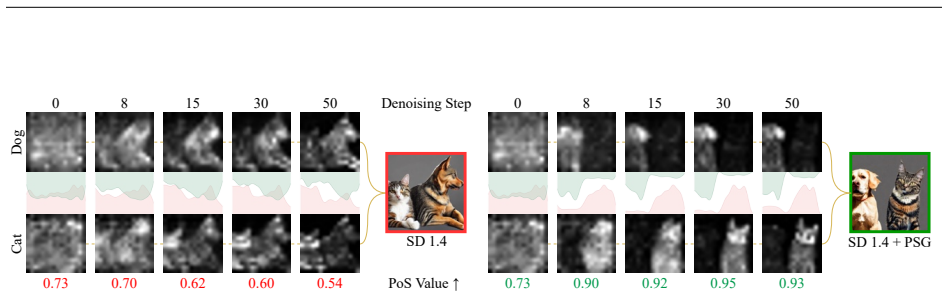
The carrying object is the Probability of Superiority ($\mathrm{PoS}$) between two one-dimensional probability distributions, $\mathrm{PoS}(A,B) = P_{X\sim A, Y\sim B}(X > Y)$, i.e., the probability that a random draw from $A$ exceeds a random draw from $B$. For spatial relations, the two distributions are normalized projections of each object's pixel mask (or cross-attention map) onto the axis of the relation, and the PSE score subtracts the reverse-relation PoS and takes the positive part so ambiguous placements score near zero instead of a hard 0/1. In PSG this same quantity is differentiated with respect to the latent to push probability mass in the desired direction during early denoising steps, directly repurposing the mathematics of the metric as the objective of the guidance.
What would settle it
Run a human study on an independent set of, say, 1,000 generated images with spatial prompts and check whether PSE's Spearman correlation advantage over VISOR—about 0.2 in the paper—reproduces with fresh annotators and fresh prompts; if the advantage shrinks or vanishes, the metric's human-alignment claim is not robust. A complementary check is to apply gradient-based PSG to a model whose cross-attention maps are corrupted (e.g., spatially shuffled), and see whether spatial accuracy still improves; if it does, the effectiveness is not actually mediated by attention maps.
Extended reading notes
Core claim
The central claim is that spatial relationship accuracy in text-to-image models is better measured and better controlled by the Probability of Superiority of the two objects' full pixel distributions than by the relative positions of their bounding-box centers. Concretely, the paper defines $\mathrm{PSE}(A,B;r) = [\mathrm{PoS}_v(A,B) - \mathrm{PoS}_{-v}(A,B)]_+$, the positive part of the difference between the probability that a random pixel of $A$ lies on the requested side of a random pixel of $B$ and the probability of the opposite relation, computed on segmentation masks in 2D and on depth-quantized masks for 3D. This continuous score avoids the false confidence of center-based metrics on wide objects and on ambiguous middle placements. The same score, applied to cross-attention maps during denoising, becomes the reward for PSG: a gradient step on the latent (generative semantic nursing) or a Best-of-N selection over initial noise vectors. The paper reports that PSE raises Spearman correlation with human judgments from 0.551 (VISOR) to 0.726, and that PSG raises the VISOR unconditional score of SDXL from 65.74% to 80.02% while improving T2I-CompBench and HRS spatial scores.
Load-bearing premise
The gradient guidance assumes that moving probability mass in the cross-attention map of an object actually moves that object's final rendered location, without erasing or distorting it, and this assumption is supported mainly by benchmark numbers and qualitative examples rather than by a causal analysis.
Editorial extensions
If this is right
- PSE can replace or complement center-based metrics in existing benchmarks such as VISOR, T2I-CompBench, and HRS, giving a graded, human-aligned score instead of a binary verdict.
- PSG improves spatial accuracy across U-Net backbones (SD 1.4, SDXL) and a transformer backbone (PixArt-$\alpha$) with no fine-tuning, and the Best-of-N variant works on black-box models like FLUX, SANA, and SD3.
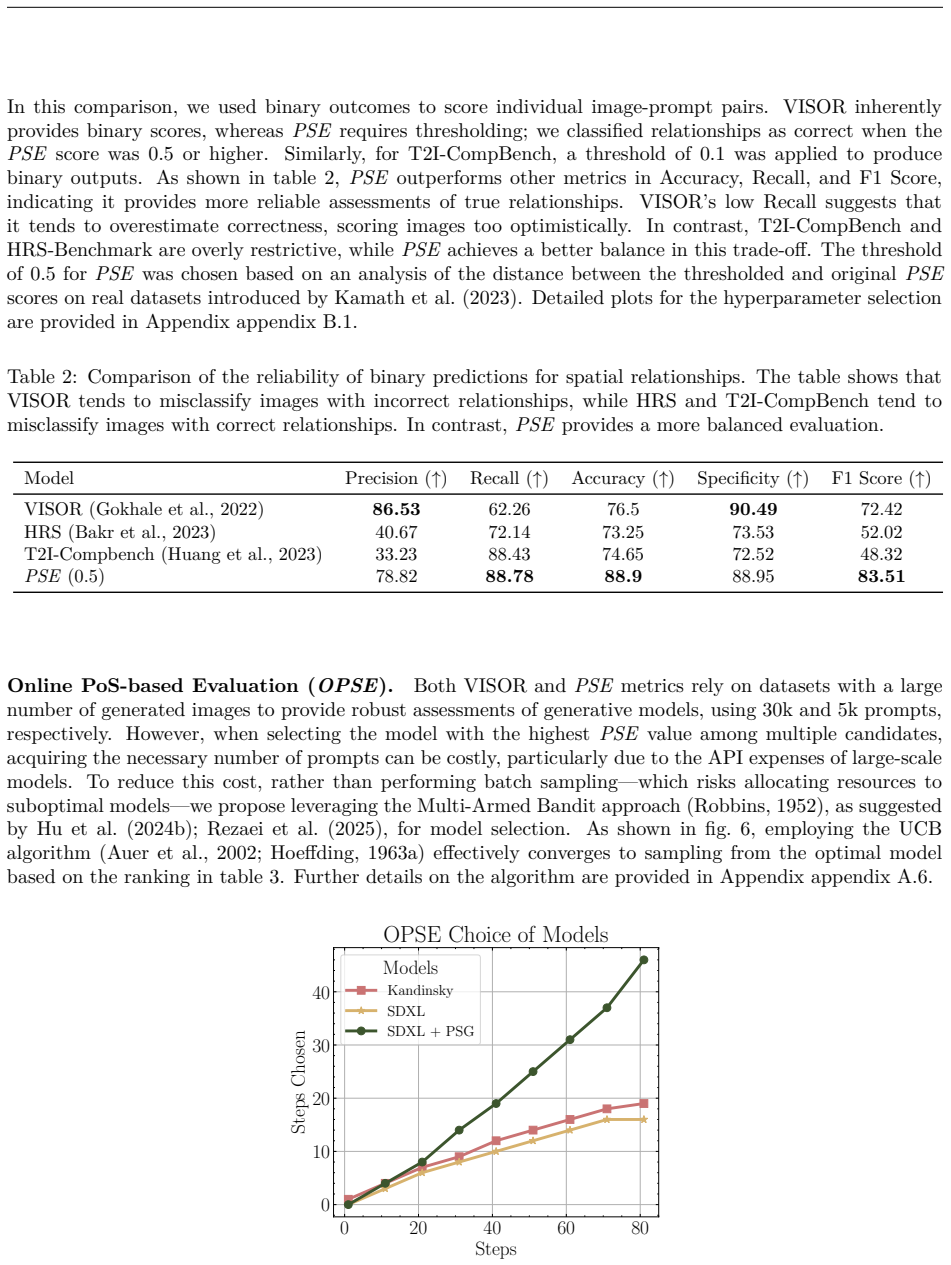
- The OPSE bandit version identifies the best model with far fewer generated images, lowering the cost of model comparison when APIs are expensive.
- Because PSG operates on the prompt alone, it avoids the layout bias of LLM-generated bounding-box guidance and produces more diverse object placements.
Reading between the lines
- The same PoS machinery could be applied to other compositional attributes, such as attribute binding or size relations, whenever the attribute can be expressed as a distribution over pixels or attention mass.
- The search-based PSG variant is a general inference-time-scaling wrapper: any differentiable or non-differentiable reward computed on the final image could be swapped into the Best-of-N loop, so PSG's 3D gains may be attributable as much to selection as to the PoS reward itself.
- A testable extension is to use PSE as a reward in fine-tuning rather than only inference-time guidance; the paper's own limitation notes that training-free guidance may not suffice for prompts with many entities, so a PoS-based loss for fine-tuning would be a natural next step.
- The metric's dependence on segmentation and depth estimators means its human-alignment claims are bracketed by detector quality; improvements in grounding models should transfer directly to PSE without changing the framework.
Editorial analysis
A structured set of objections, weighed in public.
Referee Report
Summary. The paper proposes a probabilistic framework, based on Probability of Superiority (PoS), for evaluating and improving spatial relationships in text-to-image models. It introduces PSE, a metric that compares whole-object segmentation masks (and depth, for 3D relations) rather than bounding-box centers; PSG, an inference-time guidance method that uses a PoS-based reward either through gradient updates on cross-attention maps or through Best-of-N selection; and OPSE, a multi-armed-bandit version of PSE for efficient online model evaluation. The authors report that PSE correlates more strongly with human judgment than VISOR, T2I-CompBench, HRS-Bench, CLIP Score, XVLM, and Image Reward, and that PSG substantially improves spatial accuracy on the VISOR, T2I-CompBench, and HRS benchmarks without fine-tuning.
Significance. If the claims hold, the paper makes a useful contribution: a metric that accounts for object shape and extent rather than only centers is a principled improvement, and a training-free guidance method for spatial relations is practically valuable. The paper includes several strengths: the mathematical formulation is simple and correct; evaluation is checked against external benchmarks (VISOR, T2I-CompBench, HRS) and a fresh human study; robustness experiments show PSE is stable to mask corruption and detector choice; and PSG is demonstrated on multiple backbones, including a transformer-based model. The main weaknesses are experimental: missing uncertainty quantification, a potentially confounded human-evaluation setup, and a prompt-simplified variant whose evaluation protocol is ambiguous and which appears to drive the headline numbers.
major comments (5)
- [Section 4.2, Table 4] The PSG(2) variant replaces explicit spatial terms with "and" in the prompt, yet the reported VISOR numbers presumably still evaluate the original spatial relation. If so, the method is scored on a relation that is absent from the generation prompt, so the 32% headline improvement does not measure instruction-following; if instead the simplified prompt is used for evaluation, then the relation is absent from the test condition and the metric is not well defined. Please clarify exactly which prompt is used for scoring and either drop PSG(2) from the headline claims or report PSG(1) (which does not modify the prompt) as the primary result.
- [Section 4.1, Table 1] No confidence intervals, bootstrap estimates, or significance tests are reported for the correlation coefficients in Table 1, and the human study uses only three annotators with no inter-annotator agreement statistic. Without these, the claimed "approximately 0.2 improvement in Spearman correlation over VISOR" cannot be distinguished from sampling noise. Please add CIs (e.g., bootstrap) for all correlations and report annotator agreement (e.g., Fleiss' kappa or pairwise agreement).
- [Section 4.1] The human-evaluation set of 2,000 images includes 500 images generated by "SDXL + PSG," a model that is itself guided by the PoS objective. Including PSE-guided images in the metric-validation set makes the evaluation partially circular: the metric is being tested on images that were selected or steered to have high PSE scores. Please report the correlations separately for each source model, or restrict the main comparison to the three independent backbones, to establish that PSE's advantage is not an artifact of this confound.
- [Section 3.2, Eq. (6)] The gradient-based PSG updates the latent so that the cross-attention maps Ai and Aj move toward the requested PoS relation, but the paper does not establish that this translates into relocated final object masks rather than merely reshaping attention maps or eroding object identity. The qualitative attention maps in Fig. 5 and aggregate VISOR numbers in Table 4 are suggestive but not causal evidence. Please provide a per-prompt analysis linking the attention shift to the final segmentation (e.g., tracking mask IoU or center displacement), or an ablation that controls for object-erasure and overlap, to support the claim that PSG improves final spatial alignment.
- [Appendix B.1, Section 4.2] The hyperparameters of gradient-based PSG (number of guided steps and loss scale) are selected using the VISOR metric on a small development set and then evaluated on VISOR in Table 4. This creates a risk of benchmark overfitting. Please report sensitivity of the main results to these hyperparameters and, if possible, validate the chosen settings on a held-out set of relations not used for tuning.
minor comments (6)
- [Abstract] The abstract refers to "Part-of-Speech PoS-based reward function," but PoS stands for Probability of Superiority; please correct this typo.
- [Section 3.1, Eq. (5)] Please define the bracket notation [x]_+ explicitly as max(x, 0) when PSE is introduced.
- [Section 4.2] The sentence "5,000 prompts with four random seeds to where used compare PSG with re-evaluated baseline models" is garbled and should be rewritten.
- [Appendix A.1, Figure 7] The axes and tick labels in Figure 7 appear corrupted or missing; the plots should be regenerated with readable labels.
- [Appendix A.3, Table 11] The model name "Gounding-Dino" is a typo for "Grounding DINO."
- [Appendix A.3, Table 10] The robustness table reports mean PSE scores under corruptions but no standard deviation; adding variance would make the robustness claim more convincing.
Circularity Check
The central metric and generation claims are externally benchmarked, but the appendix best-of-N table reports PSE improvement that is guaranteed by the PSE-based selection objective; this is localized and not load-bearing.
-
self definitional
[Section 3.2 (Search-Based PSG) and Appendix B.2, Table 14]
"We adopt this approach by using the PSE score as a reward function to guide the selection process. Specifically, we generate N = 32 samples per prompt and select the image that achieves the highest PSE score, as computed by the evaluation pipeline described in section 3.1. ... Table 14: PSE/(center position accuracy) of PSG inference time scaling. This table demonstrates the effectiveness of our method for different models. Increasing N, shows that by using more compute we can get consistently better alignment."
The PSE column in Table 14 is computed with the same PSE metric that the selection procedure maximizes. For N > 1, choosing the highest-PSE sample among N independent draws makes the selected PSE increase with N by construction, so reporting this increase as evidence of better spatial alignment is a property of taking a maximum, not of improved object placement. The companion center-position accuracy column is an independent check and does improve, and the paper's headline claims rest on VISOR, T2I-CompBench, and HRS rather than on this table. The circularity is therefore real but localized.
full rationale
The paper's main evaluation claims are checked against external benchmarks and a fresh human study: PSE is correlated against human labels on 2,000 generated images, and PSG is compared with VISOR, T2I-CompBench, and HRS-Benchmark, none of which use the proposed PSE reward as their scoring function. The authors also explicitly mark Table 3 as 'not a performance validation for PSG as it uses the same measure,' which is the correct treatment of a self-referential comparison. Self-citations to Marioriyad et al. (2024) and Rezaei et al. (2025) are used for a failure taxonomy and bandit selection inspiration, respectively, and neither is load-bearing for the core derivation. The one construction-reduced piece of evidence is the appendix best-of-N table, where the PSE score is both the selection objective and the reported outcome; this is a genuine but minor circularity because the same table also reports center-position accuracy and the central claims do not depend on it. Overall, the derivation chain is substantially self-contained, so the circularity score is low.
Assumptions & free parameters
free parameters (7)
- PSE binary threshold =
0.5
- PSG gradient scale factor =
1000 for SDXL, 25 for SD 1.4
- PSG guided denoising steps =
10 steps for SDXL, 20 for SD 1.4
- Search-based PSG sample count =
N = 32
- UCB exploration constant =
alpha = 2
- Distance loss threshold =
c = 5
- 3D IoU detection threshold =
0.5
assumptions (5)
- standard math Probability of Superiority as defined by Wolfe and Hogg (1971) is a valid measure of ordinal dominance between two distributions.
- domain assumption Cross-attention maps in diffusion T2I models are normalized and can be treated as probability distributions over spatial locations for each object.
- domain assumption Gradient updates on the latent with respect to the PoS loss on attention maps shift the final object layout without breaking image quality.
- domain assumption Grounded SAM masks and Depth Anything depth estimates are accurate enough proxies for the true object regions.
- domain assumption Human annotations in the user study are the ground truth for spatial correctness.
Cite this review
Pith. "Pith review of Why Settle for Mid: A Probabilistic Viewpoint to Spatial Relationship Alignment in Text-to-image Models." pith.science (2026). https://pith.science/paper/VPBQQPVN
@misc{pith2026250623418,
  author       = {Pith},
  title        = {Pith review of: Why Settle for Mid: A Probabilistic Viewpoint to Spatial Relationship Alignment in Text-to-image Models},
  year         = {2026},
  howpublished = {\url{https://pith.science/paper/VPBQQPVN}},
  note         = {Machine review of arXiv:2506.23418}
}
read the original abstract
Despite the ability of text-to-image models to generate high-quality, realistic, and diverse images, they face challenges in compositional generation, often struggling to accurately represent details specified in the input prompt. A prevalent issue in compositional generation is the misalignment of spatial relationships, as models often fail to faithfully generate images that reflect the spatial configurations specified between objects in the input prompts. To address this challenge, we propose a novel probabilistic framework for modeling the relative spatial positioning of objects in a scene, leveraging the concept of Probability of Superiority (PoS). Building on this insight, we make two key contributions. First, we introduce a novel evaluation metric, PoS-based Evaluation (PSE), designed to assess the alignment of 2D and 3D spatial relationships between text and image, with improved adherence to human judgment. Second, we propose PoS-based Generation (PSG), an inference-time method that improves the alignment of 2D and 3D spatial relationships in T2I models without requiring fine-tuning. PSG employs a Part-of-Speech PoS-based reward function that can be utilized in two distinct ways: (1) as a gradient-based guidance mechanism applied to the cross-attention maps during the denoising steps, or (2) as a search-based strategy that evaluates a set of initial noise vectors to select the best one. Extensive experiments demonstrate that the PSE metric exhibits stronger alignment with human judgment compared to traditional center-based metrics, providing a more nuanced and reliable measure of complex spatial relationship accuracy in text-image alignment. Furthermore, PSG significantly enhances the ability of text-to-image models to generate images with specified spatial configurations, outperforming state-of-the-art methods across multiple evaluation metrics and benchmarks.
Figures


Figures from the paper (16 more)



Reference graph
Works this paper leans on
-
[1]
write newline
" write newline "" before.all 'output.state := FUNCTION n.dashify 't := "" t empty not t #1 #1 substring "-" = t #1 #2 substring "--" = not "--" * t #2 global.max substring 't := t #1 #1 substring "-" = "-" * t #2 global.max substring 't := while if t #1 #1 substring * t #2 global.max substring 't := if while FUNCTION format.date year duplicate empty "emp...
-
[2]
A-star: Test-time attention segregation and retention for text-to-image synthesis
Aishwarya Agarwal, Srikrishna Karanam, K J Joseph, Apoorv Saxena, Koustava Goswami, and Balaji Vasan Srinivasan. A-star: Test-time attention segregation and retention for text-to-image synthesis. In Proceedings of the IEEE/CVF International Conference on Computer Vision (ICCV), pp.\ 2283--2293, October 2023
2023
-
[3]
Kandinsky 3.0 technical report, 2024
Vladimir Arkhipkin, Andrei Filatov, Viacheslav Vasilev, Anastasia Maltseva, Said Azizov, Igor Pavlov, Julia Agafonova, Andrey Kuznetsov, and Denis Dimitrov. Kandinsky 3.0 technical report, 2024. URL https://arxiv.org/abs/2312.03511
arXiv 2024
-
[4]
Finite-time analysis of the multiarmed bandit problem
Peter Auer, Nicolò Cesa-Bianchi, and Paul Fischer. Finite-time analysis of the multiarmed bandit problem. Machine Learning, 47 0 (2/3): 0 235–256, 2002. ISSN 0885-6125. doi:10.1023/a:1013689704352. URL http://dx.doi.org/10.1023/A:1013689704352
-
[5]
Spatext: Spatio-textual representation for controllable image generation
Omri Avrahami, Thomas Hayes, Oran Gafni, Sonal Gupta, Yaniv Taigman, Devi Parikh, Dani Lischinski, Ohad Fried, and Xi Yin. Spatext: Spatio-textual representation for controllable image generation. In 2023 IEEE/CVF Conference on Computer Vision and Pattern Recognition (CVPR), pp.\ 18370–18380. IEEE, June 2023. doi:10.1109/cvpr52729.2023.01762. URL http://d...
arXiv 2023
-
[6]
Cc3d: Layout-conditioned generation of compositional 3d scenes
Sherwin Bahmani, Jeong Joon Park, Despoina Paschalidou, Xingguang Yan, Gordon Wetzstein, Leonidas Guibas, and Andrea Tagliasacchi. Cc3d: Layout-conditioned generation of compositional 3d scenes. In Proceedings of the IEEE/CVF International Conference on Computer Vision, pp.\ 7171--7181, 2023
2023
-
[7]
Hrs-bench: Holistic, reliable and scalable benchmark for text-to-image models, 2023
Eslam Mohamed Bakr, Pengzhan Sun, Xiaoqian Shen, Faizan Farooq Khan, Li Erran Li, and Mohamed Elhoseiny. Hrs-bench: Holistic, reliable and scalable benchmark for text-to-image models, 2023
2023
-
[8]
Multidiffusion: Fusing diffusion paths for controlled image generation, 2023
Omer Bar-Tal, Lior Yariv, Yaron Lipman, and Tali Dekel. Multidiffusion: Fusing diffusion paths for controlled image generation, 2023. URL https://arxiv.org/abs/2302.08113
arXiv 2023
Show all 85 references
-
[9]
Improving image generation with better captions
James Betker, Gabriel Goh, Li Jing, † TimBrooks, Jianfeng Wang, Linjie Li, † LongOuyang, † JuntangZhuang, † JoyceLee, † YufeiGuo, † WesamManassra, † PrafullaDhariwal, † CaseyChu, † YunxinJiao, and Aditya Ramesh. Improving image generation with better captions. URL https://api....
-
[10]
Make it count: Text-to-image generation with an accurate number of objects
Lital Binyamin, Yoad Tewel, Hilit Segev, Eran Hirsch, Royi Rassin, and Gal Chechik. Make it count: Text-to-image generation with an accurate number of objects. arXiv preprint arXiv:2406.10210, 2024
2024 arXiv
-
[11]
Conceptual 12M : Pushing web-scale image-text pre-training to recognize long-tail visual concepts
Soravit Changpinyo, Piyush Sharma, Nan Ding, and Radu Soricut. Conceptual 12M : Pushing web-scale image-text pre-training to recognize long-tail visual concepts. In CVPR, 2021
2021
-
[12]
Getting it right: Improving spatial consistency in text-to-image models
Agneet Chatterjee, Gabriela Ben Melech Stan, Estelle Aflalo, Sayak Paul, Dhruba Ghosh, Tejas Gokhale, Ludwig Schmidt, Hannaneh Hajishirzi, Vasudev Lal, Chitta Baral, et al. Getting it right: Improving spatial consistency in text-to-image models. arXiv preprint arXiv:2404.01197, 2024
2024 arXiv
-
[13]
Attend-and-excite: Attention-based semantic guidance for text-to-image diffusion models
Hila Chefer, Yuval Alaluf, Yael Vinker, Lior Wolf, and Daniel Cohen-Or. Attend-and-excite: Attention-based semantic guidance for text-to-image diffusion models. ACM Transactions on Graphics (TOG), 42: 0 1 -- 10, 2023. URL https://api.semanticscholar.org/CorpusID:256416326
2023
-
[14]
Spatialvlm: Endowing vision-language models with spatial reasoning capabilities, 2024 a
Boyuan Chen, Zhuo Xu, Sean Kirmani, Brian Ichter, Danny Driess, Pete Florence, Dorsa Sadigh, Leonidas Guibas, and Fei Xia. Spatialvlm: Endowing vision-language models with spatial reasoning capabilities, 2024 a . URL https://arxiv.org/abs/2401.12168
2024 arXiv
-
[15]
Pixart- : Fast training of diffusion transformer for photorealistic text-to-image synthesis
Junsong Chen, Jincheng Yu, Chongjian Ge, Lewei Yao, Enze Xie, Yue Wu, Zhongdao Wang, James Kwok, Ping Luo, Huchuan Lu, et al. Pixart- : Fast training of diffusion transformer for photorealistic text-to-image synthesis. arXiv preprint arXiv:2310.00426, 2023
-
[16]
Training-free layout control with cross-attention guidance
Minghao Chen, Iro Laina, and Andrea Vedaldi. Training-free layout control with cross-attention guidance. In Proceedings of the IEEE/CVF Winter Conference on Applications of Computer Vision, pp.\ 5343--5353, 2024 b
2024
-
[17]
Layoutdiffuse: Adapting foundational diffusion models for layout-to-image generation, 2023
Jiaxin Cheng, Xiao Liang, Xingjian Shi, Tong He, Tianjun Xiao, and Mu Li. Layoutdiffuse: Adapting foundational diffusion models for layout-to-image generation, 2023. URL https://arxiv.org/abs/2302.08908
2023 arXiv
-
[18]
Dall·e mini, 7 2021
Boris Dayma, Suraj Patil, Pedro Cuenca, Khalid Saifullah, Tanishq Abraham, Phuc Le Khac, Luke Melas, and Ritobrata Ghosh. Dall·e mini, 7 2021. URL https://github.com/borisdayma/dalle-mini
2021
-
[19]
Cogview2: Faster and better text-to-image generation via hierarchical transformers, 2022
Ming Ding, Wendi Zheng, Wenyi Hong, and Jie Tang. Cogview2: Faster and better text-to-image generation via hierarchical transformers, 2022. URL https://arxiv.org/abs/2204.14217
2022 arXiv
-
[20]
Training-free structured diffusion guidance for compositional text-to-image synthesis
Weixi Feng, Xuehai He, Tsu-Jui Fu, Varun Jampani, Arjun Reddy Akula, Pradyumna Narayana, Sugato Basu, Xin Eric Wang, and William Yang Wang. Training-free structured diffusion guidance for compositional text-to-image synthesis. In The Eleventh International Conference on Learni...
2023
-
[21]
Make-a-scene: Scene-based text-to-image generation with human priors, 2022
Oran Gafni, Adam Polyak, Oron Ashual, Shelly Sheynin, Devi Parikh, and Yaniv Taigman. Make-a-scene: Scene-based text-to-image generation with human priors, 2022. URL https://arxiv.org/abs/2203.13131
2022 arXiv
-
[22]
Geneval: An object-focused framework for evaluating text-to-image alignment, 2023
Dhruba Ghosh, Hanna Hajishirzi, and Ludwig Schmidt. Geneval: An object-focused framework for evaluating text-to-image alignment, 2023. URL https://arxiv.org/abs/2310.11513
2023 arXiv
-
[23]
Benchmarking spatial relationships in text-to-image generation
Tejas Gokhale, Hamid Palangi, Besmira Nushi, Vibhav Vineet, Eric Horvitz, Ece Kamar, Chitta Baral, and Yezhou Yang. Benchmarking spatial relationships in text-to-image generation. arXiv preprint arXiv:2212.10015, 2022
2022 arXiv
-
[24]
Gradient guidance for diffusion models: An optimization perspective, 2024
Yingqing Guo, Hui Yuan, Yukang Yang, Minshuo Chen, and Mengdi Wang. Gradient guidance for diffusion models: An optimization perspective, 2024. URL https://arxiv. org/abs/2404.14743, 10
2024 arXiv
-
[25]
Clipscore: A reference-free evaluation metric for image captioning
Jack Hessel, Ari Holtzman, Maxwell Forbes, Ronan Le Bras, and Yejin Choi. Clipscore: A reference-free evaluation metric for image captioning. arXiv preprint arXiv:2104.08718, 2021
2021 arXiv
-
[26]
Gans trained by a two time-scale update rule converge to a local nash equilibrium, 2018
Martin Heusel, Hubert Ramsauer, Thomas Unterthiner, Bernhard Nessler, and Sepp Hochreiter. Gans trained by a two time-scale update rule converge to a local nash equilibrium, 2018. URL https://arxiv.org/abs/1706.08500
2018 arXiv
-
[27]
Probability inequalities for sums of bounded random variables
Wassily Hoeffding. Probability inequalities for sums of bounded random variables. Journal of the American Statistical Association, 58 0 (301): 0 13--30, 1963 a . ISSN 01621459, 1537274X. URL http://www.jstor.org/stable/2282952
1963
-
[28]
Probability inequalities for sums of bounded random variables
Wassily Hoeffding. Probability inequalities for sums of bounded random variables. Journal of the American Statistical Association, 58 0 (301): 0 13–30, March 1963 b . ISSN 1537-274X. doi:10.1080/01621459.1963.10500830. URL http://dx.doi.org/10.1080/01621459.1963.10500830
1963
-
[29]
Token merging for training-free semantic binding in text-to-image synthesis
Taihang Hu, Linxuan Li, Joost van de Weijer, Hongcheng Gao, Fahad Shahbaz Khan, Jian Yang, Ming-Ming Cheng, Kai Wang, and Yaxing Wang. Token merging for training-free semantic binding in text-to-image synthesis. Advances in Neural Information Processing Systems, 37: 0 137646--...
2024
-
[30]
An optimism-based approach to online evaluation of generative models, 2024 b
Xiaoyan Hu, Ho fung Leung, and Farzan Farnia. An optimism-based approach to online evaluation of generative models, 2024 b . URL https://arxiv.org/abs/2406.07451
2024 arXiv
-
[31]
T2i-compbench: A comprehensive benchmark for open-world compositional text-to-image generation
Kaiyi Huang, Kaiyue Sun, Enze Xie, Zhenguo Li, and Xihui Liu. T2i-compbench: A comprehensive benchmark for open-world compositional text-to-image generation. In Thirty-seventh Conference on Neural Information Processing Systems Datasets and Benchmarks Track, 2023. URL https://...
2023
-
[32]
An information-theoretic evaluation of generative models in learning multi-modal distributions
Mohammad Jalali, Cheuk Ting Li, and Farzan Farnia. An information-theoretic evaluation of generative models in learning multi-modal distributions. In Thirty-seventh Conference on Neural Information Processing Systems, 2023. URL https://openreview.net/forum?id=PdZhf6PiAb
2023
-
[33]
Rethinking fid: Towards a better evaluation metric for image generation, 2024
Sadeep Jayasumana, Srikumar Ramalingam, Andreas Veit, Daniel Glasner, Ayan Chakrabarti, and Sanjiv Kumar. Rethinking fid: Towards a better evaluation metric for image generation, 2024. URL https://arxiv.org/abs/2401.09603
2024 arXiv
-
[34]
What's ``up'' with vision-language models? investigating their struggle with spatial reasoning
Amita Kamath, Jack Hessel, and Kai-Wei Chang. What's ``up'' with vision-language models? investigating their struggle with spatial reasoning. In EMNLP, 2023
2023
-
[35]
If at first you don't succeed, try, try again: Faithful diffusion-based text-to-image generation by selection
Shyamgopal Karthik, Karsten Roth, Massimiliano Mancini, and Zeynep Akata. If at first you don't succeed, try, try again: Faithful diffusion-based text-to-image generation by selection. arXiv preprint arXiv:2305.13308, 2023
2023 arXiv
-
[36]
Beyondscene: Higher-resolution human-centric scene generation with pretrained diffusion, 2024
Gwanghyun Kim, Hayeon Kim, Hoigi Seo, Dong Un Kang, and Se Young Chun. Beyondscene: Higher-resolution human-centric scene generation with pretrained diffusion, 2024. URL https://arxiv.org/abs/2404.04544
2024 arXiv
-
[37]
Dense text-to-image generation with attention modulation
Yunji Kim, Jiyoung Lee, Jin-Hwa Kim, Jung-Woo Ha, and Jun-Yan Zhu. Dense text-to-image generation with attention modulation. In Proceedings of the IEEE/CVF International Conference on Computer Vision, pp.\ 7701--7711, 2023
2023
-
[38]
Berg, Wan-Yen Lo, Piotr Dollár, and Ross Girshick
Alexander Kirillov, Eric Mintun, Nikhila Ravi, Hanzi Mao, Chloe Rolland, Laura Gustafson, Tete Xiao, Spencer Whitehead, Alexander C. Berg, Wan-Yen Lo, Piotr Dollár, and Ross Girshick. Segment anything, 2023. URL https://arxiv.org/abs/2304.02643
2023 arXiv
-
[39]
Improved precision and recall metric for assessing generative models, 2019
Tuomas Kynkäänniemi, Tero Karras, Samuli Laine, Jaakko Lehtinen, and Timo Aila. Improved precision and recall metric for assessing generative models, 2019. URL https://arxiv.org/abs/1904.06991
2019 arXiv
-
[40]
Laion-coco 600m
LAION. Laion-coco 600m. https://laion.ai/blog/laion-coco, 2022
2022
-
[41]
Lee, Taehoon Yoon, and Minhyuk Sung
Phillip Y. Lee, Taehoon Yoon, and Minhyuk Sung. Groundit: Grounding diffusion transformers via noisy patch transplantation, 2024. URL https://arxiv.org/abs/2410.20474
2024 arXiv
-
[42]
Gligen: Open-set grounded text-to-image generation, 2023 a
Yuheng Li, Haotian Liu, Qingyang Wu, Fangzhou Mu, Jianwei Yang, Jianfeng Gao, Chunyuan Li, and Yong Jae Lee. Gligen: Open-set grounded text-to-image generation, 2023 a . URL https://arxiv.org/abs/2301.07093
2023 arXiv
-
[43]
Divide & bind your attention for improved generative semantic nursing
Yumeng Li, Margret Keuper, Dan Zhang, and Anna Khoreva. Divide & bind your attention for improved generative semantic nursing. In 34th British Machine Vision Conference 2023, BMVC 2023 , 2023 b
2023
-
[44]
Llm-grounded diffusion: Enhancing prompt understanding of text-to-image diffusion models with large language models, 2024
Long Lian, Boyi Li, Adam Yala, and Trevor Darrell. Llm-grounded diffusion: Enhancing prompt understanding of text-to-image diffusion models with large language models, 2024. URL https://arxiv.org/abs/2305.13655
2024 arXiv
-
[45]
Lawrence Zitnick, and Piotr Dollár
Tsung-Yi Lin, Michael Maire, Serge Belongie, Lubomir Bourdev, Ross Girshick, James Hays, Pietro Perona, Deva Ramanan, C. Lawrence Zitnick, and Piotr Dollár. Microsoft coco: Common objects in context, 2015. URL https://arxiv.org/abs/1405.0312
2015 arXiv
-
[46]
Evaluating text-to-visual generation with image-to-text generation, 2024
Zhiqiu Lin, Deepak Pathak, Baiqi Li, Jiayao Li, Xide Xia, Graham Neubig, Pengchuan Zhang, and Deva Ramanan. Evaluating text-to-visual generation with image-to-text generation, 2024. URL https://arxiv.org/abs/2404.01291
2024 arXiv
-
[47]
Tenenbaum
Nan Liu, Shuang Li, Yilun Du, Antonio Torralba, and Joshua B. Tenenbaum. Compositional visual generation with composable diffusion models, 2023. URL https://arxiv.org/abs/2206.01714
2023 arXiv
-
[48]
Grounding dino: Marrying dino with grounded pre-training for open-set object detection
Shilong Liu, Zhaoyang Zeng, Tianhe Ren, Feng Li, Hao Zhang, Jie Yang, Qing Jiang, Chunyuan Li, Jianwei Yang, Hang Su, et al. Grounding dino: Marrying dino with grounded pre-training for open-set object detection. In European Conference on Computer Vision, pp.\ 38--55. Springer, 2024 a
2024
-
[49]
Correcting diffusion generation through resampling
Yujian Liu, Yang Zhang, Tommi Jaakkola, and Shiyu Chang. Correcting diffusion generation through resampling. In Proceedings of the IEEE/CVF Conference on Computer Vision and Pattern Recognition, pp.\ 8713--8723, 2024 b
2024
-
[50]
Inference-time scaling for diffusion models beyond scaling denoising steps
Nanye Ma, Shangyuan Tong, Haolin Jia, Hexiang Hu, Yu-Chuan Su, Mingda Zhang, Xuan Yang, Yandong Li, Tommi Jaakkola, Xuhui Jia, et al. Inference-time scaling for diffusion models beyond scaling denoising steps. arXiv preprint arXiv:2501.09732, 2025
2025 arXiv
-
[51]
Diffusion beats autoregressive: An evaluation of compositional generation in text-to-image models
Arash Marioriyad, Parham Rezaei, Mahdieh Soleymani Baghshah, and Mohammad Hossein Rohban. Diffusion beats autoregressive: An evaluation of compositional generation in text-to-image models. arXiv preprint arXiv:2410.22775, 2024
-
[52]
Scaling open-vocabulary object detection
Neil Houlsby Matthias Minderer, Alexey Gritsenko. Scaling open-vocabulary object detection. NeurIPS, 2023
2023
-
[53]
Simple open-vocabulary object detection with vision transformers, 2022
Matthias Minderer, Alexey Gritsenko, Austin Stone, Maxim Neumann, Dirk Weissenborn, Alexey Dosovitskiy, Aravindh Mahendran, Anurag Arnab, Mostafa Dehghani, Zhuoran Shen, Xiao Wang, Xiaohua Zhai, Thomas Kipf, and Neil Houlsby. Simple open-vocabulary object detection with vision...
2022 arXiv
-
[54]
Glide: Towards photorealistic image generation and editing with text-guided diffusion models, 2022
Alex Nichol, Prafulla Dhariwal, Aditya Ramesh, Pranav Shyam, Pamela Mishkin, Bob McGrew, Ilya Sutskever, and Mark Chen. Glide: Towards photorealistic image generation and editing with text-guided diffusion models, 2022. URL https://arxiv.org/abs/2112.10741
2022 arXiv
-
[55]
Gpt-4 technical report, 2024
OpenAI. Gpt-4 technical report, 2024. URL https://arxiv.org/abs/2303.08774
2024 arXiv
-
[56]
Dinov2: Learning robust visual features without supervision
Maxime Oquab, Timoth \'e e Darcet, Th \'e o Moutakanni, Huy Vo, Marc Szafraniec, Vasil Khalidov, Pierre Fernandez, Daniel Haziza, Francisco Massa, Alaaeldin El-Nouby, et al. Dinov2: Learning robust visual features without supervision. arXiv preprint arXiv:2304.07193, 2023
2023 arXiv
-
[57]
Grounded text-to-image synthesis with attention refocusing, 2023
Quynh Phung, Songwei Ge, and Jia-Bin Huang. Grounded text-to-image synthesis with attention refocusing, 2023. URL https://arxiv.org/abs/2306.05427
2023 arXiv
-
[58]
Sdxl: Improving latent diffusion models for high-resolution image synthesis, 2023
Dustin Podell, Zion English, Kyle Lacey, Andreas Blattmann, Tim Dockhorn, Jonas Müller, Joe Penna, and Robin Rombach. Sdxl: Improving latent diffusion models for high-resolution image synthesis, 2023. URL https://arxiv.org/abs/2307.01952
2023 arXiv
-
[59]
Learning transferable visual models from natural language supervision
Alec Radford, Jong Wook Kim, Chris Hallacy, Aditya Ramesh, Gabriel Goh, Sandhini Agarwal, Girish Sastry, Amanda Askell, Pamela Mishkin, Jack Clark, Gretchen Krueger, and Ilya Sutskever. Learning transferable visual models from natural language supervision. In International Con...
2021
-
[60]
Zero-shot text-to-image generation
Aditya Ramesh, Mikhail Pavlov, Gabriel Goh, Scott Gray, Chelsea Voss, Alec Radford, Mark Chen, and Ilya Sutskever. Zero-shot text-to-image generation. In International conference on machine learning, pp.\ 8821--8831. Pmlr, 2021
2021
-
[61]
Hierarchical text-conditional image generation with clip latents
Aditya Ramesh, Prafulla Dhariwal, Alex Nichol, Casey Chu, and Mark Chen. Hierarchical text-conditional image generation with clip latents. ArXiv, abs/2204.06125, 2022. URL https://api.semanticscholar.org/CorpusID:248097655
2022 arXiv
-
[62]
Linguistic binding in diffusion models: Enhancing attribute correspondence through attention map alignment
Royi Rassin, Eran Hirsch, Daniel Glickman, Shauli Ravfogel, Yoav Goldberg, and Gal Chechik. Linguistic binding in diffusion models: Enhancing attribute correspondence through attention map alignment. In Thirty-seventh Conference on Neural Information Processing Systems, 2023. ...
2023
-
[63]
Arkhipkin, Igor Pavlov, Ilya Ryabov, Angelina Kuts, Alexander Panchenko, Andrey Kuznetsov, and Denis Dimitrov
Anton Razzhigaev, Arseniy Shakhmatov, Anastasia Maltseva, V.Ya. Arkhipkin, Igor Pavlov, Ilya Ryabov, Angelina Kuts, Alexander Panchenko, Andrey Kuznetsov, and Denis Dimitrov. Kandinsky: an improved text-to-image synthesis with image prior and latent diffusion. In Conference on...
2023
-
[64]
Grounded sam: Assembling open-world models for diverse visual tasks, 2024
Tianhe Ren, Shilong Liu, Ailing Zeng, Jing Lin, Kunchang Li, He Cao, Jiayu Chen, Xinyu Huang, Yukang Chen, Feng Yan, Zhaoyang Zeng, Hao Zhang, Feng Li, Jie Yang, Hongyang Li, Qing Jiang, and Lei Zhang. Grounded sam: Assembling open-world models for diverse visual tasks, 2024. ...
2024 arXiv
-
[65]
Be more diverse than the most diverse: Optimal mixtures of generative models via mixture- UCB bandit algorithms
Parham Rezaei, Farzan Farnia, and Cheuk Ting Li. Be more diverse than the most diverse: Optimal mixtures of generative models via mixture- UCB bandit algorithms. In The Thirteenth International Conference on Learning Representations, 2025. URL https://openreview.net/forum?id=2...
2025
-
[66]
Some aspects of the sequential design of experiments
Herbert Robbins. Some aspects of the sequential design of experiments. Bulletin of the American Mathematical Society, 58 0 (5): 0 527–535, 1952. ISSN 1088-9485. doi:10.1090/s0002-9904-1952-09620-8. URL http://dx.doi.org/10.1090/S0002-9904-1952-09620-8
1952 doi
-
[67]
High-resolution image synthesis with latent diffusion models
Robin Rombach, Andreas Blattmann, Dominik Lorenz, Patrick Esser, and Bj \"o rn Ommer. High-resolution image synthesis with latent diffusion models. In Proceedings of the IEEE/CVF conference on computer vision and pattern recognition, pp.\ 10684--10695, 2022
2022
-
[68]
Dreambooth: Fine tuning text-to-image diffusion models for subject-driven generation
Nataniel Ruiz, Yuanzhen Li, Varun Jampani, Yael Pritch, Michael Rubinstein, and Kfir Aberman. Dreambooth: Fine tuning text-to-image diffusion models for subject-driven generation. In Proceedings of the IEEE/CVF conference on computer vision and pattern recognition, pp.\ 22500-...
2023
-
[69]
Predicated diffusion: Predicate logic-based attention guidance for text-to-image diffusion models
Kota Sueyoshi and Takashi Matsubara. Predicated diffusion: Predicate logic-based attention guidance for text-to-image diffusion models. In Proceedings of the IEEE/CVF Conference on Computer Vision and Pattern Recognition, pp.\ 8651--8660, 2024
2024
-
[70]
Instancediffusion: Instance-level control for image generation, 2024
Xudong Wang, Trevor Darrell, Sai Saketh Rambhatla, Rohit Girdhar, and Ishan Misra. Instancediffusion: Instance-level control for image generation, 2024. URL https://arxiv.org/abs/2402.03290
2024 arXiv
-
[71]
Wolfe and Robert V
Douglas A. Wolfe and Robert V. Hogg. On constructing statistics and reporting data. The American Statistician, 25 0 (4): 0 27--30, 1971. ISSN 00031305, 15372731. URL http://www.jstor.org/stable/2682922
1971
-
[72]
R&b: Region and boundary aware zero-shot grounded text-to-image generation, 2023
Jiayu Xiao, Henglei Lv, Liang Li, Shuhui Wang, and Qingming Huang. R&b: Region and boundary aware zero-shot grounded text-to-image generation, 2023. URL https://arxiv.org/abs/2310.08872
2023 arXiv
-
[73]
Boxdiff: Text-to-image synthesis with training-free box-constrained diffusion, 2023
Jinheng Xie, Yuexiang Li, Yawen Huang, Haozhe Liu, Wentian Zhang, Yefeng Zheng, and Mike Zheng Shou. Boxdiff: Text-to-image synthesis with training-free box-constrained diffusion, 2023. URL https://arxiv.org/abs/2307.10816
2023 arXiv
-
[74]
Imagereward: Learning and evaluating human preferences for text-to-image generation
Jiazheng Xu, Xiao Liu, Yuchen Wu, Yuxuan Tong, Qinkai Li, Ming Ding, Jie Tang, and Yuxiao Dong. Imagereward: Learning and evaluating human preferences for text-to-image generation. In A. Oh, T. Naumann, A. Globerson, K. Saenko, M. Hardt, and S. Levine (eds.), Advances in Neura...
2023
-
[75]
Mastering text-to-image diffusion: Recaptioning, planning, and generating with multimodal llms, 2024
Ling Yang, Zhaochen Yu, Chenlin Meng, Minkai Xu, Stefano Ermon, and Bin Cui. Mastering text-to-image diffusion: Recaptioning, planning, and generating with multimodal llms, 2024. URL https://arxiv.org/abs/2401.11708
2024 arXiv
-
[76]
Reco: Region-controlled text-to-image generation
Zhengyuan Yang, Jianfeng Wang, Zhe Gan, Linjie Li, Kevin Lin, Chenfei Wu, Nan Duan, Zicheng Liu, Ce Liu, Michael Zeng, et al. Reco: Region-controlled text-to-image generation. In Proceedings of the IEEE/CVF Conference on Computer Vision and Pattern Recognition, pp.\ 14246--14255, 2023
2023
-
[77]
Iterative object count optimization for text-to-image diffusion models
Oz Zafar, Lior Wolf, and Idan Schwartz. Iterative object count optimization for text-to-image diffusion models. arXiv preprint arXiv:2408.11721, 2024
2024 arXiv
-
[78]
Understanding and mitigating compositional issues in text-to-image generative models
Arman Zarei, Keivan Rezaei, Samyadeep Basu, Mehrdad Saberi, Mazda Moayeri, Priyatham Kattakinda, and Soheil Feizi. Understanding and mitigating compositional issues in text-to-image generative models. arXiv preprint arXiv:2406.07844, 2024
2024 arXiv
-
[79]
Multi-grained vision language pre-training: Aligning texts with visual concepts
Yan Zeng, Xinsong Zhang, and Hang Li. Multi-grained vision language pre-training: Aligning texts with visual concepts. In International Conference on Machine Learning, 2021. URL https://api.semanticscholar.org/CorpusID:244129883
2021
-
[80]
Adding conditional control to text-to-image diffusion models, 2023
Lvmin Zhang, Anyi Rao, and Maneesh Agrawala. Adding conditional control to text-to-image diffusion models, 2023. URL https://arxiv.org/abs/2302.05543
2023 arXiv
-
[81]
Realcompo: Balancing realism and compositionality improves text-to-image diffusion models
Xinchen Zhang, Ling Yang, Yaqi Cai, Zhaochen Yu, Kaini Wang, Jiake Xie, Ye Tian, Minkai Xu, Yong Tang, Yujiu Yang, and Bin Cui. Realcompo: Balancing realism and compositionality improves text-to-image diffusion models. Advances in Neural Information Processing Systems, 2024 a
2024
-
[82]
Enhancing semantic fidelity in text-to-image synthesis: Attention regulation in diffusion models
Yang Zhang, Teoh Tze Tzun, Lim Wei Hern, Tiviatis Sim, and Kenji Kawaguchi. Enhancing semantic fidelity in text-to-image synthesis: Attention regulation in diffusion models. arXiv preprint arXiv:2403.06381, 2024 b
2024 arXiv
-
[83]
Layoutdiffusion: Controllable diffusion model for layout-to-image generation, 2024
Guangcong Zheng, Xianpan Zhou, Xuewei Li, Zhongang Qi, Ying Shan, and Xi Li. Layoutdiffusion: Controllable diffusion model for layout-to-image generation, 2024. URL https://arxiv.org/abs/2303.17189
2024 arXiv
-
[84]
a henb \
Xingyi Zhou, Vladlen Koltun, and Philipp Kr \"a henb \"u hl. Simple multi-dataset detection. In CVPR, 2022
2022
-
[85]
write newline
" write newline "" before.all 'output.state := FUNCTION n.dashify 't := "" t empty not t #1 #1 substring "-" = t #1 #2 substring "--" = not "--" * t #2 global.max substring 't := t #1 #1 substring "-" = "-" * t #2 global.max substring 't := while if t #1 #1 substring * t #2 gl...
Reviewed August 6, 2026 · model on record in the stance chip above.
Discussion (0). Sign in to comment.