REVIEW 5 major objections 8 minor 33 references
What to Keep and What to Drop: Adaptive Table Filtering Framework
T0 review · 5 major / 8 minor · reviewed 2026-08-06 · deepseek-v4-flash
Pith's one-line read ATF, a question-aware table-filtering pipeline, claims to cut table cells by up to 70% while improving or maintaining out-of-domain TableQA accuracy without retraining.
desk verdict A practical table-filtering pipeline with honest caveats, but the headline OOD gains rest on baseline numbers that do not add up on their face. read the letter →
The pith
A machine-rendered reading of the paper's core claim, the machinery that carries it, and where it could break.
The reading
What carries the argument
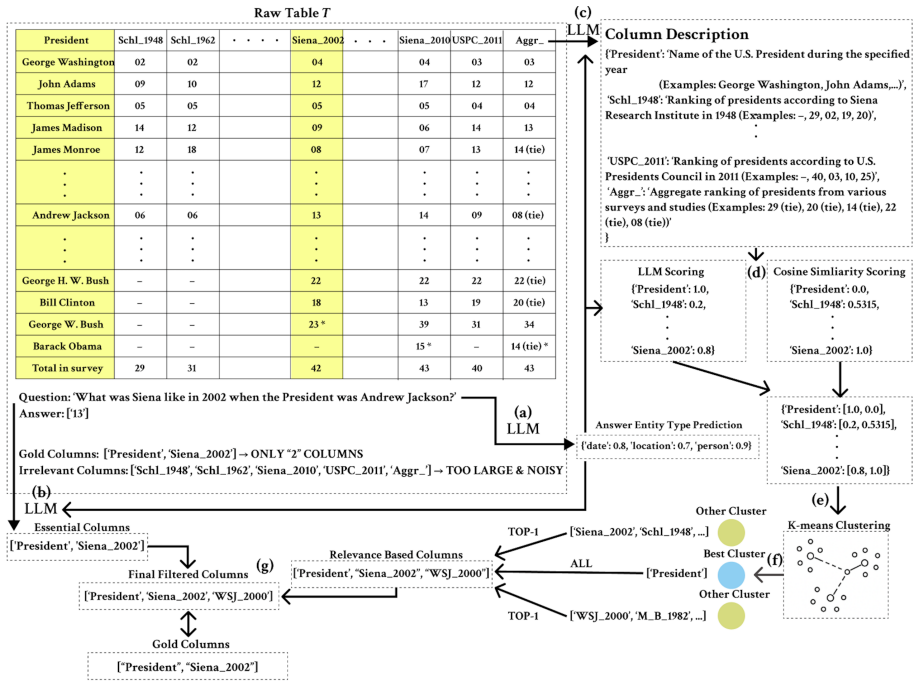
ATF's machinery is a five-stage, question-conditioned pruning pipeline. First, an LLM predicts the answer entity type. Second, an LLM names essential columns that are always kept. Third, each column gets a generated semantic description, then repeated LLM relevance scores (averaged and discounted by their standard deviation) plus a cosine-similarity score from sentence embeddings. Fourth, columns are clustered by their two scores with K-means, and the best cluster is chosen by majority vote of three selection criteria, with the top column from each other cluster and all essential columns added. Fifth, rows are serialized only through the selected columns, scored by TF-IDF, BM25, and dense similarity, softmax-normalized, fused with weights 0.4/0.3/0.3, and the top $\lceil 0.4n \rceil$ rows are kept. The final table is $T[R', C']$.
What would settle it
Run ATF on an out-of-domain TableQA set where every question requires aggregating over more than 40% of the rows (for example, asking for a sum or average over all rows in the table); if accuracy drops below the unfiltered baseline, the claim that ATF preserves out-of-domain QA accuracy fails because the fixed row-retention rule systematically removes needed rows.
Extended reading notes
Core claim
The paper's central discovery is that a large share of TableQA can be answered from a small, question-relevant fragment of a table, and that fragment can be found before the QA model runs. ATF uses an LLM to describe and score columns, clusters columns by those scores, then scores rows against the question using sparse and dense retrieval, keeping the top 40% of rows. On out-of-domain benchmarks (Open-WikiTable and AIT-QA), applying this front-end to two fine-tuned table-parsing models improved exact match and F1 while cutting cells by 67-70%; on AIT-QA the small base model with ATF matched a larger unfiltered model on exact match. The same filtering consistently hurt in-domain WikiTableQuestions and table fact verification, which the paper attributes to those settings needing the full table context the model was trained on.
Load-bearing premise
The load-bearing premise is that every answer's evidence lies within the top 40% of rows (and the selected columns), so a question whose answer requires rows outside that fraction—such as an aggregation over most of the table—will have the needed evidence discarded before the QA model sees it.
Editorial extensions
If this is right
- Models that already struggle with long tables can serve larger inputs: after ATF, the fraction of Open-WikiTable inputs exceeding TAPAS's length limit falls from 22.2% to 2.4%.
- Out-of-domain TableQA improves without any parameter update: TAPAS EM rises from 0.599 to 0.610 on Open-WikiTable and from 0.376 to 0.508 on AIT-QA; TAPEX EM rises from 0.446 to 0.489 on Open-WikiTable.
- ATF can narrow the model-size gap: TAPAS-base with ATF reaches 0.508 EM on AIT-QA, slightly above the 0.505 EM of unfiltered TAPAS-large.
- Aggressive compression is safe for localized-reasoning QA but not for holistic tasks: table fact verification accuracy drops by 1.3-7.5 percentage points across TabFact and SEM-TAB-FACT even with 67-71% cell reduction.
- The clustering-based column selection is load-bearing: replacing it with simple top-K selection drops EM and F1 by 5.7-8.0% on Open-WikiTable.
Reading between the lines
- The in-domain degradation suggests a direct follow-up: fine-tune the downstream model on ATF-filtered tables so training and inference distributions match; the paper lists this as future work, and the observed in-domain drops would be the baseline to beat.
- The fixed 40% row retention is the most task-blind component; a question-type-aware rule (keep all rows for aggregation or verification questions) is a testable modification that could recover the fact-verification losses.
- Because the filtering scores come from an LLM, part of the out-of-domain gain may be an implicit ability of that LLM to recognize entities and schemas; swapping the scoring LLM for a weaker or stronger one would separate filtering skill from world knowledge.
- The same describe-score-cluster-prune pattern could transfer to non-tabular structured inputs, such as JSON documents or knowledge-base excerpts, wherever a question targets a small subset of fields.
Editorial analysis
A structured set of objections, weighed in public.
Referee Report
Summary. The paper proposes ATF, a question-aware preprocessing framework that prunes table columns and rows before a downstream TableQA model (TAPAS/TAPEX) sees the table. Column pruning uses LLM-generated semantic descriptions, repeated LLM relevance scoring with variance adjustment, dense cosine similarity, and K-means clustering with an ensemble of cluster-selection criteria; row pruning uses a softmax-fused combination of TF-IDF, BM25, and Sentence-BERT scores with a fixed 40% row-retention ratio. The central empirical claim is that ATF reduces table cells by up to 70% while improving or maintaining EM/F1 on out-of-domain TableQA datasets (Open-WikiTable, AIT-QA) without retraining the QA model, while it slightly degrades in-domain WikiTableQuestions and Table Fact Verification. The paper includes ablations, token-overflow statistics, and several worked examples.
Significance. If the empirical claim holds, ATF is a useful, model-agnostic preprocessing lever: it is cheap, requires no downstream fine-tuning, and it is accompanied by released code and detailed prompts, which strengthens reproducibility. The claim is falsifiable and the paper is honest about limitations, reporting degradations on in-domain TableQA and on Table Fact Verification. However, the evidence is not yet conclusive. The raw OOD baselines in Table 2 are internally suspicious, no error bars or significance tests are provided, several hyperparameters appear to be tuned on the evaluation sets, and there is no comparison to existing filtering/retrieval methods. The paper's practical value is real if these issues are resolved, but the current experimental support is insufficient for the strength of the stated claims.
major comments (5)
- [§4.4, Tables 1 and 2] The raw TAPAS-base numbers are internally inconsistent with the paper's own difficulty framing. On the in-domain WikiTableQuestions test set, TAPAS-base achieves EM 0.296 (Table 1), but the same model reportedly achieves EM 0.599 on Open-WikiTable, a dataset the paper describes as requiring 'more complex reasoning, such as multi-row inference and latent column operations.' A model fine-tuned on WTQ should not nearly double its EM on an unseen, harder dataset. Please state explicitly whether exactly the same checkpoint, preprocessing, evaluation script, answer normalization, and test split are used in both tables; if different resources were used, the reported ATF gains (+1.8% on Open-WikiTable and +35.4% on AIT-QA) are not interpretable until the raw baseline is recomputed consistently.
- [§4.4, Table 7] The overflow statistics in Table 7 do not support a truncation-based explanation of the gains: for Open-WikiTable, only 22.2% of raw TAPAS inputs exceed the 512-token limit, and for AIT-QA only 21.8%, so more than three quarters of the OOD examples are already inside the window. The reported benefits must therefore come from improved reasoning on in-window tables, yet all tables report single runs with no standard deviation, confidence intervals, or significance tests. The Open-WikiTable EM gain is only 0.011 absolute (0.599 vs. 0.610), which is well within plausible run-to-run noise for a TAPAS evaluation. Please add multiple seeds or bootstrap confidence intervals, and report per-dataset variance.
- [§3.9.3, §3.9.4, §4.7] Several central hyperparameters appear to be selected with knowledge of the evaluation data. The row-fusion weights (0.4 TF-IDF, 0.3 BM25, 0.3 dense) are described as 'empirically chosen' without a separate validation split; the MCDM weights (0.4, 0.2, 0.2, 0.2), confidence weights (0.4, 0.4, 0.2), and the threshold tau = 0.7 are fixed constants; and K = 3 in K-means is selected using Elbow/Silhouette analyses whose data provenance is not specified. If these choices were tuned on Open-WikiTable and AIT-QA, then the 'out-of-domain' claim is not fully held-out. Please report a validation-based selection procedure or a sensitivity analysis, and clarify which datasets were used to set each hyperparameter.
- [§3.9.4, Eq. (19)] The fixed row-retention ratio alpha = 0.4 always discards 60% of rows before the QA model sees the table. For questions that require aggregation over many rows, or where the answer row is not lexically or semantically similar to the question, the filtered table cannot contain the evidence needed for the answer. This is a mechanism-level premise that is not validated separately for the OOD datasets. The paper does not report performance broken down by reasoning type (e.g., count, comparison, lookup), so it is unclear how often this failure mode occurs and whether it explains the in-domain degradation or the TFV degradation.
- [§2.2, §4.4] The experimental comparison is limited to raw tables and a Top-K ablation; no existing filtering or table-compression method is used as a baseline, despite a detailed related-work discussion of MATE, DATER, Chain-of-Table, TableRAG, and ALTER. Given the paper's claim that ATF is a novel modular framework, at least one comparison to an existing preprocessing or retrieval-based subsetting method is needed to establish that the observed OOD gains are specific to ATF rather than a general property of any filtering front-end. If such a comparison is not feasible, the claims should be tempered to 'filtering can help' rather than 'ATF is superior.'
minor comments (8)
- [Throughout] There are numerous typographical errors, including 'fintuned' (§4.2), 'Essentail' (Table 11 header area), 'Anser' (Table 9), and the erroneous appearance of the column 'nominated for' in the AIT-QA cluster description of Table 11. A thorough proofread is needed.
- [Table 11] The 'Filtered Table (Output)' in the AIT-QA case study shows all six original columns, even though the 'Final Selected Columns' lists only four columns. This internal inconsistency in a worked example undermines confidence in the implementation; please correct the example or the pipeline description.
- [§3.5.1] The sentence 'This semantic abstraction serves as an intermediate representation that enhances [Wang et al., 2024] interpretability' is ungrammatical and appears to place a citation in the wrong position; the intended reference is unclear.
- [Table 3] The 7.5% relative drop for TAPAS-large on SEM-TAB-FACT test_a (0.751 to 0.695) is described in the text as 'slight,' but it is larger than the other reported drops; please use a more neutral characterization and report absolute percentage-point differences as well.
- [§4.5, Table 5] In the ablation table, the 'w/o column filtering' row shows EM 0.606 for TAPAS, which is higher than the raw baseline EM 0.599 but the text says performance degrades when either component is removed. The comparison baseline is presumably the full ATF (0.610) rather than the raw model; please make this explicit in the text to avoid confusion.
- [§4.6, Figure 9] The text mentions 'Figure 4 (Bottom)' when referring to the Silhouette Score plot, but the plot is labeled Figure 9; the cross-reference is incorrect.
- [Table 1, Table 2] The meaning of 'Cell ↓' is not defined; state whether the reported percentages correspond to cell-level, token-level, or both, and specify the averaging method across tables.
- [Limitations] The Limitations section appropriately acknowledges in-domain and TFV degradation and LLM-induced latency; however, the main concern about baseline credibility and hyperparameter tuning is not acknowledged there and should be addressed in the revision.
Circularity Check
No significant circularity: ATF is an empirical filtering evaluation whose reported gains are contingent measurements, not consequences of its own equations or self-citations.
full rationale
ATF is an empirical preprocessing system evaluated on external benchmarks (WTQ, Open-WikiTable, AIT-QA, TabFact, SEM-TAB-FACT); there is no derivation chain whose conclusion is presupposed by its premises. The filtering pipeline (Eqs. 1-20) is question-conditioned but does not access gold answers or gold filtered tables: column relevance comes from LLM scoring and embedding similarity (Eqs. 4-7), cluster selection from question-cluster similarity and confidence (Eqs. 9-11), and row selection from TF-IDF/BM25/dense similarity (Eqs. 15-18). The reported gains are empirical outcomes, not identities: e.g., Table 2's +1.8% EM on Open-WikiTable and +35.4% on AIT-QA are contingent measurements, not consequences of the filter equations. There are no self-citations to the author's prior work, no imported uniqueness theorems, and no known result renamed as new. Some design choices (K=3 via Elbow/Silhouette, alpha=0.4, fusion weights) are admittedly empirical (Sections 3.9.3-3.9.4 and 4.7), which is a tuning concern that could overstate OOD gains, but it does not make the evaluation circular: the final EM/F1 numbers are not statistically forced by those choices. The implausible raw TAPAS OOD baseline (0.599 vs 0.296 in-domain) is a correctness/verification issue, not a circularity issue. The paper also openly states its limitations (ID and TFV degradation, LLM latency), further indicating that the empirical claims are not protected by construction. Verdict: no significant circularity.
Assumptions & free parameters
free parameters (6)
- alpha_row_keep =
0.4
- fusion_weights =
0.4 TF-IDF, 0.3 BM25, 0.3 dense
- K_clusters =
3
- MCDM_weights =
0.4, 0.2, 0.2, 0.2
- confidence_weights =
0.4, 0.4, 0.2
- info_density_threshold =
0.7
assumptions (5)
- domain assumption GPT-4-mini outputs stable and accurate column descriptions and relevance scores at temperature 0.
- standard math K-means on 2D score vectors yields semantically meaningful column clusters.
- domain assumption Sparse and dense retrieval scores identify answer-bearing rows.
- domain assumption The top 40% row retention preserves all rows needed for the answer.
- domain assumption The fine-tuned TAPAS and TAPEX checkpoints and dataset splits reproduce the benchmark conditions the paper assumes.
Cite this review
Pith. "Pith review of What to Keep and What to Drop: Adaptive Table Filtering Framework." pith.science (2026). https://pith.science/paper/3FLBGI6R
@misc{pith2026250623463,
  author       = {Pith},
  title        = {Pith review of: What to Keep and What to Drop: Adaptive Table Filtering Framework},
  year         = {2026},
  howpublished = {\url{https://pith.science/paper/3FLBGI6R}},
  note         = {Machine review of arXiv:2506.23463}
}
read the original abstract
Large language models (LLMs) for table-based reasoning often struggle with large tables due to input length limits. We propose ATF (Adaptive Table Filtering Framework), a modular and question-aware filtering pipeline that prunes uninformative columns and rows using LLM-generated column descriptions, clustering, and sparse-dense alignment scores. ATF integrates seamlessly with existing models (e.g., TAPAS, TAPEX) without retraining. Experiments show that ATF reduces table cells by 70%, boosting performance on out-of-domain TableQA tasks while causing slight performance drops on Table Fact Verification, where full-table context is more critical. These results highlight ATF's ability to adaptively balance informativeness and minimalism across tasks. Our code available at: https://github.com/torijune/ATF-Adaptive-Table-Filtering-Framework
Figures


Figures from the paper (10 more)


Reference graph
Works this paper leans on
-
[1]
A theory of learning from different domains
Shai Ben-David, John Blitzer, Koby Crammer, and Fernando Pereira. A theory of learning from different domains. In Machine learning, pages 79--103. Springer, 2010
work page 2010
-
[2]
Tablerag: Million-token table understanding with language models, 2024
Si-An Chen, Lesly Miculicich, Julian Martin Eisenschlos, Zifeng Wang, Zilong Wang, Yanfei Chen, Yasuhisa Fujii, Hsuan-Tien Lin, Chen-Yu Lee, and Tomas Pfister. Tablerag: Million-token table understanding with language models, 2024. URL https://arxiv.org/abs/2410.04739
arXiv 2024
-
[3]
Tabfact: A large-scale dataset for table-based fact verification
Wenhu Chen, Hongmin Wang, Jianshu Chen, Yunkai Zhang, Hong Wang, Shiyang Li, Xiyou Zhou, and William Yang Wang. Tabfact: A large-scale dataset for table-based fact verification. In Proceedings of the International Conference on Learning Representations (ICLR), Addis Ababa, Ethiopia, April 2020
work page 2020
-
[4]
Binder: Binding language models in symbolic languages
Zhoujun Cheng et al. Binder: Binding language models in symbolic languages. In Proceedings of the International Conference on Learning Representations (ICLR), 2023
work page 2023
-
[5]
Bert: Pre-training of deep bidirectional transformers for language understanding, 2019
Jacob Devlin, Ming-Wei Chang, Kenton Lee, and Kristina Toutanova. Bert: Pre-training of deep bidirectional transformers for language understanding, 2019. URL https://arxiv.org/abs/1810.04805
arXiv 2019
-
[6]
Mate: Multi-view attention for table transformers
Julian Eisenschlos, Long Phuoc Duong, Sebastian Ruder, Shashi Narayan, and Dani Yogatama. Mate: Multi-view attention for table transformers. In Findings of the Association for Computational Linguistics: EMNLP 2021, 2021
work page 2021
-
[7]
Llm chain ensembles for scalable and accurate data annotation
David Farr, Nico Manzonelli, Iain Cruickshank, Kate Starbird, and Jevin West. Llm chain ensembles for scalable and accurate data annotation. In 2024 IEEE International Conference on Big Data (BigData), pages 2110--2118, 2024. doi:10.1109/BigData62323.2024.10826109
arXiv 2024
-
[8]
Blendsql: A scalable dialect for unifying hybrid qa in relational algebra, 2024
Parker Glenn et al. Blendsql: A scalable dialect for unifying hybrid qa in relational algebra, 2024. Preprint
work page 2024
Show all 33 references
-
[9]
Anomaly detection using softmax probability of pre-trained deep neural networks
Dan Hendrycks and Kevin Gimpel. Anomaly detection using softmax probability of pre-trained deep neural networks. arXiv preprint arXiv:1612.02685, 2020
2020 arXiv
-
[10]
Tapas: Weakly supervised table parsing via pre-training
Jonathan Herzig, Pawe Nowak, Thomas M \"u ller, Francesco Piccinno, and Julian Eisenschlos. Tapas: Weakly supervised table parsing via pre-training. In Proceedings of the 58th Annual Meeting of the Association for Computational Linguistics (ACL), 2020
2020
-
[11]
An Introduction to Statistical Learning
Gareth James, Daniela Witten, Trevor Hastie, and Robert Tibshirani. An Introduction to Statistical Learning. Springer, 2013
2013
-
[12]
A statistical interpretation of term specificity and its application in retrieval
Karen Spärck Jones. A statistical interpretation of term specificity and its application in retrieval. Journal of Documentation, 28 0 (1): 0 11--21, 1972
1972
-
[13]
Ait-qa: Question answering dataset over complex tables in the airline industry, 2021
Yannis Katsis, Saneem Chemmengath, Vishwajeet Kumar, Samarth Bharadwaj, Mustafa Canim, Michael Glass, Alfio Gliozzo, Feifei Pan, Jaydeep Sen, Karthik Sankaranarayanan, and Soumen Chakrabarti. Ait-qa: Question answering dataset over complex tables in the airline industry, 2021
2021
-
[14]
Open-wikitable: Dataset for open domain question answering with complex reasoning over table, 2023 a
Sunjun Kweon, Yeonsu Kwon, Seonhee Cho, Yohan Jo, and Edward Choi. Open-wikitable: Dataset for open domain question answering with complex reasoning over table, 2023 a . URL https://arxiv.org/abs/2305.07288
2023 arXiv
-
[15]
Open-wikitable: Dataset for odqa with complex reasoning over table
Sunjun Kweon et al. Open-wikitable: Dataset for odqa with complex reasoning over table. In ACL Findings, 2023 b
2023
-
[16]
BART : Denoising sequence-to-sequence pre-training for natural language generation, translation, and comprehension
Mike Lewis, Yinhan Liu, Naman Goyal, Marjan Ghazvininejad, Abdelrahman Mohamed, Omer Levy, Veselin Stoyanov, and Luke Zettlemoyer. BART : Denoising sequence-to-sequence pre-training for natural language generation, translation, and comprehension. In Dan Jurafsky, Joyce Chai, N...
2020
-
[17]
Tapex: Table pre-training via learning a neural sql executor, 2022
Qian Liu, Bei Chen, Jiaqi Guo, Morteza Ziyadi, Zeqi Lin, Weizhu Chen, and Jian-Guang Lou. Tapex: Table pre-training via learning a neural sql executor, 2022. URL https://arxiv.org/abs/2107.07653
2022 arXiv
-
[18]
Interpretable llm-based table question answering, 2025
Giang Nguyen, Ivan Brugere, Shubham Sharma, Sanjay Kariyappa, Anh Totti Nguyen, and Freddy Lecue. Interpretable llm-based table question answering, 2025. URL https://arxiv.org/abs/2412.12386
2025 arXiv
-
[19]
Gpt-4o: Openai’s new multimodal model
OpenAI. Gpt-4o: Openai’s new multimodal model. https://openai.com/index/gpt-4o, May 2024. Accessed: 2025-06-02
2024
-
[20]
Compositional semantic parsing on semi-structured tables, 2015
Panupong Pasupat and Percy Liang. Compositional semantic parsing on semi-structured tables, 2015. URL https://arxiv.org/abs/1508.00305
2015 arXiv
-
[21]
Sentence-bert: Sentence embeddings using siamese bert-networks
Nils Reimers and Iryna Gurevych. Sentence-bert: Sentence embeddings using siamese bert-networks. In Proceedings of the 2019 Conference on Empirical Methods in Natural Language Processing (EMNLP), pages 3982--3992, 2019. URL https://aclanthology.org/D19-1410
2019
-
[22]
Some simple effective approximations to the 2-poisson model for probabilistic weighted retrieval
Stephen Robertson and Steve Walker. Some simple effective approximations to the 2-poisson model for probabilistic weighted retrieval. SIGIR, pages 232--241, 1994
1994
-
[23]
Silhouettes: a graphical aid to the interpretation and validation of cluster analysis
Peter J Rousseeuw. Silhouettes: a graphical aid to the interpretation and validation of cluster analysis. Journal of computational and applied mathematics, 20: 0 53--65, 1987
1987
-
[24]
Unveiling implicit table knowledge with question-then-pinpoint reasoner for insightful table summarization, 2024
Kwangwook Seo, Jinyoung Yeo, and Dongha Lee. Unveiling implicit table knowledge with question-then-pinpoint reasoner for insightful table summarization, 2024. URL https://arxiv.org/abs/2406.12269
2024 arXiv
-
[25]
Attention is all you need
Ashish Vaswani, Noam Shazeer, Niki Parmar, Jakob Uszkoreit, Llion Jones, Aidan N Gomez, ukasz Kaiser, and Illia Polosukhin. Attention is all you need. In Advances in neural information processing systems, pages 5998--6008, 2017
2017
-
[26]
Self-consistency improves chain of thought reasoning in language models
Jason Wang, Jason Wei, Dale Schuurmans, Quoc V Le, Ed H Chi, Denny Zhou, et al. Self-consistency improves chain of thought reasoning in language models. arXiv preprint arXiv:2203.11171, 2022
2022 arXiv
-
[27]
Nancy X. R. Wang, Diwakar Mahajan, Marina Danilevsky, and Sara Rosenthal. S em E val-2021 task 9: Fact verification and evidence finding for tabular data in scientific documents ( SEM - TAB - FACTS ). In Alexis Palmer, Nathan Schneider, Natalie Schluter, Guy Emerson, Aurelie H...
2021 doi
-
[28]
Chain-of-table: Evolving tables in the reasoning chain for table understanding, 2024
Zilong Wang, Hao Zhang, Chun-Liang Li, Julian Martin Eisenschlos, Vincent Perot, Zifeng Wang, Lesly Miculicich, Yasuhisa Fujii, Jingbo Shang, Chen-Yu Lee, and Tomas Pfister. Chain-of-table: Evolving tables in the reasoning chain for table understanding, 2024. URL https://arxiv...
2024 arXiv
-
[29]
Protrix: Planning and reasoning over tables with sentence context
Zirui Wu and Yansong Feng. Protrix: Planning and reasoning over tables with sentence context. In Proceedings of the 2024 Conference on Empirical Methods in Natural Language Processing (EMNLP), 2024
2024
-
[30]
Large language models are versatile decomposers: Decompose evidence and questions for table-based reasoning, 2023
Yunhu Ye, Binyuan Hui, Min Yang, Binhua Li, Fei Huang, and Yongbin Li. Large language models are versatile decomposers: Decompose evidence and questions for table-based reasoning, 2023. URL https://arxiv.org/abs/2301.13808
2023 arXiv
-
[31]
ALTER : Augmentation for large-table-based reasoning
Han Zhang, Yuheng Ma, and Hanfang Yang. ALTER : Augmentation for large-table-based reasoning. In Luis Chiruzzo, Alan Ritter, and Lu Wang, editors, Proceedings of the 2025 Conference of the Nations of the Americas Chapter of the Association for Computational Linguistics: Human ...
2025 doi
-
[32]
Yunjia Zhang, Jordan Henkel, Avrilia Floratou, Joyce Cahoon, Shaleen Deep, and Jignesh M. Patel. Reactable: Enhancing react for table question answering, 2023. URL https://arxiv.org/abs/2310.00815
2023 arXiv
-
[33]
Tat-qa: A question answering benchmark on a hybrid of tabular and textual content in finance, 2021
Fengbin Zhu, Wenqiang Lei, Youcheng Huang, Chao Wang, Shuo Zhang, Jiancheng Lv, Fuli Feng, and Tat-Seng Chua. Tat-qa: A question answering benchmark on a hybrid of tabular and textual content in finance, 2021. URL https://arxiv.org/abs/2105.07624
2021 arXiv
Reviewed August 6, 2026 · model on record in the stance chip above.
Discussion (0). Sign in to comment.