REVIEW 4 major objections 8 minor 81 references
Reconciling Attribute and Structural Anomalies for Improved Graph Anomaly Detection
T0 review · 4 major / 8 minor · reviewed 2026-08-06 · deepseek-v4-flash
Pith's one-line read TripleAD separates graph anomaly detection into attribute, structure, and mixed channels and reports higher scores than 14 baselines on all five datasets.
desk verdict TripleAD is a sensible divide-and-conquer framework for unsupervised graph anomaly detection, but its novel attribute-mixed curvature is formally under-specified (Eq. 22 can yield negative probabilities) and the reported gains are small with no variance. read the letter →
The pith
A machine-rendered reading of the paper's core claim, the machinery that carries it, and where it could break.
The reading
What carries the argument
The load-bearing mechanism is the attribute-mixed curvature $\kappa(i,j)$ of Eqs. (21)-(23), a per-edge score that combines Wasserstein graph curvature with normalized attribute similarity and is used in place of the adjacency matrix for a GCN-based reconstruction. It carries the mixed-anomaly channel: normal-normal pairs are expected to score higher than normal-abnormal pairs, and the reconstruction error of this curvature becomes the third anomaly signal. The other two mechanisms are the multi-scale attribute estimator, which forms an attention-weighted combination of $L$ propagated feature views to avoid over-smoothing, and the link-enhanced structure estimator, which builds a $k$-NN graph so that edge-masked nodes still receive information; a triplet distillation loss ties all three channels together.
What would settle it
Compute the distribution of attribute-mixed curvature values for normal-normal versus normal-abnormal node pairs on Amazon, YelpChi, ACM, and Flickr; if the curves overlap or invert on any of them, the mixed channel's reconstruction error carries no signal and the combined anomaly score of Eq. (34) should lose accuracy.
Extended reading notes
Core claim
TripleAD's central claim is that attribute anomalies, structural anomalies, and mixed anomalies are best detected by three separate estimation modules whose losses are optimized sequentially rather than jointly, with inter-channel knowledge transfer handled by a triplet-loss distillation. The attribute channel masks a node's attributes and reconstructs them from attention-weighted multi-scale propagated neighbor features; the structure channel masks edges and reconstructs the adjacency matrix with the help of a kNN-enhanced graph that keeps masked nodes reachable; the mixed channel replaces the adjacency matrix with an attribute-mixed curvature and reconstructs that curvature through a GCN. The final anomaly score is a weighted sum of the three reconstruction errors. The paper reports that this architecture outperforms 14 baselines on all five datasets in every metric, with relative improvements of 0.05% to 2.64% over the strongest baseline, and that ablations removing any channel or the distillation step degrade performance.
Load-bearing premise
The mixed channel's signal rests on the assumption that its attribute-mixed curvature score is always lower for abnormal node pairs than for normal ones, yet the paper shows this separation only on CiteSeer and never verifies it on the other four datasets.
Editorial extensions
If this is right
- Graph anomaly detectors no longer need to compromise between attribute fidelity and structural fidelity; each node can be scored on three separate axes and the scores combined with weights.
- The multi-scale attribute module supplies a way to reach long-range neighborhood information for reconstruction without stacking deep GNN layers, avoiding over-smoothing.
- The link-enhanced structure module shows that edge masking need not isolate a node, since a kNN graph built on propagated features keeps information flowing to the target.
- The attribute-mixed curvature turns both attributes and topology into a single per-edge reconstruction target, so mixed anomalies fall under the same reconstruction-error logic as the other two types.
- According to the ablations, removing any channel or the distillation step lowers performance, so the reported gain comes from the combination of all three channels plus mutual distillation.
Reading between the lines
- The curvature gap that motivates the mixed channel is shown only on CiteSeer; measuring the same gap on Amazon, YelpChi, ACM, and Flickr would directly test whether the signal transfers.
- The fixed training order of attribute, then structure, then mixture, is not varied in the paper, so whether the claimed interference relief depends on this curriculum is an open question.
- The divide-and-conquer-plus-distillation pattern could plausibly carry over to other graph tasks with conflicting objectives, such as joint link prediction and node classification, though TripleAD itself is evaluated only for anomaly detection.
- The curvature-weighted adjacency matrix and the kNN-enhanced graph are computed as preprocessing and could be reused as input signals for other detectors, an extension the paper does not explore.
Signed reviews
Editorial analysis
A structured set of objections, weighed in public.
Referee Report
Summary. The paper proposes TripleAD, an unsupervised graph anomaly detection framework that decomposes the task into three channels for attribute, structural, and mixed anomalies. The attribute channel uses multi-scale feature propagation to reconstruct masked attributes; the structure channel builds a kNN link-enhanced graph and reconstructs masked edges; the mixed channel introduces an attribute-mixed curvature, computed from a modified Wasserstein distance between local distributions, and reconstructs this curvature using a GCN. The three channels are connected by a mutual distillation strategy based on triplet losses. Experiments on five datasets (Amazon, YelpChi, CiteSeer, ACM, Flickr) report that TripleAD outperforms 15 baselines on AUC-ROC, AUC-PR, and F1 metrics, with relative improvements between 0.05% and 2.64%. The paper also presents ablation and sensitivity analyses to support the contribution of each module.
Significance. If the claims hold, TripleAD would be a useful contribution by showing that explicitly separating anomaly types can reduce interference, and the mutual distillation mechanism provides a way to combine specialized representations. The paper includes extensive comparisons against 15 baselines, ablation studies, and sensitivity analyses, which are strengths. However, the core novelty—attribute-mixed curvature—has a definitional gap, and the empirical evidence for the central 'tug-of-war' claim is indirect because no single-model variant with comparable capacity is tested. The reported improvements are modest and lack statistical validation.
major comments (4)
- [III-D, Eq. (22)] The distribution \hat{m}_i(j) in Eq. (22) is not guaranteed to be a valid probability distribution. The entry for x ∈ N_i − N_j equals (1 − δ − S'_ij/|N_i − N_j|)/k_i, which is negative whenever S_ij > (1−δ)^2 |N_i − N_j|. For δ = 0.5 and a pair with only one non-common neighbor, any attribute similarity above 0.25 yields a negative mass. Since S_ij is never defined in the paper, δ is not listed in the hyperparameter search space (Table II), and no clipping or renormalization is mentioned, the Wasserstein distance in Eq. (21) is undefined for many node pairs. Consequently, the attribute-mixed curvature κ(i,j), and hence the entire mixed channel (Eqs. (23)–(26) and (33)–(34)), is not well-defined for these pairs. The authors should either constrain S_ij, choose δ appropriately, or clip/renormalize the distribution, and re-evaluate the experiments.
- [IV-D, Unified Versus Separate] The paper uses DOMINANT and CoLA to illustrate the 'tug-of-war' but does not compare TripleAD with a single unified model of comparable capacity trained to reconstruct both attributes and structure simultaneously. The ablation study in §IV-C removes individual components but always retains three channels. Therefore, the observed gains in Table III are not directly attributable to the separation of anomaly types; they could stem from increased model capacity, the link-enhanced graph, or the distillation objective. A single-channel variant with the same total parameter budget should be tested to support the central claim.
- [IV-B, Table III] No standard deviations, number of independent runs, or significance tests are reported for any of the results in Table III. Several relative improvements are very small (e.g., 0.05% on Flickr APR), so without statistical evidence the claim of 'superior detection performance across all evaluated datasets' is not supported. The authors should run multiple seeds and report mean ± std or a significance test, especially for the smallest improvements.
- [II-B and III-D, Fig. 2] The discriminative power of the attribute-mixed curvature is demonstrated on a single dataset (CiteSeer) via Fig. 2. The paper does not show analogous curvature distributions for Amazon, YelpChi, ACM, or Flickr, yet the mixed-channel score is used on all five datasets. If the separation between normal-normal and abnormal-normal pairs does not hold on a given graph, AS_mix in Eq. (34) adds noise rather than signal. The authors should provide per-dataset evidence or an analysis of when the curvature assumption holds.
minor comments (8)
- [III-D, Eq. (22)] The attribute similarity S_ij is used in Eq. (22) but never defined; please specify it (e.g., cosine similarity after normalization).
- [III-B and III-C] The masking ratios and strategies for attributes and edges are not specified; please state them (e.g., random 20% masking) to make the reconstruction setup reproducible.
- [Table II] The search space in Table II omits several hyperparameters that are tuned in the experiments, including k, γ, η1, η2, m, δ, and the GCN layer count in the mixture module; please list these or state that they are set by grid search elsewhere.
- [III-D, Eq. (24)] The symbol L is used both for the number of propagation scales and for the matrix in Eq. (24); please use different symbols to avoid confusion.
- [III-D, Eq. (24)] Calling L = \tilde{D}^{-1/2} C \tilde{D}^{-1/2} a 'Laplacian' is misleading because C contains nonnegative entries; it is a normalized adjacency matrix with self-loops.
- [References] Reference [56] is missing the article title, and reference [57] appears incomplete; please supply full bibliographic information.
- [IV-B] The statement 'In addition, we calculate the runtime of our model...' is not backed by any reported runtime results; please include the results or remove the claim.
- [Index Terms] There is a typo: 'graph neutral network' should be 'graph neural network.'
Circularity Check
No significant circularity: TripleAD's predictions are reconstruction errors on external benchmarks, not fitted inputs or imported self-cited constraints.
full rationale
TripleAD's central claim—that three separately optimized channels reduce attribute/structure interference and improve detection—is tested against 14 baselines on five public datasets (Table III), with ablations (Fig. 4) and a unified-versus-separate comparison (Fig. 5). The reconstruction targets X, A, and C are computed directly from the input graph; no anomaly label enters the curvature definition or the training objectives, and hyperparameters are grid-searched on a validation split (Table II). The final anomaly score in Eq. (34) is a weighted sum of three reconstruction errors, not a fitted parameter renamed as a prediction. The paper contains a few self-citations (e.g., [10], [35], [60]) but only for contextual purposes—graph-anomaly applications, a standard FC decoder design, and graph-level anomaly detection—so none is load-bearing for the central derivation. The curvature motivation in Section II-B uses CiteSeer to illustrate separation while CiteSeer also appears in the test set; this is a possible design-choice/test-set overlap and deserves methodological scrutiny, but it is not circular because the curvature formula is fixed and unlabeled. Likewise, the negative-mass issue in Eq. (22) is a mathematical correctness risk, not a circularity: the Wasserstein distance may be undefined for some pairs, but repairing or constraining the distributions would not make the model's predictions equivalent to its inputs by construction. No self-definitional, fitted-input-as-prediction, imported-uniqueness, or ansatz-smuggling step was found.
Assumptions & free parameters
free parameters (13)
- Number of propagation scales L =
Grid-searched over {1..8}, optimal not reported
- Propagation iterations T =
Grid-searched over {1..8}, optimal not reported
- Restart probabilities alpha and beta =
Grid-searched over {0.001, 0.05, 0.1, 0.2}
- Hidden dimension h =
Grid-searched over {32, 64, 128, 256}
- Learning rate =
Grid-searched over {0.1, 0.01, 0.001, 0.0001}
- Anomaly score weights lambda1, lambda2, lambda3 =
Grid-searched over {0.1, 0.2, ..., 0.9}
- kNN neighbor number k =
Tuned, optimal not reported
- Consistency weight gamma =
Tuned, optimal not reported
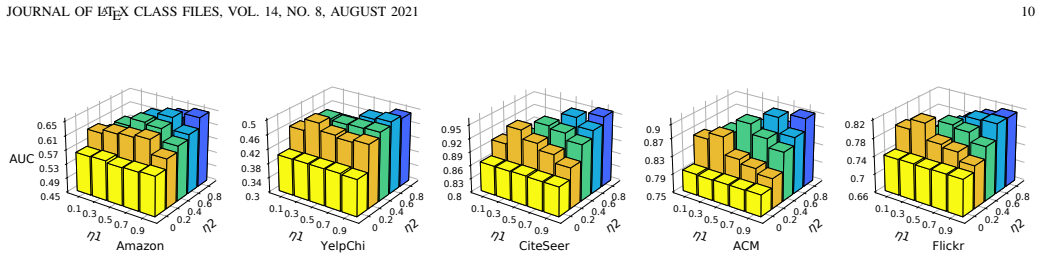
- Distillation weights eta1 and eta2 =
Grid-searched over {0.1..0.9}
- Triplet margin m =
Grid-searched over {0.1, 0.3, 0.5, 1, 1.5}
- Curvature distribution coefficient delta =
Not reported
- GCN layer count in mixture module =
Not reported
- Masking ratio for attributes and edges =
Not reported
assumptions (5)
- domain assumption Graph curvature defined by Eq. (1) with the distribution in Eq. (2) is a meaningful measure of interaction and overlap strength.
- domain assumption Normal-normal node pairs have higher curvature than normal-abnormal pairs on unseen graphs.
- domain assumption Anomalies are hard to reconstruct by a model trained on the majority normal pattern.
- ad hoc to paper Attribute, structural, and mixed anomalies are separable categories that can be detected independently and then combined.
- domain assumption The kNN link-enhanced graph built from propagated features preserves the information needed to reconstruct isolated nodes.
invented entities (1)
-
Attribute-mixed curvature kappa(i,j)
Cite this review
Pith. "Pith review of Reconciling Attribute and Structural Anomalies for Improved Graph Anomaly Detection." pith.science (2026). https://pith.science/paper/4NVLFNX5
@misc{pith2026250623469,
  author       = {Pith},
  title        = {Pith review of: Reconciling Attribute and Structural Anomalies for Improved Graph Anomaly Detection},
  year         = {2026},
  howpublished = {\url{https://pith.science/paper/4NVLFNX5}},
  note         = {Machine review of arXiv:2506.23469}
}
read the original abstract
Graph anomaly detection is critical in domains such as healthcare and economics, where identifying deviations can prevent substantial losses. Existing unsupervised approaches strive to learn a single model capable of detecting both attribute and structural anomalies. However, they confront the tug-of-war problem between two distinct types of anomalies, resulting in suboptimal performance. This work presents TripleAD, a mutual distillation-based triple-channel graph anomaly detection framework. It includes three estimation modules to identify the attribute, structural, and mixed anomalies while mitigating the interference between different types of anomalies. In the first channel, we design a multiscale attribute estimation module to capture extensive node interactions and ameliorate the over-smoothing issue. To better identify structural anomalies, we introduce a link-enhanced structure estimation module in the second channel that facilitates information flow to topologically isolated nodes. The third channel is powered by an attribute-mixed curvature, a new indicator that encapsulates both attribute and structural information for discriminating mixed anomalies. Moreover, a mutual distillation strategy is introduced to encourage communication and collaboration between the three channels. Extensive experiments demonstrate the effectiveness of the proposed TripleAD model against strong baselines.
Figures


Figures from the paper (6 more)




Reference graph
Works this paper leans on
-
[1]
Generalized video anomaly event detection: Systematic taxonomy and comparison of deep models,
Y . Liu, D. Yang, Y . Wang, J. Liu, J. Liu, A. Boukerche, P. Sun, and L. Song, “Generalized video anomaly event detection: Systematic taxonomy and comparison of deep models,” ACM Computing Surveys , vol. 56, no. 7, pp. 1–38, 2024
2024
-
[2]
Self-supervised learning for time series analysis: Taxonomy, progress, and prospects,
K. Zhang, Q. Wen, C. Zhang, R. Cai, M. Jin, Y . Liu, J. Y . Zhang, Y . Liang, G. Pang, D. Song et al. , “Self-supervised learning for time series analysis: Taxonomy, progress, and prospects,” IEEE Transactions on Pattern Analysis and Machine Intelligence, vol. 46, no. 10, pp. 6775– 6794, 2024
work page 2024
-
[3]
Fighting against organized fraudsters using risk diffusion-based parallel graph neural network
J. Ma, F. Li, R. Zhang, Z. Xu, D. Cheng, Y . Ouyang, R. Zhao, J. Zheng, Y . Zheng, and C. Jiang, “Fighting against organized fraudsters using risk diffusion-based parallel graph neural network.” in International Joint Conference on Artificial Intelligence , 2023, pp. 6138–6146
work page 2023
-
[4]
A comprehensive survey on graph neural networks,
Z. Wu, S. Pan, F. Chen, G. Long, C. Zhang, and S. Y . Philip, “A comprehensive survey on graph neural networks,” IEEE Transactions on Neural Networks and Learning Systems , vol. 32, no. 1, pp. 4–24, 2020
work page 2020
-
[5]
Comga: Community-aware attributed graph anomaly detection,
X. Luo, J. Wu, A. Beheshti, J. Yang, X. Zhang, Y . Wang, and S. Xue, “Comga: Community-aware attributed graph anomaly detection,” in ACM International Conference on Web Search and Data Mining , 2022, pp. 657–665
work page 2022
-
[6]
Interleaved sequence rnns for fraud detection,
B. Branco, P. Abreu, A. S. Gomes, M. S. Almeida, J. T. Ascens ˜ao, and P. Bizarro, “Interleaved sequence rnns for fraud detection,” in Proceedings of the ACM SIGKDD Conference on Knowledge Discovery and Data Mining , 2020, pp. 3101–3109
work page 2020
-
[7]
Fang: Leverag- ing social context for fake news detection using graph representation,
V .-H. Nguyen, K. Sugiyama, P. Nakov, and M.-Y . Kan, “Fang: Leverag- ing social context for fake news detection using graph representation,” in ACM International Conference on Information & Knowledge Man- agement, 2020, pp. 1165–1174
work page 2020
-
[8]
Netwalk: A flexible deep embedding approach for anomaly detection in dynamic networks,
W. Yu, W. Cheng, C. C. Aggarwal, K. Zhang, H. Chen, and W. Wang, “Netwalk: A flexible deep embedding approach for anomaly detection in dynamic networks,” in Proceedings of the ACM SIGKDD Conference on Knowledge Discovery and Data Mining , 2018, pp. 2672–2681
work page 2018
Show all 81 references
-
[9]
Bond: Benchmarking unsupervised outlier node detection on static attributed graphs,
K. Liu, Y . Dou, Y . Zhao, X. Ding, X. Hu, R. Zhang, K. Ding, C. Chen, H. Peng, K. Shu et al., “Bond: Benchmarking unsupervised outlier node detection on static attributed graphs,” in Advances in Neural Information Processing Systems, vol. 35, 2022, pp. 27 021–27 035
2022
-
[10]
Counter- factual data augmentation with denoising diffusion for graph anomaly detection,
C. Xiao, S. Pang, X. Xu, X. Li, G. Trajcevski, and F. Zhou, “Counter- factual data augmentation with denoising diffusion for graph anomaly detection,” IEEE Transactions on Computational Social Systems, vol. 11, no. 6, pp. 7555–7567, 2024
2024
-
[11]
Radar: Residual analysis for anomaly detection in attributed networks,
J. Li, H. Dani, X. Hu, and H. Liu, “Radar: Residual analysis for anomaly detection in attributed networks,” in International Joint Conference on Artificial Intelligence, 2017, pp. 2152–2158
2017
-
[12]
Mixedad: A scalable algorithm for detecting mixed anomalies in attributed graphs,
M. Zhu and H. Zhu, “Mixedad: A scalable algorithm for detecting mixed anomalies in attributed graphs,” in AAAI Conference on Artificial Intelligence, 2020, pp. 1274–1281
2020
-
[13]
Anomaly de- tection on attributed networks via contrastive self-supervised learning,
Y . Liu, Z. Li, S. Pan, C. Gong, C. Zhou, and G. Karypis, “Anomaly de- tection on attributed networks via contrastive self-supervised learning,” IEEE Transactions on Neural Networks and Learning Systems , vol. 33, no. 6, pp. 2378–2392, 2021
2021
-
[14]
A comprehensive survey on graph anomaly detection with deep learning,
X. Ma, J. Wu, S. Xue, J. Yang, C. Zhou, Q. Z. Sheng, H. Xiong, and L. Akoglu, “A comprehensive survey on graph anomaly detection with deep learning,” IEEE Transactions on Knowledge and Data Engineering, vol. 35, no. 12, pp. 12 012–12 038, 2021
2021
-
[15]
Deep anomaly detection on attributed networks,
K. Ding, J. Li, R. Bhanushali, and H. Liu, “Deep anomaly detection on attributed networks,” in SIAM International Conference on Data Mining, 2019, pp. 594–602
2019
-
[16]
Hybrid-order anomaly detection on attributed networks,
L. Huang, Y . Zhu, Y . Gao, T. Liu, C. Chang, C. Liu, Y . Tang, and C.-D. Wang, “Hybrid-order anomaly detection on attributed networks,” IEEE Transactions on Knowledge and Data Engineering , vol. 35, no. 12, pp. 12 249–12 263, 2021
2021
-
[17]
A deep multi- view framework for anomaly detection on attributed networks,
Z. Peng, M. Luo, J. Li, L. Xue, and Q. Zheng, “A deep multi- view framework for anomaly detection on attributed networks,” IEEE Transactions on Knowledge and Data Engineering , vol. 34, no. 6, pp. 2539–2552, 2020
2020
-
[18]
Generative and contrastive self-supervised learning for graph anomaly detection,
Y . Zheng, M. Jin, Y . Liu, L. Chi, K. T. Phan, and Y .-P. P. Chen, “Generative and contrastive self-supervised learning for graph anomaly detection,” IEEE Transactions on Knowledge and Data Engineering , vol. 35, no. 12, pp. 12 220 – 12 233, 2021
2021
-
[19]
Reconstruction enhanced multi-view contrastive learning for anomaly detection on attributed networks,
J. Zhang, S. Wang, and S. Chen, “Reconstruction enhanced multi-view contrastive learning for anomaly detection on attributed networks,” in International Joint Conference on Artificial Intelligence, 2022, pp. 2376– 2382
2022
-
[20]
Graph anomaly detection via multi-scale contrastive learning networks with augmented view,
J. Duan, S. Wang, P. Zhang, E. Zhu, J. Hu, H. Jin, Y . Liu, and Z. Dong, “Graph anomaly detection via multi-scale contrastive learning networks with augmented view,” in AAAI Conference on Artificial Intelligence , 2023, pp. 7459–7467
2023
-
[21]
Embracing change: Continual learning in deep neural networks,
R. Hadsell, D. Rao, A. A. Rusu, and R. Pascanu, “Embracing change: Continual learning in deep neural networks,” Trends in cognitive sci- ences, vol. 24, no. 12, pp. 1028–1040, 2020
2020
-
[22]
Octavius: Mitigating task inter- ference in mllms via moe,
Z. Chen, Z. Wang, Z. Wang, H. Liu, Z. Yin, S. Liu, L. Sheng, W. Ouyang, Y . Qiao, and J. Shao, “Octavius: Mitigating task inter- ference in mllms via moe,” in International Conference on Learning Representations, 2024
2024
-
[23]
Graph neural networks beyond compromise between attribute and topology,
L. Yang, W. Zhou, W. Peng, B. Niu, J. Gu, C. Wang, X. Cao, and D. He, “Graph neural networks beyond compromise between attribute and topology,” in Proceedings of the ACM Web Conference , 2022, pp. 1127–1135
2022
-
[24]
Am-gcn: Adaptive multi-channel graph convolutional networks,
X. Wang, M. Zhu, D. Bo, P. Cui, C. Shi, and J. Pei, “Am-gcn: Adaptive multi-channel graph convolutional networks,” inProceedings of the ACM SIGKDD Conference on Knowledge Discovery and Data Mining , 2020, pp. 1243–1253. JOURNAL OF LATEX CLASS FILES, VOL. 14, NO. 8, AUGUST 2021 13
2020
-
[25]
Divide and contrast: Self- supervised learning from uncurated data,
Y . Tian, O. J. Henaff, and A. van den Oord, “Divide and contrast: Self- supervised learning from uncurated data,” in IEEE/CVF International Conference on Computer Vision , 2021, pp. 10 063–10 074
2021
-
[26]
Component divide-and-conquer for real-world image super-resolution,
P. Wei, Z. Xie, H. Lu, Z. Zhan, Q. Ye, W. Zuo, and L. Lin, “Component divide-and-conquer for real-world image super-resolution,” in European Conference on Computer Vision , 2020, pp. 101–117
2020
-
[27]
A divide-and-conquer approach to the summarization of long documents,
A. Gidiotis and G. Tsoumakas, “A divide-and-conquer approach to the summarization of long documents,” IEEE/ACM Transactions on Audio, Speech, and Language Processing , vol. 28, pp. 3029–3040, 2020
2020
-
[28]
Ricci curvature of markov chains on metric spaces,
Y . Ollivier, “Ricci curvature of markov chains on metric spaces,”Journal of Functional Analysis , vol. 256, no. 3, pp. 810–864, 2009
2009
-
[29]
Curvature graph network,
Z. Ye, K. S. Liu, T. Ma, J. Gao, and C. Chen, “Curvature graph network,” in International Conference on Learning Representations , 2020
2020
-
[30]
Learning stochastic equivalence based on discrete ricci curvature,
X. Guo, Q. Tian, W. Zhang, W. Wang, and P. Jiao, “Learning stochastic equivalence based on discrete ricci curvature,” in International Joint Conference on Artificial Intelligence , 2021, pp. 1456–1462
2021
-
[31]
Curvature graph neural network,
H. Li, J. Cao, J. Zhu, Y . Liu, Q. Zhu, and G. Wu, “Curvature graph neural network,” Information Sciences, vol. 592, pp. 50–66, 2022
2022
-
[32]
Measuring and relieving the over-smoothing problem for graph neural networks from the topological view,
D. Chen, Y . Lin, W. Li, P. Li, J. Zhou, and X. Sun, “Measuring and relieving the over-smoothing problem for graph neural networks from the topological view,” in AAAI Conference on Artificial Intelligence , vol. 34, no. 04, 2020, pp. 3438–3445
2020
-
[33]
Eliciting structural and semantic global knowledge in unsupervised graph contrastive learning,
K. Ding, Y . Wang, Y . Yang, and H. Liu, “Eliciting structural and semantic global knowledge in unsupervised graph contrastive learning,” in AAAI Conference on Artificial Intelligence , 2023, pp. 7378–7386
2023
-
[34]
Self-supervised representation learning via latent graph prediction,
Y . Xie, Z. Xu, and S. Ji, “Self-supervised representation learning via latent graph prediction,” in International Conferenceon Machine Learning, 2022, pp. 24 460–24 477
2022
-
[35]
Counterfactual graph learning for anomaly detection on attributed networks,
C. Xiao, X. Xu, Y . Lei, K. Zhang, S. Liu, and F. Zhou, “Counterfactual graph learning for anomaly detection on attributed networks,” IEEE Transactions on Knowledge and Data Engineering , vol. 35, no. 10, pp. 10 540–10 553, 2023
2023
-
[36]
Learning strong graph neural networks with weak information,
Y . Liu, K. Ding, J. Wang, V . Lee, H. Liu, and S. Pan, “Learning strong graph neural networks with weak information,” in Proceedings of the ACM SIGKDD Conference on Knowledge Discovery and Data Mining , 2023, pp. 1559–1571
2023
-
[37]
Semi-supervised classification with graph convolutional networks,
T. N. Kipf and M. Welling, “Semi-supervised classification with graph convolutional networks,” in International Conference on Learning Rep- resentations, 2017
2017
-
[38]
Knowledge distillation: A survey,
J. Gou, B. Yu, S. J. Maybank, and D. Tao, “Knowledge distillation: A survey,” International Journal of Computer Vision , vol. 129, no. 6, pp. 1789–1819, 2021
2021
-
[39]
Knowledge distillation on graphs: A survey,
Y . Tian, S. Pei, X. Zhang, C. Zhang, and N. V . Chawla, “Knowledge distillation on graphs: A survey,” ACM Computing Surveys , vol. 57, no. 8, pp. 1–16, 2025
2025
-
[40]
Triplet loss for knowledge distillation,
H. Oki, M. Abe, J. Miyao, and T. Kurita, “Triplet loss for knowledge distillation,” in International Joint Conference on Neural Networks , 2020, pp. 1–7
2020
-
[41]
Self-restrained triplet loss for accurate masked face recognition,
F. Boutros, N. Damer, F. Kirchbuchner, and A. Kuijper, “Self-restrained triplet loss for accurate masked face recognition,” Pattern Recognition, vol. 124, p. 108473, 2022
2022
-
[42]
Non-negative residual matrix factorization with application to graph anomaly detection,
H. Tong and C.-Y . Lin, “Non-negative residual matrix factorization with application to graph anomaly detection,” in SIAM International Conference on Data Mining , 2011, pp. 143–153
2011
-
[43]
Rethinking graph neural networks for anomaly detection,
J. Tang, J. Li, Z. Gao, and J. Li, “Rethinking graph neural networks for anomaly detection,” in International Conferenceon Machine Learning , 2022, pp. 21 076–21 089
2022
-
[44]
Inductive anomaly detection on attributed networks,
K. Ding, J. Li, N. Agarwal, and H. Liu, “Inductive anomaly detection on attributed networks,” in International Joint Conference on Artificial Intelligence, 2021, pp. 1288–1294
2021
-
[45]
Scalable anomaly ranking of attributed neighborhoods,
B. Perozzi and L. Akoglu, “Scalable anomaly ranking of attributed neighborhoods,” in SIAM International Conference on Data Mining , 2016, pp. 207–215
2016
-
[46]
Anomalous: A joint modeling approach for anomaly detection on attributed networks,
Z. Peng, M. Luo, J. Li, H. Liu, Q. Zheng et al. , “Anomalous: A joint modeling approach for anomaly detection on attributed networks,” in International Joint Conference on Artificial Intelligence, 2018, pp. 3513– 3519
2018
-
[47]
Anomalydae: Dual autoencoder for anomaly detection on attributed networks,
H. Fan, F. Zhang, and Z. Li, “Anomalydae: Dual autoencoder for anomaly detection on attributed networks,” in IEEE International Con- ference on Acoustics, Speech and Signal Processing , 2020, pp. 5685– 5689
2020
-
[48]
Ada-gad: Anomaly- denoised autoencoders for graph anomaly detection,
J. He, Q. Xu, Y . Jiang, Z. Wang, and Q. Huang, “Ada-gad: Anomaly- denoised autoencoders for graph anomaly detection,” in AAAI Confer- ence on Artificial Intelligence , vol. 38, no. 8, 2024, pp. 8481–8489
2024
-
[49]
Gad- nr: Graph anomaly detection via neighborhood reconstruction,
A. Roy, J. Shu, J. Li, C. Yang, O. Elshocht, J. Smeets, and P. Li, “Gad- nr: Graph anomaly detection via neighborhood reconstruction,” in ACM International Conference on Web Search and Data Mining , 2024, pp. 576–585
2024
-
[50]
Federated graph anomaly detection via contrastive self-supervised learning,
X. Kong, W. Zhang, H. Wang, M. Hou, X. Chen, X. Yan, and S. K. Das, “Federated graph anomaly detection via contrastive self-supervised learning,” IEEE Transactions on Neural Networks and Learning Systems, pp. 1–14, 2024
2024
-
[51]
Lifelong language pretraining with distribution-specialized experts,
W. Chen, Y . Zhou, N. Du, Y . Huang, J. Laudon, Z. Chen, and C. Cui, “Lifelong language pretraining with distribution-specialized experts,” in International Conferenceon Machine Learning , 2023, pp. 5383–5395
2023
-
[52]
A divide-and-conquer method for scalable robust multitask learning,
Y . Pan, R. Xia, J. Yin, and N. Liu, “A divide-and-conquer method for scalable robust multitask learning,” IEEE Transactions on Neural Networks and Learning Systems , vol. 26, no. 12, pp. 3163–3175, 2015
2015
-
[53]
Graph learning: A survey,
F. Xia, K. Sun, S. Yu, A. Aziz, L. Wan, S. Pan, and H. Liu, “Graph learning: A survey,” IEEE Transactions on Artificial Intelligence, vol. 2, no. 2, pp. 109–127, 2021
2021
-
[54]
Augmentation-free self-supervised learning on graphs,
N. Lee, J. Lee, and C. Park, “Augmentation-free self-supervised learning on graphs,” in AAAI Conference on Artificial Intelligence, vol. 36, no. 7, 2022, pp. 7372–7380
2022
-
[55]
Accelerated local anomaly detection via resolving attributed networks,
N. Liu, X. Huang, and X. Hu, “Accelerated local anomaly detection via resolving attributed networks,” in International Joint Conference on Artificial Intelligence, 2017, pp. 2337–2343
2017
-
[56]
H. Wu, Y . Wu, N. Li, M. Yang, J. Zhang, M. K. Ng, and J. Long, Machine Learning, vol. 113, no. 9, pp. 6247–6272, 2024
2024
-
[57]
Multiplex graph representation learning via dual correlation reduction,
Y . Mo, Y . Chen, Y . Lei, L. Peng, X. Shi, C. Yuan, and X. Zhu, “Multiplex graph representation learning via dual correlation reduction,” IEEE Transactions on Knowledge and Data Engineering, vol. 35, no. 12, pp. 12 814–12 827, 2023
2023
-
[58]
Self- attentive attributed network embedding through adversarial learning,
W. Yu, W. Cheng, C. Aggarwal, B. Zong, H. Chen, and W. Wang, “Self- attentive attributed network embedding through adversarial learning,” in IEEE International Conference on Data Mining , 2019, pp. 758–767
2019
-
[59]
Addressing het- erophily in graph anomaly detection: A perspective of graph spectrum,
Y . Gao, X. Wang, X. He, Z. Liu, H. Feng, and Y . Zhang, “Addressing het- erophily in graph anomaly detection: A perspective of graph spectrum,” in Proceedings of the ACM Web Conference , 2023, pp. 1528–1538
2023
-
[60]
Motif- consistent counterfactuals with adversarial refinement for graph-level anomaly detection,
C. Xiao, S. Pang, W. Tai, Y . Huang, G. Trajcevski, and F. Zhou, “Motif- consistent counterfactuals with adversarial refinement for graph-level anomaly detection,” in Proceedings of the ACM SIGKDD Conference on Knowledge Discovery and Data Mining , 2024, p. 3518–3526
2024
-
[61]
Alleviat- ing structural distribution shift in graph anomaly detection,
Y . Gao, X. Wang, X. He, Z. Liu, H. Feng, and Y . Zhang, “Alleviat- ing structural distribution shift in graph anomaly detection,” in ACM International Conference on Web Search and Data Mining , 2023, pp. 357–365
2023
-
[62]
Learning graph deep autoencoder for anomaly detection in multi-attributed networks,
M. Shao, Y . Lin, Q. Peng, J. Zhao, Z. Pei, and Y . Sun, “Learning graph deep autoencoder for anomaly detection in multi-attributed networks,” Knowledge-Based Systems, vol. 260, p. 110084, 2023
2023
-
[63]
Anomman: Detect anomalies on multi-view attributed networks,
L.-H. Chen, H. Li, W. Zhang, J. Huang, X. Ma, J. Cui, N. Li, and J. Yoo, “Anomman: Detect anomalies on multi-view attributed networks,” Information Sciences, vol. 628, pp. 1–21, 2023
2023
-
[64]
Arise: Graph anomaly detection on attributed networks via substructure awareness,
J. Duan, B. Xiao, S. Wang, H. Zhou, and X. Liu, “Arise: Graph anomaly detection on attributed networks via substructure awareness,” IEEE Transactions on Neural Networks and Learning Systems , vol. 35, no. 12, pp. 18 172–18 185, 2023
2023
-
[65]
Samcl: Subgraph-aligned multiview contrastive learning for graph anomaly detection,
J. Hu, B. Xiao, H. Jin, J. Duan, S. Wang, Z. Lv, S. Wang, X. Liu, and E. Zhu, “Samcl: Subgraph-aligned multiview contrastive learning for graph anomaly detection,” IEEE Transactions on Neural Networks and Learning Systems , vol. 36, no. 1, pp. 1664–1676, 2023
2023
-
[66]
Anemone: Graph anomaly detection with multi-scale contrastive learning,
M. Jin, Y . Liu, Y . Zheng, L. Chi, Y .-F. Li, and S. Pan, “Anemone: Graph anomaly detection with multi-scale contrastive learning,” in ACM International Conference on Information & Knowledge Management , 2021, pp. 3122–3126
2021
-
[67]
Data augmentation for deep graph learning: A survey,
K. Ding, Z. Xu, H. Tong, and H. Liu, “Data augmentation for deep graph learning: A survey,” ACM SIGKDD Explorations Newsletter , vol. 24, no. 2, pp. 61–77, 2022
2022
-
[68]
Learning on attribute-missing graphs,
X. Chen, S. Chen, J. Yao, H. Zheng, Y . Zhang, and I. W. Tsang, “Learning on attribute-missing graphs,” IEEE Transactions on Pattern Analysis and Machine Intelligence , vol. 44, no. 2, pp. 740–757, 2020
2020
-
[69]
Heterogeneous graph neural net- work via attribute completion,
D. Jin, C. Huo, C. Liang, and L. Yang, “Heterogeneous graph neural net- work via attribute completion,” in Proceedings of The Web Conference , 2021, pp. 391–400
2021
-
[70]
Initializing then refining: A simple graph attribute imputation network,
W. Tu, S. Zhou, X. Liu, Y . Liu, Z. Cai, E. Zhu, Z. Changwang, and J. Cheng, “Initializing then refining: A simple graph attribute imputation network,” in International Joint Conference on Artificial Intelligence , 2022, pp. 3494–3500
2022
-
[71]
Missing data imputation with adversarially-trained graph convolutional networks,
I. Spinelli, S. Scardapane, and A. Uncini, “Missing data imputation with adversarially-trained graph convolutional networks,” Neural Networks , vol. 129, pp. 249–260, 2020. JOURNAL OF LATEX CLASS FILES, VOL. 14, NO. 8, AUGUST 2021 14
2020
-
[72]
Graph convolutional networks for graphs containing missing features,
H. Taguchi, X. Liu, and T. Murata, “Graph convolutional networks for graphs containing missing features,” Future Generation Computer Systems, vol. 117, pp. 155–168, 2021
2021
-
[73]
Handling missing data via max-entropy regularized graph autoencoder,
Z. Gao, Y . Niu, J. Cheng, J. Tang, L. Li, T. Xu, P. Zhao, F. Tsung, and J. Li, “Handling missing data via max-entropy regularized graph autoencoder,” in AAAI Conference on Artificial Intelligence , 2023, pp. 7651–7659
2023
-
[74]
S2gae: Self-supervised graph autoencoders are generalizable learners with graph masking,
Q. Tan, N. Liu, X. Huang, S.-H. Choi, L. Li, R. Chen, and X. Hu, “S2gae: Self-supervised graph autoencoders are generalizable learners with graph masking,” in ACM International Conference on Web Search and Data Mining , 2023, pp. 787–795
2023
-
[75]
Inductive and unsupervised representation learning on graph structured objects,
L. Wang, B. Zong, Q. Ma, W. Cheng, J. Ni, W. Yu, Y . Liu, D. Song, H. Chen, and Y . Fu, “Inductive and unsupervised representation learning on graph structured objects,” in International Conference on Learning Representations, 2020
2020
-
[76]
Neo-gnns: Neigh- borhood overlap-aware graph neural networks for link prediction,
S. Yun, S. Kim, J. Lee, J. Kang, and H. J. Kim, “Neo-gnns: Neigh- borhood overlap-aware graph neural networks for link prediction,” in Advances in Neural Information Processing Systems , 2021, pp. 13 683– 13 694
2021
-
[77]
Neural bellman- ford networks: A general graph neural network framework for link prediction,
Z. Zhu, Z. Zhang, L.-P. Xhonneux, and J. Tang, “Neural bellman- ford networks: A general graph neural network framework for link prediction,” in Advances in Neural Information Processing Systems , 2021, pp. 29 476–29 490
2021
-
[78]
Linkless link prediction via relational distillation,
Z. Guo, W. Shiao, S. Zhang, Y . Liu, N. V . Chawla, N. Shah, and T. Zhao, “Linkless link prediction via relational distillation,” in International Conferenceon Machine Learning , 2023, pp. 12 012–12 033
2023
-
[79]
Learning from counterfactual links for link prediction,
T. Zhao, G. Liu, D. Wang, W. Yu, and M. Jiang, “Learning from counterfactual links for link prediction,” in International Conferenceon Machine Learning, 2022, pp. 26 911–26 926
2022
-
[80]
Self-supervised temporal graph learning with temporal and structural intensity alignment,
M. Liu, K. Liang, Y . Zhao, W. Tu, S. Zhou, X. Gan, X. Liu, and K. He, “Self-supervised temporal graph learning with temporal and structural intensity alignment,” IEEE Transactions on Neural Networks and Learning Systems , vol. 36, no. 4, pp. 6355–6367, 2024
2024
-
[81]
Learning robust representations with graph denoising policy network,
L. Wang, W. Yu, W. Wang, W. Cheng, W. Zhang, H. Zha, X. He, and H. Chen, “Learning robust representations with graph denoising policy network,” in IEEE International Conference on Data Mining , 2019, pp. 1378–1383
2019
Reviewed August 6, 2026 · model on record in the stance chip above.
Discussion (0). Continue with ORCID to comment.