REVIEW 3 major objections 5 minor 2 cited by
Multiple Photon Field-induced Topological States in Bulk HgTe
T0 review · 3 major / 5 minor · reviewed 2026-08-06 · deepseek-v4-flash
Pith's one-line read Confined photon fields can switch bulk HgTe among nodal-line, Weyl, and topological-insulator phases at equilibrium.
desk verdict Novel QEDFT prediction of cavity-induced topological phases in HgTe, but the load-bearing functional is unbenchmarked in this regime and the abstract overstates vacuum-fluctuation feasibility. read the letter →
The pith
A machine-rendered reading of the paper's core claim, the machinery that carries it, and where it could break.
The reading
What carries the argument
The engine is the QEDFT Kohn-Sham scheme with a local-density approximation for the electron-photon exchange-correlation potential (pxLDA), Eq. (2). This potential acts as a polarization-dependent, density-dependent term that mimics the effect of the confined photon field on the electrons. In the calculation it produces a charge-density redistribution relative to pristine HgTe; Hellmann-Feynman forces from that redistribution are then used to relax the ions where the symmetry permits. The key control parameter is the dimensionless coupling $A_0 = \tilde{\lambda}/\sqrt{2\tilde{\omega}}$, and the orientation of the crystal relative to the photon polarization selects which symmetry is broken and therefore which topological phase appears.
What would settle it
Measure the electronic structure of HgTe placed in a hyperbolic phonon-polariton waveguide tuned to $A_0 \approx 0.0039$: the paper predicts a $\mathbb{Z}_2=1$ gap at $\Gamma$ and Fermi arcs on the (001) surface, while at $A_0 \approx 0.0078$ with the (1-10) plane facing a cavity it predicts Weyl cones with four Fermi arcs. Angle-resolved photoemission or scanning tunneling spectroscopy that finds only the trivial semimetal bands would falsify the claim. Independently, benchmark the pxLDA phase boundaries against a numerically exact solution of a minimal two-band model of HgTe coupled to the same photon modes; if the phase order or critical $A_0$ values move beyond the resolution of the paper's phase diagram, the functional, not the physics, is the source of the prediction.
Extended reading notes
Core claim
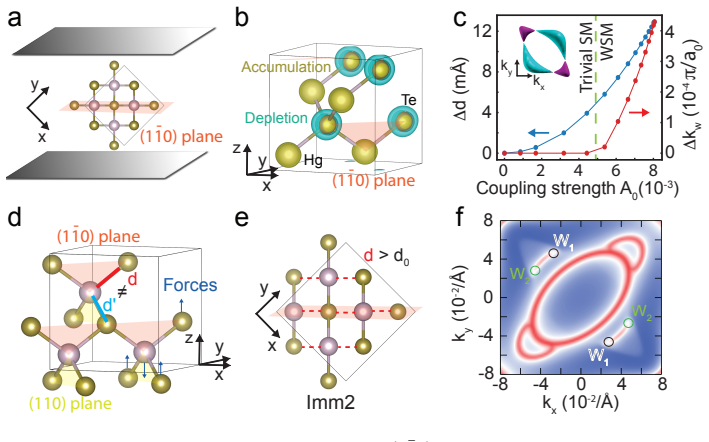
The central claim is that photon-matter hybridization, not pumping or pressure, can drive bulk HgTe through a sequence of topological phase transitions. With two cavity modes polarized parallel to the (001) plane, charge redistribution alone (no ionic motion) creates two gapless nodal lines around the Fermi level, with radius and separation growing with the coupling strength $A_0$. With two modes polarized parallel to the (1-10) plane, the same charge redistribution exerts forces that relax the lattice to space group Imm2, producing four Weyl points and Fermi arcs once $A_0 \geq 0.005$. A single waveguide mode polarized along [110] gives a $\mathbb{Z}_2=1$ topological insulator for $0.0012 \leq A_0 \leq 0.0027$, a semimetal for intermediate coupling, and a Weyl semimetal with a Cm(8) distortion for $A_0 \geq 0.0033$. The paper argues that these phases arise from self-consistent cooperation of charge and lattice modifications and do not require resonance with the photon mode.
Load-bearing premise
Everything rests on the approximate quantum description of how electrons and confined photons interact being quantitatively reliable at strong coupling, a regime where the paper gives no independent check against more exact calculations or experiment.
Editorial extensions
If this is right
- Bulk HgTe inside a cavity with mirrors parallel to (001) becomes a nodal-line semimetal whose nodal-line radius and separation grow with $A_0$, with no lattice distortion.
- Rotating the crystal so the (1-10) plane is parallel to the mirrors produces a Weyl semimetal with four Weyl points and Fermi arcs for $A_0 \geq 0.005$, driven by an Imm2 ionic distortion.
- A single waveguide mode polarized along [110] gives a three-step sequence: trivial semimetal, then a $\mathbb{Z}_2=1$ topological insulator for $0.0012 \leq A_0 \leq 0.0027$, then a semimetal, then a Weyl semimetal with a Cm(8) distortion.
- The predicted effects persist in steady state, so they could operate in devices at ambient conditions without the heating and the short lifetimes of laser-driven phases.
- The required coupling strengths are within reach of hyperbolic phonon-polariton or plasmon-polariton structures in their ground states, while two-mirror cavities would need a nonzero photon population.
Reading between the lines
- The same polarization-mediated symmetry-breaking route should apply to other zinc-blende or closely related semimetals whose topological character is symmetry-protected; a computational survey could identify additional switchable candidates.
- A direct experimental test is available: HgTe in a hyperbolic phonon-polariton waveguide at $A_0 \approx 0.0039$ should show a gap at $\Gamma$ and Fermi arcs on the (001) surface; absence of both would point to the pxLDA functional rather than the mechanism.
- If the topological-insulator window survives more accurate methods, a cavity-confined HgTe slab could serve as an optically switchable topological Josephson junction for superconducting circuits.
- The orientation dependence suggests a practical knob: rotating a single HgTe sample inside a fixed cavity would sweep through the full phase diagram, enabling in-situ topological phase switching.
Editorial analysis
A structured set of objections, weighed in public.
Referee Report
Summary. The manuscript reports first-principles QEDFT calculations for bulk HgTe coupled to confined photon modes. The authors find that, depending on the polarization orientation and coupling strength A0, the trivial semimetal HgTe becomes a nodal-line semimetal (for two in-plane cavity polarizations on the (001) plane), a Weyl semimetal (for two polarizations on the (1¯10) plane or one [110] mode), or a topological insulator (for a single mode along [110] or [111]). The phases are characterized by band structures, Z2 invariants, Weyl point positions, and Fermi arc surface states. Control calculations with fixed lattice geometry are used to separate electronic and ionic contributions. The paper also discusses the feasibility of the required couplings in different photonic environments.
Significance. If the predictions are correct, the paper would demonstrate a versatile steady-state route to multiple topological phases in a single bulk material, using only the polarization direction and coupling strength as knobs, and would be a notable application of QEDFT to topological matter. The paper has strengths: the control calculations separating electronic and ionic mechanisms, the computation of surface Fermi arcs and Z2 invariants, and an honest discussion of the difficulty of reaching strong couplings with vacuum fluctuations alone. However, the central claim is conditional on the unvalidated pxLDA electron-photon functional in the strong-coupling regime, and the abstract's vacuum-fluctuation emphasis is not matched by the feasibility caveat in the Discussion. With the requested validation and reframing, the paper could be a valuable contribution.
major comments (3)
- [Method, Eq. (2); Results, Figs. 3c and 4c] The central phase diagram is generated entirely by the pxLDA electron-photon exchange-correlation potential in Eq. (2), with no benchmark against exact QED calculations, higher-level QEDFT functionals, or experiment in the strong-coupling regime (A0 up to 0.008). The topological transitions are determined by small symmetry-lowering splittings near the Fermi level (e.g., the TI gap in Fig. 4c is at the meV scale), so an approximation error in the density dependence or gradient structure of vpxc could shift or eliminate the phases. I ask the authors to provide a sensitivity analysis of the phase boundaries with respect to the form of vpxc, a comparison against an exactly solvable model or a higher-level functional, or at least a calibration of the method on a known topological transition in HgTe (e.g., the pressure-driven transition [45]). Without such validation, the central claim is conditional on the unvalidated functional.
- [Abstract and Discussion] The abstract and introduction emphasize vacuum-fluctuation-induced effects, but the Discussion concedes that the required couplings (A0 ≥ 0.005 for the WSM in Fig. 3c and A0 ≥ 0.0033 for the WSM in Fig. 4e) are 'challenging to achieve by photon vacuum-fluctuation only' for the two-mirror Fabry-Pérot configuration and would require a pumped cavity. Since the paper's headline example, the NLSM, also uses A0 = 0.0078, the vacuum-fluctuation route is not demonstrated for any of the phases at the stated couplings. The authors should either soften the abstract's vacuum-fluctuation claim or provide a quantitative estimate, with citations, of the maximum A0 achievable for the specific hyperbolic/plasmonic structures they invoke, and show the phase boundaries for that range.
- [Method and Results, Figs. 2–4] The underlying electron-electron exchange-correlation functional is the Perdew-Wang LDA, which is not benchmarked for HgTe in this context. HgTe's topological properties are known to be sensitive to the treatment of spin-orbit coupling and the band inversion; the meV-scale photon-induced splittings reported in Fig. 4c may be within the error bar of LDA for this material. I recommend the authors add a comparison of the pristine HgTe band structure against hybrid-functional or GW results, and discuss how the uncertainty in the electron-electron xc affects the predicted phase boundaries.
minor comments (5)
- [Results, Fig. 4 caption] The caption says 'These regions with a green background stand for the semimetallic phase' but the text says 'the green boxes indicate the trivial semimetallic phase region'; please make the wording consistent.
- [Method] Please define A0 with explicit units: currently it is stated as 'λ̃/√(2ω̃) = 0.0078 in atomic Hartree unit', which is ambiguous because λ̃ and ω̃ have different dimensions in SI; clarify the unit system used for both quantities.
- [Table 1] The table layout is difficult to read in the preprint text: each row's entries are not aligned with the column headers. Please reformat the table so that the phases correspond unambiguously to the photon directions.
- [General] No data availability statement is provided, and the custom QEDFT code is not released; please add a statement about availability of code and input files, consistent with the journal's data policy.
- [References] Reference [35] is an arXiv preprint from 2023; if it has been published, please update the citation to the archival version.
Circularity Check
No significant circularity: the predicted topological phases are genuine outputs of the QEDFT Hamiltonian, not re-statements of its inputs.
full rationale
The paper's derivation chain starts from the Kohn-Sham Hamiltonian with the pxLDA electron-photon potential (Eq. 2), the HgTe crystal structure, the photon polarization direction, and a scanned light-matter coupling strength A0. The reported NLSM, WSM, and TI phases are obtained by self-consistently solving that Hamiltonian, computing charge densities, relaxing ions, and evaluating band structures and topological invariants. No parameter is fitted to the target topological phases, and the phase boundaries are read off the computed electronic structure rather than imposed. The main reliance on the authors' prior pxLDA functional [47] is a methodological self-citation, but pxLDA is a parameter-free general approximation whose assumptions do not include the HgTe topological transitions, so it constitutes independent support rather than a circular reduction. The lack of a direct benchmark against exact QED or experiment at strong coupling is a valid robustness concern, but it is a correctness risk, not a circularity. Therefore no step in the derivation reduces to its own inputs by construction.
Assumptions & free parameters
free parameters (1)
- A0 (light-matter coupling strength) =
0 to 0.008; key values 0.0027, 0.0033, 0.0039, 0.005, 0.0078
assumptions (4)
- domain assumption The QEDFT Pauli-Fierz Hamiltonian and its Kohn-Sham mapping provide the correct ground state for a solid coupled to cavity modes.
- domain assumption The pxLDA electron-photon exchange-correlation potential in Eq. (2) is quantitatively reliable at coupling strengths up to A0 = 0.008 for HgTe.
- domain assumption Cavity and waveguide photon modes can be represented as one or two uniform dressed photon modes in the long-wavelength approximation.
- domain assumption The relevant physical state is the ground state or thermal steady state of the coupled Hamiltonian, with dissipation not modeled.
Cite this review
Pith. "Pith review of Multiple Photon Field-induced Topological States in Bulk HgTe." pith.science (2026). https://pith.science/paper/3R4BW6AU
@misc{pith2026250623494,
  author       = {Pith},
  title        = {Pith review of: Multiple Photon Field-induced Topological States in Bulk HgTe},
  year         = {2026},
  howpublished = {\url{https://pith.science/paper/3R4BW6AU}},
  note         = {Machine review of arXiv:2506.23494}
}
read the original abstract
Strong light-matter interactions can be exploited to modify properties of quantum materials both in and out of thermal equilibrium. Recent studies suggest electromagnetic fields in photonic structures can hybridize with condensed matter systems, resulting in photon field-dressed collective quantum states such as charge density waves, superconductivity, and ferroelectricity. Here, we show that photon fields in photonic structures, including optical cavities and waveguides, induce emergent topological phases in solids through polarization-mediated symmetry-breaking mechanisms. Using state-of-the-art quantum electrodynamic density functional theory (QEDFT) calculations, we demonstrate that strong light-matter coupling can reconfigure both the electronic and ionic structures of HgTe, driving the system into Weyl, nodal-line, or topological insulator phases. These phases depend on the relative orientation of the sample in the photonic structures, as well as the coupling strength. Unlike previously reported laser-driven phenomena with ultrashort lifetimes, the photon field-induced symmetry breaking arises from steady-state photon-matter hybridization, enabling multiple robust topological states to emerge. Our study demonstrates that vacuum fluctuations in photonic structures can be used to engineer material properties and realize rich topological phenomena in quantum materials on demand.
Figures


Forward citations
Cited by 2 Pith papers
-
Modifying electronic and structural properties of 2D van der Waals materials via cavity quantum vacuum fluctuations: A first-principles QEDFT study
Cavity vacuum fluctuations are predicted to localize electron density along the cavity polarization, tuning band gaps, interlayer spacing, ferroelectricity, and nonlinear optical response in 2D van der Waals materials.
-
Unified ab initio quantum-electrodynamical density-functional theory for cavity-modified electron-phonon-photon coupling in solids
A QEDFT-DFPT framework computes cavity-modified band gaps, phonon dispersions, Born charges, dielectric tensors, and optical absorption in wurtzite GaN, predicting several-GHz THz signatures.
Reference graph
Works this paper leans on
-
[45]
Ruan, J. et al. Symmetry-protected ideal Weyl semimetal in HgTe-class materials. Nature Communi- cations 7, 11136 (2016). 7
work page 2016
-
[1]
N., Averitt, R
Basov, D. N., Averitt, R. D. & Hsieh, D. Towards proper- ties on demand in quantum materials. Nature Materials 16, 1077–1088 (2017)
2017
-
[2]
Rudner, M. S. & Lindner, N. H. Band structure engineer- ing and non-equilibrium dynamics in Floquet topological insulators. Nature Reviews Physics2, 229–244 (2020)
work page 2020
-
[3]
Bernevig, B. A., Hughes, T. L. & Zhang, S.-C. Quan- tum Spin Hall Effect and Topological Phase Transition in HgTe Quantum Wells. Science 314, 1757–1761 (2006)
work page 2006
-
[4]
F., Disa, A
Nova, T. F., Disa, A. S., Fechner, M. & Cavalleri, A. Metastable ferroelectricity in optically strained SrTiO 3. Science 364, 1075–1079 (2019)
2019
-
[5]
Guan, M. X., Wang, E., You, P. W., Sun, J. T. & Meng, S. Manipulating weyl quasiparticles by orbital- selective photoexcitation in WTe2. Nat. Commun. 12, 1885 (2021)
work page 2021
-
[6]
de la Torre, A. et al. Colloquium: Nonthermal pathways to ultrafast control in quantum materials. Reviews of Modern Physics 93, 041002 (2021)
work page 2021
-
[7]
et al.Cavity-mediated thermal control of metal- to-insulator transition in 1T-TaS2
Jarc, G. et al.Cavity-mediated thermal control of metal- to-insulator transition in 1T-TaS2. Nature 622, 487–492 (2023)
work page 2023
Show all 57 references
-
[8]
et al.Cavity-Altered Superconductivity (2025)
Keren, I. et al.Cavity-Altered Superconductivity (2025). URL http://arxiv.org/abs/2505.17378
2025
-
[9]
Lu, I.-T. et al. Cavity-enhanced superconductivity in MgB 2 from first-principles quantum electrodynamics (QEDFT). Proceedings of the National Academy of Sci- ences 121, e2415061121 (2024)
2024
-
[10]
Sie, E. J. et al. An ultrafast symmetry switch in a Weyl semimetal. Nature 565, 61–66 (2019)
2019
-
[11]
& Tang, P
Shin, D., Rubio, A. & Tang, P. Light-Induced Ideal Weyl Semimetal in HgTe via Nonlinear Phononics. Physical Review Letters 132, 016603 (2024)
2024
-
[12]
Vaswani, C. et al. Light-Driven Raman Coherence as a Nonthermal Route to Ultrafast Topology Switching in a Dirac Semimetal. Physical Review X10, 021013 (2020)
2020
-
[13]
McIver, J. W. et al. Light-induced anomalous Hall effect in graphene. Nature Physics 16, 38–41 (2020)
2020
-
[14]
S., Nova, T
Disa, A. S., Nova, T. F. & Cavalleri, A. Engineering crystal structures with light. Nature Physics 17, 1087– 1092 (2021). 6
2021
-
[15]
Zhou, S. et al. Pseudospin-selective Floquet band engi- neering in black phosphorus. Nature 614, 75–80 (2023)
2023
-
[16]
& Zhou, S
Bao, C., Tang, P., Sun, D. & Zhou, S. Light-induced emergent phenomena in 2D materials and topological materials. Nature Reviews Physics4, 33–48 (2022)
2022
-
[17]
Zhou, S. et al. Floquet Engineering of Black Phosphorus upon Below-Gap Pumping. Physical Review Letters131, 116401 (2023)
2023
-
[18]
& Tang, P
Fan, B., Duan, W., Rubio, A. & Tang, P. Chiral Floquet engineering on topological fermions in chiral crystals. npj Quantum Materials 9, 101 (2024)
2024
-
[19]
& Rubio, A
Bloch, J., Cavalleri, A., Galitski, V., Hafezi, M. & Rubio, A. Strongly correlated electron–photon systems. Nature 606, 41–48 (2022)
2022
-
[20]
Torre, A. d. l. et al. Colloquium: Nonthermal pathways to ultrafast control in quantum materials. Reviews of Modern Physics 93, 041002 (2021)
2021
-
[21]
Latini, S. et al. The ferroelectric photo ground state of SrTiO3: Cavity materials engineering. Proc. Natl. Acad. Sci. USA 118, e2105618118 (2021)
2021
-
[22]
et al.Cavity engineering of solid-state materials without external driving
Lu, I.-T. et al.Cavity engineering of solid-state materials without external driving. Adv. Opt. Photon.17, 441–525 (2025)
2025
-
[23]
Herzig Sheinfux, H. et al. High-quality nanocavities through multimodal confinement of hyperbolic polari- tons in hexagonal boron nitride. Nat. Mater.23, 499–505 (2024)
2024
-
[24]
& Kennes, D
Weber, L., Vi˜ nas Bostr¨ om, E., Claassen, M., Rubio, A. & Kennes, D. M. Cavity-renormalized quantum criticality in a honeycomb bilayer antiferromagnet. Communica- tions Physics 6, 247 (2023)
2023
-
[25]
& Nori, F
Dong, X.-L., Li, P.-B., Gong, Z. & Nori, F. Waveguide QED with dissipative light-matter couplings. Physical Review Research7, L012036 (2025)
2025
-
[26]
Jin, X. et al. Reshaping the phonon energy landscape of nanocrystals inside a terahertz plasmonic nanocavity. Nature Communications 9, 763 (2018)
2018
-
[27]
Stern, H. L. et al.A quantum coherent spin in hexagonal boron nitride at ambient conditions. Nature Materials 23, 1379–1385 (2024)
2024
-
[28]
T., Singh, A
Hugall, J. T., Singh, A. & van Hulst, N. F. Plasmonic Cavity Coupling. ACS Photonics 5, 43–53 (2018)
2018
-
[29]
& Solano, E
Forn-D ´ ıaz, P., Lamata, L., Rico, E., Kono, J. & Solano, E. Ultrastrong coupling regimes of light-matter interac- tion. Reviews of Modern Physics91, 025005 (2019)
2019
-
[30]
J., Ciuti, C
Garcia-Vidal, F. J., Ciuti, C. & Ebbesen, T. W. Ma- nipulating matter by strong coupling to vacuum fields. Science 373, eabd0336 (2021)
2021
-
[31]
Enkner, J. et al. Tunable vacuum-field control of frac- tional and integer quantum Hall phases. Nature 641, 884–889 (2025)
2025
-
[32]
Thermal Purcell effect and cavity-induced renormalization of dissipations
Chiriac` o, G. Thermal Purcell effect and cavity-induced renormalization of dissipations. Physical Review B110, L161107 (2024)
2024
-
[33]
& Yuen-Zhou, J
Pannir-Sivajothi, S. & Yuen-Zhou, J. Blackbody Radi- ation and Thermal Effects on Chemical Reactions and Phase Transitions in Cavities. ACS Nano19, 9896–9905 (2025)
2025
-
[34]
& Rubio, A
Sch¨ afer, C., Flick, J., Ronca, E., Narang, P. & Rubio, A. Shining light on the microscopic resonant mechanism re- sponsible for cavity-mediated chemical reactivity.Nature Communications 13, 7817 (2022)
2022
-
[35]
Svendsen, M. K. et al. Theory of Quantum Light-Matter Interaction in Cavities: Extended Systems and the Long Wavelength Approximation (2023). URL arxiv.org/ abs/2312.17374
2023 arXiv
-
[36]
& Rubio, A
Ruggenthaler, M., Sidler, D. & Rubio, A. Understanding Polaritonic Chemistry from Ab Initio Quantum Electro- dynamics. Chemical Reviews 123, 11191–11229 (2023)
2023
-
[37]
& Rubio, A
Sidler, D., Ruggenthaler, M., Sch¨ afer, C., Ronca, E. & Rubio, A. A perspective on ab initio modeling of polari- tonic chemistry: The role of non-equilibrium effects and quantum collectivity. The Journal of Chemical Physics 156, 230901 (2022)
2022
-
[38]
& Rubio, A
Flick, J., Ruggenthaler, M., Appel, H. & Rubio, A. Atoms and molecules in cavities, from weak to strong coupling in quantum-electrodynamics (QED) chemistry. Proceedings of the National Academy of Sciences114, 3026–3034 (2017)
2017
-
[39]
& Olejn ´ ık, K
Jungwirth, T., Wunderlich, J. & Olejn ´ ık, K. Spin Hall effect devices. Nature Materials 11, 382–390 (2012)
2012
-
[40]
Quantum, M. A. et al. Interferometric single-shot parity measurement in inas–al hybrid devices.Nature 638, 651– 655 (2025)
2025
-
[41]
Nadj-Perge, S. et al. Observation of majorana fermions in ferromagnetic atomic chains on a superconductor. Sci- ence 346, 602–607 (2014)
2014
-
[42]
& Rubio, A
Sch¨ afer, C., Buchholz, F., Penz, M., Ruggenthaler, M. & Rubio, A. Making ab initio QED functional(s): Non- perturbative and photon-free effective frameworks for strong light–matter coupling. Proceedings of the National Academy of Sciences118, e2110464118 (2021)
2021
-
[43]
Ruggenthaler, M. et al. Quantum-electrodynamical density-functional theory: Bridging quantum optics and electronic-structure theory. Physical Review A 90, 012508 (2014)
2014
-
[44]
De Oliveira, R. E. P. & De Matos, C. J. S. Graphene based waveguide polarizers: In-depth physical analysis and relevant parameters. Sci Rep 5, 16949 (2014)
2014
-
[46]
Quantum spin hall insulator state in HgTe quantum wells
K¨ onig, M.et al. Quantum spin hall insulator state in HgTe quantum wells. Science 318, 766–770 (2007)
2007
-
[47]
Lu, I.-T. et al. Electron-photon exchange-correlation approximation for quantum-electrodynamical density- functional theory. Phys. Rev. A109, 052823 (2024)
2024
-
[48]
Kim, T. et al. Fabry–Perot Cavity Control for Tunable Raman Scattering. Small 19, 2207003 (2023)
2023
-
[49]
Li, Z. et al. Fabry-perot resonance modes in a mos 2- based vertical stacking cavity for light-matter coupling and topological phase singularity. Physical Review B 111, 205414 (2025)
2025
-
[50]
Huang, X. et al. Fabry-Perot cavity enhanced light- matter interactions in two-dimensional van der Waals heterostructure. Nano Energy 62, 667–673 (2019)
2019
-
[51]
et al.Cavity Floquet engineering
Zhou, L. et al.Cavity Floquet engineering. Nature Com- munications 15, 7782 (2024)
2024
-
[52]
V., Svendsen, M
Grunwald, L., Bostr¨ om, E. V., Svendsen, M. K., Kennes, D. M. & Rubio, A. Cavity Spectroscopy for Strongly Correlated Polaritonic Systems. Physical Review Letters 134, 246901 (2025)
2025
-
[53]
& Fausti, D
Fassioli, F., Faist, J., Eckstein, M. & Fausti, D. Control- ling radiative heat flow through cavity electrodynamics. arXiv (2024). URL arxiv.org/abs/2403.00851
2024 arXiv
-
[54]
Giannozzi, P. et al. Advanced capabilities for materials modelling with quantum espresso. Journal of Physics: Condensed Matter 29, 465901 (2017)
2017
-
[55]
Perdew, J. P. & Wang, Y. Accurate and simple ana- lytic representation of the electron-gas correlation en- ergy. Phys. Rev. B45, 13244–13249 (1992)
1992
-
[56]
et al.Wannier90 as a community code: new fea- tures and applications
Pizzi, G. et al.Wannier90 as a community code: new fea- tures and applications. Journal of Physics: Condensed Matter 32, 165902 (2020)
2020
-
[57]
CUI: Advanced Imaging of Matter
Wu, Q., Zhang, S., Song, H.-F., Troyer, M. & Soluyanov, A. A. WannierTools: An open-source software package for novel topological materials. Computer Physics Com- munications 224, 405–416 (2018). Acknowledgments We acknowledge support by the Max Planck Institute New York City ...
2018
Reviewed August 6, 2026 · model on record in the stance chip above.
Discussion (0). Sign in to comment.