REVIEW 4 major objections 7 minor 51 references
WAVE: Warp-Based View Guidance for Consistent Novel View Synthesis Using a Single Image
T0 review · 4 major / 7 minor · reviewed 2026-08-06 · deepseek-v4-flash
Pith's one-line read WAVE is a training-free method that improves view consistency in single-image novel view synthesis by warping the input view and using the warps to guide attention and reinitialize noise.
desk verdict A useful training-free consistency booster for diffusion NVS, with real gains on ground-truth and 3D-reconstruction metrics, but the self-introduced COLMAP/LPIPS evaluation needs transparency fixes before the headline numbers can be trusted. read the letter →
The pith
A machine-rendered reading of the paper's core claim, the machinery that carries it, and where it could break.
The reading
What carries the argument
The load-bearing object is the warped image set $\{W_1,\ldots,W_N\}$ obtained by 3D warping the input view with its depth to the target camera poses. From this set the method derives binary warped region masks $M$, a viewpoint-overlap IoU matrix $U$, and the reference range $[\mu_i-\sigma_i,\mu_i+\sigma_i]$ for each view, where $\mu_i$ and $\sigma_i$ are the mean and standard deviation of the IoU values for view $i$. Warp-guided adaptive attention (WGAA) multiplies the softmax attention map by the mask before aggregating values, so each generated view borrows features only from viewpoints whose warped regions overlap it; pose-aware noise initialization (PANI) fills the warped holes with noise, encodes the warped images, runs a DDPM forward step, extracts normalized low-frequency components, and adds back high-frequency randomness from fresh noise. These two mechanisms inject the same geometric prior once at the attention level and once at the noise level.
What would settle it
Generate an orbit around a known synthetic scene with ground-truth depth and large pose steps such as 60 degrees, run WAVE, and compare LPIPS-next, CLIPSIM-next, and rotation-angle error against the base model and against a variant that masks attention with the true warped regions; if WAVE does not beat the base model, or if visual attention-map peaks do not track the warped region masks at those large baselines, the spatial-correspondence assumption is falsified.
Extended reading notes
Core claim
The paper's central claim is that diffusion models trained for novel view synthesis fail at view consistency because they generate each viewpoint independently and because noise randomness perturbs appearance, and that both failures can be repaired by injecting geometry from a 3D warp of the input view. Warp-guided adaptive attention computes binary masks of the regions visible after warping, measures inter-view overlap with an IoU matrix, picks an adaptive reference range per view, and masks the decoder's batch self-attention so each generated view borrows features only from overlapping views. Pose-aware noise initialization fills warped-image holes with noise, encodes the warped images, runs a DDPM forward step, extracts normalized low-frequency components, and combines them with the high-frequency part of fresh noise. The paper argues that these two mechanisms make generated views more coherent with each other and with the input, and supports the claim with consistency metrics, camera-pose accuracy, and a 3D-rendering downstream evaluation across datasets and diffusion models.
Load-bearing premise
The method depends on the decoder attention of the diffusion U-Net preserving spatial position correspondence, so that the image-space masks from warping line up with the attention maps; if that correspondence breaks, especially under large viewpoint changes, the masks would hide the features that should be shared and the consistency gain would vanish.
Editorial extensions
If this is right
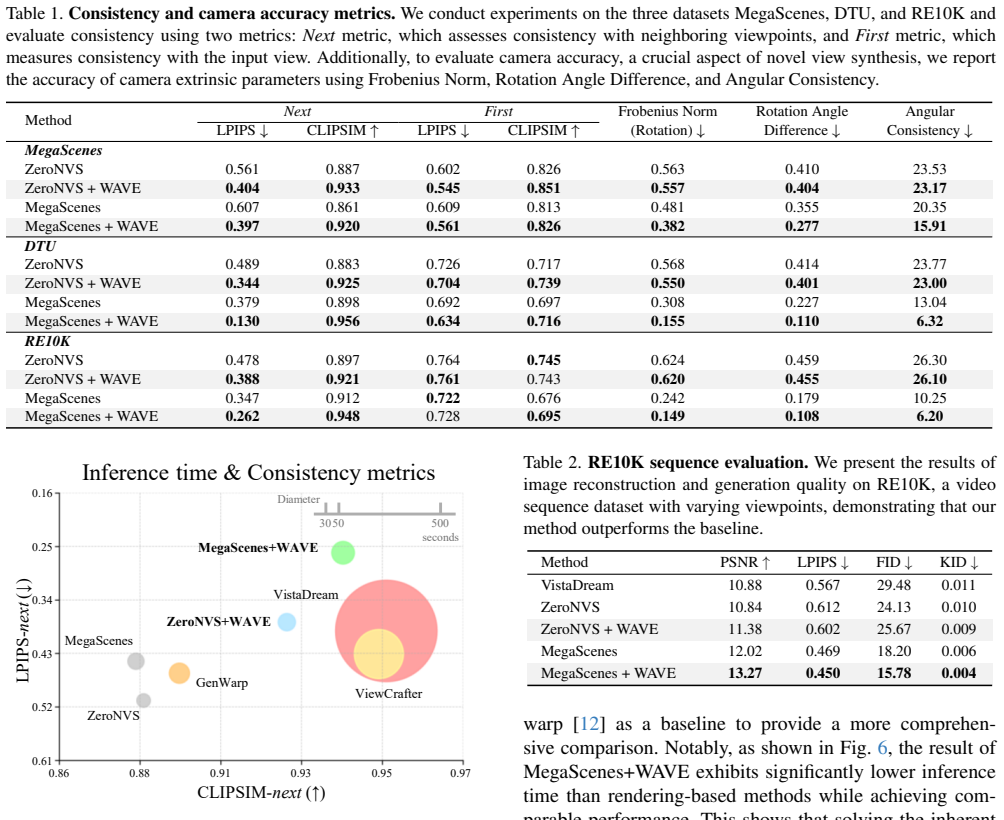
- Applied to either MegaScenes or ZeroNVS, WAVE lowers LPIPS-next and raises CLIPSIM-next, so neighboring generated views become visually closer while the set stays aligned with the input view.
- Camera rotation errors (Frobenius norm, rotation angle difference, and angular consistency) decrease, meaning the generated set reads as a coherent camera trajectory rather than unrelated images.
- Feeding WAVE-generated images to 3D Gaussian splatting improves rendered PSNR and SSIM over the base model's images, so view consistency directly helps 3D reconstruction from a single image.
- Because the method is training-free and adds no modules, existing single-image diffusion models can adopt it without changing weights and with only the warp operation as extra inference overhead.
Reading between the lines
- An extension the paper leaves implicit is that the same warp-mask recipe would likely transfer to other attention-based generative models whose decoder self-attention preserves spatial correspondence, potentially covering multi-view object generation or camera-conditioned video.
- Since PANI only injects low-frequency structure, the paper's results imply that a large share of observed view inconsistency is a low-frequency phenomenon in color and layout rather than in high-frequency detail; directly measuring the frequency profile of consistency errors would test this.
- A testable extension is the paper's suggested autoregressive strategy: generate a nearby view range, warp from those generated views, and repeat; if it removes the large-baseline degradation, it would make the method practical for full 360-degree orbits.
- The method tolerates degraded depth estimates, since the paper reports that using smaller Depth Anything models changes consistency only slightly, suggesting the warp prior does not need to be pixel-perfect to improve consistency.
Editorial analysis
A structured set of objections, weighed in public.
Referee Report
Summary. The paper proposes WAVE, a training-free plug-in for single-image novel view synthesis diffusion models. WAVE consists of two components: warp-guided adaptive attention (WGAA), which applies warped-region masks to batch self-attention over adaptively selected reference views, and pose-aware noise initialization (PANI), which re-initializes the diffusion noise with low-frequency content of warped target views. The authors also introduce a view-consistency metric framework combining video-style LPIPS/CLIP similarity between adjacent/input views with COLMAP-based camera pose accuracy. Experiments are conducted on MegaScenes, DTU, RE10K, and Mip-NeRF 360, using MegaScenes and ZeroNVS as base diffusion models, with a 3D Gaussian Splatting downstream task and ablations. The headline claim is that WAVE improves view consistency across different diffusion models at roughly constant inference cost.
Significance. If the results hold, WAVE would offer a low-cost, model-agnostic way to improve consistency in single-image novel view synthesis without retraining or added modules. The paper has clear strengths: the method is training-free, the ablation study isolates the two components, the downstream 3D rendering experiment provides an independent use case, and a project page with code is provided. However, the evaluation is weakened by the use of self-introduced metrics that are not externally validated, an ad hoc COLMAP pose penalty, and several supplementary numbers that contradict the paper's broad claims of improved image quality. The significance is therefore conditional: the core idea is novel and plausible, but the evidence as presented does not yet establish that the gains represent true 3D view consistency rather than shared low-frequency appearance.
major comments (4)
- [Section 4.1 and Supp. C] The LPIPS-next/CLIPSIM-next metrics are not established view-consistency metrics, and PANI (Algorithm 1) injects the low-frequency component of each warped image into the initial noise of its corresponding target view. As a result, adjacent generated views are initialized to share low-frequency content by construction, and LPIPS/CLIP are known to be strongly influenced by low-frequency structure. The reported gains may therefore reflect this shared initialization rather than 3D-consistent geometry across viewpoints. No external validation of the metric framework on novel-view synthesis data is provided, and no error bars or significance tests are reported. This directly affects the central claim that WAVE improves view consistency.
- [Supp. D.2] The COLMAP pose-accuracy penalty is ad hoc. The text states that when COLMAP reconstructs only 2 of 19 cameras, the available poses are duplicated to 19 before computing Frobenius Norm, Rotation Angle Difference, and Angular Consistency. The frequency of such truncation is not reported per method, so the reader cannot determine how much of the pose-accuracy improvement is driven by this penalty. The authors themselves acknowledge that the duplication approach 'may not be suitable for all scenarios,' yet these metrics are central to Table 1 and to the camera-accuracy claims.
- [Supp. Table 5 vs. Section 4.1] The claim that WAVE 'improves performance over the baseline methods across overall metrics' is contradicted by several entries in Supp. Table 5. For example, on RE10K, MegaScenes+WAVE has SSIM 0.261 vs. 0.309 and LPIPS 0.516 vs. 0.494, both worse than MegaScenes; on the MegaScenes dataset, FID worsens from 13.55 to 15.03; and on Mip-NeRF 360, KID worsens from 0.009 to 0.011. Table 2 likewise shows ZeroNVS+WAVE FID worsening from 24.13 to 25.67. These inconsistencies must be resolved, and the image-quality claims need to be qualified accordingly.
- [Section 3.3 and Supp. B.1] WGAA relies on the assumption that the decoder self-attention preserves spatial position correspondence, so that image-space warped-region masks can be applied directly to attention maps. The only support is a qualitative attention-map visualization (Fig. 9), and the Limitations section admits sensitivity to large viewpoint changes. A quantitative validation of this assumption is needed, for example by measuring the alignment between attention maps and warped-region masks over varying viewpoint distances, or by ablating WGAA under large viewpoint changes. As written, a reader cannot tell whether WGAA's mechanism is responsible for the reported gains or whether those gains arise primarily from PANI.
minor comments (7)
- [Algorithm 1] The note in Algorithm 1 uses G(D0) but D0 is not defined; it should be G(D), the Gaussian filter applied to the input depth map.
- [Supp. E.1] The text contains a typo 'key-vale pairs'; it should be 'key-value pairs'.
- [Section 4.1] There is a missing space in 'VistaDream[42] and Viewcrafter[47]'; the bracket should follow a space after the model name.
- [Figure 4] The labels in Figure 4, especially in part (a), are cluttered and hard to read; please enlarge or reorganize the annotation.
- [Supp. D.1] The statement that varying the dropout ratio causes 'no significant performance changes' is not supported by any reported experiment; either add the ablation or remove the claim.
- [Supp. C.2] In the Frobenius Norm definition, the matrix A whose entries aij are used is not explicitly defined as the difference between estimated and ground-truth extrinsic matrices; please clarify the notation.
- [Supp. D.4] The RE10K sequence evaluation uses only 6 target views per video; the total number of evaluation videos and whether FID/KID are pooled across all frames should be stated.
Circularity Check
No significant circularity: WAVE's consistency gains come from externally cited geometric and noise-initialization priors applied to task inputs, not from fitting or self-citation.
full rationale
WAVE's derivation chain is self-contained. WGAA (Section 3.3) and PANI (Section 3.4, Algorithm 1) are defined directly on the task inputs—input view, depth map, and target camera poses—via 3D warping, and the reported metrics are computed on the generated outputs against external baselines (ZeroNVS, MegaScenes, VistaDream), with RE10K additionally evaluated against ground-truth frames. No parameter is fitted to the evaluation metrics, and no load-bearing claim rests on a self-citation: the low-frequency noise-initialization idea is credited to prior external work [24,44], and the attention-masking concept is credited to [38,51]. The WGAA spatial-correspondence assumption is an empirical hypothesis validated qualitatively in Supp. B.1, not an assumption that includes the target result. The main risk is metric validity—PANI injects warped-image low-frequency content into every generated sample, which can inflate LPIPS-next, and the COLMAP duplication penalty in Supp. D.2 is ad hoc—but these are evaluation concerns, not circular derivation. The central claim is therefore not equivalent to its inputs by construction.
Assumptions & free parameters
free parameters (3)
- attention dropout ratio =
0.2
- DDPM noise level for noise initialization =
950
- Gaussian low-pass filter parameters =
not specified (borrowed from FreeInit/ConsistI2V)
assumptions (5)
- domain assumption Decoder self-attention preserves spatial position correspondence, so image-space warp masks can be applied directly to attention maps.
- domain assumption 3D warped region masks computed from monocular depth and target poses measure true viewpoint overlap.
- domain assumption Low-frequency components of warped latents can be replaced or mixed with high-frequency noise without harming generation fidelity.
- domain assumption COLMAP rotation estimates on generated images are a valid proxy for view consistency.
- standard math Standard FFT/IFFT, Gaussian filtering, and attention softmax behave as expected.
Cite this review
Pith. "Pith review of WAVE: Warp-Based View Guidance for Consistent Novel View Synthesis Using a Single Image." pith.science (2026). https://pith.science/paper/TZDQ3GWU
@misc{pith2026250623518,
  author       = {Pith},
  title        = {Pith review of: WAVE: Warp-Based View Guidance for Consistent Novel View Synthesis Using a Single Image},
  year         = {2026},
  howpublished = {\url{https://pith.science/paper/TZDQ3GWU}},
  note         = {Machine review of arXiv:2506.23518}
}
read the original abstract
Generating high-quality novel views of a scene from a single image requires maintaining structural coherence across different views, referred to as view consistency. While diffusion models have driven advancements in novel view synthesis, they still struggle to preserve spatial continuity across views. Diffusion models have been combined with 3D models to address the issue, but such approaches lack efficiency due to their complex multi-step pipelines. This paper proposes a novel view-consistent image generation method which utilizes diffusion models without additional modules. Our key idea is to enhance diffusion models with a training-free method that enables adaptive attention manipulation and noise reinitialization by leveraging view-guided warping to ensure view consistency. Through our comprehensive metric framework suitable for novel-view datasets, we show that our method improves view consistency across various diffusion models, demonstrating its broader applicability.
Figures


Figures from the paper (13 more)




Reference graph
Works this paper leans on
-
[1]
Large-scale data for multiple-view stereopsis
Henrik Aanæs, Rasmus Ramsbøl Jensen, George V ogiatzis, Engin Tola, and Anders Bjorholm Dahl. Large-scale data for multiple-view stereopsis. International Journal of Computer Vision, pages 1–16, 2016. 5, 8, 15
work page 2016
-
[2]
Mip-nerf 360: Unbounded anti-aliased neural radiance fields
Jonathan T Barron, Ben Mildenhall, Dor Verbin, Pratul P Srinivasan, and Peter Hedman. Mip-nerf 360: Unbounded anti-aliased neural radiance fields. In Proceedings of the IEEE/CVF conference on computer vision and pattern recognition, pages 5470–5479, 2022. 5, 8, 15
work page 2022
-
[3]
Consistent diffusion models: Mitigating sampling drift by learning to be consistent.Advances in Neu- ral Information Processing Systems, 36, 2024
Giannis Daras, Yuval Dagan, Alex Dimakis, and Constanti- nos Daskalakis. Consistent diffusion models: Mitigating sampling drift by learning to be consistent.Advances in Neu- ral Information Processing Systems, 36, 2024. 3
2024
-
[4]
Objaverse-xl: A universe of 10m+ 3d objects
Matt Deitke, Ruoshi Liu, Matthew Wallingford, Huong Ngo, Oscar Michel, Aditya Kusupati, Alan Fan, Christian Laforte, Vikram V oleti, Samir Yitzhak Gadre, et al. Objaverse-xl: A universe of 10m+ 3d objects. Advances in Neural Informa- tion Processing Systems, 36, 2024. 2
work page 2024
-
[5]
Cat3d: Create anything in 3d with multi-view diffusion models
Ruiqi Gao, Aleksander Holynski, Philipp Henzler, Arthur Brussee, Ricardo Martin-Brualla, Pratul Srinivasan, Jonathan T Barron, and Ben Poole. Cat3d: Create anything in 3d with multi-view diffusion models. arXiv preprint arXiv:2405.10314, 2024. 1
arXiv 2024
-
[6]
Nerfdiff: Single-image view synthesis with nerf-guided dis- tillation from 3d-aware diffusion
Jiatao Gu, Alex Trevithick, Kai-En Lin, Joshua M Susskind, Christian Theobalt, Lingjie Liu, and Ravi Ramamoorthi. Nerfdiff: Single-image view synthesis with nerf-guided dis- tillation from 3d-aware diffusion. In International Con- ference on Machine Learning, pages 11808–11826. PMLR,
-
[7]
Sparsectrl: Adding sparse controls to text-to-video diffusion models
Yuwei Guo, Ceyuan Yang, Anyi Rao, Maneesh Agrawala, Dahua Lin, and Bo Dai. Sparsectrl: Adding sparse controls to text-to-video diffusion models. In European Conference on Computer Vision, pages 330–348. Springer, 2024. 2, 12, 13
work page 2024
-
[8]
Prompt-to-prompt im- age editing with cross attention control
Amir Hertz, Ron Mokady, Jay Tenenbaum, Kfir Aberman, Yael Pritch, and Daniel Cohen-Or. Prompt-to-prompt im- age editing with cross attention control. arXiv preprint arXiv:2208.01626, 2022. 2, 3, 5
arXiv 2022
Show all 51 references
-
[9]
Clipscore: A reference-free evaluation met- ric for image captioning
Jack Hessel, Ari Holtzman, Maxwell Forbes, Ronan Le Bras, and Yejin Choi. Clipscore: A reference-free evaluation met- ric for image captioning. arXiv preprint arXiv:2104.08718,
-
[10]
Videobooth: Diffusion-based video generation with image prompts
Yuming Jiang, Tianxing Wu, Shuai Yang, Chenyang Si, Dahua Lin, Yu Qiao, Chen Change Loy, and Ziwei Liu. Videobooth: Diffusion-based video generation with image prompts. In Proceedings of the IEEE/CVF Conference on Computer Vision and Pattern Recognition , pages 6689– 6700, 2024. 3
2024
-
[11]
3d gaussian splatting for real-time radiance field rendering
Bernhard Kerbl, Georgios Kopanas, Thomas Leimk ¨uhler, and George Drettakis. 3d gaussian splatting for real-time radiance field rendering. ACM Transactions on Graphics, 42 (4), 2023. 1, 2, 8, 16
2023
-
[12]
Genwarp: Single image to novel views with semantic-preserving generative warping
Seungryong Kim. Genwarp: Single image to novel views with semantic-preserving generative warping. In 38th Con- ference on Neural Information Processing Systems Work- shop, NeurIPS 2024. Neural information processing systems foundation, 2024. 2, 3, 6
2024
-
[13]
Vivid-1-to-3: Novel view synthesis with video diffusion models
Jeong-gi Kwak, Erqun Dong, Yuhe Jin, Hanseok Ko, Shweta Mahajan, and Kwang Moo Yi. Vivid-1-to-3: Novel view synthesis with video diffusion models. In Proceedings of the IEEE/CVF Conference on Computer Vision and Pattern Recognition, pages 6775–6785, 2024. 2, 5
2024
-
[14]
Infinitenature-zero: Learning perpetual view gen- eration of natural scenes from single images
Zhengqi Li, Qianqian Wang, Noah Snavely, and Angjoo Kanazawa. Infinitenature-zero: Learning perpetual view gen- eration of natural scenes from single images. In European Conference on Computer Vision , pages 515–534. Springer,
-
[15]
Infinite na- ture: Perpetual view generation of natural scenes from a sin- gle image
Andrew Liu, Richard Tucker, Varun Jampani, Ameesh Makadia, Noah Snavely, and Angjoo Kanazawa. Infinite na- ture: Perpetual view generation of natural scenes from a sin- gle image. In Proceedings of the IEEE/CVF International Conference on Computer Vision, pages 14458–14467, 2021. 2, 3
2021
-
[16]
Zero-1-to- 3: Zero-shot one image to 3d object
Ruoshi Liu, Rundi Wu, Basile Van Hoorick, Pavel Tok- makov, Sergey Zakharov, and Carl V ondrick. Zero-1-to- 3: Zero-shot one image to 3d object. In Proceedings of the IEEE/CVF international conference on computer vision, pages 9298–9309, 2023. 2
2023
-
[17]
Wonder3d: Sin- gle image to 3d using cross-domain diffusion
Xiaoxiao Long, Yuan-Chen Guo, Cheng Lin, Yuan Liu, Zhiyang Dou, Lingjie Liu, Yuexin Ma, Song-Hai Zhang, Marc Habermann, Christian Theobalt, et al. Wonder3d: Sin- gle image to 3d using cross-domain diffusion. In Proceed- ings of the IEEE/CVF conference on computer vision and pa...
2024
-
[18]
Improving text- to-image consistency via automatic prompt optimization
Oscar Ma ˜nas, Pietro Astolfi, Melissa Hall, Candace Ross, Jack Urbanek, Adina Williams, Aishwarya Agrawal, Adri- ana Romero-Soriano, and Michal Drozdzal. Improving text- to-image consistency via automatic prompt optimization. arXiv preprint arXiv:2403.17804, 2024. 3
2024 arXiv
-
[19]
Post- rendering 3d warping
William R Mark, Leonard McMillan, and Gary Bishop. Post- rendering 3d warping. In Proceedings of the 1997 sympo- sium on Interactive 3D graphics, pages 7–ff, 1997. 2, 3
1997
-
[20]
Srinivasan, Matthew Tancik, Jonathan T
Ben Mildenhall, Pratul P. Srinivasan, Matthew Tancik, Jonathan T. Barron, Ravi Ramamoorthi, and Ren Ng. Nerf: Representing scenes as neural radiance fields for view syn- thesis. In ECCV, 2020. 1
2020
-
[21]
Multidiff: Consistent novel view synthesis from a single image
Norman M ¨uller, Katja Schwarz, Barbara R ¨ossle, Lorenzo Porzi, Samuel Rota Bul `o, Matthias Nießner, and Peter Kontschieder. Multidiff: Consistent novel view synthesis from a single image. In Proceedings of the IEEE/CVF Con- ference on Computer Vision and Pattern Recognition...
2024
-
[22]
Instant neural graphics primitives with a mul- tiresolution hash encoding
Thomas M ¨uller, Alex Evans, Christoph Schied, and Alexan- der Keller. Instant neural graphics primitives with a mul- tiresolution hash encoding. ACM transactions on graphics (TOG), 41(4):1–15, 2022. 15
2022
-
[23]
Com- mon objects in 3d: Large-scale learning and evaluation of real-life 3d category reconstruction
Jeremy Reizenstein, Roman Shapovalov, Philipp Henzler, Luca Sbordone, Patrick Labatut, and David Novotny. Com- mon objects in 3d: Large-scale learning and evaluation of real-life 3d category reconstruction. In Proceedings of the IEEE/CVF international conference on computer vi...
2021
-
[24]
Consisti2v: Enhancing visual consistency for image-to-video generation
Weiming Ren, Huan Yang, Ge Zhang, Cong Wei, Xinrun Du, Wenhao Huang, and Wenhu Chen. Consisti2v: Enhancing visual consistency for image-to-video generation. Transac- tions on Machine Learning Research. 2, 3, 5, 14, 17
-
[25]
Generalized in- tersection over union: A metric and a loss for bounding box regression
Hamid Rezatofighi, Nathan Tsoi, JunYoung Gwak, Amir Sadeghian, Ian Reid, and Silvio Savarese. Generalized in- tersection over union: A metric and a loss for bounding box regression. In Proceedings of the IEEE/CVF conference on computer vision and pattern recognition , pages 658–666,
-
[26]
High-resolution image synthesis with latent diffusion models
Robin Rombach, Andreas Blattmann, Dominik Lorenz, Patrick Esser, and Bj ¨orn Ommer. High-resolution image synthesis with latent diffusion models. In Proceedings of the IEEE/CVF conference on computer vision and pattern recognition, pages 10684–10695, 2022. 3
2022
-
[27]
Diffusion models with learned adap- tive noise
Subham Sekhar Sahoo, Aaron Gokaslan, Chris De Sa, and V olodymyr Kuleshov. Diffusion models with learned adap- tive noise. arXiv preprint arXiv:2312.13236, 2023. 2, 5
2023 arXiv
-
[28]
Zeronvs: Zero-shot 360- degree view synthesis from a single image
Kyle Sargent, Zizhang Li, Tanmay Shah, Charles Herrmann, Hong-Xing Yu, Yunzhi Zhang, Eric Ryan Chan, Dmitry La- gun, Li Fei-Fei, Deqing Sun, et al. Zeronvs: Zero-shot 360- degree view synthesis from a single image. In Proceedings of the IEEE/CVF Conference on Computer Vision a...
2024
-
[29]
Structure-from-motion revisited
Johannes Lutz Sch ¨onberger and Jan-Michael Frahm. Structure-from-motion revisited. In Conference on Com- puter Vision and Pattern Recognition (CVPR), 2016. 15, 16
2016
-
[30]
Pixelwise view selection for un- structured multi-view stereo
Johannes Lutz Sch ¨onberger, Enliang Zheng, Marc Pollefeys, and Jan-Michael Frahm. Pixelwise view selection for un- structured multi-view stereo. In European Conference on Computer Vision (ECCV), 2016. 15, 16
2016
-
[31]
Let 2d diffusion model know 3d- consistency for robust text-to-3d generation
Junyoung Seo, Wooseok Jang, Min-Seop Kwak, Hyeonsu Kim, Jaehoon Ko, Junho Kim, Jin-Hwa Kim, Jiyoung Lee, and Seungryong Kim. Let 2d diffusion model know 3d- consistency for robust text-to-3d generation. arXiv preprint arXiv:2303.07937, 2023. 8
2023 arXiv
-
[32]
Zero123++: a single image to consistent multi-view dif- fusion base model, 2023
Ruoxi Shi, Hansheng Chen, Zhuoyang Zhang, Minghua Liu, Chao Xu, Xinyue Wei, Linghao Chen, Chong Zeng, and Hao Su. Zero123++: a single image to consistent multi-view dif- fusion base model, 2023. 2
2023
-
[33]
Mvdream: Multi-view diffusion for 3d gen- eration, 2024
Yichun Shi, Peng Wang, Jianglong Ye, Mai Long, Kejie Li, and Xiao Yang. Mvdream: Multi-view diffusion for 3d gen- eration, 2024. 8
2024
-
[34]
Realmdreamer: Text-driven 3d scene generation with inpainting and depth diffusion
Jaidev Shriram, Alex Trevithick, Lingjie Liu, and Ravi Ra- mamoorthi. Realmdreamer: Text-driven 3d scene generation with inpainting and depth diffusion. 2025. 2, 3
2025
-
[35]
Very deep convolutional networks for large-scale image recognition
Karen Simonyan. Very deep convolutional networks for large-scale image recognition. arXiv preprint arXiv:1409.1556, 2014. 12
2014 arXiv
-
[36]
Denois- ing diffusion implicit models, 2022
Jiaming Song, Chenlin Meng, and Stefano Ermon. Denois- ing diffusion implicit models, 2022. 12
2022
-
[37]
Dreamgaussian: Generative gaussian splatting for effi- cient 3d content creation
Jiaxiang Tang, Jiawei Ren, Hang Zhou, Ziwei Liu, and Gang Zeng. Dreamgaussian: Generative gaussian splatting for effi- cient 3d content creation. arXiv preprint arXiv:2309.16653,
-
[38]
Training-free consis- tent text-to-image generation
Yoad Tewel, Omri Kaduri, Rinon Gal, Yoni Kasten, Lior Wolf, Gal Chechik, and Yuval Atzmon. Training-free consis- tent text-to-image generation. ACM Transactions on Graph- ics (TOG), 43(4):1–18, 2024. 2, 3, 4, 14, 16
2024
-
[39]
Megascenes: Scene-level view synthesis at scale
Joseph Tung, Gene Chou, Ruojin Cai, Guandao Yang, Kai Zhang, Gordon Wetzstein, Bharath Hariharan, and Noah Snavely. Megascenes: Scene-level view synthesis at scale. In European Conference on Computer Vision, pages 197–214. Springer, 2025. 1, 2, 3, 5, 7, 8, 14, 15, 16, 18, 19, 22
2025
-
[40]
Attention is all you need
A Vaswani. Attention is all you need. Advances in Neural Information Processing Systems, 2017. 3
2017
-
[41]
Sv3d: Novel multi-view syn- thesis and 3d generation from a single image using latent video diffusion
Vikram V oleti, Chun-Han Yao, Mark Boss, Adam Letts, David Pankratz, Dmitry Tochilkin, Christian Laforte, Robin Rombach, and Varun Jampani. Sv3d: Novel multi-view syn- thesis and 3d generation from a single image using latent video diffusion. In European Conference on Computer...
2024
-
[42]
Vistadream: Sampling multi- view consistent images for single-view scene reconstruction
Haiping Wang, Yuan Liu, Ziwei Liu, Wenping Wang, Zhen Dong, and Bisheng Yang. Vistadream: Sampling multi- view consistent images for single-view scene reconstruction. arXiv preprint arXiv:2410.16892, 2024. 1, 2, 3, 5, 6, 16
2024 arXiv
-
[43]
A latent space of stochastic diffusion models for zero-shot image editing and guidance
Chen Henry Wu and Fernando De la Torre. A latent space of stochastic diffusion models for zero-shot image editing and guidance. In Proceedings of the IEEE/CVF International Conference on Computer Vision, pages 7378–7387, 2023. 3
2023
-
[44]
Freeinit: Bridging initialization gap in video dif- fusion models
Tianxing Wu, Chenyang Si, Yuming Jiang, Ziqi Huang, and Ziwei Liu. Freeinit: Bridging initialization gap in video dif- fusion models. In European Conference on Computer Vision, pages 378–394. Springer, 2025. 2, 3, 5, 14
2025
-
[45]
Depth anything: Unleashing the power of large-scale unlabeled data
Lihe Yang, Bingyi Kang, Zilong Huang, Xiaogang Xu, Jiashi Feng, and Hengshuang Zhao. Depth anything: Unleashing the power of large-scale unlabeled data. In Proceedings of the IEEE/CVF Conference on Computer Vision and Pattern Recognition, pages 10371–10381, 2024. 14, 17
2024
-
[46]
Wonderjourney: Going from anywhere to everywhere
Hong-Xing Yu, Haoyi Duan, Junhwa Hur, Kyle Sargent, Michael Rubinstein, William T Freeman, Forrester Cole, De- qing Sun, Noah Snavely, Jiajun Wu, et al. Wonderjourney: Going from anywhere to everywhere. In Proceedings of the IEEE/CVF Conference on Computer Vision and Pattern R...
2024
-
[47]
Viewcrafter: Taming video diffusion models for high-fidelity novel view synthesis.arXiv preprint arXiv:2409.02048, 2024
Wangbo Yu, Jinbo Xing, Li Yuan, Wenbo Hu, Xiaoyu Li, Zhipeng Huang, Xiangjun Gao, Tien-Tsin Wong, Ying Shan, and Yonghong Tian. Viewcrafter: Taming video diffusion models for high-fidelity novel view synthesis.arXiv preprint arXiv:2409.02048, 2024. 6
2024 arXiv
-
[48]
The unreasonable effectiveness of deep features as a perceptual metric
Richard Zhang, Phillip Isola, Alexei A Efros, Eli Shechtman, and Oliver Wang. The unreasonable effectiveness of deep features as a perceptual metric. In CVPR, 2018. 12
2018
-
[49]
Free3d: Consistent novel view synthesis without 3d representation
Chuanxia Zheng and Andrea Vedaldi. Free3d: Consistent novel view synthesis without 3d representation. In Proceed- ings of the IEEE/CVF Conference on Computer Vision and Pattern Recognition, pages 9720–9731, 2024. 3, 4, 16
2024
-
[50]
Stereo magnification: learning view synthesis using multiplane images
Tinghui Zhou, Richard Tucker, John Flynn, Graham Fyffe, and Noah Snavely. Stereo magnification: learning view synthesis using multiplane images. ACM Transactions on Graphics (TOG), 37(4):1–12, 2018. 5, 8, 15, 16, 18, 20, 21
2018
-
[51]
Storydiffusion: Consistent self- attention for long-range image and video generation
Yupeng Zhou, Daquan Zhou, Ming-Ming Cheng, Jiashi Feng, and Qibin Hou. Storydiffusion: Consistent self- attention for long-range image and video generation. arXiv preprint arXiv:2405.01434, 2024. 2, 3, 12, 13, 16 A. Code and Website A project website has been created to introd...
2024 arXiv
Reviewed August 6, 2026 · model on record in the stance chip above.
Discussion (0). Sign in to comment.