REVIEW 4 major objections 7 minor 3 cited by
AFUNet: Cross-Iterative Alignment-Fusion Synergy for HDR Reconstruction via Deep Unfolding Paradigm
T0 review · 4 major / 7 minor · reviewed 2026-08-06 · deepseek-v4-flash
Pith's one-line read AFUNet reconstructs HDR images from multi-exposure LDR inputs by alternating alignment and fusion at every iterative stage, and reports top results on three standard benchmarks.
desk verdict A competitive HDR deghosting network whose MAP-unfolding story is contradicted by its own modules; empirically solid, theoretically overstated. read the letter →
The pith
A machine-rendered reading of the paper's core claim, the machinery that carries it, and where it could break.
The reading
What carries the argument
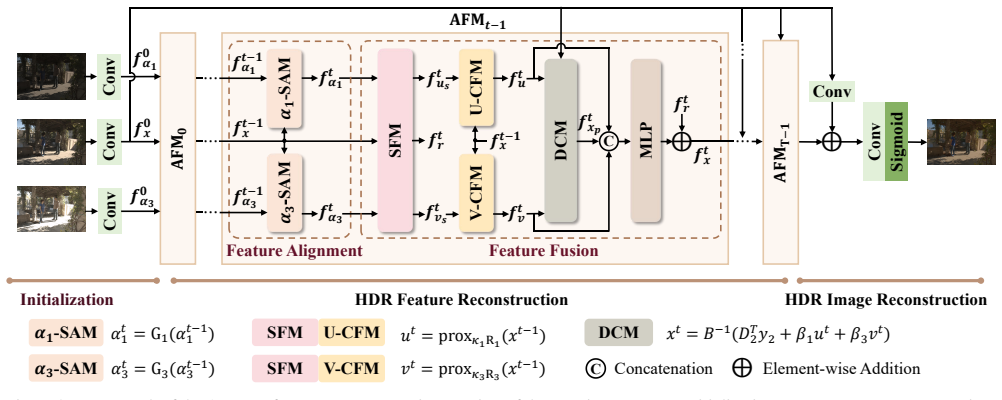
The central object is the cross-iterative Alignment-Fusion Module (AFM), the network block obtained by unrolling one alternating-minimization step. Within an AFM, two window-based cross-attention Spatial Alignment Modules act as the gradient descent operators G1 and G3 of Eq. (4), aligning the non-reference features with the reference feature; a transformer-based Spatial Fusion Module followed by two channel-attention Channel Fusion Modules acts as the proximal operators of Eq. (7); and a Data Consistency Module implements the closed-form update of Eq. (8) as a learned combination of u, v, and the reference feature, with an MLP and residual connection refining the result. The mathematical roles are assigned by construction: the paper identifies SAM with gradient descent on the alignment priors, the SFM/CFM pair with proximal operators for the fusion priors, and DCM with the quadratic-regularized least-squares update. The network uses four default stages, with each stage sharing the same structure but independent parameters.
What would settle it
Train AFUNet in two configurations: the full model and a stripped model in which the SAM, CFM, and DCM are replaced by generic attention or convolution blocks of comparable capacity, and also record the value of the objective in Eq. (5) after each stage. If the stripped model matches the full model's accuracy, or if the unfolded objective does not decrease stage by stage, then the claimed correspondence between the modules and the optimization operators is not doing the work; conversely, if the full model strictly outperforms and the objective decreases, the theory is supported.
Extended reading notes
Core claim
The paper's central claim is that multi-exposure HDR reconstruction is a joint alignment-and-fusion problem that should be optimized in alternation, not as sequential stages. Starting from a MAP objective over the reference exposure and two non-reference exposures, the authors introduce spatial correspondence priors p1 and p3, decompose the objective into alignment subproblems (solved by gradient descent operators G1 and G3) and a fusion subproblem (solved with half-quadratic splitting and proximal operators), and obtain a closed-form data-consistency update x_t = (D2^T D2 + (β1+β3)I)^{-1}(D2^T y2 + β1 u_t + β3 v_t). Unfolding this iteration yields AFUNet, whose T stages each contain a Spatial Alignment Module (window-based cross-attention), a Spatial Fusion Module plus two Channel Fusion Modules (channel-attention transformers), and a Data Consistency Module, with the degradation matrices $B^{{-1}}$ and D2^T learned by MLPs. The paper argues that because alignment sees the fusion state and fusion sees the alignment state at every stage, the two subtasks reinforce each other, producing better deghosting and detail than either the alignment-first or fusion-only paradigm. Empirically, the paper reports top PSNR, SSIM, and HDR-VDP2 numbers on the Kalantari, Hu, and Tel datasets, plus qualitative generalization to the Tursun dataset.
Load-bearing premise
The load-bearing premise is that the network's attention modules really perform the mathematical optimization steps they are named after (gradient descent, proximal updates, closed-form fusion); the paper provides no check that they do, so if that correspondence is only a name, the mathematical foundation is a post-hoc story and the real contribution is the empirical design.
Editorial extensions
If this is right
- If the reported numbers hold, AFUNet is the best-performing HDR deghosting network on the Kalantari, Hu, and Tel benchmarks across PSNR, SSIM, and HDR-VDP2.
- The alternating alignment-fusion pattern becomes a validated architectural template for multi-exposure reconstruction, since ablations show that adding SAM, CFM, and DCM each improves the result and that alignment-before-fusion beats fusion-before-alignment.
- Because the degradation matrices B^{-1} and D2^T are learned rather than fixed, the same architecture can adapt to different camera response and degradation settings without re-deriving the model.
- The 3-stage model already surpasses previous state-of-the-art in PSNR-µ and SSIM-µ, suggesting that the unfolding design achieves strong results with fewer iterations.
- The deep-unfolding formulation means each stage refines a common objective rather than being a purely feed-forward stack, so the number of stages can be traded against quality and complexity.
Reading between the lines
- The mathematical grounding is asserted but not verified: nothing in the training loss or ablations checks that the module outputs satisfy the fixed-point equations of the derived operators, so a cautious reading treats the MAP derivation as a design metaphor whose empirical payoff is what the tables show.
- If the cross-iterative pattern is what matters, the same alternating alignment-fusion unfolding could transfer to other multi-image tasks such as burst denoising, video super-resolution, or multi-exposure fusion outside HDR, where alignment and fusion are also coupled.
- A direct testable extension would be to add a consistency loss that penalizes deviation from the optimization equations, for example by enforcing that SAM's output equals a gradient step or that DCM matches Eq. (8) with shared B^{-1} and D2^T; such a constraint would either strengthen the theory-based claim or reveal where the analogy breaks.
- Interpreting what the learned B^{-1} and D2^T matrices encode, such as whether they converge to expected degradation structure, could clarify how much of the model's behavior is truly unfolded optimization versus learned feature processing.
Editorial analysis
A structured set of objections, weighed in public.
Referee Report
Summary. The paper proposes AFUNet, a deep unfolding network for multi-exposure HDR reconstruction. The authors formulate HDR reconstruction as a MAP estimation problem with two spatial-correspondence priors, decompose it into alternating alignment and fusion subproblems, and derive iterative updates involving gradient descent, proximal operators, and a closed-form least-squares step. These updates are then 'unfolded' into a T-stage network whose modules—SAM, SFM, CFM, and DCM—are claimed to implement the derived operators. The method is evaluated on Kalantari, Hu, and Tel datasets, with qualitative results on Tursun, and ablation studies on component contributions, paradigm ordering, and number of stages. The code is publicly available.
Significance. If the empirical results hold, AFUNet is a competitive HDR deghosting model, and the cross-iterative alignment-fusion design is a plausible design pattern; the ablations in Table 4-6 provide some evidence for the contribution of each module. However, the paper's central theoretical claim—that the network is 'theory-grounded' via MAP unfolding—is not substantiated: the priors p1 and p3 are never defined, and no evidence is given that the learned modules implement the derived mathematical operators. The empirical margins over the strongest baselines are small (often below 0.2 dB), with no error bars or significance tests. The contribution is therefore best viewed as an empirical architecture with a MAP-inspired narrative rather than a validated unfolding algorithm.
major comments (4)
- [Section 3.3, Eqs. (11)-(15)] The central claim that AFUNet is 'theory-grounded' is not supported by the module design. In Eq. (4), G_i is defined as a gradient descent operator on p_i(D_i x, alpha_i); for any differentiable p_i, the Jacobian of G_i with respect to alpha_i is I - zeta_i * Hessian_{alpha_i}(p_i), which is symmetric. SAM uses window-based cross-attention and an FFN (Eqs. 11-12), whose Jacobian is generically non-symmetric, so SAM cannot implement Eq. (4) for any differentiable prior. Similarly, CFM is described as a proximal operator for Eq. (7), but no property of the learned module (e.g., a minimization objective or fixed-point condition) is verified, and the proximal operator of p_i(D_i u, alpha_i) has a specific dependence on D_i and alpha_i that CFM does not reflect. Moreover, the paper states that all stages have independent parameters, so the T stages do not correspond to repeated iterations of a single objective. The authors should either provide constraints or training losses that enforce the operator identities, or explicitly reposition the MAP derivation as an architectural inspiration rather than an implemented optimization.
- [Section 3.3, Eqs. (8) and (14)] The closed-form update in Eq. (8) is derived in image space and requires B^{-1} = (D_2^T D_2 + (beta1 + beta3) I)^{-1}. The DCM learns B^{-1} and D_2^T with independent MLPs (Fig. 3d) and applies them to feature maps f_u, f_y2, and f_v, but no invertible mapping between image space and feature space is supplied. Thus Eq. (14) is not the feature-space version of Eq. (8) unless the MLPs are constrained to satisfy the Woodbury relation linking B^{-1}, D_2, and the beta weights. Please add consistency constraints or an experiment demonstrating that the learned matrices satisfy the required relation on the validation set.
- [Abstract, Section 4.2, Table 1] The statement that AFUNet 'consistently surpass[es] state-of-the-art methods' is overstated. On Kalantari PSNR-l, AFUNet (42.59 dB) ties LFDiff and is below FlexHDR (42.60 dB) and SAFNet (43.18 dB); the PSNR-mu margins over the strongest baselines are 0.15 dB (LFDiff) and 0.25 dB (SAFNet), respectively, and no error bars, multiple seeds, or significance tests are provided. Please quantify variability and either soften the claim or add a statistical test.
- [Section 3.2, Eq. (2)] The spatial correspondence priors p1 and p3 are never defined; the paper does not specify their functional form, differentiability, or how they relate to the training loss in Eq. (17). The variables alpha1 and alpha3 are initialized as features, not as aligned images, and no term in the training loss enforces that alpha_i is a spatially aligned version of y_i. Consequently, the MAP derivation is a scaffold that is not instantiated or verified. Please either define the priors and show the corresponding gradient and proximal operators, or state clearly that p1 and p3 are abstract placeholders and that the contribution is an empirical unfolding architecture.
minor comments (7)
- [Section 3.2, Eq. (7a)] There is an unmatched parenthesis in the proximal operator definition: 'prox_{lambda1/beta1 p1(·,alpha_t1))}(x^{t-1})' has an extra closing parenthesis; please fix the notation.
- [Section 3.3, after Eq. (10)] The text says 'The features f^{t-1}_{alpha1}, f^{t-1}_x, f^{t-1}_{alpha3} represent the outputs from stage t-2', but Eq. (10) indicates they are the outputs from stage t-1; the indexing should be made consistent.
- [Figure 3(a) caption] The caption says SAM aligns features with 'f^t_x', but Eq. (11) uses f^{t-1}_x; the notation should be aligned.
- [Table 3] Table 3 lists only a subset of the baselines included in Tables 1 and 2 (e.g., ADNet, APNT, HyHDR, LFDiff, RFG-HDR, SAFNet are omitted). Please either include the same baseline set or state explicitly why some methods are not compared on Tel's dataset.
- [Section 4.1, Implementation Details] The paper does not report the number of parameters, FLOPs, or runtime for the proposed model or the compared methods; please add these for reproducibility and practical assessment.
- [Section 4.2 and Figure 5] The dataset name is spelled 'Tursen' in the main text and figure caption; the correct name is 'Tursun'.
- [Section 3.4, Eq. (17)] The text says the loss is computed in the tone-mapped domain by applying the mu-law function, but the formula applies tau(x) and tau(hat x) without specifying how the predicted HDR values are clamped or normalized before tone mapping; please clarify the preprocessing.
Circularity Check
AFUNet's 'theory-grounded' claim is self-definitional: the MAP priors are never specified, the derived operators B−1 and D2T of Eq. (8) are learned by unconstrained MLPs, and SAM's cross-attention update cannot be a gradient step of any differentiable prior; the architecture defines the theory rather than being derived from it.
-
self definitional
[Section 3.2, Eq. (8), and Section 3.3 / Fig. 3(d)]
"The matrix inverse is computationally expensive, so we treat (DT2 D2 + (β1 + β3)I)−1 as a single entity, denoted as B−1. To efficiently handle this, we design neural networks to learn the complex degradation matrices B−1 and DT2."
Eq. (8) is the paper's derived closed-form fusion update whose defining relation is B−1 = (DT2 D2 + (β1 + β3)I)−1. The paper then declares this matrix inverse 'computationally expensive' and assigns its computation, together with DT2, to neural networks (independent MLPs, Fig. 3(d)), and names a module DCM that 'obtains f t xp according to Eq. (8)'. No constraint enforces the defining relation B−1 = (DT2 D2 + (β1 + β3)I)−1 or ties the two MLPs together. The supposedly derived operator therefore has no definition independent of the trained network: whatever the MLP computes is, by naming, the closed-form update. The claim that the network implements the derivation is thus true only by construction, in the manner of a fitted parameter re-labeled as a prediction.
-
self definitional
[Section 3.3, subsection A (Feature Alignment), Eqs. (4), (11)-(12)]
"There are two SAMs act as gradient descent operators G1(·) and G3(·) in Eq. (4a) and (4b), respectively, producing the aligned features f t α1 , f t α3. ... we construct the SAM as a window-based cross-attention transformer block [19], which can be formulated as: f t αi = FFN(WCAA(f t−1 αi , f t−1 x )), (11)"
For any twice-differentiable prior p_i, the gradient-descent map Gi(α) = α − ς ∇α p_i(D_i x, α) of Eq. (4) has Jacobian I − ς·Hessian(p_i), which is symmetric. The SAM update of Eqs. (11)-(12) is a windowed cross-attention block plus FFN whose Jacobian is generically non-symmetric, so no differentiable p_i exists for which SAM equals Gi. The asserted identity 'two SAMs act as gradient descent operators' therefore cannot be a consequence of the derivation. It can hold only if the prior p_i and operator Gi are defined to be the trained SAM, i.e., the theory is reverse-engineered from the module and the gradient-descent label is attached after the fact. The alignment update 'derived' in Eq. (4) thus places no constraint on the architecture.
1 more flagged steps
-
other
[Section 3.3, first paragraph (HDR Feature Reconstruction)]
"Notably, as outlined in Section 3.2, the solution to the unfolding paradigm is performed in the image space, where the LDR images y1, y2, y3 are directly involved in the optimization process. In contrast, in this section, we apply the iterative optimization and refinement at the feature space and propose a learnable solution using a deep unfolding network."
The derivation of Eqs. (2)-(8) is conducted on image variables x, α1, α3, u, v with degradation operators D1, D2, D3, and its closed form mixes y2, u, v as images. The paper concedes the translation: the solution is 'performed in the image space' while the network operates 'at the feature space'. All variables are replaced by features f_x, f_αi, f_u, f_v produced by a single convolutional layer (SFEMi, Eq. (9)), with no invertible map supplied between image y2 or x and their feature counterparts. Hence the modules are not the derived iterations; they are feature-space networks that inherit the names of image-space variables. The 'unfolding' step is a renaming convention rather than a construction from Eq. (8), so the claimed derivation does not connect to the implemented modules.
full rationale
The empirical contribution is genuine and benchmark-grounded: Tables 1-3 compare AFUNet against prior methods on the held-out Kalantari, Hu, and Tel test sets, and Tables 4-6 measure component and stage-count effects on held-out data. On that axis the paper is self-contained and not circular, which is why the score is not higher. (The abstract's 'consistently surpassing state-of-the-art' is overstated: on Kalantari PSNR-l AFUNet ties LFDiff at 42.59 and trails SAFNet at 43.18, but that is a correctness/accuracy concern, not circularity.) The circularity lies in the paper's central novelty claim: that the architecture is 'theory-grounded' because it is unfolded from a MAP objective (Eqs. 1-8). That claim reduces by construction. First, the priors p1 and p3 in Eqs. (2)-(7) are never given functional forms, and the 'proximal operators' and 'gradient descent operators' are asserted to be the learned modules themselves. Second, the only non-trivial derived quantity, the closed-form matrix B−1 in Eq. (8), is replaced by an independent learned MLP with no constraint enforcing its defining relation to D2. Third, the identity 'SAM = Gi' is mathematically incompatible with Eq. (4) for any differentiable prior (the gradient-step Jacobian must be symmetric; cross-attention's is not), so the gradient-descent step is a post hoc label: Gi is defined to be SAM. Fourth, the derivation is performed in image space but implemented in feature space with no invertible variable map, and all stages 'share the same structure but have independent parameters', so the stages are not iterations of one fixed objective. Each of these moves ensures the derived equations place no constraint on the network: the network is the data and the MAP symbols are fitted to it afterward. No self-citation chain is involved; the circularity is of the self-definitional kind, and it affects the theoretical contribution rather than the external benchmark results.
Assumptions & free parameters
free parameters (4)
- Number of unfolding stages T =
4
- Perceptual loss weight eta =
0.005
- Balancing coefficients lambda1, lambda3, beta1, beta3 and step sizes xi_i =
unspecified
- Learning rate and schedule =
5e-4 to 5e-6 cosine decay
assumptions (5)
- domain assumption The degradation process is modeled as y = Dx + n with additive Gaussian noise, justifying the l2 data fidelity term.
- ad hoc to paper Spatial correspondence priors p1 and p3 exist, are differentiable, and are strong enough to make the alternating optimization meaningful.
- ad hoc to paper The hand-designed modules (SAM, CFM, DCM) compute the corresponding mathematical operators (gradient descent, proximal, closed-form) from Eqs. (4)-(8).
- ad hoc to paper The matrices B^{-1} and D2^T can be learned by MLPs and still correspond to the degradation model used in Eq. (8).
- standard math Half-Quadratic Splitting converges to the solution of Eq. (2) under the chosen priors.
invented entities (3)
-
Spatial correspondence priors p1(D1x, alpha1) and p3(D3x, alpha3)
-
Spatially aligned versions alpha1 and alpha3 of the non-reference images
-
Learned degradation matrices B^{-1} and D2^T
Cite this review
Pith. "Pith review of AFUNet: Cross-Iterative Alignment-Fusion Synergy for HDR Reconstruction via Deep Unfolding Paradigm." pith.science (2026). https://pith.science/paper/YUETZWGZ
@misc{pith2026250623537,
  author       = {Pith},
  title        = {Pith review of: AFUNet: Cross-Iterative Alignment-Fusion Synergy for HDR Reconstruction via Deep Unfolding Paradigm},
  year         = {2026},
  howpublished = {\url{https://pith.science/paper/YUETZWGZ}},
  note         = {Machine review of arXiv:2506.23537}
}
read the original abstract
Existing learning-based methods effectively reconstruct HDR images from multi-exposure LDR inputs with extended dynamic range and improved detail, but they rely more on empirical design rather than theoretical foundation, which can impact their reliability. To address these limitations, we propose the cross-iterative Alignment and Fusion deep Unfolding Network (AFUNet), where HDR reconstruction is systematically decoupled into two interleaved subtasks -- alignment and fusion -- optimized through alternating refinement, achieving synergy between the two subtasks to enhance the overall performance. Our method formulates multi-exposure HDR reconstruction from a Maximum A Posteriori (MAP) estimation perspective, explicitly incorporating spatial correspondence priors across LDR images and naturally bridging the alignment and fusion subproblems through joint constraints. Building on the mathematical foundation, we reimagine traditional iterative optimization through unfolding -- transforming the conventional solution process into an end-to-end trainable AFUNet with carefully designed modules that work progressively. Specifically, each iteration of AFUNet incorporates an Alignment-Fusion Module (AFM) that alternates between a Spatial Alignment Module (SAM) for alignment and a Channel Fusion Module (CFM) for adaptive feature fusion, progressively bridging misaligned content and exposure discrepancies. Extensive qualitative and quantitative evaluations demonstrate AFUNet's superior performance, consistently surpassing state-of-the-art methods. Our code is available at: https://github.com/eezkni/AFUNet
Figures


Figures from the paper (2 more)


Forward citations
Cited by 3 Pith papers
-
LoCAtion: Long-time Collaborative Attention Framework for High Dynamic Range Video Reconstruction
Dual-stream HDR video can be reconstructed without fragile cross-exposure warping by backbone-guided collaborative attention plus sequence-level residual refinement.
-
GMODiff: One-Step Gain Map Refinement with Diffusion Priors for HDR Reconstruction
HDR reconstruction is reformulated as one-step gain map refinement, enabling a pre-trained latent diffusion model plus regression priors to produce high-quality HDR at a fraction of the cost of prior diffusion approaches.
-
Coarse-to-fine Framework for Generative MEF via Implicit Neural Representation
A coarse-to-fine multi-exposure fusion method that fuses low-res diffusion output with implicit-neural high-res detail reconstruction, achieving ~3.5x speedup over a diffusion-only baseline.
Reference graph
Works this paper leans on
-
[1]
Extending dynamic range of monochrome and color images through fusion
Luca Bogoni. Extending dynamic range of monochrome and color images through fusion. In IEEE International Confer- ence on Pattern Recognition, pages 7–12, 2000. 1
work page 2000
-
[2]
FlexHDR: Modeling alignment and exposure uncertainties for flexible HDR imaging
Sibi Catley-Chandar, Thomas Tanay, Lucas Vandroux, Ale ˇs Leonardis, Gregory Slabaugh, and Eduardo P ´erez-Pellitero. FlexHDR: Modeling alignment and exposure uncertainties for flexible HDR imaging. IEEE Transactions on Image Pro- cessing, 31:5923–5935, 2022. 2, 6
work page 2022
-
[3]
Attention-guided progressive neural tex- ture fusion for high dynamic range image restoration
Jie Chen, Zaifeng Yang, Tsz Nam Chan, Hui Li, Junhui Hou, and Lap-Pui Chau. Attention-guided progressive neural tex- ture fusion for high dynamic range image restoration. IEEE Transactions on Image Processing, 31:2661–2672, 2022. 6
work page 2022
-
[4]
Improving dynamic HDR imaging with fusion transformer
Rufeng Chen, Bolun Zheng, Hua Zhang, Quan Chen, Cheng- gang Yan, Gregory Slabaugh, and Shanxin Yuan. Improving dynamic HDR imaging with fusion transformer. In Proceed- ings of the AAAI Conference on Artificial Intelligence, pages 340–349, 2023. 2
work page 2023
-
[5]
Recovering high dy- namic range radiance maps from photographs
Paul E Debevec and Jitendra Malik. Recovering high dy- namic range radiance maps from photographs. In Proceed- ings of the 24th Annual Conference on Computer Graphics and Interactive Techniques, pages 369–378, 1997. 1
work page 1997
-
[6]
Nonlinear image recov- ery with half-quadratic regularization
Donald Geman and Chengda Yang. Nonlinear image recov- ery with half-quadratic regularization. IEEE Transactions on Image Processing, 4(7):932–946, 1995. 3
work page 1995
-
[7]
Fast and robust high dynamic range image generation with camera and object movement
Thorsten Grosch et al. Fast and robust high dynamic range image generation with camera and object movement. Vi- sion, Modeling and Visualization, RWTH Aachen , 277284 (3):2, 2006. 1
work page 2006
-
[8]
Zhen Guo and Hongping Gan. CPP-Net: Embracing multi- scale feature fusion into deep unfolding CP-PPA network for compressive sensing. In Proceedings of the IEEE/CVF Con- ference on Computer Vision and Pattern Recognition, pages 25086–25095, 2024. 2
work page 2024
Show all 50 references
-
[9]
MERF: a prac- tical HDR-like image generator via mutual-guided learning between multi-exposure registration and fusion.IEEE Trans- actions on Image Processing, 33:2361–2376, 2024
Wenhui Hong, Hao Zhang, and Jiayi Ma. MERF: a prac- tical HDR-like image generator via mutual-guided learning between multi-exposure registration and fusion.IEEE Trans- actions on Image Processing, 33:2361–2376, 2024. 2
2024
-
[10]
HDR deghosting: How to deal with saturation? In Proceedings of the IEEE/CVF International Conference on Computer Vi- sion, pages 1163–1170, 2013
Jun Hu, Orazio Gallo, Kari Pulli, and Xiaobai Sun. HDR deghosting: How to deal with saturation? In Proceedings of the IEEE/CVF International Conference on Computer Vi- sion, pages 1163–1170, 2013. 1, 6, 7
2013
-
[11]
Gen- erating content for HDR deghosting from frequency view
Tao Hu, Qingsen Yan, Yuankai Qi, and Yanning Zhang. Gen- erating content for HDR deghosting from frequency view. In Proceedings of the IEEE/CVF Conference on Computer Vi- sion and Pattern Recognition, pages 25732–25741, 2024. 6, 7
2024
-
[12]
Un- folding the alternating optimization for blind super resolu- tion
Yan Huang, Shang Li, Liang Wang, Tieniu Tan, et al. Un- folding the alternating optimization for blind super resolu- tion. Advances in Neural Information Processing Systems , 33:5632–5643, 2020. 2
2020
-
[13]
Deep high dynamic range imaging of dynamic scenes
Nima Khademi Kalantari and Ravi Ramamoorthi. Deep high dynamic range imaging of dynamic scenes. ACM Transac- tions on Graphics, 36(4):1–12, 2017. 2, 6, 7, 8
2017
-
[14]
High dynamic range video
Sing Bing Kang, Matthew Uyttendaele, Simon Winder, and Richard Szeliski. High dynamic range video. ACM Transac- tions on Graphics, 22(3):319–325, 2003. 1
2003
-
[15]
SAFNet: Selective alignment fusion net- work for efficient HDR imaging
Lingtong Kong, Bo Li, Yike Xiong, Hao Zhang, Hong Gu, and Jinwei Chen. SAFNet: Selective alignment fusion net- work for efficient HDR imaging. In Proceedings of the Eu- ropean Conference on Computer Vision, 2024. 2, 6, 7
2024
-
[16]
Ghost-free high dynamic range imaging via rank minimization
Chul Lee, Yuelong Li, and Vishal Monga. Ghost-free high dynamic range imaging via rank minimization. IEEE Signal Processing Letters, 21(9):1045–1049, 2014. 1
2014
-
[17]
RFG-HDR: Representative feature-guided transformer for multi-exposure high dynamic range imaging
Keuntek Lee, Jaehyun Park, Gu Yong Park, and Nam Ik Cho. RFG-HDR: Representative feature-guided transformer for multi-exposure high dynamic range imaging. In 2024 IEEE International Conference on Image Processing, pages 1521–1527. IEEE, 2024. 6
2024
-
[18]
ADNet: Attention-guided deformable convolutional network for high dynamic range imaging
Zhen Liu, Wenjie Lin, Xinpeng Li, Qing Rao, Ting Jiang, Mingyan Han, Haoqiang Fan, Jian Sun, and Shuaicheng Liu. ADNet: Attention-guided deformable convolutional network for high dynamic range imaging. In Proceedings of the IEEE/CVF Conference on Computer Vision and Pattern Re...
2021
-
[19]
Swin transformer: Hierarchical vision transformer using shifted windows
Ze Liu, Yutong Lin, Yue Cao, Han Hu, Yixuan Wei, Zheng Zhang, Stephen Lin, and Baining Guo. Swin transformer: Hierarchical vision transformer using shifted windows. In Proceedings of the IEEE/CVF International Conference on Computer Vision, pages 10012–10022, 2021. 5
2021
-
[20]
Ghost-free high dynamic range imaging with context-aware transformer
Zhen Liu, Yinglong Wang, Bing Zeng, and Shuaicheng Liu. Ghost-free high dynamic range imaging with context-aware transformer. In Proceedings of the European Conference on Computer Vision, pages 344–360, 2022. 2, 6, 7
2022
-
[21]
Robust multi-exposure image fusion: a struc- tural patch decomposition approach
Kede Ma, Hui Li, Hongwei Yong, Zhou Wang, Deyu Meng, and Lei Zhang. Robust multi-exposure image fusion: a struc- tural patch decomposition approach. IEEE Transactions on Image Processing, 26(5):2519–2532, 2017. 1
2017
-
[22]
Deep guided learning for fast multi- exposure image fusion
Kede Ma, Zhengfang Duanmu, Hanwei Zhu, Yuming Fang, and Zhou Wang. Deep guided learning for fast multi- exposure image fusion. IEEE Transactions on Image Pro- cessing, 29:2808–2819, 2020. 1
2020
-
[23]
Deep unrolled low-rank tensor completion for high dynamic range imaging
Truong Thanh Nhat Mai, Edmund Y Lam, and Chul Lee. Deep unrolled low-rank tensor completion for high dynamic range imaging. IEEE Transactions on Image Processing, 31: 5774–5787, 2022. 2
2022
-
[24]
HDR-VDP-2: A calibrated visual metric for visibility and quality predictions in all luminance conditions
Rafał Mantiuk, Kil Joong Kim, Allan G Rempel, and Wolf- gang Heidrich. HDR-VDP-2: A calibrated visual metric for visibility and quality predictions in all luminance conditions. ACM Transactions on graphics, 30(4):1–14, 2011. 6
2011
-
[25]
Progressive high-frequency re- construction for pan-sharpening with implicit neural repre- sentation
Ge Meng, Jingjia Huang, Yingying Wang, Zhenqi Fu, Xing- hao Ding, and Yue Huang. Progressive high-frequency re- construction for pan-sharpening with implicit neural repre- sentation. In Proceedings of the AAAI Conference on Artifi- cial Intelligence, pages 4189–4197, 2024. 2
2024
-
[26]
HDR-GAN: HDR image reconstruction from multi-exposed LDR images with large motions
Yuzhen Niu, Jianbin Wu, Wenxi Liu, Wenzhong Guo, and Rynson WH Lau. HDR-GAN: HDR image reconstruction from multi-exposed LDR images with large motions. IEEE Transactions on Image Processing, 30:3885–3896, 2021. 6
2021
-
[27]
Robust high dynamic range imaging by rank min- imization
Tae-Hyun Oh, Joon-Young Lee, Yu-Wing Tai, and In So Kweon. Robust high dynamic range imaging by rank min- imization. IEEE Transactions on Pattern Analysis and Ma- chine Intelligence, 37(6):1219–1232, 2014. 1 9
2014
-
[28]
Ram Prabhakar, V Sai Srikar, and R
K. Ram Prabhakar, V Sai Srikar, and R. Venkatesh Babu. DeepFuse: A deep unsupervised approach for exposure fu- sion with extreme exposure image pairs. In Proceedings of the IEEE International Conference on Computer Vision ,
-
[29]
Robust patch-based HDR reconstruction of dynamic scenes
Pradeep Sen, Nima Khademi Kalantari, Maziar Yaesoubi, Soheil Darabi, Dan B Goldman, and Eli Shechtman. Robust patch-based HDR reconstruction of dynamic scenes. ACM Transactions on Graphics, 31(6):203, 2012. 1
2012
-
[30]
Very deep convolutional net- works for large-scale image recognition
K Simonyan and A Zisserman. Very deep convolutional net- works for large-scale image recognition. In International Conference on Learning Representations, 2015. 6
2015
-
[31]
Dynamic path- controllable deep unfolding network for compressive sens- ing
Jiechong Song, Bin Chen, and Jian Zhang. Dynamic path- controllable deep unfolding network for compressive sens- ing. IEEE Transactions on Image Processing , 32:2202– 2214, 2023. 2
2023
-
[32]
Selective TransHDR: Transformer-based selective HDR imaging using ghost region mask
Jou Won Song, Ye-In Park, Kyeongbo Kong, Jaeho Kwak, and Suk-Ju Kang. Selective TransHDR: Transformer-based selective HDR imaging using ghost region mask. In Eu- ropean Conference on Computer Vision , pages 288–304. Springer, 2022. 2
2022
-
[33]
Alignment-free HDR deghosting with semantics consistent transformer
Steven Tel, Zongwei Wu, Yulun Zhang, Barth ´el´emy Heyr- man, C ´edric Demonceaux, Radu Timofte, and Dominique Ginhac. Alignment-free HDR deghosting with semantics consistent transformer. In Proceedings of the IEEE/CVF In- ternational Conference on Computer Vision , pages 1283...
2023
-
[34]
An objective deghosting quality metric for HDR images
Okan Tarhan Tursun, Ahmet O˘guz Aky¨uz, Aykut Erdem, and Erkut Erdem. An objective deghosting quality metric for HDR images. In Computer Graphics Forum, pages 139–152,
-
[35]
Progressive divide-and-conquer via subsam- pling decomposition for accelerated mri
Chong Wang, Lanqing Guo, Yufei Wang, Hao Cheng, Yi Yu, and Bihan Wen. Progressive divide-and-conquer via subsam- pling decomposition for accelerated mri. In Proceedings of the IEEE/CVF Conference on Computer Vision and Pattern Recognition, pages 25128–25137, 2024. 2
2024
-
[36]
Deep unfolded network with intrinsic super- vision for pan-sharpening
Hebaixu Wang, Meiqi Gong, Xiaoguang Mei, Hao Zhang, and Jiayi Ma. Deep unfolded network with intrinsic super- vision for pan-sharpening. In Proceedings of the AAAI Con- ference on Artificial Intelligence, pages 5419–5426, 2024. 2
2024
-
[37]
Image quality assessment: from error visibility to structural similarity
Zhou Wang, Alan C Bovik, Hamid R Sheikh, and Eero P Si- moncelli. Image quality assessment: from error visibility to structural similarity. IEEE transactions on image processing, 13(4):600–612, 2004. 6
2004
-
[38]
Chi- Keung
Shangzhe Wu, Xu Jiarui, Tai Yu-Wing, and Tang. Chi- Keung. Deep high dynamic range imaging with large fore- ground motions. In Proceedings of the European Conference on Computer Vision, pages 117–132, 2018. 6
2018
-
[39]
Attention- guided network for ghost-free high dynamic range imaging
Qingsen Yan, Dong Gong, Qinfeng Shi, Anton van den Hen- gel, Chunhua Shen, Ian Reid, and Yanning Zhang. Attention- guided network for ghost-free high dynamic range imaging. In Proceedings of the IEEE/CVF Conference on Computer Vision and Pattern Recognition, pages 1751–1760, 2...
2019
-
[40]
Deep HDR imaging via a non- local network
Qingsen Yan, Lei Zhang, Yu Liu, Yu Zhu, Jinqiu Sun, Qin- feng Shi, and Yanning Zhang. Deep HDR imaging via a non- local network. IEEE Transactions on Image Processing, 29: 4308–4322, 2020. 2, 6
2020
-
[41]
A unified HDR imaging method with pixel and patch level
Qingsen Yan, Weiye Chen, Song Zhang, Yu Zhu, Jinqiu Sun, and Yanning Zhang. A unified HDR imaging method with pixel and patch level. In Proceedings of the IEEE/CVF Con- ference on Computer Vision and Pattern Recognition, pages 22211–22220, 2023. 2, 6
2023
-
[42]
Towards high- quality HDR deghosting with conditional diffusion models
Qingsen Yan, Tao Hu, Yuan Sun, Hao Tang, Yu Zhu, Wei Dong, Luc Van Gool, and Yanning Zhang. Towards high- quality HDR deghosting with conditional diffusion models. IEEE Transactions on Circuits and Systems for Video Tech- nology, 2023. 6
2023
-
[43]
Memory-augmented deep conditional unfolding network for pan-sharpening
Gang Yang, Man Zhou, Keyu Yan, Aiping Liu, Xueyang Fu, and Fan Wang. Memory-augmented deep conditional unfolding network for pan-sharpening. In Proceedings of the IEEE/CVF conference on computer vision and pattern recognition, pages 1788–1797, 2022. 2
2022
-
[44]
Progressive and selective fusion network for high dynamic range imaging
Qian Ye, Jun Xiao, Kin-man Lam, and Takayuki Okatani. Progressive and selective fusion network for high dynamic range imaging. In Proceedings of the 29th ACM Interna- tional Conference on Multimedia , pages 5290–5297, 2021. 2
2021
-
[45]
Restormer: Efficient transformer for high-resolution image restoration
Syed Waqas Zamir, Aditya Arora, Salman Khan, Mu- nawar Hayat, Fahad Shahbaz Khan, and Ming-Hsuan Yang. Restormer: Efficient transformer for high-resolution image restoration. In Proceedings of the IEEE/CVF conference on computer vision and pattern recognition, pages 5728–5739,
-
[46]
Deep unfold- ing network for image super-resolution
Kai Zhang, Luc Van Gool, and Radu Timofte. Deep unfold- ing network for image super-resolution. In Proceedings of the IEEE/CVF Conference on Computer Vision and Pattern Recognition, pages 3217–3226, 2020. 2
2020
-
[47]
Gradient-directed multiex- posure composition
Wei Zhang and Wai-Kuen Cham. Gradient-directed multiex- posure composition. IEEE Transactions on Image Process- ing, 21(4):2318–2323, 2011. 1
2011
-
[48]
Hl-hdr: Multi-exposure high dy- namic range reconstruction with high-low frequency decom- position
Xiang Zhang, Genggeng Chen, Tao Hu, Kangzhen Yang, Fan Zhang, and Qingsen Yan. Hl-hdr: Multi-exposure high dy- namic range reconstruction with high-low frequency decom- position. In 2024 International Joint Conference on Neural Networks, pages 1–9. IEEE, 2024. 2
2024
-
[49]
Memory-augmented deep unfolding net- work for guided image super-resolution
Man Zhou, Keyu Yan, Jinshan Pan, Wenqi Ren, Qi Xie, and Xiangyong Cao. Memory-augmented deep unfolding net- work for guided image super-resolution. International Jour- nal of Computer Vision, 131(1):215–242, 2023. 2
2023
-
[50]
Freehand HDR imaging of moving scenes with simultane- ous resolution enhancement
Henning Zimmer, Andr ´es Bruhn, and Joachim Weickert. Freehand HDR imaging of moving scenes with simultane- ous resolution enhancement. In Computer Graphics Forum, pages 405–414, 2011. 1 10
2011
Reviewed August 6, 2026 · model on record in the stance chip above.
Discussion (0). Sign in to comment.