REVIEW 4 major objections 6 minor 2 cited by
Event-based Tiny Object Detection: A Benchmark Dataset and Baseline
T0 review · 4 major / 6 minor · reviewed 2026-08-06 · deepseek-v4-flash
Pith's one-line read A new event-camera dataset and a sparse point-cloud network push tiny UAV detection to a 77.53% hit rate, the best among 13 recent detectors.
desk verdict EV-UAV is a genuinely useful dataset, but the method's SOTA claim rests on an unfair comparison and an approximate annotation protocol that needs to be fixed before the performance numbers can be trusted. read the letter →
The pith
A machine-rendered reading of the paper's core claim, the machinery that carries it, and where it could break.
The reading
What carries the argument
Two machinery pieces carry the argument. The first is the 3D $(x,y,t)$ event point cloud with event-level labels: annotations are generated by extending 2D bounding boxes drawn on accumulated event frames into 3D XYT boxes and labeling every event inside as a target, which makes per-event supervision possible without hand-labeling individual events. The second is the network and loss: the Grouped Dilated Sparse Convolution Attention (GDSCA) module extracts curve features at multiple scales and shares global context across patches, while the Spatiotemporal Correlation (STC) loss reweights each event's cross-entropy by the sigmoid of the summed predicted confidence in a $k \times k \times \tau$ neighborhood, so connected, motion-consistent events are retained and isolated false positives are discarded.
What would settle it
Take a random sample of EV-UAV test sequences, have annotators manually label each event as target or not without seeing the automatic labels, and compare the two label sets; if the manual labels disagree with the box-derived labels on more than a few percent of events, or if a model trained on manual labels outperforms the same model trained on box-derived labels, the generation procedure is the main source of the reported performance difference.
Extended reading notes
Core claim
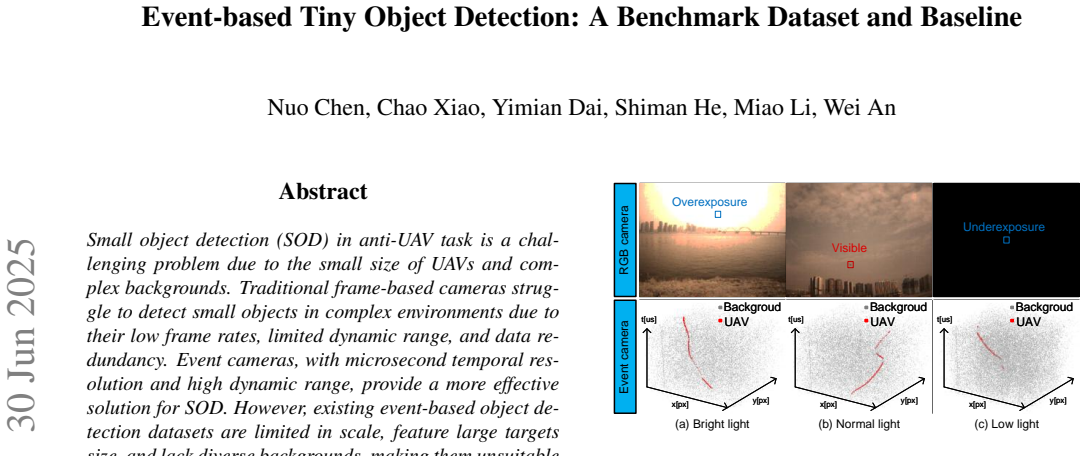
The paper's central claim is that small moving targets in raw event data are distinguishable from background and noise by their shape in the spatiotemporal point cloud: targets form long, thin continuous curves, background forms surfaces, and noise forms isolated points. EV-UAV provides per-event labels that let networks be trained directly in this space, and EV-SpSegNet operationalizes the distinction with grouped dilated sparse convolutions that capture multi-scale local curve structure and a patch-attention block that interacts globally across the point cloud. The Spatiotemporal Correlation (STC) loss further biases the network toward events whose neighbors predict high target confidence, suppressing isolated noise. The result is an IoU of 55.18%, accuracy of 65.02%, detection probability of 77.53%, and a false-alarm rate of 1.63e-4 on the test set, ahead of all 13 compared methods including point-cloud segmenters.
Load-bearing premise
The dataset's per-event ground truth is made by extending 2D boxes into 3D XYT boxes and labeling every event inside as a target, which assumes those boxes contain exactly the target's events and no background events.
Editorial extensions
If this is right
- The benchmark makes the detection problem event-level: algorithms can be trained and evaluated directly on events rather than on frame conversions, so future methods can use sparse point clouds or spiking networks without losing temporal fidelity.
- The STC loss is a drop-in training term: the paper reports consistent gains when added to KPConv, RandLA-Net, and COSeg, so any point-cloud segmentation model for moving objects could adopt it.
- If the curve-continuity prior is right, detectors should spend computation on preserving raw timing, and event representations that destroy timing (like simple event-count frames) will stay at a disadvantage on tiny targets.
- The dataset's extreme target scale, about 1/50 the size of previous event UAV datasets, resets the difficulty bar for the field and provides a harder testbed for future anti-drone detectors.
Reading between the lines
- A testable extension: if the 3D-box label generation is exact, then re-training on a small subset with manually refined per-event labels should not change scores; the paper's own observation that EV-SpSegNet finds targets the annotators missed suggests the generated labels may under-count target events, so the reported recall is likely conservative.
- Another implication: the same curve-versus-surface-versus-noise geometry should generalize to other tiny moving objects (birds, debris, vehicles at distance) in event streams, so the STC loss and the point-cloud segmentation approach could transfer without retraining on new object classes.
- The paper's limitation statement implies a fusion test: fusing EV-UAV with a frame-based camera dataset should recover detections when the drone is stationary or slow, a scenario the current event-only method cannot see.
- A methodological caution implied by the benchmarks: comparing frame-based methods that see 50 ms event frames against a point-cloud method that ingests 8 seconds of events conflates architecture and input duration; an equal-input comparison would isolate the contribution of the curve-based representation.
Editorial analysis
A structured set of objections, weighed in public.
Referee Report
Summary. The paper introduces EV-UAV, a 147-sequence event-camera dataset with event-level annotations for tiny drone detection, and proposes EV-SpSegNet, a sparse-convolution U-shaped network with a spatiotemporal correlation (STC) loss. The authors report state-of-the-art results on this dataset against 13 baselines, with the best IoU of 55.18%, and claim the first large-scale, event-level-annotated benchmark for event-based small object detection in anti-UAV tasks.
Significance. The dataset resource is potentially valuable: it is large-scale, covers diverse lighting and cluttered scenes, and provides per-event labels that support point-cloud and SNN-based methods, which existing event-based datasets generally lack. The proposed curve-based segmentation view—treating tiny moving targets as continuous spatiotemporal curves—is an interesting direction, and the STC loss is a plausible auxiliary training signal. The public release of dataset and code is a strength. However, the empirical claims rest on two load-bearing pillars—the validity of the event-level annotations and the fairness of the comparison protocol—and neither is currently established to the standard required for a benchmark paper.
major comments (4)
- [§5.1, Table 2] The comparison is not matched in temporal context. EV-SpSegNet ingests 8 seconds of events (with a 1 ms voxel size), while the frame-based baselines receive only 50 ms event frames. This gives the proposed method access to a vastly longer motion history, directly favoring its curve-based architecture and potentially inflating its reported lead (e.g., IoU 55.18 vs. 43.21 for RVT). To support the SOTA claim, the authors must evaluate the baselines with equivalent input durations, or report a fixed-window variant of their own method, or explicitly reframe the comparison as a different task setting with clear disclosure of the asymmetry.
- [§3.2.2, §5.2] Event-level ground truth is generated by extending 2D bounding boxes into 3D XYT boxes and labeling every enclosed event as a target event. For targets averaging 6.8×5.4 pixels in cluttered scenes, this cannot be an exact event partition: background and noise events inside the box are labeled positive, while target events outside the box (e.g., during fast motion between annotated frames) are labeled negative. The authors' own observation in Section 5.2 that the network 'detects some targets that were missed by manual annotation' confirms that the labels are incomplete. Since IoU, ACC, Pd, and Fa are computed against this approximate GT, the benchmark numbers—and any method that simply labels boxed events as positive—are potentially biased. Please provide a quantitative validation of annotation quality, such as manual event-level re-annotation of a random subset with agreement statistics, or a report of the background-event fraction inside the 3D boxes.
- [§3.4, §5.2] The conversion from bounding-box detections to event-level metrics is not described in the main text. For the frame-based baselines (SSD, Faster R-CNN, DETR, YOLOv10), the authors must specify exactly how a box output becomes an event-level positive/negative prediction—for example, whether all events inside the box over its temporal window are labeled positive, how the 50 ms windows are aligned with the 8-second evaluation window, and how Pd and Fa are defined for event streams. Without this rule, Table 2 cannot be independently reproduced or interpreted. The description should appear in the main text or in an unambiguously referenced supplementary section.
- [§4.2, Eq. (3)] The STC loss weights each event by the sum of the model's own predicted probabilities in a k×k×τ neighborhood. This self-referential weighting can amplify the model's confidence on already-confident regions and penalize true events surrounded by low-confidence predictions, so the consistent gains in Tables 3 and 6 require a more careful analysis. Please report the sensitivity of the hyperparameters k, τ, and γ in the main text (the supplementary is cited but a main-text figure is needed), and include a comparison against a variant that uses ground-truth correlation weights to separate the benefit of continuity-aware weighting from confidence feedback.
minor comments (6)
- [§4.2, Eq. (2)] The sentence 'γ is a hyperparameters to control the influence of spatiotemporal correlations' contains a grammatical error; it should be 'a hyperparameter'.
- [Table 6] The Fa values for RandLA-Net and COSeg appear to be swapped relative to Table 2 (Table 2 gives RandLA-Net Fa=6.95 and COSeg Fa=9.21, while Table 6 lists 9.21 and 6.95 respectively), and the COSeg* ACC improvement is listed as +0.99 but the actual difference is +1.38. Please verify the table.
- [§1] The word 'spatio-temproal' in the introductory paragraph is a typo and should be 'spatiotemporal'.
- [References] The references for VisEvent (entries [40] and [41]) and EventVOT (entries [43] and [44]) appear to be duplicated with different citation numbers; please consolidate or remove the redundant entries.
- [§5.1] Please clarify whether the 8-second input is a fixed chunk or a sliding window, and how EV-SpSegNet handles variable-length event streams at inference time; the runtime of 35.9 ms should be reported for a specific input length.
- [Table 1] The column header '#AGV.' is ambiguous; it should be descriptive, such as 'Avg. target area (px)' or 'Target scale'.
Circularity Check
No significant circularity: the benchmark labels and baseline evaluation are externally grounded, and the STC loss's confidence-based weighting is a training heuristic rather than a construction of the reported result.
full rationale
The paper's central chain is: (1) collect event data, (2) generate event-level ground truth by extending manual 2D boxes into 3D XYT boxes and labeling all enclosed events as targets (Section 3.2.2, Fig. 3), and (3) train and evaluate EV-SpSegNet on this benchmark. The ground-truth generation is approximate and may contain annotation noise, but it is independent of the network's predictions; no reported metric (IoU, ACC, Pd, Fa) is defined as a function of a fitted parameter of the proposed model. The STC loss (Eqs. 2 and 3) uses the model's own neighboring predicted confidences to weight the BCE term, which is self-referential as a training heuristic, but it does not make the evaluation result true by construction: performance is measured on held-out test annotations, and the loss's benefit is assessed through generalization. The only self-citation by a co-author is [47], used merely for a three-level small-target scale taxonomy; it is not load-bearing for the dataset or the claimed state-of-the-art result. Section 6 even states a genuine limitation (stationary or slow targets produce no events), which is inconsistent with a derivation engineered to force success. Concerns about label quality or the fairness of comparing methods on approximate event-level labels are correctness or benchmark-validity risks, not circularity under the definitional standard applied here. Therefore the appropriate finding is no significant circularity, score 0.
Assumptions & free parameters
free parameters (4)
- STC loss hyperparameters (k, tau, gamma) =
3, 5, 2
- Number of GDSC branches =
4
- Dilation rate combination =
(1,2,3,4)
- Voxel size and input duration =
1 px by 1 px by 1 ms; 8 s input
assumptions (3)
- domain assumption Small moving targets form continuous, elongated curves in spatiotemporal event point clouds, distinct from background surfaces and noise points.
- domain assumption Event-level annotations generated by extending 2D boxes into 3D XYT boxes and filtering all events inside are accurate enough for evaluation.
- standard math Standard sparse convolution and attention operations preserve spatiotemporal correlations needed for segmentation.
Cite this review
Pith. "Pith review of Event-based Tiny Object Detection: A Benchmark Dataset and Baseline." pith.science (2026). https://pith.science/paper/VQ5XV3F7
@misc{pith2026250623575,
  author       = {Pith},
  title        = {Pith review of: Event-based Tiny Object Detection: A Benchmark Dataset and Baseline},
  year         = {2026},
  howpublished = {\url{https://pith.science/paper/VQ5XV3F7}},
  note         = {Machine review of arXiv:2506.23575}
}
abstract
Small object detection (SOD) in anti-UAV task is a challenging problem due to the small size of UAVs and complex backgrounds. Traditional frame-based cameras struggle to detect small objects in complex environments due to their low frame rates, limited dynamic range, and data redundancy. Event cameras, with microsecond temporal resolution and high dynamic range, provide a more effective solution for SOD. However, existing event-based object detection datasets are limited in scale, feature large targets size, and lack diverse backgrounds, making them unsuitable for SOD benchmarks. In this paper, we introduce a Event-based Small object detection (EVSOD) dataset (namely EV-UAV), the first large-scale, highly diverse benchmark for anti-UAV tasks. It includes 147 sequences with over 2.3 million event-level annotations, featuring extremely small targets (averaging 6.8 $\times$ 5.4 pixels) and diverse scenarios such as urban clutter and extreme lighting conditions. Furthermore, based on the observation that small moving targets form continuous curves in spatiotemporal event point clouds, we propose Event based Sparse Segmentation Network (EV-SpSegNet), a novel baseline for event segmentation in point cloud space, along with a Spatiotemporal Correlation (STC) loss that leverages motion continuity to guide the network in retaining target events. Extensive experiments on the EV-UAV dataset demonstrate the superiority of our method and provide a benchmark for future research in EVSOD. The dataset and code are at https://github.com/ChenYichen9527/Ev-UAV.
Figures


Figures from the paper (3 more)


Forward citations
Cited by 2 Pith papers
-
SkyEV: RGB-Event UAV detection and tracking dataset and baseline
The paper introduces SkyEV, a 2.17-hour RGB-event drone detection dataset with ego-motion and varied optics, plus a SAST+YOLOX fusion baseline.
-
Drone Detection with Event Cameras
A survey of event camera-based drone detection that maps methods by data representation and covers tracking, forecasting, and propeller signature analysis.
Reference graph
Works this paper leans on
-
[1]
Ev-segnet: Semantic seg- mentation for event-based cameras
Inigo Alonso and Ana C Murillo. Ev-segnet: Semantic seg- mentation for event-based cameras. In CVPRW, pages 0–0,
-
[2]
Re- thinking few-shot 3d point cloud semantic segmentation
Zhaochong An, Guolei Sun, Yun Liu, Fayao Liu, Zongwei Wu, Dan Wang, Luc Van Gool, and Serge Belongie. Re- thinking few-shot 3d point cloud semantic segmentation. In CVPR, pages 3996–4006, 2024. 2, 7, 8
work page 2024
-
[3]
Ryad Benosman, Charles Clercq, Xavier Lagorce, Sio-Hoi Ieng, and Chiara Bartolozzi. Event-based visual flow. IEEE Trans. Neural Networks and Learning Systems , 25(2):407– 417, 2013. 3
work page 2013
-
[4]
Ob- ject detection with spiking neural networks on automotive event data
Lo ¨ıc Cordone, Benoˆıt Miramond, and Philippe Thierion. Ob- ject detection with spiking neural networks on automotive event data. In IEEE International Joint Conference on Neu- ral Networks (IJCNN), pages 1–8, 2022. 2
work page 2022
-
[5]
A large scale event- based detection dataset for automotive
Pierre De Tournemire, Davide Nitti, Etienne Perot, Da- vide Migliore, and Amos Sironi. A large scale event- based detection dataset for automotive. arXiv preprint arXiv:2001.08499, 2020. 2
arXiv 2001
-
[6]
Guillermo Gallego, Tobi Delbr ¨uck, Garrick Orchard, Chiara Bartolozzi, Brian Taba, Andrea Censi, Stefan Leutenegger, Andrew J Davison, J ¨org Conradt, Kostas Daniilidis, et al. Event-based vision: A survey. 44(1):154–180, 2020. 1
work page 2020
-
[7]
Recurrent vision transformers for object detection with event cameras
Mathias Gehrig and Davide Scaramuzza. Recurrent vision transformers for object detection with event cameras. In CVPR, pages 13884–13893, 2023. 1, 2, 3, 6, 7
work page 2023
-
[8]
Dsec: A stereo event camera dataset for driv- ing scenarios
Mathias Gehrig, Willem Aarents, Daniel Gehrig, and Davide Scaramuzza. Dsec: A stereo event camera dataset for driv- ing scenarios. IEEE Robotics and Automation Letters, 6(3): 4947–4954, 2021. 3
work page 2021
Show all 50 references
-
[9]
Randla-net: Efficient semantic segmentation of large-scale point clouds
Qingyong Hu, Bo Yang, Linhai Xie, Stefano Rosa, Yulan Guo, Zhihua Wang, Niki Trigoni, and Andrew Markham. Randla-net: Efficient semantic segmentation of large-scale point clouds. In CVPR, pages 11108–11117, 2020. 2, 7, 8
2020
-
[10]
Anti-uav410: A thermal infrared benchmark and customized scheme for tracking drones in the wild
Bo Huang, Jianan Li, Junjie Chen, Gang Wang, Jian Zhao, and Tingfa Xu. Anti-uav410: A thermal infrared benchmark and customized scheme for tracking drones in the wild. 46 (5):2852–2865, 2023. 1
2023
-
[11]
Anti-uav: A large multi-modal benchmark for uav tracking
Nan Jiang, Kuiran Wang, Xiaoke Peng, Xuehui Yu, Qiang Wang, Junliang Xing, Guorong Li, Jian Zhao, Guodong Guo, and Zhenjun Han. Anti-uav: A large multi-modal benchmark for uav tracking. arXiv preprint arXiv:2101.08466, 2021. 1
2021 arXiv
-
[12]
Adam: Amethod for stochastic optimization
Diederik P Kingma and Jimmy Lei Ba. Adam: Amethod for stochastic optimization. In ICLR, pages 1–15, 2014. 6
2014
-
[13]
Interactive multi-class tiny-object detection
Chunggi Lee, Seonwook Park, Heon Song, Jeongun Ryu, Sanghoon Kim, Haejoon Kim, S´ergio Pereira, and Donggeun Yoo. Interactive multi-class tiny-object detection. In CVPR, pages 14136–14145, 2022. 2
2022
-
[14]
Asynchronous spatio-temporal memory net- work for continuous event-based object detection.IEEE TIP, 31:2975–2987, 2022
Jianing Li, Jia Li, Lin Zhu, Xijie Xiang, Tiejun Huang, and Yonghong Tian. Asynchronous spatio-temporal memory net- work for continuous event-based object detection.IEEE TIP, 31:2975–2987, 2022. 3
2022
-
[15]
Neural scene flow fields for space-time view synthesis of dy- namic scenes
Zhengqi Li, Simon Niklaus, Noah Snavely, and Oliver Wang. Neural scene flow fields for space-time view synthesis of dy- namic scenes. In CVPR, pages 6498–6508, 2021. 2
2021
-
[16]
Ssd: Single shot multibox detector
Wei Liu, Dragomir Anguelov, Dumitru Erhan, Christian Szegedy, Scott Reed, Cheng-Yang Fu, and Alexander C Berg. Ssd: Single shot multibox detector. In ECCV, pages 21–37. Springer, 2016. 2, 6, 7
2016
-
[17]
Integer-valued training and spike-driven inference spiking neural network for high-performance and energy-efficient object detection
Xinhao Luo, Man Yao, Yuhong Chou, Bo Xu, and Guoqi Li. Integer-valued training and spike-driven inference spiking neural network for high-performance and energy-efficient object detection. In ECCV, 2024. 2, 6, 7
2024
-
[18]
Neuromorphic drone de- tection: an event-rgb multimodal approach
Gabriele Magrini, Federico Becattini, Pietro Pala, Alberto Del Bimbo, and Antonio Porta. Neuromorphic drone de- tection: an event-rgb multimodal approach. arXiv preprint arXiv:2409.16099, 2024. 2, 3
2024 arXiv
-
[19]
Towards real-time fast unmanned aerial vehicle de- tection using dynamic vision sensors
Jakub Mandula, Jonas K ¨uhne, Luca Pascarella, and Michele Magno. Towards real-time fast unmanned aerial vehicle de- tection using dynamic vision sensors. In 2024 IEEE Interna- tional Instrumentation and Measurement Technology Con- ference (I2MTC), pages 1–6. IEEE, 2024. 2, 3
2024
-
[20]
Maqueda, Antonio Loquercio, Guillermo Gallego, Narciso Garc´ıa, and Davide Scaramuzza
Ana I. Maqueda, Antonio Loquercio, Guillermo Gallego, Narciso Garc´ıa, and Davide Scaramuzza. Event-based vision meets deep learning on steering prediction for self-driving cars. In CVPR, pages 5419–5427, 2018. 3, 6
2018
-
[21]
Learning visual motion segmentation using event surfaces
Anton Mitrokhin, Zhiyuan Hua, Cornelia Fermuller, and Yiannis Aloimonos. Learning visual motion segmentation using event surfaces. In CVPR, pages 14414–14423, 2020. 2
2020
-
[22]
Uav for 3d mapping applications: a review
Francesco Nex and Fabio Remondino. Uav for 3d mapping applications: a review. Applied geomatics, 6:1–15, 2014. 1
2014
-
[23]
Unsupervised learning of a hierarchical spiking neural network for optical flow estimation: From events to global motion perception
Federico Paredes-Vall ´es, Kirk YW Scheper, and Guido CHE De Croon. Unsupervised learning of a hierarchical spiking neural network for optical flow estimation: From events to global motion perception. IEEE TPAMI, 42(8):2051–2064,
-
[24]
Get: group event transformer for event-based vision
Yansong Peng, Yueyi Zhang, Zhiwei Xiong, Xiaoyan Sun, and Feng Wu. Get: group event transformer for event-based vision. In ICCV, pages 6038–6048, 2023. 2, 6, 7
2023
-
[25]
Scene adaptive sparse transformer for event-based object detection
Yansong Peng, Hebei Li, Yueyi Zhang, Xiaoyan Sun, and Feng Wu. Scene adaptive sparse transformer for event-based object detection. In CVPR, pages 16794–16804, 2024. 6, 7
2024
-
[26]
Learning to detect objects with a 1 megapixel event camera
Etienne Perot, Pierre De Tournemire, Davide Nitti, Jonathan Masci, and Amos Sironi. Learning to detect objects with a 1 megapixel event camera. NeurIPS, 33:16639–16652, 2020. 1, 2, 3, 6, 7
2020
-
[27]
A qvga 143 db dynamic range frame-free pwm image sensor with lossless pixel-level video compression and time-domain cds
Christoph Posch, Daniel Matolin, and Rainer Wohlgenannt. A qvga 143 db dynamic range frame-free pwm image sensor with lossless pixel-level video compression and time-domain cds. IEEE Journal of Solid-State Circuits , 46(1):259–275,
-
[28]
A compilation of uav applications for precision agriculture
Panagiotis Radoglou-Grammatikis, Panagiotis Sarigiannidis, Thomas Lagkas, and Ioannis Moscholios. A compilation of uav applications for precision agriculture. Computer Net- works, 172:107148, 2020. 1
2020
-
[29]
Real-time visual-inertial odometry for event cameras using keyframe-based nonlinear optimization
Henri Rebecq, Timo Horstschaefer, and Davide Scaramuzza. Real-time visual-inertial odometry for event cameras using keyframe-based nonlinear optimization. In BMVC, 2017. 3
2017
-
[30]
Faster r-cnn: Towards real-time object detection with region proposal networks
Shaoqing Ren, Kaiming He, Ross Girshick, and Jian Sun. Faster r-cnn: Towards real-time object detection with region proposal networks. IEEE transactions on pattern analysis and machine intelligence, 39(6):1137–1149, 2016. 2, 6, 7
2016
-
[31]
Generalized in- tersection over union: A metric and a loss for bounding box regression
Hamid Rezatofighi, Nathan Tsoi, JunYoung Gwak, Amir Sadeghian, Ian Reid, and Silvio Savarese. Generalized in- tersection over union: A metric and a loss for bounding box regression. In CVPR, pages 658–666, 2019. 4
2019
-
[32]
Aegnn: Asynchronous event-based graph neural networks
Simon Schaefer, Daniel Gehrig, and Davide Scaramuzza. Aegnn: Asynchronous event-based graph neural networks. In CVPR, pages 12371–12381, 2022. 2
2022
-
[33]
Slayer: Spike layer error reassignment in time
Sumit Bam Shrestha and Garrick Orchard. Slayer: Spike layer error reassignment in time. arXiv preprint arXiv.1810.08646, 2018. 2
2018 arXiv
-
[34]
Deep directly-trained spiking neural networks for object detection
Qiaoyi Su, Yuhong Chou, Yifan Hu, Jianing Li, Shijie Mei, Ziyang Zhang, and Guoqi Li. Deep directly-trained spiking neural networks for object detection. In ICCV, pages 6555– 6565, 2023. 2, 6, 7
2023
-
[35]
Ess: Learning event-based semantic seg- mentation from still images
Zhaoning Sun, Nico Messikommer, Daniel Gehrig, and Da- vide Scaramuzza. Ess: Learning event-based semantic seg- mentation from still images. In ECCV, pages 341–357. Springer, 2022. 3
2022
-
[36]
Kpconv: Flexible and deformable convolution for point clouds
Hugues Thomas, Charles R Qi, Jean-Emmanuel Deschaud, Beatriz Marcotegui, Franc ¸ois Goulette, and Leonidas J Guibas. Kpconv: Flexible and deformable convolution for point clouds. In ICCV, pages 6411–6420, 2019. 2, 7, 8
2019
-
[37]
Yolov10: Real-time end-to-end object de- tection
Ao Wang, Hui Chen, Lihao Liu, Kai Chen, Zijia Lin, Jun- gong Han, et al. Yolov10: Real-time end-to-end object de- tection. NeurIPS, 37:107984–108011, 2025. 2, 6, 7
2025
-
[38]
Miss detection vs
Huan Wang, Luping Zhou, and Lei Wang. Miss detection vs. false alarm: Adversarial learning for small object segmenta- tion in infrared images. In ICCV, pages 8509–8518, 2019. 2
2019
-
[39]
Vi- sevent: Reliable object tracking via collaboration of frame and event flows
Xiao Wang, Jianing Li, Lin Zhu, Zhipeng Zhang, Zhe Chen, Xin Li, Yaowei Wang, Yonghong Tian, and Feng Wu. Vi- sevent: Reliable object tracking via collaboration of frame and event flows. IEEE Transactions on Cybernetics, 54(3): 1997–2010, 2023. 2
1997
-
[40]
Vi- sevent: Reliable object tracking via collaboration of frame and event flows
Xiao Wang, Jianing Li, Lin Zhu, Zhipeng Zhang, Zhe Chen, Xin Li, Yaowei Wang, Yonghong Tian, and Feng Wu. Vi- sevent: Reliable object tracking via collaboration of frame and event flows. IEEE Transactions on Cybernetics, 54(3): 1997–2010, 2023. 3
1997
-
[42]
Object detection using event camera: A moe heat conduction based detector and a new benchmark dataset
Xiao Wang, Yu Jin, Wentao Wu, Wei Zhang, Lin Zhu, Bo Jiang, and Yonghong Tian. Object detection using event camera: A moe heat conduction based detector and a new benchmark dataset. arXiv preprint arXiv:2412.06647, 2024. 3
2024 arXiv
-
[43]
Event stream-based visual object tracking: A high-resolution benchmark dataset and a novel baseline
Xiao Wang, Shiao Wang, Chuanming Tang, Lin Zhu, Bo Jiang, Yonghong Tian, and Jin Tang. Event stream-based visual object tracking: A high-resolution benchmark dataset and a novel baseline. In CVPR, pages 19248–19257, 2024. 2
2024
-
[44]
Event stream-based visual object tracking: A high-resolution benchmark dataset and a novel baseline
Xiao Wang, Shiao Wang, Chuanming Tang, Lin Zhu, Bo Jiang, Yonghong Tian, and Jin Tang. Event stream-based visual object tracking: A high-resolution benchmark dataset and a novel baseline. In CVPR, pages 19248–19257, 2024. 2, 3
2024
-
[45]
Rfla: Gaussian receptive field based label assignment for tiny object detection
Chang Xu, Jinwang Wang, Wen Yang, Huai Yu, Lei Yu, and Gui-Song Xia. Rfla: Gaussian receptive field based label assignment for tiny object detection. In ECCV, pages 526–
-
[46]
Query- det: Cascaded sparse query for accelerating high-resolution small object detection
Chenhongyi Yang, Zehao Huang, and Naiyan Wang. Query- det: Cascaded sparse query for accelerating high-resolution small object detection. In CVPR, pages 13668–13677, 2022. 2
2022
-
[47]
Visible-thermal tiny object detection: A benchmark dataset and baselines
Xinyi Ying, Chao Xiao, Ruojing Li, Xu He, Boyang Li, Xu Cao, Zhaoxu Li, Yingqian Wang, Mingyuan Hu, Qingyu Xu, et al. Visible-thermal tiny object detection: A benchmark dataset and baselines. arXiv preprint arXiv:2406.14482 ,
-
[48]
Neftci; Hesham Mostafa; Friedemann Zenke
Emre O. Neftci; Hesham Mostafa; Friedemann Zenke. Sur- rogate gradient learning in spiking neural networks: Bring- ing the power of gradient-based optimization to spiking neu- ral networks. IEEE Signal Processing Magazine, pages 51– 63, 2019. 2
2019
-
[49]
Isnet: Shape matters for infrared small target detection
Mingjin Zhang, Rui Zhang, Yuxiang Yang, Haichen Bai, Jing Zhang, and Jie Guo. Isnet: Shape matters for infrared small target detection. In CVPR, pages 877–886, 2022. 2
2022
-
[50]
Unsupervised event-based learning of op- tical flow, depth, and egomotion
Alex Zihao Zhu, Liangzhe Yuan, Kenneth Chaney, and Kostas Daniilidis. Unsupervised event-based learning of op- tical flow, depth, and egomotion. In CVPR, pages 989–997,
-
[51]
Deformable detr: Deformable transformers for end-to-end object detection
Xizhou Zhu, Weijie Su, Lewei Lu, Bin Li, Xiaogang Wang, and Jifeng Dai. Deformable detr: Deformable transformers for end-to-end object detection. In ICLR, 2020. 2, 6, 7
2020
Reviewed August 6, 2026 · model on record in the stance chip above.
Discussion (0). Sign in to comment.