Quantum phase transition in a double quantum dot Josephson junction driven by electron-electron interactions
Pith reviewed 2026-05-19 07:53 UTC · model grok-4.3
The pith
Electron interactions in two quantum dots coupled to superconducting leads produce a sequence of distinct phase transitions tunable by interaction strengths and magnetic field.
A machine-rendered reading of the paper's core claim, the machinery that carries it, and where it could break.
Core claim
Exact diagonalization of the surrogate BCS model reveals that the double quantum dot Josephson junction undergoes three successive interaction-driven phase transitions: the first when U2 is varied at U1 = 0, the second when U1 is subsequently turned on, and the third when inter-dot coupling is adjusted. Parallel magnetic field induces reversible ferromagnetic-antiferromagnetic transitions, and weak field on QD1 produces non-local magnetization whose orientation is controlled by the value of U2 on the second dot.
What carries the argument
Surrogate BCS model with discrete energy levels solved by exact diagonalization, which computes ground-state properties including magnetization and phase boundaries as functions of interaction parameters and magnetic field.
If this is right
- Varying the interaction strength on QD2 alone induces a phase transition even when QD1 remains non-interacting.
- Subsequent adjustment of the interaction on QD1 produces a second distinct phase transition.
- Modulation of the inter-dot coupling strength triggers a third phase transition.
- Application of a parallel magnetic field drives reversible transitions between ferromagnetic and antiferromagnetic states under appropriate conditions.
- Weak magnetic field applied only to QD1 generates non-local magnetization whose orientation can be reversed by changing the interaction strength U2 on QD2.
Where Pith is reading between the lines
- The non-local magnetization effect implies that interaction tuning on one dot could remotely control spin properties on a distant dot without direct field application to the second site.
- The sequence of interaction-driven transitions suggests a route to switch between ordered states using gate voltages that control charging energies rather than external magnets.
- Similar interaction tuning in extended arrays of quantum dots might produce richer phase diagrams with additional controllable transitions.
Load-bearing premise
The discrete-level BCS surrogate model accurately represents the low-energy physics of the actual double quantum dot Josephson junction without introducing artifacts from level discretization or the mean-field treatment of the leads.
What would settle it
Fabrication and measurement of a real double quantum dot Josephson junction showing that the critical values of U1, U2, or magnetic field at which magnetization or current-phase relation changes do not match the locations predicted by the discrete-level calculations.
Figures


read the original abstract
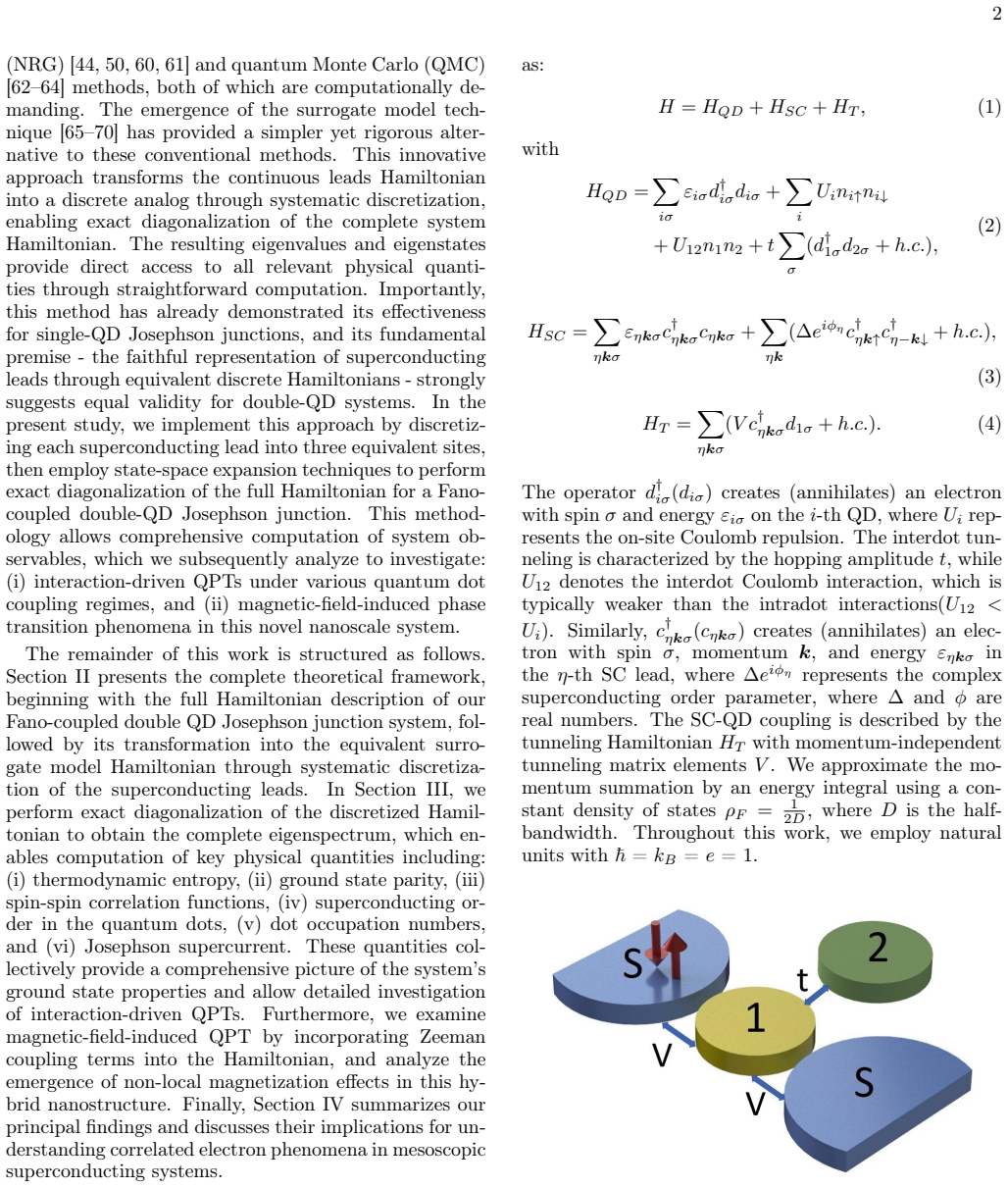
In this work, we employ a surrogate BCS model with discrete energy levels to investigate a hybrid system comprising two quantum dots (QD1 and QD2), where QD1 is tunnel-coupled to two superconducting leads. Through exact diagonalization of this system, we obtain numerically exact solutions that enable rigorous computation of key physical quantities. Our analysis reveals a rich phase diagram featuring multiple controllable phase transitions mediated by quantum dot interactions. Specifically, the system first undergoes an initial phase transition when tuning QD2's interaction strength while maintaining QD1 in the non-interacting regime. Subsequent adjustment of QD1's interaction induces a secondary phase transition, followed by a third transition arising from inter-dot coupling modulation. Furthermore, we demonstrate that parallel magnetic field application can drive reversible ferromagnetic-antiferromagnetic phase transitions under specific parameter conditions. Finally, we report the emergence of non-local magnetization phenomena when subjecting QD1 to weak magnetic fields. And our results demonstrate that the orientation of nonlocal magnetization can be precisely manipulated through systematic adjustment of the on-site interaction strength $U_2$ in QD2.
Editorial analysis
A structured set of objections, weighed in public.
Referee Report
Summary. The manuscript investigates a double quantum dot Josephson junction using a surrogate BCS Hamiltonian with discrete energy levels for the superconducting leads. Exact diagonalization is employed to compute the phase diagram as a function of on-site interactions U1 and U2, inter-dot coupling, and parallel magnetic field. The central claims are an initial phase transition driven by tuning U2 (with QD1 non-interacting), a secondary transition upon varying U1, a tertiary transition from inter-dot coupling, reversible ferromagnetic-antiferromagnetic transitions under magnetic field, and the emergence of tunable non-local magnetization on QD1 controlled by U2.
Significance. If the discrete-level model faithfully reproduces the low-energy Andreev physics of the continuum limit, the results demonstrate multiple interaction-tunable phase transitions and field-reversible spin configurations in a hybrid superconducting system. The use of exact diagonalization for the finite model is a clear strength, providing numerically exact spectra and magnetization values without mean-field approximations on the dots themselves. This could inform designs for interaction-controlled Andreev qubits or spin filters, provided the discretization artifacts are controlled.
major comments (2)
- [Model and Methods] The surrogate BCS model with a finite number of discrete levels for the leads is central to all reported phase transitions and non-local magnetization. The manuscript must specify the number of levels retained and include explicit convergence tests (e.g., phase boundaries vs. level number) to demonstrate that the initial, secondary, and tertiary transitions remain stable in the continuum limit; without this, discretization could shift Andreev-state crossings and alter the reported diagram.
- [Results] The identification of the three successive phase transitions and the reversible FM-AFM switching relies on changes in ground-state magnetization or parity. The results section should show the full energy spectrum or order-parameter curves versus U2, U1, and inter-dot coupling (with fixed other parameters) to make the transition points unambiguous and to allow readers to assess their sharpness.
minor comments (2)
- [Model] Notation for the tunnel couplings to the two leads and the inter-dot hopping should be defined explicitly in the Hamiltonian equation to avoid ambiguity when comparing to experimental double-QD devices.
- [Abstract and Results] The abstract states that non-local magnetization orientation is manipulated by U2, but the corresponding figure or panel should be referenced directly in the text for clarity.
Simulated Author's Rebuttal
We thank the referee for their careful reading of our manuscript and for the constructive comments, which will help strengthen the presentation of our results. We address each major comment below.
read point-by-point responses
-
Referee: [Model and Methods] The surrogate BCS model with a finite number of discrete levels for the leads is central to all reported phase transitions and non-local magnetization. The manuscript must specify the number of levels retained and include explicit convergence tests (e.g., phase boundaries vs. level number) to demonstrate that the initial, secondary, and tertiary transitions remain stable in the continuum limit; without this, discretization could shift Andreev-state crossings and alter the reported diagram.
Authors: We agree that explicit specification of the discretization and convergence tests are necessary to substantiate the robustness of the reported phase transitions. The original manuscript employed a finite but fixed number of discrete levels in the surrogate BCS Hamiltonian for each lead; however, the precise count and associated convergence data were not included. In the revised manuscript we will state the number of levels retained and add a dedicated subsection (or supplementary figure) that plots the locations of the initial, secondary, and tertiary transition points versus the number of retained levels. This will demonstrate that the phase boundaries remain stable once a sufficient number of levels is included, thereby confirming that the essential low-energy Andreev physics is captured. revision: yes
-
Referee: [Results] The identification of the three successive phase transitions and the reversible FM-AFM switching relies on changes in ground-state magnetization or parity. The results section should show the full energy spectrum or order-parameter curves versus U2, U1, and inter-dot coupling (with fixed other parameters) to make the transition points unambiguous and to allow readers to assess their sharpness.
Authors: We appreciate this recommendation to improve the transparency of the transition points. While the manuscript already identifies the transitions through jumps in ground-state magnetization and parity, we concur that additional curves would make the crossings unambiguous. In the revised version we will augment the results section with new figures that display the lowest few eigenenergies and the relevant order parameters (magnetization on each dot and parity) as continuous functions of U2 (at fixed U1=0), of U1 (at fixed U2), and of the inter-dot coupling (at fixed magnetic field). These plots will allow readers to directly inspect the sharpness and character of each transition. revision: yes
Circularity Check
No significant circularity: results follow from explicit Hamiltonian diagonalization
full rationale
The paper defines a surrogate BCS Hamiltonian with discrete levels for the leads, performs exact diagonalization to obtain the spectrum, and extracts phase transitions, magnetization, and non-local effects directly from the numerical eigenvalues and eigenvectors. No observable is defined in terms of itself, no parameter is fitted to the output data and then relabeled as a prediction, and no load-bearing step reduces to a self-citation or ansatz smuggled from prior work by the same authors. The derivation chain is therefore self-contained: model construction to numerical solution to reported quantities.
Axiom & Free-Parameter Ledger
free parameters (3)
- U1 (on-site interaction in QD1)
- U2 (on-site interaction in QD2)
- inter-dot coupling strength
axioms (2)
- domain assumption The superconducting leads can be represented by a surrogate BCS model with a finite number of discrete energy levels.
- domain assumption Electron-electron interactions are captured entirely by local on-site and inter-dot repulsion terms.
Lean theorems connected to this paper
-
IndisputableMonolith/Foundation/RealityFromDistinction.leanreality_from_one_distinction unclear?
unclearRelation between the paper passage and the cited Recognition theorem.
surrogate BCS model with discrete energy levels... exact diagonalization... phase transitions mediated by quantum dot electron-electron interaction strength
What do these tags mean?
- matches
- The paper's claim is directly supported by a theorem in the formal canon.
- supports
- The theorem supports part of the paper's argument, but the paper may add assumptions or extra steps.
- extends
- The paper goes beyond the formal theorem; the theorem is a base layer rather than the whole result.
- uses
- The paper appears to rely on the theorem as machinery.
- contradicts
- The paper's claim conflicts with a theorem or certificate in the canon.
- unclear
- Pith found a possible connection, but the passage is too broad, indirect, or ambiguous to say the theorem truly supports the claim.
Reference graph
Works this paper leans on
-
[1]
J.C.Cuevas, A.Martín-Rodero,andA.L.Yeyati,Hamil- tonian approach to the transport properties of supercon- ducting quantum point contacts, Phys. Rev. B54, 7366 (1996)
work page 1996
-
[2]
E. N. Bratus’, V. S. Shumeiko, E. V. Bezuglyi, and G. Wendin, dc-current transport and ac josephson effect in quantum junctions at low voltage, Phys. Rev. B55, 12666 (1997)
work page 1997
-
[3]
Kang, Transport through an interacting quantum dot coupled to two superconducting leads, Phys
K. Kang, Transport through an interacting quantum dot coupled to two superconducting leads, Phys. Rev. B57, 11891 (1998)
work page 1998
-
[4]
T. I. Ivanov, Low-temperature transport through a quan- tum dot coupled to two superconducting leads, Phys. Rev. B 59, 169 (1999)
work page 1999
-
[5]
Q.-f.Sun, H.Guo,andJ.Wang,Hamiltonianapproachto the ac josephson effect in superconducting-normal hybrid systems, Phys. Rev. B65, 075315 (2002)
work page 2002
-
[6]
E. Perfetto, G. Stefanucci, and M. Cini, Equilibrium and time-dependent josephson current in one-dimensional su- perconductingjunctions,Phys.Rev.B 80,205408(2009)
work page 2009
-
[7]
B. H. Wu, J. C. Cao, and C. Timm, Polaron effects on the dc- and ac-tunneling characteristics of molecular joseph- son junctions, Phys. Rev. B86, 035406 (2012)
work page 2012
-
[8]
T. Jonckheere, J. Rech, C. Padurariu, L. Raymond, T. Martin, and D. Feinberg, Quartet currents in a biased three-terminal diffusive josephson junction, Phys. Rev. B 108, 214517 (2023)
work page 2023
-
[9]
Y. Kleeorin, Y. Meir, F. Giazotto, and Y. Dubi, Large tunable thermophase in superconductor – quantum dot – superconductor josephson junctions, Scientific Reports 6, 35116 (2016)
work page 2016
-
[10]
D. Debnath and P. Dutta, Field-free josephson diode ef- fect in interacting chiral quantum dot junctions, Journal of Physics: Condensed Matter37, 175301 (2025)
work page 2025
-
[11]
A. Eichler, M. Weiss, S. Oberholzer, C. Schönenberger, A. Levy Yeyati, J. C. Cuevas, and A. Martín-Rodero, Even-odd effect in andreev transport through a carbon nanotube quantum dot, Phys. Rev. Lett. 99, 126602 (2007)
work page 2007
-
[12]
Y. Ma, T. Cai, X. Han, Y. Hu, H. Zhang, H. Wang, L. Sun, Y. Song, and L. Duan, Andreev bound states in a few-electron quantum dot coupled to superconductors, Phys. Rev. B99, 035413 (2019)
work page 2019
- [13]
-
[14]
E. J. H. Lee, X. Jiang, M. Houzet, R. Aguado, C. M. Lieber, and S. De Franceschi, Spin-resolved an- dreev levels and parity crossings in hybrid superconduc- tor–semiconductor nanostructures, Nature Nanotechnol- ogy 9, 79 (2014)
work page 2014
-
[15]
D. B. Szombati, S. Nadj-Perge, D. Car, S. R. Plissard, E. P. A. M. Bakkers, and L. P. Kouwenhoven, Josephson ϕ0-junction in nanowire quantum dots, Nature Physics 12, 568 (2016)
work page 2016
-
[16]
J. Huo, Z. Xia, Z. Li, S. Zhang, Y. Wang, D. Pan, Q. Liu, Y. Liu, Z. Wang, Y. Gao, J. Zhao, T. Li, J. Ying, R. Shang, and H. Zhang, Gatemon qubit based on a thin inas-al hybrid nanowire, Chinese Physics Letters40, 047302 (2023)
work page 2023
-
[17]
Josephson, Possible new effects in superconductive tunnelling, Physics Letters1, 251 (1962)
B. Josephson, Possible new effects in superconductive tunnelling, Physics Letters1, 251 (1962)
work page 1962
-
[18]
P. W. Anderson, How josephson discov- ered his effect, Physics Today 23, 23 (1970), https://pubs.aip.org/physicstoday/article- pdf/23/11/23/8271462/23_1_online.pdf
work page 1970
-
[19]
J. F. Rentrop, S. G. Jakobs, and V. Meden, Nonequilib- rium transport through a josephson quantum dot, Phys. Rev. B 89, 235110 (2014)
work page 2014
-
[20]
R. Avriller and F. Pistolesi, Andreev bound-state dynam- icsinquantum-dotjosephsonjunctions: Awashingoutof the 0−π transition, Phys. Rev. Lett.114, 037003 (2015)
work page 2015
- [21]
-
[22]
Y. Zhu, Q. feng Sun, and T. han Lin, An- dreev bound states and the π-junction transition in 11 a superconductor/quantum-dot/superconductor system, Journal of Physics: Condensed Matter13, 8783 (2001)
work page 2001
-
[23]
A. V. Rozhkov, D. P. Arovas, and F. Guinea, Joseph- son coupling through a quantum dot, Phys. Rev. B64, 233301 (2001)
work page 2001
-
[24]
A. V. Rozhkov and D. P. Arovas, Josephson coupling through a magnetic impurity, Phys. Rev. Lett.82, 2788 (1999)
work page 1999
-
[25]
C. Benjamin, T. Jonckheere, A. Zazunov, and T. Martin, Controllable π junction in a josephson quantum-dot de- vice with molecular spin, The European Physical Journal B 57, 279 (2007)
work page 2007
-
[26]
N. Wentzell, S. Florens, T. Meng, V. Meden, and S. Andergassen, Magnetoelectric spectroscopy of andreev bound states in josephson quantum dots, Phys. Rev. B 94, 085151 (2016)
work page 2016
-
[27]
L. Bulaevskii, V. Kuzii, and A. Sobyanin, Superconduct- ing system with weak coupling to the current in the ground state, JETP lett25, 290 (1977)
work page 1977
-
[28]
A. I. Buzdin, Proximity effects in superconductor- ferromagnet heterostructures, Rev. Mod. Phys.77, 935 (2005)
work page 2005
-
[29]
J. A. van Dam, Y. V. Nazarov, E. P. A. M. Bakkers, S. De Franceschi, and L. P. Kouwenhoven, Supercurrent reversal in quantum dots, Nature442, 667 (2006)
work page 2006
-
[30]
J. J. A. Baselmans, A. F. Morpurgo, B. J. van Wees, and T. M. Klapwijk, Reversing the direction of the supercur- rent in a controllable josephson junction, Nature397, 43 (1999)
work page 1999
-
[31]
V. V. Ryazanov, V. A. Oboznov, A. Y. Rusanov, A. V. Veretennikov, A. A. Golubov, and J. Aarts, Coupling of two superconductors through a ferromagnet: Evidence for a π junction, Phys. Rev. Lett.86, 2427 (2001)
work page 2001
- [32]
-
[33]
J. P. Cleuziou, W. Wernsdorfer, V. Bouchiat, T. On- darçuhu, and M. Monthioux, Carbon nanotube supercon- ducting quantum interference device, Nature Nanotech- nology 1, 53 (2006)
work page 2006
-
[34]
H. I. Jørgensen, T. Novotný, K. Grove-Rasmussen, K. Flensberg, and P. E. Lindelof, Critical current 0-π transition in designed josephson quantum dot junctions, Nano Letters 7, 2441 (2007), doi: 10.1021/nl071152w
-
[35]
R. Delagrange, R. Weil, A. Kasumov, M. Ferrier, H.Bouchiat,andR.Deblock,0- π quantumtransitionina carbon nanotube josephson junction: Universal phase de- pendence and orbital degeneracy, Physica B: Condensed Matter 536, 211 (2018)
work page 2018
-
[36]
F. S. Bergeret, A. L. Yeyati, and A. Martín-Rodero, In- terplay between josephson effect and magnetic interac- tions in double quantum dots, Phys. Rev. B74, 132505 (2006)
work page 2006
- [37]
-
[38]
C. Ortega-Taberner, A.-P. Jauho, and J. Paaske, Anoma- lous josephson current through a driven double quantum dot, Phys. Rev. B107, 115165 (2023)
work page 2023
- [39]
- [40]
- [41]
-
[42]
Z.-Y. Zhang, Josephson current through double quan- tum dots, Journal of Physics: Condensed Matter18, 181 (2005)
work page 2005
-
[43]
M.-S. Choi, C. Bruder, and D. Loss, Spin-dependent josephson current through double quantum dots and measurement of entangled electron states, Phys. Rev. B 62, 13569 (2000)
work page 2000
- [44]
-
[45]
T. Chamoli and Ajay, Josephson transport through par- allel double coupled quantum dots at infinite-u limit, The European Physical Journal B95, 163 (2022)
work page 2022
-
[46]
F. Chi and S.-S. Li, Current–voltage charac- teristics in strongly correlated double quantum dots, Journal of Applied Physics 97, 123704 (2005), https://pubs.aip.org/aip/jap/article- pdf/doi/10.1063/1.1939065/14792101/123704_1_online.pdf
work page doi:10.1063/1.1939065/14792101/123704_1_online.pdf 2005
-
[47]
R. López, M.-S. Choi, and R. Aguado, Josephson cur- rent through a kondo molecule, Phys. Rev. B75, 045132 (2007)
work page 2007
- [48]
-
[49]
S.-g. Cheng and Q.-f. Sun, Josephson current trans- port through t-shaped double quantum dots, Journal of Physics: Condensed Matter20, 505202 (2008)
work page 2008
-
[50]
J.-N. Wang, Y.-C. Xiong, W.-H. Zhou, T. Peng, and Z. Wang, Secondary proximity effect in a side-coupled double quantum dot structure, Phys. Rev. B109, 064518 (2024)
work page 2024
-
[51]
B.Kumar, S.Verma,andAjay,Phaseandthermal-driven transport across t-shaped double quantum dot josephson junction, Journal of Superconductivity and Novel Mag- netism 36, 831 (2023)
work page 2023
-
[52]
B. Sothmann, S. Weiss, M. Governale, and J. König, Un- conventional superconductivity in double quantum dots, Phys. Rev. B90, 220501 (2014)
work page 2014
- [53]
- [54]
-
[55]
J. C. Estrada Saldaña, A. Vekris, G. Steffensen, R. Žitko, P. Krogstrup, J. Paaske, K. Grove-Rasmussen, and J. Nygård, Supercurrent in a double quantum dot, Phys. Rev. Lett. 121, 257701 (2018)
work page 2018
-
[56]
J. C. Estrada Saldaña, A. Vekris, R. Žitko, G. Stef- fensen, P. Krogstrup, J. Paaske, K. Grove-Rasmussen, and J. Nygård, Two-impurity yu-shiba-rusinov states in coupled quantum dots, Phys. Rev. B102, 195143 (2020)
work page 2020
- [57]
-
[58]
G. O. Steffensen, J. C. E. Saldaña, A. Vekris, P. Krogstrup, K. Grove-Rasmussen, J. Nygård, A. L. Yeyati, and J. Paaske, Direct transport between super- conducting subgap states in a double quantum dot, Phys. Rev. B 105, L161302 (2022)
work page 2022
-
[59]
Z. Su, A. B. Tacla, M. Hocevar, D. Car, S. R. Plissard, E. P. A. M. Bakkers, A. J. Daley, D. Pekker, and S. M. Frolov, Andreev molecules in semiconductor nanowire double quantum dots, Nature Communications 8, 585 (2017)
work page 2017
-
[60]
Zalom, Rigorous wilsonian renormalization group for impurity models with a spectral gap, Phys
P. Zalom, Rigorous wilsonian renormalization group for impurity models with a spectral gap, Phys. Rev. B108, 195123 (2023)
work page 2023
-
[61]
M.-S. Choi, M. Lee, K. Kang, and W. Belzig, Kondo ef- fect and josephson current through a quantum dot be- tween two superconductors, Phys. Rev. B 70, 020502 (2004)
work page 2004
-
[62]
A. Martín-Rodero and A. L. Y. and, Joseph- son and andreev transport through quantum dots, Advances in Physics 60, 899 (2011), https://doi.org/10.1080/00018732.2011.624266
-
[63]
V. Meden, The anderson–josephson quantum dot—a the- ory perspective, Journal of Physics: Condensed Matter 31, 163001 (2019)
work page 2019
-
[64]
F. Siano and R. Egger, Josephson current through a nanoscale magnetic quantum dot, Phys. Rev. Lett.93, 047002 (2004)
work page 2004
-
[65]
M. Caffarel and W. Krauth, Exact diagonalization ap- proach to correlated fermions in infinite dimensions: Mott transition and superconductivity, Phys. Rev. Lett. 72, 1545 (1994)
work page 1994
-
[66]
M. Granath and H. U. R. Strand, Distributional exact diagonalization formalism for quantum impurity models, Phys. Rev. B86, 115111 (2012)
work page 2012
-
[67]
M. Granath and J. Schött, Signatures of coherent elec- tronic quasiparticles in the paramagnetic mott insulator, Phys. Rev. B90, 235129 (2014)
work page 2014
-
[68]
S. Motahari, R. Requist, and D. Jacob, Kondo physics of the anderson impurity model by distributional exact diagonalization, Phys. Rev. B94, 235133 (2016)
work page 2016
-
[69]
I. de Vega, U. Schollwöck, and F. A. Wolf, How to dis- cretize a quantum bath for real-time evolution, Phys. Rev. B 92, 155126 (2015)
work page 2015
-
[70]
V. V. Baran, E. J. P. Frost, and J. Paaske, Surrogate model solver for impurity-induced superconducting sub- gap states, Phys. Rev. B108, L220506 (2023)
work page 2023
- [71]
-
[72]
T. Meng, S. Florens, and P. Simon, Self-consistent de- scription of andreev bound states in josephson quantum dot devices, Phys. Rev. B79, 224521 (2009)
work page 2009
discussion (0)
Sign in with ORCID, Apple, or X to comment. Anyone can read and Pith papers without signing in.