REVIEW 4 major objections 4 minor 65 references
A composite of the effects of major sudden stratospheric warming events on carbon dioxide radiative cooling in the mesosphere-lower-thermosphere
T0 review · 4 major / 4 minor · reviewed 2026-08-06 · deepseek-v4-flash
Pith's one-line read Polar CO2 cooling drops about 35 percent during sudden stratospheric warmings.
desk verdict A useful multi-event composite of CO2 cooling changes during SSWs, but the central O-vs-temperature attribution rests on an undocumented one-factor-at-a-time decomposition that needs equations, residual reporting, and uncertainty before the numbers can be trusted. read the letter →
The pith
A machine-rendered reading of the paper's core claim, the machinery that carries it, and where it could break.
The reading
What carries the argument
The carrying object is the CO2 15 µm vibrational emission rate, proportional to the population ratio CO2(0110)/CO2(0000), which is set by collisional excitation and quenching. Temperature controls the availability of the excited state, and atomic oxygen is the key collision partner above roughly 80 km. The paper computes composite emission rates with each of temperature, O density, and CO2 density varied while the other two are held at pre-SSW values, producing a one-at-a-time attribution of the cooling change; the vertical residual circulation is the dynamic link that moves O-poor, CO2-rich air up during SSWs and O-rich, CO2-poor air down afterward.
What would settle it
Run a non-LTE radiative transfer calculation on the composite profiles, perturbing temperature, O density, and CO2 density simultaneously as observed, and compare the cooling change with the sum of the paper's three one-at-a-time contributions; if the joint response differs by more than the quoted percentages, the O-density dominance claim fails.
Extended reading notes
Core claim
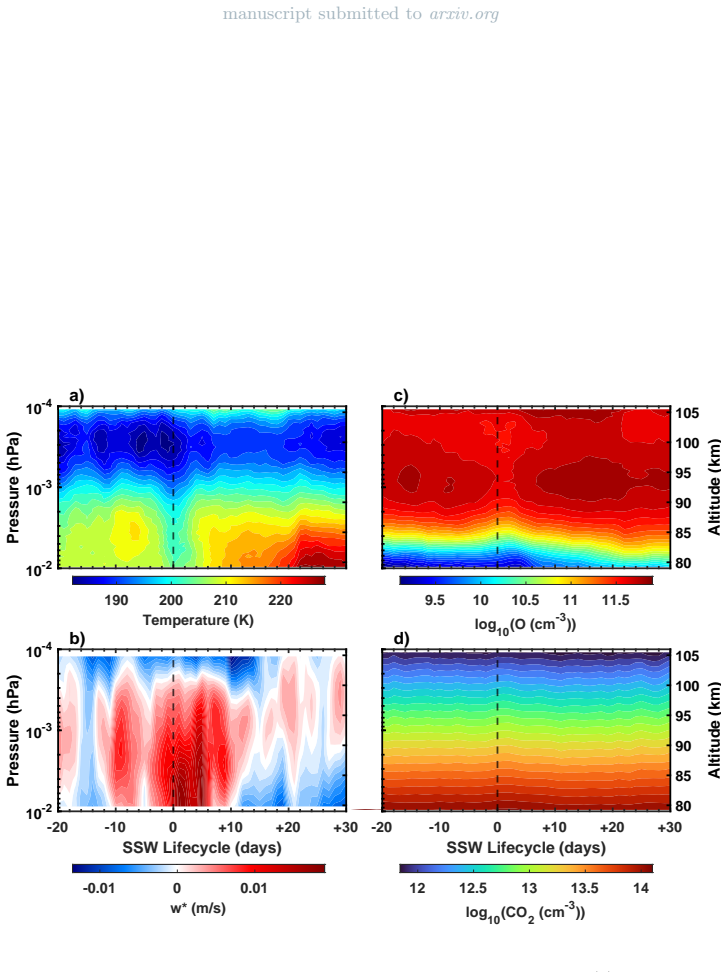
The paper's central claim is that major SSW events reorganize CO2 15 µm radiative cooling in the polar MLT through circulation-driven changes in temperature and atomic oxygen, not through CO2 abundance. During SSW onset, upwelling cools the polar mesosphere and carries O-poor air upward; both effects reduce collisional excitation of CO2's bending mode and cut cooling by about 35 percent. After the event, downwelling warms the mesosphere and brings O-rich air downward, raising cooling by about 25 percent. The paper shows the emission rate responds more to O density changes (about 23 percent decrease at onset) than to temperature changes (about 12 percent decrease), whereas CO2 density changes produce only about 8 percent increase, and concludes that oxygen transport is the dominant dynamic control.
Load-bearing premise
The attribution rests on assuming the cooling response can be decomposed by changing temperature, oxygen, and CO2 one at a time while holding the other two fixed, which ignores how those variables move together and any nonlinear interactions.
Editorial extensions
If this is right
- SSW-driven swings of about 35 percent down and 25 percent up in polar MLT CO2 cooling imply a substantial episodic perturbation to the mesospheric heat budget during and after each event.
- Because atomic oxygen transport rather than CO2 abundance drives the signal, models that misrepresent or smooth vertical residual circulation will misplace the cooling anomaly.
- Composite behavior is consistent across the eight events, so the pattern should be expected in most major northern-hemisphere SSWs, with event-specific magnitudes as seen in 2009 versus 2010.
- The opposite tendency between CO2 density and cooling means CO2 concentration alone cannot be used as a proxy for radiative cooling during SSWs.
Reading between the lines
- If O transport dominates, future parameterizations of MLT energy balance may need to track atomic oxygen advection rather than only temperature, an extension the paper does not develop.
- The same one-at-a-time decomposition could be applied to other radiative emitters, such as NO or H2O bands, to see whether SSW circulation changes shift their cooling contributions as well.
- The 2009 and 2010 cases show comparable cooling swings despite different O responses, suggesting that the cooling response may depend on whether the vortex was already disturbed by a preceding minor SSW.
- With a longer event record, the composite could be stratified by elevated-stratopause versus non-elevated-stratopause events to test whether the O-transport dominance is universal.
Editorial analysis
A structured set of objections, weighed in public.
Referee Report
Summary. The manuscript presents a composite analysis of eight major sudden stratospheric warming (SSW) events between 2005 and 2020, using TIMED/SABER temperature, atomic oxygen, and CO2 15 micron radiative cooling data, ACE-FTS CO2 density, and SD-WACCM-X residual circulation. The main claim is that in the polar MLT (60-70N), CO2 radiative cooling decreases during the SSW main phase and increases during recovery, with the dominant causes being temperature perturbations and atomic oxygen transport, while CO2 density variability plays a minor role. The evidence includes composite time series at a pressure level near 0.003 hPa, two case studies (2009 and 2010), and a one-factor-at-a-time decomposition of 15 micron emission rates in Figure 5. The qualitative pattern is coherent and consistent across the composite and the two cases, but the quantitative attribution and the reported percentages are not fully auditable as presented.
Significance. If the results hold, this would be one of the first composite observational characterizations of CO2 radiative cooling changes in the MLT during major SSWs, extending the authors' earlier single-event study to a multi-event composite and linking the cooling changes to vertical residual circulation and atomic oxygen transport. The use of direct SABER level 2B cooling products, publicly available ACE-FTS CO2 profiles, and a WACCM-X specified-dynamics circulation output is a strength, and the consistent sign of the composite response across events is encouraging. However, the central attribution O>temperature>CO2 rests on an undocumented decomposition that has not been shown to be additive, and the reported percentage contributions are internally inconsistent in the recovery phase; this is the load-bearing weakness. No uncertainty quantification or significance testing is provided for the composite percentages, which limits the strength of the quantitative claims.
major comments (4)
- [Section 3, Figure 5] The one-factor-at-a-time decomposition of the 15 micron emission rate is not reproducible as written. No equation for the emission rate E(T,[O],[CO2]) is given, and the text only states that each parameter is varied while the others are held at their pre-SSW values. Because the CO2 v2 emission process depends nonlinearly on temperature and atomic oxygen through collisional excitation and quenching, an additive decomposition must be justified: the cross term (d^2 E/dT d[O]) dT d[O] and the correlated covariance of T and O are simply discarded. The reported numbers themselves indicate the problem: during the SSW phase the single-variable contributions sum to -12% -23% +8% = -27%, close to the stated total of -25%, but in the recovery phase they sum to +15% +28% -10% = +33%, leaving about 7 percentage points of the stated +40% total unexplained. The paper must state the explicit emission-rate formula, define the baseline averaging window, report the residual (total minus sum of single-variable contributions), and provide a sensitivity test of the decomposition. Until this is done, the ranking O > temperature > CO2 in the paragraph describing Figure 5 is not auditable.
- [Section 3, Figure 3] The composite percentage changes are quoted without any measure of uncertainty or significance. The text reports, for example, approximately 35% reduction in CO2 radiative cooling during SSW occurrence and 25% enhancement during recovery at 0.003 hPa, but no event-to-event spread, confidence interval, or significance test is given. This matters because the 2009 and 2010 case studies in Figure 4 show markedly different magnitudes (50% and 45% cooling reductions, respectively), so the composite percentages could be driven by a subset of events. At minimum, the authors should provide the per-event scatter or a bootstrap confidence interval for the composite percentage changes, and should state whether the composite anomalies differ significantly from zero.
- [Figure 3 caption versus text] The altitude attributed to the composite time series is inconsistent. The caption of Figure 3 states the averages are taken at 0.001 hPa, while the text in Section 3 states the same quantities are shown at 0.003 hPa, and Figure 5 is described as being at 0.0035 hPa. The quantitative claims (35%, 25%, 50%, 90%, and the decomposition percentages) must be tied to a single, clearly stated pressure level or altitude; otherwise the reader cannot tell which surface the composite cooling changes apply to.
- [Section 2] The eight major SSW events included in the composite are never explicitly enumerated. The text says that eight events were identified between 2005 and 2020 based on MERRA-2 zonal-mean wind reversal and poleward temperature gradient, but the individual winters are only implied through Figure 1. Because the composite central day and the pre-SSW averaging window (day -15 to -8) are event-specific, a table listing the events, their onset dates, and the central day used for each would be needed for the composite to be reproducible.
minor comments (4)
- [Section 3] The sentence 'There are some cases of major SSW events preceding the minor SSW events, e.g., 2006, 2007, 2008, 2010, and 2018, 2019' appears to reverse the sequence described later in the text, where a minor SSW precedes the major event in 2010; the wording should be corrected to avoid confusion.
- [Section 3] Several typographical errors should be fixed: 'limitted' should be 'limited', 'arround' should be 'around', and 'It can be suggest' should be 'It can be suggested' (or 'one can suggest').
- [Figure 5] The y-axis label of Figure 5 reads 'Emission Rate' with units photons cm^-3 s^-1, but the text discusses relative percentage contributions to the emission rate variability; it would be clearer to state explicitly in the caption that the curves show emission rates computed with only one parameter varying from its pre-SSW value.
- [References] The Data Availability section contains broken URLs with spaces (e.g., 'http:// gats-inc.com/projects saber.htm' and 'http://www.ace.uwaterloo.ca/data.php' is fine but the SABER link should be repaired); the references should also be checked for consistent formatting.
Circularity Check
No significant circularity: the composite SSW analysis and the O-over-temperature attribution rest on independent observational data and an external emission-rate relation, not on self-defined or fitted inputs.
full rationale
The paper's central claims are derived from composite SABER temperature, O density, and CO2 radiative cooling data, ACE-FTS CO2 density data, and SD-WACCM-X vertical residual circulation. The emission-rate decomposition in Section 3 and Figure 5 is a one-factor-at-a-time sensitivity calculation based on the published CO2 15 um emission-rate relation (Khomich et al., 2008; Castle et al., 2012), not on a parameter fitted to the cooling data itself. The cooling data are direct SABER level 2B products, and the decomposition holds other variables fixed at pre-SSW values to isolate individual contributions; this is a standard, if imperfect, attribution approach and does not make the prediction equivalent to its input. The authors' prior single-event study (Kumar et al., 2024b) is cited as motivation and context, not as the source of the composite numbers or the decomposition, so the self-citation is not load-bearing. The weaknesses noted by the skeptic, such as the unquantified cross-term residual in the one-factor-at-a-time decomposition and the unexplained recovery-phase percentage gap, are correctness and robustness concerns, not circularity: they do not show that the derivation reduces by construction to its own inputs. No fitted parameter is renamed as a prediction, no uniqueness theorem is imported, and no known result is relabeled as a new derivation. The paper is self-contained against external benchmarks, so the appropriate circularity score is 0.
Assumptions & free parameters
free parameters (1)
- pre-SSW baseline averaging window =
day -15 to -8 relative to central day (and DoY 10-15 for the 2010 case)
assumptions (4)
- domain assumption SABER V2.07 retrievals of temperature, O density, and CO2 radiative cooling have biases small enough for composite percentage changes at 80-100 km.
- domain assumption SD-WACCM-X specified-dynamics vertical residual circulation w* accurately represents the MLT vertical transport in the 60-70N polar region.
- domain assumption The 15 um emission-rate parameterization from Khomich et al. (2008), with quenching rates from Castle et al. (2012), is valid at the analysis altitude of about 85 km.
- domain assumption ACE-FTS solar occultation sampling provides representative zonal-mean daily CO2 densities in the polar MLT.
Cite this review
Pith. "Pith review of A composite of the effects of major sudden stratospheric warming events on carbon dioxide radiative cooling in the mesosphere-lower-thermosphere." pith.science (2026). https://pith.science/paper/DTHE2GGH
@misc{pith2026250623764,
  author       = {Pith},
  title        = {Pith review of: A composite of the effects of major sudden stratospheric warming events on carbon dioxide radiative cooling in the mesosphere-lower-thermosphere},
  year         = {2026},
  howpublished = {\url{https://pith.science/paper/DTHE2GGH}},
  note         = {Machine review of arXiv:2506.23764}
}
abstract
The major sudden stratospheric warming (SSW) events strongly influence the mean structure of the entire atmosphere, from the troposphere to the thermosphere. These events disrupt the compositional and thermal structure of the mesosphere and lower thermosphere (MLT), causing spatiotemporal variations in the concentration of trace species of this region. Currently, the role of dynamical changes during SSW events on radiative cooling in the MLT region is not well understood. An investigation of the SSW-induced changes in CO$_2$ radiative cooling in the MLT region is presented by examining the changes in the dynamics and transport of key species, such as CO$_2$ and atomic oxygen (O). A composite analysis has been performed to understand these changes during the major SSW events that occurred between 2005 and 2020. The variation of trace species is found to be associated with the change in vertical residual circulation. The results also show that CO$_2$ radiative cooling decreases during the mesospheric cooling that occurs during the stratospheric warming over the polar region. During the recovery stage of the SSW event, the CO$_2$ radiative cooling enhances in the mesosphere. These variations in CO$_2$ radiative cooling are mainly caused by temperature perturbations and oxygen transport in the MLT region. The contribution of temperature change and transport have also been investigated in detail.
Figures


Figures from the paper (3 more)


Reference graph
Works this paper leans on
-
[1]
ACE_FTS APACrefauthors ACE-FTS-Team. APACrefauthors \ 2003 . Atmospheric Chemistry Experiment Fourier Transform Spectrometer Dataset . Atmospheric Chemistry Experiment Fourier Transform Spectrometer Dataset . Canadian Space Agency [Dataset] . APACrefURL http://www.ace.uwaterloo.ca/data.php APACrefURL
work page 2003
-
[2]
akmaev2006impact APACrefauthors Akmaev, R. , Fomichev, V. \ Zhu, X. APACrefauthors \ 2006 . Impact of middle-atmospheric composition changes on greenhouse cooling in the upper atmosphere Impact of middle-atmospheric composition changes on greenhouse cooling in the upper atmosphere . Journal of atmospheric and solar-terrestrial physics 68 17 1879--1889 . A...
-
[3]
andrews1987middle APACrefauthors Andrews, D G. , Holton, J R. \ Leovy, C B. APACrefauthors \ 1987 . Middle atmosphere dynamics Middle atmosphere dynamics \ ( 40). Academic press
work page 1987
-
[4]
bailey2014multi APACrefauthors Bailey, S. , Thurairajah, B. , Randall, C. , Holt, L. , Siskind, D. , Harvey, V. Russell, J. APACrefauthors \ 2014 . A multi tracer analysis of thermosphere to stratosphere descent triggered by the 2013 Stratospheric Sudden Warming A multi tracer analysis of thermosphere to stratosphere descent triggered by the 2013 stratosp...
-
[5]
baldwin2021sudden APACrefauthors Baldwin, M P. , Ayarzag \"u ena, B. , Birner, T. , Butchart, N. , Butler, A H. , Charlton-Perez, A J. others APACrefauthors \ 2021 . Sudden stratospheric warmings Sudden stratospheric warmings . Reviews of Geophysics 59 1 e2020RG000708 . APACrefDOI doi:https://doi.org/10.1029/2020RG000708 APACrefDOI
-
[6]
butler2015defining APACrefauthors Butler, A H. , Seidel, D J. , Hardiman, S C. , Butchart, N. , Birner, T. \ Match, A. APACrefauthors \ 2015 . Defining sudden stratospheric warmings Defining sudden stratospheric warmings . Bulletin of the American Meteorological Society 96 11 1913--1928 . APACrefDOI doi:https://doi.org/10.1175/BAMS-D-13-00173.1 APACrefDOI
-
[7]
castle2012vibrational APACrefauthors Castle, K J. , Black, L A. , Simione, M W. \ Dodd, J A. APACrefauthors \ 2012 . Vibrational Relaxation of CO2 ( 2) by O (3P) in the 142--490 K Temperature Range Vibrational relaxation of co2 ( 2) by o (3p) in the 142--490 k temperature range . Journal of Geophysical Research: Space Physics 117 A4 . APACrefDOI doi:https...
-
[8]
castle2006vibrational APACrefauthors Castle, K J. , Kleissas, K M. , Rhinehart, J M. , Hwang, E S. \ Dodd, J A. APACrefauthors \ 2006 . Vibrational relaxation of CO2 ( 2) by atomic oxygen Vibrational relaxation of co2 ( 2) by atomic oxygen . Journal of Geophysical Research: Space Physics 111 A9 . APACrefDOI doi:https://doi.org/10.1029/2006JA011736 APACrefDOI
Show all 65 references
-
[9]
, Kockarts, G
chabrillat2002impact APACrefauthors Chabrillat, S. , Kockarts, G. , Fonteyn, D. \ Brasseur, G. APACrefauthors \ 2002 . Impact of molecular diffusion on the CO2 distribution and the temperature in the mesosphere Impact of molecular diffusion on the co2 distribution and the temp...
2002 doi
-
[10]
, Collins, R
chandran2014stratosphere APACrefauthors Chandran, A. , Collins, R. \ Harvey, V. APACrefauthors \ 2014 . Stratosphere-mesosphere coupling during stratospheric sudden warming events Stratosphere-mesosphere coupling during stratospheric sudden warming events . Advances in Space R...
2014 doi
-
[11]
\ Polvani, L M
charlton2007new APACrefauthors Charlton, A J. \ Polvani, L M. APACrefauthors \ 2007 . A new look at stratospheric sudden warmings. Part I: Climatology and modeling benchmarks A new look at stratospheric sudden warmings. part i: Climatology and modeling benchmarks . Journal of ...
2007 doi
-
[12]
, Storini, M
damiani2010variability APACrefauthors Damiani, A. , Storini, M. , Santee, M. \ Wang, S. APACrefauthors \ 2010 . Variability of the nighttime OH layer and mesospheric ozone at high latitudes during northern winter: influence of meteorology Variability of the nighttime oh layer ...
2010 doi
-
[13]
, Abalos, M
de2018changes APACrefauthors de la C \'a mara, A. , Abalos, M. \ Hitchcock, P. APACrefauthors \ 2018 . Changes in stratospheric transport and mixing during sudden stratospheric warmings Changes in stratospheric transport and mixing during sudden stratospheric warmings . Journa...
2018 doi
-
[14]
APACrefauthors \ 1984
dickinson1984infrared APACrefauthors Dickinson, R E. APACrefauthors \ 1984 . Infrared radiative cooling in the mesosphere and lower thermosphere Infrared radiative cooling in the mesosphere and lower thermosphere . Journal of atmospheric and terrestrial physics 46 11 995--1008...
1984 doi
-
[15]
, Mlynczak, M G
esplin2023sounding APACrefauthors Esplin, R. , Mlynczak, M G. , Russell, J. , Gordley, L. \ Team, S. APACrefauthors \ 2023 . Sounding of the Atmosphere using Broadband Emission Radiometry (SABER): Instrument and science measurement description Sounding of the atmosphere using ...
2023 doi
-
[16]
\ Pitts Jr, J N
finlayson1999chemistry APACrefauthors Finlayson-Pitts, B J. \ Pitts Jr, J N. APACrefauthors \ 1999 . Chemistry of the upper and lower atmosphere: theory, experiments, and applications Chemistry of the upper and lower atmosphere: theory, experiments, and applications . Elsevier...
1999 doi
-
[17]
, Ch \'e din, A
foucher2011carbon APACrefauthors Foucher, P. , Ch \'e din, A. , Armante, R. , Boone, C. , Crevoisier, C. \ Bernath, P. APACrefauthors \ 2011 . Carbon dioxide atmospheric vertical profiles retrieved from space observation using ACE-FTS solar occultation instrument Carbon dioxid...
2011 doi
-
[18]
, L \'o pez-Puertas, M
garcia2016secular APACrefauthors Garcia, R R. , L \'o pez-Puertas, M. , Funke, B. , Kinnison, D E. , Marsh, D R. \ Qian, L. APACrefauthors \ 2016 . On the secular trend of COx and CO2 in the lower thermosphere On the secular trend of cox and co2 in the lower thermosphere . Jou...
2016 doi
-
[19]
, L \'o pez-Puertas, M
garcia2014distribution APACrefauthors Garcia, R R. , L \'o pez-Puertas, M. , Funke, B. , Marsh, D R. , Kinnison, D E. , Smith, A K. \ Gonz \'a lez-Galindo, F. APACrefauthors \ 2014 . On the distribution of CO2 and CO in the mesosphere and lower thermosphere On the distribution...
2014 doi
-
[20]
APACrefauthors \ 2019
WACCM_X2023 APACrefauthors Gasperini, F. APACrefauthors \ 2019 . CCSM run SD-WACCM-X Version 1 Daily Averaged Atmosphere History Data. Ccsm run sd-waccm-x version 1 daily averaged atmosphere history data. Earthsystemgrid [Dataset] . APACrefURL https://rda.ucar.edu/datasets/d65...
2019 doi
-
[21]
, McCarty, W
gelaro2017modern APACrefauthors Gelaro, R. , McCarty, W. , Su \'a rez, M J. , Todling, R. , Molod, A. , Takacs, L. others APACrefauthors \ 2017 . The modern-era retrospective analysis for research and applications, version 2 (MERRA-2) The modern-era retrospective analysis for ...
2017 doi
-
[22]
APACrefauthors \ 2015
MERRA2_2015 APACrefauthors GMAO. APACrefauthors \ 2015 . MERRA-2 inst6_3d_ana_Np : 3d,6-Hourly,Instantaneous,Pressure-Level,Analysis,Analyzed Meteorological Fields V5.12.4, Greenbelt, MD, USA, Goddard Earth Sciences Data and Information Services Center (GES DISC). Merra-2 inst...
2015
-
[23]
APACrefauthors \ 1969
houghton1969absorption APACrefauthors Houghton, J. APACrefauthors \ 1969 . Absorption and emission by carbon-dioxide in the mesosphere Absorption and emission by carbon-dioxide in the mesosphere . Quarterly Journal of the Royal Meteorological Society 95 403 1--20 . APACrefDOI ...
1969 doi
-
[24]
, Semenov, A I
khomich2008airglow APACrefauthors Khomich, V Y. , Semenov, A I. \ Shefov, N N. APACrefauthors \ 2008 . Airglow as an indicator of upper atmospheric structure and dynamics Airglow as an indicator of upper atmospheric structure and dynamics . Springer Science & Business Media . ...
2008 doi
-
[25]
, Mukougawa, H
kodera2016absorbing APACrefauthors Kodera, K. , Mukougawa, H. , Maury, P. , Ueda, M. \ Claud, C. APACrefauthors \ 2016 . Absorbing and reflecting sudden stratospheric warming events and their relationship with tropospheric circulation Absorbing and reflecting sudden stratosphe...
2016 doi
-
[26]
\ London, J
kuhn1969infrared APACrefauthors Kuhn, W R. \ London, J. APACrefauthors \ 1969 . Infrared radiative cooling in the middle atmosphere (30--110 km) Infrared radiative cooling in the middle atmosphere (30--110 km) . Journal of the Atmospheric Sciences 26 2 189--204 . APACrefDOI ht...
1969 doi
-
[27]
, Krishna, M V S
kumar2024influence APACrefauthors Kumar, A. , Krishna, M V S. , Ranjan, A K. , Bender, S. , Sinnhuber, M. \ Sarkhel, S. APACrefauthors \ 2024a . Influence of temperature changes and vertically transported trace species on the structure of MLT region during major SSW events Inf...
-
[28]
, Sunil Krishna, M V
kumar2024effect APACrefauthors Kumar, A. , Sunil Krishna, M V. \ Ranjan, A K. APACrefauthors \ 2024b . Effect of 2009 Major SSW Event on the Mesospheric CO_2 Cooling Effect of 2009 major ssw event on the mesospheric co_2 cooling . Journal of Geophysical Research: Atmospheres 1...
2009 doi
-
[29]
, Ogawa, Y
kurihara2010links APACrefauthors Kurihara, J. , Ogawa, Y. , Oyama, S. , Nozawa, S. , Tsutsumi, M. , Hall, C. Fujii, R. APACrefauthors \ 2010 . Links between a stratospheric sudden warming and thermal structures and dynamics in the high-latitude mesosphere, lower thermosphere, ...
2010
-
[30]
\ Ahuja, D R
lashof1990relative APACrefauthors Lashof, D A. \ Ahuja, D R. APACrefauthors \ 1990 . Relative contributions of greenhouse gas emissions to global warming Relative contributions of greenhouse gas emissions to global warming . Nature 344 6266 529--531 . APACrefDOI doi:https://do...
1990 doi
-
[31]
, McCormack, J P
laskar2019interhemispheric APACrefauthors Laskar, F I. , McCormack, J P. , Chau, J L. , Pallamraju, D. , Hoffmann, P. \ Singh, R P. APACrefauthors \ 2019 . Interhemispheric meridional circulation during sudden stratospheric warming Interhemispheric meridional circulation durin...
2019 doi
-
[32]
APACrefauthors \ 2023
lavstovivcka2023progress APACrefauthors La s tovi c ka, J. APACrefauthors \ 2023 . Progress in investigating long-term trends in the mesosphere, thermosphere, and ionosphere Progress in investigating long-term trends in the mesosphere, thermosphere, and ionosphere . Atmospheri...
2023 doi
-
[33]
, Orsolini, Y J
limpasuvan2016composite APACrefauthors Limpasuvan, V. , Orsolini, Y J. , Chandran, A. , Garcia, R R. \ Smith, A K. APACrefauthors \ 2016 . On the composite response of the MLT to major sudden stratospheric warming events with elevated stratopause On the composite response of t...
2016 doi
-
[34]
, Bardeen, C G
liu2018development APACrefauthors Liu, H L. , Bardeen, C G. , Foster, B T. , Lauritzen, P. , Liu, J. , Lu, G. others APACrefauthors \ 2018 . Development and validation of the Whole Atmosphere Community Climate Model with thermosphere and ionosphere extension (WACCM-X 2.0) Deve...
2018
-
[35]
\ Roble, R
liu2002study APACrefauthors Liu, H L. \ Roble, R. APACrefauthors \ 2002 . A study of a self-generated stratospheric sudden warming and its mesospheric--lower thermospheric impacts using the coupled TIME-GCM/CCM3 A study of a self-generated stratospheric sudden warming and its ...
2002 doi
-
[36]
, L \'o pez-Valverde, M \'A
lopez2000review APACrefauthors L \'o pez-Puertas, M. , L \'o pez-Valverde, M \'A . , Garcia, R R. \ Roble, R G. APACrefauthors \ 2000 . A review of CO 2 and CO abundances in the middle atmosphere A review of co 2 and co abundances in the middle atmosphere . Washington DC Ameri...
-
[37]
\ Taylor, F W
lopez2001non APACrefauthors L \'o pez-Puertas, M. \ Taylor, F W. APACrefauthors \ 2001 . Non-LTE radiative transfer in the Atmosphere Non-lte radiative transfer in the atmosphere \ ( 3). World Scientific . APACrefDOI doi:https://doi.org/10.1142/4650 APACrefDOI
2001 doi
-
[38]
, Schwartz, M J
manney2009aura APACrefauthors Manney, G L. , Schwartz, M J. , Kr \"u ger, K. , Santee, M L. , Pawson, S. , Lee, J N. Livesey, N J. APACrefauthors \ 2009 . Aura Microwave Limb Sounder observations of dynamics and transport during the record-breaking 2009 Arctic stratospheric ma...
2009
-
[39]
APACrefauthors \ 1971
matsuno1971dynamical APACrefauthors Matsuno, T. APACrefauthors \ 1971 . A dynamical model of the stratospheric sudden warming A dynamical model of the stratospheric sudden warming . Journal of Atmospheric Sciences 28 8 1479--1494 . APACrefDOI doi:https://doi.org/10.1175/1520-0...
1971 doi
-
[40]
APACrefauthors \ 2000
mlynczak2000contemporary APACrefauthors Mlynczak, M G. APACrefauthors \ 2000 . A contemporary assessment of the mesospheric energy budget A contemporary assessment of the mesospheric energy budget . Washington DC American Geophysical Union Geophysical Monograph Series 123 37--...
2000 doi
-
[41]
, Hunt, L A
mlynczak2022cooling APACrefauthors Mlynczak, M G. , Hunt, L A. , Garcia, R R. , Harvey, V L. , Marshall, B T. , Yue, J. Russell III, J M. APACrefauthors \ 2022 . Cooling and Contraction of the Mesosphere and Lower Thermosphere from 2002 to 2021 Cooling and contraction of the m...
2022 doi
-
[42]
, Hunt, L A
mlynczak2010observations APACrefauthors Mlynczak, M G. , Hunt, L A. , Thomas Marshall, B. , Martin-Torres, F J. , Mertens, C J. , Russell III, J M. others APACrefauthors \ 2010 . Observations of infrared radiative cooling in the thermosphere on daily to multiyear timescales fr...
2010
-
[43]
, Chen, W
nath2016dynamics APACrefauthors Nath, D. , Chen, W. , Zelin, C. , Pogoreltsev, A I. \ Wei, K. APACrefauthors \ 2016 . Dynamics of 2013 Sudden Stratospheric Warming event and its impact on cold weather over Eurasia: Role of planetary wave reflection Dynamics of 2013 sudden stra...
2016 doi
-
[44]
\ Yi g it, E
nayak2019variation APACrefauthors Nayak, C. \ Yi g it, E. APACrefauthors \ 2019 . Variation of small-scale gravity wave activity in the ionosphere during the major sudden stratospheric warming event of 2009 Variation of small-scale gravity wave activity in the ionosphere durin...
2019 doi
-
[45]
, Zhang, J
orsolini2022abrupt APACrefauthors Orsolini, Y J. , Zhang, J. \ Limpasuvan, V. APACrefauthors \ 2022 . Abrupt change in the lower thermospheric mean meridional circulation during sudden stratospheric warmings and its impact on trace species Abrupt change in the lower thermosphe...
2022 doi
-
[46]
, Burns, A G
qian2017carbon APACrefauthors Qian, L. , Burns, A G. , Solomon, S C. \ Wang, W. APACrefauthors \ 2017 . Carbon dioxide trends in the mesosphere and lower thermosphere Carbon dioxide trends in the mesosphere and lower thermosphere . Journal of Geophysical Research: Space Physic...
2017 doi
-
[47]
, Harvey, V
randall2006enhanced APACrefauthors Randall, C. , Harvey, V. , Singleton, C. , Bernath, P. , Boone, C. \ Kozyra, J. APACrefauthors \ 2006 . Enhanced NOx in 2006 linked to strong upper stratospheric Arctic vortex Enhanced nox in 2006 linked to strong upper stratospheric arctic v...
2006 doi
-
[48]
, Suarez, M J
rienecker2011merra APACrefauthors Rienecker, M M. , Suarez, M J. , Gelaro, R. , Todling, R. , Bacmeister, J. , Liu, E. others APACrefauthors \ 2011 . MERRA: NASA’s modern-era retrospective analysis for research and applications Merra: Nasa’s modern-era retrospective analysis f...
2011 doi
-
[49]
Greenhouse cooling
roble1993greenhouse APACrefauthors Roble, R. APACrefauthors \ 1993 . “Greenhouse cooling” of the upper atmosphere. “greenhouse cooling” of the upper atmosphere. Wiley Online Library . APACrefDOI doi:https://doi.org/10.1029/93EO00233 APACrefDOI
1993 doi
-
[50]
\ Dickinson, R
roble1989will APACrefauthors Roble, R. \ Dickinson, R. APACrefauthors \ 1989 . How will changes in carbon dioxide and methane modify the mean structure of the mesosphere and thermosphere? How will changes in carbon dioxide and methane modify the mean structure of the mesospher...
1989 doi
-
[51]
, Mlynczak, M G
russell1999overview APACrefauthors Russell III, J M. , Mlynczak, M G. , Gordley, L L. , Tansock Jr, J J. \ Esplin, R W. APACrefauthors \ 1999 . Overview of the SABER experiment and preliminary calibration results Overview of the saber experiment and preliminary calibration res...
1999
-
[52]
APACrefauthors \ 2002
SABER2023 APACrefauthors SABER-Team. APACrefauthors \ 2002 . Sounding of the Atmosphere using Broadband Emission Radiometry (SABER) Data from TIMED . Sounding of the Atmosphere using Broadband Emission Radiometry (SABER) Data from TIMED . SABER [Dataset] . APACrefURL http://ga...
2002
-
[53]
o lix, L. , Kyr \
salmi2011mesosphere APACrefauthors Salmi, S M. , Verronen, P. , Th \"o lix, L. , Kyr \"o l \"a , E. , Backman, L. , Karpechko, A Y. \ Sepp \"a l \"a , A. APACrefauthors \ 2011 . Mesosphere-to-stratosphere descent of odd nitrogen in February--March 2009 after sudden stratospher...
2011 doi
-
[54]
\ Wintersteiner, P P
sharma1990role APACrefauthors Sharma, R D. \ Wintersteiner, P P. APACrefauthors \ 1990 . Role of carbon dioxide in cooling planetary thermospheres Role of carbon dioxide in cooling planetary thermospheres . Geophysical Research Letters 17 12 2201--2204 . APACrefDOI doi:https:/...
1990 doi
-
[55]
, Beagley, S
shepherd2014stratospheric APACrefauthors Shepherd, M. , Beagley, S. \ Fomichev, V. APACrefauthors \ 2014 . Stratospheric warming influence on the mesosphere/lower thermosphere as seen by the extended CMAM Stratospheric warming influence on the mesosphere/lower thermosphere as ...
2014 doi
-
[56]
, Cho, Y M
shepherd2010mesospheric APACrefauthors Shepherd, M G. , Cho, Y M. , Shepherd, G G. , Ward, W. \ Drummond, J R. APACrefauthors \ 2010 . Mesospheric temperature and atomic oxygen response during the January 2009 major stratospheric warming Mesospheric temperature and atomic oxyg...
2010 doi
-
[57]
, Khvorostovskaya, L E
shved2003measurement APACrefauthors Shved, G M. , Khvorostovskaya, L E. , Potekhin, I Y. , Ogibalov, V P. \ Uzyukova, T V. APACrefauthors \ 2003 . Measurement of rate constant for quenching CO2 (0110) by atomic oxygen at low temperatures: reassessment of the population of CO2 ...
2003
-
[58]
, Coy, L
siskind2005observations APACrefauthors Siskind, D. , Coy, L. \ Espy, P. APACrefauthors \ 2005 . Observations of stratospheric warmings and mesospheric coolings by the TIMED SABER instrument Observations of stratospheric warmings and mesospheric coolings by the timed saber inst...
2005 doi
-
[59]
, Plattner, G K
solomon2009irreversible APACrefauthors Solomon, S. , Plattner, G K. , Knutti, R. \ Friedlingstein, P. APACrefauthors \ 2009 . Irreversible climate change due to carbon dioxide emissions Irreversible climate change due to carbon dioxide emissions . Proceedings of the national a...
2009 doi
-
[60]
, Chateauneuf, F
soucy2002ace APACrefauthors Soucy, M A A. , Chateauneuf, F. , Deutsch, C. \ Etienne, N. APACrefauthors \ 2002 . ACE-FTS instrument detailed design Ace-fts instrument detailed design . Earth Observing Systems VII Earth observing systems vii \ ( \ 4814, \ 70--81). APACrefDOI doi...
2002 doi
-
[61]
, Limpasuvan, V
tweedy2013nighttime APACrefauthors Tweedy, O V. , Limpasuvan, V. , Orsolini, Y J. , Smith, A K. , Garcia, R R. , Kinnison, D. others APACrefauthors \ 2013 . Nighttime secondary ozone layer during major stratospheric sudden warmings in specified-dynamics WACCM Nighttime seconda...
2013 doi
-
[62]
, Qian, L
wang2022climatology APACrefauthors Wang, N. , Qian, L. , Yue, J. , Wang, W. , Mlynczak, M G. \ Russell III, J M. APACrefauthors \ 2022 . Climatology of Mesosphere and Lower Thermosphere Residual Circulations and Mesopause Height Derived From SABER Observations Climatology of m...
2022 doi
-
[63]
, Shulga, V
wang2019winter APACrefauthors Wang, Y. , Shulga, V. , Milinevsky, G. , Patoka, A. , Evtushevsky, O. , Klekociuk, A. others APACrefauthors \ 2019 . Winter 2018 major sudden stratospheric warming impact on midlatitude mesosphere from microwave radiometer measurements Winter 2018...
2019 doi
-
[64]
, Kn \' z ov \'a , P K
yiugit2016review APACrefauthors Yi g it, E. , Kn \' z ov \'a , P K. , Georgieva, K. \ Ward, W. APACrefauthors \ 2016 . A review of vertical coupling in the Atmosphere--Ionosphere system: Effects of waves, sudden stratospheric warmings, space weather, and of solar activity A re...
2016
-
[65]
\ Becker, E
zulicke2013structure APACrefauthors Z \"u licke, C. \ Becker, E. APACrefauthors \ 2013 . The structure of the mesosphere during sudden stratospheric warmings in a global circulation model The structure of the mesosphere during sudden stratospheric warmings in a global circulat...
2013 doi
Reviewed August 6, 2026 · model on record in the stance chip above.
Discussion (0). Continue with ORCID to comment.