REVIEW 3 major objections 5 minor 73 references
Simulation of images of protoplanetary disks after collision with free-floating planets
T0 review · 3 major / 5 minor · reviewed 2026-08-06 · deepseek-v4-flash
Pith's one-line read A 10-Jupiter-mass free-floating planet passing through a protoplanetary disk would leave a two-arm spiral if it moves with the disk's rotation and a one-arm spiral if it moves against it, along with a warped plane and a trailing gas…
desk verdict Clearly stated and potentially useful prediction (two vs one spiral arms for prograde vs retrograde flyby) but the grid is too coarse to support it; a convergence study is needed before trusting the arm-count claim. read the letter →
The pith
A machine-rendered reading of the paper's core claim, the machinery that carries it, and where it could break.
The reading
What carries the argument
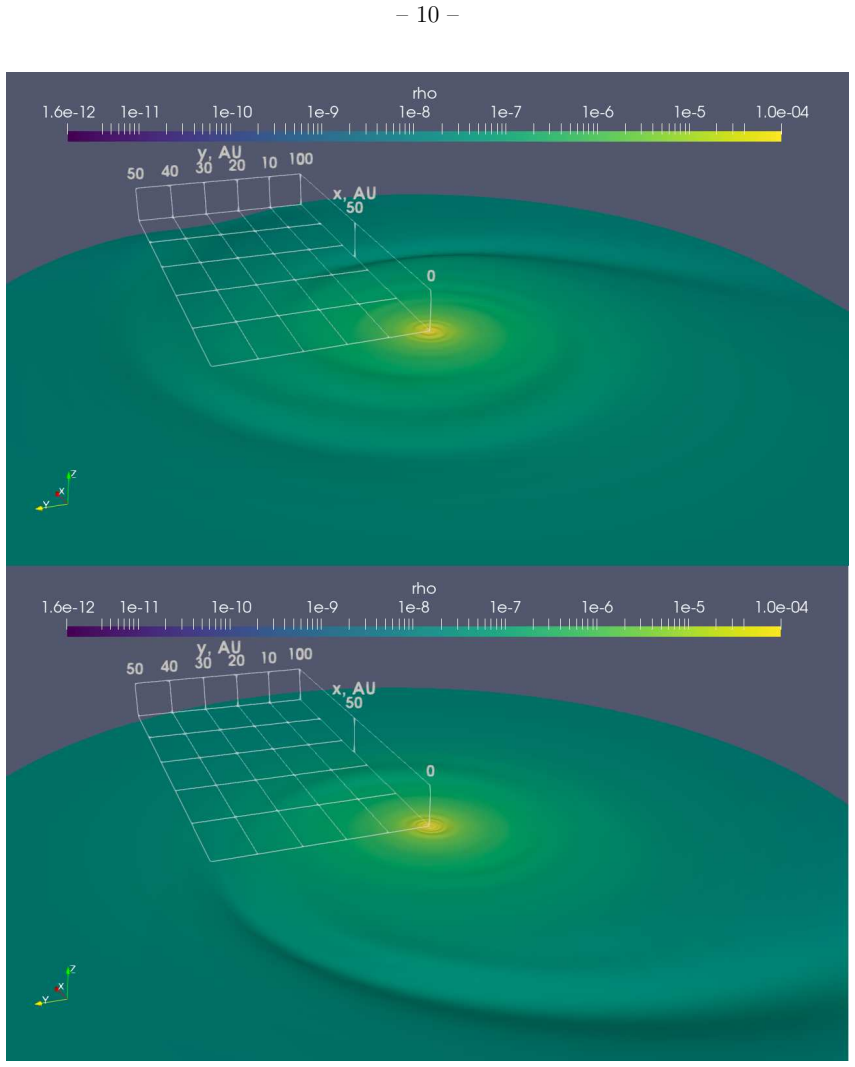
The argument rests on a three-stage numerical pipeline. First, the PLUTO finite-volume code evolves the Euler equations with the star's potential plus a smoothed planetary potential (Klahr-Kley form) on a 144x60x144 spherical grid, with the planet on a fixed parabolic orbit—either prograde or retrograde relative to the disk's rotation. Second, RADMC-3D computes Monte Carlo radiative transfer through the resulting density field, assuming dust opacities for magnesium-iron silicates. Third, the CASA simulator turns the fluxes into synthetic ALMA images at 740 µm with realistic noise. The key physical mechanism is the gravitational wake: the planet raises two spiral humps at the two disk-plane crossings; the disk's rotation then determines whether the second hump survives as a separate arm (prograde) or merges into the first (retrograde). The diagnostic power comes from the one-arm/two-arm count, the warp asymmetry, and the trailing tail.
What would settle it
Target nearby young clusters with ALMA at 740 µm to search for disks with a single dominant spiral arm, an asymmetric warp, and a trailing gas tail. If surveys of several hundred disks in Taurus and Ophiuchus find no such morphology despite a substantial population of massive free-floating planets, the predicted ~500-year visibility window or the one-arm retrograde signature would be called into question.
Extended reading notes
Core claim
The central claim is that a 10-Jupiter-mass planet passing through a protoplanetary disk creates a specific, observationally identifiable morphology: two spiral density humps on the disk surface for a prograde encounter, one for a retrograde encounter, plus a warped disk plane and a trailing gas tail, all detectable in infrared (3 µm) and submillimeter (740 µm) images at distances of ~140 pc. The distinction between one and two arms arises because the planet intersects the disk plane twice; for retrograde motion the second hump merges with the first under the disk's rotation, whereas for prograde motion the two remain separate. Detectability requires a planet of at least 3 Jupiter masses and a fine-dust mass of roughly $10^{-4}$ solar masses; close flybys (pericenter ~5 AU) favor single-arm spirals, while more distant encounters (~20 AU) make double-arm spirals resolvable. The authors also show that the flyby does not change the disk's accretion rate onto the star.
Load-bearing premise
The planet is treated as a point mass on a fixed parabolic orbit, and the disk gas and the disk's self-gravity never push back on the planet, even though the disk's mass (0.01 solar masses) is about the same as the planet's (10 Jupiter masses).
Editorial extensions
If this is right
- A pole-on image of a young disk with two bright spiral arms could be evidence of a recent prograde planetary flyby rather than an embedded planet or gravitational instability.
- A single-arm spiral with a warped outer plane and a gas tail would point to a retrograde encounter, offering a way to infer the encounter geometry from a single snapshot.
- The structures fade within ~500 years, so detections would imply either a very recent flyby or a planet on a highly eccentric bound orbit that re-intersects the disk every ~680 years, making repeated sightings possible.
- ALMA Band 8 observations at ~140 pc can resolve the predicted spirals; single-arm spirals are best sought in close-flyby events, double-arm spirals in more distant passings.
Reading between the lines
- If an eccentric bound planet re-encounters the disk every ~680 years, the one-arm and two-arm morphologies could appear repeatedly in the same object; a time series of images could then pin down the unseen planet's orbital period and pericenter.
- The mass threshold of ~3 Jupiter masses implies that surveys for such scars should prioritize disks around stars in dense clusters, where massive free-floating planets are most common; a null detection in a large cluster sample would constrain the product of encounter rate and 500-year visibility time.
- The computational domain truncates the gas tail, so its full length and detectability remain open; a follow-up simulation with a larger radial grid could test whether the tail is visible in CO or HI line emission, not just continuum.
Editorial analysis
A structured set of objections, weighed in public.
Referee Report
Summary. The paper presents three-dimensional gas-dynamical simulations of a protoplanetary disk (0.01 M_sun) around a solar-mass star perturbed by a 10-Jupiter-mass free-floating planet on a parabolic orbit. Using the PLUTO code on a 144×60×144 spherical grid, the authors follow the disk response for about 500 years after the encounter, then post-process density distributions with RADMC-3D and the CASA simulator to produce synthetic infrared and submillimeter images. The central claim is that a prograde flyby produces two observable spiral arms in pole-on images, while a retrograde flyby produces a single arm, with additional signatures such as disk warping and a trailing gas tail. Variations in pericenter distance, inclination, argument of pericenter, and planet mass are explored, and the paper concludes that such structures are observable in nearby star-forming regions but persist for only ~500 years.
Significance. If correct, this work establishes a new, morphologically distinctive diagnostic for free-floating planet encounters with protoplanetary disks: the number and handedness of spiral arms would indicate the encounter geometry. The use of state-of-the-art radiative transfer and ALMA image synthesis makes the predictions falsifiable with current facilities. The paper also demonstrates that such structures persist only ~500 years, implying that frequent encounters (e.g., via highly eccentric bound planets) would be needed for detection. The strengths are the broad parameter scan, the use of publicly available validated codes (PLUTO, RADMC-3D, CASA), and the explicit synthetic observations. The main caveat is the absence of a resolution study and the simplified treatment of the planet's orbit and disk self-gravity, which bear directly on the headline result.
major comments (3)
- [Model and method / Results] The central one-arm versus two-arm discriminator is based on a single grid resolution of 144×60×144 cells over R∈[0.2,107.2] AU and θ∈[15°,165°]. In the region of interest (r≈5–20 AU), the vertical cell height is ~0.22–0.44 AU, while the disk pressure scale height H is ~0.34–0.8 AU; thus the disk thickness is resolved by only 1–2 cells. The Hill radius of a 10 M_Jup planet at 5 AU (~0.74 AU) is comparable to the radial cell width (~0.74 AU). The retrograde one-arm pattern is attributed to the second hump 'merging' with the first (Results, paragraph after Fig. 4), which could be a numerical diffusion artifact at this resolution. No convergence test or resolution study is presented. I request a resolution study, at least one higher-resolution run for the fiducial prograde and retrograde cases, to demonstrate that the arm count and merging behavior are converged.
- [Model and method] The planet is assumed to move on a fixed parabolic orbit, and disk self-gravity is neglected. The disk mass (0.01 M_sun) is ~10.5 M_Jup, almost identical to the planet mass (10 M_Jup). The gravitational back-reaction of the disk on the planet could decelerate or deflect the planet during its two disk-plane crossings, changing the epochs and locations of the hump excitation; self-gravity could also modify spiral wave propagation. Please provide an order-of-magnitude estimate of the dynamical friction or deflection timescale against the crossing time (~10^2 yr) to justify the fixed-orbit approximation, or quantify the effect on the predicted morphology.
- [Abstract / Results] The abstract claims that 'two spiral arms can be observed in case of the prograde fall, and one with retrograde case.' However, the Results state that 'In the inner part of the disk in both cases bright two-armed spirals are visible' (paragraph after Fig. 4). Thus the clean prograde/retrograde discriminator applies only to the outer part of the disk, or to the overall large-scale pattern, and not to the full pole-on image. Please reconcile the abstract with the detailed morphology and specify exactly which radial range or brightness level separates the two cases.
minor comments (5)
- [Table 1] Table 1 lists the unit of velocity as v0 = 4.74×10^5 cm s^-1 with the comment '2πL0/t0'; however, 2πL0/t0 = 2π × 1 AU / 1 year ≈ 2.98×10^6 cm s^-1, so the numerical value corresponds to L0/t0 without the factor 2π. Please correct the table or the value.
- [Initial and boundary conditions / Eq. (6)] The symbol ρ0 is used both as the normalization density (Table 1, 5.94×10^-7 g cm^-3) and as the midplane density scale in Eq. (6) and the subsequent text ('ρ0 = Σ0/√(2π) H0'). This double use is confusing; please rename one of them.
- [Image generation / Results (Fig. 8)] In the Image generation section, the total fine-dust mass is stated as ~2×10^-5 M_sun, but later the text says the structures can be observed 'if the mass of fine dust is at least 10^-4 M_sun'. Please clarify which dust mass was used for the images in Figs. 8 and 9 and reconcile the factor 5 difference.
- [Discussion / Conclusion] The tail of gas trailing the planet is claimed as a possible observable, but the authors note that 'due to the limited size of the computational domain, this tail is cut off'. As a result, the prediction for the tail's extent and brightness is incomplete; consider stating this caveat in the abstract or conclusions.
- [Results] The claim that the minimum planet mass for identifiable spirals is 3 M_Jup appears to be based on only two computed masses (1 and 10 M_Jup) plus possibly an intermediate run; please state the actual grid of masses used or rephrase as 'between 1 and 3 M_Jup' if no intermediate value was run.
Circularity Check
No circularity: the predicted arm morphologies are emergent outputs of the PLUTO/RADMC-3D/CASA forward model, not encoded in any fitted input or self-citation.
full rationale
The paper's load-bearing claims (prograde flyby leaves a two-armed spiral, retrograde leaves one arm, warped disk plane, trailing gas tail, ~500 yr visibility, ALMA detectability) are all presented as results of a forward simulation chain: PLUTO gas dynamics, RADMC-3D radiative transfer, and CASA synthetic observations. The setup parameters (M* = 1 Msun, Md = 0.01 Msun, density profile from Nelson et al. 2013, inner temperature 1000 K, mp = 10 MJup, parabolic orbit with specified q, omega, and i) are literature-based or physically motivated; none encodes the arm count or morphology being predicted. No parameter is fitted to observational images or to the target structures. The one-arm/two-arm difference is described as an emergent outcome: 'in the case of a retrograde fall, the second hump merges with the first due to the rotation of the disk.' The self-citations (Grigoryev & Demidova 2024 for viscosity/thermal-conductivity coefficients, Demidova & Shevchenko 2015 for transient spirals in circumbinary disks, and Grigoryev & Demidova 2025 for UX Ori eclipses) are not used to import the central result or to forbid alternatives; they provide supporting method or context only. A reviewer concern that the 144x60x144 grid may under-resolve the disk scale height is a numerical convergence and robustness question, not circularity: even if the arm count were numerical, that would be an error, not a derivation that reduces to its own inputs by construction.
Assumptions & free parameters
free parameters (8)
- Planet mass mp =
10 MJup (also 1 MJup tested)
- Pericenter distance q =
5 AU baseline; 10, 20 AU also run
- Orbital inclination i =
10 deg baseline; 20 deg also run
- Argument of pericenter omega =
90 deg baseline; 0, 45, 135 deg also run
- Disk mass Md =
0.01 M_sun
- Adiabatic index gamma =
1.05
- Viscosity and thermal conductivity coefficients =
not given; referenced to Grigoryev and Demidova (2024)
- Smoothed potential radius Rsm =
0.03R
assumptions (6)
- domain assumption The ideal-gas hydrodynamics with gamma = 1.05 and a maintained temperature profile capture the disk response to the planet.
- domain assumption The planet travels on a fixed parabolic orbit, unaffected by gas drag or disk gravity.
- domain assumption Disk self-gravity is negligible.
- domain assumption The smoothed planet potential (3) with Rsm = 0.03R represents a 10 MJup planet at the chosen resolution.
- domain assumption Initial density (6), sound speed (7), and angular velocity (9) describe a realistic disk.
- domain assumption Mie-theory dust opacities with sub-Rayleigh grains and fixed dust mass yield representative images.
Cite this review
Pith. "Pith review of Simulation of images of protoplanetary disks after collision with free-floating planets." pith.science (2026). https://pith.science/paper/JE2AT6OS
@misc{pith2026250623795,
  author       = {Pith},
  title        = {Pith review of: Simulation of images of protoplanetary disks after collision with free-floating planets},
  year         = {2026},
  howpublished = {\url{https://pith.science/paper/JE2AT6OS}},
  note         = {Machine review of arXiv:2506.23795}
}
read the original abstract
Observational manifestations of disturbances in a protoplanetary disk caused by a collision with a massive planet are studied. It is assumed that the planet moves along a parabolic trajectory that intersects the disk plane near the star. Gas-dynamic simulation is performed using the finite volume method on a long time scale. On its basis, images of the disk observed from the pole and edge-on are constructed in the infrared and submillimeter ranges. A wide range of planet orbit parameters is considered. The approach of the planet was considered both prograde and retrograde with the respect to the disk rotation. Calculations have shown that in the images of the disk seen pole-on, two spiral arms can be observed in case of the prograde fall, and one with retrograde case. In the case of observations of a disk whose plane is inclined at a small angle to the line of sight, distortions of the disk plane can be noticeable. In addition, a gas tail is extended from the disk in the direction of the planet's motion, which can also be identified in observations.
Figures


Figures from the paper (6 more)


Reference graph
Works this paper leans on
-
[1]
A Hybrid Scenario for the Formation of Brown Dwarfs and Very Low Mass Stars //
Basu Shantanu, Vorobyov Eduard I. A Hybrid Scenario for the Formation of Brown Dwarfs and Very Low Mass Stars // . V 2012. 750, 1. 30
work page 2012
-
[2]
Absorption and Scattering of Light by Small Particles
Bohren Craig F., Huffman Donald R. Absorption and Scattering of Light by Small Particles . 1998
work page 1998
-
[3]
Boley Aaron C., Payne Matthew J., Ford Eric B. Interactions between Moderate- and Long-period Giant Planets: Scattering Experiments for Systems in Isolation and with Stellar Flybys // . VII 2012. 754, 1. 57
work page 2012
-
[4]
A., Price Daniel J., Pinte Christophe, Cuello Nicol \'a s
Borchert Elisabeth M. A., Price Daniel J., Pinte Christophe, Cuello Nicol \'a s . On the rise times in FU Orionis events // . II 2022 a . 510, 1. L37--L41
work page 2022
-
[5]
A., Price Daniel J., Pinte Christophe, Cuello Nicol \'a s
Borchert Elisabeth M. A., Price Daniel J., Pinte Christophe, Cuello Nicol \'a s . Sustained FU Orionis-type outbursts from colliding discs in stellar flybys // . XII 2022 b . 517, 3. 4436--4446
work page 2022
-
[6]
Formation of Planetary-Mass Objects by Protostellar Collapse and Fragmentation //
Boss Alan P. Formation of Planetary-Mass Objects by Protostellar Collapse and Fragmentation // . IV 2001. 551, 2. L167--L170
work page 2001
-
[7]
Burgess A. S. M., Moraux E., Bouvier J., Marmo C., Albert L., Bouy H. Young T-dwarf candidates in IC 348 // . XII 2009. 508, 2. 823--831
work page 2009
-
[8]
Tidal stripping and disk kinematics in the RW Aurigae system //
Cabrit S., Pety J., Pesenti N., Dougados C. Tidal stripping and disk kinematics in the RW Aurigae system // . VI 2006. 452, 3. 897--906
work page 2006
Show all 73 references
-
[9]
Cai Maxwell Xu, Kouwenhoven M. B. N., Portegies Zwart Simon F., Spurzem Rainer . Stability of multiplanetary systems in star clusters // . X 2017. 470, 4. 4337--4353
2017
-
[10]
A dusty filament and turbulent CO spirals in HD 135344B - SAO 206462 //
Casassus Simon, Christiaens Valentin, C \'a rcamo Miguel, P \'e rez Sebasti \'a n, Weber Philipp, Ercolano Barbara, van der Marel Nienke, Pinte Christophe, Dong Ruobing, Baruteau Cl \'e ment, Cieza Lucas, van Dishoeck Ewine F., Jordan Andr \'e s, Price Daniel J., Absil Olivier...
2021
-
[11]
A Multiwavelength Study of the Highly Asymmetrical Debris Disk around HD 111520 //
Crotts Katie A., Draper Zachary H., Matthews Brenda C., Duch \^e ne Gaspard, Esposito Thomas M., Wilner David, Mazoyer Johan, Padgett Deborah, Kalas Paul, Stapelfeldt Karl . A Multiwavelength Study of the Highly Asymmetrical Debris Disk around HD 111520 // . VI 2022. 932, 1. 23
2022
-
[12]
Flybys in protoplanetary discs: I
Cuello Nicol \'a s, Dipierro Giovanni, Mentiplay Daniel, Price Daniel J., Pinte Christophe, Cuadra Jorge, Laibe Guillaume, M \'e nard Fran c ois, Poblete Pedro P., Montesinos Mat \' as . Flybys in protoplanetary discs: I. Gas and dust dynamics // . III 2019. 483, 3. 4114--4139
2019
-
[13]
Flybys in protoplanetary discs - II
Cuello Nicol \'a s, Louvet Fabien, Mentiplay Daniel, Pinte Christophe, Price Daniel J., Winter Andrew J., Nealon Rebecca, M \'e nard Fran c ois, Lodato Giuseppe, Dipierro Giovanni, Christiaens Valentin, Montesinos Mat \' as, Cuadra Jorge, Laibe Guillaume, Cieza Lucas, Dong Ruo...
2020
-
[14]
Close encounters: How stellar flybys shape planet-forming discs // European Physical Journal Plus
Cuello Nicol \'a s, M \'e nard Fran c ois, Price Daniel J. Close encounters: How stellar flybys shape planet-forming discs // European Physical Journal Plus. I 2023. 138, 1. 11
2023
-
[15]
CFBDSIR2149-0403: a 4-7 Jupiter-mass free-floating planet in the young moving group AB Doradus? //
Delorme P., Gagn \'e J., Malo L., Reyl \'e C., Artigau E., Albert L., Forveille T., Delfosse X., Allard F., Homeier D. CFBDSIR2149-0403: a 4-7 Jupiter-mass free-floating planet in the young moving group AB Doradus? // . XII 2012. 548. A26
2012
-
[16]
Spiral Patterns in Planetesimal Circumbinary Disks //
Demidova Tatiana V., Shevchenko Ivan I. Spiral Patterns in Planetesimal Circumbinary Disks // . V 2015. 805, 1. 38
2015
-
[17]
The Eccentric Cavity, Triple Rings, Two-armed Spirals, and Double Clumps of the MWC 758 Disk //
Dong Ruobing, Liu Sheng-yuan, Eisner Josh, Andrews Sean, Fung Jeffrey, Zhu Zhaohuan, Chiang Eugene, Hashimoto Jun, Liu Hauyu Baobab, Casassus Simon, Esposito Thomas, Hasegawa Yasuhiro, Muto Takayuki, Pavlyuchenkov Yaroslav, Wilner David, Akiyama Eiji, Tamura Motohide, Wisniews...
2018
-
[18]
P., Juhasz A., Pohl A., Sereshti F., Shetty R., Peters T., Commercon B., Flock M
Dullemond C. P., Juhasz A., Pohl A., Sereshti F., Shetty R., Peters T., Commercon B., Flock M. RADMC-3D: A multi-purpose radiative transfer tool . II 2012
2012
-
[19]
Images of the GG Tauri rotating ring //
Dutrey A., Guilloteau S., Simon M. Images of the GG Tauri rotating ring // . VI 1994. 286. 149--159
1994
-
[20]
Flammini Dotti Francesco, Kouwenhoven M. B. N., Cai Maxwell Xu, Spurzem Rainer . Planetary systems in a star cluster I: the Solar system scenario // . X 2019. 489, 2. 2280--2297
2019
-
[21]
P., Pinte C., Padgett D., Connelley M
Flores C., Duch \^e ne G., Wolff S., Villenave M., Stapelfeldt K., Williams J. P., Pinte C., Padgett D., Connelley M. S., van der Plas G., M \'e nard F., Perrin M. D. The Anatomy of an Unusual Edge-on Protoplanetary Disk. II. Gas Temperature and a Warm Outer Region // . V 2021...
2021
-
[22]
Stellar encounters in the context of outburst phenomena //
Forgan Duncan, Rice Ken . Stellar encounters in the context of outburst phenomena // . II 2010. 402, 2. 1349--1356
2010
-
[23]
Spiral Structure in the Circumstellar Disk around AB Aurigae //
Fukagawa Misato, Hayashi Masahiko, Tamura Motohide, Itoh Yoichi, Hayashi Saeko S., Oasa Yumiko, Takeuchi Taku, Morino Jun-ichi, Murakawa Koji, Oya Shin, Yamashita Takuya, Suto Hiroshi, Mayama Satoshi, Naoi Takahiro, Ishii Miki, Pyo Tae-Soo, Nishikawa Takayuki, Takato Naruhisa,...
2004
-
[24]
E., Humphreys E., Testi L
Garufi A., Podio L., Codella C., Segura-Cox D., Vander Donckt M., Mercimek S., Bacciotti F., Fedele D., Kasper M., Pineda J. E., Humphreys E., Testi L. ALMA chemical survey of disk-outflow sources in Taurus (ALMA-DOT). VI. Accretion shocks in the disk of DG Tau and HL Tau // ....
2022
-
[25]
Gaudi B. Scott . Microlensing Surveys for Exoplanets // . IX 2012. 50. 411--453
2012
-
[26]
Capture of free-floating planets by planetary systems //
Goulinski Nadav, Ribak Erez N. Capture of free-floating planets by planetary systems // . I 2018. 473, 2. 1589--1595
2018
-
[27]
V., Demidova T
Grigoryev V. V., Demidova T. V. Simulation of the Free Fall of a Gas Stream on a Protoplanetary Disk // Astronomy Reports. X 2024. 68, 10. 949--966
2024
-
[28]
V., Demidova T
Grigoryev V. V., Demidova T. V. Free Fall of a Jupiter-like Planet onto a Protoplanetary Disk // Lobachevskii J. of Math.,. X 2025. 46, 1. 95--104
2025
-
[29]
Jr., Lada Elizabeth A., Lada Charles J
Haisch Karl E. Jr., Lada Elizabeth A., Lada Charles J. Disk Frequencies and Lifetimes in Young Clusters // . VI 2001. 553, 2. L153--L156
2001
-
[30]
Hao W., Kouwenhoven M. B. N., Spurzem R. The dynamical evolution of multiplanet systems in open clusters // . VII 2013. 433, 1. 867--877
2013
-
[31]
3D-radiation hydro simulations of disk-planet interactions
Klahr H., Kley W. 3D-radiation hydro simulations of disk-planet interactions. I. Numerical algorithm and test cases // . I 2006. 445, 2. 747--758
2006
-
[32]
The Modification of Planetary Orbits in Dense Open Clusters //
Laughlin Gregory, Adams Fred C. The Modification of Planetary Orbits in Dense Open Clusters // . XII 1998. 508, 2. L171--L174
1998
-
[33]
Cross-sections for planetary systems interacting with passing stars and binaries //
Li Gongjie, Adams Fred C. Cross-sections for planetary systems interacting with passing stars and binaries // . III 2015. 448, 1. 344--363
2015
-
[34]
S., Chambers K
Liu Michael C., Magnier Eugene A., Deacon Niall R., Allers Katelyn N., Dupuy Trent J., Kotson Michael C., Aller Kimberly M., Burgett W. S., Chambers K. C., Draper P. W., Hodapp K. W., Jedicke R., Kaiser N., Kudritzki R. P., Metcalfe N., Morgan J. S., Price P. A., Tonry J. L., ...
2013
-
[35]
W., Weights D
Lucas P. W., Weights D. J., Roche P. F., Riddick F. C. Spectroscopy of planetary mass brown dwarfs in Orion // . XI 2006. 373, 1. L60--L64
2006
-
[36]
The effects of fly-bys on planetary systems //
Malmberg Daniel, Davies Melvyn B., Heggie Douglas C. The effects of fly-bys on planetary systems // . II 2011. 411, 2. 859--877
2011
-
[37]
Davy, Lowrance Patrick J., Cutri Roc M., Velusamy Thangasamy
Marsh Kenneth A., Plavchan Peter, Kirkpatrick J. Davy, Lowrance Patrick J., Cutri Roc M., Velusamy Thangasamy . Deep Near-infrared Imaging of the Oph cloud core: Clues to the Origin of the Lowest-mass Brown Dwarfs // . VIII 2010. 719, 1. 550--560
2010
-
[38]
McCaughrean Mark J., O'Dell C. Robert . Direct Imaging of Circumstellar Disks in the Orion Nebula // . V 1996. 111. 1977
1996
-
[39]
On the Origin of the Spiral Morphology in the Elias 2-27 Circumstellar Disk //
Meru Farzana, Juh \'a sz Attila, Ilee John D., Clarke Cathie J., Rosotti Giovanni P., Booth Richard A. On the Origin of the Spiral Morphology in the Elias 2-27 Circumstellar Disk // . IV 2017. 839, 2. L24
2017
-
[40]
Beitraege zur Optik trueber Medien, speziell kolloidaler Metalloesungen // Annalen der Physik
Mie Gustav . Beitraege zur Optik trueber Medien, speziell kolloidaler Metalloesungen // Annalen der Physik. I 1908. 330, 3. 377--445
1908
-
[41]
M., Muscianisi G
Mignone A., Flock M., Stute M., Kolb S. M., Muscianisi G. A conservative orbital advection scheme for simulations of magnetized shear flows with the PLUTO code // . IX 2012. 545. A152
2012
-
[42]
Rendez-vous with massive interstellar objects, as triggers of destabilization //
Mikryukov Denis V., Shevchenko Ivan I. Rendez-vous with massive interstellar objects, as triggers of destabilization // . III 2024. 528, 4. 6411--6424
2024
-
[43]
High-resolution Pan-STARRS and SMA Observations of IRAS 23077+6707: A Giant Edge-on Protoplanetary Disk //
Monsch Kristina, Lovell Joshua Bennett, Berghea Ciprian T., Edenhofer Gordian, Keating Garrett K., Andrews Sean M., Bayyari Ammar, Drake Jeremy J., Wilner David J. High-resolution Pan-STARRS and SMA Observations of IRAS 23077+6707: A Giant Edge-on Protoplanetary Disk // . V 20...
2024
-
[44]
Eccentricity evolution of giant planet orbits due to circumstellar disk torques // Icarus
Moorhead Althea V., Adams Fred C. Eccentricity evolution of giant planet orbits due to circumstellar disk torques // Icarus. II 2008. 193, 2. 475--484
2008
-
[45]
No large population of unbound or wide-orbit Jupiter-mass planets //
Mr \'o z Przemek, Udalski Andrzej, Skowron Jan, Poleski Rados aw, Koz owski Szymon, Szyma \'n ski Micha K., Soszy \'n ski Igor, Wyrzykowski ukasz, Pietrukowicz Pawe , Ulaczyk Krzysztof, Skowron Dorota, Pawlak Micha . No large population of unbound or wide-orbit Jupiter-mass pl...
2017
-
[46]
Substellar Objects in Nearby Young Clusters (SONYC) IX: The Planetary-Mass Domain of Chamaeleon-I and Updated Mass Function in Lupus-3 //
Mu z i \'c Koraljka, Scholz Alexander, Geers Vincent C., Jayawardhana Ray . Substellar Objects in Nearby Young Clusters (SONYC) IX: The Planetary-Mass Domain of Chamaeleon-I and Updated Mass Function in Lupus-3 // . IX 2015. 810, 2. 159
2015
-
[47]
Linear and non-linear evolution of the vertical shear instability in accretion discs //
Nelson Richard P., Gressel Oliver, Umurhan Orkan M. Linear and non-linear evolution of the vertical shear instability in accretion discs // . XI 2013. 435, 3. 2610--2632
2013
-
[48]
First Detection of Orbital Motion for HD 106906 b: A Wide-separation Exoplanet on a Planet Nine-like Orbit //
Nguyen Meiji M., De Rosa Robert J., Kalas Paul . First Detection of Orbital Motion for HD 106906 b: A Wide-separation Exoplanet on a Planet Nine-like Orbit // . I 2021. 161, 1. 22
2021
-
[49]
Detectability of Free Floating Planets in Open Clusters with the James Webb Space Telescope //
Pacucci Fabio, Ferrara Andrea, D'Onghia Elena . Detectability of Free Floating Planets in Open Clusters with the James Webb Space Telescope // . XII 2013. 778, 2. L42
2013
-
[50]
The ``Mysterious'' Origin of Brown Dwarfs //
Padoan Paolo, Nordlund A ke . The ``Mysterious'' Origin of Brown Dwarfs // . XII 2004. 617, 1. 559--564
2004
-
[51]
M., Benisty M., Hall C., Veronesi B., Lodato G., Sierra A., Carpenter J
Paneque-Carre \ n o T., P \'e rez L. M., Benisty M., Hall C., Veronesi B., Lodato G., Sierra A., Carpenter J. M., Andrews S. M., Bae Jaehan, Henning Th., Kwon W., Linz H., Loinard L., Pinte C., Ricci L., Tazzari M., Testi L., Wilner D. Spiral Arms and a Massive Dust Disk with ...
2021
-
[52]
Pe \ n a Ram \' rez K., B \'e jar V. J. S., Zapatero Osorio M. R., Petr-Gotzens M. G., Mart \' n E. L. New Isolated Planetary-mass Objects and the Stellar and Substellar Mass Function of the Orionis Cluster // . VII 2012. 754, 1. 30
2012
-
[53]
Jupiter Mass Binary Objects in the Trapezium Cluster // arXiv e-prints
Pearson Samuel G, McCaughrean Mark J . Jupiter Mass Binary Objects in the Trapezium Cluster // arXiv e-prints. X 2023. arXiv:2310.01231
2023 arXiv
-
[54]
Analysing ALMA Data with CASA // Astronomical Data Analysis Software and Systems XXI
Petry Dirk, CASA Development Team . Analysing ALMA Data with CASA // Astronomical Data Analysis Software and Systems XXI. 461. IX 2012. 849. (Astronomical Society of the Pacific Conference Series)
2012
-
[55]
Encounter-driven accretion in young stellar clusters - A connection to FUors? //
Pfalzner S. Encounter-driven accretion in young stellar clusters - A connection to FUors? // . XII 2008. 492, 3. 735--741
2008
-
[56]
Search for Very Low-Mass Brown Dwarfs and Free-Floating Planetary-Mass Objects in Taurus //
Quanz Sascha P., Goldman Bertrand, Henning Thomas, Brandner Wolfgang, Burrows Adam, Hofstetter Lorne W. Search for Very Low-Mass Brown Dwarfs and Free-Floating Planetary-Mass Objects in Taurus // . I 2010. 708, 1. 770--784
2010
-
[57]
Dynamical instabilities and the formation of extrasolar planetary systems // Science
Rasio Frederic A., Ford Eric B. Dynamical instabilities and the formation of extrasolar planetary systems // Science. XI 1996. 274. 954--956
1996
-
[58]
Substellar Objects in Nearby Young Clusters (SONYC)
Scholz Alexander, Jayawardhana Ray, Muzic Koraljka, Geers Vincent, Tamura Motohide, Tanaka Ichi . Substellar Objects in Nearby Young Clusters (SONYC). VI. The Planetary-mass Domain of NGC 1333 // . IX 2012. 756, 1. 24
2012
-
[59]
M., Vorobyov E
Skliarevskii A. M., Vorobyov E. I. Luminosity Outbursts in Interacting Protoplanetary Systems // Astronomy Reports. XII 2023. 67, 12. 1401--1417
2023
-
[60]
Brendan, Mittal Tushar, Moerchen Margaret, N'Diaye Mamadou, Rajan Abhijith, Wolff Schuyler, Debes John, Hines Dean C., Schneider Glenn
Soummer R \'e mi, Perrin Marshall D., Pueyo Laurent, Choquet \'E lodie, Chen Christine, Golimowski David A., Hagan J. Brendan, Mittal Tushar, Moerchen Margaret, N'Diaye Mamadou, Rajan Abhijith, Wolff Schuyler, Debes John, Hines Dean C., Schneider Glenn . Five Debris Disks Newl...
2014
-
[61]
C., Lin D
Spurzem R., Giersz M., Heggie D. C., Lin D. N. C. Dynamics of Planetary Systems in Star Clusters // . V 2009. 697, 1. 458--482
2009
-
[62]
Stock Katja, Cai Maxwell X., Spurzem Rainer, Kouwenhoven M. B. N., Portegies Zwart Simon . On the survival of resonant and non-resonant planetary systems in star clusters // . IX 2020. 497, 2. 1807--1825
2020
-
[63]
P., Bond I
Sumi T., Kamiya K., Bennett D. P., Bond I. A., Abe F., Botzler C. S., Fukui A., Furusawa K., Hearnshaw J. B., Itow Y., Kilmartin P. M., Korpela A., Lin W., Ling C. H., Masuda K., Matsubara Y., Miyake N., Motomura M., Muraki Y., Nagaya M., Nakamura S., Ohnishi K., Okumura T., P...
2011
-
[64]
P., Wilner D
Testi L., Birnstiel T., Ricci L., Andrews S., Blum J., Carpenter J., Dominik C., Isella A., Natta A., Williams J. P., Wilner D. J. Dust Evolution in Protoplanetary Disks // Protostars and Planets VI. I 2014. 339--361
2014
-
[65]
Villenave M., M \'e nard F., Dent W. R. F., Duch \^e ne G., Stapelfeldt K. R., Benisty M., Boehler Y., van der Plas G., Pinte C., Telkamp Z., Wolff S., Flores C., Lesur G., Louvet F., Riols A., Dougados C., Williams H., Padgett D. Observations of edge-on protoplanetary disks w...
2020
-
[66]
The origin of tail-like structures around protoplanetary disks //
Vorobyov Eduard I., Skliarevskii Alexandr M., Elbakyan Vardan G., Takami Michihiro, Liu Hauyu Baobab, Liu Sheng-Yuan, Akiyama Eiji . The origin of tail-like structures around protoplanetary disks // . III 2020. 635. A196
2020
-
[67]
Protoplanetary Disks and Their Evolution //
Williams Jonathan P., Cieza Lucas A. Protoplanetary Disks and Their Evolution // . IX 2011. 49, 1. 67--117
2011
-
[68]
Generation of highly inclined protoplanetary discs through single stellar flybys //
Xiang-Gruess M. Generation of highly inclined protoplanetary discs through single stellar flybys // . I 2016. 455, 3. 3086--3100
2016
-
[69]
Excitation and Propagation of Eccentricity Disturbances in Planetary Systems //
Zakamska Nadia L., Tremaine Scott . Excitation and Propagation of Eccentricity Disturbances in Planetary Systems // . VIII 2004. 128, 2. 869--877
2004
-
[70]
R., B \'e jar V
Zapatero Osorio M. R., B \'e jar V. J. S., Mart \' n E. L., Rebolo R., Barrado y Navascu \'e s D., Bailer-Jones C. A. L., Mundt R. Discovery of Young, Isolated Planetary Mass Objects in the Orionis Star Cluster // Science. X 2000. 290, 5489. 103--107
2000
-
[71]
Zheng Xiaochen, Kouwenhoven M. B. N., Wang Long . The dynamical fate of planetary systems in young star clusters // . XI 2015. 453, 3. 2759--2770
2015
-
[72]
The Great Inequality and the Dynamical Disintegration of the Outer Solar System //
Zink Jon K., Batygin Konstantin, Adams Fred C. The Great Inequality and the Dynamical Disintegration of the Outer Solar System // . XI 2020. 160, 5. 232
2020
-
[73]
Near-IR High-resolution Imaging Polarimetry of the SU Aur Disk: Clues for Tidal Tails? //
de Leon Jerome, Takami Michihiro, Karr Jennifer L., Hashimoto Jun, Kudo Tomoyuki, Sitko Michael, Mayama Satoshi, Kusakabe Nobuyuki, Akiyama Eiji, Liu Hauyu Baobab, Usuda Tomonori, Abe Lyu, Brandner Wolfgang, Brandt Timothy D., Carson Joseph, Currie Thayne, Egner Sebastian E., ...
2015
Reviewed August 6, 2026 · model on record in the stance chip above.
Discussion (0). Continue with ORCID to comment.