REVIEW 4 major objections 5 minor 52 references
Polarization Probes of New Physics in Lepton-Flavor-Violating Hyperon Production from $e^- N \to \tau^- Y$ Scattering
T0 review · 4 major / 5 minor · reviewed 2026-08-06 · deepseek-v4-flash
Pith's one-line read A pair of polarization measurements would pin down the chiral nature of lepton-flavor-violating vector interactions in $e^- N \to \tau^- Y$ scattering.
desk verdict Systematic form-factor comparison adds real value, but the 'unique operator identification' claim is conditional on the very form-factor model the strategy is supposed to determine; still worth refereeing. read the letter →
The pith
A machine-rendered reading of the paper's core claim, the machinery that carries it, and where it could break.
The reading
What carries the argument
The machinery is the spin-density-matrix treatment of the $e^- N \to \tau^- Y$ amplitude, built from a general low-energy effective Lagrangian with scalar, vector, and tensor operators and expressed through reduced amplitudes $A_{\alpha-\beta}$. The Bouchiat-Michel identity projects the lepton spin structure onto three orthogonal spin vectors, longitudinal, perpendicular, and transverse, and the hyperon spin is treated analogously with its own spin vectors. The hadronic input is the set of five $N \to Y$ form-factor parametrizations: Galster, BBBA, and BHLT derived from nucleon electromagnetic form factors through SU(3) flavor relations, and chiral perturbation theory and QCD sum-rule schemes obtained by analytically continuing $Y \to N$ decay form factors from the timelike region to the spacelike $q^2$ region required for scattering. An additional load-bearing piece is the Nambu relation for $g_3$, which matters here because the tau lepton is heavy enough that $g_3$ effects are not suppressed by a small lepton mass.
What would settle it
Measure $\langle P^{\tau}_{L}\rangle$ and $\langle P^{\Sigma}_{T}\rangle$ in $e^- p \to \tau^- \Sigma^+$ at a fixed-target electron experiment with sufficient statistics; if the observed sign pair matches no row of the paper's mapping table for the assumed form-factor family, either tensor operators contribute or the form-factor set is incomplete. Alternatively, a lattice QCD computation of the vector and axial-vector $N \to Y$ transition form factors at spacelike $Q^2$ would settle whether any of the five parametrizations describes the transition, and if none does, the model-discrimination strategy fails.
Extended reading notes
Core claim
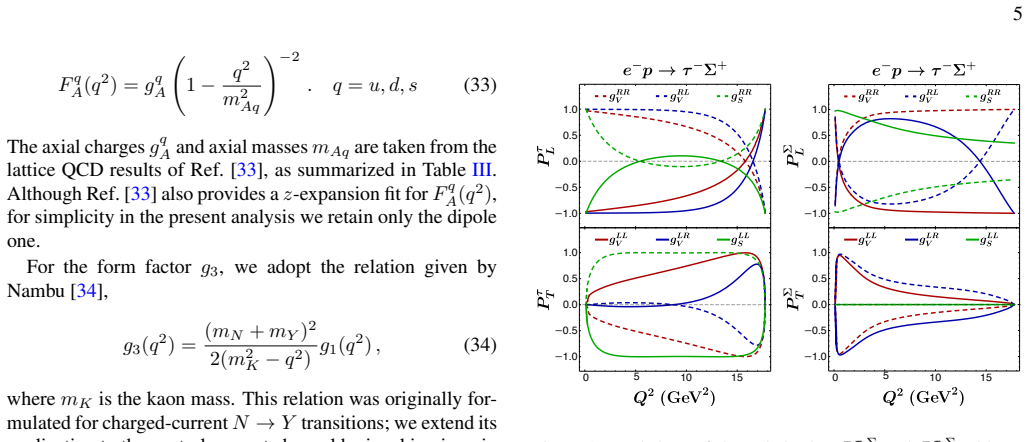
The paper's central claim is that averaged polarizations such as $\langle P^{\Sigma}_{L,T}\rangle$ and $\langle P^{\Lambda}_{L}\rangle$ can separate the five form-factor parametrizations into distinct model families, and that the combined sign pattern of $\langle P^{\tau}_{L}\rangle$ and $\langle P^{\Sigma}_{T}\rangle$ provides a one-to-one fingerprint of the vector operator. For a pure vector interaction, the QCD sum-rule scheme predicts positive values for both $\langle P^{\Sigma}_{L}\rangle$ and $\langle P^{\Sigma}_{T}\rangle$, chiral perturbation theory predicts a negative longitudinal and positive transverse hyperon polarization, and the BBBA, Galster, and BHLT models predict both negative; a measurement of $\langle P^{\Lambda}_{L}\rangle$ further separates that third family. Once a model family is fixed, the paper presents an explicit mapping table in which the sign combination of the two observables selects exactly one of $O^{LL}_{V}$, $O^{LR}_{V}$, $O^{RR}_{V}$, or $O^{RL}_{V}$. The same analysis shows that scalar operators yield zero transverse hyperon polarization, so a nonzero $\langle P^{\Sigma}_{T}\rangle$ singles out vector interactions, and that the form factor $g_3$, usually neglected in light-lepton hyperon decays, strongly reshapes scalar-operator predictions because $m_\tau/m_Y \sim O(1)$.
Load-bearing premise
The operator-identification strategy assumes that the true $N \to Y$ transition form factors belong to one of the five parametrizations compared here, that the timelike-region QCD sum-rule and chiral perturbation theory form factors can be analytically continued reliably into the spacelike region, and that tensor-operator contributions are negligible.
Editorial extensions
If this is right
- A positive signal in $eN \to \tau Y$ scattering would open a baryonic window on electron-tau flavor violation that tau decays to hyperons cannot reach, and a nonzero $\langle P^{\Sigma}_{T}\rangle$ would point to vector rather than scalar new physics.
- Within one assumed form-factor class, measuring the signs of $\langle P^{\tau}_{L}\rangle$ and $\langle P^{\Sigma}_{T}\rangle$ would select exactly one of the four chiral vector operators, not merely constrain its magnitude.
- Polarization data would double as a form-factor discriminator, separating the QCD sum-rule and chiral perturbation theory family from the BBBA, BHLT, and Galster family before operator identification is attempted.
- For scalar operators, reliable interpretation requires knowledge of the spacelike form factor $g_3$; without it, predicted hyperon polarizations in scalar scenarios are not trustworthy.
- At the high-luminosity fixed-target setup considered, projected annual yields range from below one to several hundred events depending on the form-factor model, so rate-based discovery is plausible only in the most optimistic scenarios while polarization measurements would require the higher luminosities of future facilities.
Reading between the lines
- If tensor-operator contributions are not negligible, the clean vector-operator sign map would be contaminated; computing tensor $N \to Y$ form factors and adding them to the effective amplitude would show whether the distinguishing power survives.
- The paper treats one operator at a time, but a global fit with several operators active would change the polarization patterns through interference terms, and the same spin-density machinery extends directly to that case.
- A direct lattice QCD evaluation of the $N \to Y$ transition form factors at spacelike $q^2$ would test whether any of the five parametrizations lies near the truth, turning the model spread into a falsifiable prediction.
- The large rate hierarchy between the QCD sum-rule and chiral perturbation theory family and the BBBA, Galster, and BHLT family implies that even a handful of signal events at the quoted luminosity would already disfavor the low-rate form-factor models.
Editorial analysis
A structured set of objections, weighed in public.
Referee Report
Summary. The paper studies charged-lepton-flavor-violating quasi-elastic scattering processes e- N -> tau- Y (Y = Lambda, Sigma0, Sigma+) within a general low-energy effective Lagrangian with scalar, vector, and tensor operators. The authors construct spin density matrices, compute differential and total cross sections, and analyze averaged longitudinal/transverse polarizations of the tau and hyperon across five hadronic form-factor parametrizations (BBBA, Galster, BHLT, QCDSR, and chiPT). They derive Wilson-coefficient upper bounds from existing tau-decay limits, forecast annual event rates at the SoLID experiment, and propose an operator-identification strategy based on sign combinations of <P_tau_L> and <P_Sigma_T>. The central advertised claim is that these polarization combinations can uniquely identify the chiral nature of the underlying vector operator, provided tensor contributions are negligible.
Significance. If the advertised claims held, this would be a useful contribution: it opens a baryonic channel for probing the e-tau-d-s transition that is kinematically forbidden in hyperon decays, systematically exposes the strong form-factor-model dependence of both rates and polarization observables, provides explicit rate forecasts for a concrete experimental setup, and gives a first assessment of the g3 form-factor sensitivity for tau-mass final states. The paper is honest about its modeling assumptions and reports order-of-magnitude differences between form-factor choices rather than hiding them. Its main value at present is as a survey of model dependence and a roadmap for future high-luminosity searches, not as a robust model-independent operator-identification procedure; the uniqueness claim is not established as stated.
major comments (4)
- [Sec. III C and Table VI] The central claim stated in Sec. I and the abstract that a measurement of <P_tau_L> and <P_Sigma_T> can 'uniquely identify the chiral nature' of a vector operator is not supported by Table VI as written. The same sign pair maps to different operators in the two model families: (+,+) identifies gRR_V under QCDSR/chiPT but gRL_V under BBBA/BHLT/Galster, and (-,-) identifies gLL_V under QCDSR/chiPT but gLR_V under the other family. The proposed first step, using <P_Sigma_L,T> to discriminate among form-factor models, is illustrated in Sec. III C only for the specific NP scenarios OLR_V and OLL_S; for those scenarios the classification already assumes a chiral operator. Without an independent determination of which form-factor family is physical, the measured sign pair does not tell the experimenter which column of Table VI applies. The claim of uniqueness must be qualified or replaced by a conditional statement, or the strategy must be supplemented with a model-selection step that does not presuppose the operator type.
- [Sec. III A, Eqs. (35)-(36)] The reduced amplitudes A_{alpha-beta} and A^{tau,Y}_{alpha-beta} that determine the normalization C and the polarization vectors Sigma_i are never shown. The text states that they can be obtained with FeynCalc or Package-X, but all subsequent numerical results, including the sign table in Table VI and every curve in Figs. 1-9, depend on these omitted expressions. A reader cannot verify from the manuscript that the sign relationships in Sec. III A, the sign flips in Fig. 1, or the model classifications in Table VI are correct. The explicit expressions, or a machine-readable supplementary file, should be provided so that the central phenomenological claims are independently checkable.
- [Sec. II D and Sec. IV B] The paper sets the hadronic tensor matrix elements to zero because no tensor transition form factors have been computed, and the operator-identification strategy in Sec. III C is explicitly conditional on tensor contributions being negligible. However, the tau-decay bounds used in Sec. IV B constrain only the Wilson combinations V_l_tau, A_l_tau, S_l_tau, and P_l_tau (Appendix D), none of which involves gT. The paper therefore gives no numerical or parametric estimate of how large a subleading tensor contribution would have to be to change the sign pairs in Table VI or to alter the classification in Sec. III C. This is a load-bearing caveat for the central claim and should be quantified, or the claim should be narrowed to the subset of models where tensor operators are assumed absent.
- [Sec. II D and Appendix C] For two of the five form-factor parametrizations, QCDSR and chiPT, the hyperon transition form factors are determined in the timelike region (q^2 > 0) from semileptonic decay analyses and are then analytically continued to the spacelike region required for e- N -> tau- Y scattering. The paper itself shows that this choice changes the predicted cross sections by orders of magnitude (Table VII and Figs. 2 and 5) and that the polarization signs in Table VI differ between these two models and the other three. The analytic-continuation step is not independently validated in the spacelike region, so the discrimination step and the resulting operator-identification strategy are not model-independent. This limitation should be stated explicitly in the abstract or conclusion, since it bears directly on the robustness of the proposed experimental strategy.
minor comments (5)
- [Abstract] The abstract states that polarization observables can 'help to determine the chiral nature of the vectorial new physics interaction' but does not carry the paper's own caveat from Sec. III C that this holds only when tensor contributions are negligible and only after a form-factor model is adopted as a baseline; the abstract should include these qualifications to avoid overstating the result.
- [Figs. 3 and 4] The captions say that different line styles denote different form-factor parametrizations, but the correspondence between line style and model is not given in either the caption or a legend; please add an explicit legend or a table matching line styles to BBBA, Galster, BHLT, QCDSR, and chiPT.
- [Notation, Eq. (7) vs Appendix D] The symbol P_i is used both for polarization components in Sec. II C and for the pseudoscalar coefficients in the tau-decay amplitudes in Appendix D; the two uses are in different contexts but the reuse is confusing and should be eliminated by renaming one of them.
- [Sec. III A] The statement that the transverse hyperon polarization P^Y_T vanishes for scalar operators is attributed to the vanishing of p . n_T in the Lab frame; this argument should be spelled out at that point rather than in a parenthetical, since the reader otherwise has to reconstruct the kinematics from Eq. (12).
- [References] References [36] and [37] are incomplete: 'JHEP 04, 104' and 'JHEP 06, 122' lack the publication year; the arXiv identifiers are present but the published bibliographic data should be completed.
Circularity Check
No significant circularity: the polarization predictions are computed from external form factors and independently constrained Wilson coefficients, and the operator-identification strategy is explicitly conditional rather than definitionally circular.
full rationale
The paper's derivation chain is not circular. The effective-Lagrangian predictions are computed from operator matrix elements, and the hadronic form factors are taken from external parametrizations (Galster, BBBA, BHLT, QCDSR, chiPT) and lattice inputs, none of which are fitted to the polarization observables predicted here. The Wilson coefficients used to forecast rates are bounded by independent Belle limits on tau to eKS, tau to eK*0, and tau to e pi K (Eqs. (37)-(41)), so the forecast is constrained input, not a fitted output. The central operator-identification strategy is explicitly conditional: Table VI gives a one-to-one sign-pair mapping within each form-factor family, and the text states the uniqueness holds 'if a specific model is taken as a baseline.' The fact that the same sign pair maps to different operators in different form-factor families is a model-dependence and robustness limitation, not a reduction of the prediction to its input; the paper does not hide this dependence. The self-citations to Refs. [14-17] are used for density-matrix construction and polarization-vector definitions, which are standard technical formulas rather than load-bearing uniqueness theorems. No fitted parameter is renamed as a prediction, and no derived quantity is defined in terms of the observable it claims to predict. The conditional ambiguity surrounding form-factor discrimination and the unconstrained tensor-operator contributions is a correctness risk, not circularity, and the paper itself flags the tensor caveat in the Introduction and Sec. III C.
Assumptions & free parameters
free parameters (8)
- Galster M_V (nucleon EM dipole mass) =
0.843 GeV
- BBBA rational function coefficients for G_E,M^p,n =
see Eq (B2)
- BHLT z-expansion coefficients a_k,b_k =
from fits in Ref [30]
- Axial dipole parameters g_A^q and m_A^q =
g_A^u=0.859, g_A^d=-0.423, g_A^s=-0.044; m_A^u=1.187, m_A^d=1.168, m_A^s=0.992 GeV
- Strange vector form factor parameters (mu_s, <r^2_M>_s, <r^2_E>_s) =
-0.017, -0.015 fm^2, 0.0048 fm^2
- QCDSR z-expansion form factor parameters f'_i(0), a_1, pole masses =
pole masses 0.892 GeV (f'_1), 1.27 GeV (g'_1); other values in Ref [37]
- chiPT axial couplings D and F =
D=0.81, F=0.47
- Wilson coefficient upper bounds |g_V|, |g_S| =
2.77e-4 (vector), 4.09e-4 (scalar)
assumptions (7)
- domain assumption Time-reversal invariance makes all N->Y transition form factors real; G-parity, SU(3) flavor symmetry, and conserved vector current require f3 = g2 = 0.
- domain assumption SU(3) flavor symmetry relates N->Y form factors to N->N form factors with coefficients from Table II, neglecting SU(3) breaking.
- domain assumption Y->N decay form factors from chiPT and QCDSR can be analytically continued from timelike (q^2>0) to spacelike (q^2<0) for scattering kinematics.
- ad hoc to paper Nambu relation for g3 (Eq. (34)), originally for charged-current N->Y, is extended to the neutral-current channel via isospin symmetry.
- ad hoc to paper Tensor hadronic matrix elements are neglected because no tensor transition form factors have been computed.
- domain assumption Only one effective operator O_alpha is active at a time (single-operator dominance).
- domain assumption The low-energy effective Lagrangian in Eq. (1) with operators in Table I is the complete description of the e-d to tau-s transition.
Cite this review
Pith. "Pith review of Polarization Probes of New Physics in Lepton-Flavor-Violating Hyperon Production from $e^- N \to \tau^- Y$ Scattering." pith.science (2026). https://pith.science/paper/CMLIOPLJ
@misc{pith2026250623804,
  author       = {Pith},
  title        = {Pith review of: Polarization Probes of New Physics in Lepton-Flavor-Violating Hyperon Production from $e^- N \to \tau^- Y$ Scattering},
  year         = {2026},
  howpublished = {\url{https://pith.science/paper/CMLIOPLJ}},
  note         = {Machine review of arXiv:2506.23804}
}
abstract
While charged lepton-flavor-violating tau decays to strange mesons provide powerful probes of the underlying $\tau\to\ell d \bar{s}$ transition, the corresponding decay modes involving hyperons are kinematically forbidden. To address this gap, we propose the quasi-elastic scattering processes $e^- N \to \tau^- Y$. Within a general low-energy effective Lagrangian, we perform a comprehensive analysis of the final-state polarizations of both the $\tau$ lepton and the hyperon $Y$, systematically addressing the theoretical uncertainty driven by the model dependence of form factors. Our analysis demonstrates that while this uncertainty leads to large variations in predicted rates, the polarization observables can potentially distinguish between the form factor models, and help to determine the chiral nature of the vectorial new physics interaction. Finally, we forecast the event rates for future facilities, revealing a strong dependence on the form factor models, with predicted yields ranging from potentially observable levels to rates far below current detection thresholds.
Figures


Figures from the paper (6 more)


Reference graph
Works this paper leans on
-
[1]
Galster Parameterization The Galster parameterization [28] is expressed as Gp E(q2) = 1 − q2 M 2 V −2 , Gp M (q2) µp = Gn M (q2) µn = Gp E(q2) , Gn E(q2) = − µnτ 1 + λnτ Gp E(q2) , (B1) where MV = 0 .843 GeV, µp = 2 .7928, µn = −1.9130, λn = 5.6, and τ = −q2/(4m2 N ) with mN the nucleon mass
-
[2]
BBBA Parameterization The BBBA parameterization [29] adopts a rational func- tional form: Gp E(q2) = 1 − 0.0578τ 1 + 11.1τ + 13.6τ 2 + 33.0τ 3 , Gp M (q2) µp = 1 + 0.15τ 1 + 11.1τ + 19.6τ 2 + 7.54τ 3 , Gn E(q2) = 1.25τ + 1.30τ 2 1 − 9.86τ + 305τ 2 − 758τ 3 + 802τ 4 , Gn M (q2) µn = 1 + 1.81τ 1 + 14.1τ + 20.7τ 2 + 68.7τ 3 . (B2)
-
[3]
BHLT Parameterization The BHLT parameterization [30] employs a model- independent expansion in the conformal variable z(q2), de- fined as z(q2) = p tcut − q2 − √tcut − t0p tcut − q2 + √tcut − t0 , (B3) with tcut = 4 m2 π and t0 = −0.21 GeV2. The form factors are expanded as Gp,n E (q2) = kmaxX k=0 ak z(q2)k , Gp,n M (q2) = Gp,n M (0) kmaxX k=0 bk z(q2)k ,...
-
[4]
For the numerical values ofa1, f ′ 1(0), and g′ 1(0) in each transition, we refer the reader to Ref. [37]. Appendix D: |∆S| = 1 leptonic and semileptonic τ decays This section details the formalism for calculating the rates of lepton flavor violatingτ decays. The calculations are based on the effective Lagrangian, Leff, presented in Eq. (1). Our approach ...
-
[5]
Two-Body Decays a. Pseudoscalar Meson Final States ( τ → ℓP ) For the decay of a τ lepton into a charged lepton ℓ and a pseudoscalar meson P , the general amplitude is given by Mτ →ℓP = i¯uℓ S ℓ P + γ5P ℓ P uτ . (D1) The corresponding decay rate is then Γτ →ℓP = K1/2(m2 τ , m2 ℓ , m2 P ) 16πm3τ n (mτ + mℓ)2 − m2 P S ℓ P 2 + (mτ − mℓ)2 − m2 P P ℓ P 2 o , (...
-
[6]
(D17) Here, ∆2 Kπ = m2 K+ − m2 π+ and ˜B0 = ∆2 Kπ /(ms − md)
Three-Body Decay: τ − → ℓ−π−K + For the three-body decay, the hadronic matrix elements are parametrized by form factors f0, f+, and f−, which depend on q2 = (pπ + pK)2: ⟨π−K +| ¯dγµs|0⟩ = f+(pπ − pK)µ − f−qµ , (D16) ⟨π−K +| ¯ds|0⟩ = ˜B0f0 . (D17) Here, ∆2 Kπ = m2 K+ − m2 π+ and ˜B0 = ∆2 Kπ /(ms − md). The form factors are related by f− = (f0 − f+)∆2 Kπ /q...
-
[7]
L. Calibbi and G. Signorelli, Riv. Nuovo Cim. 41, 71 (2018), arXiv:1709.00294 [hep-ph]
arXiv 2018
- [8]
Show all 52 references
-
[9]
Davidson, B
S. Davidson, B. Echenard, R. H. Bernstein, J. Heeck, and D. G. Hitlin, (2022), arXiv:2209.00142 [hep-ex]
2022 arXiv
-
[10]
Frau and C
G. Frau and C. Langenbruch, Symmetry 16, 359 (2024)
2024
-
[11]
Aaboud et al
M. Aaboud et al. (ATLAS), Phys. Rev. D 98, 092008 (2018), arXiv:1807.06573 [hep-ex]
2018 arXiv
-
[12]
Angelescu, D
A. Angelescu, D. A. Faroughy, and O. Sumensari, Eur. Phys. J. C 80, 641 (2020), arXiv:2002.05684 [hep-ph]
2020 arXiv
-
[13]
Cirigliano, K
V . Cirigliano, K. Fuyuto, C. Lee, E. Mereghetti, and B. Yan, JHEP 03, 256, arXiv:2102.06176 [hep-ph]
-
[14]
Miyazaki et al
Y . Miyazaki et al. (Belle), Phys. Lett. B 692, 4 (2010), arXiv:1003.1183 [hep-ex]
2010 arXiv
- [15]
-
[16]
Miyazaki et al
Y . Miyazaki et al. (Belle), Phys. Lett. B 719, 346 (2013), arXiv:1206.5595 [hep-ex]
2013 arXiv
-
[17]
Navas et al
S. Navas et al. (Particle Data Group), Phys. Rev. D110, 030001 (2024)
2024
-
[18]
S. K. Singh and M. J. Vicente Vacas, Phys. Rev. D 74, 053009 (2006), arXiv:hep-ph/0606235
2006 arXiv
-
[19]
J. E. Sobczyk, N. Rocco, A. Lovato, and J. Nieves, Phys. Rev. C 99, 065503 (2019), arXiv:1901.10192 [nucl-th]
2019 arXiv
-
[20]
Lai, X.-Q
L.-F. Lai, X.-Q. Li, X.-S. Yan, and Y .-D. Yang, Phys. Rev. D 105, 035007 (2022), arXiv:2111.01463 [hep-ph]
2022 arXiv
-
[21]
Lai, X.-Q
L.-F. Lai, X.-Q. Li, X.-S. Yan, and Y .-D. Yang, Phys. Rev. D 105, 115025 (2022), arXiv:2203.17104 [hep-ph]
2022 arXiv
-
[22]
Kong, L.-F
Y .-R. Kong, L.-F. Lai, X.-Q. Li, X.-S. Yan, Y .-D. Yang, and D.- H. Zheng, Phys. Rev. D108, 095036 (2023), arXiv:2307.07239 [hep-ph]
2023 arXiv
-
[23]
Yan, L.-H
X.-S. Yan, L.-H. Zhang, Q. Chang, and Y .-D. Yang, Phys. Rev. D 109, 075025 (2024), arXiv:2402.16344 [hep-ph]
2024 arXiv
-
[24]
Arrington et al., Prog
J. Arrington et al., Prog. Part. Nucl. Phys. 127, 103985 (2022), arXiv:2112.00060 [nucl-ex]
2022 arXiv
-
[25]
H. E. Haber, in 21st Annual SLAC Summer Institute on Particle Physics: Spin Structure in High-energy Processes (School: 26 Jul - 3 Aug, Topical Conference: 4-6 Aug) (SSI 93) (1994) pp. 231–272, arXiv:hep-ph/9405376
1994 arXiv
-
[26]
Bouchiat and L
C. Bouchiat and L. Michel, Nucl. Phys. 5, 416 (1958)
1958
-
[27]
Michel, Nuovo Cim
L. Michel, Nuovo Cim. 14, 95 (1959)
1959
-
[28]
K. M. Graczyk, Nucl. Phys. A 748, 313 (2005), arXiv:hep- ph/0407275
2005
-
[29]
Fatima, M
A. Fatima, M. Sajjad Athar, and S. K. Singh, Phys. Rev. D 102, 113009 (2020), arXiv:2010.10311 [hep-ph]
2020 arXiv
-
[30]
M. S. Athar and S. K. Singh, The Physics of Neutrino Interac- tions (Cambridge University Press, 2020)
2020
-
[31]
Fatima, M
A. Fatima, M. S. Athar, and S. K. Singh, Phys. Rev. D 105, 073004 (2022), arXiv:2201.01474 [hep-ph]
2022 arXiv
-
[32]
Cabibbo and F
N. Cabibbo and F. Chilton, Phys. Rev. 137, B1628 (1965)
1965
-
[33]
Rafi Alam, L
Ilma, M. Rafi Alam, L. Alvarez-Ruso, M. B. Galan, I. Ruiz Simo, and S. K. Singh, (2024), arXiv:2412.04818 [hep- ph]
2024 arXiv
-
[34]
Galster, H
S. Galster, H. Klein, J. Moritz, K. H. Schmidt, D. Wegener, and J. Bleckwenn, Nucl. Phys. B 32, 221 (1971)
1971
-
[35]
Bradford, A
R. Bradford, A. Bodek, H. S. Budd, and J. Arrington, Nucl. Phys. B Proc. Suppl. 159, 127 (2006), arXiv:hep-ex/0602017
2006 arXiv
-
[36]
Borah, R
K. Borah, R. J. Hill, G. Lee, and O. Tomalak, Phys. Rev. D102, 074012 (2020), arXiv:2003.13640 [hep-ph]
2020 arXiv
-
[37]
G. T. Garvey, W. C. Louis, and D. H. White, Phys. Rev. C 48, 761 (1993)
1993
-
[38]
Alexandrou, S
C. Alexandrou, S. Bacchio, M. Constantinou, J. Finkenrath, K. Hadjiyiannakou, K. Jansen, and G. Koutsou, Phys. Rev. D 101, 031501 (2020), arXiv:1909.10744 [hep-lat]
2020 arXiv
-
[39]
Alexandrou, S
C. Alexandrou, S. Bacchio, M. Constantinou, K. Hadjiyian- nakou, K. Jansen, and G. Koutsou, Phys. Rev. D 104, 074503 (2021), arXiv:2106.13468 [hep-lat]
2021 arXiv
-
[40]
Nambu, Phys
Y . Nambu, Phys. Rev. Lett.4, 380 (1960)
1960
-
[41]
R. E. Marshak, Riazuddin, and C. P. Ryan, Theory of Weak In- teractions in Particle Physics (Wiley-Interscience, 1969)
1969
-
[42]
Tandean, JHEP 04, 104, arXiv:1901.10447 [hep-ph]
J. Tandean, JHEP 04, 104, arXiv:1901.10447 [hep-ph]
1901 arXiv
- [43]
-
[44]
Shtabovenko, R
V . Shtabovenko, R. Mertig, and F. Orellana, Comput. Phys. Commun. 306, 109357 (2025), arXiv:2312.14089 [hep-ph]
2025 arXiv
-
[45]
H. H. Patel, Comput. Phys. Commun. 218, 66 (2017), arXiv:1612.00009 [hep-ph]
2017 arXiv
-
[46]
Schlumpf, Phys
F. Schlumpf, Phys. Rev. D 51, 2262 (1995), arXiv:hep- ph/9409272
1995
-
[47]
Sasaki and T
S. Sasaki and T. Yamazaki, Phys. Rev. D 79, 074508 (2009), arXiv:0811.1406 [hep-ph]
2009 arXiv
-
[48]
Arrington et al
J. Arrington et al. (Jefferson Lab SoLID), J. Phys. G50, 110501 (2023), arXiv:2209.13357 [nucl-ex]
2023 arXiv
-
[49]
T. Liu, Z. W. Zhao, M. Cai, D. Byer, and H. Gao, (2023), arXiv:2310.05405 [nucl-ex]
2023 arXiv
-
[50]
Hafidi et al
K. Hafidi et al. (E12-12-006), Near Threshold Electroproduc- tion of J/Ψ at 11 GeV (2012)
2012
-
[51]
X.-G. He, J. Tandean, and G. Valencia, Phys. Lett. B 797, 134842 (2019), arXiv:1904.04043 [hep-ph]
2019 arXiv
-
[52]
G. Lee, J. R. Arrington, and R. J. Hill, Phys. Rev. D 92, 013013 (2015), arXiv:1505.01489 [hep-ph]
2015 arXiv
Reviewed August 6, 2026 · model on record in the stance chip above.
Discussion (0). Sign in to comment.