REVIEW 4 major objections 6 minor 12 references
EFPI: Elastic Formation and Position Identification in Football (Soccer) using Template Matching and Linear Assignment
T0 review · 4 major / 6 minor · reviewed 2026-08-06 · deepseek-v4-flash
Pith's one-line read The paper claims that scaling player positions to template dimensions before linear-sum assignment lets a single transparent method label both formations and individual roles from spatiotemporal tracking data.
desk verdict Incremental template-matching method with a promising scaling fix that is not yet validated by any quantitative experiment. read the letter →
The pith
A machine-rendered reading of the paper's core claim, the machinery that carries it, and where it could break.
The reading
What carries the argument
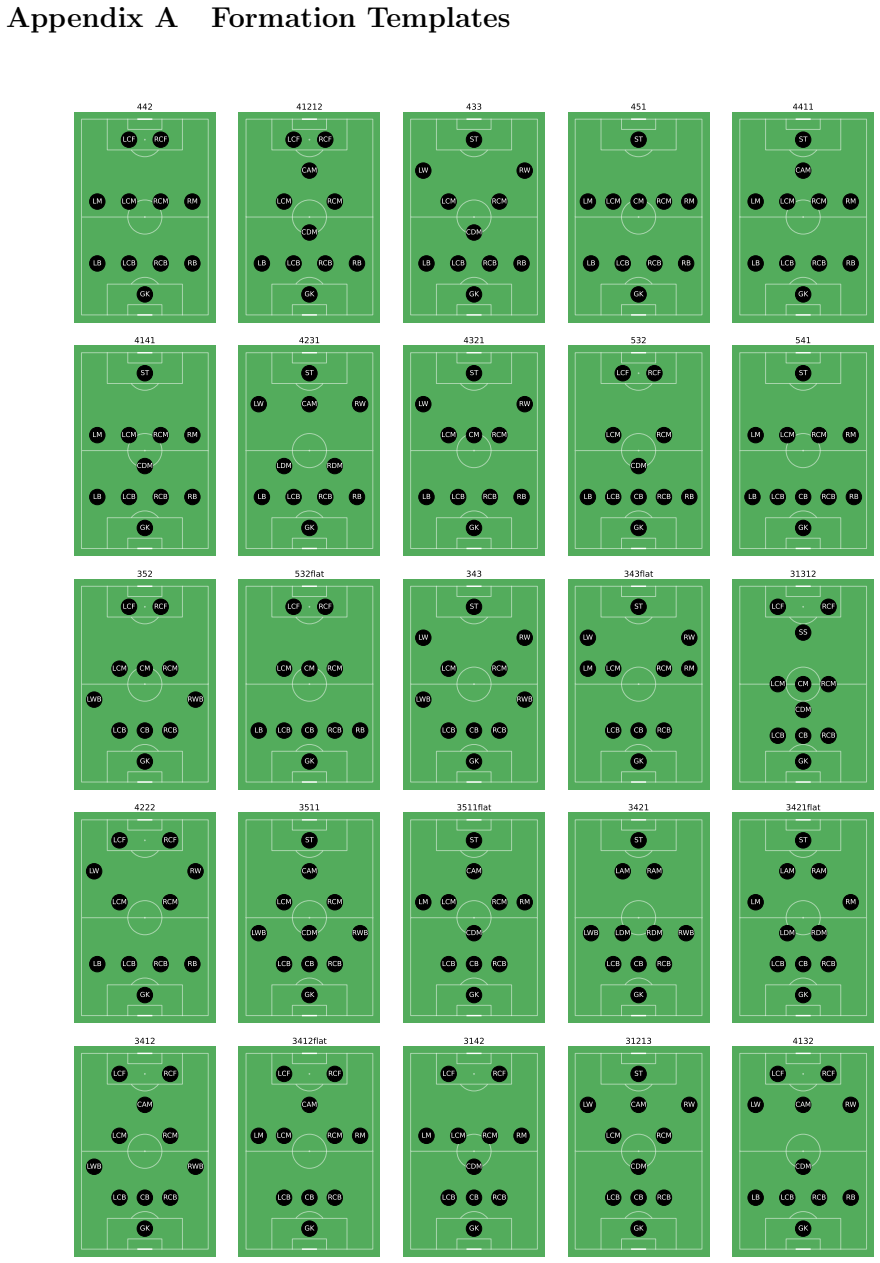
The mechanism is the linear sum assignment problem, solved with the Hungarian algorithm, applied to a cost matrix of Euclidean distances between players and template positions. Before any cost is computed, all player coordinates are scaled to the maximum width and length of the 65-template set, which turns the matching into a shape comparison rather than a raw proximity fit. Assignment is run separately for each template, the lowest-cost template wins, and the player-to-position matching from that template supplies the role labels. An optional stability parameter $\epsilon$ blocks a template change unless the new cost is at least $\epsilon$ percent lower than the previous one.
What would settle it
Take a sample of match frames with human-annotated formations and roles, run EFPI with and without scaling, and compare agreement. If the scaled version disagrees with the annotations systematically in compressed or stretched situations—teams packed deep, attacking in wide spaces, or playing narrow—then the scaling does not preserve the geometry needed for correct assignment.
Extended reading notes
Core claim
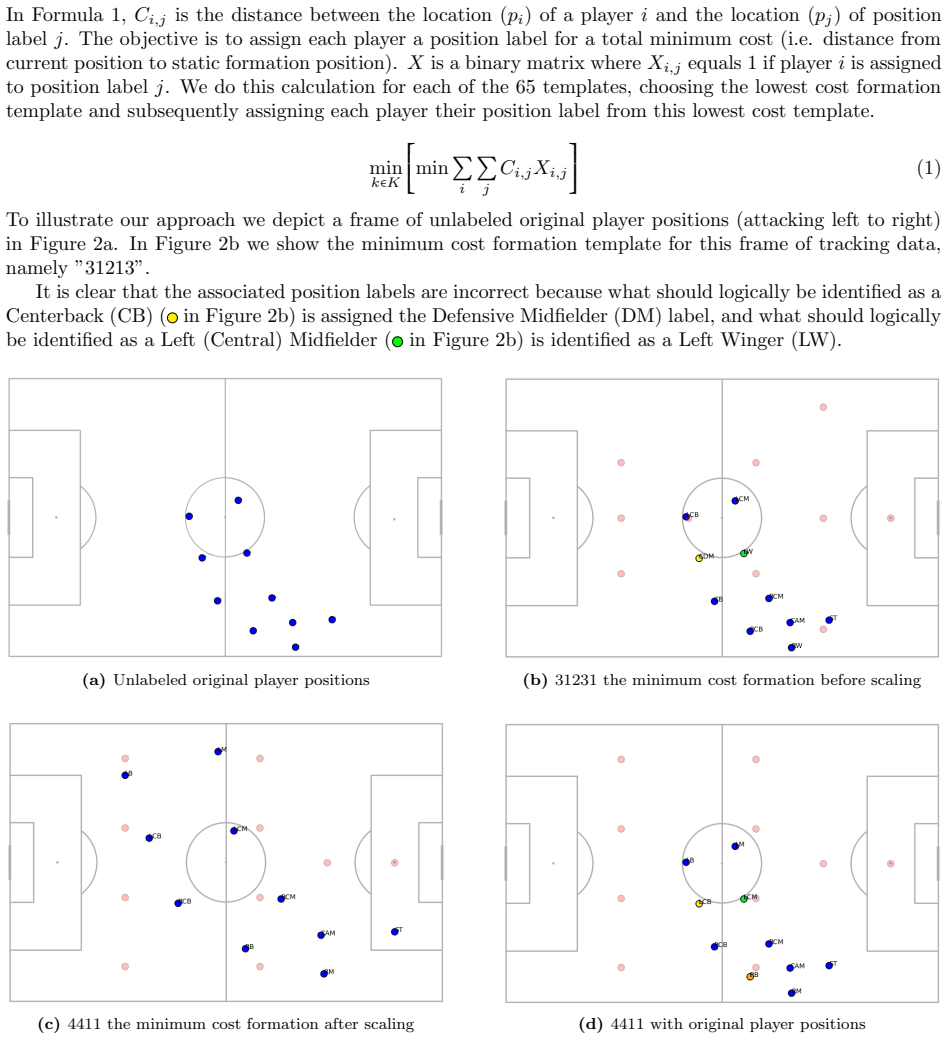
On the paper's own terms, the central claim is that scaling player coordinates to the bounding dimensions of the formation templates before cost computation makes template matching tactically coherent. In the paper's illustrative frame, unscaled matching labels a center back as a defensive midfielder and a central midfielder as a winger; after scaling, the same frame is labeled 4411 with roles the author treats as correct. The paper states that this scaling largely resolves the illogical assignment problem identified in earlier work, and that formation labels and player position labels can therefore be produced instantly and simultaneously for any time segment, from single frames to full periods.
Load-bearing premise
The load-bearing premise is that linearly scaling all player positions to the widest and longest formation template preserves the relative geometry that makes the lowest-cost template the tactically correct one in every game situation; this normalization is introduced without a sensitivity analysis.
Editorial extensions
If this is right
- A single algorithm outputs both the formation label and individual role labels for every outfield player, without training data or manual annotation.
- Because player locations can be averaged over any segment, the same code labels single frames, possessions, 5-minute windows, or full periods.
- The stability parameter $\epsilon$ suppresses spurious formation switches during transitions while still allowing genuine changes when the cost improvement is large enough.
- Templates for 8, 9, and 10 outfield players let the method keep working when red cards or injuries reduce a team's numbers.
- The open-source implementation consumes standardized tracking data, so it can be applied to data from a wide range of providers.
Reading between the lines
- The scaling step is implicitly a claim that formation geometry is scale-invariant across match situations; a natural extension would test rotation or shear alignment, which the paper does not do.
- Frame-level labels from EFPI could serve as weak supervision for role-classification models, but that use would require checking EFPI's own accuracy against annotated ground truth first.
- The stability threshold and segment length interact: a fixed $\epsilon$ may be too lax for long segments and too strict for short ones, so an adaptive threshold is a testable refinement.
- A systematic comparison of EFPI's formation labels with human-annotated formations across varied match states would reveal whether the scaling truly resolves illogical assignments or only on the illustrated frame.
Editorial analysis
A structured set of objections, weighed in public.
Referee Report
Summary. The paper introduces EFPI, a rule-based method for football formation recognition and per-player role labeling from spatiotemporal tracking data. For each frame or time segment, player coordinates are linearly scaled to the maximum width and length of a fixed set of 65 static formation templates, a linear sum assignment solver matches players to template positions for each template, and the lowest-cost template is selected. An optional stability parameter suppresses formation changes when the relative cost improvement is below a threshold. The method is illustrated on a single frame and on Portugal's 2022 World Cup match against Switzerland, and the implementation is released through the open-source unravelsports Python package.
Significance. If the scaling step can be shown to preserve the relevant geometry of player arrangements, EFPI would provide a simple, transparent, and computationally cheap baseline for dynamic formation and role labeling, complementing supervised and change-point approaches such as those of Pleuler (2024) and Kim et al. (2022). The open-source implementation and support for multiple tracking-data providers through Kloppy are clear practical strengths, as is the use of an openly available dataset for the code example. However, the paper currently offers no quantitative evidence for its central claim that the method 'functions effectively': there is no ground-truth comparison, no error metric, no sensitivity analysis, and no baseline comparison. The contribution is therefore a plausible algorithmic recipe whose practical validity remains unestablished.
major comments (4)
- [Section 2.1] The per-frame scaling of player positions to the maximum width and length of the template set is the load-bearing novelty of the method, but it is neither justified nor validated. The scaling factors depend on the current bounding box of the team, so the same real formation can map to different normalized shapes in a compact low block versus a stretched high press, and the assignment cost in Eq. (1) is not invariant under this normalization. The paper provides no comparison of scaled versus unscaled assignment costs, no ablation of the scaling, and no sensitivity analysis. The single illustrative frame in Figure 2 cannot establish that the lowest-cost template after scaling corresponds to the true formation. The claim that scaling 'largely resolves the illogical assignment problem pointed out by Poppeliers (2025)' therefore needs quantitative support, for example by comparing assignment accuracy against ground-truth formation and role labels on a labeled dataset.
- [Entire manuscript (especially Abstract and Figures 2, 4, 5)] The central claim that EFPI 'functions effectively on individual frames' is not supported by any quantitative experiment. The paper reports no accuracy, precision, recall, or error rates for formation identification or player-role assignment, and it compares against no baseline method such as Wei et al. (2013), Pleuler (2024), or SoccerCPD. The qualitative Portugal-Switzerland case study (Figures 4-5) and the single-frame example (Figure 2) cannot substantiate the claim. Because the paper's stated goal is a usable tactical-analytics tool, the authors should evaluate EFPI on the openly available dataset cited as [1], using ground-truth labels (e.g., starting lineups and known formation annotations), and report frame-level and segment-level metrics against at least one baseline.
- [Section 2.3, Eq. (3)] The stability parameter is a free parameter, yet the paper provides no sensitivity analysis. The only demonstration is a single 24-second sequence in Figure 3, which is insufficient to show that the threshold reliably separates genuine formation changes from noise. Additionally, Eq. (3) uses C_{t-1} for the cost of the previously assigned template but does not specify what happens if that template was not the lowest-cost template at time t-1, or how the parameter interacts with the 'change after possession' option shown in Codeblock 1. A systematic robustness study over a range of epsilon values, and over multiple matches and game situations, is needed before the stability mechanism can be considered a validated component.
- [Section 2.2] The segmentation procedure that averages player positions over a segment (Eq. (2)) is presented without validation. Averaging over a full period or a five-minute window can obscure genuine tactical transitions and is sensitive to substitutions and out-of-possession excursions. The statement that segments are 'partitioned by attacking and defending periods' is not operationalized, and it is unclear how this interacts with possession data. The paper should compare frame-level vs segment-level assignments and report how often the segment-level label differs from the majority of frame-level labels, especially in transition-heavy intervals.
minor comments (6)
- [Figure 2 caption] The caption refers to '31231' while the text and figure describe '31213'; the caption also contains the typo 'identifeied'. Please correct both.
- [Eq. (3)] The expression should be written as (C_{t-1} - C_t)/C_t > epsilon, and each symbol should be defined at first use, including the distinction between the cost of the previously assigned template and the cost of the best template at time t.
- [Section 2.2] The phrase 'partition these segments by attacking and defending periods' needs a precise definition, including how attacking and defending are determined from tracking or event data.
- [References] Reference [7] is incomplete: no publication venue, arXiv identifier, or year-consistent citation details are given. Please provide a complete citation or remove it if it is not publicly available.
- [Codeblock 1] The heading 'Model Configuration and Training' is a misnomer because the method has no training phase. Also, the 'change_threshold' parameter is not explicitly connected to the stability parameter epsilon in the text.
- [General] There are several typographical and phrasing issues, including 'the the' in Section 2.4, 'individually players' in the introduction, and variable naming inconsistencies (N and q in Eq. (2)). A careful proofread is recommended.
Circularity Check
No circularity: EFPI is an open-loop template-matching procedure; no fitted parameter or self-citation is load-bearing.
full rationale
The paper's derivation chain is straightforward: Eq. 1 solves a linear sum assignment against 65 predefined static templates, and the only novel ingredient is a pre-scaling of player coordinates to the maximum template width and length before computing costs. This scaling is a heuristic introduced in Section 2.1, not derived from the output, and the assignment cost is simply minimized over templates. The result is always one of the predefined templates by construction of the method, which is a model-selection property rather than a circular prediction. There is no fitted parameter that is later relabeled as a prediction: no ground-truth labels are used for fitting, and the stability parameter epsilon is user-chosen and is not itself used to generate the template assignments it filters. The self-citations ([2], [3]) point to the software package and prior work by the same author, but they are implementation references, not load-bearing premises for the assignment math. External citations provide the assignment solver and the template library. The claim that scaling 'largely resolves' Poppeliers's illogical-assignment problem is an empirical assertion that is not validated with ground truth, and this is a correctness or validation concern, not circularity. Therefore no significant circularity is present.
Assumptions & free parameters
free parameters (2)
- stability parameter epsilon =
0.1 (example, user-chosen)
- scaling to maximum template width and length
assumptions (4)
- domain assumption The 65 predefined templates from mplsoccer sufficiently represent all plausible formations and role layouts in a match.
- domain assumption Player tracking positions are accurate, and the goalkeeper's role label from the data provider is correct.
- domain assumption The minimum assignment cost over templates is a valid proxy for the true formation and player roles.
- standard math The Hungarian algorithm solves the linear sum assignment problem optimally.
Cite this review
Pith. "Pith review of EFPI: Elastic Formation and Position Identification in Football (Soccer) using Template Matching and Linear Assignment." pith.science (2026). https://pith.science/paper/RLZSK2RS
@misc{pith2026250623843,
  author       = {Pith},
  title        = {Pith review of: EFPI: Elastic Formation and Position Identification in Football (Soccer) using Template Matching and Linear Assignment},
  year         = {2026},
  howpublished = {\url{https://pith.science/paper/RLZSK2RS}},
  note         = {Machine review of arXiv:2506.23843}
}
read the original abstract
Understanding team formations and player positioning is crucial for tactical analysis in football (soccer). This paper presents a flexible method for formation recognition and player position assignment in football using predefined static formation templates and cost minimization from spatiotemporal tracking data, called EFPI. Our approach employs linear sum assignment to optimally match players to positions within a set of template formations by minimizing the total distance between actual player locations and template positions, subsequently selecting the formation with the lowest assignment cost. To improve accuracy, we scale actual player positions to match the dimensions of these formation templates in both width and length. While the method functions effectively on individual frames, it extends naturally to larger game segments such as complete periods, possession sequences or specific intervals (e.g. 10 second intervals, 5 minute intervals etc.). Additionally, we incorporate an optional stability parameter that prevents unnecessary formation changes when assignment costs differ only marginally between time segments. EFPI is available as open-source code through the unravelsports Python package.
Figures


Figures from the paper (5 more)




Reference graph
Works this paper leans on
-
[1]
An integrated dataset of spatiotemporal and event data in elite soccer
Manuel Bassek et al. “An integrated dataset of spatiotemporal and event data in elite soccer”. In: Scientific Data 12.1 (2025), p. 195 (cit. on p. 6)
work page 2025
-
[2]
J. Bekkers. unravelsports [GitHub]. Version 1.1.0. 2024. url: https://github.com/UnravelSports/ unravelsports (cit. on pp. 1, 2, 6)
work page 2024
-
[3]
A Graph Neural Network deep-dive into successful counter- attacks
Joris Bekkers and Amod Sahasrabudhe. “A Graph Neural Network deep-dive into successful counter- attacks”. In: arXiv preprint arXiv:2411.17450 (2024) (cit. on p. 2)
arXiv 2024
-
[4]
Hyunsung Kim et al. “SoccerCPD: Formation and role change-point detection in soccer matches using spatiotemporal tracking data”. In: Proceedings of the 28th ACM SIGKDD Conference on Knowledge Discovery and Data Mining . 2022, pp. 3146–3156 (cit. on p. 1)
work page 2022
-
[5]
The Hungarian method for the assignment problem
Harold W Kuhn. “The Hungarian method for the assignment problem”. In: Naval research logistics quarterly 2.1-2 (1955), pp. 83–97 (cit. on p. 2)
work page 1955
-
[6]
Devin Pleuler. Frame by Frame Position . https : / / github . com / devinpleuler / research / blob / master/frame-by-frame-position.md . Accessed: 2025-03-25. 2024 (cit. on p. 2)
work page 2025
-
[7]
Automatic discovery of buildup tactics using football match data
Pieter-Jan Poppeliers. “Automatic discovery of buildup tactics using football match data”. In: (2025) (cit. on pp. 1, 2)
work page 2025
-
[8]
mplsoccer: A python package for plotting soccer/football charts in matplotlib
Andrew Rowlinson. mplsoccer: A python package for plotting soccer/football charts in matplotlib . htt ps://github.com/andrewRowlinson/mplsoccer. Version 1.5.0. 2021 (cit. on p. 2)
work page 2021
Show all 12 references
-
[9]
Dynamic analysis of team strategy in professional football
Laurie Shaw and Mark Glickman. “Dynamic analysis of team strategy in professional football”. In: Bar¸ ca sports analytics summit13 (2019), pp. 1–13 (cit. on p. 1)
2019
-
[10]
SciPy 1.0: fundamental algorithms for scientific computing in Python
Pauli Virtanen et al. “SciPy 1.0: fundamental algorithms for scientific computing in Python”. In: Nature methods 17.3 (2020), pp. 261–272 (cit. on p. 2)
2020
-
[11]
Kloppy: standardizing soccer tracking and event data [GitHub]
Koen Vossen. Kloppy: standardizing soccer tracking and event data [GitHub] . 2020. url: https:// github.com/PySport/kloppy (visited on 02/03/2024) (cit. on p. 6)
2020
-
[12]
Large-scale analysis of formations in soccer
Xinyu Wei et al. “Large-scale analysis of formations in soccer”. In: 2013 international conference on digital image computing: techniques and applications (DICTA) . IEEE. 2013, pp. 1–8 (cit. on pp. 1, 2). 11
2013
Reviewed August 6, 2026 · model on record in the stance chip above.
Discussion (0). Continue with ORCID to comment.