REVIEW 3 major objections 5 minor 62 references
Modeling blazar broadband emission with convolutional neural networks -- III. proton synchrotron and hybrid models
T0 review · 3 major / 5 minor · reviewed 2026-08-06 · deepseek-v4-flash
Pith's one-line read A convolutional neural network can reproduce proton-synchrotron and hybrid blazar emission fast enough for Bayesian multimessenger fits.
desk verdict Genuine extension of the CNN surrogate to hadronic scenarios, but the accuracy claim rests on internal validation alone and the posteriors are never checked against direct SOPRANO runs. read the letter →
The pith
A machine-rendered reading of the paper's core claim, the machinery that carries it, and where it could break.
The reading
What carries the argument
The load-bearing object is a composite convolutional neural network trained on spectral outputs of SOPRANO, an implicit kinetic code that evolves the coupled Fokker–Planck equations for electrons, protons, photons, neutrons, and secondary particles (Equations 3 and 4). The network maps ten physical parameters — Doppler factor, blob radius, magnetic field, electron and proton injection indices, minimum and maximum electron Lorentz factors, maximum proton Lorentz factor, and electron and proton luminosities — to electromagnetic and neutrino spectra. The photon parameter space is split into four overlapping luminosity regions, each with its own network whose outputs are averaged in overlaps, and spectral derivatives are included in the training target to suppress oscillations; separate networks handle the neutrino spectra. This surrogate is what makes full posterior sampling of hadronic models computationally affordable.
What would settle it
Run SOPRANO at the best-fit parameter sets in Table 2 and at random parameter draws from the fitted posteriors, then compare the resulting electromagnetic and neutrino spectra with the CNN predictions; a mismatch larger than the quoted mean absolute error in the regions that drive the fits would show that the surrogate's posterior is biased.
Extended reading notes
Core claim
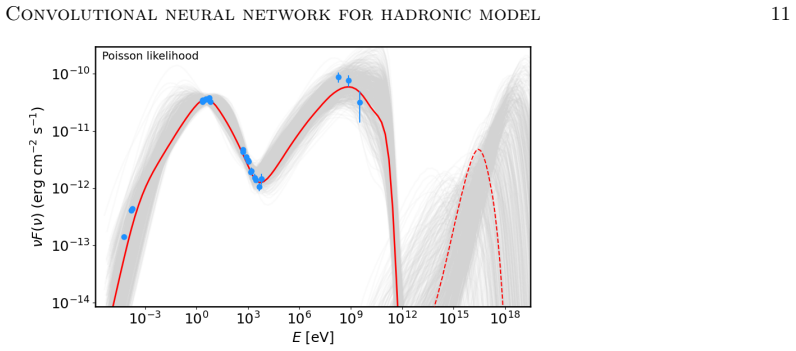
The central claim is that a convolutional neural network trained on $7\times10^6$ spectra generated by the SOPRANO code can act as a surrogate for the full time-dependent hadronic model, reproducing the broadband electromagnetic and neutrino spectra of both proton-synchrotron and hybrid lepto-hadronic scenarios. The authors report an average validation $R^2=0.66$ and mean absolute error $5.05\times10^{-3}$ across the four photon networks, with similar behaviour for the neutrino networks. Coupled to a Bayesian sampler, the surrogate recovers best-fit parameter sets for TXS 0506+059 and PKS 0735+178: a Gaussian likelihood on an assumed neutrino spectrum favours a hybrid model for TXS 0506+059, while a Poisson event-count likelihood favours a proton-synchrotron model for the same source, and the PKS 0735+178 posterior is bimodal between the two scenarios.
Load-bearing premise
The entire fitting exercise rests on the trained network being a faithful stand-in for the numerical model, even though it was only validated against spectra drawn from the same simulation database used for training.
Editorial extensions
If this is right
- For TXS 0506+059, the preferred model depends on the neutrino likelihood: a Gaussian likelihood on an assumed neutrino spectrum favours a hybrid scenario, while a Poisson likelihood based on one IceCube event per year favours proton synchrotron.
- For PKS 0735+178, the Poisson-likelihood fit favours a proton-synchrotron solution, but the posterior is bimodal with a secondary hybrid mode, so the current multimessenger data cannot cleanly distinguish the two scenarios.
- Because the CNN is fast, full posterior sampling becomes feasible, allowing model selection between P-syn and hybrid scenarios to be driven by the data rather than fixed before the fit.
- The trained network is released as an online fitting service, letting other researchers fit their own multimessenger SEDs without recomputing the seven-million-spectrum simulation database.
- A stated next step is to include external photon fields, which would extend the surrogate to sources with accretion disks or broad-line regions.
Reading between the lines
- The validation metrics are measured only on spectra drawn from the same simulation database used for training; the paper does not propagate surrogate error into the posterior, so a locally biased region of the CNN could masquerade as a preferred model, for instance in the PKS 0735+178 bimodality.
- A direct test of reliability would be to run SOPRANO at the best-fit parameters and at random posterior draws and compare the predicted spectra; the reported $R^2$ alone does not guarantee uniform accuracy across the parameter space.
- The Poisson-likelihood results assume one detected neutrino in a one-year IceCube exposure and use a specific effective area; altering those assumptions would shift the inferred proton luminosity and could change the hybrid-versus-P-syn balance.
- Because the paper explicitly excludes external photon fields, the current surrogate is most directly applicable to BL Lac-type jets; adding external radiation could reduce the very high proton luminosity found for TXS 0506+059.
Signed reviews
Editorial analysis
A structured set of objections, weighed in public.
Referee Report
Summary. This paper extends the authors' prior CNN-based surrogate modeling program to hadronic and hybrid lepto-hadronic blazar emission models. A convolutional neural network is trained on 7e6 synthetic spectra generated with the SOPRANO kinetic code over a wide parameter space, augmented by focused sampling in proton-synchrotron and hybrid regions. The trained surrogate, comprising separate CNNs for photon and neutrino outputs, is coupled to MultiNest and applied to fit the multimessenger SEDs of TXS 0506+059 and PKS 0735+178 under two neutrino likelihood treatments: a Gaussian likelihood using assumed neutrino flux points and a Poisson likelihood based on one IceCube event in one year. The paper reports best-fit parameters for both sources, finds hybrid or proton-synchrotron solutions depending on the likelihood and source, and makes the trained model available through the MMDC web platform.
Significance. If the emulator's fidelity is confirmed at the fitted parameter values, this is a useful and timely contribution: it would make Bayesian fitting of computationally expensive hadronic blazar models practical and would provide the community with a public tool for multimessenger SED interpretation. The scale of the training database (7e6 SOPRANO spectra), the integration into MMDC, and the explicit treatment of neutrino likelihoods are concrete strengths. The central claim, however, is that the CNN 'effectively reproduces' SOPRANO's electromagnetic and neutrino outputs; the support offered for that claim is internal validation only, and the reported average R2=0.66 is modest. The significance of the astrophysical applications is therefore conditional on an additional validation step that is currently missing.
major comments (3)
- [§3.3] The validation metrics reported in §3.3 (average R2=0.66, MSE=2.25e-3, MAE=5.05e-3 across the four photon models) are not sufficient to support the claim of 'great accuracy' in the Figure 1 caption, and no region-resolved or spectral-band-specific metrics are provided. The statement 'Similar results hold for neutrinos' is given without any quantitative support, even though the neutrino output is the decisive input for the Gaussian-versus-Poisson comparison in §4.2. The authors should report per-region accuracy, worst-case residuals, and neutrino-specific metrics (e.g., R2 or MAE on the relevant energy range) before claiming that the surrogate reliably reproduces multimessenger spectra.
- [§4] All fits in Section 4, including the plotted best-fit SEDs, gray posterior envelopes, and neutrino spectra, are CNN predictions; no spectrum is checked against SOPRANO after fitting. Because the validation in §3.3 is drawn from the same simulation database used for training, the reported accuracy measures emulator self-consistency rather than agreement with an independent calculation. Since the proton-synchrotron solutions for TXS 0506+059 (Poisson) and PKS 0735+178 lie at log10(B/[G])~2.7-2.9 and log10(γp,max)~8, inside the focused P-syn sampling region, a localized surrogate bias could shift the posterior modes or create the PKS 0735+178 bimodality discussed in §4.3. The authors should run SOPRANO on the best-fit parameters and on a sample of posterior draws, compare the electromagnetic and neutrino spectra, and either propagate surrogate uncertainty into the posteriors or explicitly quantify its effect on the reported parameter constraints.
- [§4.2-4.3] The astrophysical conclusions rest on several ad hoc choices that are not stress-tested: the assumed two-point neutrino flux at 183 TeV and 4.3 PeV with 10% uncertainty in the Gaussian likelihood, the one-year/one-event IceCube assumption in the Poisson likelihood, and the fixed log10(γe,min)=2.0 in the Poisson runs. The TXS 0506+059 result changes from a hybrid to a proton-synchrotron interpretation when the neutrino likelihood is changed (Table 2), so the model-selection statement is sensitive to exactly these choices. The authors should add sensitivity tests over exposure time, event count, and γe,min priors, and state which of the reported conclusions are robust to these choices.
minor comments (5)
- [Figure 1 caption] The caption states that the results have 'great accuracy,' but the reported average R2=0.66 is modest; please either provide stronger region-specific metrics or soften the claim to match the quantitative results.
- [§4.2] The text states that Lp=1.5e51 erg/s is at the 'upper boundary of the parameter range used to train' the network, but Table 1 lists the maximum as log10(Lp)=52, which is a factor of several above the fitted value; please clarify which boundary is meant.
- [§4.1, Eq. (5)] The Poisson likelihood expression as written, log10 L = 2Σ(t mi) - Si log10(t mi) + log10(Si!), does not match the standard Cash statistic convention; please clarify the definition of L, the role of the factor 2, and the units of t mi.
- [Throughout] The text alternates between 'P-sync' and 'P-syn'; please use a single abbreviation consistently.
- [§5] The Data Availability statement says the network 'can be shared on a reasonable request' while §5 says it is publicly available through MMDC; please make the accessibility statement consistent.
Circularity Check
No significant circularity: CNN emulation of SOPRANO is validated on held-out SOPRANO spectra and applied to external observed SEDs; remaining concerns are accuracy/calibration risks, not circularity.
full rationale
The paper's derivation chain is: SOPRANO computes synthetic EM and neutrino spectra from a kinetic model (Eqs. 1-4); a CNN is trained to map the 10 model parameters to those spectra; the CNN is then used inside a Bayesian fit to observed SEDs of TXS 0506+059 and PKS 0735+178. Validation on a held-out split of the same SOPRANO database is the appropriate test of an emulator's interpolation accuracy; it measures the CNN's fidelity to its target code, which is exactly the claim being made ('effectively reproducing electromagnetic and neutrino emissions' means reproducing SOPRANO's outputs, not independently establishing blazar physics). The application to real observational data is an external benchmark that was not used to train the CNN, so the astrophysical fits do not reduce to the training inputs. Self-citations (Bégué et al. 2024, Sahakyan et al. 2024b for the CNN architecture; Gasparyan et al. 2022 for SOPRANO) are methodological and code references rather than load-bearing evidence for the hadronic emulator's validity; the governing equations are stated in the paper, and no uniqueness theorem or ansatz is smuggled in via citation. The paper itself flags model limitations (no external photon fields, and the PKS 0735+178 P-syn/hybrid bimodality as data-driven ambiguity). The skeptical concern that surrogate error in the posterior region is unquantified (validation R2 = 0.66, no direct SOPRANO re-evaluation of best-fit SEDs) is a legitimate accuracy and uncertainty-propagation risk, but it is not circularity: the CNN predictions are not identical to the fitted inputs by construction, and the observed SEDs are independent of the training database. Therefore no self-definitional, fitted-input-as-prediction, or self-citation-load-bearing circular step is present.
Assumptions & free parameters
free parameters (12)
- Doppler factor delta =
TXS Gaussian: 15.49; TXS Poisson: 23.18; PKS Poisson: 26.00
- Blob radius R =
10^17.76 cm (TXS Gaussian), 10^14.53 cm (TXS Poisson), 10^14.55 cm (PKS)
- Magnetic field B =
10^-1.52 G, 10^2.73 G, 10^2.88 G
- Electron injection index pe =
1.77, 2.87, 2.62
- Proton injection index pp =
2.03, 2.00, 1.87
- Minimum electron Lorentz factor gamma_e,min =
10^1.52 (TXS Gaussian); fixed to 100 in Poisson fits
- Maximum electron Lorentz factor gamma_e,max =
10^4.76, 10^3.25, 10^3.10
- Maximum proton Lorentz factor gamma_p,max =
10^6.37, 10^8.00, 10^7.95
- Electron luminosity Le =
10^46.50, 10^43.99, 10^44.61 erg/s
- Proton luminosity Lp =
10^51.18, 10^46.69, 10^46.91 erg/s
- Assumed neutrino flux for Gaussian likelihood =
1e-12 erg cm^-2 s^-1 at 183 TeV and 4.3 PeV
- Assumed IceCube exposure and event count for Poisson likelihood =
one event over one year
assumptions (7)
- domain assumption SOPRANO's kinetic equations (Equations 3 and 4) correctly describe electron, proton, photon, and secondary evolution in a one-zone jet.
- domain assumption The system reaches equilibrium at t = 4 t_dyn with negligible spectral variation.
- domain assumption One-zone spherical emitting region with uniform B, delta = Gamma, no adiabatic losses, and no external photon fields.
- standard math Latin hypercube sampling with the stated parameter ranges provides representative coverage of the 10-dimensional parameter space.
- domain assumption The CNN architecture and L1 training on spectra plus derivatives generalize to unseen parameter combinations.
- domain assumption IceCube effective area from Blaufuss et al. 2019 and quasi-two-neutrino oscillation mixing fractions apply.
- domain assumption The EBL absorption model of Domínguez et al. 2011 is correct.
Cite this review
Pith. "Pith review of Modeling blazar broadband emission with convolutional neural networks -- III. proton synchrotron and hybrid models." pith.science (2026). https://pith.science/paper/Q32EYOYY
@misc{pith2026250623885,
  author       = {Pith},
  title        = {Pith review of: Modeling blazar broadband emission with convolutional neural networks -- III. proton synchrotron and hybrid models},
  year         = {2026},
  howpublished = {\url{https://pith.science/paper/Q32EYOYY}},
  note         = {Machine review of arXiv:2506.23885}
}
read the original abstract
Modeling the broadband emission of blazars has become increasingly challenging with the advent of multimessenger observations. Building upon previous successes in applying convolutional neural networks (CNNs) to leptonic emission scenarios, we present an efficient CNN-based approach for modeling blazar emission under proton synchrotron and hybrid lepto-hadronic frameworks. Our CNN is trained on extensive numerical simulations generated by SOPRANO, which span a comprehensive parameter space accounting for the injection and all significant cooling processes of electrons and protons. The trained CNN captures complex interactions involving both primary and secondary particles, effectively reproducing electromagnetic and neutrino emissions. This allows for rapid and thorough exploration of the parameter space characteristic of hadronic and hybrid emission scenarios. The effectiveness of the trained CNN is demonstrated through fitting the spectral energy distributions of two prominent blazars, TXS 0506+059 and PKS 0735+178, both associated with IceCube neutrino detections. The modeling is conducted under assumptions of constant neutrino flux across distinct energy ranges, as well as by adopting a fitting that incorporates the expected neutrino event count through a Poisson likelihood method. The trained CNN is integrated into the Markarian Multiwavelength Data Center (MMDC; https://www.mmdc.am), offering a robust tool for the astrophysical community to explore blazar jet physics within a hadronic framework.
Figures


Figures from the paper (3 more)


Reference graph
Works this paper leans on
-
[1]
E,u mҢTQB u UH# 9 l65̚V ] EX #QH K](M# m:!y -Qӄkj YHgꆮ֮3 +آ< : ڣ -6 Fd fY[_ēfVw | VSv
thebibliography [1] 20pt to REFERENCES 6pt =0pt -12pt 10pt plus 3pt =0pt =0pt =1pt plus 1pt =0pt =0pt -12pt =13pt plus 1pt =20pt =13pt plus 1pt \@M =10000 =-1.0em =0pt =0pt 0pt =0pt =1.0em @enumiv\@empty 10000 10000 `\.\@m \@noitemerr \@latex@warning Empty `thebibliography' environment \@ifnextchar \@reference \@latexerr Missing key on reference command E...
2021
-
[2]
Abe H., et al., 2023, @doi [ ] 10.3847/1538-4365/acc181 , https://ui.adsabs.harvard.edu/abs/2023ApJS..266...37A 266, 37
-
[3]
Acharyya A., et al., 2023, @doi [ ] 10.3847/1538-4357/ace327 , https://ui.adsabs.harvard.edu/abs/2023ApJ...954...70A 954, 70
-
[4]
Ansoldi S., et al., 2018, @doi [ ] 10.3847/2041-8213/aad083 , http://adsabs.harvard.edu/abs/2018ApJ...863L..10A 863, L10
-
[5]
Becker J. K., 2008, @doi [ ] 10.1016/j.physrep.2007.10.006 , https://ui.adsabs.harvard.edu/abs/2008PhR...458..173B 458, 173
-
[6]
B \'e gu \'e D., Sahakyan N., Dereli-B \'e gu \'e H., Giommi P., Gasparyan S., Khachatryan M., Casotto A., Pe'er A., 2024, @doi [ ] 10.3847/1538-4357/ad19cf , https://ui.adsabs.harvard.edu/abs/2024ApJ...963...71B 963, 71
-
[7]
The Next Generation of IceCube Realtime Neutrino Alerts
Blaufuss E., Kintscher T., Lu L., Tung C. F., 2019, in 36th International Cosmic Ray Conference (ICRC2019). p. 1021 ( @eprint arXiv 1908.04884 ), @doi 10.22323/1.358.01021
work page Pith review arXiv 2019
-
[8]
M., 2000, @doi [ ] 10.1086/317791 , https://ui.adsabs.harvard.edu/abs/2000ApJ...545..107B 545, 107
B a \.z ejowski M., Sikora M., Moderski R., Madejski G. M., 2000, @doi [ ] 10.1086/317791 , https://ui.adsabs.harvard.edu/abs/2000ApJ...545..107B 545, 107
doi:10.1086/317791 2000
Show all 62 references
-
[9]
D., Marscher A
Bloom S. D., Marscher A. P., 1996, @doi [ ] 10.1086/177092 , https://ui.adsabs.harvard.edu/abs/1996ApJ...461..657B 461, 657
1996 doi
-
[10]
M., van Leeuwen J., 2023, @doi [ ] 10.1017/pasa.2023.32 , https://ui.adsabs.harvard.edu/abs/2023PASA...40...30B 40, e030
Boersma O. M., van Leeuwen J., 2023, @doi [ ] 10.1017/pasa.2023.32 , https://ui.adsabs.harvard.edu/abs/2023PASA...40...30B 40, e030
2023 doi
-
[11]
B \"o ttcher M., Reimer A., Sweeney K., Prakash A., 2013, @doi [ ] 10.1088/0004-637X/768/1/54 , http://adsabs.harvard.edu/abs/2013ApJ...768...54B 768, 54
2013 doi
-
[12]
M., 2023, @doi [The Journal of Open Source Software] 10.21105/joss.04969 , https://ui.adsabs.harvard.edu/abs/2023JOSS....8.4969B 8, 4969
Burgess J. M., 2023, @doi [The Journal of Open Source Software] 10.21105/joss.04969 , https://ui.adsabs.harvard.edu/abs/2023JOSS....8.4969B 8, 4969
2023 doi
-
[13]
Cash W., 1979, @doi [ ] 10.1086/156922 , https://ui.adsabs.harvard.edu/abs/1979ApJ...228..939C 228, 939
1979 doi
-
[14]
Cerruti M., Zech A., Boisson C., Emery G., Inoue S., Lenain J.-P., 2019, @doi [ ] 10.1093/mnrasl/sly210 , https://ui.adsabs.harvard.edu/abs/2019MNRAS.483L..12C 483, L12
2019 doi
-
[15]
D., Schlickeiser R., 1994, @doi [ ] 10.1086/191929 , https://ui.adsabs.harvard.edu/abs/1994ApJS...90..945D 90, 945
Dermer C. D., Schlickeiser R., 1994, @doi [ ] 10.1086/191929 , https://ui.adsabs.harvard.edu/abs/1994ApJS...90..945D 90, 945
1994 doi
-
[16]
D., Schlickeiser R., Mastichiadis A., 1992, , https://ui.adsabs.harvard.edu/abs/1992A&A...256L..27D 256, L27
Dermer C. D., Schlickeiser R., Mastichiadis A., 1992, , https://ui.adsabs.harvard.edu/abs/1992A&A...256L..27D 256, L27
1992
-
[17]
Dom \' nguez A., et al., 2011, @doi [ ] 10.1111/j.1365-2966.2010.17631.x , https://ui.adsabs.harvard.edu/abs/2011MNRAS.410.2556D 410, 2556
2011
-
[18]
A., Suvorova O., Baikal-GVD Collaboration 2021, The Astronomer's Telegram, https://ui.adsabs.harvard.edu/abs/2021ATel15112....1D 15112, 1
Dzhilkibaev Z. A., Suvorova O., Baikal-GVD Collaboration 2021, The Astronomer's Telegram, https://ui.adsabs.harvard.edu/abs/2021ATel15112....1D 15112, 1
2021
- [19]
-
[20]
P., Bridges M., 2009, @doi [ ] 10.1111/j.1365-2966.2009.14548.x , http://adsabs.harvard.edu/abs/2009MNRAS.398.1601F 398, 1601
Feroz F., Hobson M. P., Bridges M., 2009, @doi [ ] 10.1111/j.1365-2966.2009.14548.x , http://adsabs.harvard.edu/abs/2009MNRAS.398.1601F 398, 1601
2009
-
[21]
Filippini F., et al., 2022, The Astronomer's Telegram, https://ui.adsabs.harvard.edu/abs/2022ATel15290....1F 15290, 1
2022
-
[22]
Gao S., Fedynitch A., Winter W., Pohl M., 2019, @doi [Nature Astronomy] 10.1038/s41550-018-0610-1 , https://ui.adsabs.harvard.edu/abs/2019NatAs...3...88G 3, 88
2019 doi
-
[23]
Gasparyan S., B \'e gu \'e D., Sahakyan N., 2022, @doi [ ] 10.1093/mnras/stab2688 , https://ui.adsabs.harvard.edu/abs/2022MNRAS.509.2102G 509, 2102
2022 doi
-
[24]
Ghisellini G., Maraschi L., Treves A., 1985, , https://ui.adsabs.harvard.edu/abs/1985A&A...146..204G 146, 204
1985
-
[25]
Giommi P., Padovani P., Oikonomou F., Glauch T., Paiano S., Resconi E., 2020, @doi [ ] 10.1051/0004-6361/202038423 , https://ui.adsabs.harvard.edu/abs/2020A&A...640L...4G 640, L4
2020 doi
-
[26]
IceCube Collaboration 2021, GRB Coordinates Network, https://ui.adsabs.harvard.edu/abs/2021GCN.31191....1I 31191, 1
2021
-
[27]
IceCube Collaboration et al., 2018a, @doi [Science] 10.1126/science.aat1378 , http://adsabs.harvard.edu/abs/2018Sci...361.1378I 361, eaat1378
-
[28]
IceCube Collaboration et al., 2018b, @doi [Science] 10.1126/science.aat2890 , https://ui.adsabs.harvard.edu/abs/2018Sci...361..147I 361, 147
-
[29]
Keivani A., et al., 2018, @doi [ ] 10.3847/1538-4357/aad59a , http://adsabs.harvard.edu/abs/2018ApJ...864...84K 864, 84
2018 doi
-
[30]
Krau F., et al., 2020, @doi [ ] 10.1093/mnras/staa2148 , https://ui.adsabs.harvard.edu/abs/2020MNRAS.497.2553K 497, 2553
2020 doi
-
[31]
Liao N.-H., et al., 2022, @doi [ ] 10.3847/2041-8213/ac756f , https://ui.adsabs.harvard.edu/abs/2022ApJ...932L..25L 932, L25
2022 doi
-
[32]
Mannheim K., 1993, , http://adsabs.harvard.edu/abs/1993A
1993
-
[33]
L., 1989, , http://adsabs.harvard.edu/abs/1989A
Mannheim K., Biermann P. L., 1989, , http://adsabs.harvard.edu/abs/1989A
1989
-
[34]
Maraschi L., Ghisellini G., Celotti A., 1992, @doi [ ] 10.1086/186531 , https://ui.adsabs.harvard.edu/abs/1992ApJ...397L...5M 397, L5
1992 doi
-
[35]
D., Beckman R
McKay M. D., Beckman R. J., Conover W. J., 2000, Technometrics, 42, 55
2000
-
[36]
J., 2001, @doi [Astroparticle Physics] 10.1016/S0927-6505(00)00141-9 , https://ui.adsabs.harvard.edu/abs/2001APh....15..121M 15, 121
M \"u cke A., Protheroe R. J., 2001, @doi [Astroparticle Physics] 10.1016/S0927-6505(00)00141-9 , https://ui.adsabs.harvard.edu/abs/2001APh....15..121M 15, 121
2001 doi
-
[37]
J., Engel R., Rachen J
M \"u cke A., Protheroe R. J., Engel R., Rachen J. P., Stanev T., 2003, @doi [Astroparticle Physics] 10.1016/S0927-6505(02)00185-8 , http://adsabs.harvard.edu/abs/2003APh....18..593M 18, 593
2003 doi
-
[38]
Murase K., Oikonomou F., Petropoulou M., 2018, @doi [ ] 10.3847/1538-4357/aada00 , http://adsabs.harvard.edu/abs/2018ApJ...865..124M 865, 124
2018 doi
-
[39]
Oikonomou F., Petropoulou M., Murase K., Tohuvavohu A., Vasilopoulos G., Buson S., Santander M., 2021, @doi [ ] 10.1088/1475-7516/2021/10/082 , https://ui.adsabs.harvard.edu/abs/2021JCAP...10..082O 2021, 082
2021 doi
-
[40]
Omeliukh A., et al., 2025, @doi [ ] 10.1051/0004-6361/202452143 , https://ui.adsabs.harvard.edu/abs/2025A&A...695A.266O 695, A266
2025 doi
-
[41]
Padovani P., Giommi P., Resconi E., Glauch T., Arsioli B., Sahakyan N., Huber M., 2018, @doi [ ] 10.1093/mnras/sty1852 , https://ui.adsabs.harvard.edu/abs/2018MNRAS.480..192P 480, 192
2018 doi
-
[42]
Padovani P., Oikonomou F., Petropoulou M., Giommi P., Resconi E., 2019, @doi [ ] 10.1093/mnrasl/slz011 , https://ui.adsabs.harvard.edu/abs/2019MNRAS.484L.104P 484, L104
2019 doi
-
[43]
Padovani P., Boccardi B., Falomo R., Giommi P., 2022, @doi [ ] 10.1093/mnras/stac376 , https://ui.adsabs.harvard.edu/abs/2022MNRAS.511.4697P 511, 4697
2022 doi
-
[44]
Paiano S., Falomo R., Treves A., Scarpa R., 2018, @doi [ ] 10.3847/2041-8213/aaad5e , https://ui.adsabs.harvard.edu/abs/2018ApJ...854L..32P 854, L32
2018 doi
-
[45]
Paliya V. S., B \"o ttcher M., Olmo-Garc \' a A., Dom \' nguez A., Gil de Paz A., Franckowiak A., Garrappa S., Stein R., 2020, @doi [ ] 10.3847/1538-4357/abb46e , https://ui.adsabs.harvard.edu/abs/2020ApJ...902...29P 902, 29
2020 doi
-
[46]
B., Novoseltsev Y
Petkov V. B., Novoseltsev Y. F., Novoseltseva R. V., Baksan Underground Scintillation Telescope Group 2021, The Astronomer's Telegram, https://ui.adsabs.harvard.edu/abs/2021ATel15143....1P 15143, 1
2021
-
[47]
Petropoulou M., Mastichiadis A., 2015, @doi [ ] 10.1093/mnras/stu2364 , https://ui.adsabs.harvard.edu/abs/2015MNRAS.447...36P 447, 36
2015 doi
-
[48]
Petropoulou M., Oikonomou F., Mastichiadis A., Murase K., Padovani P., Vasilopoulos G., Giommi P., 2020, @doi [ ] 10.3847/1538-4357/aba8a0 , https://ui.adsabs.harvard.edu/abs/2020ApJ...899..113P 899, 113
2020 doi
-
[49]
Prince R., Das S., Gupta N., Majumdar P., Czerny B., 2024, @doi [ ] 10.1093/mnras/stad3804 , https://ui.adsabs.harvard.edu/abs/2024MNRAS.527.8746P 527, 8746
2024 doi
-
[50]
Righi C., Tavecchio F., Pacciani L., 2019, @doi [ ] 10.1093/mnras/sty3072 , https://ui.adsabs.harvard.edu/abs/2019MNRAS.484.2067R 484, 2067
2019 doi
-
[51]
S., Garrappa S., Omeliukh A., Franckowiak A., Winter W., 2024a, @doi [ ] 10.1051/0004-6361/202347540 , https://ui.adsabs.harvard.edu/abs/2024A&A...681A.119R 681, A119
Rodrigues X., Paliya V. S., Garrappa S., Omeliukh A., Franckowiak A., Winter W., 2024a, @doi [ ] 10.1051/0004-6361/202347540 , https://ui.adsabs.harvard.edu/abs/2024A&A...681A.119R 681, A119
-
[52]
Rodrigues X., Karl M., Padovani P., Giommi P., Paiano S., Falomo R., Petropoulou M., Oikonomou F., 2024b, @doi [ ] 10.1051/0004-6361/202450592 , https://ui.adsabs.harvard.edu/abs/2024A&A...689A.147R 689, A147
-
[53]
Sahakyan N., 2018, @doi [ ] 10.3847/1538-4357/aadade , http://adsabs.harvard.edu/abs/2018ApJ...866..109S 866, 109
2018 doi
-
[54]
Sahakyan N., 2019, @doi [ ] 10.1051/0004-6361/201834606 , https://ui.adsabs.harvard.edu/abs/2019A&A...622A.144S 622, A144
2019 doi
-
[55]
Sahakyan N., Giommi P., Padovani P., Petropoulou M., B \'e gu \'e D., Boccardi B., Gasparyan S., 2023, @doi [ ] 10.1093/mnras/stac3607 , https://ui.adsabs.harvard.edu/abs/2023MNRAS.519.1396S 519, 1396
2023 doi
-
[56]
Sahakyan N., et al., 2024a, @doi [ ] 10.3847/1538-3881/ad8231 , https://ui.adsabs.harvard.edu/abs/2024AJ....168..289S 168, 289
-
[57]
Sahakyan N., et al., 2024b, @doi [ ] 10.3847/1538-4357/ad5351 , https://ui.adsabs.harvard.edu/abs/2024ApJ...971...70S 971, 70
-
[58]
C., Rees M
Sikora M., Begelman M. C., Rees M. J., 1994, @doi [ ] 10.1086/173633 , https://ui.adsabs.harvard.edu/abs/1994ApJ...421..153S 421, 153
1994 doi
-
[59]
I., 2024, @doi [ ] 10.1051/0004-6361/202348566 , https://ui.adsabs.harvard.edu/abs/2024A&A...683A.185T 683, A185
Tzavellas A., Vasilopoulos G., Petropoulou M., Mastichiadis A., Stathopoulos S. I., 2024, @doi [ ] 10.1051/0004-6361/202348566 , https://ui.adsabs.harvard.edu/abs/2024A&A...683A.185T 683, A185
2024 doi
-
[60]
M., Padovani P., 1995, @doi [ ] 10.1086/133630 , https://ui.adsabs.harvard.edu/abs/1995PASP..107..803U 107, 803
Urry C. M., Padovani P., 1995, @doi [ ] 10.1086/133630 , https://ui.adsabs.harvard.edu/abs/1995PASP..107..803U 107, 803
1995 doi
-
[61]
A., 2016, Quality and reliability engineering international, 32, 1975
Viana F. A., 2016, Quality and reliability engineering international, 32, 1975
2016
-
[62]
F., Sarin N., 2025, @doi [ ] 10.1093/mnras/staf623 , https://ui.adsabs.harvard.edu/abs/2025MNRAS.539.3319W 539, 3319
Wallace W. F., Sarin N., 2025, @doi [ ] 10.1093/mnras/staf623 , https://ui.adsabs.harvard.edu/abs/2025MNRAS.539.3319W 539, 3319
2025 doi
Reviewed August 6, 2026 · model on record in the stance chip above.
Discussion (0). Continue with ORCID to comment.