REVIEW 2 major objections 5 minor 1 cited by
The Next Generation of IceCube Realtime Neutrino Alerts
T0 review · 2 major / 5 minor · reviewed 2026-08-14 · deepseek-v4-flash
Pith's one-line read IceCube's upgraded realtime alert system will issue about 10 Gold and 20 Bronze neutrino alerts per year, with the Gold channel reserved for events at least 50% likely to be astrophysical.
desk verdict Useful description of IceCube's new Gold/Bronze alert system, but the Bronze purity claim is contradicted by the paper's own Table 1. read the letter →
The pith
A machine-rendered reading of the paper's core claim, the machinery that carries it, and where it could break.
The reading
What carries the argument
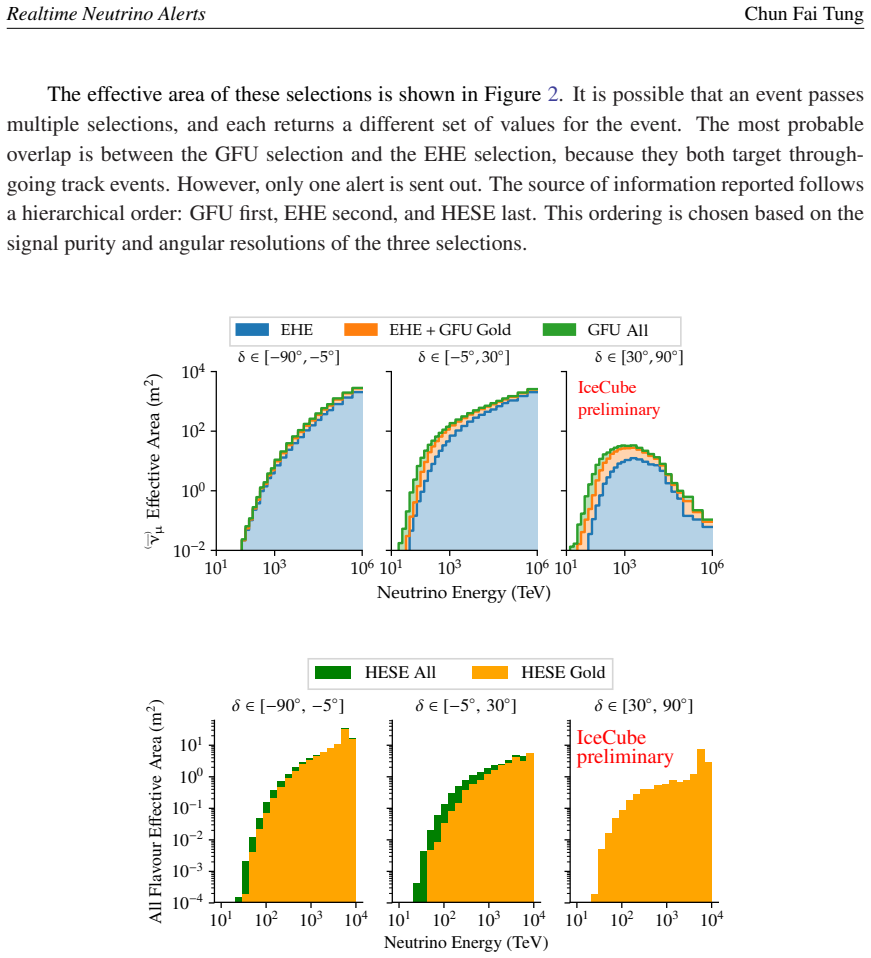
The central object is the signalness formula, Signalness(E, δ) = N_signal(E, δ) / (N_signal(E, δ) + N_background(E, δ)), which assigns each candidate a probability of being astrophysical based on the assumed diffuse flux and simulated atmospheric backgrounds. Three event selections feed this formula: GFU uses boosted decision trees to pick well-reconstructed through-going muon tracks and applies declination-dependent energy thresholds; HESE selects starting tracks with an outgoing muon and a 200-meter track length; EHE requires 4000+ photoelectrons and a fit-quality cut. These selections define the effective area and the Gold/Bronze rate tables.
What would settle it
Compare the actual one-year alert stream after deployment with the Table 1 predictions: if the observed Gold rate (in total, not per selection) is far from ~10 per year, or if archival classification of the Bronze events shows that fewer than 30% are truly of astrophysical origin, the assumed flux or background model would be invalidated.
Extended reading notes
Core claim
The central claim is that IceCube can simultaneously increase the rate and the astrophysical purity of realtime neutrino alerts by splitting the alert stream into two tiers defined by a per-event signalness measure. Signalness is defined as the ratio of expected astrophysical signal events to expected total events at that declination and energy proxy, using the best-fit diffuse astrophysical neutrino flux with spectral index -2.19 and normalization 1.01e-18 $GeV^{-1}$ $cm^{-2}$ $s^{-1}$ $sr^{-1}$ at 100 TeV. The updated selection uses three event samples—GFU (boosted decision tree selected through-going tracks), HESE (starting tracks with a muon), and EHE (extreme high energy tracks)—and the Gold/Bronze cuts are set at 50% and 30% signalness respectively. The paper reports expected alert rates of about 10 Gold and 20 Bronze events per year, with higher purity and clearer message content than the previous system.
Load-bearing premise
The signalness values and alert rates rely on the assumption that the true diffuse astrophysical neutrino flux follows a power law with spectral index -2.19 and normalization 1.01e-18 $GeV^{-1}$ $cm^{-2}$ $s^{-1}$ $sr^{-1}$ at 100 TeV, and that the simulated atmospheric neutrino and muon backgrounds accurately match the real detector; if those are wrong, the Gold/Bronze classifications and quoted purities shift.
Editorial extensions
If this is right
- If the flux and background assumptions hold, the astronomy community will receive roughly three times as many realtime neutrino alerts per year as before, with each alert carrying a quantified astrophysical signalness.
- The Gold/Bronze classification gives follow-up observers a principled way to prioritize targets: Gold alerts warrant immediate multi-wavelength observation, while Bronze alerts still merit attention as moderate-purity candidates.
- The reported angular error, energy, and signalness in each GCN Notice should allow more efficient and homogeneous follow-up campaigns compared with the previous alert stream.
- The expected declination dependence means most alerts will be concentrated in the Northern sky, guiding the pointing strategies of optical, X-ray, and gamma-ray telescopes.
Reading between the lines
- The quoted Gold/Bronze purities are conditional on the assumed astrophysical spectral index of -2.19; if the true diffuse flux is harder or softer, the same event could cross the 50% or 30% thresholds differently, so the real-time classification is inherently model-dependent.
- A natural test of the system's calibration is to accumulate one year of archival alerts and compare the empirically measured fraction of events that later show multi-messenger counterparts with the claimed signalness values.
- The Bronze channel effectively creates a public low-threshold sample that could be used to search for time-clustered neutrino flares (like the 2014-2015 TXS 0506+056 episode) even when no single event is high-purity.
- Because the EHE selection is held unchanged from the previous system, the main improvement in alert rate comes from adding GFU and loosening HESE cuts; this suggests future gains may come from even lower-energy track selections or from improving the southern-sky charge-based energy estimator.
Signed reviews
Editorial analysis
A structured set of objections, weighed in public.
Referee Report
Summary. The paper describes the next-generation IceCube realtime alert system deployed in June 2019, which introduces two alert channels: a Gold channel for candidates at least 50% likely to be astrophysical and a Bronze channel for candidates between 30% and 50% likely to be astrophysical. It presents the three event selections (GFU, HESE, and EHE), the design of the alert message and GCN circular, and expected and observed alert rates computed from the best-fit diffuse astrophysical neutrino flux and simulated atmospheric backgrounds. The central claims are that the new system will deliver roughly 10 Gold and 20 Bronze alerts per year, with higher astrophysical purity and improved message content compared with the previous generation of alerts.
Significance. If the system performs as described, this is a useful operational advancement for multi-messenger astronomy: the explicit two-channel design with signalness thresholds, the public alert message format, and the historical comparison using seven years of IceCube data are all strengths. The comparison with observed historical rates provides some empirical grounding for the rate predictions, which reduces circularity concerns despite the signal model being fitted to the same data. However, the advertised Bronze purity is not supported by the paper's own Table 1, and the absence of uncertainties on the rate table makes the central quantitative claims difficult to evaluate. The value of the paper is mainly as a system description and performance forecast, and the technical issues are correctable in revision.
major comments (2)
- [Abstract and Section 2; Table 1] The abstract and Section 2 define Bronze alerts as candidates with signalness between 30% and 50%, and Eq. (2.1) is described as the probability that an event is astrophysical. However, Table 1's expected Bronze rates give an astrophysical fraction of 2.8/(2.8+14.7), which is approximately 16%, well below the advertised range. This internal inconsistency undermines the central Bronze purity claim. Please either revise the Bronze threshold definition, clarify that Eq. (2.1) is a cumulative sample fraction rather than a per-event posterior (and adjust the text accordingly), or correct Table 1 so that the expected signal fraction matches the stated Bronze definition.
- [Section 2.3; Table 1] The expected and observed alert rates in Table 1 are quoted as point values with no uncertainties. This matters because the expected signal rates and all signalness values are computed from the best-fit diffuse flux (spectral index -2.19, normalization 1.01e-18 GeV^-1 cm^-2 s^-1 sr^-1) and from simulated atmospheric backgrounds, while Section 2.2 acknowledges that signalness varies with spectral index but does not quantify the effect. The comparison between expected and observed rates (e.g., Gold 12.7/yr expected vs 9.9/yr observed; Bronze 17.5/yr expected vs 19.5/yr observed) is therefore unquantified. Please add statistical uncertainties from the seven-year historical sample and a statement of the systematic spread induced by the assumed spectral index and background model.
minor comments (5)
- [Section 2, first paragraph] Typo: 'over the Iridum satellite' should read 'over the Iridium satellite.'
- [Section 2.2, last paragraph] The statement that 'all of the information is generated during the reconstructions performed at South Pole' appears to conflict with Section 2, which says that signalness is assessed in the North after the event data are transferred; please clarify where each alert quantity is computed.
- [Equation (2.1)] Please specify whether Nsignal(E,δ) and Nbackground(E,δ) count events with energy proxy greater than E and whether these are rates per year or counts; currently 'above' is ambiguous.
- [Figure 4 and text] In the text, 'Figure4' is missing a space, and the figure caption uses 'Thru-going' where 'Through-going' is meant.
- [Table 1] The table would be easier to read if the Gold and Bronze columns separated signal and background totals more clearly and if the Gold overlap between GFU and EHE were denoted in the row layout rather than only in the caption.
Circularity Check
No significant circularity: the expected rates are transparent model projections under a prior measured flux, with observed-data cross-checks.
full rationale
The paper's quantitative claims are conditional expectations, not circular derivations. Section 2.3 states clearly: 'The expected rates of signal events passing the updated selection are calculated using the best-fit diffuse astrophysical neutrino flux, which has a spectral index of −2.19 and normalization at 100 TeV of 1.01 × 10⁻¹⁸ GeV−1 cm−2 s−1 sr−1, as reported in [12].' This is an explicitly stated input, not a hidden fit performed in this paper. Equation (2.1) defines signalness via the same signal and background counts, so the Gold/Bronze purity labels are design thresholds rather than independently discovered physical results; that is definitional, but it does not make the alert-rate projection circular. The seven-year observed rates in Table 1 provide an external, data-side check on the overall rates. The paper also acknowledges its main model dependence: 'the reported signalness and neutrino energy vary with spectral index of the astrophysical neutrino flux.' The self-citation to [12] is a prior IceCube measurement, not an unverified uniqueness claim, and no parameter fitted in this paper is relabeled as a prediction. One non-circular concern is that Table 1's expected Bronze signal fraction (2.8 / (2.8 + 14.7) ≈ 16%) is inconsistent with the advertised 30–50% Bronze signalness window; that is an internal self-consistency and correctness issue, not a circularity. Overall, no step reduces to its own input by construction, so the circularity score is 0.
Assumptions & free parameters
free parameters (3)
- Diffuse astrophysical neutrino flux normalization =
1.01e-18 GeV^-1 cm^-2 s^-1 sr^-1 at 100 TeV
- Diffuse astrophysical neutrino spectral index =
-2.19
- Signalness thresholds =
30% and 50%
assumptions (3)
- domain assumption Atmospheric background simulation correctly models the rates and properties of atmospheric neutrinos and muons.
- domain assumption Detector simulation correctly gives effective areas, angular resolutions, and reconstruction performance for the online selections.
- domain assumption The astrophysical neutrino flux follows a single power law with index -2.19 down to the alert threshold energies.
Cite this review
Pith. "Pith review of The Next Generation of IceCube Realtime Neutrino Alerts." pith.science (2026). https://pith.science/paper/VOFTUDYU
@misc{pith2026190804884,
  author       = {Pith},
  title        = {Pith review of: The Next Generation of IceCube Realtime Neutrino Alerts},
  year         = {2026},
  howpublished = {\url{https://pith.science/paper/VOFTUDYU}},
  note         = {Machine review of arXiv:1908.04884}
}
abstract
In 2016, IceCube initiated a system of public real-time alerts that are typically issued within one minute, following the detection of a neutrino candidate event that is likely to be of astrophysical origin. The goal of these alerts is to enable multi-messenger observations that may identify the neutrino source. Through January 31, 2019, a total of 20 public alerts have been issued, with many of them receiving follow-up observations across multiple wavelength bands. One alert in particular, IceCube-170922A, was found to be associated with a flaring gamma-ray blazar, TXS 0506+056. This was the first >3 sigma association of a high-energy neutrino with an electromagnetic counterpart. In 2019, the IceCube collaboration is introducing a new set of neutrino candidate selections that expand the alert program. These new selections provide two alert channels. A "Gold" channel will issue alerts for neutrino candidates at least 50% likely to be of astrophysical origin and is expected to deliver $\sim$10 alerts per year. Additionally a more frequent "Bronze" channel will provide $\sim$20 alerts per year for neutrino candidates that are between 30% and 50% likely to be of astrophysical origin. We present the neutrino event selections used to generate these alerts, the expected alert rates, and a description of the alert message.
Figures


Figures from the paper (1 more)

Forward citations
Cited by 1 Pith paper
-
Modeling blazar broadband emission with convolutional neural networks -- III. proton synchrotron and hybrid models
A CNN surrogate for proton-synchrotron and hybrid lepto-hadronic blazar models reproduces SOPRANO spectra and fits the multimessenger SEDs of TXS 0506+059 and PKS 0735+178.
Reference graph
Works this paper leans on
-
[1]
IceCube Collaboration, M. G. Aartsen et al., Science 342 (2013) 1242856
2013
-
[2]
IceCube Collaboration, M. G. Aartsen et al., Phys. Rev. Lett. 113 (2014) 101101
2014
-
[3]
IceCube Collaboration, M. G. Aartsen et al., Eur . Phys. J.C79 (2019) 234
2019
-
[4]
IceCube Collaboration, PoS(ICRC2019)851 (these proceedings)
-
[5]
IceCube Collaboration, M. G. Aartsen et al., JINST 12 (2017) P03012
2017
-
[6]
IceCube Collaboration, M. G. Aartsen et al., JINST 9 (2014) P03009
2014
-
[7]
IceCube Collaboration, M. G. Aartsen et al., Astropart. Phys. 92 (2017) 30–41
2017
-
[8]
IceCube, Fermi-LA T, MAGIC, AGILE, ASAS-SN, HA WC, H.E.S.S., INTEGRAL, Kanata, Kiso, Kapteyn, Liverpool Telescope, Subaru, Swift NuSTAR, VERITAS, VLA/17B-403 Collaboration, M. G. Aartsen et al., Science 361 (2018) eaat1378
2018
Show all 12 references
-
[9]
IceCube Collaboration, M. G. Aartsen et al., Science 361 (2018) 147–151
2018
-
[10]
IceCube, MAGIC, VERITAS Collaboration, M. G. Aartsen et al., JINST 11 (2016) P11009
2016
-
[11]
IceCube Collaboration, M. G. Aartsen et al., Phys. Rev. Lett. 111 (2013) 021103
2013
-
[12]
Haack and C
IceCube Collaboration, C. Haack and C. Wiebusch, PoS(ICRC2017)1005 (2018). 8
2018
Reviewed August 14, 2026 · model on record in the stance chip above.
Discussion (0). Continue with ORCID to comment.