REVIEW 5 major objections 5 minor 97 references
Tidal Inflation is Stronger for Misaligned Neptune-Sized Planets Than Aligned Ones
T0 review · 5 major / 5 minor · reviewed 2026-08-06 · deepseek-v4-flash
Pith's one-line read The paper's statistical tests show misaligned Neptune-sized planets are more tidally inflated than aligned ones, at at least 90% confidence.
desk verdict The population comparison is a good idea and the case study is interesting, but the statistical evidence for 'at least 90% confidence' does not survive contact with the model-boundary and uncertainty problems. read the letter →
The pith
A machine-rendered reading of the paper's core claim, the machinery that carries it, and where it could break.
The reading
What carries the argument
The central object is the degree of inflation, $R_{p,t}/R_{p,0}$: the ratio of the radius a tidal-heating model assigns to a planet (matching the observed radius) to the radius the same envelope mass fraction would have if tides were absent. It is extracted from a grid of about 15,000 two-layer thermal-evolution models by fitting each observed planet twice, once with and once without tidal heating, and comparing the inferred envelope fractions at a fixed reduced tidal quality factor $Q' = 10^4$. The tidal luminosity law used sets the heating from eccentricity tides with planetary obliquity set to zero, so the machinery isolates eccentricity-driven inflation rather than obliquity-driven tides.
What would settle it
A larger sample of Neptune/sub-Saturn planets with measured eccentricities, ages, and 3D obliquities could settle it: if the inflation excess among misaligned planets disappears once eccentricity and age are controlled, or if equally inflated planets appear at low obliquity, the central claim fails.
Extended reading notes
Core claim
For a sample of 24 Neptune-to-sub-Saturn planets with measured stellar obliquities, the paper finds that misaligned planets ($|\lambda| > 40^\circ$) have average tidally induced radius inflation $\langle R_{p,t}/R_{p,0}\rangle_m \approx 1.4$, compared with $\langle R_{p,t}/R_{p,0}\rangle_a \approx 1.1$ for aligned planets, evaluated at a fixed reduced tidal quality factor $Q' = 10^4$. The inferred envelope mass fraction drops by roughly 12% for misaligned planets when tides are included, versus about 5% for aligned planets. The Kolmogorov-Smirnov, Student's t, Welch's t, and Mann-Whitney U tests reject the null hypothesis that the two populations are drawn from the same inflation distribution at the 90%, 97%, 97%, and 95% confidence levels respectively. The paper interprets this as evidence that misaligned planets' dynamically excited histories, which place them in close-in, eccentric, highly inclined orbits, deposit more tidal heat into their envelopes and puff them up.
Load-bearing premise
The result stands on the assumption that the tidal-heating model with zero planetary obliquity, its simulation grid, and a linear extrapolation to a common tidal quality factor estimate inflation without a bias that tracks misalignment.
Editorial extensions
If this is right
- Observed radii of misaligned Neptune/sub-Saturn planets should be interpreted with tidal inflation in mind; otherwise their envelope mass fractions are overestimated.
- Low densities among misaligned planets can be read as a signature of past high-eccentricity migration or scattering, not necessarily of unusually massive envelopes.
- Population studies of sub-Neptune and sub-Saturn composition should treat aligned and misaligned planets separately rather than combining them.
- Dynamical modeling of close-in planets should couple radius evolution to orbital evolution; ignoring radius changes overestimates the tidal circularization rate.
- The WASP-107 b case study favors $Q' \approx 10^4$-$10^6$, consistent with internal heat constraints from recent infrared observations.
Reading between the lines
- A testable extension would be to measure internal temperatures across a larger sample with infrared emission spectroscopy; the model predicts misaligned planets should show systematically higher internal heat at fixed mass, radius, and incident flux.
- If eccentricity tides are the driver, the inflation signal should weaken as orbits circularize, predicting a correlation between current eccentricity and inflation among misaligned planets and a deficit of inflated low-eccentricity misaligned planets at old ages.
- The paper's exclusion of Jupiter-mass planets leaves open whether a similar alignment trend exists among hot Jupiters, where tidal inflation is also common but the dominant formation channels differ.
Signed reviews
Editorial analysis
A structured set of objections, weighed in public.
Referee Report
Summary. The paper investigates whether misaligned (including polar) Neptune-sized and sub-Saturn-sized planets are more tidally inflated than aligned planets. Using 12 misaligned and 12 aligned planets with stellar obliquity measurements, the authors apply a MESA-based thermal evolution model with and without tidal heating, fix the reduced tidal quality factor at Q'=10^4, and infer envelope mass fractions (fenv,0 and fenv,t) and a dimensionless degree of inflation Rp,t/Rp,0. The reported mean inflation is about 1.4 for misaligned planets and 1.1 for aligned planets; four statistical tests (KS, Student t, Welch, Mann-Whitney) give p-values of 0.099, 0.022, 0.024, and 0.046, which the authors interpret as at least 90% confidence that misaligned planets are more inflated. The paper also presents a case study of WASP-107 b, coupling tidal orbital evolution with radius evolution, and derives Q' in the range 10^4-10^6, said to agree with JWST-based internal temperature constraints.
Significance. If the population-level claim is correct, it would establish a direct observational connection between a planet's dynamical history (spin-orbit misalignment and eccentricity excitation) and its present-day interior heat budget, with consequences for formation and migration theories. The assembled catalog of aligned and misaligned Neptune/sub-Saturn planets with obliquity measurements is a useful community resource, and the WASP-107 b coupled orbital-radius evolution model provides a concrete methodological advance by showing that radius feedback can slow tidal circularization. The paper also makes a falsifiable prediction: misaligned Neptunes should show systematically larger tidally-induced radius inflation under equilibrium-tide models. However, the statistical evidence as presented is not yet robust enough to support the stated confidence level, because the key tests ignore the quoted uncertainties and the sample treatment at the model boundary is inconsistent.
major comments (5)
- [Section 5.3 and Table 3] The four statistical tests are applied to single point estimates of Rp,t/Rp,0 with no propagation of the quoted uncertainties. The errors in Table 3 are standard deviations of Rp,t/Rp,0 over the log10 Q' bin [3.8,4.2] (Sections 4.1 and 4.2), not the full posterior or measurement uncertainties at fixed Q', so the effective noise is larger than reported. The p-values (especially the t-test p=0.022 and Welch p=0.024) would need to be recomputed using draws from the posterior distributions, or at least using Monte Carlo resampling from the individual standard deviations, before the claim of 'at least 90% confidence' is supported.
- [Section 4.1 and Table 3] The treatment of planets whose no-tide fits require fenv,0 > 50% is internally inconsistent: TOI-1842 b and HD 148193 b are excluded for this reason, while WASP-107 b, HAT-P-12 b, HAT-P-18 b, and Kepler-9 b are retained with fenv,0 > 50% in Table 3. Three of the four retained planets are misaligned and have some of the largest inflation ratios (Rp,t/Rp,0 between 1.68 and 1.89), so the exclusion rule directly affects the group means and the statistical comparison. The authors should specify a uniform, pre-selected boundary criterion and report results both with and without the fenv,0 > 50% planets.
- [Section 3.3 and Table 3] The assumption of e = 0.05 ± 0.02 for planets without measured eccentricities, combined with setting the planetary obliquity to ϵ = 0 for all planets, is not sufficiently stress-tested. The reported sensitivity analysis using only planets with measured eccentricities is reassuring in direction, but the subsample is small and no p-values are given. Because the inferred Rp,t/Rp,0 values depend strongly on the assumed eccentricity through equation (8), a quantitative sensitivity study (for example, comparing e = 0.05 vs e = 0.1, and including obliquity tides for polar planets) is needed to establish that the population difference is not an artifact of these choices.
- [Section 6.2.1] In the WASP-107 b case study, the authors fix fenv,t = 0.49 at Q' = 10^6 because the simulation grid ends at fenv = 50%, even though the MCMC fit at Q' = 10^4 gives fenv,t ≈ 24%. This clipping is a strong modeling assumption, and the resulting conclusion that Q' ≈ 10^4-10^6 for WASP-107 b should be labeled as conditional on that cap. A dedicated exploration of the sensitivity of the inferred Q' range to the fenv ceiling, or an extension of the simulation grid, would make the dynamical constraints more convincing.
- [Section 5.3 and Table 4] Multiple testing is not accounted for. Four separate tests are presented and the paper selects the 'at least 90% confidence' framing based on the ensemble. The KS p-value of 0.099 is the weakest, and the t-test p-value of 0.022 would not survive a strict 95% Bonferroni correction (0.022 × 4 = 0.088, though still below 0.1). The tests are also not independent because they are computed from the same point estimates. The authors should either pre-specify a primary test or report adjusted p-values; at present the evidence for the population difference is suggestive but not as strong as the abstract claims.
minor comments (5)
- [Figure 4 caption] The caption contains a doubled word: 'Impact of of tidal inflation'; please correct.
- [Throughout] The abbreviation for the Kolmogorov-Smirnov test appears as both 'K-S Test' and 'KS test'; please standardize to one form.
- [Table 3] The Ltide column lists values without uncertainties; if these are point estimates computed at Q' = 10^4, please clarify, or provide errors consistent with the other columns.
- [Section 6.2.1] The sentence 'we determine the value of fenv,t corresponding to this Q′ to be ≥ 50%' would be clearer as 'to be at least 50%', and the subsequent clipping at 0.49 should be described with an explicit justification.
- [Table 1] The reference list for the sample properties is long but not keyed to individual planets; a per-row citation column would aid reproducibility.
Circularity Check
No circular derivation: the population difference is emergent from MCMC fits to observed radii; self-cited tidal models are reused but are not load-bearing restatements of the conclusion.
full rationale
The central quantity, Rp,t/Rp,0, is not defined in terms of the alignment classification. Section 4.2 states that 'Rp,t equals the planet's observed radius by construction of the model' and that Rp,0 is the radius for the same envelope fraction without tidal heating. Both fenv,0 and fenv,t are obtained by fitting each planet's observed mass, flux, and radius independently with MCMC; the aligned-versus-misaligned difference emerges only after these fits are aggregated. Nothing in the model construction forces misaligned planets to have larger Rp,t/Rp,0, so the headline claim is not true by definition. The authors do reuse their own MESA simulation grid (Millholland 2019, 2020), but that grid is a public, physically motivated evolution code, and the transformation in Eq. 8 is an explicit luminosity-invariance mapping rather than an import of the paper's conclusion. The case-study Q' constraints for WASP-107 b are compared with independent JWST-based internal-temperature estimates, and the Louden & Millholland (2024) self-citation about long-term polar-orbit stability is peripheral, not the load-bearing step. The statistical caveats noted by critics, such as using point estimates without propagating the quoted uncertainties and retaining extrapolated boundary cases, are genuine robustness concerns but are not circularity: they affect whether the p-values are reliable, not whether the derived inflation ratios are equivalent to the inputs. Overall, the derivation chain is self-contained against external observations; the only circularity-adjacent feature is the repeated reliance on the authors' own previously published tidal models, which is not load-bearing in the logical sense.
Assumptions & free parameters
free parameters (5)
- Q' (reduced tidal quality factor) fixed at 10^4 =
10^4
- Assumed eccentricity for planets without measured e =
0.05 +/- 0.02
- tau_inf (inflation timescale) =
5.8 Myr
- tau_def (deflation timescale) =
0.5 Gyr
- fenv,t clipped at 0.49 for WASP-107 b =
0.49
assumptions (6)
- domain assumption Equilibrium tide theory with a constant time lag (viscous model) describes tidal dissipation in these planets.
- domain assumption The MESA simulation suite from Millholland (2019) and Millholland et al. (2020) accurately models the thermal and structural evolution of sub-Neptune planets with and without tidal heating.
- ad hoc to paper Planetary obliquity is zero for all planets, so only eccentricity tides contribute.
- domain assumption Ohmic dissipation is subdominant to tidal heating for the population as a whole.
- ad hoc to paper The linear extrapolation of log fenv,t and Rp,t/Rp,0 vs log Q' to Q'=10^4 is valid for planets whose posteriors do not reach that value.
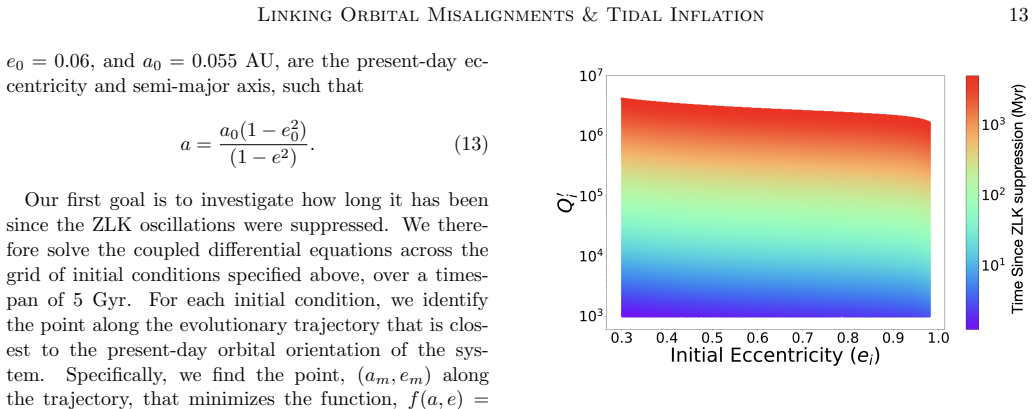
- domain assumption The angular momentum conservation relation (Eq. 13) links initial eccentricity and semi-major axis for WASP-107 b after ZLK suppression.
Cite this review
Pith. "Pith review of Tidal Inflation is Stronger for Misaligned Neptune-Sized Planets Than Aligned Ones." pith.science (2026). https://pith.science/paper/7IWE5FTZ
@misc{pith2026250624100,
  author       = {Pith},
  title        = {Pith review of: Tidal Inflation is Stronger for Misaligned Neptune-Sized Planets Than Aligned Ones},
  year         = {2026},
  howpublished = {\url{https://pith.science/paper/7IWE5FTZ}},
  note         = {Machine review of arXiv:2506.24100}
}
abstract
Recent observations have revealed an intriguing abundance of polar-orbiting Neptune-sized planets, many of which exhibit unusually inflated radii. While such misaligned orbits point to a complex dynamical history, the connection between their orbital orientations and planetary structures remains poorly understood. In this study, we analyze a sample of 12 misaligned and 12 aligned planets using structure models that incorporate tidal heating. We use various statistical tests to demonstrate with at least $90\%$ confidence that misaligned planets experience more tidally-induced radius inflation compared to aligned planets. This inflation likely stems from their dynamically active histories, which often place them in close-in, eccentric, and highly inclined orbits. We further present a case study of WASP-107~b, an exceptionally inflated polar Neptune, and model its history using a simple coupled orbital and radius evolution approach. Our results place constraints on the planet's tidal quality factor that agree with recent JWST observations.
Figures


Figures from the paper (4 more)



Reference graph
Works this paper leans on
-
[1]
L., Chen, X., Ciardi, D., et al
Akeson, R. L., Chen, X., Ciardi, D., et al. 2013, The NASA Exoplanet Archive: Data and Tools for Exoplanet
2013
-
[2]
Research, PASP, 125, 989, doi: 10.1086/672273
-
[3]
Albrecht, S. H., Dawson, R. I., & Winn, J. N. 2022, Stellar Obliquities in Exoplanetary Systems, PASP, 134, 082001, doi: 10.1088/1538-3873/ac6c09
-
[4]
Albrecht, S. H., Marcussen, M. L., Winn, J. N., Dawson, R. I., & Knudstrup, E. 2021, A Preponderance of Perpendicular Planets, ApJL, 916, L1, doi: 10.3847/2041-8213/ac0f03
-
[5]
R., Collier Cameron, A., Delrez, L., et al
Anderson, D. R., Collier Cameron, A., Delrez, L., et al. 2017, The discoveries of W ASP-91b, W ASP-105b and W ASP-107b: Two warm Jupiters and a planet in the transition region between ice giants and gas giants, A&A, 604, A110, doi: 10.1051/0004-6361/201730439
-
[6]
Anderson, K. R., & Lai, D. 2018, Teetering stars: resonant excitation of stellar obliquities by hot and warm Jupiters with external companions, MNRAS, 480, 1402, doi: 10.1093/mnras/sty1937
-
[7]
Attia, M., Bourrier, V., Delisle, J. B., & Eggenberger, P. 2023, DREAM: II. The spin–orbit angle distribution of close-in exoplanets under the lens of tides, A&A, 674, A120, doi: 10.1051/0004-6361/202245237
-
[8]
Awiphan, S., Kerins, E., Pichadee, S., et al. 2016, Transit timing variation and transmission spectroscopy analyses of the hot Neptune GJ3470b, MNRAS, 463, 2574, doi: 10.1093/mnras/stw2148
Show all 97 references
-
[9]
´A., Torres, G., P´ al, A., et al
Bakos, G. ´A., Torres, G., P´ al, A., et al. 2010, HAT-P-11b: A Super-Neptune Planet Transiting a Bright K Star in the Kepler Field, ApJ, 710, 1724, doi: 10.1088/0004-637X/710/2/1724
2010 doi
-
[10]
Barros, S. C. C., Gosselin, H., Lillo-Box, J., et al. 2017, Precise masses for the transiting planetary system HD 106315 with HARPS, A&A, 608, A25, doi: 10.1051/0004-6361/201731276
2017 doi
-
[11]
S., et al
Basilicata, M., Giacobbe, P., Bonomo, A. S., et al. 2024, The GAPS Programme at TNG. L V. Multiple molecular species in the atmosphere of HAT-P-11 b and review of the HAT-P-11 planetary system, A&A, 686, A127, doi: 10.1051/0004-6361/202347659
2024 doi
-
[12]
2025, From Tides to Currents: Unraveling the Mechanism that Powers W ASP-107b’s Internal Heat
Batygin, K. 2025, From Tides to Currents: Unraveling the Mechanism that Powers W ASP-107b’s Internal Heat
2025
-
[13]
Flux, ApJ, 985, 87, doi: 10.3847/1538-4357/adccc4
-
[14]
J., & Bodenheimer, P
Batygin, K., Stevenson, D. J., & Bodenheimer, P. H. 2011, Evolution of Ohmically Heated Hot Jupiters, ApJ, 738, 1, doi: 10.1088/0004-637X/738/1/1 Beaug´ e, C., & Nesvorn´ y, D. 2012, Multiple-planet Scattering and the Origin of Hot Jupiters, ApJ, 751, 119, doi: 10.1088/0004-63...
2011 doi
-
[15]
Bodenheimer, P., Lin, D. N. C., & Mardling, R. A. 2001, On the Tidal Inflation of Short-Period Extrasolar
2001
-
[16]
Planets, ApJ, 548, 466, doi: 10.1086/318667
-
[17]
S., Desidera, S., Benatti, S., et al
Bonomo, A. S., Desidera, S., Benatti, S., et al. 2017, The GAPS Programme with HARPS-N at TNG . XIV. Investigating giant planet migration history via improved eccentricity and mass determination for 231 transiting planets, A&A, 602, A107, doi: 10.1051/0004-6361/201629882
2017 doi
-
[18]
S., Dumusque, X., Massa, A., et al
Bonomo, A. S., Dumusque, X., Massa, A., et al. 2023, Cold Jupiters and improved masses in 38 Kepler and K2 small planet systems from 3661 HARPS-N radial velocities. No excess of cold Jupiters in small planet systems, A&A, 677, A33, doi: 10.1051/0004-6361/202346211 Linking Orbi...
2023 doi
-
[19]
2018, Orbital misalignment of the Neptune-mass exoplanet GJ 436b with the spin of its cool star, Nature, 553, 477, doi: 10.1038/nature24677
Bourrier, V., Lovis, C., Beust, H., et al. 2018, Orbital misalignment of the Neptune-mass exoplanet GJ 436b with the spin of its cool star, Nature, 553, 477, doi: 10.1038/nature24677
2018 doi
-
[20]
2023, DREAM: I
Bourrier, V., Attia, M., Mallonn, M., et al. 2023, DREAM: I. Orbital architecture orrery, A&A, 669, A63, doi: 10.1051/0004-6361/202245004
2023 doi
-
[21]
P., Vogt, S
Butler, R. P., Vogt, S. S., Marcy, G. W., et al. 2004, A Neptune-Mass Planet Orbiting the Nearby M Dwarf GJ 436, ApJ, 617, 580, doi: 10.1086/425173
2004 doi
-
[22]
L., Reefe, M., Plavchan, P., et al
Cale, B. L., Reefe, M., Plavchan, P., et al. 2021, Diving Beneath the Sea of Stellar Activity: Chromatic Radial Velocities of the Young AU Mic Planetary System, AJ, 162, 295, doi: 10.3847/1538-3881/ac2c80
2021 doi
-
[23]
K., Soares-Furtado, M., Vanderburg, A., et al
Capistrant, B. K., Soares-Furtado, M., Vanderburg, A., et al. 2024, TESS Hunt for Young and Maturing Exoplanets (THYME). XI. An Earth-sized Planet Orbiting a Nearby, Solar-like Host in the 400 Myr Ursa Major Moving Group, AJ, 167, 54, doi: 10.3847/1538-3881/ad1039
2024 doi
-
[24]
B., Matsumura, S., & Rasio, F
Chatterjee, S., Ford, E. B., Matsumura, S., & Rasio, F. A. 2008, Dynamical Outcomes of Planet-Planet Scattering, ApJ, 686, 580, doi: 10.1086/590227
2008 doi
-
[25]
Chen, H., & Rogers, L. A. 2016, Evolutionary Analysis of Gaseous Sub-Neptune-mass Planets with MESA, ApJ, 831, 180, doi: 10.3847/0004-637X/831/2/180
2016 doi
-
[26]
Dai, F., & Winn, J. N. 2017, The Oblique Orbit of W ASP-107b from K2 Photometry, AJ, 153, 205, doi: 10.3847/1538-3881/aa65d1
2017 doi
-
[27]
2023, TOI-1136 is a
Dai, F., Masuda, K., Beard, C., et al. 2023, TOI-1136 is a
2023
-
[28]
Young, Coplanar, Aligned Planetary System in a Pristine Resonant Chain, AJ, 165, 33, doi: 10.3847/1538-3881/aca327
-
[29]
Demangeon, O. D. S., Faedi, F., H´ ebrard, G., et al. 2018, The discovery of W ASP-151b, W ASP-153b, W ASP-156b: Insights on giant planet migration and the upper boundary of the Neptunian desert, A&A, 610, A63, doi: 10.1051/0004-6361/201731735
2018 doi
-
[30]
2013, Spitzer Observations of GJ 3470 b: A Very Low-density Neptune-size Planet Orbiting a Metal-rich M Dwarf, ApJ, 768, 154, doi: 10.1088/0004-637X/768/2/154
Demory, B.-O., Torres, G., Neves, V., et al. 2013, Spitzer Observations of GJ 3470 b: A Very Low-density Neptune-size Planet Orbiting a Metal-rich M Dwarf, ApJ, 768, 154, doi: 10.1088/0004-637X/768/2/154
2013 doi
-
[31]
2023, A Hierarchical Bayesian Framework for Inferring the Stellar Obliquity
Dong, J., & Foreman-Mackey, D. 2023, A Hierarchical Bayesian Framework for Inferring the Stellar Obliquity
2023
-
[32]
Distribution, AJ, 166, 112, doi: 10.3847/1538-3881/ace105
-
[33]
I., Stef´ ansson, G., Petrovich, C., et al
Espinoza-Retamal, J. I., Stef´ ansson, G., Petrovich, C., et al. 2024, HATS-38 b and W ASP-139 b Join a Growing Group of Hot Neptunes on Polar Orbits, AJ, 168, 185, doi: 10.3847/1538-3881/ad70b8
2024 doi
-
[34]
2014, The GAPS Programme with HARPS-N at TNG
Esposito, M., Covino, E., Mancini, L., et al. 2014, The GAPS Programme with HARPS-N at TNG. III: The retrograde orbit of HAT-P-18b, A&A, 564, L13, doi: 10.1051/0004-6361/201423735
2014 doi
-
[35]
2007, Shrinking Binary and Planetary Orbits by Kozai Cycles with Tidal Friction, ApJ, 669, 1298, doi: 10.1086/521702
Fabrycky, D., & Tremaine, S. 2007, Shrinking Binary and Planetary Orbits by Kozai Cycles with Tidal Friction, ApJ, 669, 1298, doi: 10.1086/521702
2007 doi
-
[36]
1966, Q in the Solar System, Icarus, 5, 375, doi: 10.1016/0019-1035(66)90051-0
Goldreich, P., & Soter, S. 1966, Q in the Solar System, Icarus, 5, 375, doi: 10.1016/0019-1035(66)90051-0
1966 doi
-
[37]
2023, DREAM: III
Guilluy, G., Bourrier, V., Jaziri, Y., et al. 2023, DREAM: III. A helium survey in exoplanets on the edge of the hot Neptune desert with GIANO-B at TNG, A&A, 676, A130, doi: 10.1051/0004-6361/202346419
2023 doi
-
[38]
S., & Lai, D
Hamers, A. S., & Lai, D. 2017, Secular chaotic dynamics in hierarchical quadruple systems, with applications to hot Jupiters in stellar binaries and triples, MNRAS, 470, 1657, doi: 10.1093/mnras/stx1319
2017 doi
-
[39]
D., Bakos, G
Hartman, J. D., Bakos, G. ´A., Torres, G., et al. 2009, HAT-P-12b: A Low-Density Sub-Saturn Mass Planet Transiting a Metal-Poor K Dwarf, ApJ, 706, 785, doi: 10.1088/0004-637X/706/1/785
2009 doi
-
[40]
D., Bakos, G
Hartman, J. D., Bakos, G. ´A., Sato, B., et al. 2011, HAT-P-18b and HAT-P-19b: Two Low-density Saturn-mass Planets Transiting Metal-rich K Stars, ApJ, 726, 52, doi: 10.1088/0004-637X/726/1/52
2011 doi
-
[41]
R., Collier Cameron, A., et al
Hellier, C., Anderson, D. R., Collier Cameron, A., et al. 2017, W ASP-South transiting exoplanets: W ASP-130b, W ASP-131b, W ASP-132b, W ASP-139b, W ASP-140b, W ASP-141b and W ASP-142b, MNRAS, 465, 3693, doi: 10.1093/mnras/stw3005
2017 doi
-
[42]
R., Triaud, A
Hellier, C., Anderson, D. R., Triaud, A. H. M. J., et al. 2019, W ASP-166b: a bloated super-Neptune transiting a V = 9 star, MNRAS, 488, 3067, doi: 10.1093/mnras/stz1903
2019 doi
-
[43]
2020, Limits on the Spin-Orbit Angle and Atmospheric Escape for the 22 Myr Old Planet AU Mic b, ApJL, 899, L13, doi: 10.3847/2041-8213/aba6eb
Hirano, T., Krishnamurthy, V., Gaidos, E., et al. 2020, Limits on the Spin-Orbit Angle and Atmospheric Escape for the 22 Myr Old Planet AU Mic b, ApJL, 899, L13, doi: 10.3847/2041-8213/aba6eb
2020 doi
-
[44]
2021, A backward-spinning star with two coplanar planets, Proceedings of the National Academy of Science, 118, e2017418118, doi: 10.1073/pnas.2017418118
Hjorth, M., Albrecht, S., Hirano, T., et al. 2021, A backward-spinning star with two coplanar planets, Proceedings of the National Academy of Science, 118, e2017418118, doi: 10.1073/pnas.2017418118
2021 doi
-
[45]
B., Hirano, T., et al
Hjorth, M., Justesen, A. B., Hirano, T., et al. 2019, K2-290: a warm Jupiter and a mini-Neptune in a triple-star system, MNRAS, 484, 3522, doi: 10.1093/mnras/stz139
2019 doi
-
[46]
1981, Tidal evolution in close binary systems., A&A, 99, 126
Hut, P. 1981, Tidal evolution in close binary systems., A&A, 99, 126
1981
-
[47]
2008, Tidal Evolution of Close-in Extrasolar Planets, ApJ, 678, 1396, doi: 10.1086/529187 18 Sethi & Millholland Jord´ an, A., Bakos, G.´A., Bayliss, D., et al
Jackson, B., Greenberg, R., & Barnes, R. 2008, Tidal Evolution of Close-in Extrasolar Planets, ApJ, 678, 1396, doi: 10.1086/529187 18 Sethi & Millholland Jord´ an, A., Bakos, G.´A., Bayliss, D., et al. 2020, HATS-37Ab and HATS-38b: Two Transiting Hot Neptunes in the Desert, AJ...
2008 doi
-
[48]
H., Winn, J
Knudstrup, E., Albrecht, S. H., Winn, J. N., et al. 2024, Obliquities of exoplanet host stars: Nineteen new and updated measurements, and trends in the sample of 205 measurements, A&A, 690, A379, doi: 10.1051/0004-6361/202450627
2024 doi
-
[49]
2010, Is tidal heating sufficient to explain bloated exoplanets? Consistent calculations accounting for finite initial eccentricity, A&A, 516, A64, doi: 10.1051/0004-6361/201014337
Leconte, J., Chabrier, G., Baraffe, I., & Levrard, B. 2010, Is tidal heating sufficient to explain bloated exoplanets? Consistent calculations accounting for finite initial eccentricity, A&A, 516, A64, doi: 10.1051/0004-6361/201014337
2010 doi
-
[50]
Levrard, B., Correia, A. C. M., Chabrier, G., et al. 2007, Tidal dissipation within hot Jupiters: a new appraisal, A&A, 462, L5, doi: 10.1051/0004-6361:20066487
2007 doi
-
[51]
M., & Stevenson, D
Liu, J., Goldreich, P. M., & Stevenson, D. J. 2008, Constraints on deep-seated zonal winds inside Jupiter and Saturn, Icarus, 196, 653, doi: 10.1016/j.icarus.2007.11.036
2008 doi
-
[52]
D., & Fortney, J
Lopez, E. D., & Fortney, J. J. 2014, Understanding the Mass-Radius Relation for Sub-neptunes: Radius as a Proxy for Composition, ApJ, 792, 1, doi: 10.1088/0004-637X/792/1/1
2014 doi
-
[53]
M., & Millholland, S
Louden, E. M., & Millholland, S. C. 2024, Polar Neptunes Are Stable to Tides, ApJ, 974, 304, doi: 10.3847/1538-4357/ad74ff
2024 doi
-
[54]
2025, Planet–Planet Scattering and Von Zeipel–Lidov–Kozai Migration—The Dynamical History of HAT-P-11, ApJ, 979, 218, doi: 10.3847/1538-4357/ad9b79
Lu, T., An, Q., Li, G., et al. 2025, Planet–Planet Scattering and Von Zeipel–Lidov–Kozai Migration—The Dynamical History of HAT-P-11, ApJ, 979, 218, doi: 10.3847/1538-4357/ad9b79
2025 doi
-
[55]
A., Van Zandt, J., et al
Lubin, J., Petigura, E. A., Van Zandt, J., et al. 2024, The HD 191939 Exoplanet System is Well Aligned and Flat, AJ, 168, 196, doi: 10.3847/1538-3881/ad79ed
2024 doi
- [56]
-
[57]
2024, Orbital obliquity of the young planet TOI-5398 b and the evolutionary history of the system, A&A, 684, L17, doi: 10.1051/0004-6361/202449769
Mantovan, G., Malavolta, L., Locci, D., et al. 2024, Orbital obliquity of the young planet TOI-5398 b and the evolutionary history of the system, A&A, 684, L17, doi: 10.1051/0004-6361/202449769
2024 doi
-
[58]
Marzari, F., & Weidenschilling, S. J. 2002, Eccentric Extrasolar Planets: The Jumping Jupiter Model, Icarus, 156, 570, doi: 10.1006/icar.2001.6786
2002
-
[59]
2019, Tidally Induced Radius Inflation of
Millholland, S. 2019, Tidally Induced Radius Inflation of
2019
-
[60]
Sub-Neptunes, ApJ, 886, 72, doi: 10.3847/1538-4357/ab4c3f
-
[61]
2020, Tidal Inflation Reconciles Low-density Sub-Saturns with Core
Millholland, S., Petigura, E., & Batygin, K. 2020, Tidal Inflation Reconciles Low-density Sub-Saturns with Core
2020
-
[62]
Accretion, ApJ, 897, 7, doi: 10.3847/1538-4357/ab959c
-
[63]
M., Howard, A
Mills, S. M., Howard, A. W., Weiss, L. M., et al. 2019, Long-period Giant Companions to Three Compact, Multiplanet Systems, AJ, 157, 145, doi: 10.3847/1538-3881/ab0899
2019 doi
-
[64]
V., Knutson, H., Line, M., et al
Morley, C. V., Knutson, H., Line, M., et al. 2017, Forward and Inverse Modeling of the Emission and Transmission Spectrum of GJ 436b: Investigating Metal Enrichment, Tidal Heating, and Clouds, AJ, 153, 86, doi: 10.3847/1538-3881/153/2/86
2017 doi
-
[65]
2011, Hot Jupiters from secular planet-planet interactions, Nature, 473, 187, doi: 10.1038/nature10076
Teyssandier, J. 2011, Hot Jupiters from secular planet-planet interactions, Nature, 473, 187, doi: 10.1038/nature10076
2011 doi
-
[66]
2017, The K2-ESPRINT project
Narita, N., Hirano, T., Fukui, A., et al. 2017, The K2-ESPRINT project. VI. K2-105 b, a hot Neptune around a metal-rich G-dwarf, PASJ, 69, 29, doi: 10.1093/pasj/psx002
2017 doi
-
[67]
P., Bonfanti, A., Gandolfi, D., et al
Osborn, H. P., Bonfanti, A., Gandolfi, D., et al. 2022, Uncovering the true periods of the young sub-Neptunes orbiting TOI-2076, A&A, 664, A156, doi: 10.1051/0004-6361/202243065 ¨Ozt¨ urk, O., & Erdem, A. 2019, New photometric analysis of five exoplanets: CoRoT-2b, HAT-P-12b, ...
2022 doi
-
[68]
2011, Modules for Experiments in Stellar Astrophysics (MESA), ApJS, 192, 3, doi: 10.1088/0067-0049/192/1/3
Paxton, B., Bildsten, L., Dotter, A., et al. 2011, Modules for Experiments in Stellar Astrophysics (MESA), ApJS, 192, 3, doi: 10.1088/0067-0049/192/1/3
2011 doi
-
[69]
2013, Modules for Experiments in Stellar Astrophysics (MESA):
Paxton, B., Cantiello, M., Arras, P., et al. 2013, Modules for Experiments in Stellar Astrophysics (MESA):
2013
-
[70]
Planets, Oscillations, Rotation, and Massive Stars, ApJS, 208, 4, doi: 10.1088/0067-0049/208/1/4
-
[71]
2015, Modules for Experiments in Stellar Astrophysics (MESA):
Paxton, B., Marchant, P., Schwab, J., et al. 2015, Modules for Experiments in Stellar Astrophysics (MESA):
2015
-
[72]
Binaries, Pulsations, and Explosions, ApJS, 220, 15, doi: 10.1088/0067-0049/220/1/15
-
[73]
B., et al
Paxton, B., Schwab, J., Bauer, E. B., et al. 2018, Modules for Experiments in Stellar Astrophysics (MESA): Convective Boundaries, Element Diffusion, and Massive Star Explosions, ApJS, 234, 34, doi: 10.3847/1538-4365/aaa5a8
2018 doi
-
[74]
J., Kratter, K
Petrovich, C., Mu˜ noz, D. J., Kratter, K. M., & Malhotra, R. 2020, A Disk-driven Resonance as the Origin of High Inclinations of Close-in Planets, ApJL, 902, L5, doi: 10.3847/2041-8213/abb952 Linking Orbital Misalignments & Tidal Inflation 19
2020 doi
-
[75]
A., et al
Piaulet, C., Benneke, B., Rubenzahl, R. A., et al. 2021, W ASP-107b’s Density Is Even Lower: A Case Study for the Physics of Planetary Gas Envelope Accretion and Orbital Migration, AJ, 161, 70, doi: 10.3847/1538-3881/abcd3c
2021 doi
-
[76]
S., Lubin, J., Beard, C., et al
Polanski, A. S., Lubin, J., Beard, C., et al. 2024, The TESS-Keck Survey. XX. 15 New TESS Planets and a Uniform R V Analysis of All Survey Targets, ApJS, 272, 32, doi: 10.3847/1538-4365/ad4484
2024 doi
-
[77]
2017, Ohmic Dissipation in
Pu, B., & Valencia, D. 2017, Ohmic Dissipation in
2017
-
[78]
Mini-Neptunes, ApJ, 846, 47, doi: 10.3847/1538-4357/aa826f
-
[79]
2018, Chaotic Excitation and Tidal Damping in the GJ 876 System, AJ, 155, 157, doi: 10.3847/1538-3881/aab09f
Puranam, A., & Batygin, K. 2018, Chaotic Excitation and Tidal Damping in the GJ 876 System, AJ, 155, 157, doi: 10.3847/1538-3881/aab09f
2018 doi
-
[80]
C., Winn, J
Sanchis-Ojeda, R., Fabrycky, D. C., Winn, J. N., et al. 2012, Alignment of the stellar spin with the orbits of a three-planet system, Nature, 487, 449, doi: 10.1038/nature11301
2012 doi
-
[81]
C., Winn, J
Siegel, J. C., Winn, J. N., & Albrecht, S. H. 2023, Ponderings on the Possible Preponderance of Perpendicular Planets, ApJL, 950, L2, doi: 10.3847/2041-8213/acd62f
2023 doi
-
[82]
K., Rustamkulov, Z., Thorngren, D
Sing, D. K., Rustamkulov, Z., Thorngren, D. P., et al. 2024, A warm Neptune’s methane reveals core mass and vigorous atmospheric mixing, Nature, 630, 831, doi: 10.1038/s41586-024-07395-z
2024 doi
-
[83]
2011, Homogeneous studies of transiting extrasolar planets - IV
Southworth, J. 2011, Homogeneous studies of transiting extrasolar planets - IV. Thirty systems with space-based light curves, MNRAS, 417, 2166, doi: 10.1111/j.1365-2966.2011.19399.x
2011
-
[84]
2019, Formation of hot Jupiters through secular chaos and dynamical tides, MNRAS, 486, 2265, doi: 10.1093/mnras/stz1011
Teyssandier, J., Lai, D., & Vick, M. 2019, Formation of hot Jupiters through secular chaos and dynamical tides, MNRAS, 486, 2265, doi: 10.1093/mnras/stz1011
2019 doi
-
[85]
P., Fortney, J
Thorngren, D. P., Fortney, J. J., Lopez, E. D., Berger, T. A., & Huber, D. 2021, Slow Cooling and Fast Reinflation for Hot Jupiters, ApJL, 909, L16, doi: 10.3847/2041-8213/abe86d
2021 doi
-
[86]
A., Rodriguez, J
Thygesen, E., Ranshaw, J. A., Rodriguez, J. E., et al. 2023, The K2 and TESS Synergy. II. Revisiting 26 Systems in the TESS Primary Mission, AJ, 165, 155, doi: 10.3847/1538-3881/acaf03
2023 doi
-
[87]
A., et al
Vanderburg, A., Bieryla, A., Duev, D. A., et al. 2016, Two Small Planets Transiting HD 3167, ApJL, 829, L9, doi: 10.3847/2041-8205/829/1/L9
2016 doi
-
[88]
2023, High-eccentricity Migration with Disk-induced Spin-Orbit Misalignment: A Preference for Perpendicular Hot Jupiters, ApJL, 943, L13, doi: 10.3847/2041-8213/acaea6
Vick, M., Su, Y., & Lai, D. 2023, High-eccentricity Migration with Disk-induced Spin-Orbit Misalignment: A Preference for Perpendicular Hot Jupiters, ApJL, 943, L13, doi: 10.3847/2041-8213/acaea6
2023 doi
-
[89]
A., et al
Wang, S., Addison, B., Fischer, D. A., et al. 2018, Stellar Spin-Orbit Alignment for Kepler-9, a Multi-transiting Planetary System with Two Outer Planets Near 2:1
2018
-
[90]
Resonance, AJ, 155, 70, doi: 10.3847/1538-3881/aaa2fb
-
[91]
J., Beatty, T
Welbanks, L., Bell, T. J., Beatty, T. G., et al. 2024, A high internal heat flux and large core in a warm Neptune exoplanet, Nature, 630, 836, doi: 10.1038/s41586-024-07514-w
2024 doi
-
[92]
N., & Fabrycky, D
Winn, J. N., & Fabrycky, D. C. 2015, The Occurrence and Architecture of Exoplanetary Systems, ARA&A, 53, 409, doi: 10.1146/annurev-astro-082214-122246
2015 doi
-
[93]
N., Noyes, R
Winn, J. N., Noyes, R. W., Holman, M. J., et al. 2005, Measurement of Spin-Orbit Alignment in an Extrasolar Planetary System, ApJ, 631, 1215, doi: 10.1086/432571
2005 doi
-
[94]
W., Petigura, E
Yee, S. W., Petigura, E. A., Fulton, B. J., et al. 2018, HAT-P-11: Discovery of a Second Planet and a Clue to Understanding Exoplanet Obliquities, AJ, 155, 255, doi: 10.3847/1538-3881/aabfec
2018 doi
-
[95]
2024, Are W ASP-107-like Systems Consistent with High-eccentricity Migration?, ApJ, 972, 159, doi: 10.3847/1538-4357/ad5ffb
Yu, H., & Dai, F. 2024, Are W ASP-107-like Systems Consistent with High-eccentricity Migration?, ApJ, 972, 159, doi: 10.3847/1538-4357/ad5ffb
2024 doi
-
[96]
E., Vanderburg, A., et al
Zhou, G., Rodriguez, J. E., Vanderburg, A., et al. 2018, The Warm Neptunes around HD 106315 Have Low Stellar
2018
-
[97]
Obliquities, AJ, 156, 93, doi: 10.3847/1538-3881/aad085
Reviewed August 6, 2026 · model on record in the stance chip above.
Discussion (0). Continue with ORCID to comment.