REVIEW 2 major objections 5 minor 2 cited by
Multi-Target Density Matrix Renormalization Group X algorithm and its application to circuit quantum electrodynamics
T0 review · 2 major / 5 minor · reviewed 2026-08-06 · deepseek-v4-flash
Pith's one-line read New algorithm finds many excited states at once, skipping lower ones
desk verdict Plausible new DMRG variant for multiple excited states, but the strong-hybridization claim needs an exact-diagonalization benchmark and a tie-breaking rule. read the letter →
The pith
A machine-rendered reading of the paper's core claim, the machinery that carries it, and where it could break.
The reading
What carries the argument
The load-bearing mechanism is the overlap-based local update rule of Eq. (14): in each two-site DMRG sweep step, the eigenstate |ψ^(λ)> of the effective two-site Hamiltonian is chosen by argmax |<P_k|ψ^(λ)>|, where |P_k> is the projection of the current MPS onto the k-th reference bare state, rather than by minimizing energy. This rule is combined with the multi-target MPS ansatz (Eq. 9), which carries m states on an extra index k, so that m effective-Hamiltonian eigenstates are selected and decomposed together by singular value decomposition. The algorithm is initialized with the reference bare states themselves (Eq. 12), and the Lanczos-X variant seeds the Krylov subspace with the reference-state projections, giving O($χ^{3}$) updates that appear independent of excitation number in the tested regime.
What would settle it
Run MTDMRG-X on a small transmon array (for example, a 3x3 qubit grid) with parameters that produce a nearly degenerate resonant subspace, and compare each converged MPS against the corresponding exact-diagonalization eigenstate by computing their squared overlap; if any returned state has infidelity above the threshold implied by the reported variances, or the states are returned in the wrong order within the subspace, the overlap-based assignment has converged to the wrong eigenstates.
Extended reading notes
Core claim
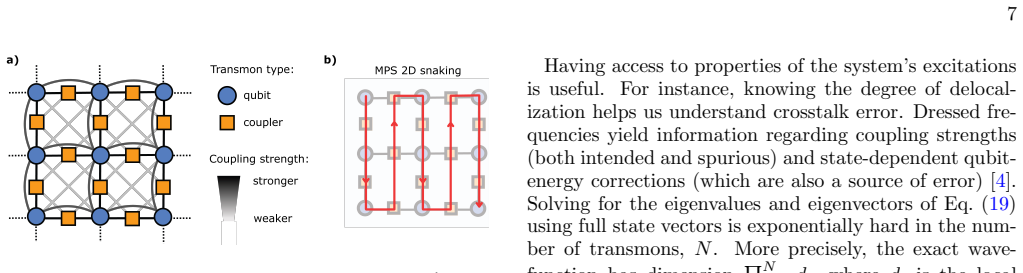
The central claim is that replacing the energy-minimization step of two-site DMRG with an overlap-maximization step, and carrying this out for multiple reference states at once, yields the simultaneous convergence of a set of strongly hybridized excited eigenstates without first computing lower-energy states. Concretely, for a set S of m reference bare product states, the update builds projections {|P_k>} of the current variational MPS onto those states, then selects the eigenstate of the effective Hamiltonian with the largest overlap with each |P_k> and assembles them into a multi-target two-site state (Eqs. 13-14). The authors demonstrate the method on a 5x5 transmon array with qubits and couplers: DMRG-X produces qubit-like single-excitation states with high localization and coupler-like states with noticeable delocalization, and MTDMRG-X resolves four-state resonant subspaces to extract state-dependent exchange coupling g and ZZ coupling ζ. They also introduce Lanczos-X, a Krylov-subspace variant built around the reference states, which reduces runtime when the target states lie deep in the effective spectrum.
Load-bearing premise
The method assumes that each target eigenstate has high overlap with at least one of the supplied reference bare states—product states of single-site levels—so that maximizing local overlap tracks the intended global eigenstate.
Editorial extensions
If this is right
- Order-100 transmon arrays, such as a 5x5 chip with 25 qubits and 40 couplers, can have their dressed single-excitation states computed with DMRG-X at bond dimension χ=80, reaching Hamiltonian variances of 10^-9 to 10^-7 GHz^2.
- Excited states deep in the spectrum can be targeted directly and in parallel per state or per subspace, avoiding the m^2 cost and error accumulation of orthogonalization against all lower-energy states.
- Strongly resonant subspaces with near-equal bare-state projections, such as ψ± ≈ |01> ± |10>, can be resolved simultaneously by MTDMRG-X instead of by sequential projection out of previously found states.
- State-dependent coupling analysis becomes numerically accessible: exchange and ZZ couplings of a target qubit pair can vary with the excitation state of a nearby aggressor pair, with ZZ corrections reaching about 10 MHz at distance 1 for two aggressor excitations in the studied parameters.
Reading between the lines
- One testable extension is to scan coupler-frequency disorder and recompute the localization metric ς(d) for coupler-like eigenstates, which would show whether the observed coupler delocalization can be suppressed by increasing frequency spread among couplers.
- The overlap-based update rule is not limited to transmon arrays; it could be applied to other bosonic circuit elements with quasi-localized eigenstates, such as fluxonium devices, as a way to compute dressed spectra without full diagonalization.
- A stress test for the method is to compare MTDMRG-X results against exact diagonalization on small arrays (for example, 3x3) at several detunings; confirming that the returned states match true eigenstates by fidelity would establish the reliability of variance-based convergence metrics in near-degenerate subspaces.
- The overlap-based update rule could also be used to benchmark Schrieffer-Wolff perturbation theory in the nonperturbative regime, supplying numerically exact dressed couplings against which truncated expansions can be tested.
Editorial analysis
A structured set of objections, weighed in public.
Referee Report
Summary. The paper introduces MTDMRG-X, a multi-target extension of the DMRG-X algorithm, which simultaneously targets several excited eigenstates by selecting, at each two-site update, the eigenstates of the effective Hamiltonian with largest overlap with a set of reference bare states (Sec. IV, Eqs. (13)-(14)). The authors also describe a Lanczos-based variant, Lanczos-X, that builds the Krylov subspace around the reference states to reduce runtime for deeply excited states, and they apply DMRG-X and MTDMRG-X to a 5x5 transmon array with qubits and couplers. Numerically, they report Hamiltonian variance checks (10^-9-10^-7 GHz^2 for DMRG-X, 10^-10-10^-8 GHz^2 for MTDMRG-X), an analysis of single-excitation localization in the chip, and state-dependent exchange (g) and ZZ (zeta) couplings for a target qubit pair in the presence of an on-resonance aggressor pair.
Significance. If the algorithm performs as claimed, MTDMRG-X would be a useful tool for obtaining excited eigenstates of circuit-QED Hamiltonians without first computing all lower-energy states, including in regimes with strong hybridization. The manuscript is clearly written and provides a concrete algorithmic prescription, a practical Lanczos-X speedup with a runtime benchmark, honest convergence metrics (Hamiltonian variances), and physically motivated applications to localization and spectator-induced couplings in a realistic transmon architecture. However, the central claim of robustness to strong hybridization rests on an under-specified matching rule at Eq. (14) and lacks a direct exact-diagonalization benchmark in the strongly hybridized regime, so the numerical evidence does not yet establish the advertised capability.
major comments (2)
- [Sec. IV, Eq. (14)] The central update rule is under-specified precisely in the regime the paper claims to target. Eq. (14) defines, for each reference projection |P_k>, an argmax over the eigenstates of the effective Hamiltonian, but it does not require that different k select distinct eigenstates. In the advertised resonant case psi_+ = (|01> + |10>)/sqrt(2) and psi_- = (|01> - |10>)/sqrt(2), both reference projections have identical squared overlap 1/2 with both eigenstates, so the argmax is not unique. The sequential-Lanczos description in Appendix A 1 does not state a tie-breaking rule or explicitly exclude already-matched eigenstates from subsequent matching; if two reference states are assigned to the same effective eigenstate, the SVD of gamma_opt collapses the multi-target state and one dressed state is lost. Please specify the assignment rule (e.g., greedy matching with exclusion of used eigenstates, or a global assignment such as the Hungarian algorithm) and demonstrate on a resonant pair that the intended distinct states are recovered.
- [Sec. V C 2 and Appendix E] There is no direct validation of MTDMRG-X against exact diagonalization in a strongly hybridized subspace. The 5x5 results in Fig. 6 report Hamiltonian variances of 10^-10-10^-8 GHz^2, but as Appendix B shows, variance is small for any near-eigenstate; inside a near-degenerate resonant subspace, a wrong linear combination can also have near-zero variance, so the variance check does not certify that the intended pair of dressed states was found. Appendix C, Fig. 9, compares MTDMRG with DMRG-X on a single coupler excitation, not MTDMRG-X on a resonant pair. Please add an exact-diagonalization benchmark for a small system (e.g., two transmons at resonance, or a single resonant pair embedded in a small lattice) reporting fidelities, energies, and assignment of the recovered states to the exact psi_+ and psi_-. This is the minimal evidence needed to support the central claim of simultaneous resolution of strongly hybridized states.
minor comments (5)
- [Sec. V C 1, Eq. (20)] The localization measure P_(x,y),k is the same overlap used as the DMRG-X targeting objective, so the finding that qubit eigenstates are localized is partly built into the method. The distance-decay profiles and the qubit-vs-coupler difference are not forced by the construction and are informative, but the text should explicitly acknowledge this partial circularity and state that the localization magnitude itself is not an independent verification of the method.
- [Appendix E] The reported variance ranges are given as 10^-10-10^-8 (GHz); the units should be GHz^2, matching Eq. (7) and the main-text statement in Sec. V C 1.
- [Fig. 5b] The dashed gray line is described as an 'approximate bound consistent with the requested DMRG accuracy' with values below it shown only to display the trend. Please define this bound numerically (which variance or infidelity it corresponds to) so that readers do not interpret values below it as quantitatively meaningful.
- [Sec. IV, Eq. (15) and Appendix A 1] The thresholds theta (used to define the reference set S) and th (used in the sequential matching) are never specified or varied. Please state the values used in the numerical experiments and comment on the sensitivity of the results to these thresholds.
- [Sec. IV, Eq. (14)] The notation lambda in the argmax is confusing: Eq. (6) uses lambda to label eigenstates of H_eff, and Eq. (14) reuses lambda as the variable being optimized. Please rename the eigenstate index (e.g., to nu) for clarity.
Circularity Check
Localization result in Sec. V C 1 partly restates the DMRG-X overlap objective; the MTDMRG-X algorithm itself is not circular.
-
self definitional
[Sec. V C 1, Eq. (20), relative to Sec. III B (DMRG-X update) and Sec. IV Eq. (14)]
"The variational MPS is initialized to be the product (bare) state that has the largest overlap with our target state. The rule for finding the optimal two-site effective state |ψopt⟩x,x+1 in step ii) becomes: find the eigenstate of Ĥeff x,x+1 with largest overlap with the current variational MPS. [...] We study eigenstate localization via the intuitive per-site localization measure: P(x,y),k = | ⟨0, . . . ,1(x,y), . . . ,0|Ψk⟩ |2."
DMRG-X (and MTDMRG-X via Eq. (14)) selects each target state by maximizing its overlap with the corresponding bare-state projection during every local update. Equation (20) reports precisely the squared overlap of the converged state with that same bare-state input. Therefore the statement that the qubit-like eigenstate is largely localized at the targeted site is a restatement of the selection objective, not an independent numerical discovery. The delocalization profile away from the target site and the qubit/coupler difference are not fixed by the update rule, so the circularity is only partial.
full rationale
The central MTDMRG-X construction (Eqs. 12-14) is an algorithm, not a derived physical prediction, and it does not reduce to its inputs: it genuinely combines the MTMPS ansatz with an overlap-based selection rule, and the benchmark against DMRG-X and MTDMRG in Appendix C compares two algorithms on the same coupler state rather than fitting a parameter to a target. No load-bearing self-citation chain or imported uniqueness theorem is used; the DMRG-X and MTDMRG ingredients are independent literature results, and the authors' own prior MTDMRG work appears only as a building block, not as a forced premise. The only identifiable circular element is the localization analysis of Sec. V C 1: the per-site overlap P(x,y),k measured in Eq. (20) is the same overlap that DMRG-X explicitly maximizes in its two-site update, so the observation that the target site carries most of the weight is partly a restatement of the algorithm's selection rule. The distance-decay tail, the coupler-versus-qubit difference, and the state-dependent g and zeta results are not fixed by the update objective, and the MTDMRG-X strong-hybridization capability remains an independent algorithmic claim. The unresolved tie-breaking in Eq. (14) for equal-overlap resonant states is a correctness and robustness concern, not a circularity. Score 3 reflects a partially self-confirming localization metric alongside an otherwise non-circular central algorithm.
Assumptions & free parameters
free parameters (5)
- MPS bond dimension chi (single-excitation DMRG-X) =
80
- MTMPS bond dimension chi (MTDMRG-X) =
20 * |S|
- Krylov subspace dimension D (Lanczos-X) =
100
- Convergence energy threshold =
1e-10 GHz
- Local Hilbert space dimensions =
d_q=4, d_c=3
assumptions (5)
- domain assumption Target eigenstates have high overlap with the reference bare product states in S (Eq. 11).
- domain assumption Low-lying eigenstates of the 2D transmon Hamiltonian (Eq. 19) are efficiently representable as MPS with moderate bond dimension.
- domain assumption The simplified Kerr Hamiltonian (Eq. 16) and capacitive coupling (Eq. 17) capture the relevant circuit-QED physics in the studied regime.
- ad hoc to paper At each two-site update, the eigenstate of the effective Hamiltonian with the largest overlap with the reference bare-state projection converges to the global target eigenstate.
- domain assumption The charge offset n_g can be set to zero and the phase treated as non-compact in the transmon regime.
Cite this review
Pith. "Pith review of Multi-Target Density Matrix Renormalization Group X algorithm and its application to circuit quantum electrodynamics." pith.science (2026). https://pith.science/paper/OV2LIOKQ
@misc{pith2026250624109,
  author       = {Pith},
  title        = {Pith review of: Multi-Target Density Matrix Renormalization Group X algorithm and its application to circuit quantum electrodynamics},
  year         = {2026},
  howpublished = {\url{https://pith.science/paper/OV2LIOKQ}},
  note         = {Machine review of arXiv:2506.24109}
}
read the original abstract
Obtaining accurate representations of the eigenstates of an array of coupled superconducting qubits is a crucial step in the design of circuit quantum electrodynamics (QED)-based quantum processors. However, exact diagonalization of the device Hamiltonian is challenging for system sizes beyond tens of qubits. Here, we employ a variant of the density matrix renormalization group (DMRG) algorithm, DMRG-X, to efficiently obtain localized eigenstates of a 2D transmon array without the need to first compute lower-energy states. We also introduce MTDMRG-X, a new algorithm that combines DMRG-X with multi-target DMRG to efficiently compute excited states even in regimes with strong eigenstate hybridization. We showcase the use of these methods for the analysis of long-range couplings in a multi-transmon Hamiltonian including qubits and couplers, and we discuss eigenstate localization. These developments facilitate the design and parameter optimization of large-scale superconducting quantum processors.
Figures


Figures from the paper (8 more)




Forward citations
Cited by 2 Pith papers
-
Experimental Characterization and Modeling of Measurement-Induced State-Transitions in a Fluxonium Superconducting Qubit
Experimental mapping of measurement-induced state transitions in a fluxonium qubit validates numerical models predicting eleven high-error flux regions, including effects from superinductor array modes.
-
Completely Positive and Trace Preserving Schemes with Tensor Train Compression for the Lindblad Equation
A two-level low-rank method using tall-skinny factorization plus tensor-train compression enables completely positive trace-preserving integration of the Lindblad equation for systems with up to 10^19 degrees of freedom.
Reference graph
Works this paper leans on
-
[1]
(2), the coefficient of each basis state is represented as a matrix product
· · ·C αoc [oc] · · ·RαN [N ] |α1 · · ·αN ⟩ , (4) where as in Eq. (2), the coefficient of each basis state is represented as a matrix product. When working with states given in MPS form, it is helpful to represent operators, such as the Hamiltonian, as matrix product operators (MPOs). An MPO is shown FIG. 2. Two-site DMRG update. a) Construction of the ef...
-
[2]
· · ·BαN −1 [N −1]BαN [N ] . (2) Using standard tensor network diagrammatic notation, we show an MPS in Fig. 1a. Each circle represents the collection of matrices, {Bαx [x] | αx ∈ 1, · · ·, dx}, on the corresponding site. We view this collection as a rank-3 tensor with indices αx, βx−1, and βx. The “physical in- dex” αx corresponds to different choices of...
-
[3]
· · ·BαN −1,βN −2βN −1 [N −1] BαN ,βN −1 [N ] . 3 FIG. 1. MPS and MPO conventions. a) Diagrammatic depiction of the MPS ansatz. b) MPS ansatz in the center of orthogonality canonical form. c) Left and right isometric conditions. d) Matrix product operator. This tensor contraction is shown in the figure via the horizontal lines connecting the sites. We wil...
-
[4]
· · ·M αN α′ N ,βN −1 [N ] . (5) B. Density Matrix Renormalization Group The MPS ansatz can be efficiently optimized to approx- imately represent low energy eigenstates of a gapped local Hamiltonian ˆH through the density matrix renormaliza- tion group (DMRG) algorithm [13, 19, 21]. The DMRG algorithm begins by representing the Hamiltonian as an MPO, then...
-
[5]
This implementation is easily generalized for a left sweep
→ (x + 1, x+ 2) and the procedure is repeated to con- tinue with the right DMRG sweep. This implementation is easily generalized for a left sweep. The DMRG terminates when the total energy mea- sured from the effective two-site states has converged be- low some threshold; see appendix B 1. In our numerical experiments (Sec. V) the energy convergence thres...
-
[6]
Solving for excited states with DMRG In addition to finding the ground state, DMRG and related algorithms can also be used to find excited states. Here we review three approaches: orthogonal- izing against previously found lower-energy states [32]; multi-target DMRG [14, 15, 26, 31], where we use a modified MPS to target multiple low-energy states simulta...
-
[7]
· · · C αoc [oc] k · · ·RαN [N ] |α1 · · ·αN ⟩ |k⟩ . (9) The proper orthonormality of the states represented by the MTMPS is ensured by the condition in Fig. 3b. Instead of variationally optimizing a single MPS to represent the ground state of ˆH as per the standard DMRG, the multi-target DMRG algorithm optimizes the MTMPS to represent the m lowest energy...
-
[8]
Single-qubit and single-coupler excitations via DMRG-X Determining how the bare qubit and coupler exci- tations are dressed in the presence of capacitive cou- plings is crucial for identifying sources of error such as crosstalk and population transport due to effective (medi- ated) nonlocal couplings. While a localized regime is de- sired for high-fidelit...
Show all 62 references
-
[9]
State-dependent two-qubit couplings via MTDMRG-X State localization is an instructive metric, but it only provides a qualitative picture of potential error channels. A more direct probe is offered by the single- and double- excitation state couplings, which in circuit QED are ...
-
[10]
J. Koch, T. M. Yu, J. Gambetta, A. A. Houck, D. I. Schuster, J. Majer, A. Blais, M. H. Devoret, S. M. Girvin, and R. J. Schoelkopf, Charge-insensitive qubit design de- rived from the cooper pair box, Phys. Rev. A 76, 042319 (2007)
2007
-
[11]
Blais, R.-S
A. Blais, R.-S. Huang, A. Wallraff, S. M. Girvin, and R. J. Schoelkopf, Cavity quantum electrodynamics for superconducting electrical circuits: An architecture for quantum computation, Phys. Rev. A 69, 062320 (2004)
2004
-
[12]
Blais, A
A. Blais, A. L. Grimsmo, S. M. Girvin, and A. Wallraff, Circuit quantum electrodynamics, Rev. Mod. Phys. 93, 025005 (2021)
2021
-
[13]
Berke, E
C. Berke, E. Varvelis, S. Trebst, A. Altland, and D. P. DiVincenzo, Transmon platform for quantum computing challenged by chaotic fluctuations, Nature Communica- tions 13, 2495 (2022)
2022
-
[14]
Lamata, A
L. Lamata, A. Parra-Rodriguez, M. Sanz, and E. Solano, Digital-analog quantum simulations with superconduct- ing circuits, Advances in Physics: X 3, 1457981 (2018)
2018
-
[15]
Bluvstein, H
D. Bluvstein, H. Levine, G. Semeghini, T. T. Wang, S. Ebadi, M. Kalinowski, A. Keesling, N. Maskara, H. Pichler, M. Greiner, V. Vuleti´ c, and M. D. Lukin, A quantum processor based on coherent transport of en- tangled atom arrays, Nature 604, 451–456 (2022)
2022
-
[16]
A. L. Shaw, Z. Chen, J. Choi, D. K. Mark, P. Scholl, R. Finkelstein, A. Elben, S. Choi, and M. Endres, Bench- marking highly entangled states on a 60-atom analogue quantum simulator, Nature 628, 71–77 (2024)
2024
-
[17]
T. I. Andersen et al., Thermalization and criticality on an analogue–digital quantum simulator (2025)
2025
-
[18]
J. R. Schrieffer and P. A. Wolff, Relation between the anderson and kondo hamiltonians, Phys. Rev. 149, 491 (1966)
1966
-
[19]
Bravyi, D
S. Bravyi, D. P. DiVincenzo, and D. Loss, Schrieffer–wolff transformation for quantum many-body systems, Annals of Physics 326, 2793–2826 (2011)
2011
-
[20]
Abanin, W
D. Abanin, W. De Roeck, W. W. Ho, and F. Huveneers, A rigorous theory of many-body prethermalization for periodically driven and closed quantum systems, Com- munications in Mathematical Physics 354, 809 (2017)
2017
-
[21]
T. Mori, T. N. Ikeda, E. Kaminishi, and M. Ueda, Thermalization and prethermalization in isolated quan- tum systems: a theoretical overview, Journal of Physics B: Atomic, Molecular and Optical Physics 51, 112001 (2018)
2018
-
[22]
S. R. White, Density matrix formulation for quantum renormalization groups, Phys. Rev. Lett.69, 2863 (1992)
1992
-
[23]
Dolgov, B
S. Dolgov, B. Khoromskij, I. Oseledets, and D. Savostyanov, Computation of extreme eigenval- ues in higher dimensions using block tensor train format, Computer Physics Communications 185, 1207–1216 (2014)
2014
-
[24]
T. E. Baker, A. Foley, and D. S´ en´ echal, Direct solution of multiple excitations in a matrix product state with block lanczos (2023)
2023
-
[26]
Fannes, B
M. Fannes, B. Nachtergaele, and R. F. Werner, Finitely correlated states on quantum spin chains, Communica- tions in Mathematical Physics 144, 443 (1992)
1992
-
[27]
¨Ostlund and S
S. ¨Ostlund and S. Rommer, Thermodynamic limit of den- sity matrix renormalization, Phys. Rev. Lett. 75, 3537 (1995)
1995
-
[28]
Verstraete and J
F. Verstraete and J. I. Cirac, Matrix product states rep- resent ground states faithfully, Phys. Rev. B 73, 094423 (2006)
2006
-
[29]
Verstraete, V
F. Verstraete, V. Murg, and J. Cirac, Matrix product states, projected entangled pair states, and variational renormalization group methods for quantum spin sys- tems, Advances in Physics 57, 143 (2008)
2008
-
[30]
Schollw¨ ock, The density-matrix renormalization group in the age of matrix product states, Annals of Physics 326, 96 (2011)
U. Schollw¨ ock, The density-matrix renormalization group in the age of matrix product states, Annals of Physics 326, 96 (2011)
2011
-
[31]
S. G. Chung, The superconductor - insulator transition in a josephson junction chain with quantum fluctuation, Journal of Physics: Condensed Matter 9, L619 (1997)
1997
-
[33]
D. K. Weiss, A. C. Y. Li, D. G. Ferguson, and J. Koch, Spectrum and coherence properties of the current- mirror qubit, Physical Review B 100, 10.1103/phys- revb.100.224507 (2019)
2019 doi
-
[34]
Di Paolo, T
A. Di Paolo, T. E. Baker, A. Foley, D. S´ en´ echal, and A. Blais, Efficient modeling of superconducting quantum circuits with tensor networks, npj Quantum Information 7, 10.1038/s41534-020-00352-4 (2021)
2021 doi
-
[35]
S. R. White, Density-matrix algorithms for quantum renormalization groups, Phys. Rev. B 48, 10345 (1993)
1993
-
[36]
Chandross and J
M. Chandross and J. C. Hicks, Density-matrix renormalization-group method for excited states, Phys. Rev. B 59, 9699 (1999)
1999
-
[37]
Degli Esposti Boschi, C
F. Degli Esposti Boschi, C. Ortolani, Investigation of quantum phase transitions using multi-target dmrg methods, The European Physical Journal B - Condensed Matter and Complex Systems 10.1140/epjb/e2004- 00344-1 (2004)
2004 doi
-
[38]
Chepiga and F
N. Chepiga and F. Mila, Excitation spectrum and density matrix renormalization group iterations, Physical Review B 96, 10.1103/physrevb.96.054425 (2017). 12
2017 doi
-
[39]
X. Li, Z. Zhou, G. Xu, R. Chi, Y. Guo, T. Liu, H. Liao, and T. Xiang, Accurate determination of low-energy eigenspectra with multi-target matrix product states (2023), arXiv:2305.15868 [cond-mat.str-el]
2023 arXiv
-
[40]
Huang, H.-J
R.-Z. Huang, H.-J. Liao, Z.-Y. Liu, H.-D. Xie, Z.-Y. Xie, H.-H. Zhao, J. Chen, and T. Xiang, Generalized lanc- zos method for systematic optimization of tensor network states, Chinese Physics B 27, 070501 (2018)
2018
-
[41]
Stoudenmire and S
E. Stoudenmire and S. R. White, Studying two- dimensional systems with the density matrix renormal- ization group, Annual Review of Condensed Matter Physics 3, 111 (2012)
2012
-
[42]
Gyenis, A
A. Gyenis, A. Di Paolo, J. Koch, A. Blais, A. A. Houck, and D. I. Schuster, Moving beyond the transmon: Noise- protected superconducting quantum circuits, PRX Quan- tum 2, 030101 (2021)
2021
-
[43]
Krantz, M
P. Krantz, M. Kjaergaard, F. Yan, T. P. Orlando, S. Gus- tavsson, and W. D. Oliver, A quantum engineer’s guide to superconducting qubits, Applied Physics Reviews 6, 021318 (2019)
2019
-
[44]
C. J. Neill, A path towards quantum supremacy with su- perconducting qubits(University of California, Santa Bar- bara, 2017)
2017
-
[45]
F. Yan, P. Krantz, Y. Sung, M. Kjaergaard, D. L. Camp- bell, T. P. Orlando, S. Gustavsson, and W. D. Oliver, Tunable coupling scheme for implementing high-fidelity two-qubit gates, Physical Review Applied 10 (2018)
2018
-
[46]
Google Quantum AI and collaborators, Quantum error correction below the surface code threshold, Nature 638, 920 (2024)
2024
-
[47]
Magesan and J
E. Magesan and J. M. Gambetta, Effective hamiltonian models of the cross-resonance gate, Phys. Rev. A 101, 052308 (2020)
2020
-
[48]
Krinner, S
S. Krinner, S. Lazar, A. Remm, C. Andersen, N. Lacroix, G. Norris, C. Hellings, M. Gabureac, C. Eichler, and A. Wallraff, Benchmarking coherent errors in controlled- phase gates due to spectator qubits, Phys. Rev. Appl. 14, 024042 (2020)
2020
-
[49]
E. Rui, A. T. Petrescu, and J. Cohen, in preparation, (2025)
2025
-
[50]
We note again that the bare states need not be product states
-
[51]
C. Lanczos, An iteration method for the solution of the eigenvalue problem of linear differential and linear op- erators, Journal of Research of the National Bureau of Standards 45 (4), 255–282 (1950)
1950
-
[52]
Vool and M
U. Vool and M. Devoret, Introduction to quantum elec- tromagnetic circuits, International Journal of Circuit Theory and Applications 45, 897 (2017)
2017
-
[53]
M. H. Devoret, Does Brian Josephson’s gauge-invariant phase difference live on a line or a circle?, Journal of Su- perconductivity and Novel Magnetism 34, 1633 (2021)
2021
-
[54]
J. Koch, V. Manucharyan, M. H. Devoret, and L. I. Glaz- man, Charging effects in the inductively shunted joseph- son junction, Phys. Rev. Lett. 103, 217004 (2009)
2009
-
[55]
Didier, E
N. Didier, E. A. Sete, M. P. da Silva, and C. Rigetti, An- alytical modeling of parametrically modulated transmon qubits, Phys. Rev. A 97, 022330 (2018)
2018
-
[56]
Petrescu, C
A. Petrescu, C. Le Calonnec, C. Leroux, A. Di Paolo, P. Mundada, S. Sussman, A. Vrajitoarea, A. A. Houck, and A. Blais, Accurate methods for the analysis of strong- drive effects in parametric gates, Phys. Rev. Appl. 19, 044003 (2023). A. MUL TI-T ARGET DMRG-X ALGORITHM As int...
2023
-
[57]
In short, the Lanczos algorithm is an iterative method used to find the l ‘extreme’ (highest or lowest) eigenvalues and associated eigenvectors of a Hermitian square matrix A
Sequential Lanczos We find the eigenstates of ˆH eff x,x+1 sequentially in ascending eigenvalue order, using the Lanczos algo- rithm [42]. In short, the Lanczos algorithm is an iterative method used to find the l ‘extreme’ (highest or lowest) eigenvalues and associated eigenve...
-
[58]
Lanczos-X: restriction of Krylov subspace In the MTDMRG-X with standard (sequential) Lanc- zos as described above, we explore the effective Hamil- tonian spectrum sequentially in ascending eigenvalue or- der until the state is matched or a cumulative overlap is saturated. Alth...
-
[59]
In particular, we test for convergence when the update site is in the middle of the chain, x = N/2
Convergence criteria The DMRG algorithm is assessed for convergence using the total energy of the effective two site state: ϵopt = ⟨ψopt|x,x+1 ˆH eff x,x+1 |ψopt⟩x,x+1 , (B1) for DMRG-X and mX k=1 ϵopt k = mX k=1 ⟨k| ⟨ψopt|x,x+1 k ˆH eff x,x+1 |ψopt⟩x,x+1 k |k⟩ (B2) for MTDMRG...
-
[60]
The infidelity of the state is therefore: 1 − | ⟨Ψ| ˜Ψ⟩ |2 = ε
State accuracy The resulting converged MPS state from the DMRG al- gorithm, |Ψ⟩, will be a superposition of the actual eigen- state which we targeted | ˜Ψ⟩ (which has energy E ˜Ψ), and the rest of the energy eigenstates {|ϕn⟩}: |Ψ⟩ = √ 1 − ε | ˜Ψ⟩ + √ε X n cn |ϕn⟩ where X n |c...
-
[61]
The transmon circuit is shown in Fig
T ransmon qubit Hamiltonian In this section, we discuss a simplified version of the transmon Hamiltonian that we use in the main text. The transmon circuit is shown in Fig. 10. Following [43], we write down the Lagrangian, derive the Hamiltonian via a Legendre transformation, ...
-
[62]
Our discus- sion avoids some of the technical details involved in the derivation of the full-circuit Hamiltonian
Capacitive couplings Here we describe the form of the capacitive-coupling Hamiltonian between two transmon modes. Our discus- sion avoids some of the technical details involved in the derivation of the full-circuit Hamiltonian. However, the interested reader can consult the re...
-
[63]
V is: ˆHi/ℏ = X i=1,2 ωiˆa† i ˆai − ηi 2 ˆa†2 i ˆa2 i + g(ˆa1 + ˆa† 1)(ˆa2 + ˆa† 2)
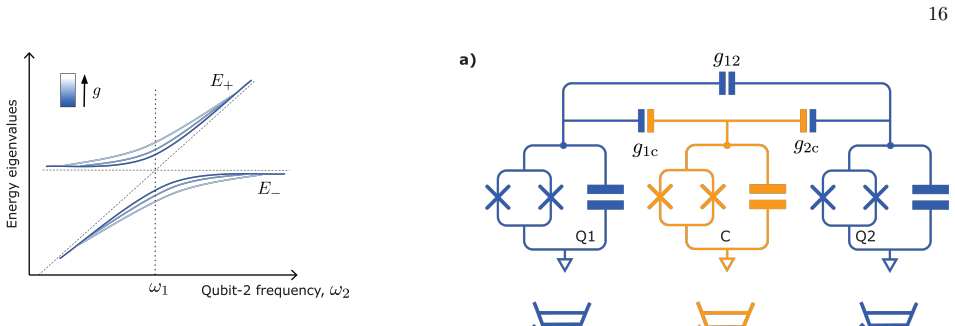
Two-qubit avoided level crossing The bosonic Hamiltonian for two interacting transmons as presented in Sec. V is: ˆHi/ℏ = X i=1,2 ωiˆa† i ˆai − ηi 2 ˆa†2 i ˆa2 i + g(ˆa1 + ˆa† 1)(ˆa2 + ˆa† 2). (D11) Near the resonance condition ω1 ≈ ω2, the Hamiltonian restricted to the single...
-
[64]
That is, the transmons that encode the qubit degrees of freedom are connected by couplers that are, themselves, transmons
T unable-coupler scheme The qubit architecture that we consider incorporates a tunable coupling scheme [35, 36]. That is, the transmons that encode the qubit degrees of freedom are connected by couplers that are, themselves, transmons. The circuit diagram for the two-qubit+cou...
Reviewed August 6, 2026 · model on record in the stance chip above.
Discussion (0). Sign in to comment.