REVIEW 3 major objections 6 minor 83 references
Electrostatic Charge Fractionalization and Unconventional Superconductivity in Strained Monolayer Graphene
T0 review · 3 major / 6 minor · reviewed 2026-08-06 · deepseek-v4-flash
Pith's one-line read Uniaxially strained monolayer graphene hosts flat bands that, through a self-consistent Hartree potential, pin the Fermi level to a van Hove singularity and drive unconventional superconductivity up to 9.5 K, with charge density waves at…
desk verdict Solid Hartree and superconductivity results in a simpler platform than TBG, but the fractionalization headline overreaches: the multi-cell states are seed-dependent CDWs with no fractional charge or topological invariant computed. read the letter →
The pith
A machine-rendered reading of the paper's core claim, the machinery that carries it, and where it could break.
The reading
What carries the argument
The load-bearing machinery is the self-consistent Hartree potential built from the plane-wave expansion of the Coulomb interaction in the moiré supercell. Because the supercell wavelength $\lambda$ is much larger than the lattice spacing (13.6–27.2 nm here), only the Fourier components along the strain direction matter, and the potential $v_H(y) = \sum_n v_C(G_n)\delta\rho(G_n)e^{iG_n y}$ reaches amplitudes around 500 meV, far exceeding the few-meV flat-band width; this imbalance is what lets electrostatics rearrange the flat bands with filling and pin the van Hove singularity to the Fermi level. The flat-band wavefunctions, being localized at the topological domain walls where $t_x = t_y$, respond strongly to this potential, and different self-consistent starting states produce sublattice-symmetric, sublattice-polarized, and multi-cell broken-symmetry charge arrangements. Superconductivity is then assessed from the screened Coulomb potential in the random-phase approximation: the electronic susceptibility in the mini-Brillouin zone, including Umklapp processes, screens the bare potential down from about 1.1 eV to 120 meV, and the resulting kernel in the linearized gap equation distinguishes intraband and interband pairing components, with the interband contribution decisive in the high-$T_c$ SS solution.
What would settle it
Compute the integrated excess charge relative to charge neutrality in each supercell for the two- and three-cell broken-symmetry solutions: if no cell carries a non-integer multiple of the electron charge, the electrostatic charge-fractionalization claim is not established. Equally decisive would be an experimental scanning tunneling microscope map at filling $\nu = 1/2$ or $\nu = 1/3$, which should show the predicted alternating sublattice-polarized charge domains if these states are physical.
Extended reading notes
Core claim
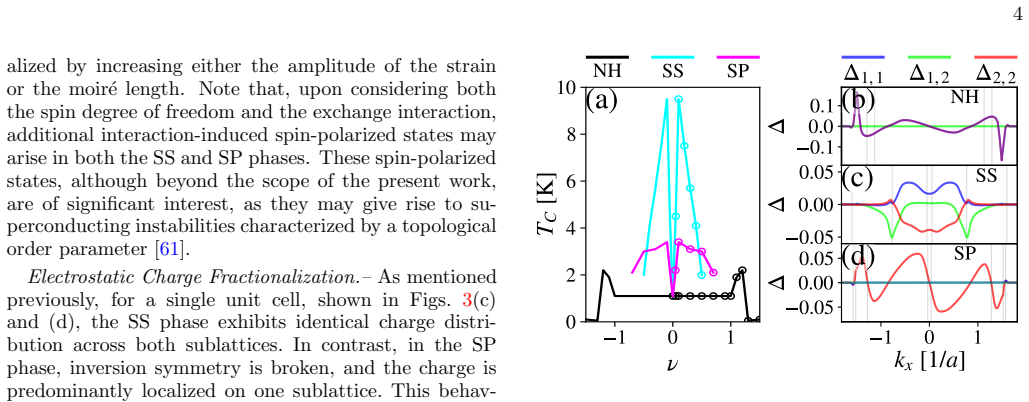
Under a sinusoidal uniaxial strain $u(y) = A\cos(2\pi y/\lambda_0 + \phi)$ whose wavelength is slightly detuned from the sublattice periodicity, monolayer graphene forms a one-dimensional moiré with supercell length $\lambda$; the strain modulation makes the hoppings $t_x(y)$ and $t_y(y)$ oscillate out of phase, creating topological domain walls at $t_x = t_y$. Around each domain wall the zero-energy solutions are almost localized soliton states, and these appear in the spectrum as two degenerate flat bands with opposite sublattice polarization. Treating the Coulomb interaction at the Hartree level, the paper finds that the flat bands are strongly distorted by the filling-dependent electrostatic potential, which pins the van Hove singularity to the Fermi energy; that symmetric (SS) and sublattice-polarized (SP) self-consistent solutions exist; that SP solutions are gapped and can become the ground state at small fillings when interactions and localization are enhanced; and that in multi-cell calculations metastable solutions break inversion and translational symmetry, producing charge density waves whose fractional cell occupancy resembles Tao-Thouless states. The screened Coulomb interaction, computed within the RPA including Umklapp processes, feeds the linearized gap equation, and the largest eigenvalue crossing one gives $T_c$ up to 9.5 K in the SS state at $\nu = 0.1$; the no-Hartree (NH) and SP states give spin-triplet odd-parity order parameters, while the SS state gives spin-singlet even-parity pairing with a nonzero interband order parameter whose removal drops $T_c$ to 2.2 K.
Load-bearing premise
The load-bearing premise is that the inhomogeneous, symmetry-broken multi-cell Hartree solutions are physical equilibrium states of strained graphene and not numerical artifacts of the self-consistent seeds, since the paper demonstrates charge patterns but does not compute a fractional charge or a topological invariant.
Editorial extensions
If this is right
- A single layer of periodically strained graphene becomes a tunable flat-band platform: superconductivity survives with $T_c$ of a few kelvin as the strain amplitude is varied, so precise fine-tuning of the strain is not required.
- Filling controls the correlated phases: near $\nu = 0.1$ the SS Hartree state gives the highest $T_c$ (9.5 K), while fractional fillings such as $\nu = 1/2$ and $\nu = 1/3$ in multi-cell calculations host electrostatically stabilized charge density waves with broken translational symmetry.
- The pairing is purely electronic and its symmetry depends on the self-consistent state: spin-triplet odd-parity in the no-Hartree and sublattice-polarized cases, spin-singlet even-parity with a nonzero interband component in the sublattice-symmetric case.
- Interband pairing is a quantitative driver of superconductivity: turning off the interband terms in the gap equation reduces $T_c$ in the SS case from 9.5 K to 2.2 K.
- These phases emerge without a magnetic field and without a twist, indicating that long-range Coulomb electrostatics alone can stabilize the kind of correlated and paired states usually associated with twisted moiré heterostructures.
Reading between the lines
- A direct test not performed in the paper would be to integrate the excess charge in each superlattice cell of the two- and three-cell solutions; if the pattern carries a non-integer multiple of the electron charge per cell, the charge-fractionalization claim would be supported, and if not, the Tao-Thouless analogy would remain only visual.
- The same Hartree-plus-RPA machinery could be applied to other single-layer strain profiles (crenulated, folded, or generic strain superlattices) to predict which geometries maximize the 500 meV-scale Hartree potential and hence the pinning and $T_c$.
- The predicted multi-cell charge patterns are in principle observable by scanning tunneling microscopy at fractional fillings; because the solutions are metastable and seed-dependent, samples with mild inhomogeneities may actually favor them, a statement the paper makes but does not test.
- The interband-pairing sensitivity suggests a design rule for flat-band superconductors: make the Fermi points degenerate so that interband pairing is allowed, since that is the channel that more than quadruples $T_c$ in the sublattice-symmetric case.
Editorial analysis
A structured set of objections, weighed in public.
Referee Report
Summary. The paper studies monolayer graphene under a periodic uniaxial strain, which creates a one-dimensional moiré pattern with two flat, sublattice-polarized bands. The authors compute the self-consistent Hartree potential and find that the Fermi level pins to a van Hove singularity, that sublattice-polarized and multi-cell inhomogeneous charge-ordered states appear at fractional fillings, and that a Kohn-Luttinger-like RPA calculation yields unconventional superconductivity with critical temperatures up to 9.5 K. The central advertised result is 'electrostatic charge fractionalization', argued by analogy to Tao-Thouless states; the evidence presented, however, consists of seed-dependent metastable charge-density-wave patterns in two- and three-cell supercells.
Significance. If the superconductivity and Hartree-pinning results hold, the paper provides a valuable, more tractable analogue of twisted-bilayer-graphene physics in a single-layer strained system, with a fully self-consistent and parameter-free (in the sense of no fitted ad hoc couplings) computational scheme. The flat-band construction via a Jackiw-Rebbi mechanism and the interband-pairing enhancement of Tc are concrete, falsifiable predictions. The charge-fractionalization claim, however, is not established: no fractional charge, no polarization or topological invariant, and no defect state is computed, so the title and the main-text claims overstate what the data show.
major comments (3)
- [Electrostatic Charge Fractionalization (main text, Fig. 3(f)-(g); SM Sec. V, Figs. S5-S6)] The evidence for charge fractionalization consists of inhomogeneous, seed-dependent metastable charge patterns at rational fillings; no fractional charge, polarization invariant, Zak phase, or many-body topological invariant is computed, and no defect state is identified. In the absence of such a quantized quantity, these states are ordinary charge density waves at rational filling, and the title's central claim is not supported.
- [Electrostatic Induced Polarized States (Fig. 3(e); SM Sec. V)] The phase diagram in Fig. 3(e) concerns single-cell SS and SP states, but the multi-cell inhomogeneous states of SM Sec. V are never compared in energy to the uniform or phase-separated states. The claim that SP states can become the ground state at small nu is not sufficient for the multi-cell states; without total-energy or grand-potential comparisons, the thermodynamic stability of the claimed fractional-charge patterns is unestablished.
- [Superconductivity (main text, Eq. (4); SM Secs. VI-VII)] The Kohn-Luttinger analysis is internally consistent, but the paper should justify the use of the normal-state Hartree bands and RPA screening in a regime where the Hartree potential (~500 meV) greatly exceeds the flat-band width and where Tc is a sizeable fraction of the bandwidth; a statement about the expected size of vertex corrections or a comparison with a controlled weak-coupling criterion would strengthen the claim that the pairing mechanism is captured.
minor comments (6)
- [Electrostatic Induced Polarized States] The text refers to 'the phase diagram in Fig. 3(d)' but the phase diagram is panel (e) of Fig. 3; please correct the cross-reference.
- [Fig. 1 caption] 'An schematic of the local deformation' should read 'A schematic of the local deformation'.
- [Conclusions] The sentence ending 'demonstrate that role of long-range Coulomb interactions' contains a grammatical error; it should read 'demonstrate the role'.
- [SM Sec. V, Figs. S5-S6 captions] The captions describe the first panel as 'Periodic solution of 1 cell' even though the calculation is for two or three cells; clarify that this is the repeated single-cell periodic solution.
- [SM Eq. (S27)] The summation variable in Eq. (S27) is written as q, but the integrand depends on k'; this should be a summation over k'.
- [References] References [59] and [83] are duplicates of the same PNAS paper; one should be removed.
Circularity Check
No significant circularity: Hartree pinning and RPA superconductivity are computed self-consistently from the strained-lattice Hamiltonian with no fitted parameters; the Tao-Thouless 'charge fractionalization' label is an unsupported interpretational overlay, not a circular derivation.
full rationale
The central calculations are self-contained. The flat bands are derived in SM Sec. I from the 1D tight-binding model (Eq. S2) as Jackiw-Rebbi zero modes (Eqs. S7-S8); prior work [47-50] is cited for context, not as the sole support. The Hartree potential (Eqs. 2-3 and SM Sec. III) is computed self-consistently from the occupied states at fixed filling, and the Fermi-level pinning emerges from that self-consistency; no parameter is fitted to produce it. The superconductivity calculation is also closed: SM Sec. VI computes the RPA-screened Coulomb interaction from the band structure, and SM Sec. VII solves the linearized gap equation, with the interband contribution isolated by a controlled switch (SM Sec. VIII). No fitted input is renamed as a prediction. The main limitation is the charge-fractionalization claim in the section 'Electrostatic Charge Fractionalization' and SM Sec. V/Figs. S5-S6: the paper itself states these multi-cell solutions are metastable and strongly depend on initial conditions, and it shows charge density waves at rational fillings nu=1/2 and nu=1/3 without computing any fractional charge, topological invariant, or local charge integral. That is an evidentiary/interpretational overstatement, not circularity: the inhomogeneous self-consistent charge pattern is a genuine output of the Hartree calculation, and the 'fractional' label is an analogy to Tao-Thouless states rather than a quantity derived from the input. Because the derivations are not equivalent to their inputs by construction, the circularity score is low despite the unsupported headline.
Assumptions & free parameters
free parameters (5)
- Strain amplitude A =
0.15a (range studied: 0.075a to 0.15a)
- Moire wavelength lambda =
13.6 nm (also 27.2 nm)
- Dielectric constant epsilon =
10 (also 6)
- Gate distance dg =
40 nm
- Grunesien parameter beta =
~3
assumptions (7)
- domain assumption Standard tight-binding model with exponential strain-dependent hoppings
- domain assumption Hopping modulation expanded and truncated to O(alpha^2)
- domain assumption Hartree potential includes only y-directed reciprocal vectors
- domain assumption RPA screening describes the effective interaction
- domain assumption Kohn-Luttinger mechanism: repulsive interaction leads to pairing
- domain assumption Gap equation projected onto the two middle flat bands
- ad hoc to paper Metastable multi-cell CDW states represent physical charge fractionalization
Cite this review
Pith. "Pith review of Electrostatic Charge Fractionalization and Unconventional Superconductivity in Strained Monolayer Graphene." pith.science (2026). https://pith.science/paper/TAVWMA2A
@misc{pith2026250700112,
  author       = {Pith},
  title        = {Pith review of: Electrostatic Charge Fractionalization and Unconventional Superconductivity in Strained Monolayer Graphene},
  year         = {2026},
  howpublished = {\url{https://pith.science/paper/TAVWMA2A}},
  note         = {Machine review of arXiv:2507.00112}
}
read the original abstract
Two-dimensional systems with flat bands support correlated phases such as superconductivity and charge fractionalization. While twisted moire systems like twisted bilayer graphene have revealed such states, they remain complex to control. Here, we study monolayer graphene under uniaxial periodic strain, which forms a 1D moire and hosts two flat, sublattice-polarized bands. It is shown that this system exhibits features akin to its twisted counterparts, such as a pinning of the Fermi level to the van Hove singularity and unconventional superconductivity. We also found inhomogeneous charge density waves for rational fractional fillings of the unit cell
Figures


Figures from the paper (1 more)
Reference graph
Works this paper leans on
-
[1]
Unconventional superconductivity in magic- angle graphene superlattices
Yuan Cao, Valla Fatemi, Shiang Fang, Kenji Watanabe, Takashi Taniguchi, Efthimios Kaxiras, and Pablo Jarillo- Herrero. Unconventional superconductivity in magic- angle graphene superlattices. Nature, 556(7699):43–50, 2018
2018
-
[2]
Correlated insulator behaviour at half-filling in magic-angle graphene superlattices
Yuan Cao, Valla Fatemi, Ahmet Demir, Shiang Fang, Spencer L Tomarken, Jason Y Luo, Javier D Sanchez-Yamagishi, Kenji Watanabe, Takashi Taniguchi, Efthimios Kaxiras, et al. Correlated insulator behaviour at half-filling in magic-angle graphene superlattices. Na- ture, 556(7699):80–84, 2018
2018
-
[3]
Watanabe, T
Matthew Yankowitz, Shaowen Chen, Hryhoriy Polshyn, Yuxuan Zhang, K. Watanabe, T. Taniguchi, David Graf, Andrea F. Young, and Cory R. Dean. Tuning su- perconductivity in twisted bilayer graphene. Science, 363(6431):1059–1064, mar 2019
2019
-
[4]
Superconductors, orbital magnets and correlated states in magic-angle bilayer graphene
Xiaobo Lu, Petr Stepanov, Wei Yang, Ming Xie, Mo- hammed Ali Aamir, Ipsita Das, Carles Urgell, Kenji Watanabe, Takashi Taniguchi, Guangyu Zhang, et al. Superconductors, orbital magnets and correlated states in magic-angle bilayer graphene. Nature, 574(7780):653– 657, 2019
work page 2019
-
[5]
Spectroscopic sig- natures of many-body correlations in magic-angle twisted bilayer graphene
Yonglong Xie, Biao Lian, Berthold J¨ ack, Xiaomeng Liu, Cheng-Li Chiu, Kenji Watanabe, Takashi Taniguchi, B Andrei Bernevig, and Ali Yazdani. Spectroscopic sig- natures of many-body correlations in magic-angle twisted bilayer graphene. Nature, 572(7767):101–105, 2019
work page 2019
-
[6]
Aaron L. Sharpe, Eli J. Fox, Arthur W. Barnard, Joe Finney, Kenji Watanabe, Takashi Taniguchi, M. A. Kast- ner, and David Goldhaber-Gordon. Emergent ferro- magnetism near three-quarters filling in twisted bilayer graphene. Science, 365(6453):605–608, aug 2019
work page 2019
-
[7]
Charge order and broken rotational symme- try in magic-angle twisted bilayer graphene
Yuhang Jiang, Xinyuan Lai, Kenji Watanabe, Takashi Taniguchi, Kristjan Haule, Jinhai Mao, and Eva Y 6 Andrei. Charge order and broken rotational symme- try in magic-angle twisted bilayer graphene. Nature, 573(7772):91–95, 2019
work page 2019
-
[8]
Electronic correlations in twisted bilayer graphene near the magic angle
Youngjoon Choi, Jeannette Kemmer, Yang Peng, Alex Thomson, Harpreet Arora, Robert Polski, Yiran Zhang, Hechen Ren, Jason Alicea, Gil Refael, et al. Electronic correlations in twisted bilayer graphene near the magic angle. Nature physics, 15(11):1174–1180, 2019
work page 2019
Show all 83 references
-
[9]
Petr Stepanov, Ipsita Das, Xiaobo Lu, Ali Fahimniya, Kenji Watanabe, Takashi Taniguchi, Frank H. L. Kop- pens, Johannes Lischner, Leonid Levitov, and Dmitri K. Efetov. Untying the insulating and superconducting or- ders in magic-angle graphene. Nature, 583(7816):375– 378, jul 2020
2020
-
[10]
Nuckolls, Dillon Wong, Ryan L
Myungchul Oh, Kevin P. Nuckolls, Dillon Wong, Ryan L. Lee, Xiaomeng Liu, Kenji Watanabe, Takashi Taniguchi, and Ali Yazdani. Evidence for unconventional su- perconductivity in twisted bilayer graphene. Nature, 600(7888):240–245, oct 2021
2021
-
[11]
Su´ arez Morell, J
E. Su´ arez Morell, J. D. Correa, P. Vargas, M. Pacheco, and Z. Barticevic. Flat bands in slightly twisted bi- layer graphene: Tight-binding calculations. Phys. Rev. B, 82:121407, Sep 2010
2010
-
[12]
Moir´ e bands in twisted double-layer graphene
Rafi Bistritzer and Allan H MacDonald. Moir´ e bands in twisted double-layer graphene. Proceedings of the Na- tional Academy of Sciences , 108(30):12233–12237, 2011
2011
-
[13]
Tunable strongly coupled superconductivity in magic-angle twisted trilayer graphene
Jeong Min Park, Yuan Cao, Kenji Watanabe, Takashi Taniguchi, and Pablo Jarillo-Herrero. Tunable strongly coupled superconductivity in magic-angle twisted trilayer graphene. Nature, 590(7845):249–255, 2021
2021
-
[14]
Zeyu Hao, A. M. Zimmerman, Patrick Ledwith, Es- lam Khalaf, Danial Haie Najafabadi, Kenji Watan- abe, Takashi Taniguchi, Ashvin Vishwanath, and Philip Kim. Electric field–tunable superconductivity in alternating-twist magic-angle trilayer graphene. Science, 371(6534):1133–1138, 2021
2021
-
[15]
Evidence for unconventional super- conductivity in twisted trilayer graphene
Hyunjin Kim, Youngjoon Choi, Cyprian Lewandowski, Alex Thomson, Yiran Zhang, Robert Polski, Kenji Watanabe, Takashi Taniguchi, Jason Alicea, and Ste- van Nadj-Perge. Evidence for unconventional super- conductivity in twisted trilayer graphene. Nature, 606(7914):494–500, 2022
2022
-
[16]
Correlated states in twisted double bilayer graphene
Cheng Shen, Yanbang Chu, QuanSheng Wu, Na Li, Shuopei Wang, Yanchong Zhao, Jian Tang, Jieying Liu, Jinpeng Tian, Kenji Watanabe, et al. Correlated states in twisted double bilayer graphene. Nature Physics , 16(5):520–525, 2020
2020
-
[17]
Tunable correlated states and spin-polarized phases in twisted bilayer–bilayer graphene
Yuan Cao, Daniel Rodan-Legrain, Oriol Rubies-Bigorda, Jeong Min Park, Kenji Watanabe, Takashi Taniguchi, and Pablo Jarillo-Herrero. Tunable correlated states and spin-polarized phases in twisted bilayer–bilayer graphene. Nature, 583(7815):215–220, 2020
2020
-
[18]
Robust superconductivity in magic-angle multi- layer graphene family
Jeong Min Park, Yuan Cao, Li-Qiao Xia, Shuwen Sun, Kenji Watanabe, Takashi Taniguchi, and Pablo Jarillo- Herrero. Robust superconductivity in magic-angle multi- layer graphene family. Nature Materials, 21(8):877–883, 2022
2022
-
[19]
Promotion of superconductivity in magic-angle graphene multilayers
Yiran Zhang, Robert Polski, Cyprian Lewandowski, Alex Thomson, Yang Peng, Youngjoon Choi, Hyunjin Kim, Kenji Watanabe, Takashi Taniguchi, Jason Alicea, et al. Promotion of superconductivity in magic-angle graphene multilayers. Science, 377(6614):1538–1543, 2022
2022
-
[20]
Spontaneous time-reversal symmetry breaking in twisted double bilayer graphene
Manabendra Kuiri, Christopher Coleman, Zhenxiang Gao, Aswin Vishnuradhan, Kenji Watanabe, Takashi Taniguchi, Jihang Zhu, Allan H MacDonald, and Joshua Folk. Spontaneous time-reversal symmetry breaking in twisted double bilayer graphene. Nature Communica- tions, 13(1):6468, 2022
2022
-
[21]
Superconductivity in twisted double bilayer graphene stabilized by wse2
Ruiheng Su, Manabendra Kuiri, Kenji Watanabe, Takashi Taniguchi, and Joshua Folk. Superconductivity in twisted double bilayer graphene stabilized by wse2. Nature Materials, 22(11):1332–1337, 2023
2023
-
[22]
Superconductivity in rhom- bohedral trilayer graphene
Haoxin Zhou, Tian Xie, Takashi Taniguchi, Kenji Watan- abe, and Andrea F Young. Superconductivity in rhom- bohedral trilayer graphene. Nature, 598(7881):434–438, 2021
2021
-
[23]
Isospin magnetism and spin-polarized superconductivity in bernal bilayer graphene
Haoxin Zhou, Ludwig Holleis, Yu Saito, Liam Co- hen, William Huynh, Caitlin L Patterson, Fangyuan Yang, Takashi Taniguchi, Kenji Watanabe, and An- drea F Young. Isospin magnetism and spin-polarized superconductivity in bernal bilayer graphene. Science, 375(6582):774–778, 2022
2022
-
[24]
Enhanced superconductiv- ity in spin–orbit proximitized bilayer graphene
Yiran Zhang, Robert Polski, Alex Thomson, ´Etienne Lantagne-Hurtubise, Cyprian Lewandowski, Haoxin Zhou, Kenji Watanabe, Takashi Taniguchi, Jason Al- icea, and Stevan Nadj-Perge. Enhanced superconductiv- ity in spin–orbit proximitized bilayer graphene. Nature, 613(7943):268–273, 2023
2023
-
[25]
Spontaneous broken- symmetry insulator and metals in tetralayer rhombohe- dral graphene
Kai Liu, Jian Zheng, Yating Sha, Bosai Lyu, Fengping Li, Youngju Park, Yulu Ren, Kenji Watanabe, Takashi Taniguchi, Jinfeng Jia, et al. Spontaneous broken- symmetry insulator and metals in tetralayer rhombohe- dral graphene. Nature nanotechnology , 19(2):188–195, 2024
2024
-
[26]
Correlated in- sulator and chern insulators in pentalayer rhombohedral- stacked graphene
Tonghang Han, Zhengguang Lu, Giovanni Scuri, Jiho Sung, Jue Wang, Tianyi Han, Kenji Watanabe, Takashi Taniguchi, Hongkun Park, and Long Ju. Correlated in- sulator and chern insulators in pentalayer rhombohedral- stacked graphene. Nature Nanotechnology , 19(2):181– 187, 2024
2024
-
[27]
Nematicity and orbital depairing in superconducting bernal bilayer graphene
Ludwig Holleis, Caitlin L Patterson, Yiran Zhang, Yaar Vituri, Heun Mo Yoo, Haoxin Zhou, Takashi Taniguchi, Kenji Watanabe, Erez Berg, Stevan Nadj-Perge, et al. Nematicity and orbital depairing in superconducting bernal bilayer graphene. Nature Physics, pages 1–7, 2025
2025
-
[28]
Signatures of chiral superconductivity in rhombohedral graphene
Tonghang Han, Zhengguang Lu, Zach Hadjri, Lihan Shi, Zhenghan Wu, Wei Xu, Yuxuan Yao, Armel A Cotten, Omid Sharifi Sedeh, Henok Weldeyesus, et al. Signatures of chiral superconductivity in rhombohedral graphene. Nature, pages 1–3, 2025
2025
-
[29]
E. Y. Andrei, G. Deville, D. C. Glattli, F. I. B. Williams, E. Paris, and B. Etienne. Observation of a magnetically induced wigner solid. Phys. Rev. Lett., 60:2765–2768, Jun 1988
1988
-
[30]
Fractional quantum hall effect and in- sulating phase of dirac electrons in graphene
Xu Du, Ivan Skachko, Fabian Duerr, Adina Luican, and Eva Y Andrei. Fractional quantum hall effect and in- sulating phase of dirac electrons in graphene. Nature, 462(7270):192–195, 2009
2009
-
[31]
Observation of the fractional quantum hall effect in graphene
Kirill I Bolotin, Fereshte Ghahari, Michael D Shulman, Horst L Stormer, and Philip Kim. Observation of the fractional quantum hall effect in graphene. Nature, 462(7270):196–199, 2009
2009
-
[32]
N. Levy, S. A. Burke, K. L. Meaker, M. Panlasigui, A. Zettl, F. Guinea, A. H. Castro Neto, and M. F. Crommie. Strain-induced pseudo–magnetic fields greater than 300 tesla in graphene nanobubbles. Science, 329(5991):544–547, 2010. 7
2010
-
[33]
Energy gaps and a zero-field quantum hall effect in graphene by strain engineering
Francisco Guinea, Mikhail I Katsnelson, and AK Geim. Energy gaps and a zero-field quantum hall effect in graphene by strain engineering. Nature Physics, 6(1):30– 33, 2010
2010
-
[34]
Guinea, A
F. Guinea, A. K. Geim, M. I. Katsnelson, and K. S. Novoselov. Generating quantizing pseudomagnetic fields by bending graphene ribbons. Phys. Rev. B , 81:035408, Jan 2010
2010
-
[35]
Pseudo magnetic field in strained graphene: Revisited
M Ramezani Masir, D Moldovan, and FM Peeters. Pseudo magnetic field in strained graphene: Revisited. Solid state communications , 175:76–82, 2013
2013
-
[36]
Visualizing strain-induced pseudomagnetic fields in graphene through an hbn magnifying glass
Yuhang Jiang, Jinhai Mao, Junxi Duan, Xinyuan Lai, Kenji Watanabe, Takashi Taniguchi, and Eva Y An- drei. Visualizing strain-induced pseudomagnetic fields in graphene through an hbn magnifying glass. Nano letters, 17(5):2839–2843, 2017
2017
-
[37]
Electronic and op- tical properties of strained graphene and other strained 2d materials: a review
Gerardo G Naumis, Salvador Barraza-Lopez, Maurice Oliva-Leyva, and Humberto Terrones. Electronic and op- tical properties of strained graphene and other strained 2d materials: a review. Reports on Progress in Physics , 80(9):096501, aug 2017
2017
-
[38]
Evidence of flat bands and corre- lated states in buckled graphene superlattices
Jinhai Mao, Slaviˇ sa P Milovanovi´ c, Miˇ sa Andelkovi´ c, Xinyuan Lai, Yang Cao, Kenji Watanabe, Takashi Taniguchi, Lucian Covaci, Francois M Peeters, An- dre K Geim, et al. Evidence of flat bands and corre- lated states in buckled graphene superlattices. Nature, 584(7820):2...
2020
-
[39]
Mechan- ical, electronic, optical, piezoelectric and ferroic proper- ties of strained graphene and other strained monolay- ers and multilayers: an update
Gerardo G Naumis, Sa´ ul A Herrera, Shiva P Poudel, Hiro Nakamura, and Salvador Barraza-Lopez. Mechan- ical, electronic, optical, piezoelectric and ferroic proper- ties of strained graphene and other strained monolay- ers and multilayers: an update. Reports on Progress in Phys...
2023
-
[40]
Origami-controlled strain engineering of tunable flat bands and correlated states in folded graphene
Li-Zhen Yang, Ling-Hui Tong, Cheng-Sheng Liao, Qilong Wu, Xiaoshuai Fu, Yue-Ying Zhou, Yuan Tian, Li Zhang, Lijie Zhang, Meng-Qiu Cai, et al. Origami-controlled strain engineering of tunable flat bands and correlated states in folded graphene. Physical Review Materials , 6(4):...
2022
-
[41]
Quantum transport signature of strain-induced scalar and pseudovector po- tentials in a crenelated h-BN/graphene heterostructure
Romaine Kerjouan, Michael Rosticher, Aur´ elie Pierret, Kenji Watanabe, Takashi Taniguchi, Sukhdeep Dhillon, Robson Ferreira, Daniel Dolfi, Mark Goerbig, Bernard Pla¸ cais, and Juliette Mangeney. Quantum transport signature of strain-induced scalar and pseudovector po- tential...
2024
-
[42]
Strain modulated superlat- tices in graphene
Riju Banerjee, Viet-Hung Nguyen, Tomotaroh Granzier- Nakajima, Lavish Pabbi, Aurelien Lherbier, Anna Ruth Binion, Jean-Christophe Charlier, Mauricio Terrones, and Eric William Hudson. Strain modulated superlat- tices in graphene. Nano letters , 20(5):3113–3121, 2020
2020
-
[43]
Dirac-harper theory for one-dimensional moir´ e superlattices
Abigail Timmel and EJ Mele. Dirac-harper theory for one-dimensional moir´ e superlattices. Physical Review Letters, 125(16):166803, 2020
2020
-
[44]
Untwisting moir´ e physics: Almost ideal bands and fractional chern insulators in pe- riodically strained monolayer graphene
Qiang Gao, Junkai Dong, Patrick Ledwith, Daniel Parker, and Eslam Khalaf. Untwisting moir´ e physics: Almost ideal bands and fractional chern insulators in pe- riodically strained monolayer graphene. Physical Review Letters, 131(9):096401, 2023
2023
-
[45]
Nearly flat chern band in periodically strained monolayer and bilayer graphene
Xiaohan Wan, Siddhartha Sarkar, Kai Sun, and Shi- Zeng Lin. Nearly flat chern band in periodically strained monolayer and bilayer graphene. Physical Review B , 108(12):125129, 2023
2023
-
[46]
Flat bands and superconductivity induced by peri- odic strain in monolayer graphene
Jingyao Meng, Runyu Ma, Tianxing Ma, and Hai-Qing Lin. Flat bands and superconductivity induced by peri- odic strain in monolayer graphene. Physical Review B , 110(23):235128, 2024
2024
-
[47]
Naumis and Pedro Roman-Taboada
Gerardo G. Naumis and Pedro Roman-Taboada. Map- ping of strained graphene into one-dimensional hamilto- nians: Quasicrystals and modulated crystals. Phys. Rev. B, 89:241404, Jun 2014
2014
-
[48]
Topo- logical flat bands in time-periodically driven uniaxial strained graphene nanoribbons
Pedro Roman-Taboada and Gerardo G Naumis. Topo- logical flat bands in time-periodically driven uniaxial strained graphene nanoribbons. Physical Review B , 95(11):115440, 2017
2017
-
[49]
Elias Andrade, Florentino L´ opez-Ur ´ ıas, and Gerardo G. Naumis. Topological origin of flat bands as pseudo- landau levels in uniaxial strained graphene nanoribbons and induced magnetic ordering due to electron-electron interactions. Phys. Rev. B , 107:235143, Jun 2023
2023
-
[50]
Elias Andrade, Florentino L´ opez-Ur ´ ıas, and Gerardo G Naumis. Flat bands without twists through the use of a one harmonic moir´ e systems: topological nature of modes and electron–electron pairing in periodic uniaxial strained or crenellated graphene nanoribbons. 2D Mate- ...
2024
-
[51]
Tao and D
R. Tao and D. J. Thouless. Fractional quantization of hall conductance. Phys. Rev. B , 28:1142–1144, Jul 1983
1983
-
[52]
E. J. Bergholtz and A. Karlhede. Quantum hall system in tao-thouless limit. Phys. Rev. B, 77:155308, Apr 2008
2008
-
[53]
See Supplemental Material at [URL will be inserted by publisher] for a more detailed explanation of the model and the calculations for both the Hartee potential and superconductivity
-
[54]
Botello-M´ endez, Juan Carlos Obeso-Jureidini, and Gerardo G
Andr´ es R. Botello-M´ endez, Juan Carlos Obeso-Jureidini, and Gerardo G. Naumis. Toward an accurate tight- binding model of graphene’s electronic properties un- der strain. The Journal of Physical Chemistry C , 122(27):15753–15760, 2018
2018
-
[55]
Francisco Guinea and Niels R. Walet. Electrostatic ef- fects, band distortions, and superconductivity in twisted graphene bilayers. Proceedings of the National Academy of Sciences, 115(52):13174–13179, dec 2018
2018
-
[56]
Charge-transfer insulation in twisted bilayer graphene
Louk Rademaker and Paula Mellado. Charge-transfer insulation in twisted bilayer graphene. Physical Review B, 98(23), dec 2018
2018
-
[57]
Walet, and Francisco Guinea
Tommaso Cea, Niels R. Walet, and Francisco Guinea. Electronic band structure and pinning of fermi energy to van hove singularities in twisted bilayer graphene: A self-consistent approach. Physical Review B, 100(20), nov 2019
2019
-
[58]
Narrow bands, electro- static interactions and band topology in graphene stacks
Pierre A Pantaleon, Tommaso Cea, Rory Brown, Niels R Walet, and Francisco Guinea. Narrow bands, electro- static interactions and band topology in graphene stacks. 2D Materials , 8(4):044006, August 2021
2021
-
[59]
Pantaleon, and Francisco Guinea
Min Long, Alejandro Jimeno-Pozo, H´ ector Sainz-Cruz, Pierre A. Pantaleon, and Francisco Guinea. Evolu- tion of superconductivity in twisted graphene multilay- ers. Proceedings of the National Academy of Sciences , 121(32):e2405259121, 2024
2024
-
[60]
Pantaleon, Jia-Qi He, Ya-Xin Zhao, Kenji Watanabe, Takashi Taniguchi, Francisco Guinea, and Lin He
Chen-Yue Hao, Zhen Zhan, Pierre A. Pantaleon, Jia-Qi He, Ya-Xin Zhao, Kenji Watanabe, Takashi Taniguchi, Francisco Guinea, and Lin He. Robust flat bands in twisted trilayer graphene moir´ e quasicrystals. Nature Communications, 15(1), September 2024
2024
-
[61]
Pantaleon, Jose An- 8 gel Silva-Guillen, and Francisco Guinea
Guillermo Parra-Martinez, Alejandro Jimeno-Pozo, Vo Tien Phong, Hector Sainz-Cruz, Daniel Kaplan, Pe- leg Emanuel, Yuval Oreg, Pierre A. Pantaleon, Jose An- 8 gel Silva-Guillen, and Francisco Guinea. Band renormal- ization, quarter metals, and chiral superconductivity in rhomb...
2025
-
[62]
Abelian and non- abelian hall liquids and charge-density wave: Quantum number fractionalization in one and two dimensions
Alexander Seidel and Dung-Hai Lee. Abelian and non- abelian hall liquids and charge-density wave: Quantum number fractionalization in one and two dimensions. Physical Review Letters, 97(5):056804, 2006
2006
-
[63]
Kohn and J
W. Kohn and J. M. Luttinger. New mechanism for su- perconductivity. Phys. Rev. Lett., 15:524–526, Sep 1965
1965
-
[64]
Chubukov
Andrey V. Chubukov. Kohn-luttinger effect and the in- stability of a two-dimensional repulsive fermi liquid at t=0. Phys. Rev. B , 48:1097–1104, Jul 1993
1993
-
[65]
Pantale´ on, Tommaso Cea, and Francisco Guinea
V˜ o Tien Phong, Pierre A. Pantale´ on, Tommaso Cea, and Francisco Guinea. Band structure and superconductivity in twisted trilayer graphene. Phys. Rev. B , 104:L121116, Sep 2021
2021
-
[66]
Pantale´ on, V˜ o Tien Phong, and Francisco Guinea
Tommaso Cea, Pierre A. Pantale´ on, V˜ o Tien Phong, and Francisco Guinea. Superconductivity from repulsive in- teractions in rhombohedral trilayer graphene: A kohn- luttinger-like mechanism. Phys. Rev. B , 105:075432, Feb 2022
2022
-
[67]
Superconductivity and correlated phases in non-twisted bilayer and trilayer graphene
Pierre A Pantale´ on, Alejandro Jimeno-Pozo, H´ ector Sainz-Cruz, Vo Tien Phong, Tommaso Cea, and Fran- cisco Guinea. Superconductivity and correlated phases in non-twisted bilayer and trilayer graphene. Nature Re- views Physics , pages 1–12, 2023
2023
-
[68]
Pantale´ on, and Francisco Guinea
Alejandro Jimeno-Pozo, H´ ector Sainz-Cruz, Tommaso Cea, Pierre A. Pantale´ on, and Francisco Guinea. Super- conductivity from electronic interactions and spin-orbit enhancement in bilayer and trilayer graphene.Phys. Rev. B, 107:L161106, Apr 2023
2023
-
[69]
Superconductivity induced by the inter- valley coulomb scattering in a few layers of graphene
Tommaso Cea. Superconductivity induced by the inter- valley coulomb scattering in a few layers of graphene. Phys. Rev. B , 107:L041111, Jan 2023
2023
-
[70]
Herrera, Guillermo Parra-Mart ´ ınez, Philipp Rosenzweig, Bharti Matta, Craig M
Sa´ ul A. Herrera, Guillermo Parra-Mart ´ ınez, Philipp Rosenzweig, Bharti Matta, Craig M. Polley, Kathrin K¨ uster, Ulrich Starke, Francisco Guinea, Jos´ e ´Angel Silva-Guill´ en, Gerardo G. Naumis, and Pierre A. Pan- taleon. Topological superconductivity in heavily doped sin...
-
[71]
Note that, in this one-dimensional system, the Fermi sur- face consists of discrete points
-
[72]
Guerci, D
D. Guerci, D. Kaplan, J. Ingham, J. H. Pixley, and A. J. Millis. Topological superconductivity from repulsive in- teractions in twisted WSe 2. arXiv:2408.16075, 2024. http://arxiv.org/abs/2408.16075
2024 arXiv
-
[73]
Gonz´ alez and T
J. Gonz´ alez and T. Stauber. Ising superconductivity in- duced from spin-selective valley symmetry breaking in twisted trilayer graphene. Nature Communications, 14, 2023
2023
-
[74]
Cr´ epel, T
V. Cr´ epel, T. Cea, L. Fu, and F. Guinea. Unconven- tional superconductivity due to interband polarization. Physical Review B , 105, 2022
2022
-
[75]
Pahlevanzadeh, P
B. Pahlevanzadeh, P. Sahebsara, and D. S´ en´ echal. Chi- ral p-wave superconductivity in twisted bilayer graphene from dynamical mean field theory. SciPost Physics , 11, 2021
2021
-
[76]
Samajdar and M
R. Samajdar and M. S. Scheurer. Microscopic pairing mechanism, order parameter, and disorder sensitivity in moir´ e superlattices: Applications to twisted double- bilayer graphene. Physical Review B , 102, 2020
2020
-
[77]
Coulomb interac- tion, phonons, and superconductivity in twisted bilayer graphene
Tommaso Cea and Francisco Guinea. Coulomb interac- tion, phonons, and superconductivity in twisted bilayer graphene. Proceedings of the National Academy of Sci- ences, 118(32), aug 2021
2021
-
[78]
Sharma, M
G. Sharma, M. Trushin, O. P. Sushkov, G. Vignale, and S. Adam. Superconductivity from collective excitations in magic-angle twisted bilayer graphene. Physical Review Research, 2, 2020
2020
-
[79]
Lewandowski, D
C. Lewandowski, D. Chowdhury, and J. Ruhman. Pairing in magic-angle twisted bilayer graphene: Role of phonon and plasmon umklapp. Physical Review B , 103, 2021
2021
-
[80]
Z. A. H. Goodwin, F. Corsetti, A. A. Mostofi, and J. Lis- chner. Twist-angle sensitivity of electron correlations in moir´ e graphene bilayers.Physical Review B , 100, 2019
2019
-
[81]
Roy and V
B. Roy and V. Juriˇ ci´ c. Unconventional superconductivity in nearly flat bands in twisted bilayer graphene. Physical Review B, 99, 2019
2019
-
[82]
Gonz´ alez and T
J. Gonz´ alez and T. Stauber. Kohn-luttinger supercon- ductivity in twisted bilayer graphene. Physical Review Letters, 122, 2019
2019
-
[83]
Pantaleon, and Francisco Guinea
Min Long, Alejandro Jimeno-Pozo, H´ ector Sainz-Cruz, Pierre A. Pantaleon, and Francisco Guinea. Evolution of superconductivity in twisted graphene multilayers. Pro- ceedings of the National Academy of Sciences , 121(32), jul 2024. 1 Supplementary Material for Electrostatic Ch...
2024
Reviewed August 6, 2026 · model on record in the stance chip above.
Discussion (0). Continue with ORCID to comment.