Majorana zero modes in semiconductor-superconductor hybrid structures: Defining topology in short and disordered nanowires through Majorana splitting
Pith reviewed 2026-05-19 06:27 UTC · model grok-4.3
The pith
Disorder even weaker than the gap suppresses exponential Majorana protection in short nanowires
A machine-rendered reading of the paper's core claim, the machinery that carries it, and where it could break.
Core claim
In experimentally relevant short disordered nanowires, the exponential regime of Majorana splitting is highly constrained and is suppressed for disorder somewhat less than the topological superconducting gap. Consequently, topology in finite disordered wires may not be uniquely defined without a careful, parameter-specific analysis.
What carries the argument
Majorana splitting energy produced by overlap of end-localized modes whose localization length is set by the topological gap and modified by disorder scattering.
If this is right
- Exponential topological protection holds only when both wire length greatly exceeds the localization length and disorder remains well below the gap.
- Zero-bias conductance peaks observed in short disordered devices cannot be automatically interpreted as topologically protected Majorana modes.
- Experimental searches must map splitting versus disorder and length to determine whether a given sample sits inside the protected regime.
- Topology in finite wires becomes a quantitative, context-dependent statement rather than a binary label.
Where Pith is reading between the lines
- Longer, cleaner wires will be required before the exponential regime becomes routinely accessible.
- New diagnostics that do not rely solely on splitting energy may be needed to certify topological character under realistic disorder.
- Current experimental claims based on short wires may need re-evaluation once the disorder threshold is taken into account.
Load-bearing premise
The calculations rely on realistic models of nanowires currently being used experimentally that accurately capture the combined effects of finite length and disorder on Majorana splitting.
What would settle it
A measurement or simulation in which the splitting energy stays exponentially small even when disorder strength approaches or exceeds the topological gap would directly contradict the claimed constraint.
Figures





read the original abstract
Majorana zero modes (MZMs) are bound midgap topological excitations at the ends of a 1D topological superconductor, which must come in pairs. If the two MZMs in the pair are sufficiently well-separated by a distance much larger than their individual localization lengths, then the MZMs behave as non-Abelian anyons which can be braided to carry out fault-tolerant topological quantum computation. In this `topological' regime of well-separated MZMs, their overlap is exponentially small, leading to exponentially small Majorana splitting, thus enabling the MZMs to be topologically protected by the superconducting gap. In real experimental samples, however, the existence of disorder and the finite length of the 1D wire considerably complicate the situation, leading to ambiguities in defining `topology' since the Majorana splitting between the two end modes may not necessarily be small in disordered wires of short length. We theoretically study this situation by calculating the splitting in experimentally relevant short disordered wires, and explicitly investigating the applicability of the `exponential protection' constraint as a function of disorder, wire length, and other system parameters in realistic models of nanowires currently being used experimentally. We find that the exponential regime is highly constrained, and is suppressed for disorder somewhat less than the topological superconducting gap. We provide detailed results and discuss the implications of our theory for the currently active experimental search for MZMs in superconductor-semiconductor hybrid platforms. A general consequence of our work is that `topology' in finite disordered wires may not be uniquely defined, necessitating a careful analysis which depends on the context.
Editorial analysis
A structured set of objections, weighed in public.
Referee Report
Summary. The manuscript numerically computes Majorana splitting energies in short, disordered semiconductor-superconductor hybrid nanowires using realistic models. It concludes that the exponential-protection regime is highly constrained and is suppressed already for disorder strengths somewhat less than the topological superconducting gap, implying that topology cannot be uniquely defined in finite disordered wires without additional context-dependent analysis.
Significance. If the central numerical result holds, the work supplies concrete, experimentally relevant bounds on when exponential protection can be expected in current nanowire platforms. The explicit parameter scan over disorder and length in realistic models is a positive feature that directly addresses ambiguities in defining topology for finite systems.
major comments (2)
- The load-bearing claim that the exponential regime is suppressed for disorder 'somewhat less than the topological superconducting gap' requires explicit definition of the gap employed. It is unclear whether the reference gap is the clean-system value or the disorder-renormalized minigap extracted from the density of states or lowest bulk eigenvalue. Because disorder reduces the effective bulk gap, this choice directly affects the reported suppression threshold and the robustness of the constrained-regime conclusion.
- Details on the numerical methods, basis sets, convergence criteria, and error estimates for the splitting calculations are not provided. Given that the findings rest on explicit computation of splitting versus disorder and length rather than an analytic reduction, these technical specifications are necessary to assess the reliability of the reported thresholds.
minor comments (2)
- Notation for the splitting energy and the localization length should be defined once at first use and used consistently thereafter.
- A brief discussion of how the topological gap is extracted in the disordered case (e.g., from the bulk spectrum or local density of states) would improve clarity even if placed in the methods or supplementary material.
Simulated Author's Rebuttal
We thank the referee for the careful reading of our manuscript and the constructive comments. We address each major point below and have revised the manuscript accordingly to improve clarity and reproducibility.
read point-by-point responses
-
Referee: The load-bearing claim that the exponential regime is suppressed for disorder 'somewhat less than the topological superconducting gap' requires explicit definition of the gap employed. It is unclear whether the reference gap is the clean-system value or the disorder-renormalized minigap extracted from the density of states or lowest bulk eigenvalue. Because disorder reduces the effective bulk gap, this choice directly affects the reported suppression threshold and the robustness of the constrained-regime conclusion.
Authors: We thank the referee for identifying this important ambiguity. In our calculations the topological superconducting gap is the clean-system value, which defines the scale for exponential protection in the ideal topological regime. We agree that disorder reduces the effective minigap and that this distinction matters for interpreting the suppression threshold. In the revised manuscript we will explicitly state that the comparison uses the clean gap, add a brief discussion of the disorder-renormalized minigap (extracted from the lowest bulk eigenvalue), and include a supplementary panel showing the minigap versus disorder strength to demonstrate that our central conclusion remains robust under either reference. revision: yes
-
Referee: Details on the numerical methods, basis sets, convergence criteria, and error estimates for the splitting calculations are not provided. Given that the findings rest on explicit computation of splitting versus disorder and length rather than an analytic reduction, these technical specifications are necessary to assess the reliability of the reported thresholds.
Authors: We agree that these technical details are essential for assessing reliability and reproducibility. The calculations employ a real-space tight-binding discretization of the Bogoliubov–de Gennes Hamiltonian on a one-dimensional chain. In the revised manuscript we will add a dedicated methods paragraph (or appendix) specifying the lattice spacing, basis size, convergence tolerance on the lowest eigenvalues, and error estimation procedure (standard deviation over an ensemble of disorder realizations). These additions will directly address the referee’s request without altering any results. revision: yes
Circularity Check
No circularity detected; results from explicit numerical calculations
full rationale
The paper's central claims derive from direct computation of Majorana splitting as a function of disorder strength, wire length, and other parameters in realistic nanowire models. The finding that the exponential regime is highly constrained and suppressed for disorder somewhat less than the topological superconducting gap is presented as an outcome of these calculations rather than any self-referential definition, fitted parameter renamed as a prediction, or load-bearing self-citation chain. No equations or steps reduce by construction to the inputs; the work is self-contained against external benchmarks through explicit simulation of finite-length disordered systems.
Axiom & Free-Parameter Ledger
free parameters (2)
- disorder strength
- wire length
axioms (2)
- standard math Majorana zero modes appear in pairs at the ends of a 1D topological superconductor and their overlap produces a finite splitting energy
- domain assumption The nanowire is described by a Bogoliubov-de Gennes Hamiltonian incorporating superconducting pairing and disorder
Reference graph
Works this paper leans on
-
[1]
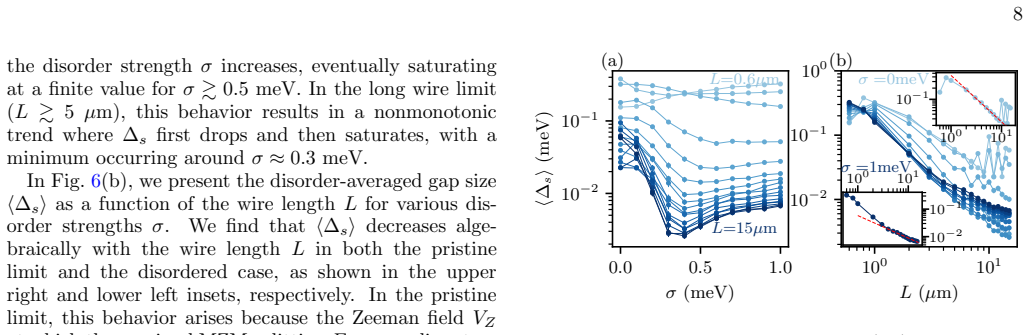
Near the TQPT, the gap size ∆ s is governed by the band edge at k = 0 in the continuum limit, giving ∆s = E1(k = 0) = VZ − p µ2 + ∆2. Therefore, the gap size ∆s scales inversely with L in the pristine limit, which is qualitatively consistent with the power-law fit in the upper right inset of Fig. 6(b) with ⟨∆s⟩ = α∆L−η∆, with best-fit parameters α∆ = 0.43...
-
[2]
A. Y. Kitaev, Unpaired Majorana fermions in quantum wires, Phys.-Usp. 44, 131 (2001)
work page 2001
-
[3]
N. Read and D. Green, Paired states of fermions in two dimensions with breaking of parity and time-reversal symmetries and the fractional quantum Hall effect, Phys. Rev. B 61, 10267 (2000)
work page 2000
-
[4]
K. Sengupta, I. ˇZuti´ c, H.-J. Kwon, V. M. Yakovenko, and S. Das Sarma, Midgap edge states and pairing symmetry of quasi-one-dimensional organic superconductors, Phys. Rev. B 63, 144531 (2001)
work page 2001
-
[5]
O. Motrunich, K. Damle, and D. A. Huse, Griffiths ef- fects and quantum critical points in dirty superconduc- tors without spin-rotation invariance: One-dimensional examples, Phys. Rev. B 63, 224204 (2001)
work page 2001
- [6]
-
[7]
S. Das Sarma, M. P. Lilly, E. H. Hwang, L. N. Pfeiffer, K. W. West, and J. L. Reno, Two-Dimensional Metal- Insulator Transition as a Percolation Transition in a High-Mobility Electron System, Phys. Rev. Lett. 94, 136401 (2005)
work page 2005
-
[8]
R. M. Lutchyn, J. D. Sau, and S. Das Sarma, Majo- rana Fermions and a Topological Phase Transition in Semiconductor-Superconductor Heterostructures, Phys. Rev. Lett. 105, 077001 (2010)
work page 2010
-
[9]
J. D. Sau, R. M. Lutchyn, S. Tewari, and S. Das Sarma, Generic New Platform for Topological Quantum Compu- tation Using Semiconductor Heterostructures, Phys. Rev. Lett. 104, 040502 (2010)
work page 2010
-
[10]
J. D. Sau, S. Tewari, R. M. Lutchyn, T. D. Stanescu, and S. Das Sarma, Non-Abelian quantum order in spin-orbit- coupled semiconductors: Search for topological Majorana particles in solid-state systems, Phys. Rev. B 82, 214509 (2010)
work page 2010
-
[11]
Y. Oreg, G. Refael, and F. von Oppen, Helical Liquids and Majorana Bound States in Quantum Wires, Phys. Rev. Lett. 105, 177002 (2010)
work page 2010
-
[12]
A. Das, Y. Ronen, Y. Most, Y. Oreg, M. Heiblum, and H. Shtrikman, Zero-bias peaks and splitting in an Al– InAs nanowire topological superconductor as a signature of Majorana fermions, Nature Physics 8, 887 (2012)
work page 2012
-
[13]
M. T. Deng, C. L. Yu, G. Y. Huang, M. Larsson, P. Caroff, and H. Q. Xu, Anomalous Zero-Bias Conduc- tance Peak in a Nb–InSb Nanowire–Nb Hybrid Device, Nano Letters 12, 6414 (2012)
work page 2012
- [14]
-
[15]
H. O. H. Churchill, V. Fatemi, K. Grove-Rasmussen, M. T. Deng, P. Caroff, H. Q. Xu, and C. M. Marcus, Superconductor-nanowire devices from tunneling to the multichannel regime: Zero-bias oscillations and magneto- conductance crossover, Phys. Rev. B 87, 241401 (2013)
work page 2013
-
[16]
A. D. K. Finck, D. J. Van Harlingen, P. K. Mohseni, K. Jung, and X. Li, Anomalous Modulation of a Zero- Bias Peak in a Hybrid Nanowire-Superconductor Device, Phys. Rev. Lett. 110, 126406 (2013)
work page 2013
-
[17]
F. Nichele, A. C. C. Drachmann, A. M. Whiticar, E. C. T. O’Farrell, H. J. Suominen, A. Fornieri, T. Wang, G. C. Gardner, C. Thomas, A. T. Hatke, P. Krogstrup, M. J. Manfra, K. Flensberg, and C. M. Marcus, Scaling of Ma- jorana Zero-Bias Conductance Peaks, Phys. Rev. Lett. 119, 136803 (2017)
work page 2017
-
[18]
H. Zhang, C.-X. Liu, S. Gazibegovic, D. Xu, J. A. Lo- gan, G. Wang, N. van Loo, J. D. S. Bommer, M. W. A. de Moor, D. Car, R. L. M. O. het Veld, P. J. van Veld- hoven, S. Koelling, M. A. Verheijen, M. Pendharkar, D. J. Pennachio, B. Shojaei, J. S. Lee, C. J. Palmstrom, E. P. A. M. Bakkers, S. D. Sarma, and L. P. Kouwenhoven, Quantized Majorana conductance...
work page 2017
-
[19]
H. Zhang, M. W. A. de Moor, J. D. S. Bommer, D. Xu, G. Wang, N. van Loo, C.-X. Liu, S. Gazibegovic, J. A. Logan, D. Car, R. L. M. O. het Veld, P. J. van Veldhoven, S. Koelling, M. A. Verheijen, M. Pend- harkar, D. J. Pennachio, B. Shojaei, J. S. Lee, C. J. Palmstrøm, E. P. A. M. Bakkers, S. D. Sarma, and L. P. Kouwenhoven, Large zero-bias peaks in InSb-Al...
- [20]
-
[21]
Microsoft Quantum, M. Aghaee, A. Akkala, Z. Alam, R. Ali, A. Alcaraz Ramirez, M. Andrzejczuk, A. E. An- tipov, P. Aseev, M. Astafev, B. Bauer, J. Becker, S. Bod- dapati, F. Boekhout, J. Bommer, T. Bosma, L. Bour- det, S. Boutin, P. Caroff, L. Casparis, M. Cassidy, S. Chatoor, A. W. Christensen, N. Clay, W. S. Cole, F. Corsetti, A. Cui, P. Dalampiras, A. D...
work page 2023
-
[22]
M. Aghaee, A. Alcaraz Ramirez, Z. Alam, R. Ali, M. Andrzejczuk, A. Antipov, M. Astafev, A. Barze- gar, B. Bauer, J. Becker, U. K. Bhaskar, A. Bocharov, S. Boddapati, D. Bohn, J. Bommer, L. Bourdet, A. Bous- quet, S. Boutin, L. Casparis, B. J. Chapman, S. Cha- toor, A. W. Christensen, C. Chua, P. Codd, W. Cole, P. Cooper, F. Corsetti, A. Cui, P. Dalpasso, ...
work page 2025
- [23]
-
[24]
S. Das Sarma and H. Pan, Disorder-induced zero-bias peaks in Majorana nanowires, Phys. Rev. B 103, 195158 (2021)
work page 2021
-
[25]
S. Ahn, H. Pan, B. Woods, T. D. Stanescu, and S. Das Sarma, Estimating disorder and its adverse ef- fects in semiconductor Majorana nanowires, Phys. Rev. Materials 5, 124602 (2021)
work page 2021
-
[26]
Das Sarma, In search of Majorana, Nat
S. Das Sarma, In search of Majorana, Nat. Phys. 19, 165 (2023)
work page 2023
-
[27]
L. Kouwenhoven, Perspective on Majorana bound-states in hybrid superconductor-semiconductor nanowires, Mod. Phys. Lett. B 39, 2540002 (2025)
work page 2025
-
[28]
H. Pan, J. D. Sau, and S. Das Sarma, Three-terminal nonlocal conductance in Majorana nanowires: Distin- guishing topological and trivial in realistic systems with disorder and inhomogeneous potential, Phys. Rev. B103, 014513 (2021)
work page 2021
-
[29]
A. R. Akhmerov, J. P. Dahlhaus, F. Hassler, M. Wim- mer, and C. W. J. Beenakker, Quantized Conductance at the Majorana Phase Transition in a Disordered Super- conducting Wire, Phys. Rev. Lett. 106, 057001 (2011)
work page 2011
-
[30]
I. C. Fulga, F. Hassler, A. R. Akhmerov, and C. W. J. Beenakker, Scattering formula for the topological quan- tum number of a disordered multimode wire, Phys. Rev. B 83, 155429 (2011)
work page 2011
-
[31]
I. C. Fulga, F. Hassler, and A. R. Akhmerov, Scatter- ing theory of topological insulators and superconductors, Phys. Rev. B 85, 165409 (2012)
work page 2012
-
[32]
S. Das Sarma, A. Nag, and J. D. Sau, How to in- fer non-Abelian statistics and topological visibility from tunneling conductance properties of realistic Majorana nanowires, Phys. Rev. B 94, 035143 (2016)
work page 2016
-
[33]
S. Das Sarma, J. D. Sau, and T. D. Stanescu, Spectral properties, topological patches, and effective phase di- agrams of finite disordered Majorana nanowires, Phys. Rev. B 108, 085416 (2023)
work page 2023
-
[34]
S. Das Sarma and H. Pan, Density of states, transport, and topology in disordered Majorana nanowires, Phys. Rev. B 108, 085415 (2023)
work page 2023
- [35]
-
[36]
I. A. Day, A. L. R. Manesco, M. Wimmer, and A. R. Akhmerov, Identifying biases of the Majorana scattering invariant (2025)
work page 2025
- [37]
- [38]
-
[39]
S. Das Sarma, J. D. Sau, and T. D. Stanescu, Split- ting of the zero-bias conductance peak as smoking gun evidence for the existence of the Majorana mode in a superconductor-semiconductor nanowire, Phys. Rev. B 86, 220506 (2012)
work page 2012
-
[40]
S. S. Hegde and S. Vishveshwara, Majorana wave- function oscillations, fermion parity switches, and dis- order in Kitaev chains, Phys. Rev. B 94, 115166 (2016)
work page 2016
-
[41]
F. Pe˜ naranda, R. Aguado, P. San-Jose, and E. Prada, Quantifying wave-function overlaps in inhomogeneous Majorana nanowires, Phys. Rev. B 98, 235406 (2018)
work page 2018
- [42]
- [43]
-
[44]
A. A. Zyuzin, D. Rainis, J. Klinovaja, and D. Loss, Cor- relations between Majorana Fermions Through a Super- conductor, Phys. Rev. Lett. 111, 056802 (2013)
work page 2013
-
[45]
D. I. Pikulin, B. van Heck, T. Karzig, E. A. Martinez, B. Nijholt, T. Laeven, G. W. Winkler, J. D. Watson, S. Heedt, M. Temurhan, V. Svidenko, R. M. Lutchyn, M. Thomas, G. de Lange, L. Casparis, and C. Nayak, Protocol to identify a topological superconducting phase in a three-terminal device (2021)
work page 2021
- [46]
-
[47]
In the SM (i.e., ∆ = 0) for VZ > µ , there is a unique Fermi wave vector kF =h 2 m2α2 + mµ + m p V 2 Z + m2α4 + 2mα2µ i1/2 = 2 p m(mα2 + µ) + 1 2 µ q m (mα2+µ)3 ∆VZ, where ∆VZ = VZ − µ
-
[48]
P. W. Brouwer, M. Duckheim, A. Romito, and F. von Op- pen, Probability Distribution of Majorana End-State En- ergies in Disordered Wires, Phys. Rev. Lett. 107, 196804 (2011)
work page 2011
-
[49]
C.-X. Liu, J. D. Sau, T. D. Stanescu, and S. Das Sarma, Andreev bound states versus Majorana bound states in quantum dot-nanowire-superconductor hybrid struc- tures: Trivial versus topological zero-bias conductance peaks, Phys. Rev. B 96, 075161 (2017)
work page 2017
-
[50]
C.-X. Liu, J. D. Sau, and S. Das Sarma, Distinguishing topological Majorana bound states from trivial Andreev bound states: Proposed tests through differential tunnel- ing conductance spectroscopy, Phys. Rev. B 97, 214502 (2018)
work page 2018
-
[51]
C.-K. Chiu and S. Das Sarma, Fractional Josephson effect with and without Majorana zero modes, Phys. Rev. B99, 035312 (2019)
work page 2019
-
[52]
C.-K. Chiu, J. D. Sau, and S. Das Sarma, Conduc- tance of a superconducting Coulomb-blockaded Majo- rana nanowire, Phys. Rev. B 96, 054504 (2017)
work page 2017
- [53]
-
[54]
H. Pan, W. S. Cole, J. D. Sau, and S. Das Sarma, Generic quantized zero-bias conductance peaks in superconductor-semiconductor hybrid structures, Phys. Rev. B 101, 024506 (2020)
work page 2020
-
[55]
H. Pan, J. D. Sau, and S. Das Sarma, Random matrix theory for the robustness, quantization, and end-to-end correlation of zero-bias conductance peaks in a class D ensemble, Phys. Rev. B 106, 115413 (2022)
work page 2022
- [56]
- [57]
-
[58]
J. R. Taylor, J. D. Sau, and S. Das Sarma, Ma- chine Learning the Disorder Landscape of Majorana Nanowires, Phys. Rev. Lett. 132, 206602 (2024)
work page 2024
-
[59]
J. R. Taylor and S. Das Sarma, Vision transformer based deep learning of topological indicators in Majorana nanowires, Phys. Rev. B 111, 104208 (2025)
work page 2025
-
[60]
R. Willett, J. P. Eisenstein, H. L. St¨ ormer, D. C. Tsui, A. C. Gossard, and J. H. English, Observation of an even- denominator quantum number in the fractional quantum Hall effect, Phys. Rev. Lett. 59, 1776 (1987)
work page 1987
-
[61]
S. Das Sarma, M. Freedman, and C. Nayak, Topologically Protected Qubits from a Possible Non-Abelian Fractional Quantum Hall State, Phys. Rev. Lett.94, 166802 (2005)
work page 2005
-
[62]
R. L. Willett, K. Shtengel, C. Nayak, L. N. Pfeiffer, Y. J. Chung, M. L. Peabody, K. W. Baldwin, and K. W. West, Interference Measurements of Non-Abelian e/4 & Abelian e/2 Quasiparticle Braiding, Phys. Rev. X 13, 011028 (2023)
work page 2023
- [63]
- [64]
-
[65]
S. M. Albrecht, AP. Higginbotham, M. Madsen, F. Kuemmeth, T. S. Jespersen, J. Nyg˚ ard, P. Krogstrup, and CM. Marcus, Exponential protection of zero modes in Majorana islands, Nature (London) 531, 206 (2016)
work page 2016
-
[66]
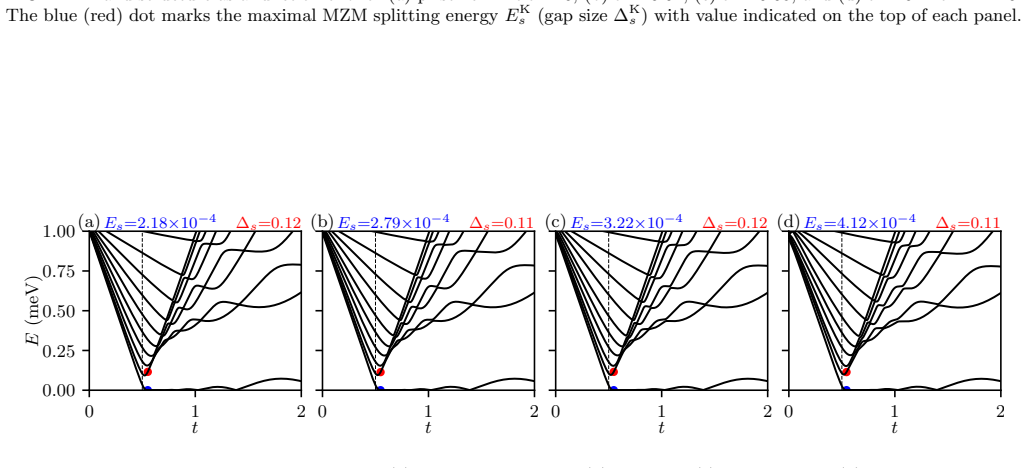
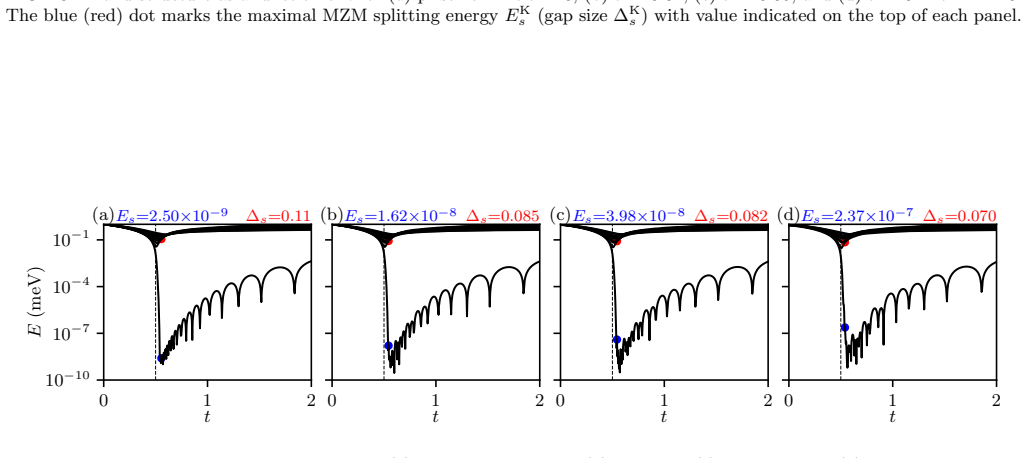
Y.-H. Lai, S. Das Sarma, and J. D. Sau, Theory of Coulomb blockaded transport in realistic Majorana nanowires, Phys. Rev. B 104, 085403 (2021). Appendix A: More examples of nanowire band structure In this section, we present more examples of the band structure of the nanowire for a very short wire length L = 0.6 µm in Fig. 9 and a long wire length L = 10 ...
work page 2021
discussion (0)
Sign in with ORCID, Apple, or X to comment. Anyone can read and Pith papers without signing in.