REVIEW 3 major objections 5 minor 37 references
Superconductivity induced by spin-orbit coupling in a two-valley ferromagnet
T0 review · 3 major / 5 minor · reviewed 2026-08-06 · deepseek-v4-flash
Pith's one-line read Spin-orbit coupling makes two-magnon exchange attractive for pairing in a canted ferromagnetic half-metal, so superconductivity can arise by retardation despite a stronger static repulsion.
desk verdict A genuinely new SOC-induced two-magnon pairing mechanism in a half-metal, but the gap-equation step is conjectured rather than computed. read the letter →
The pith
A machine-rendered reading of the paper's core claim, the machinery that carries it, and where it could break.
The reading
What carries the argument
The load-bearing object is the effective two-magnon pairing vertex Gamma^sc_2mag(0)=\int \frac{$d^{2}$ q\,d\Omega_m}{(2\pi)^3} A(q,\Omega_m)\chi_\$perp^{2}$(q,\Omega_m), with \chi_\perp the transverse Goldstone magnon propagator and A the combined amplitude of all first- and second-order two-magnon processes. In the low-energy regime the paper obtains A(q,\Omega_m)=-\frac{$U_3^{2}$\$cos^{4}$\$\theta$}{(2\$mu_0^{2}$ $c^{2}$)^3}\bar A(q,\Omega_m) with \bar A(q,\Omega_m)=\$Omega_m^{4}$+\frac{$q^{2}$\mu_0}{m}\$Omega_m^{2}$(c+1)+\left(\frac{$q^{2}$\mu_0}{2m}\right)^2(c-1)^2, which is strictly negative. The crucial structural fact is the Adler principle: A(0,0)=0, and the quadratic terms vanish as well, so the sign of the interaction is decided at fourth order and cannot be guessed from any single diagram.
What would settle it
Map the Fermi surface in the high-Tc region of Bernal bilayer and rhombohedral trilayer graphene on WSe2: resolving a minority-spin pocket would falsify the true half-metal premise and shift the pairing mechanism to the single-magnon channel, while a strictly half-metallic state whose Tc vanishes when the spin-orbit proximity effect is removed would support this mechanism. A second check is that the predicted enhancement of the coupling as c approaches 1 must saturate when c-1 is of order beta rather than diverging.
Extended reading notes
Core claim
The central claim is that in a two-valley ferromagnet with Ising spin-orbit coupling and no minority Fermi surface, the effective pairing interaction between majority (spin-up) fermions from filled bands, mediated by two Goldstone magnons, is attractive for a valley-odd/spatially-even order parameter. Collecting all first- and second-order two-magnon processes, the paper writes the interaction as an integral over magnon momentum and frequency of A(q,$\Omega$) times the square of the magnon propagator, and shows that A(0,0)=0, as required by the Adler principle for Goldstone bosons. Expanding A to fourth order gives A(q,$\Omega$)<0, so the pairing interaction Gamma^sc_2mag(0) is negative (attractive); its dimensionless strength scales as $c^{3}$/(c-1) $beta^{2}$, with $\beta$ a small parameter controlled by spin-orbit coupling, and the corresponding coupling constant is enhanced both near the onset of the canted ferromagnetic order and deep inside it. The attraction exists only at energies below $\beta$ mu_0, while the competing static repulsion U_2 acts at energies of order the Fermi energy, so by retardation the weak attraction can still produce superconductivity.
Load-bearing premise
The calculation assumes the canted ferromagnetic state is a true half-metal with no minority-spin Fermi surface in the parameter range where superconductivity is observed; if a small minority Fermi surface exists, the single-magnon mechanism of Ref. [24] becomes the leading pairing channel and the two-magnon attraction computed here is no longer the controlling process.
Editorial extensions
If this is right
- A strictly half-metallic canted ferromagnet can be superconducting, with the pairing glue provided by two Goldstone magnons rather than by any minority-spin Fermi surface.
- The dimensionless pairing strength is controlled by the spin-orbit parameter beta, growing like c^3/(c-1) beta^2; the corresponding coupling constant is enhanced near the onset of the canted order (c about 1) and deep inside it (c much larger than 1), consistent with the observed high-Tc windows in the two materials.
- The attractive pairing channel is valley-odd and spatially even, so it is a zero-momentum isospin-singlet state; pair-density-wave pairing within a single valley is left as a separate, competing channel.
- Because the attraction is confined to energies below beta mu_0 while the static repulsion acts at energies of order mu_0, retardation plays the same role here as in phonon-mediated superconductivity, giving Tc roughly beta mu_0 exp[-1/(|lambda_sc_2mag|-mu*)].
Reading between the lines
- Beyond the paper: the sign of the fourth-order expansion is fixed by the broken U(1) symmetry and the Adler constraint, so the same two-magnon attraction should appear in any two-valley canted ferromagnet with Ising spin-orbit coupling, not only in graphene-based systems.
- Beyond the paper: including trigonal warping could create a minority pocket in part of the phase diagram; the theory then predicts a crossover from the two-magnon mechanism to the single-magnon O(1) mechanism, which could be tested by looking for a change in Tc behavior where the pocket appears.
- Beyond the paper: the inputs U1, U2, and U3 are treated as static parameters; fixing them with microscopic calculations would determine whether beta is genuinely small, since for beta of order 1 the clean low-energy/high-energy separation on which the retardation argument rests disappears.
- Beyond the paper: measuring Tc as a function of displacement field or doping across the canted ferromagnetic phase, rather than only at its boundary, would test the predicted non-divergent enhancement deep inside the half-metal, where the paper expects a saturation window of enhanced pairing.
Editorial analysis
A structured set of objections, weighed in public.
Referee Report
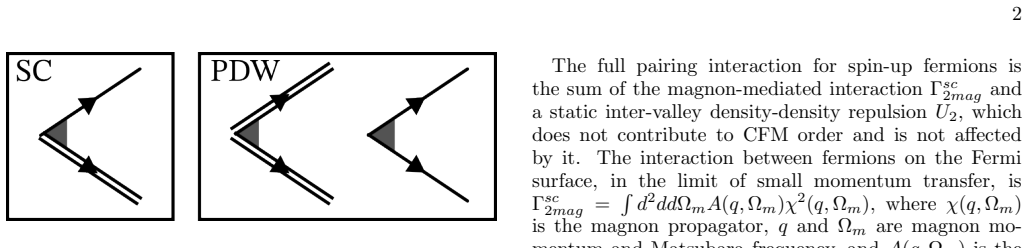
Summary. The paper analyzes superconductivity in a two-valley ferromagnet with Ising spin-orbit coupling, motivated by experiments on graphene multilayers proximitized to WSe2. Starting from a model with intra-valley and inter-valley repulsions U1, U2, U3 and Ising SOC λ, the authors derive a canted ferromagnetic order that is assumed to produce a true half-metal. They compute the magnon spectrum, the single-magnon and two-magnon four-fermion interactions, and the resulting pairing interaction Γ_sc_2mag for a valley-odd/spatially-even gap. The central technical result is that the vertex A(q,Ω) satisfies the Adler condition A(0,0)=0, and its fourth-order expansion is negative, giving an attractive low-energy contribution N_F Γ_sc ~ c^3/(c-1) β^2 and a dimensionless coupling λ_sc ~ β^{5/2} enhanced near the ferromagnetic onset. The paper argues by analogy with phonon-mediated pairing that this attraction leads to superconductivity despite a stronger static repulsion, while explicitly stating that the gap equation and the renormalized μ* are not computed.
Significance. If the sign and magnitude of the two-magnon interaction are correct, this is a useful and nontrivial contribution: it identifies a SOC-induced attractive pairing channel that is absent in a SU(2)-symmetric ferromagnet, and it derives the Adler-principle cancellation rather than imposing it. The calculation is self-contained in the sense that A(0,0)=0 is an output, model parameters are inputs rather than fitted to the target result, and the paper makes falsifiable qualitative predictions (SOC-dependent pairing, enhancement near the CFM onset and deep inside the half-metal). These strengths are real. However, the superconductivity conclusion is conditional on an unverified retardation argument, and the missing gap-equation step is load-bearing for the title and abstract claim that SOC 'gives rise to superconductivity.'
major comments (3)
- The central claim that the SOC-induced attraction gives rise to superconductivity is not established. The paper states 'We conjecture that, like there, superconductivity develops due to retardation' and 'More sophisticated calculations are needed to obtain μ*', but the abstract and introduction nevertheless conclude that the mechanism gives rise to superconductivity. The linearized Eliashberg or gap equation with the full kernel Aχ² + U2 + high-q repulsion is never solved, so the competition between the low-energy attraction and the static repulsion is not quantified. This matters numerically: with the natural validity condition c−1 > β stated in the paper, Eq. (12) gives λ_sc ≲ a β, which for β ~ 0.1 and a = O(1) is ~ 0.1, while the static-repulsion pseudopotential is parametrically of order μ* ~ c/[1 + c ln(1/β)] ~ 0.3 in the same regime. The phonon analogy is therefore not automatically quantitative, and the paper's own Tc formula is only a conjecture. To support the central claim, the authors should either solve the gap equation (at least in a one-pole approximation for the kernel) and compute μ*, or explicitly downgrade the conclusion to a suggestion that the attractive channel 'may' induce superconductivity.
- The derivation of the central expression A(q,Ω) is omitted. The text says 'The computations are rather straightforward, so we skip the fine details', but the sign of Γ_sc_2mag — and hence the entire proposal — depends on the fourth-order expansion in Eq. (10). Appendix A gives the ladder expressions for U_eff_A–D, but not the step-by-step evaluation of the diagrams in Figs. 2 and 3 that leads to A(0,0)=0, the vanishing of the q² and Ω² terms, and the negative fourth-order coefficient. This is not a presentational detail: without a reproducible derivation, the reader cannot verify the Adler cancellation or the sign of A. The authors should include the derivation or a detailed appendix with the diagram-by-diagram computation and the intermediate momentum/frequency integrals.
- The proposed mechanism is predicated on the existence of a true half-metal with no minority-spin Fermi surface. The paper itself acknowledges in Section V that 'whether or not a minority Fermi surface exists ... will almost certainly be settled by the experiments' and that trigonal warping can produce a small minority pocket within the same model. If such a pocket exists, the O(1) single-magnon process of Ref. [24] dominates over the β^{5/2} two-magnon mechanism computed here. Since the paper aims to explain the high-Tc superconductivity observed in BBG/RTG/WSe2, it should either provide evidence or conditions under which the half-metal assumption holds in the relevant experimental parameter range, or analyze the almost-half-metal case. As written, the relevance of the mechanism to the quoted experiments is conditional on an assumption that may be violated.
minor comments (5)
- The equation for λ_sc lacks an equals sign in the displayed text; it should read λ_sc = a c^4/(c−1)^{3/2} β^{5/2}.
- Figure 4 would be clearer with labeled axes and an indication of the horizontal variable (presumably c) and the meaning of the dashed curve, if any.
- The phrase 'the computations are rather straightforward, so we skip the fine details' appears in the main text and is repeated in spirit for the effective interactions; since the validity of the approximation Π ≈ Π(0,0) in the numerator of Eq. (A1) is nontrivial, a brief justification of that approximation would improve the paper.
- The notation Γ_sc_2mag(k,−k; k+δ,−k−δ) is defined only after the statement that the sign can be determined by evaluating Γ_sc_2mag(0); defining the momentum/frequency transfer δ earlier would help the reader follow the finite-δ discussion.
- Refs. [26] and [27] are footnotes in the text; consider converting them to regular references or making the footnote markers more visible, as one of them contains a substantive justification (the neglect of more-than-two-magnon processes).
Circularity Check
No significant circularity: the pairing interaction is derived from the model, not fitted, and the superconductivity step is an explicitly labeled conjecture, not a circular reduction.
full rationale
The central derivation (magnon spectrum, effective single- and two-magnon vertices, and the sign and scaling of Γ^sc_{2mag}) is carried out from the stated Hamiltonian with parameters U1,U2,U3,λ as inputs; none are fitted to the target result. A(0,0)=0 is obtained as a consistency condition and the negative sign follows from the explicit fourth-order expression in Eqs. (9)-(10), so the attraction is not imposed by definition. The only load-bearing self-citations are Ref. [31] for a ladder resummation technique (the relevant U^eff_{A-D} are displayed in Appendix A) and Refs. [29,30] for the first-order FM transition; the half-metal state is also explicitly stated as an assumption, and the transition result is independently checkable physics rather than a restatement of the pairing claim. The clearest gap is in Section V after Eq. (12), where the authors write "We conjecture that, like there, superconductivity develops due to retardation" and defer μ* to "more sophisticated calculations". This is an omitted gap-equation/μ* computation, so the superconductivity claim is incomplete, but incompleteness is not circularity: the conjecture does not redefine an earlier input, and no fitted parameter is relabeled as a prediction. The comparison with Ref. [24] is external and used to benchmark the one-magnon vertices, not to import the central result. Therefore no circular step can be exhibited.
Assumptions & free parameters
free parameters (4)
- beta
- c
- a
- U2
assumptions (5)
- standard math Standard many-body perturbation theory with ladder (RPA) summation of particle-hole bubbles.
- domain assumption The two-valley Hubbard-like model with interactions U1,U2,U3 and Ising SOC lambda describes the graphene/WSe2 system.
- domain assumption The CFM order parameter jumps at the transition to its maximal value, giving a true half-metal.
- standard math Adler principle / Ward identity for Goldstone bosons requires the fermion-magnon vertex to vanish at zero momentum and frequency.
- domain assumption Retardation allows a low-energy attraction to overcome a stronger static repulsion, as in electron-phonon theory.
Cite this review
Pith. "Pith review of Superconductivity induced by spin-orbit coupling in a two-valley ferromagnet." pith.science (2026). https://pith.science/paper/4F7R3232
@misc{pith2026250700168,
  author       = {Pith},
  title        = {Pith review of: Superconductivity induced by spin-orbit coupling in a two-valley ferromagnet},
  year         = {2026},
  howpublished = {\url{https://pith.science/paper/4F7R3232}},
  note         = {Machine review of arXiv:2507.00168}
}
abstract
We analyze the origin of superconductivity in a ferromagnetically ordered state of multi-layer graphene systems placed in proximity to WSe$_2$. We model these materials by a two-valley system of interacting fermions with small pockets and Ising spin-orbit coupling. The model yields a canted ferromagnetic order, which gives rise to a half-metal. We obtain the magnon spectrum and derive two sets of magnon-mediated 4-fermion interactions: spin-flip interactions mediated by a single magnon and spin-preserving interactions mediated by two magnons. We argue that both processes have to be included on equal footing into the magnon-mediated pairing interaction between low-energy fermions from the filled bands. Then the full magnon-mediated interaction satisfies Adler criterion and for a valley-odd/spatially-even order parameter contains a universal attractive piece. This term is induced by spin-orbit coupling and is confined to energies which are parametrically smaller than the Fermi energy. We argue that, due to retardation, this magnon-mediated attraction gives rise to superconductivity despite that there exists a stronger static repulsion, in close analogy with how phonon-mediated attraction gives rise to pairing in the presence of stronger Coulomb (Hubbard) repulsion.
Figures


Figures from the paper (3 more)


Reference graph
Works this paper leans on
- [24]
-
[1]
Y. Cao, V. Fatemi, S. Fang, K. Watanabe, T. Taniguchi, E. Kaxiras, and P. Jarillo-Herrero, Unconventional super- conductivity in magic-angle graphene superlattices, Na- ture 556, 43 (2018)
2018
-
[2]
M. Oh, K. P. Nuckolls, D. Wong, R. L. Lee, X. Liu, K. Watanabe, T. Taniguchi, and A. Yazdani, Evidence for unconventional superconductivity in twisted bilayer graphene, Nature 600, 240 (2021)
2021
-
[3]
H. Zhou, L. Holleis, Y. Saito, L. Cohen, W. Huynh, C. L. Patterson, F. Yang, T. Taniguchi, K. Watanabe, and A. F. Young, Isospin magnetism and spin-polarized su- perconductivity in Bernal bilayer graphene, Science 375, 774 (2022)
2022
-
[4]
Zhang, R
Y. Zhang, R. Polski, A. Thomson, ´E. Lantagne- Hurtubise, C. Lewandowski, H. Zhou, K. Watan- abe, T. Taniguchi, J. Alicea, and S. Nadj-Perge, En- hanced superconductivity in spin–orbit proximitized bi- layer graphene, Nature 613, 268 (2023)
2023
-
[5]
L. Holleis, C. L. Patterson, Y. Zhang, H. M. Yoo, H. Zhou, T. Taniguchi, K. Watanabe, S. Nadj-Perge, and A. F. Young, Ising Superconductivity and Nematicity in Bernal Bilayer Graphene with Strong Spin Orbit Cou- 7 pling (2023), arXiv:2303.00742 [cond-mat.supr-con]
arXiv 2023
-
[6]
H. Zhou, T. Xie, T. Taniguchi, K. Watanabe, and A. F. Young, Superconductivity in rhombohedral trilayer graphene, Nature 598, 434 (2021)
2021
-
[7]
T. Han, Z. Lu, Z. Hadjri, L. Shi, Z. Wu, W. Xu, Y. Yao, A. A. Cotten, O. S. Sedeh, H. Weldeyesus, J. Yang, J. Seo, S. Ye, M. Zhou, H. Liu, G. Shi, Z. Hua, K. Watan- abe, T. Taniguchi, P. Xiong, D. M. Zumb¨ uhl, L. Fu, and L. Ju, Signatures of chiral superconductivity in rhombo- hedral graphene, Nature , 1 (2025)
work page 2025
Show all 37 references
-
[8]
Wang, D.-K
Z. Wang, D.-K. Ki, J. Y. Khoo, D. Mauro, H. Berger, L. S. Levitov, and A. F. Morpurgo, Origin and Magni- tude of ‘Designer’ Spin-Orbit Interaction in Graphene on Semiconducting Transition Metal Dichalcogenides, Phys. Rev. X 6, 041020 (2016)
2016
-
[9]
J. O. Island, X. Cui, C. Lewandowski, J. Y. Khoo, E. M. Spanton, H. Zhou, D. Rhodes, J. C. Hone, T. Taniguchi, K. Watanabe, L. S. Levitov, M. P. Zale- tel, and A. F. Young, Spin–orbit-driven band inversion in bilayer graphene by the van der Waals proximity effect, Nature 571, ...
2019
-
[10]
C. L. Patterson, O. I. Sheekey, T. B. Arp, L. F. W. Holleis, J. M. Koh, Y. Choi, T. Xie, S. Xu, E. Re- dekop, G. Babikyan, H. Zhou, X. Cheng, T. Taniguchi, K. Watanabe, C. Jin, E. Lantagne-Hurtubise, J. Alicea, and A. F. Young, Superconductivity and spin canting in spin-orbit ...
2024 arXiv
-
[11]
J. R. Schrieffer, X. G. Wen, and S. C. Zhang, Dy- namic spin fluctuations and the bag mechanism of high- ${T} {c}$ superconductivity, Phys. Rev. B 39, 11663 (1989)
1989
-
[12]
J. R. Schrieffer, Ward’s identity and the suppression of spin fluctuation superconductivity, J. Low Temp. Phys. 99, 397 (1995)
1995
-
[13]
Sachdev, A
S. Sachdev, A. V. Chubukov, and A. Sokol, Crossover and scaling in a nearly antiferromagnetic Fermi liquid in two dimensions, Phys. Rev. B 51, 14874 (1995); A. V. Chubukov, P. Monthoux, and D. K. Morr, Vertex cor- rections in antiferromagnetic spin-fluctuation theories, Phys. ...
1995
-
[14]
Flambaum, M
V. Flambaum, M. Kuchiev, and O. Sushkov, Hole-hole superconducting pairing in the t-J model induced by long-range spin-wave exchange, Phys. C Supercond. 227, 267 (1994); M.Yu. Kuchiev and O. Sushkov, Large-size two-hole bound states in the t-J model, Phys. C Super- cond. 218, ...
1994
-
[15]
Ismer, I
J.-P. Ismer, I. Eremin, E. Rossi, D. K. Morr, and G. Blumberg, Theory of multiband superconductivity in spin-density-wave metals, Phys. Rev. Lett. 105, 037003 (2010)
2010
-
[16]
S. L. Adler, Consistency Conditions on the Strong In- teractions Implied by a Partially Conserved Axial-Vector Current. II, Phys. Rev. 139, B1638 (1965); H. Watanabe and A. Vishwanath, Criterion for stability of Goldstone modes and Fermi liquid behavior in a metal with bro- ke...
1965
-
[17]
The vanishing of the vertex function atq = 0 implies that the pairing by an acoustic phonon is not advantageous compared to the one by an optical phonon
The same holds for the pairing by an acoustic phonon. The vanishing of the vertex function atq = 0 implies that the pairing by an acoustic phonon is not advantageous compared to the one by an optical phonon
-
[18]
Kozii, M
V. Kozii, M. P. Zaletel, and N. Bultinck, Spin-triplet superconductivity from intervalley Goldstone modes in magic-angle graphene, Phys. Rev. B 106, 235157 (2022)
2022
-
[19]
In TBG, the low-energy fermionic excitations are nearly valley-degenerate, hence inter-valley scattering by a Gol- stone boson in an IVC-ordered state is again a Fermi surface process
-
[20]
Fay and J
D. Fay and J. Appel, Coexistence of p -state supercon- ductivity and itinerant ferromagnetism, Phys. Rev. B22, 3173 (1980)
1980
-
[21]
T. R. Kirkpatrick, D. Belitz, T. Vojta, and R. Narayanan, Strong Enhancement of Superconducting T c in Ferro- magnetic Phases, Phys. Rev. Lett. 87, 127003 (2001)
2001
-
[22]
Y. Guo, J. Pack, J. Swann, L. Holtzman, M. Cothrine, K. Watanabe, T. Taniguchi, D. Mandrus, K. Barmak, J. Hone, A. J. Millis, A. N. Pasupathy, and C. R. Dean, Superconductivity in twisted bilayer WSe2 (2024), arXiv:2406.03418 [cond-mat.mes-hall]
2024 arXiv
-
[23]
Y. Xia, Z. Han, K. Watanabe, T. Taniguchi, J. Shan, and K. F. Mak, Superconductivity in twisted bilayer WSe2, Nature 10.1038/s41586-024-08116-2 (2024)
2024 doi
-
[25]
R. M. Fernandes and A. V. Chubukov, Low-energy mi- croscopic models for iron-based superconductors: A re- view, Rep. Prog. Phys. 80, 014503 (2016); R. M. Fernan- des, A. I. Coldea, H. Ding, I. R. Fisher, P. J. Hirschfeld, and G. Kotliar, Iron pnictides and chalcogenides: A new...
2016
-
[26]
One can easily make sure that processes involving more than two magnons give a smaller contribution to the pair- ing interaction and can therefore be neglected
-
[27]
A similar scenario has been proposed for superconduc- tivity induced by either SOC or a magnetic field in the non-magnetic phase near the onset of an order [37]
-
[28]
For U1 + U3 > U2, which we assume to hold, a homogeneous FM order is the leading instability
Another possibility is a spin-density-wave order with mo- mentum K −K ′ (a spin inter-valley coherence order). For U1 + U3 > U2, which we assume to hold, a homogeneous FM order is the leading instability
-
[29]
Z. M. Raines, L. I. Glazman, and A. V. Chubukov, Unconventional discontinuous transitions in a two- dimensional system with spin and valley degrees of free- dom, Phys. Rev. B 110, 155402 (2024), arXiv:2406.04416 [cond-mat]; Unconventional Discontinuous Transitions in Isospin S...
2024 arXiv
-
[30]
Z. M. Raines and A. V. Chubukov, Two-dimensional Stoner transitions beyond mean field, Phys. Rev. B 110, 235433 (2024), arXiv:2409.18934 [cond-mat.str-el]; V. Calvera, A. Valenti, S. D. Huber, E. Berg, and S. A. Kivelson, Theory of Coulomb driven nematicity in a multi-valley t...
2024 arXiv
-
[31]
Z. Dong, L. Levitov, and A. V. Chubukov, Superconduc- tivity near spin and valley orders in graphene multilayers, Phys. Rev. B 108, 134503 (2023)
2023
-
[32]
We are thankful to Erez Berg for emphasizing that A(0, 0) must vanish
-
[33]
Coleman, Introduction to Many-Body Physics(Cam- bridge University Press, 2015)
P. Coleman, Introduction to Many-Body Physics(Cam- bridge University Press, 2015). 8
2015
-
[34]
low-energy
The authors of [24] also speculated that although the theoretical β contains a small ratio (U3/U1 in our case), it may be O(1) for the actual parameters. In this situation, their δk ∼ kF , as is generally expected, and also our λsc 2mag is not reduced by β. However, for β = O(...
-
[35]
Y.-Z. Chou, J. Zhu, and S. Das Sarma, Intravalley spin- polarized superconductivity in rhombohedral tetralayer graphene, Phys. Rev. B 111, 174523 (2025); M. Geier, M. Davydova, and L. Fu, Chiral and topological su- perconductivity in isospin polarized multilayer graphene (2024...
2025 arXiv
-
[36]
Raines and A
Z. Raines and A. V. Chubukov, To Appear (2025)
2025
-
[37]
Z. Dong, A. V. Chubukov, and L. Levitov, Transformer spin-triplet superconductivity at the onset of isospin or- der in bilayer graphene, Phys. Rev. B107, 174512 (2023). Appendix A: Effective interactions mediated by a single magnon Each of the four interactions U eff A−D, medi...
2023
Reviewed August 6, 2026 · model on record in the stance chip above.
Discussion (0). Sign in to comment.