REVIEW 5 major objections 6 minor 1 cited by
LineRetriever: Planning-Aware Observation Reduction for Web Agents
T0 review · 5 major / 6 minor · reviewed 2026-08-06 · deepseek-v4-flash
Pith's one-line read LineRetriever claims that a small, goal-aware language model can select the accessibility-tree lines a web agent will need for future actions, cutting each observation by 58–75% while keeping success rates comparable to a full-context…
desk verdict Useful incremental method, but the paper's central claim is split: the config that cuts 58-75% loses ~8 points on two benchmarks, and the config that preserves performance only cuts 18-30%. read the letter →
The pith
A machine-rendered reading of the paper's core claim, the machinery that carries it, and where it could break.
The reading
What carries the argument
LineRetriever is a zero-shot LLM-based line selector: given a prompt containing the task goal, the optional interaction history, and the accessibility-tree observation with every line numbered, a small language model returns a JSON list of line ranges, e.g., [(3,5), (20,25)]. Post-processing then keeps exactly those lines (direct removal) or also keeps ancestor nodes needed to preserve the tree structure (structure-preserving filtering). This line-range mechanism is what carries the argument: selecting ranges rather than individual semantic chunks lets the retriever keep whole contiguous regions of the tree with minimal overhead, and the structure-preserving variant keeps the tree valid for the downstream action model.
What would settle it
Take a sample of episodes from one of the three benchmarks and record every element the action model actually clicks or types on after the observation was pruned; if a non-negligible fraction of those interacted elements were removed by LineRetriever (i.e., not present in the pruned observation), then the selector is dropping plan-critical lines despite the reported success rates.
Extended reading notes
Core claim
LineRetriever's central claim is that relevance for web-agent observations is not the same as semantic similarity: the lines worth keeping are those that support a future action, and a language model prompted with the goal and the interaction history can identify those lines directly. Concretely, the method numbers every line of the current AxTree, asks a small LLM to return line ranges likely to contribute to future action decisions, and then post-processes the selection, either removing non-selected lines outright or keeping parent structure when that is needed. On WorkArena L1, WebLINX, and WebArena, the pruned observations use 30–75% fewer tokens; success rates for the best LineRetriever variant are 49.1% on WorkArena L1, 13.7% on WebLINX, and 30.2% on WebArena, compared with 52.7%, 13.9%, and 32.3% for the full-context bottom-truncation agent. The paper also finds that the small retriever with structure preservation beats the large retriever without structure, and that both far outperform an embedding-based chunk retriever, which fails on all three benchmarks.
Load-bearing premise
The retriever LLM, prompted only with the goal, history, and a numbered list of AxTree lines, reliably selects every line needed for future actions; a single missed form field or hidden button cannot be recovered by the downstream action model, and the paper does not directly measure selection recall or precision.
Editorial extensions
If this is right
- If LineRetriever is correct, context-length limits are no longer the binding constraint for AxTree-based web agents: a small LLM can compress each observation enough to fit in the context window of the action model at modest cost.
- Embedding-based retrieval over DOM or AxTree chunks is a weak baseline for web navigation; the paper's results imply that semantic similarity alone cannot supply the plan-relevant state the agent needs.
- Preserving the hierarchical structure of the pruned tree matters: the structure-preserving variant outperforms the flat pruned tree on WorkArena L1 and WebArena, suggesting reduced observations should stay in distribution for the action model.
- Cost efficiency follows when the reduction ratio is above roughly 20% (the paper computes cost parity at alpha <= 0.8 given its token prices); the reported reductions of 58–75% far exceed that threshold.
- Smaller retrievers with structure can be competitive with or better than larger retrievers without structure, meaning the bottleneck in retrieval is not model capacity but the format of the context.
Reading between the lines
- A natural extension the paper leaves implicit is making the retriever itself adaptive: the selected line ranges could be fed back as a training signal for a small specialized retriever, potentially closing the remaining gap to the full-context agent.
- The same line-range selection protocol could be applied to any long structured observation, such as code files or form descriptions, wherever future actions depend on a small subset of the current state.
- Because the paper shows selection quality rather than token count drives performance, a cheap test of the mechanism would be to measure retriever recall against manually labeled 'needed' lines; if a retriever with higher recall consistently yields higher success rates, the planning-aware hypothesis is confirmed.
- If the hypothesis that planning relevance is not semantic similarity is right, then existing embedding-based agents may be leaving performance on the table, and retrieval-augmented web agents should be re-engineered around action-predictive selection rather than topical relevance.
Editorial analysis
A structured set of objections, weighed in public.
Referee Report
Summary. The paper introduces LineRetriever, a method that uses a lightweight LLM to prune the accessibility-tree observation passed to a web agent at each step. Given the task goal, the current numbered AxTree, and an optional interaction history, the retriever LLM outputs line ranges to retain; post-processing either removes unselected lines outright or preserves hierarchical structure by keeping parent element IDs and roles. The method is evaluated on WorkArena L1, WebLINX, and WebArena under the BrowserGym/Agentlab protocol, with GPT-4.1 and GPT-4.1-mini as retrievers and GenericAgent with bottom-truncation plus an embedding-retrieval agent as baselines. Reported reductions range from 18% to 75% depending on configuration, with success rates between 13.7% and 49.1%; the paper argues that LLM-based retrieval outperforms embedding retrieval and that preserving tree structure recovers most of the performance lost by aggressive pruning.
Significance. If the central trade-off claim is supported, the method is a simple, practical contribution to web-agent observation reduction and adds to the growing evidence that LLM-based retrieval can outperform embedding similarity for interactive decision-making. The evaluation has notable strengths: three standard benchmarks, a substantial WebLINX test set (2,650 tasks), the use of established frameworks (BrowserGym, Agentlab), and a direct comparison against an embedding-retrieval baseline. The method introduces no fitted parameters, so the reported results are not circular. However, the experimental evidence does not currently establish the abstract's central claim that large observation reduction can be achieved while maintaining consistent performance, because the high-reduction and performance-parity results come from different configurations and the paper lacks the ablations and significance tests needed to support its interpretations.
major comments (5)
- [Abstract; Table 1; Section 5] The central claim in the abstract conflates two different configurations. The no-structure variant achieves reductions of 61/72/73% but loses 7.9 percentage points on WorkArena L1 (44.8 vs. 52.7) and 7.4 points on WebArena (24.9 vs. 32.3) relative to GenericAgent-4.1; with the reported standard errors these gaps are roughly 2.1 and 2.3 SEs, respectively. The structure-preserving variant stays within about one SE of the full-context baseline on all benchmarks, but its reductions are only 30/18/24%. No single row of Table 1 demonstrates both large reduction and consistent performance, so the abstract should either be reworded to present the trade-off configuration-by-configuration or be supported by additional evidence that the no-structure drop is not systematic.
- [Section 3; Figure 4; Section 5] The novelty claim that retrieval is 'planning-aware' is not tested. Section 3 says the prompt includes the goal, the observation, and optionally the history, and the example prompt in Figure 4 includes history, but no experiment varies the presence of history or replaces the planning-oriented instruction with a semantically-focused instruction. The comparison to embedding retrieval changes both the model family and the prompting, so it cannot isolate the contribution of planning awareness. An ablation with history removed, or with an instruction to select semantically relevant lines only, is needed to support the central conceptual claim.
- [Section 4.4; Table 1; Section 5] The paper uses significance-adjacent language without statistical tests. Section 5 calls the drop 'modest' and describes the structure-augmented small retriever as 'superior,' but no paired significance tests or confidence intervals are reported. Since WorkArena uses 10 seeds per task, paired comparisons are feasible and should be reported; for WebArena, the relevant differences should at least be assessed with an appropriate test or bootstrap. Without this, the performance-parity claim is not quantitatively established.
- [Section 3; Table 1] The method's core assumption is that the retriever never misses task-critical lines, since the downstream action model cannot recover a pruned element. The paper reports only end-task success rates and token reduction, with no line-level recall, precision, or an oracle experiment that gives the retriever perfect selection. This leaves the failure analysis in Section 5 speculative: a missed form field, hidden button, or status message could explain the observed drops just as plausibly as structural distribution shift. An oracle or random-subset baseline of matched size would directly quantify how much performance loss is attributable to selection error versus structural distortion.
- [Appendix B; Table 1] The cost model in Appendix B is internally inconsistent with Table 1. The appendix derives that cost efficiency requires at least a 20% reduction (α ≤ 0.8) under CS = 0.4 and CL = 2, but the structure-preserving LineRetrieverAgent on WebLINX achieves only 18% reduction, i.e., α = 0.82. Under the paper's own inequality, that configuration is not cost-efficient on WebLINX. The paper should either present per-task cost measurements or qualify the cost-efficiency claim with the specific configurations to which it applies.
minor comments (6)
- [Table 1; Section 4.4] The table header says 'Standard Deviation (±SE)' while the text defines the reported quantity as standard error; use one term consistently.
- [Table 1] Two cells are empty because of budget constraints, including WebArena for GenericAgent-4.1 with 10K truncation and for LineRetrieverAgent with the 4.1 retriever. Since the paper makes cross-benchmark comparisons involving these configurations, the missing cells weaken the evidence and should be acknowledged explicitly in the text as limits.
- [Section 4.3] The text describes WebLINX tasks as 'single-step,' but the WebLINX benchmark is generally multi-turn. Please clarify the evaluation protocol, including how the interaction history is used if each WebLINX example is indeed treated as a single decision.
- [Section 4.2] The embedding-retrieval baseline is evaluated under a single configuration (100-token chunks, 10-token overlap, top-10 chunks). Given its very low success rates, a brief discussion of hyperparameter sensitivity or a citation to the DMR results it is modeled on would help the reader judge whether the comparison is fair.
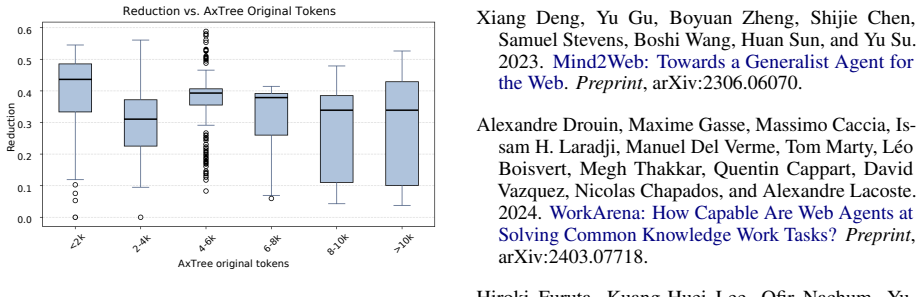
- [Figure 3] The x-axis bins '<2k' and '>10k' are not ordered consistently with the interior bins; please sort all bins along the token-count axis.
- [Throughout] There are several typos and inconsistencies, including 'fo the page' (Section 2.1), 'it's performance' (Section 4.2), 'remakable' (Section 6), and inconsistent capitalization of 'Weblinx' versus 'WebLINX'.
Circularity Check
No significant circularity: LineRetriever's central claims are empirical, the method has no fitted parameters, and the load-bearing comparisons are external benchmarks.
full rationale
LineRetriever is a prompting pipeline (Section 3, Figure 4) with no trainable parameters and no quantity fitted to the Success Rate or Reduction columns of Table 1. The observation reduction is computed directly from token counts via Reduction(o_i)=1-|o_r|/|o_i| (Section 4.4), and the success rates come from environment rollouts through BrowserGym/Agentlab; neither quantity is derived from the other. Appendix B's cost condition is an inequality derived from assumed API prices (CS=0.4, CL=2 $/M tokens), not from the experimental results, so it is not a fitted-input-called-prediction. The paper cites self-authored infrastructure (BrowserGym, WorkArena, Agentlab; Chezelles et al. 2025, Drouin et al. 2024) and WebLINX (Lù et al. 2024), but these citations provide benchmarks, baselines, and evaluation harnesses rather than any uniqueness theorem or premise that forces the method's outcome. Section 5 acknowledges that aggressive pruning causes a drop in success rate and offers a post-hoc distribution-shift explanation; whether that drop is statistically meaningful is a support/significance concern, not a circularity. No derivation step reduces to its own input, and no prediction is constructed from the target result.
Assumptions & free parameters
assumptions (4)
- domain assumption The BrowserGym/Agentlab evaluation framework and the three benchmarks (WorkArena L1, WebLINX, WebArena) produce valid measures of web agent success.
- domain assumption The token count of the AxTree text is an appropriate measure of observation size and cost.
- domain assumption The LLM retriever (GPT-4.1 or GPT-4.1-mini) reliably follows the prompt and selects exactly the relevant line ranges.
- domain assumption Including the full interaction history in the prompt captures the 'planning' information needed for future actions.
Cite this review
Pith. "Pith review of LineRetriever: Planning-Aware Observation Reduction for Web Agents." pith.science (2026). https://pith.science/paper/6GU2R5LD
@misc{pith2026250700210,
  author       = {Pith},
  title        = {Pith review of: LineRetriever: Planning-Aware Observation Reduction for Web Agents},
  year         = {2026},
  howpublished = {\url{https://pith.science/paper/6GU2R5LD}},
  note         = {Machine review of arXiv:2507.00210}
}
read the original abstract
While large language models have demonstrated impressive capabilities in web navigation tasks, the extensive context of web pages, often represented as DOM or Accessibility Tree (AxTree) structures, frequently exceeds model context limits. Current approaches like bottom-up truncation or embedding-based retrieval lose critical information about page state and action history. This is particularly problematic for adaptive planning in web agents, where understanding the current state is essential for determining future actions. We hypothesize that embedding models lack sufficient capacity to capture plan-relevant information, especially when retrieving content that supports future action prediction. This raises a fundamental question: how can retrieval methods be optimized for adaptive planning in web navigation tasks? In response, we introduce \textit{LineRetriever}, a novel approach that leverages a language model to identify and retrieve observation lines most relevant to future navigation steps. Unlike traditional retrieval methods that focus solely on semantic similarity, \textit{LineRetriever} explicitly considers the planning horizon, prioritizing elements that contribute to action prediction. Our experiments demonstrate that \textit{LineRetriever} can reduce the size of the observation at each step for the web agent while maintaining consistent performance within the context limitations.
Figures


Figures from the paper (1 more)

Forward citations
Cited by 1 Pith paper
-
Signal-Driven Observation for Long-Horizon Web Agents
Signal-Driven Observation decouples observation from action frequency in long-horizon web agents by invoking selective task-relevant DOM reads only on signals such as URL changes or action failures.
Reference graph
Works this paper leans on
-
[1]
online" 'onlinestring :=
ENTRY address archivePrefix author booktitle chapter edition editor eid eprint eprinttype howpublished institution journal key month note number organization pages publisher school series title type volume year doi pubmed url lastchecked label extra.label sort.label short.list INTEGERS output.state before.all mid.sentence after.sentence after.block STRING...
-
[2]
write newline
" write newline "" before.all 'output.state := FUNCTION n.dashify 't := "" t empty not t #1 #1 substring "-" = t #1 #2 substring "--" = not "--" * t #2 global.max substring 't := t #1 #1 substring "-" = "-" * t #2 global.max substring 't := while if t #1 #1 substring * t #2 global.max substring 't := if while FUNCTION word.in bbl.in capitalize " " * FUNCT...
-
[3]
Thibault Le Sellier De Chezelles, Maxime Gasse, Alexandre Drouin, Massimo Caccia, Léo Boisvert, Megh Thakkar, Tom Marty, Rim Assouel, Sahar Omidi Shayegan, Lawrence Keunho Jang, Xing Han Lù, Ori Yoran, Dehan Kong, Frank F. Xu, Siva Reddy, Quentin Cappart, Graham Neubig, Ruslan Salakhutdinov, Nicolas Chapados, and Alexandre Lacoste. 2025. https://arxiv.org...
arXiv 2025
-
[4]
Xiang Deng, Yu Gu, Boyuan Zheng, Shijie Chen, Samuel Stevens, Boshi Wang, Huan Sun, and Yu Su. 2023. https://arxiv.org/abs/2306.06070 Mind2Web : Towards a Generalist Agent for the Web . Preprint, arXiv:2306.06070
arXiv 2023
-
[5]
Alexandre Drouin, Maxime Gasse, Massimo Caccia, Issam H. Laradji, Manuel Del Verme, Tom Marty, L \'e o Boisvert, Megh Thakkar, Quentin Cappart, David Vazquez, Nicolas Chapados, and Alexandre Lacoste. 2024. https://arxiv.org/abs/2403.07718 WorkArena : How Capable Are Web Agents at Solving Common Knowledge Work Tasks ? Preprint, arXiv:2403.07718
arXiv 2024
-
[6]
Hiroki Furuta, Kuang-Huei Lee, Ofir Nachum, Yutaka Matsuo, Aleksandra Faust, Shixiang Shane Gu, and Izzeddin Gur. 2023. https://arxiv.org/abs/2305.11854 Multimodal Web Navigation with Instruction-Finetuned Foundation Models . Preprint, arXiv:2305.11854
arXiv 2023
-
[7]
Kelvin Guu, Kenton Lee, Zora Tung, Panupong Pasupat, and Ming-Wei Chang. 2020. https://doi.org/10.48550/arXiv.2002.08909 REALM : Retrieval - Augmented Language Model Pre - Training . arXiv preprint. ArXiv:2002.08909 [cs]
-
[8]
Jing Yu Koh, Robert Lo, Lawrence Jang, Vikram Duvvur, Ming Chong Lim, Po-Yu Huang, Graham Neubig, Shuyan Zhou, Ruslan Salakhutdinov, and Daniel Fried. 2024. VisualWebArena : Evaluating Multimodal Agents on Realistic Visual Web Tasks . https://arxiv.org/abs/2401.13649v2
arXiv 2024
Show all 22 references
- [9]
- [10]
-
[11]
Xing Han L \`u , Zden e k Kasner, and Siva Reddy. 2024. https://doi.org/10.5555/3692070.3693410 WebLINX : Real-World Website Navigation with Multi-Turn Dialogue . Preprint, arXiv:2402.05930
2024
- [12]
- [13]
- [14]
- [15]
- [16]
- [17]
- [18]
-
[19]
Jianwei Yang, Hao Zhang, Feng Li, Xueyan Zou, Chunyuan Li, and Jianfeng Gao. 2023. https://arxiv.org/abs/2310.11441 Set-of- Mark Prompting Unleashes Extraordinary Visual Grounding in GPT-4V . Preprint, arXiv:2310.11441
2023 arXiv
-
[20]
Ke Yang, Yao Liu, Sapana Chaudhary, Rasool Fakoor, Pratik Chaudhari, George Karypis, and Huzefa Rangwala. 2024. https://arxiv.org/abs/2410.13825 AgentOccam : A Simple Yet Strong Baseline for LLM-Based Web Agents . Preprint, arXiv:2410.13825
2024 arXiv
- [21]
-
[22]
Xu, Hao Zhu, Xuhui Zhou, Robert Lo, Abishek Sridhar, Xianyi Cheng, Tianyue Ou, Yonatan Bisk, Daniel Fried, Uri Alon, and Graham Neubig
Shuyan Zhou, Frank F. Xu, Hao Zhu, Xuhui Zhou, Robert Lo, Abishek Sridhar, Xianyi Cheng, Tianyue Ou, Yonatan Bisk, Daniel Fried, Uri Alon, and Graham Neubig. 2023. https://doi.org/10.48550/arXiv.2307.13854 WebArena : A Realistic Web Environment for Building Autonomous Agents ....
Reviewed August 6, 2026 · model on record in the stance chip above.
Discussion (0). Sign in to comment.