REVIEW 6 major objections 5 minor 23 references
Beyond Low-Rank Tuning: Model Prior-Guided Rank Allocation for Effective Transfer in Low-Data and Large-Gap Regimes
T0 review · 6 major / 5 minor · reviewed 2026-08-06 · deepseek-v4-flash
Pith's one-line read Setting each LoRA rank equal to the stable rank of the pretrained weight it adapts yields a search-free allocation that the paper reports beats fixed-rank and adaptive LoRA on few-shot, large-domain-gap tasks.
desk verdict Stable-rank-guided LoRA rank allocation is a genuinely new, cheap heuristic with consistent empirical wins, but the missing link between stable rank and required update rank, plus absent AdaLoRA and variance estimates, temper the strong claims. read the letter →
The pith
A machine-rendered reading of the paper's core claim, the machinery that carries it, and where it could break.
The reading
What carries the argument
The load-bearing object is the stable rank of a matrix, $\operatorname{srank}(W) = \|W\|_F^2 / \|W\|_2^2 = \sum_i \sigma_i^2(W) / \sigma_1^2(W)$. It is a smoothed, scale-invariant lower bound on the rank and is used as a measure of the effective dimensionality of a pretrained weight matrix. The paper's mechanism sets each LoRA module's rank $r_m^{(l)}$ to $\operatorname{srank}\{W_{m,0}^{(l)}\}$ for the query, value, and output projections, then trains with stochastic partial updating on the allocated rank. The stable rank does the work that other methods do with pruning or search: it converts a per-layer capacity question into a closed-form computation from frozen weights.
What would settle it
Take a frozen pretrained backbone and, on a fixed few-shot large-gap task, do a per-layer rank search for LoRA (for example, testing ranks from 1 up to the matrix dimension) and compare the searched optimal ranks with the layers' stable ranks. If the correlation is weak, or if the best searched allocation beats SR-LoRA's fixed allocation by a wide margin, the central claim that stable rank is a sufficient rank prior is falsified.
Extended reading notes
Core claim
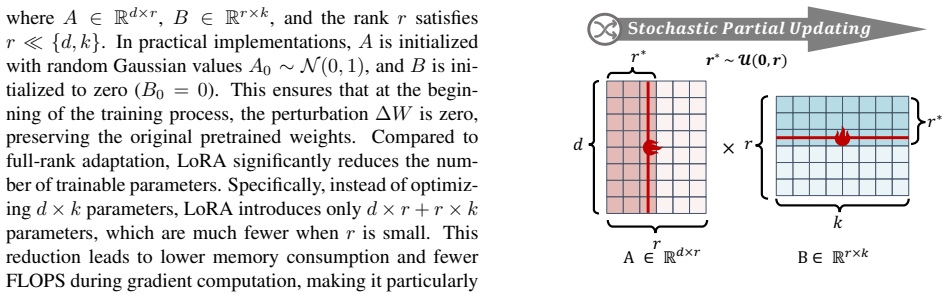
The central discovery is that the stable rank of each pretrained weight matrix can serve as a natural prior for the rank of the corresponding LoRA update: set $r_m^{(l)} = \operatorname{srank}\{W_{m,0}^{(l)}\}$, so the update is $\Delta W = \{B_m^{(l)} A_m^{(l)}\}$ with those ranks. Because stable rank is scale-invariant, bounded above by the true rank, and connected to generalization bounds through Lipschitz constants, the authors argue that it measures the effective dimensionality of each layer's parameter space. Allocating adapters accordingly redistributes capacity across layers, putting high ranks where pretrained weights have high intrinsic dimensionality and low ranks where the weights are already simple. A stochastic partial updating scheme samples a sub-rank at each step, keeping the trainable-parameter count low while still covering the full allocated space over many iterations.
Load-bearing premise
The load-bearing premise is that a pretrained layer's stable rank measures how much adaptation capacity that layer actually needs; if stable rank does not track the required update rank, the method's advantage has no mechanism.
Editorial extensions
If this is right
- If stable rank tracks adaptation capacity, rank allocation becomes a closed-form computation from frozen weights, eliminating rank search and pruning.
- SR-LoRA should beat fixed low-rank LoRA precisely where the domain gap is large, because high-capacity layers receive high ranks instead of a uniform small rank.
- Compared with adaptive LoRA variants, SR-LoRA avoids iterative pruning, rank search, and orthogonality regularization, so it is simpler to deploy and cheaper to run.
- At equal trainable-parameter budgets, layer-wise stable-rank allocation outperforms uniform rank increases (SR-LoRA versus LoRA-r32 in the paper's ablations), so the allocation itself, not the extra parameters, drives the gain.
- The allocation transfers across backbones and pretraining schemes (ViT-B/L, Swin, ImageNet-21k, DINO, MAE), suggesting the prior is a property of pretrained weights rather than of one architecture.
Reading between the lines
- A direct testable consequence the paper does not run: if per-layer stable ranks are the right prior, then a per-layer rank search on a held-out task should find optimal ranks positively correlated with stable ranks across layers.
- Because stable rank is scale-invariant, the prior ignores the overall magnitude of a layer's weights; a layer with a large but flat spectrum and a layer with a small but peaked spectrum receive the same rank, so a magnitude- or spectrum-aware variant could behave differently on out-of-distribution tasks.
- The method tunes only query, value, and output projections; the same stable-rank rule could be applied to MLP or convolutional weight matrices, where the quantity is equally computable, though the paper does not test that.
- The stochastic partial updating is ablated separately, but its interaction with the stable-rank allocation is not fully disentangled; one could test whether sampling sub-ranks from $[0, r]$ accounts for SR-LoRA's one-shot gains over full-rank adaptation.
Editorial analysis
A structured set of objections, weighed in public.
Referee Report
Summary. The paper proposes SR-LoRA, a parameter-efficient fine-tuning method in which the LoRA rank assigned to each query, value, and output projection is set to the stable rank of the corresponding frozen pretrained weight matrix (Eq. 4), and a stochastic partial updating scheme randomly samples a sub-rank each iteration to reduce the per-step trainable parameter cost. The authors argue that stable rank is a natural 'model prior' for the layer-wise adaptation capacity, and report experiments on MedFM (1/5/10-shot) and VTAB-Specialized (1-shot) showing that SR-LoRA outperforms fixed-rank LoRA and several published LoRA variants, especially on large-domain-gap tasks such as Retinopathy.
Significance. The method is attractive for its simplicity: the rank prior is computed once from frozen weights via SVD, requires no search or pruning, and SPU makes it parameter-efficient. If the central premise is valid, SR-LoRA is a genuinely search-free alternative to AdaLoRA-style adaptive rank allocation, and the empirical gains on medical and specialized datasets are practically useful. The paper also releases code, and the core linear-algebra definition of stable rank as a spectral-robust intrinsic dimensionality measure is standard. However, the significance is currently conditional: the manuscript does not establish that per-layer stable rank tracks per-layer adaptation need, omits the most directly relevant adaptive-rank baseline, and reports no variance information in a regime where seed-to-seed variation is likely large.
major comments (6)
- [Section 3.2, Eq. (4); Figure 6; Table 4] The central premise that srank(W0) is a valid prior for the rank needed by the update ΔW is never directly tested. Figure 6 correlates the average rank of the full fine-tuning update with LoRA's gain over FFT, and Figure 1 shows only that stable rank is roughly constant during fine-tuning; neither links srank(W0) to per-layer adaptation capacity. Please add (i) a scatter or table of srank(W0) per layer against the per-layer rank of the corresponding FFT update, and (ii) a control that assigns the same multiset of stable ranks to layers in a random permutation; if the permuted allocation performs as well as SR-LoRA, the specific 'prior' is not responsible for the gains.
- [Section 3.2, Eq. (5)] Stable rank is real-valued but a LoRA rank is an integer, and the rounding procedure is not specified. Eq. (5) writes rank(ΔW)=srank(W0), which is only valid after a rounding convention (floor, ceil, or round); this choice changes the per-layer allocation, the total parameter budget, and the comparison with Fixed-r64 in Table 4. State the rounding rule and report the rank values used per layer, for example in supplementary material.
- [Tables 2 and 3; Sections 1 and 2] AdaLoRA is described in the introduction and related work as the representative adaptive-rank allocation method, yet it does not appear in any experiment. Because the paper's headline claim is that SR-LoRA 'consistently outperforms recent adaptive LoRA variants,' a direct comparison with AdaLoRA, ideally matched to SR-LoRA's parameter budget, is necessary to support that claim.
- [Tables 1-3, Section 4.2] No standard deviations, confidence intervals, or number of seeds are reported for any experiment. In the 1-shot setting with batch size 4 and 20 epochs, performance is highly sensitive to the randomly selected training examples and initialization; without at least three seeds and per-seed results, the reported margins (e.g., Retinopathy 73.60 vs. 67.42) cannot be distinguished from noise. Please report mean and standard deviation and, where possible, a paired significance test.
- [Sections 1 and 3.1] The theoretical motivation is internally inconsistent as written. The cited generalization bound is O(√(∏_i ∥W_i∥_2^2 / ∑_i srank(W_i))), which places stable rank in the denominator, so decreasing stable rank increases the bound, whereas the text states that a decrease in stable rank implies better generalization. Please correct the formula, the interpretation, or both; this is the only theoretical support for using stable rank as a model prior.
- [Section 3.2, 'Stable Rank as a Lower Bound'] The phrase 'the optimal low-rank estimation' overstates what is established. Stable rank being a lower bound on rank(W0) is a property of the frozen matrix and does not by itself say anything about the rank of the task-specific update ΔW. Please either remove this claim or support it with the per-layer evidence requested above.
minor comments (5)
- [Figure 1] The caption says the stable rank is shown 'during the fine-tuning process of a pretrained model on a downstream task,' while the text says the stable rank 'remains consistent across tuning epochs after pre-training'; please specify the model, dataset, and exactly what is plotted (weights at each epoch of fine-tuning, not pre-training).
- [Table 4] The rows for SPU-r128 and SPU-r256 are identical (68.91, 75.74, 78.06, 49.47), which appears to be a copy-paste error; please correct.
- [Figure 3] The caption mentions DyLoRA and AdaLoRA, but the diagram does not show either method; update the caption or the figure.
- [References] Reference [16] is incomplete: 'Amartya Sanyal et al.' lacks the full author list and venue details; please add the complete citation.
- [Section 4.1] The paper says the VTAB training and validation sets are randomly selected for the few-shot setup, but no random seed or data-split generation procedure is given; report the seed, or state that results are averaged over multiple split draws, which would also address the variance concern above.
Circularity Check
No circularity: rank allocation is a definition from frozen weights, not a fit to the reported metrics.
full rationale
We find no significant circularity. The method's rank allocation is defined, not fitted: Eq. (4) sets each LoRA rank to the stable rank of the frozen pretrained matrix, and stable rank is computed from the pretrained weights only, independent of the downstream labels or evaluation metrics. Consequently, the reported gains on MedFM and VTAB are not forced by construction. Eq. (5) is an identity that follows from Eq. (4) and the definition of stable rank, but the paper does not use that identity as evidence for its empirical claims; the load-bearing empirical comparisons are against fixed-rank and adaptive LoRA baselines. The generalization-bound support is cited to external work [16], and no load-bearing assertion rests on a self-citation. The main weakness is evidential, not circular: the paper does not establish that per-layer stable rank tracks per-layer adaptation rank, and the ablation does not permute the rank allocation to control for total budget; those are validity concerns, not circularity. We therefore score 0.
Assumptions & free parameters
assumptions (4)
- domain assumption Stable rank of a pretrained weight matrix indicates the layer-wise rank needed for adaptation.
- domain assumption Stable rank stays approximately constant during fine-tuning with small learning rates.
- domain assumption Stochastic partial updating with rs sampled uniformly from [0,r] learns the full low-rank space over iterations.
- standard math Standard linear algebra properties of stable rank, Eq. (2), and sub-additivity of rank.
Cite this review
Pith. "Pith review of Beyond Low-Rank Tuning: Model Prior-Guided Rank Allocation for Effective Transfer in Low-Data and Large-Gap Regimes." pith.science (2026). https://pith.science/paper/UNDZBOOO
@misc{pith2026250700327,
  author       = {Pith},
  title        = {Pith review of: Beyond Low-Rank Tuning: Model Prior-Guided Rank Allocation for Effective Transfer in Low-Data and Large-Gap Regimes},
  year         = {2026},
  howpublished = {\url{https://pith.science/paper/UNDZBOOO}},
  note         = {Machine review of arXiv:2507.00327}
}
read the original abstract
Low-Rank Adaptation (LoRA) has proven effective in reducing computational costs while maintaining performance comparable to fully fine-tuned foundation models across various tasks. However, its fixed low-rank structure restricts its adaptability in scenarios with substantial domain gaps, where higher ranks are often required to capture domain-specific complexities. Current adaptive LoRA methods attempt to overcome this limitation by dynamically expanding or selectively allocating ranks, but these approaches frequently depend on computationally intensive techniques such as iterative pruning, rank searches, or additional regularization. To address these challenges, we introduce Stable Rank-Guided Low-Rank Adaptation (SR-LoRA), a novel framework that utilizes the stable rank of pre-trained weight matrices as a natural prior for layer-wise rank allocation. By leveraging the stable rank, which reflects the intrinsic dimensionality of the weights, SR-LoRA enables a principled and efficient redistribution of ranks across layers, enhancing adaptability without incurring additional search costs. Empirical evaluations on few-shot tasks with significant domain gaps show that SR-LoRA consistently outperforms recent adaptive LoRA variants, achieving a superior trade-off between performance and efficiency. Our code is available at https://github.com/EndoluminalSurgicalVision-IMR/SR-LoRA.
Figures


Figures from the paper (4 more)


Reference graph
Works this paper leans on
-
[16]
Stable rank normalization for im- proved generalization in neural networks and gans
Amartya Sanyal et al. Stable rank normalization for im- proved generalization in neural networks and gans. In ICLR. 2, 4
-
[1]
LoRA learns less and forgets less
Dan Biderman, Jacob Portes, Jose Javier Gonzalez Ortiz, Mansheej Paul, Philip Greengard, Connor Jennings, Daniel King, Sam Havens, Vitaliy Chiley, Jonathan Frankle, Cody Blakeney, and John Patrick Cunningham. LoRA learns less and forgets less. Transactions on Machine Learning Re- search, 2024. Featured Certification. 1, 7
work page 2024
-
[2]
One-for-all: Generalized lora for parameter- efficient fine-tuning
Arnav Chavan, Zhuang Liu, Deepak Gupta, Eric Xing, and Zhiqiang Shen. One-for-all: Generalized lora for parameter- efficient fine-tuning. arXiv preprint arXiv:2306.07967 ,
-
[3]
Xinyang Chen, Sinan Wang, Mingsheng Long, and Jianmin Wang. Transferability vs. discriminability: Batch spectral penalization for adversarial domain adaptation. In Proceed- ings of the 36th International Conference on Machine Learn- ing, pages 1081–1090. PMLR, 2019. 8
work page 2019
-
[4]
QuanTA: Efficient high-rank fine-tuning of LLMs with quantum-informed ten- sor adaptation
Zhuo Chen, Rumen Dangovski, Charlotte Loh, Owen M Dugan, Di Luo, and Marin Soljacic. QuanTA: Efficient high-rank fine-tuning of LLMs with quantum-informed ten- sor adaptation. In The Thirty-eighth Annual Conference on Neural Information Processing Systems, 2024. 1, 7
work page 2024
-
[5]
Ning Ding, Yujia Qin, Guang Yang, Fuchao Wei, Zonghan Yang, Yusheng Su, Shengding Hu, Yulin Chen, Chi-Min Chan, Weize Chen, et al. Parameter-efficient fine-tuning of large-scale pre-trained language models.Nature Machine In- telligence, 5(3):220–235, 2023. 1
work page 2023
-
[6]
Gelora: Geometric adaptive ranks for efficient lora fine-tuning
Abdessalam Ed-dib, Zhanibek Datbayev, and Amine Mo- hamed Aboussalah. Gelora: Geometric adaptive ranks for efficient lora fine-tuning. arXiv preprint arXiv:2412.09250,
-
[7]
Parameter-efficient transfer learning for NLP
Neil Houlsby, Andrei Giurgiu, Stanislaw Jastrzebski, Bruna Morrone, Quentin De Laroussilhe, Andrea Gesmundo, Mona Attariyan, and Sylvain Gelly. Parameter-efficient transfer learning for NLP. In Proceedings of the 36th International Conference on Machine Learning, pages 2790–2799. PMLR,
Show all 23 references
-
[8]
Lora: Low- rank adaptation of large language models
Edward J Hu, Phillip Wallis, Zeyuan Allen-Zhu, Yuanzhi Li, Shean Wang, Lu Wang, Weizhu Chen, et al. Lora: Low- rank adaptation of large language models. In International Conference on Learning Representations, 2022. 1, 2, 3, 4, 6, 7
2022
-
[9]
Structure-aware low-rank adaptation for parameter-efficient fine-tuning
Yahao Hu, Yifei Xie, Tianfeng Wang, Man Chen, and Zhisong Pan. Structure-aware low-rank adaptation for parameter-efficient fine-tuning. Mathematics, 11(20):4317,
-
[10]
Vi- sual prompt tuning
Menglin Jia, Luming Tang, Bor-Chun Chen, Claire Cardie, Serge Belongie, Bharath Hariharan, and Ser-Nam Lim. Vi- sual prompt tuning. In European Conference on Computer Vision, pages 709–727. Springer, 2022. 2, 5, 6
2022
-
[11]
Mora: High-rank updat- ing for parameter-efficient fine-tuning
Ting Jiang, Shaohan Huang, Shengyue Luo, Zihan Zhang, Haizhen Huang, Furu Wei, Weiwei Deng, Feng Sun, Qi Zhang, Deqing Wang, et al. Mora: High-rank updat- ing for parameter-efficient fine-tuning. arXiv preprint arXiv:2405.12130, 2024. 1, 2, 6, 7
2024 arXiv
-
[12]
Relora: High-rank training through low-rank updates
Vladislav Lialin, Sherin Muckatira, Namrata Shivagunde, and Anna Rumshisky. Relora: High-rank training through low-rank updates. In The Twelfth International Conference on Learning Representations, 2023. 2
2023
-
[13]
Scaling & shifting your features: A new baseline for efficient model tuning
Dongze Lian, Daquan Zhou, Jiashi Feng, and Xinchao Wang. Scaling & shifting your features: A new baseline for efficient model tuning. Advances in Neural Information Processing Systems, 35:109–123, 2022. 2, 6
2022
-
[14]
Pissa: Prin- cipal singular values and singular vectors adaptation of large language models, 2024
Fanxu Meng, Zhaohui Wang, and Muhan Zhang. Pissa: Prin- cipal singular values and singular vectors adaptation of large language models, 2024. 2, 3, 6, 7
2024
-
[15]
Melora: Mini-ensemble low-rank adapters for parameter-efficient fine-tuning
Pengjie Ren, Chengshun Shi, Shiguang Wu, Mengqi Zhang, Zhaochun Ren, Maarten Rijke, Zhumin Chen, and Ji- ahuan Pei. Melora: Mini-ensemble low-rank adapters for parameter-efficient fine-tuning. In Proceedings of the 62nd Annual Meeting of the Association for Computational Lin- ...
2024
-
[17]
Increasing model capacity for free: A simple strat- egy for parameter efficient fine-tuning
Haobo Song, Hao Zhao, Soumajit Majumder, and Tao Lin. Increasing model capacity for free: A simple strat- egy for parameter efficient fine-tuning. arXiv preprint arXiv:2407.01320, 2024. 2, 6, 7
2024 arXiv
-
[18]
Dylora: Parameter efficient tuning of pre- trained models using dynamic search-free low-rank adapta- tion
Mojtaba Valipour, Mehdi Rezagholizadeh, Ivan Kobyzev, and Ali Ghodsi. Dylora: Parameter efficient tuning of pre- trained models using dynamic search-free low-rank adapta- tion. arXiv preprint arXiv:2210.07558, 2022. 3, 6, 7
2022 arXiv
-
[19]
A real-world dataset and benchmark for foundation model adaptation in medical image classification
Dequan Wang, Xiaosong Wang, Lilong Wang, Mengzhang Li, Qian Da, Xiaoqiang Liu, Xiangyu Gao, Jun Shen, Junjun He, Tian Shen, Qi Duan, Jie Zhao, Kang Li, Yu Qiao, and Shaoting Zhang. A real-world dataset and benchmark for foundation model adaptation in medical image classificati...
2023
-
[20]
Chain of lora: Efficient fine-tuning of language models via residual learn- ing, 2024
Wenhan Xia, Chengwei Qin, and Elad Hazan. Chain of lora: Efficient fine-tuning of language models via residual learn- ing, 2024. 2
2024
-
[21]
Bit- fit: Simple parameter-efficient fine-tuning for transformer- based masked language-models
Elad Ben Zaken, Yoav Goldberg, and Shauli Ravfogel. Bit- fit: Simple parameter-efficient fine-tuning for transformer- based masked language-models. In Proceedings of the 60th Annual Meeting of the Association for Computational Lin- guistics (Volume 2: Short Papers) . Associati...
2022
-
[22]
A large-scale study of representation learning with the visual task adaptation benchmark, 2020
Xiaohua Zhai, Joan Puigcerver, Alexander Kolesnikov, Pierre Ruyssen, Carlos Riquelme, Mario Lucic, Josip Djo- longa, Andre Susano Pinto, Maxim Neumann, Alexey Doso- vitskiy, Lucas Beyer, Olivier Bachem, Michael Tschannen, Marcin Michalski, Olivier Bousquet, Sylvain Gelly, and ...
2020
-
[23]
Adalora: Adaptive budget allocation for parameter-efficient fine-tuning, 2023
Qingru Zhang, Minshuo Chen, Alexander Bukharin, Nikos Karampatziakis, Pengcheng He, Yu Cheng, Weizhu Chen, and Tuo Zhao. Adalora: Adaptive budget allocation for parameter-efficient fine-tuning, 2023. 2, 3
2023
Reviewed August 6, 2026 · model on record in the stance chip above.
Discussion (0). Sign in to comment.