REVIEW 3 major objections 5 minor 50 references
Learning Dense Feature Matching via Lifting Single 2D Image to 3D Space
T0 review · 3 major / 5 minor · reviewed 2026-08-06 · deepseek-v4-flash
Pith's one-line read L2M lifts ordinary single-view photographs into 3D with monocular depth and re-rendered views, and reports top zero-shot dense matching scores on ZEB, MegaDepth-1500, and RGB-IR benchmarks.
desk verdict A strong zero-shot feature-matching result with a plausible but unproven mechanism—the Stage 2 ablation conflates lifting with a 20x data increase. read the letter →
The pith
A machine-rendered reading of the paper's core claim, the machinery that carries it, and where it could break.
The reading
What carries the argument
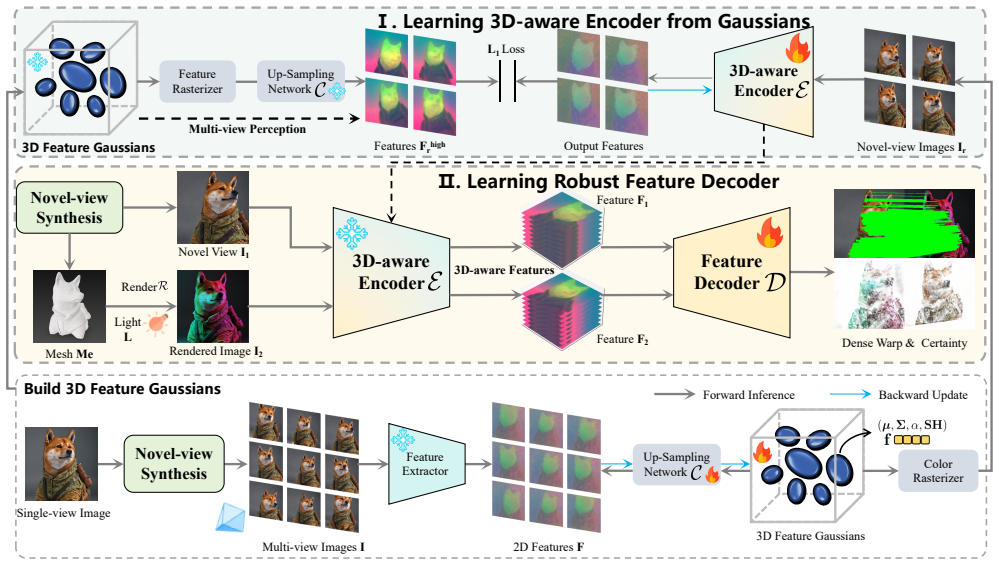
The load-bearing object is the lifting-and-rendering loop built on two stages. Stage one uses 3D feature Gaussians, a set of 3D Gaussians whose parameters include color and a low-dimensional feature vector distilled from a pretrained 2D encoder, rendered with a differentiable feature rasterizer to give the encoder multi-view-consistent supervision. Stage two turns each single image into a training pair: random scale $a$ and shift $b$ transform the monocular depth, a sampled camera intrinsic $K$ lifts pixels to 3D points, a warped novel view is masked and inpainted, and a Poisson-reconstructed mesh is re-lit to produce the second image with known dense ground-truth correspondences.
What would settle it
Train L2M on the same single-view images using depth from a multi-view reconstruction or ground-truth depth where available instead of monocular estimates, holding everything else fixed; if zero-shot AUC on ZEB does not improve, or if replacing monocular depth with random perturbations barely changes results, then the claimed gains come from data diversity and rendering rather than from the geometric lifting.
Extended reading notes
Core claim
The central discovery is that a feature matcher can be trained entirely from single-view images by first converting each image into a 3D representation and then rendering new viewpoints. In stage one, the paper learns a 3D-aware encoder: using synthesized multi-view images, it optimizes 3D feature Gaussians that store both color and distilled 2D features in space, renders those features from novel views, and trains the encoder to reproduce the rendered feature maps with an $\ell^1$ loss. In stage two, it generates paired training images by warping the lifted point cloud with a random virtual camera, masking occlusions, inpainting the missing regions, and re-rendering the reconstructed mesh under varied lighting. The authors report that this pipeline, trained on roughly 525,000 single images from twelve public datasets, establishes the highest zero-shot results among dense matchers on ZEB, on MegaDepth-1500 after fine-tuning, and on the RGB-IR METU-VisTIR benchmark, surpassing prior dense matchers GIM and RoMa.
Load-bearing premise
The whole pipeline stands or falls on the quality of monocular depth: if depth errors or inpainting fill-in artifacts dominate the synthesized pairs, the decoder can learn to match artifacts rather than true 3D geometry.
Editorial extensions
If this is right
- Zero-shot matching on unseen domains no longer requires multi-view training collections; single-view image libraries covering urban, indoor, aerial, underwater, and low-light scenes are sufficient raw material.
- A 3D-aware encoder trained through feature-Gaussian rendering carries geometry information that helps under occlusion, viewpoint change, and cross-modal input, as shown by the RGB-IR gains over RGB-only baselines.
- Fine-tuning on MegaDepth still helps, with L2M reaching 63.1 AUC@5 on MegaDepth-1500, so synthetic pretraining is compatible with standard in-domain supervision.
- Generated pairs cover variations in weather, lighting, and scene content, which is why the method stays strong on the hardest ZEB subsets such as SEA and WEA.
Reading between the lines
- A testable extension: if the synthetic pairs are geometrically faithful, the same lifting pipeline could pretrain other dense correspondence tasks, such as optical flow, stereo, or tracking, without any multi-view data.
- The monocular depth estimator is the ceiling: replacing the cited depth model with a stronger one should improve matching accuracy proportionally if the central claim is right, and failures would concentrate where depth is unreliable.
- Inpainting artifacts are a hidden risk: the decoder may learn to match hallucinated content inside mask regions, so inspecting whether matched keypoints concentrate in inpainted areas would reveal whether the gains are geometric or partly texture-based.
Editorial analysis
A structured set of objections, weighed in public.
Referee Report
Summary. The paper proposes L2M, a two-stage framework for dense feature matching. Stage 1 lifts single-view images to 3D using monocular depth, renders multi-view images, builds 3D feature Gaussians from DINOv2 features, and fine-tunes the feature encoder against rendered features to inject 3D awareness. Stage 2 uses depth-based lifting, novel-view warping, inpainting, and physics-based re-rendering to synthesize roughly 525,000 training pairs from 12 single-view datasets, then trains a dense warp-and-certainty decoder. The paper reports state-of-the-art or competitive zero-shot results on the ZEB benchmark (51.8 mean AUC@5), MegaDepth-1500 (63.1 AUC@5), and RGB-IR matching on METU-VisTIR (30.1 AUC@5), with ablations in Table 5 showing contributions from both stages. The central claim is that lifting single 2D images to 3D, rather than merely increasing training data, drives the observed generalization gains.
Significance. If the central causal claim holds, L2M offers a scalable alternative to multi-view data collection for training dense feature matchers, with potential practical impact in localization, mapping, and robotics. The paper has notable strengths: the two-stage design is clearly motivated, Stage 1 is ablated in a comparison that holds the Stage-2 data constant, the authors release code, and the evaluation spans 12 ZEB datasets plus MegaDepth and a challenging cross-modal RGB-IR benchmark where the reported margin over RoMa is substantial. However, the main causal attribution is under-supported by the current experiments: the Stage 2 ablation conflates the lifting pipeline with an order-of-magnitude increase in training data and domain breadth, and the ZEB mean margin over GIM is only 0.6 AUC points with no error bars or repeated runs. These issues are addressable with additional controlled experiments, so the work is promising but not yet conclusive.
major comments (3)
- [Section 3.5 and Table 5] Table 5 does not isolate the effect of lifting to 3D. The row 'w/o Stage 1 & Stage 2' is trained on MegaDepth only, while 'w/o Stage 1' uses the Stage-2 pipeline on roughly 525,000 images from 12 datasets. The mean AUC@5 gain of about 3.6 points therefore combines (i) the depth-based lifting and re-rendering mechanism with (ii) a roughly ten-fold increase in training data and a much wider domain distribution. A 2D-only control is needed that trains on the same ~525,000 source images with random homographies or affine warps plus the same relighting, but without depth estimation, mesh reconstruction, warping, and inpainting. Without that control, the paper does not substantiate its title claim that lifting to 3D is what drives the generalization improvement.
- [Section 4.2, Table 2] The headline zero-shot result is not accompanied by any measure of variance. The mean AUC@5 of 51.8 for L2M versus 51.2 for GIM is a 0.6-point margin, and L2M actually loses to GIM on GL3, BLE, and GTA. Without standard deviations over multiple training runs or paired statistical tests, the claim of state-of-the-art performance on ZEB is not robust. The authors should report error bars over at least three seeds or otherwise justify that the margin exceeds run-to-run variability.
- [Sections 3.2 and 3.4] The synthetic training pairs are only as reliable as the monocular depth estimates and inpainting used to create them, but the paper provides no analysis of this failure mode. Equation (3) applies a random scale and shift to Depth Anything V2 predictions, and Section 3.4 reconstructs a mesh and re-renders with a physics engine that is not identified; no quantitative evaluation is given for how often depth errors or inpainting artifacts corrupt the derived dense correspondences. If the decoder learns to match artifacts rather than true geometry, the claimed zero-shot gains could fail to transfer. The authors should add a quantitative characterization of synthesized-pair correctness (for example, using held-out images with reliable depth) or a filtering/confidence mechanism for generated pairs.
minor comments (5)
- [Throughout] There are several typos and inconsistencies: 'methodes' in the Introduction, 'One the contrary' in the Figure 1 caption, 'MegeDepth' in Section 4.1, 'im-domain' in Section 4.2, and inconsistent use of 'RoMa' versus 'ROMA'. These should be corrected.
- [Section 4.2] The text says 'Our method consistently outperforms other techniques on most cases,' which is too strong given that L2M is behind GIM on GL3, BLE, and GTA in Table 2. The wording should be revised to 'on most datasets' or similar.
- [Section 3.4] The 'physics engine' used for re-rendering and re-lighting is never specified. For reproducibility, the authors should name the renderer or provide pseudo-code for the relighting process.
- [Section 4.1] The evaluation protocol is described only as 'following GIM'; the RANSAC threshold, number of sampled correspondences, and image resolution handling for the ZEB benchmark should be stated explicitly to make the comparisons self-contained and reproducible.
- [Section 3.3] Stage 1 builds 3D feature Gaussians from DINOv2 features and then trains the encoder to predict rendered versions of those same features. Since the encoder is initialized from DINOv2, this is effectively a self-distillation loop; the paper should briefly explain what new information the 3D rendering and geometry consistency provide beyond the teacher features.
Circularity Check
No circularity: zero-shot benchmarks are external, and no fitted parameter is renamed as a prediction.
full rationale
Walked the derivation chain. Stage 1 trains a 3D-aware encoder by L1-matching feature maps rendered from 3D feature Gaussians; those Gaussians are built from multi-view features of DINOv2, so the stage is self-distillation rather than a derivation whose conclusion is presupposed. Stage 2 generates synthetic pairs (I1 from novel-view warping with occlusion inpainting, I2 from re-lighting a Poisson mesh, Eq. 4 and Eq. 7); dense match labels are known by construction from the same virtual camera parameters, not fitted to any evaluation set. The zero-shot numbers in Tables 2-4 come from external benchmarks (ZEB, MegaDepth-1500, METU-VisTIR) on which no parameter is tuned; augmentation hyperparameters (random scale/shift in Eq. 3, focal range, lighting counts) are set a priori. The only caveat is experimental rather than circular: the Table 5 'w/o Stage 1 & Stage 2' ablation changes both the pipeline and the training-data scale/domains, so the Stage-2 gain is confounded with data-scale effects. That is a missing control, not an equation-level reduction, and it does not make any reported number equivalent to an input by construction.
Assumptions & free parameters
free parameters (3)
- random depth scale a and shift b =
sampled randomly, distribution unspecified
- camera focal length K =
uniform in [0.58, 0.88] (normalized)
- lighting parameters =
1-3 lights, intensity 1000-3000, random color and position
assumptions (4)
- domain assumption Monocular depth model (Depth Anything V2) predicts relative depth accurately enough for warping.
- domain assumption Stable Diffusion v1.5 inpainting produces plausible content for occluded regions that does not corrupt matching labels.
- domain assumption 3D feature Gaussians can distill multi-view consistent features from synthetic views.
- standard math Pose estimation via essential matrix plus RANSAC with threshold 0.5 follows the GIM protocol.
Cite this review
Pith. "Pith review of Learning Dense Feature Matching via Lifting Single 2D Image to 3D Space." pith.science (2026). https://pith.science/paper/LJREY63N
@misc{pith2026250700392,
  author       = {Pith},
  title        = {Pith review of: Learning Dense Feature Matching via Lifting Single 2D Image to 3D Space},
  year         = {2026},
  howpublished = {\url{https://pith.science/paper/LJREY63N}},
  note         = {Machine review of arXiv:2507.00392}
}
read the original abstract
Feature matching plays a fundamental role in many computer vision tasks, yet existing methods heavily rely on scarce and clean multi-view image collections, which constrains their generalization to diverse and challenging scenarios. Moreover, conventional feature encoders are typically trained on single-view 2D images, limiting their capacity to capture 3D-aware correspondences. In this paper, we propose a novel two-stage framework that lifts 2D images to 3D space, named as \textbf{Lift to Match (L2M)}, taking full advantage of large-scale and diverse single-view images. To be specific, in the first stage, we learn a 3D-aware feature encoder using a combination of multi-view image synthesis and 3D feature Gaussian representation, which injects 3D geometry knowledge into the encoder. In the second stage, a novel-view rendering strategy, combined with large-scale synthetic data generation from single-view images, is employed to learn a feature decoder for robust feature matching, thus achieving generalization across diverse domains. Extensive experiments demonstrate that our method achieves superior generalization across zero-shot evaluation benchmarks, highlighting the effectiveness of the proposed framework for robust feature matching.
Figures


Figures from the paper (3 more)


Reference graph
Works this paper leans on
-
[1]
Three things ev- eryone should know to improve object retrieval
Relja Arandjelovi ´c and Andrew Zisserman. Three things ev- eryone should know to improve object retrieval. In Proceed- ings of IEEE International Conference on Computer Vision and Pattern Recognition, pages 2911–2918, 2012. 2, 6
work page 2012
-
[2]
Surf: Speeded up robust features
Herbert Bay, Tinne Tuytelaars, and Luc Van Gool. Surf: Speeded up robust features. In Proceedings of European Conference on Computer Vision, pages 404–417, 2006. 1
work page 2006
-
[3]
Image matching by bare homography
Fabio Bellavia. Image matching by bare homography. IEEE Transactions on Image Processing, 33:696–708, 2024. 2
work page 2024
-
[4]
nuscenes: A multi- modal dataset for autonomous driving
Holger Caesar, Varun Bankiti, Alex H Lang, Sourabh V ora, Venice Erin Liong, Qiang Xu, Anush Krishnan, Yu Pan, Gi- ancarlo Baldan, and Oscar Beijbom. nuscenes: A multi- modal dataset for autonomous driving. In Proceedings of IEEE International Conference on Computer Vision and Pat- tern Recognition, pages 11621–11631, 2020. 5
work page 2020
-
[5]
Improving transformer-based image matching by cascaded capturing spatially informative keypoints
Chenjie Cao and Yanwei Fu. Improving transformer-based image matching by cascaded capturing spatially informative keypoints. In Proceedings. of IEEE International Confer- enceon Computer Vision, pages 12129–12139, 2023. 7
work page 2023
-
[6]
Aspanformer: Detector-free image matching with adaptive span transformer
Hongkai Chen, Zixin Luo, Lei Zhou, Yurun Tian, Ming- min Zhen, Tian Fang, David Mckinnon, Yanghai Tsin, and Long Quan. Aspanformer: Detector-free image matching with adaptive span transformer. In Proceedings of European Conference on Computer Vision, pages 20–36, 2022. 6, 7
work page 2022
-
[7]
The cityscapes dataset for semantic urban scene understanding
Marius Cordts, Mohamed Omran, Sebastian Ramos, Timo Rehfeld, Markus Enzweiler, Rodrigo Benenson, Uwe Franke, Stefan Roth, and Bernt Schiele. The cityscapes dataset for semantic urban scene understanding. In Proceed- ings of IEEE International Conference on Computer Vision and Pattern Recognition, pages 3213–3223, 2016. 5
work page 2016
-
[8]
Yuxin Deng and Jiayi Ma. Redfeat: Recoupling detection and description for multimodal feature learning.IEEE Trans- actions on Image Processing, 32:591–602, 2022. 7
work page 2022
Show all 50 references
-
[9]
Superpoint: Self-supervised interest point detection and description
Daniel DeTone, Tomasz Malisiewicz, and Andrew Rabi- novich. Superpoint: Self-supervised interest point detection and description. In Proceedings of IEEE International Con- ference on Computer Vision and Pattern Recognition Work- shop, pages 224–236, 2018. 1
2018
-
[10]
An image is worth 16x16 words: Transformers for image recognition at scale
Alexey Dosovitskiy, Lucas Beyer, Alexander Kolesnikov, Dirk Weissenborn, Xiaohua Zhai, Thomas Unterthiner, Mostafa Dehghani, Matthias Minderer, Georg Heigold, Syl- vain Gelly, Jakob Uszkoreit, and Neil Houlsby. An image is worth 16x16 words: Transformers for image recognition ...
2021
-
[11]
Dkm: Dense kernelized feature matching for geometry estimation
Johan Edstedt, Ioannis Athanasiadis, M ˚arten Wadenb ¨ack, and Michael Felsberg. Dkm: Dense kernelized feature matching for geometry estimation. In Proceedings of IEEE International Conference on Computer Vision and Pattern Recognition, pages 17765–17775, 2023. 1, 2, 6, 7
2023
-
[12]
Roma: Robust dense feature matching
Johan Edstedt, Qiyu Sun, Georg B ¨okman, M ˚arten Wadenb¨ack, and Michael Felsberg. Roma: Robust dense feature matching. InProceedings of IEEE International Con- ference on Computer Vision and Pattern Recognition, pages 19790–19800, 2024. 2, 6, 7, 8
2024
-
[13]
Stere- oscan: Dense 3d reconstruction in real-time
Andreas Geiger, Julius Ziegler, and Christoph Stiller. Stere- oscan: Dense 3d reconstruction in real-time. In IEEE Intel- ligent Vehicles Symposium, pages 963–968, 2011. 1
2011
-
[14]
Are we ready for autonomous driving? the kitti vision benchmark suite
Andreas Geiger, Philip Lenz, and Raquel Urtasun. Are we ready for autonomous driving? the kitti vision benchmark suite. In Proceedings of IEEE International Conference on Computer Vision and Pattern Recognition, 2012. 5
2012
-
[15]
Deep residual learning for image recognition
Kaiming He, Xiangyu Zhang, Shaoqing Ren, and Jian Sun. Deep residual learning for image recognition. InProceedings of IEEE International Conference on Computer Vision and Pattern Recognition, pages 770–778, 2016. 2, 3
2016
-
[16]
Poisson surface reconstruction
Michael Kazhdan, Matthew Bolitho, and Hugues Hoppe. Poisson surface reconstruction. In Proceedings of the Eu- rographics Symposium on Geometry Processing, 2006. 5
2006
-
[17]
Imagenet classification with deep convolutional neural net- works
Alex Krizhevsky, Ilya Sutskever, and Geoffrey E Hinton. Imagenet classification with deep convolutional neural net- works. In Proceedings of Advances in Neural Information Processing Systems, 2012. 2, 3
2012
-
[18]
Low-light image and video enhancement using deep learning: A sur- vey
Chongyi Li, Chunle Guo, Linghao Han, Jun Jiang, Ming- Ming Cheng, Jinwei Gu, and Chen Change Loy. Low-light image and video enhancement using deep learning: A sur- vey. IEEE Transactions on Pattern Analysis and Machine Intelligence, 44(12):9396–9416, 2021. 5
2021
-
[19]
Megadepth: Learning single- view depth prediction from internet photos
Zhengqi Li and Noah Snavely. Megadepth: Learning single- view depth prediction from internet photos. In Proceedings of IEEE International Conference on Computer Vision and Pattern Recognition, pages 2041–2050, 2018. 2, 6, 8
2018
-
[20]
Microsoft coco: Common objects in context
Tsung-Yi Lin, Michael Maire, Serge Belongie, James Hays, Pietro Perona, Deva Ramanan, Piotr Doll´ar, and C Lawrence Zitnick. Microsoft coco: Common objects in context. In Proceedings of European Conference on Computer Vision , pages 740–755, 2014. 5
2014
-
[21]
Lightglue: Local feature matching at light speed
Philipp Lindenberger, Paul-Edouard Sarlin, and Marc Polle- feys. Lightglue: Local feature matching at light speed. In Proceedings. of IEEE International Conferenceon Computer Vision, pages 17627–17638, 2023. 6, 7
2023
-
[22]
Distinctive image features from scale- invariant keypoints
David G Lowe. Distinctive image features from scale- invariant keypoints. International Journal of Computer Vi- sion, 60:91–110, 2004. 1
2004
-
[23]
Large-scale 3d reconstruction from multi-view imagery: A comprehensive review
Haitao Luo, Jinming Zhang, Xiongfei Liu, Lili Zhang, and Junyi Liu. Large-scale 3d reconstruction from multi-view imagery: A comprehensive review. Remote Sensing, 16(5): 773, 2024. 1
2024
-
[24]
Image matching from handcrafted to deep fea- tures: A survey
Jiayi Ma, Xingyu Jiang, Aoxiang Fan, Junjun Jiang, and Junchi Yan. Image matching from handcrafted to deep fea- tures: A survey. International Journal of Computer Vision, 129(1):23–79, 2021. 1
2021
-
[25]
A large dataset to train convolutional networks for disparity, optical flow, and scene flow estimation
Nikolaus Mayer, Eddy Ilg, Philip Hausser, Philipp Fischer, Daniel Cremers, Alexey Dosovitskiy, and Thomas Brox. A large dataset to train convolutional networks for disparity, optical flow, and scene flow estimation. In Proceedings of IEEE International Conference on Computer V...
2016
-
[26]
Dinov2: Learning robust visual features without supervision
Maxime Oquab, Timoth ´ee Darcet, Th ´eo Moutakanni, Huy V o, Marc Szafraniec, Vasil Khalidov, Pierre Fernandez, Daniel Haziza, Francisco Massa, Alaaeldin El-Nouby, et al. Dinov2: Learning robust visual features without supervision. arXiv preprint arXiv:2304.07193, 2023. 2, 3, 4
2023 arXiv
-
[27]
U-shape trans- former for underwater image enhancement
Lintao Peng, Chunli Zhu, and Liheng Bian. U-shape trans- former for underwater image enhancement. IEEE Transac- tions on Image Processing, 32:3066–3079, 2023. 5
2023
-
[28]
A benchmark dataset and evaluation methodology for video object segmentation
Federico Perazzi, Jordi Pont-Tuset, Brian McWilliams, Luc Van Gool, Markus Gross, and Alexander Sorkine-Hornung. A benchmark dataset and evaluation methodology for video object segmentation. In Proceedings of IEEE International Conference on Computer Vision and Pattern Recogni...
2016
-
[29]
Xfeat: Accelerated fea- tures for lightweight image matching
Guilherme Potje, Felipe Cadar, Andr ´e Araujo, Renato Mar- tins, and Erickson R Nascimento. Xfeat: Accelerated fea- tures for lightweight image matching. In Proceedings of IEEE International Conference on Computer Vision and Pat- tern Recognition, pages 2682–2691, 2024. 6, 7
2024
-
[30]
High-resolution image syn- thesis with latent diffusion models
Robin Rombach, Andreas Blattmann, Dominik Lorenz, Patrick Esser, and Bj¨orn Ommer. High-resolution image syn- thesis with latent diffusion models. In Proceedings of IEEE International Conference on Computer Vision and Pattern Recognition, pages 10684–10695, 2022. 6
2022
-
[31]
ORB: An efficient alternative to SIFT or SURF
Ethan Rublee, Vincent Rabaud, Kurt Konolige, and Gary Bradski. ORB: An efficient alternative to SIFT or SURF. In Proceedings. of IEEE International Conferenceon Computer Vision, pages 2564–2571, 2011. 1
2011
-
[32]
From coarse to fine: Robust hierarchical localization at large scale
Paul-Edouard Sarlin, Cesar Cadena, Roland Siegwart, and Marcin Dymczyk. From coarse to fine: Robust hierarchical localization at large scale. In Proceedings of IEEE Interna- tional Conference on Computer Vision and Pattern Recogni- tion, pages 12716–12725, 2019. 1
2019
-
[33]
Superglue: Learning feature matching with graph neural networks
Paul-Edouard Sarlin, Daniel DeTone, Tomasz Malisiewicz, and Andrew Rabinovich. Superglue: Learning feature matching with graph neural networks. In Proceedings of IEEE International Conference on Computer Vision and Pat- tern Recognition, pages 4938–4947, 2020. 2, 6, 7
2020
-
[34]
Structure-from-motion revisited
Johannes Lutz Sch ¨onberger and Jan-Michael Frahm. Structure-from-motion revisited. In Proceedings of IEEE International Conference on Computer Vision and Pattern Recognition, 2016. 2
2016
-
[35]
Gim: Learning generalizable image matcher from internet videos
Xuelun Shen, Zhipeng Cai, Wei Yin, Matthias M ¨uller, Zijun Li, Kaixuan Wang, Xiaozhi Chen, and Cheng Wang. Gim: Learning generalizable image matcher from internet videos. In Proceedings of International Conferenceon Learning Rep- resentations, 2024. 2, 6, 7
2024
-
[36]
Indoor segmentation and support inference from rgbd images
Nathan Silberman, Derek Hoiem, Pushmeet Kohli, and Rob Fergus. Indoor segmentation and support inference from rgbd images. In Proceedings of European Conference on Computer Vision, pages 746–760. Springer, 2012. 5
2012
-
[37]
Loftr: Detector-free local feature matching with transformers
Jiaming Sun, Zehong Shen, Yuang Wang, Hujun Bao, and Xiaowei Zhou. Loftr: Detector-free local feature matching with transformers. In Proceedings of IEEE International Conference on Computer Vision and Pattern Recognition , pages 8922–8931, 2021. 2, 6, 7, 8
2021
-
[38]
Droid-slam: Deep visual slam for monocular, stereo, and rgb-d cameras
Zachary Teed and Jia Deng. Droid-slam: Deep visual slam for monocular, stereo, and rgb-d cameras. Proceedings of Advances in Neural Information Processing Systems , 34: 16558–16569, 2021. 1
2021
-
[39]
Learned camera gain and exposure control for improved visual feature detection and matching
Justin Tomasi, Brandon Wagstaff, Steven L Waslander, and Jonathan Kelly. Learned camera gain and exposure control for improved visual feature detection and matching. IEEE Robotics and Automation Letters, 6(2):2028–2035, 2021. 1
2021
-
[40]
Xoftr: Cross-modal feature matching transformer
¨Onder Tuzcuo ˘glu, Aybora K ¨oksal, Bu ˘gra Sofu, Sinan Kalkan, and A Aydin Alatan. Xoftr: Cross-modal feature matching transformer. In Proceedings of IEEE International Conference on Computer Vision and Pattern Recognition , pages 4275–4286, 2024. 6, 7, 8
2024
-
[41]
Efficient loftr: Semi-dense local feature match- ing with sparse-like speed
Yifan Wang, Xingyi He, Sida Peng, Dongli Tan, and Xi- aowei Zhou. Efficient loftr: Semi-dense local feature match- ing with sparse-like speed. In Proceedings of IEEE Interna- tional Conference on Computer Vision and Pattern Recogni- tion, pages 21666–21675, 2024. 6, 7
2024
-
[42]
Deep retinex decomposition for low-light enhancement
Chen Wei, Wenjing Wang, Wenhan Yang, and Jiaying Liu. Deep retinex decomposition for low-light enhancement. In Proceedings of British Machine Vision Conference, 2018. 5
2018
-
[43]
Google landmarks dataset v2-a large-scale benchmark for instance-level recognition and retrieval
Tobias Weyand, Andre Araujo, Bingyi Cao, and Jack Sim. Google landmarks dataset v2-a large-scale benchmark for instance-level recognition and retrieval. In Proceedings of IEEE International Conference on Computer Vision and Pat- tern Recognition, pages 2575–2584, 2020. 5
2020
-
[44]
Uav-visloc: A large- scale dataset for uav visual localization
Wenjia Xu, Yaxuan Yao, Jiaqi Cao, Zhiwei Wei, Chunbo Liu, Jiuniu Wang, and Mugen Peng. Uav-visloc: A large- scale dataset for uav visual localization. arXiv preprint arXiv:2405.11936, 2024. 5
2024 arXiv
-
[45]
Depth any- thing v2
Lihe Yang, Bingyi Kang, Zilong Huang, Zhen Zhao, Xiao- gang Xu, Jiashi Feng, and Hengshuang Zhao. Depth any- thing v2. Proceedings of Advances in Neural Information Processing Systems, 37:21875–21911, 2025. 3
2025
-
[46]
Fd-slam: 3-d reconstruction using features and dense matching
Xingrui Yang, Yuhang Ming, Zhaopeng Cui, and Andrew Calway. Fd-slam: 3-d reconstruction using features and dense matching. In Proceedings of the IEEE Int. Confer- ence on Robotics and Automation , pages 8040–8046, 2022. 1
2022
-
[47]
Blendedmvs: A large- scale dataset for generalized multi-view stereo networks
Yao Yao, Zixin Luo, Shiwei Li, Jingyang Zhang, Yufan Ren, Lei Zhou, Tian Fang, and Long Quan. Blendedmvs: A large- scale dataset for generalized multi-view stereo networks. In Proceedings of IEEE International Conference on Computer Vision and Pattern Recognition, pages 1790–1...
2020
-
[48]
Adaptive spot-guided transformer for consistent local feature matching
Jiahuan Yu, Jiahao Chang, Jianfeng He, Tianzhu Zhang, Jiyang Yu, and Feng Wu. Adaptive spot-guided transformer for consistent local feature matching. In Proceedings of IEEE International Conference on Computer Vision and Pat- tern Recognition, pages 21898–21908, 2023. 6
2023
-
[49]
Improving 2d feature representations by 3d-aware fine-tuning
Yuanwen Yue, Anurag Das, Francis Engelmann, Siyu Tang, and Jan Eric Lenssen. Improving 2d feature representations by 3d-aware fine-tuning. In Proceedings of European Con- ference on Computer Vision, pages 57–74, 2024. 2, 3, 4, 6
2024
-
[50]
Semantic under- standing of scenes through the ade20k dataset
Bolei Zhou, Hang Zhao, Xavier Puig, Tete Xiao, Sanja Fi- dler, Adela Barriuso, and Antonio Torralba. Semantic under- standing of scenes through the ade20k dataset. International Journal of Computer Vision, 127(3):302–321, 2019. 5
2019
Reviewed August 6, 2026 · model on record in the stance chip above.
Discussion (0). Sign in to comment.