REVIEW 4 major objections 5 minor 73 references
Learning collective variables that respect permutational symmetry
T0 review · 4 major / 5 minor · reviewed 2026-08-06 · deepseek-v4-flash
Pith's one-line read Sorting atom descriptors before manifold learning and autoencoding yields collective variables that respect permutational symmetry, and the reduced-model committor used as a reaction coordinate reproduces brute-force transition rates.
desk verdict Useful, honest engineering for permutationally symmetric CVs, but the headline overclaims: the LJ8 3D success skips the autoencoder step and the rate agreement is mainly kA. read the letter →
The pith
A machine-rendered reading of the paper's core claim, the machinery that carries it, and where it could break.
The reading
What carries the argument
The load-bearing identity is the orthogonality condition (3.19), $D\xi(x)\nabla V_1(x) = 0$, which demands that the level sets of the collective variable be orthogonal to the residence manifold where the invariant measure concentrates; Legoll and Lelièvre (2010) and Duong et al. (2018) proved that this condition suppresses the relative-entropy bound (3.17) measuring the gap between the reduced dynamics and the projected original dynamics. The paper turns this analytic condition into a training term in the autoencoder loss (4.6), alongside reconstruction and linear-independence terms. The complementary mechanism is the rate-versus-committor identity of Zhang, Hartmann, and Schütte (2016): the transition rate in any collective-variable space is never smaller than the true rate, with equality when the collective variable is the committor, which is why the reduced-model committor, not the raw learned variables, is lifted to atomic coordinates and used as the reaction coordinate for forward flux sampling and for the control $2\beta^{-1}\nabla\log q(x)$ for sampling transition paths.
What would settle it
Extend the brute-force all-atom estimates with about ten times more statistics in the channel where the paper already reports the worst agreement—the back-rate $k_B$ for LJ7 at $\beta = 7$ with the learned CVs, where the FFS and brute-force means differ by roughly a factor of two, and the $\nu_{AB}$ channel for LJ8 at $\beta = 20$, where the FFS mean is about three times smaller than the brute-force mean with comparatively tight error bars. If either discrepancy persists beyond three standard deviations at full statistics, the claim that reduced-model rates agree with brute force is false for that channel.
Extended reading notes
Core claim
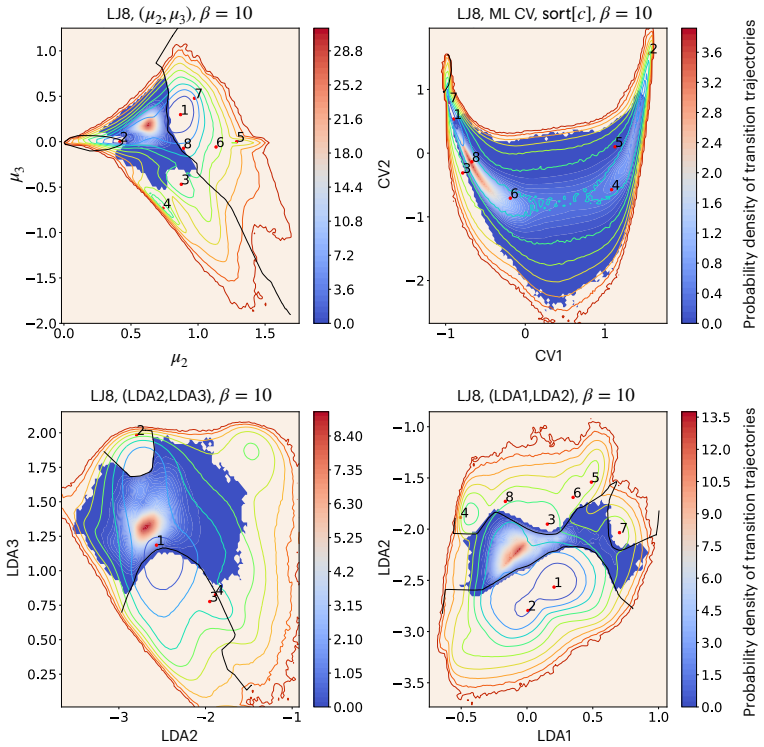
The paper's central claim is that Algorithm 1—sort-based featurization, residence-manifold learning by diffusion maps and a diffusion net, and an autoencoder whose loss contains an orthogonality term—produces collective variables that respect translational, rotational, and permutational symmetry, and that the committor of the reduced model in those variables, composed with the learned features to give $q(x) = \tilde{q}(\xi(\varphi(x)))$, is a good reaction coordinate for forward flux sampling and for the stochastic control used to sample transition paths. For both case studies the reported escape rates $k_A$ and the transition rates $\nu_{AB}$ obtained with the learned variables agree with brute-force all-atom results within statistical error; the standard coordination-moment variables $(\mu_2, \mu_3)$ fare comparably, while linear-discriminant-analysis variables show notably larger rate errors. The paper further claims that its proposed feature map, the sorted vector of coordination numbers $\mathrm{sort}[c_s]$, separates the relevant metastable basins in both systems, whereas the sorted squared-distance map $\mathrm{sort}[d^2]$ works for LJ7 in 2D but fails to separate the two main minima of LJ8 in 3D.
Load-bearing premise
The theoretical guarantee behind the training loss is proven only for smooth feature maps, while the sorted feature maps actually used are only piecewise smooth, so the orthogonality condition the loss enforces is not rigorously justified for the true inputs, a limitation the paper itself acknowledges in Section 4.1.
Editorial extensions
If this is right
- Rate estimation for permutationally symmetric clusters can be done with forward flux sampling driven by a two-dimensional reduced-model committor instead of an all-atom committor, and the reported $k_A$ and $\nu_{AB}$ values match brute-force all-atom estimates within the combined statistical error bars at essentially every temperature tested.
- The $\mathrm{sort}[c_s]$ feature map separates the free-energy basins of the relevant minima in both LJ7 in 2D and LJ8 in 3D, so the learned collective variables can serve both to define metastable sets and to visualize where transition trajectories concentrate.
- The same lifted committor defines an approximately optimal control for the transition path process, allowing the bias vector $2\beta^{-1}\nabla\log q(x)$ to be added to the drift so that reactive trajectories can be sampled in bulk and their probability density estimated by binning in the CV space.
- Because the reduced-model rates follow Arrhenius behavior across $\beta = 5,7,9$ for LJ7 and $\beta = 10,15,20$ for LJ8, in agreement with brute force, the framework inherits the temperature dependence of the underlying dynamics rather than imposing an ad hoc one.
Reading between the lines
- The sorting trick is generic: any permutation-invariant ordering of a symmetric descriptor collapses the symmetry group, so the same pipeline should transfer to other symmetric clusters, and the paper's own named next target, LJ38 with its double-funnel landscape, is a direct test of whether $\mathrm{sort}[c_s]$-style features separate competing funnels as cleanly as they separate the LJ8 minima.
- The piecewise-smoothness gap suggests a discriminating experiment the authors did not run: replace $\mathrm{sort}[d^2]$ and $\mathrm{sort}[c_s]$ with a smooth permutation-invariant embedding, for instance an equivariant graph-network descriptor, and re-run the pipeline; if rates stay the same, the orthogonality loss's theoretical basis is incidental to the empirical success, and if they change, th
- A weaker reading of the paper's message is that the orthogonality loss does not have to preserve rates directly; it only has to produce collective variables whose level-set foliation lets the lifted committor approximate the true committor closely enough for interface-crossing probabilities, and measuring the overlap of the reduced-model committor's level sets with true isocommittor surfaces for L
Editorial analysis
A structured set of objections, weighed in public.
Referee Report
Summary. The paper proposes a framework, Algorithm 1, for learning collective variables that are invariant under translation, rotation, and permutation of identical particles, by combining sorted feature maps, diffusion-map/diffusion-net residence manifold learning, and an autoencoder whose loss enforces the Legoll–Lelièvre orthogonality condition. The reduced-model committor is then used as a forward-flux-sampling reaction coordinate and as a stochastic control for sampling transition paths. Two Lennard-Jones case studies are presented: LJ7 in 2D and LJ8 in 3D, with rates obtained by FFS compared against brute-force all-atom simulations. The paper reports that the reduced-model rates agree with brute-force rates, and it makes code and detailed implementation data available.
Significance. If the method works as claimed, it is a useful contribution to collective-variable discovery for systems with permutational symmetry, an important class that is poorly served by traditional physically motivated CVs. The manuscript is particularly strong in its engineering: it provides reproducible code, detailed appendices on neural-network architectures, Jacobian derivatives of the sorted feature maps, and extensive FFS versus brute-force comparisons. However, the theoretical grounding is weakened by the acknowledged non-smoothness of the sorted features, and the 3D case study does not actually execute the autoencoder/orthogonality step that is the paper's main algorithmic novelty. The rate agreement is also more mixed than the abstract suggests. The 2D LJ7 demonstration is credible, but the central 3D claim currently overstates what has been tested.
major comments (4)
- [Section 6.1] The LJ8 'ML CV–sortrcs' case does not execute Algorithm 1. After computing the target-measure diffusion map, the authors state: 'Therefore, there is no need to learn the confining potential V1 and the CVs: ψ1pϕpxqq and ψ2pϕpxqq are the desired CVs in this case.' These ψ's are diffusion-map eigenvectors, not outputs of the autoencoder trained with the orthogonality loss (4.6). Consequently, the conclusion's statement that the LJ8 CVs were 'learned by Algorithm 1' (Section 8) is not supported by the reported workflow. The distinctive component of the proposed framework—learning CVs by enforcing Dξ∇V1 = 0—remains untested on the 3D example used to support the abstract's rate-agreement claim.
- [Sections 3.3 and 4.1] The orthogonality condition (3.19) is motivated by the relative entropy bound (3.17), which is derived under a regularity assumption (Duong et al., Assumption 2.3). Section 4.1 explicitly acknowledges that the sorted feature maps 'sortrd2s and sortrcs are continuous but only piecewise smooth, which violates the regularity assumption.' Since the CV ξ(ϕ(x)) and its Jacobian Dϕξ pass through sorting boundaries, the theoretical justification for the orthogonality-based loss does not directly apply to the feature maps actually used. The paper should either provide a relaxation of the regularity condition for sorting maps, or supply quantitative evidence (e.g., orthogonality residuals and sensitivity of the computed rates to small perturbations that change sorting order) that the lack of smoothness does not materially affect the bound.
- [Section 6.2, Tables 5–6] The abstract's claim that 'the transition rates and residence times computed with the aid of the reduced models agree with those obtained via brute-force methods' is stronger than the data support. For the LJ8 ML CV–sortrcs case at β = 10, Table 6 reports FFS νAB = 3.1 ± 2.2 × 10⁻² versus brute-force νAB = 6.1 ± 0.1 × 10⁻², a factor-of-two discrepancy that is not within one standard deviation, and kB = 3.4 ± 2.6 × 10⁻² versus 7.2 ± 0.2 × 10⁻², also a factor of about two. The LJ7 kB estimates in Tables 1 and 3 likewise deviate by more than one standard deviation at several temperatures. The kA estimates generally agree well, but the overall rate and residence-time claim needs to be qualified, with relative errors reported systematically.
- [Section 5.2] The successful LJ7 result with the sortrd2s feature map uses the minimum-energy-path arc-length constraint (5.1), which is not part of Algorithm 1. The unmodified Algorithm 1 is therefore validated only by the LJ7 sortrcs case and by the LJ8 diffusion-map-eigenvector case, which, as noted above, skips the autoencoder step. This limitation should be stated in the conclusion so that the reader does not attribute the sortrd2s success to the baseline algorithm.
minor comments (5)
- [Section 6.1] The label 'ML CV' for the LJ8 sortrcs CVs is misleading because the CVs are diffusion-map eigenvectors, not outputs of the machine-learned autoencoder. A name such as 'diffusion-map CV' would be clearer.
- [Appendix D] Table 2 appears to be an exact duplicate of Table 1. This duplication should be removed or the two tables should be given distinct content.
- [Throughout] There are numerous typos and garbled expressions: 'vice versus' in Table 1, 'Mimimum 2' in Section 7.3, 'committtor' in several Appendix headings, and corrupted figure labels such as 'vs , ML CV, , LJ8log(kA) β 𝗌𝗈𝗋𝗍[c]' in Figure 24. These should be corrected in a careful revision.
- [Sections 4.4 and 5.4] The quantities ρA and ρB are last-hit probabilities, not residence times in the usual sense of mean residence times in the metastable sets. The paper's use of 'residence times' should be defined or replaced with 'last-hit probabilities' to avoid confusion.
- [Equation (4.6)] In the reconstruction loss, the decoder's target is Ψ_DNet(ϕ), the diffusion-net embedding, rather than the original feature vector ϕ. This is an unusual choice and should be clearly motivated, since the autoencoder is then not reconstructing the input feature space but a lower-dimensional embedding of it.
Circularity Check
No significant circularity: the reduced-model rates are compared with independent brute-force all-atom benchmarks, though the LJ8 'ML CV' success bypasses the autoencoder step.
full rationale
The central rate claims are not circular. FFS rates computed with the reduced-model committor as reaction coordinate are compared against brute-force unbiased all-atom simulations for the same redefined sets A and B; neither rate is fitted to the other, so the agreement is an independent empirical check. The orthogonality loss (4.6) is motivated by the external results of Legoll-Lelievre and Duong et al., not by a self-citation, and the disclosed use of the MEP arc-length constraint (5.1) or the post-hoc redefinition of A and B as committor level sets is a modeling choice rather than a tautological input. Self-citations such as [63] and [71] describe the framework and FFS/control recipes, but they do not carry the load-bearing empirical claim, which rests on brute-force benchmarks. Two ancillary concerns are flagged as correctness/attribution gaps rather than circularity: Section 4.1 admits that sortrd2s and sortrcs are only piecewise smooth, so the Duong et al. regularity assumption behind (3.17) and (3.19) is not strictly satisfied; and Section 6.1 states that for LJ8 with sortrcs, 'there is no need to learn the confining potential V1 and the CVs: ψ1pϕpxqq and ψ2pϕpxqq are the desired CVs,' meaning the 3D 'ML CV–sortrcs' case uses diffusion-map eigenvectors directly and does not execute the autoencoder/orthogonality step. Neither of these makes the reported rate agreement a consequence of the fitted inputs.
Assumptions & free parameters
free parameters (6)
- Diffusion map bandwidth epsilon and kNN count k =
epsilon=4.0, k=256 (LJ7 sortrd2s); epsilon=1.0, k=4160 (LJ7 sortrcs); epsilon=0.5, k=4160 (LJ8 sortrcs)
- Confining potential loss weights and off-manifold sampling threshold =
a1=1, a2=0.002, r=0.005, bounding box [-0.02,0.02]^3
- Metastable region parameters for A and B =
Free energy thresholds F_Omega and ellipse parameters in Tables S2-S3 and SI S5
- Metadynamics biasing parameters =
sigma=0.02 (LJ7) or 0.01 (LJ8), h0=0.02 or 0.01, gamma=1, Nskip=500, Nbumps=50000
- FFS thresholds epsilon_A, epsilon_B and milestone counts =
epsilon_A from 1e-3 to 1e-2, epsilon_B from 1e-2 to 1e-3 depending on case; m=19 interfaces
- Neural network sizes and learning hyperparameters =
e.g., encoder [7,30,30,2], Adam learning rate 1e-3 to 5e-3, 1000-2000 epochs
assumptions (5)
- domain assumption The overdamped Langevin SDE (3.1) with the Lennard-Jones potential and a restraining spring is an adequate model of the cluster dynamics.
- standard math The effective dynamics theory of Legoll-Lelievre and Duong et al. (relative entropy bound and orthogonality condition) applies to the feature space and CVs.
- ad hoc to paper The residence manifold is well approximated by a 2D manifold in the span of the top three diffusion map eigenvectors for the chosen kernel bandwidth.
- ad hoc to paper The committor of the reduced model, lifted through the learned CV, is a sufficiently good reaction coordinate for FFS in the original atomic space.
- domain assumption The dataset generated by well-tempered metadynamics biased by (mu2,mu3) provides adequate coverage of the transition region for learning CVs.
Cite this review
Pith. "Pith review of Learning collective variables that respect permutational symmetry." pith.science (2026). https://pith.science/paper/HY726WVN
@misc{pith2026250700408,
  author       = {Pith},
  title        = {Pith review of: Learning collective variables that respect permutational symmetry},
  year         = {2026},
  howpublished = {\url{https://pith.science/paper/HY726WVN}},
  note         = {Machine review of arXiv:2507.00408}
}
read the original abstract
In addition to translational and rotational symmetries, clusters of identical interacting particles possess permutational symmetry. Coarse-grained models for such systems are instrumental in identifying metastable states, providing an effective description of their dynamics, and estimating transition rates. We propose a numerical framework for learning collective variables that respect translational, rotational, and permutational symmetries, and for estimating transition rates and residence times. It combines a sort-based featurization, residence manifold learning in the feature space, and learning collective variables with autoencoders whose loss function utilizes the orthogonality relationship (Legoll and Lelievre, 2010). The committor of the resulting reduced model is used as the reaction coordinate in the forward flux sampling and to design a control for sampling the transition path process. We offer two case studies, the Lennard-Jones-7 in 2D and the Lennard-Jones-8 in 3D. The transition rates and residence times computed with the aid of the reduced models agree with those obtained via brute-force methods.
Figures


Figures from the paper (22 more)


Reference graph
Works this paper leans on
-
[1]
R. J. Allen, C. Valeriani, and P. Rein ten Wolde. Forward flux sampling for rare event simulations. Journal of Physics: Condensed Matter , 21(46):463102, Oct. 2009
work page 2009
-
[2]
R. J. Allen, P. B. Warren, and P. R. ten Wolde. Sampling rare switching events in biochemical networks. Physical Review Letters, 94(1), Jan. 2005
work page 2005
-
[3]
D. J. W. and. Discrete path sampling. Molecular Physics , 100(20):3285–3305, 2002
work page 2002
- [4]
-
[5]
G-Invariant Representations using Coorbits: Bi-Lipschitz Properties
R. Balan and E. Tsoukanis. G-invariant representations using coorbits: Bi- lipschitz properties. arXiv preprint arXiv:2308.11784 , 2023
work page Pith review arXiv 2023
-
[6]
R. Banisch, Z. Trstanova, A. Bittracher, S. Klus, and P. Koltai. Diffusion maps tailored to arbitrary non-degenerate itˆ o processes. Applied and Computational Harmonic Analysis, 48(1):242–265, 2020
work page 2020
-
[7]
J. Behler and M. Parrinello. Generalized neural-network representation of high- dimensional potential-energy surfaces. Phys. Rev. Lett. , 98:146401, Apr 2007
work page 2007
-
[8]
Z. Belkacemi, M. Bianciotto, H. Minoux, T. Lelievre, G. Stoltz, and P. Gkeka. Autoencoders for dimensionality reduction in molecular dynamics: collective vari- able dimension, biasing and transition states. The Journal of Chemical Physics , 159(2):024122, 2023
work page 2023
Show all 73 references
-
[9]
Belkacemi, P
Z. Belkacemi, P. Gkeka, T. Leli` evre, and G. Stoltz. Chasing collective variables using autoencoders and biased trajectories. Journal of Chemical Theory and Computation, 18, 12 2021. S21 22 2 2 1 2 1 2 111 CV2 CV2 CV2 Figure S8: LJ7 in 2D. The estimated probability density of...
2021
-
[10]
Berezhkovskii and A
A. Berezhkovskii and A. Szabo. One-dimensional reaction coordinates for diffusive activated rate processes in many dimensions. The Journal of Chemical Physics , 122(1):014503, 12 2004
2004
-
[11]
R. S. Berry and D. J. Wales. Freezing, melting, spinodals, and clusters. Phys. Rev. Lett., 63:1156–1159, Sep 1989
1989
-
[12]
Blum-Smith and S
B. Blum-Smith and S. Villar. Machine learning and invariant theory. Notices of the American Mathematical Society , pages 1205–1213, 2023
2023
-
[13]
Branduardi, G
D. Branduardi, G. Bussi, and M. Parrinello. Metadynamics with adaptive gaus- sians. Journal of chemical theory and computation , 8 7:2247–54, 2012
2012
-
[14]
M. Cameron. Github: Lj7in2d lj8in3d learningcvs, 2025
2025
-
[15]
Cameron and T
M. Cameron and T. Gan. Spectral analysis and clustering of large stochas- tic networks. application to the lennard-jones-75 cluster. Molecular Simulation, 42(16):1410–1428, 2016
2016
-
[16]
M. K. Cameron. Metastability, spectrum, and eigencurrents of the lennard-jones- 38 network. The Journal of Chemical Physics , 141(18):184113, 11 2014
2014
-
[17]
M. K. Cameron and E. Vanden-Eijnden. Flows in complex networks: Theory, algorithms, and application to lennard–jones cluster rearrangement. Journal of Statistical Physics, 156:427 – 454, 2014
2014
-
[18]
Ceriotti, G
M. Ceriotti, G. Tribello, and M. Parrinello. Demonstrating the transferability and the descriptive power of sketch-map. Journal of Chemical Theory and Com- putation, 9(3):1521–1532, 2013
2013
-
[19]
Chen and A
W. Chen and A. L. Ferguson. Molecular enhanced sampling with autoencoders: On-the-fly collective variable discovery and accelerated free energy landscape ex- ploration. Journal of Computational Chemistry , 39(25):2079–2102, 2018
2018
-
[20]
W. Chen, A. R. Tan, and A. L. Ferguson. Collective variable discovery and enhanced sampling using autoencoders: Innovations in network architecture and error function design. The Journal of Chemical Physics , 149(7):072312, 05 2018
2018
-
[21]
Coifman, S
R. Coifman, S. Lafon, I. Kevrekidis, M. Maggioni, and B. Nadler. Diffusion maps, reduction coordinates, and low dimensional representation of stochastic systems. Multiscale Modeling and Simulation , 7(2):842–864, 2008
2008
-
[22]
R. R. Coifman and S. Lafon. Diffusion maps. Applied and Computational Har- monic Analysis, 21(1):5–30, 2006. Special Issue: Diffusion Maps and Wavelets
2006
-
[23]
J. F. Dama, M. Parrinello, and G. A. Voth. Well-tempered metadynamics con- verges asymptotically. Physical review letters , 112 24:240602, 2014
2014
-
[24]
Dellago, P
C. Dellago, P. G. Bolhuis, and D. Chandler. Efficient transition path sampling: Application to lennard-jones cluster rearrangements. The Journal of Chemical Physics, 108(22):9236–9245, 06 1998
1998
-
[25]
Dickson and D
B. Dickson and D. Makarov. Pitfalls of choosing an order parameter for rare event calculations. The Journal of chemical physics , 131:074108, 09 2009
2009
-
[26]
J. P. K. Doye, M. A. Miller, and D. J. Wales. The double-funnel energy land- scape of the 38-atom lennard-jones cluster. The Journal of Chemical Physics , 110(14):6896–6906, 1999
1999
-
[27]
R. O. Duda, P. E. Hart, and D. G. Stork. Pattern Classification, 2nd Edition . John Wiley and Sons, Inc., New York, 2001. S24
2001
-
[28]
M. H. Duong, A. Lamacz, M. A. Peletier, A. Schlichting, and U. Sharma. Quan- tification of coarse-graining error in langevin and overdamped langevin dynamics. Nonlinearity, 31(10):4517–4566, aug 2018
2018
-
[29]
Dym and S
N. Dym and S. J. Gortler. Low-dimensional invariant embeddings for univer- sal geometric learning. Foundations of Computational Mathematics , pages 1–41, 2024
2024
-
[30]
W. E, W. Ren, and E. Vanden-Eijnden. String method for the study of rare events. Phys. Rev. B , 66:052301, Aug 2002
2002
-
[31]
W. E, W. Ren, and E. Vanden-Eijnden. Simplified and improved string method for computing the minimum energy paths in barrier-crossing events. Journal of Chemical Physics, 126(16), 2007
2007
-
[32]
W. E and E. Vanden-Eijnden. Towards a theory of transition paths. Journal of Statistical Physics, 123:503–523, 2006
2006
-
[33]
W. E and E. Vanden-Eijnden. Transition-path theory and path-finding algorithms for the study of rare events. Annual review of physical chemistry , 61:391–420, 2010
2010
-
[34]
Evans, M
L. Evans, M. K. Cameron, and P. Tiwary. Computing committors in collective variables via mahalanobis diffusion maps. Applied and Computational Harmonic Analysis, 64:62–101, 2023
2023
-
[35]
Forman and M
Y. Forman and M. Cameron. Modeling aggregation processes of lennard-jones particles via stochastic networks. Journal of Statistical Physics , 168(2):408–433, May 2017
2017
-
[36]
Frassek, A
M. Frassek, A. Arjun, and P. G. Bolhuis. An extended autoencoder model for reaction coordinate discovery in rare event molecular dynamics datasets. The Journal of Chemical Physics , 155(6):064103, 08 2021
2021
-
[37]
Y. Gao, T. Li, X. Li, and J.-G. Liu. Transition path theory for langevin dynamics on manifolds: Optimal control and data-driven solver. Multiscale Modeling and Simulation, 21(1):1–33, Mar. 2023
2023
-
[38]
Garc ´ ıa-S´ anchez, E
A. Garc ´ ıa-S´ anchez, E. Eggink, E. S. McGarrity, S. Calero, and T. J. Vlugt. Predic- tive model for optimizing guest-host lennard-jones interactions in zeolites.Journal of Physical Chemistry C , 115(20):10187–10195, 2011
2011
-
[39]
Gkeka, G
P. Gkeka, G. Stoltz, A. Barati Farimani, Z. Belkacemi, M. Ceriotti, J. D. Chodera, A. R. Dinner, A. L. Ferguson, J.-B. Maillet, H. Minoux, C. Peter, F. Pietrucci, A. Silveira, A. Tkatchenko, Z. Trstanova, R. Wiewiora, and T. Leli` evre. Ma- chine learning force fields and coar...
2020
-
[40]
Glielmo, B
A. Glielmo, B. E. Husic, A. Rodriguez, C. Clementi, F. No´ e, and A. Laio. Un- supervised learning methods for molecular simulation data. Chemical Reviews, 121(16):9722–9758, 2021. PMID: 33945269
2021
-
[41]
D. J. W. group. Software for exploring energy landscapes and mapping them onto stochastic networks
-
[42]
H¨ anggi, P
P. H¨ anggi, P. Talkner, and M. Borkovec. Reaction-rate theory: fifty years after kramers. Reviews of Modern Physics , 62(2):251–341, 1990. S25
1990
-
[43]
Hartmann, J
C. Hartmann, J. Latorre, and G. Ciccotti. On two possible definitions of the free energy for collective variables. The European Physical Journal Special Topics , 200, 11 2011
2011
-
[44]
C. X. Hern´ andez, H. K. Wayment-Steele, M. M. Sultan, B. E. Husic, and V. S. Pande. Variational encoding of complex dynamics. Phys. Rev. E , 97:062412, Jun 2018
2018
-
[45]
Holmes-Cerfon
M. Holmes-Cerfon. Sticky-sphere clusters. Annual Review of Condensed Matter Physics, 8(Volume 8, 2017):77–98, 2017
2017
-
[46]
D. P. Kingma and J. Ba. Adam: A method for stochastic optimization, 2017
2017
-
[47]
S. J. Koelle, H. Zhang, M. Meila, and Y.-C. Chen. Manifold coordinates with physical meaning. Journal of Machine Learning Research , 23(133):1–57, 2022
2022
-
[48]
M. A. Kramer. Autoassociative neural networks. Computers & Chemical Engi- neering, 16:313–328, 1992
1992
-
[49]
H. A. Kramers. On a method of calculating the kinetic coefficient of reaction rates. Physica, 7:284–290, 1940. Also sometimes referred to as Kramers’ law; this is the formula relating reaction rates to potential energy landscapes
1940
-
[50]
Kratzer, J
K. Kratzer, J. T. Berryman, and A. Arnold. Tutorial: Rare Event Sampling with FRESHS and FFS using the example of polymer translocation through a nanopore simulated with ESPResSo . ESPResSo Summer School, Stuttgart, Germany, Oc- tober 2013
2013
-
[51]
H. H. Ku. Notes on the use of propagation of error formulas. Journal of Research of the National Bureau of Standards. Section C: Engineering and Instrumentation, 70C(4):263–273, 1966
1966
-
[52]
Legoll and T
F. Legoll and T. Leli` evre. Effective dynamics using conditional expectations. Nonlinearity, 23(9):2131–2163, jul 2010
2010
-
[53]
Lu and J
J. Lu and J. Nolen. Reactive trajectories and the transition path process. Prob- ability Theory and Related Fileds , 2015
2015
-
[54]
Maragliano, A
L. Maragliano, A. Fischer, E. Vanden-Eijnden, and G. Ciccotti. String method in collective variables: Minimum free energy paths and isocommittor surfaces. The Journal of chemical physics , 125:24106, 08 2006
2006
-
[55]
Mishne, U
G. Mishne, U. Shaham, A. Cloninger, and I. Cohen. Diffusion nets. Applied and Computational Harmonic Analysis , 47(2):259–285, 2019
2019
-
[56]
Morris, F
C. Morris, F. Frasca, N. Dym, H. Maron, I. I. Ceylan, R. Levie, D. Lim, M. M. Bronstein, M. Grohe, and S. Jegelka. Position: Future directions in the theory of graph machine learning. In International Conference on Machine Learning , pages 36294–36307. PMLR, 2024
2024
-
[57]
Pengmei, C
Z. Pengmei, C. Lorpaiboon, S. C. Guo, J. Weare, and A. R. Dinner. Using pretrained graph neural networks with token mixers as geometric featurizers for conformational dynamics. The Journal of Chemical Physics , 162(4):044107, 2025
2025
-
[58]
Picciani, M
M. Picciani, M. Ath` enes, J. Kurchan, and J. Tailleur. Simulating structural tran- sitions by direct transition current sampling: The example of lj38. The Journal of Chemical Physics , 135(3):034108, 07 2011
2011
-
[59]
J. M. L. Ribeiro, P. Bravo, Y. Wang, and P. Tiwary. Reweighted autoencoded variational bayes for enhanced sampling (rave).The Journal of Chemical Physics , 149(7):072301, 05 2018. S26
2018
-
[60]
G. O. Roberts and R. L. Tweedie. Exponential convergence of langevin distribu- tions and their discrete approximations. Bernoulli, 2:341–363, 1996
1996
-
[61]
B. Roux. Transition rate theory, spectral analysis, and reactive paths. The Journal of Chemical Physics , 156(13):134111, 04 2022
2022
-
[62]
Sidky, W
H. Sidky, W. Chen, and A. L. Ferguson. Machine learning for collective variable discovery and enhanced sampling in biomolecular simulation. Molecular Physics, 118, 2020
2020
-
[63]
S. Sule, A. Mehta, and M. Cameron. Learning collective variables that preserve transition rates, 2025
2025
-
[64]
G. A. Tribello, M. Ceriotti, and M. Parrinello. A self-learning algorithm for biased molecular dynamics. Proceedings of the National Academy of Sciences of the United States of America , 107(41):17509–17514, 2010
2010
-
[65]
S.-T. Tsai, Z. Smith, and P. Tiwary. Reaction coordinates and rate constants for liquid droplet nucleation: Quantifying the interplay between driving force and memory. The Journal of Chemical Physics , 151(15):154106, 10 2019
2019
-
[66]
Valsson, P
O. Valsson, P. Tiwary, and M. Parrinello. Enhancing important fluctuations: Rare events and metadynamics from a conceptual viewpoint. Annual Review of Physical Chemistry, 67(Volume 67, 2016):159–184, 2016
2016
-
[67]
D. Wales. Energy Landscapes: Applications to Clusters, Biomolecules and Glasses. Cambridge Molecular Science. Cambridge University Press, 2004
2004
-
[68]
D. J. Wales and J. P. K. Doye. Global optimization by basin-hopping and the lowest energy structures of lennard-jones clusters containing up to 110 atoms. The Journal of Physical Chemistry A , 101(28):5111–5116, 1997
1997
-
[69]
Wehmeyer and F
C. Wehmeyer and F. No´ e. Time-lagged autoencoders: Deep learning of slow collective variables for molecular kinetics. The Journal of Chemical Physics , 148(24):241703, 03 2018
2018
-
[70]
J. Yuan. Github: Orthogonalitycvlearning /lrcv permsym/, 2025
2025
-
[71]
J. Yuan, A. Shah, C. Bentz, and M. Cameron. Optimal control for sampling the transition path process and estimating rates. Communications in Nonlinear Science and Numerical Simulation , 129:107701, 2024
2024
-
[72]
B. J. Zhang, T. Sahai, and Y. M. Marzouk. A koopman framework for rare event simulation in stochastic differential equations. Journal of Computational Physics , 456:111025, 2022
2022
-
[73]
Zhang, C
W. Zhang, C. Hartmann, and C. Sch¨ utte. Effective dynamics along given reaction coordinates and reaction rate theory. Faraday Discuss., 195, 10 2016. S27
2016
Reviewed August 6, 2026 · model on record in the stance chip above.
Discussion (0). Continue with ORCID to comment.