REVIEW 4 major objections 6 minor 20 references
Physics-Informed Neural ODEs for Temporal Dynamics Modeling in Cardiac T1 Mapping
T0 review · 4 major / 6 minor · reviewed 2026-08-06 · deepseek-v4-flash
Pith's one-line read The paper claims that a continuous-time LSTM-ODE embedding the differential form of the relaxation model estimates T1 from 3–5 MOLLI images with accuracy matching the conventional 17-heartbeat acquisition.
desk verdict A genuine first application of a continuous-time LSTM-ODE to cardiac T1 mapping with a neat polarity-correction trick, but the paper's own Table 1 contradicts its precision claim and the validation is entirely retrospective. read the letter →
The pith
A machine-rendered reading of the paper's core claim, the machinery that carries it, and where it could break.
The reading
What carries the argument
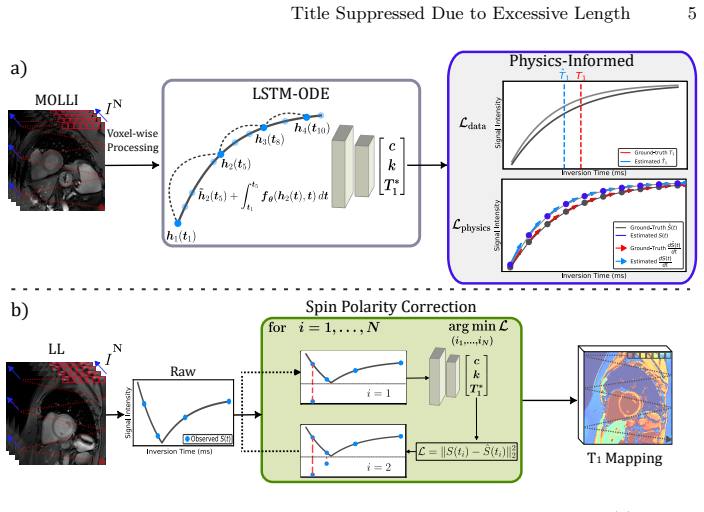
The load-bearing component is the continuous-time LSTM-ODE: at each observation the LSTM cell proposes a candidate hidden state, and a neural ODE $dh(t)/dt = f_\theta(h(t), t)$ integrates that state forward over the irregular interval until the next inversion time, so arbitrary LL sampling patterns no longer break the recurrence. A decoder reads the final hidden state into the three MOLLI parameters $\{c, k, T_1^*\}$, and the T1 map is produced through the identity $T_1 = T_1^*(k-1)$. Two coupled physics losses enforce consistency: $L_{T_1}$ penalizes deviations of the predicted T1 from the curve fit, while $L_{\mathrm{physics}}$ penalizes both signal reconstruction error and mismatch of the derivative $dS/dt$, whose explicit form is derived by differentiating the signal model. At inference, polarity correction is folded in by evaluating all $N$ sign permutations and taking the arg-min of the signal reconstruction loss, which also selects the null index.
What would settle it
A prospective same-session study in which patients receive both a truly shortened 3–5 heartbeat MOLLI acquisition and the full 17-heartbeat MOLLI sequence, with T1 accuracy checked against a phantom or a multi-TI reference; if the shortened acquisition’s mean bias or fitting SD exceeds that of the full sequence by a clinically meaningful margin, the paper’s central equivalence claim fails.
Extended reading notes
Core claim
The central claim is that enforcing the physics of signal recovery — both the 3-parameter MOLLI model $S(t_i) = c(1 - k e^{-t_i/T_1^*})$ and its time derivative $dS/dt = (ck/T_1^*) e^{-t/T_1^*}$ — inside a continuous-time LSTM-ODE yields accurate, end-to-end T1 maps from sparse subsets of 3–5 inversion-time images. The model maps each voxel’s irregularly timed readouts to the parameters $\{c, k, T_1^*\}$, computes T1 as $T_1 = T_1^*(k-1)$, and recovers the signal polarity at inference by testing all $N$ polarity permutations and selecting the one with minimal reconstruction loss. In the paper’s Monte Carlo experiments on 50 subjects, this PINN LSTM-ODE achieved the lowest mean bias among the compared methods for both native and post-contrast sequences at 3–5 Look-Locker samples, and adding the same physics losses improved MyoMapNet’s accuracy, supporting the claim that physics constraints beat a direct data-driven T1 prior.
Load-bearing premise
The accelerated scans are simulated by retrospectively subsampling the same 11-image MOLLI series, and the ground-truth T1 is the curve fit to those same 11 images, so the method’s gains assume that a genuinely shorter acquisition would have the same image quality, motion, and inversion-time coverage as the subset it is trained on.
Editorial extensions
If this is right
- T1 maps with accuracy comparable to full 17-heartbeat MOLLI can be produced from as few as 3–5 Look-Locker images, shortening breath-holds for patients who struggle to hold still.
- The physics-informed loss improves accuracy over the same architecture with a direct data-driven T1 prior (MyoMapNet), suggesting that embedding the relaxation equation helps generalization.
- The continuous-time formulation removes the irregular-time-gap limitation of discrete recurrent networks, so future acquisition schemes can space inversion times non-uniformly to sample the relaxation curve better.
- Post-contrast sequences with faster relaxation are handled without retraining on contrast data, because the model learns the underlying dynamics rather than a fixed T1 prior.
Reading between the lines
- Because the ground-truth labels are the curve fit to the same 11 images, the reported accuracy partly measures how well the network mimics that particular fit; a prospective shortened acquisition with different motion or noise could erode the advantage — a test the paper does not run.
- The same continuous-time, derivative-constrained ODE framework should transfer to other monoexponential parametric mapping problems, such as T2 or T1ρ, where irregular sampling and polarity ambiguity also arise.
- The polarity-search step runs N forward passes per voxel; reporting wall-clock time per map against conventional iterative fitting would clarify whether the end-to-end speedup holds outside the GPU-accelerated setting.
- A synthetic-phantom study with known T1 values would isolate the model's true accuracy from the circularity of using the curve fit as both training label and evaluation reference.
Editorial analysis
A structured set of objections, weighed in public.
Referee Report
Summary. The paper proposes a physics-informed neural ODE framework for accelerated cardiac T1 mapping from sparse subsets of MOLLI baseline images. A continuous-time LSTM-ODE processes irregularly sampled Look-Locker signals, and a physics-based loss enforces the MOLLI signal-recovery model and its time derivative. The model is evaluated on 50 subjects with native and post-contrast sequences, using Monte Carlo subsampling to LL3/LL4/LL5 subsets, and compared with TRF, MyoMapNet, T1Net, and a physics-informed MyoMapNet variant. The paper claims superior accuracy and precision over alternatives, particularly with limited LL samples, and states that 3-5 heartbeat estimates match conventional 17-heartbeat MOLLI.
Significance. The topic is clinically relevant: reducing breath-hold duration for cardiac T1 mapping while preserving accuracy would be valuable. The use of a continuous-time neural ODE for irregularly sampled inversion-recovery signals is a reasonable and relatively novel modeling choice, and the subject-wise split with held-out post-contrast data is a strength. The promise of released code and the inclusion of uncertainty via Monte Carlo simulations are also positive. However, the significance of the claimed advantage is substantially weakened by the reported precision statistics and by several non-significant bias differences, so the current manuscript does not support the strength of the stated conclusions.
major comments (4)
- [Section 5, Table 1] The central claim that the proposed PINN LSTM-ODE 'outperforms alternative methods in both accuracy and precision, particularly with limited LL samples' is not supported by the reported fitting SD. In the LL3 setting, P-LSTM has fitting SD of 91.18 ms (native) and 110.75 ms (post-Gd), versus TRF's 58.12 ms and 46.49 ms; at LL4 post-Gd the values are 70.55 ms vs 39.95 ms. Only in LL5 post-Gd is P-LSTM comparable (42.92 ms vs 43.27 ms). Section 4 itself concedes that 'its higher SD maps suggest that sparse representations may lead to inconsistent NODE-computed trajectories.' The conclusion and abstract should be revised to separate accuracy from precision and to acknowledge the precision loss, or new evidence should be provided to substantiate the precision claim.
- [Table 1, significance markers] Several bias advantages attributed to P-LSTM are marked as not statistically significant: native LL4 (2.62*), native LL5 (0.75*), post-Gd LL4 (-1.12*), and post-Gd LL5 (3.38*). With the paper's own convention that '*' denotes p>0.05, the strongest accuracy claims rest on non-significant differences, while the significant difference at post-Gd LL3 (-12.37 ms) is not favorable compared with P-MM or MMNet. The paper should report confidence intervals, the number of subjects contributing to the paired tests, and a clear statement of which configurations actually support the superiority claim.
- [Section 3, Implementation Details] The evaluation simulates accelerated acquisition by retrospectively subsampling the same 11-image MOLLI acquisition, and the ground-truth {c, k, T1*} parameters are the LM fits to those same 11 images. This assumes that a prospectively shortened 3-5 heartbeat protocol would have the same image quality, motion, and inversion-time coverage as the subset of the full acquisition. The claim of 'matching the performance of the conventional 17-heartbeat MOLLI sequence' therefore requires prospective validation or at least an independent test set with genuinely shortened acquisitions; without this, the reported accuracy gains may not transfer to clinical use.
- [Equations (1)-(3) and (5)] The physics-informed loss enforces the same three-parameter MOLLI signal model (Eq. 1) that defines the ground-truth labels via the LM fit, and Eq. (3) is the analytic derivative of that same model. The physics component is therefore a self-consistency regularizer rather than an independent physical law. This does not invalidate the method, but it weakens the interpretability and generalization claims; the authors should temper these claims or demonstrate behavior on a signal model not identical to the label-generation model, for example synthetic data from a Bloch-equation simulation or a different sequence such as SASHA.
minor comments (6)
- [Section 2.1] The factor gamma in Eq. (5) is introduced but never given a concrete value or computation; 'derived from the chain rule' is insufficient for reproducibility.
- [Section 2.3] The polarity-recovery procedure performs N forward passes per voxel, so the description of the method as providing 'efficient null index estimation' should be supported by actual inference time or computational cost relative to the alternatives.
- [Section 3, Implementation Details] The description '75% linearly spaced up to 2000 ms' is ambiguous; please specify how the 1000 interpolated points are distributed and how they are used in the derivative term of the loss.
- [Section 3, Comparative Studies] The architecture and training details of PINN MyoMapNet (P-MM) are not described; clarify how the physics loss is attached to MyoMapNet so that the comparison with P-LSTM is interpretable.
- [Section 2.2] The notation 'f_theta : {(S_i, t_i)}_{i=1}^N in R^{N x d_emb x 2} -> R^3' is confusing because the input is a sequence of N pairs; please rewrite the mapping notation to reflect the sequence-to-parameter nature of the decoder.
- [Figure 3] The figure caption text appears garbled in the submitted manuscript; please ensure the caption is legible and correctly formatted.
Circularity Check
No load-bearing circularity; the physics loss is a soft restatement of the label model, and self-citations are not load-bearing.
-
other
[Section 2.1, Eq. (5); Section 3, Implementation Details]
"Lphysics = 1/(N H W D) sum_{(x,y,z)} sum_{i=1}^N ||S(t_i) - \hat{S}(t_i)||^2_2 + lambda ||gamma dS(t_i)/dt - d\hat{S}(t_i)/dt||^2_2 ... All models are trained using ground-truth {c, k, T*_1} parameters fitted to the 11-image data with the Levenberg-Marquardt (LM) algorithm."
The physics-informed loss penalizes deviations from Eq. (1) and its derivative Eq. (3), which is the same 3-parameter MOLLI signal model used to generate the ground-truth labels via LM fitting and Eq. (2). The 'physics' constraint is therefore a soft restatement of the label-generating model rather than an independent physical law. This is mild: the mapping from sparse signals to parameters is learned, the loss is only a regularizer, and the held-out evaluation against the conventional LM fit is not forced by construction.
full rationale
The central derivation is not circular. The task is supervised estimation of T1 from 3-5 MOLLI images, with labels from the conventional 11-image LM fit; the model must learn a nontrivial mapping, and the physics loss (Eq. 5) is a soft regularizer, not an identity that determines the output. The retrospective subsampling is an assumption about prospective acquisition, not a circular reduction. Self-citations (Refs. 19-20) are used only for implementation and metric support and are not load-bearing. The paper's own Table 1 does contradict the Section 5 claim of superior precision (e.g., P-LSTM LL3 post-Gd SD 110.75 ms vs TRF 46.49 ms), but this is an internal-consistency or correctness issue, not circularity. Overall circularity burden is low.
Assumptions & free parameters
free parameters (5)
- lambda (derivative loss weight) =
0.01
- Interpolated point schedule =
1000 points, 75% up to 2000 ms
- ODE solver tolerance =
0.001
- LL subset selection =
early {t1-t3}, intermediate {t4-t8}, convergence {t9-t11}
- Data split =
30/5/15 subjects
assumptions (5)
- domain assumption MOLLI signal follows the 3-parameter exponential model S(t)=c(1-k exp(-t/T1*))
- domain assumption T1 relates to T1* and k by T1=T1*(k-1)
- domain assumption LM fit on all 11 images is a valid reference standard
- ad hoc to paper The NODE hidden state can represent the signal recovery dynamics
- ad hoc to paper Retrospective subsampling equals prospective shortened acquisition
Cite this review
Pith. "Pith review of Physics-Informed Neural ODEs for Temporal Dynamics Modeling in Cardiac T1 Mapping." pith.science (2026). https://pith.science/paper/GBG3JY2Z
@misc{pith2026250700613,
  author       = {Pith},
  title        = {Pith review of: Physics-Informed Neural ODEs for Temporal Dynamics Modeling in Cardiac T1 Mapping},
  year         = {2026},
  howpublished = {\url{https://pith.science/paper/GBG3JY2Z}},
  note         = {Machine review of arXiv:2507.00613}
}
abstract
Spin-lattice relaxation time ($T_1$) is an important biomarker in cardiac parametric mapping for characterizing myocardial tissue and diagnosing cardiomyopathies. Conventional Modified Look-Locker Inversion Recovery (MOLLI) acquires 11 breath-hold baseline images with interleaved rest periods to ensure mapping accuracy. However, prolonged scanning can be challenging for patients with poor breathholds, often leading to motion artifacts that degrade image quality. In addition, $T_1$ mapping requires voxel-wise nonlinear fitting to a signal recovery model involving an iterative estimation process. Recent studies have proposed deep-learning approaches for rapid $T_1$ mapping using shortened sequences to reduce acquisition time for patient comfort. Nevertheless, existing methods overlook important physics constraints, limiting interpretability and generalization. In this work, we present an accelerated, end-to-end $T_1$ mapping framework leveraging Physics-Informed Neural Ordinary Differential Equations (ODEs) to model temporal dynamics and address these challenges. Our method achieves high-accuracy $T_1$ estimation from a sparse subset of baseline images and ensures efficient null index estimation at test time. Specifically, we develop a continuous-time LSTM-ODE model to enable selective Look-Locker (LL) data acquisition with arbitrary time lags. Experimental results show superior performance in $T_1$ estimation for both native and post-contrast sequences and demonstrate the strong benefit of our physics-based formulation over direct data-driven $T_1$ priors.
Figures


Reference graph
Works this paper leans on
-
[1]
Baytas,I.M.,Xiao,C.,Zhang,X.,Wang,F.,Jain,A.K.,Zhou,J.:Patientsubtyping via time-aware lstm networks. In: Proceedings of the 23rd ACM SIGKDD Interna- tional Conference on Knowledge Discovery and Data Mining. p. 65–74. KDD ’17, Association for Computing Machinery, New York, NY, USA (2017).https://doi. org/10.1145/3097983.3097997, https://doi.org/10.1145/30...
arXiv 2017
-
[2]
Chen, R.T.Q., Rubanova, Y., Bettencourt, J., Duvenaud, D.: Neural ordinary dif- ferential equations (2019),https://arxiv.org/abs/1806.07366
arXiv 2019
-
[3]
Chow, K., Flewitt, J.A., Green, J.D., Pagano, J.J., Friedrich, M.G., Thompson, R.B.: Saturation recovery single-shot acquisition (SASHA) for myocardial t(1) mapping. Magn. Reson. Med.71(6), 2082–2095 (Jun 2014)
work page 2014
-
[4]
Journal of Cardiovascular Magnetic Res- onance 24(1), 6 (Jan 2022)
Guo, R., El-Rewaidy, H., Assana, S., Cai, X., Amyar, A., Chow, K., Bi, X., Yankama, T., Cirillo, J., Pierce, P., Goddu, B., Ngo, L., Nezafat, R.: Accel- erated cardiac t1 mapping in four heartbeats with inline myomapnet: a deep learning-based t1 estimation approach. Journal of Cardiovascular Magnetic Res- onance 24(1), 6 (Jan 2022). https://doi.org/10.118...
-
[5]
Journal of Cardiovascular Mag- netic Resonance 18(1), 89 (2016)
Haaf, P., Garg, P., Messroghli, D.R., Broadbent, D.A., Greenwood, J.P., Plein, S.: Cardiac t1 mapping and extracellular volume (ecv) in clin- ical practice: a comprehensive review. Journal of Cardiovascular Mag- netic Resonance 18(1), 89 (2016). https://doi.org/https://doi.org/10. 1186/s12968-016-0308-4, https://www.sciencedirect.com/science/article/ pii/...
work page 2016
-
[6]
Hochreiter, S., Schmidhuber, J.: Long short-term memory. Neural Computa- tion 9(8), 1735–1780 (11 1997).https://doi.org/10.1162/neco.1997.9.8.1735, https://doi.org/10.1162/neco.1997.9.8.1735
-
[7]
Journal of Cardiovascular Magnetic Resonance15(1), 1–12 (2013)
Kellman, P., Arai, A.E., Xue, H.: T1 and extracellular volume mapping in the heart: estimation of error maps and the influence of noise on precision. Journal of Cardiovascular Magnetic Resonance15(1), 1–12 (2013)
2013
-
[8]
Jour- nal of cardiovascular magnetic resonance16, 1–20 (2014)
Kellman, P., Hansen, M.S.: T1-mapping in the heart: accuracy and precision. Jour- nal of cardiovascular magnetic resonance16, 1–20 (2014)
work page 2014
Show all 20 references
-
[9]
Kidger, P., Morrill, J., Foster, J., Lyons, T.: Neural controlled differential equations for irregular time series (2020),https://arxiv.org/abs/2005.08926
2020 arXiv
-
[10]
Journal of Computational and Applied Mathematics6(1), 27– 35 (1980)
Konstantinov, M., Petkov, P., Christov, N.: Synthesis of linear systems with desired equivalent form. Journal of Computational and Applied Mathematics6(1), 27– 35 (1980). https://doi.org/https://doi.org/10.1016/0771-050X(80)90014-5, https://www.sciencedirect.com/science/articl...
1980
-
[11]
Le, J.V., Mendes, J.K., McKibben, N., Wilson, B.D., Ibrahim, M., DiBella, E.V.R., Adluru, G.: Accelerated cardiac T1 mapping with recurrent networks and cyclic, model-based loss. Med. Phys.49(11), 6986–7000 (Nov 2022)
2022
-
[12]
Lechner, M., Hasani, R.: Learning long-term dependencies in irregularly-sampled time series (2020),https://arxiv.org/abs/2006.04418
2020 arXiv
-
[13]
Magnetic Resonance in Medicine 52(1), 141–146 (2004).https://doi.org/https://doi.org/10.1002/mrm.20110, https: //onlinelibrary.wiley.com/doi/abs/10.1002/mrm.20110
Messroghli, D.R., Radjenovic, A., Kozerke, S., Higgins, D.M., Sivananthan, M.U., Ridgway, J.P.: Modified look-locker inversion recovery (molli) for high- resolution t1 mapping of the heart. Magnetic Resonance in Medicine 52(1), 141–146 (2004).https://doi.org/https://doi.org/10...
2004 doi
-
[14]
Capitão et al
Piechnik, S.K., Ferreira, V.M., Dall’Armellina, E., Cochlin, L.E., Greiser, A., Neubauer, S., Robson, M.D.: Shortened modified look-locker inversion recov- ery (shmolli) for clinical myocardial t1-mapping at 1.5 and 3 t within a 9 10 N. Capitão et al. heartbeat breathhold. Jou...
2010 doi
-
[15]
Journal of Computational Physics378, 686– 707 (2019)
Raissi, M., Perdikaris, P., Karniadakis, G.: Physics-informed neural networks: A deep learning framework for solving forward and inverse problems involving non- linear partial differential equations. Journal of Computational Physics378, 686– 707 (2019). https://doi.org/https:/...
2019 doi
-
[16]
Radiology272(3), 683–689 (Sep 2014)
Roujol, S., Weingärtner, S., Foppa, M., Chow, K., Kawaji, K., Ngo, L.H., Kellman, P., Manning, W.J., Thompson, R.B., Nezafat, R.: Accuracy, precision, and repro- ducibility of four T1 mapping sequences: a head-to-head comparison of MOLLI, ShMOLLI, SASHA, and SAPPHIRE. Radiolog...
2014
-
[17]
Schirmer, M., Eltayeb, M., Lessmann, S., Rudolph, M.: Modeling irregular time se- ries with continuous recurrent units (2022),https://arxiv.org/abs/2111.11344
2022 arXiv
-
[18]
Journal of Cardio- vascular Magnetic Resonance18(1), 84 (2016)
Weingärtner, S., Meßner, N.M., Budjan, J., Loßnitzer, D., Mattler, U., Papavas- siliu, T., Zöllner, F.G., Schad, L.R.: Myocardial t1-mapping at 3t using saturation- recovery: reference values, precision and comparison with molli. Journal of Cardio- vascular Magnetic Resonance1...
2016 doi
-
[19]
In: International Con- ference on Medical Image Computing and Computer-Assisted Intervention
Zhang, Y., Zhao, Y., Huang, L., Xia, L., Tao, Q.: Deep-learning-based groupwise registration for motion correction of cardiac t 1 mapping. In: International Con- ference on Medical Image Computing and Computer-Assisted Intervention. pp. 586–596. Springer (2024)
2024
-
[20]
In: Medical Imaging with Deep Learning (2024),https://openreview.net/ forum?id=8ONihf0Fh9
Zhang, Y., Zhao, Y., Shao, Y., Capitão, N.M.F., van den Bogert, F., Tao, Q.: Torch$t_1$: GPU-accelerated cardiac $t_1$ mapping with deep learning frame- work. In: Medical Imaging with Deep Learning (2024),https://openreview.net/ forum?id=8ONihf0Fh9
2024
Reviewed August 6, 2026 · model on record in the stance chip above.
Discussion (0). Continue with ORCID to comment.