REVIEW 4 major objections 5 minor 48 references
Decentralized Pliable Index Coding For Federated Learning In Intelligent Transportation Systems
T0 review · 4 major / 5 minor · reviewed 2026-08-06 · deepseek-v4-flash
Pith's one-line read A class of decentralized pliable index coding with consecutive side information can shuffle synthetic data in federated learning to near-IID distributions using as few as S+1 transmissions, improving accuracy and convergence speed for…
desk verdict A useful kernel of M=C constructions buried under overclaimed coverage and a vacuous flagship theorem. read the letter →
The pith
A machine-rendered reading of the paper's core claim, the machinery that carries it, and where it could break.
The reading
What carries the argument
The central object is the CDPIC(S,K) problem, a decentralized pliable index coding problem in which C clients each hold K consecutive messages from a universe of M messages and are satisfied when they decode any S messages outside their own consecutive block. The load-bearing mechanism is the spacing between transmitted messages: by selecting S+1 (or S+n) messages spaced floor(M/(S+1)) (or floor(M/(S+n))) apart around the message cycle, the scheme guarantees that no client holds more than a bounded number of transmitted messages in its side-information set, so each client misses at least S of them. The lower bound S+1 comes from the fact that the first transmitting client cannot learn anything from its own transmission and must receive S new messages from the remaining S transmissions.
What would settle it
Take a concrete CDPIC instance in the claimed optimal range, e.g., M=10, C=10, K=6, S=2, and run the Section V-D construction; if any client decodes fewer than two messages that lie outside its consecutive side-information block after S+1=3 broadcasts, the optimality claim for K in {floor(M/2), floor(M/2)+1} fails. In the FL application, a falsifying observation would be a non-IID dataset where shuffling delivers S new classes but the target accuracy does not improve because the node specifically needed a class it never received.
Extended reading notes
Core claim
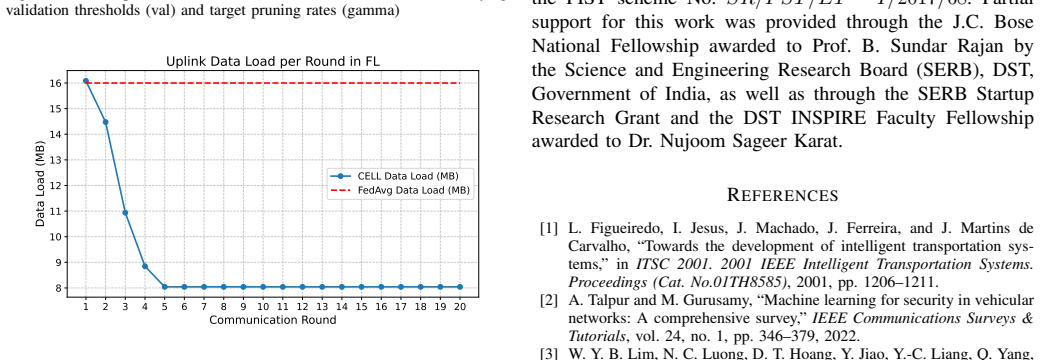
The central claim is that consecutive-side-information decentralized pliable index coding offers near-optimal communication for data shuffling: in CDPIC(S,K), with M messages arranged on a cycle and client i holding K consecutive messages, there are schemes delivering any S new messages to every client using as few as S+1 transmissions when K ≤ floor(M/(S+1)) or K > M/2, and this number is optimal because at least S+1 transmissions are always required. For middle ranges of K the paper provides constructions—uncoded for K up to about M/3, coded pairs for K between M/3 and M/2, and multi-message coded sums for K > M/2+1—with optimality proofs for S=1 in the coded-pair range and for all listed small-K regimes. The same constructions are then used as the data-shuffling layer in federated learning, where each roadside unit generates synthetic data with a conditional variational autoencoder and exchanges it according to the CDPIC scheme; experiments report accuracy gains and reductions in communication rounds for both FedAvg and CELL.
Load-bearing premise
The load-bearing premise is that real RSU data follows the CDPIC geometry: each node holds K consecutive classes, adjacent nodes differ by exactly one class, and any S classes the node lacks are an acceptable substitute for the classes it actually needs to reach IID; if real non-IID data is not ordered or node-specific class needs are fixed, the transmission savings and accuracy gains do not transfer.
Editorial extensions
If this is right
- For FL deployments with overlapping consecutive class distributions, the CDPIC schemes give a concrete protocol: generate synthetic samples locally, then shuffle with S+1 broadcasts to deliver S missing classes to every node, cutting data-shuffling transmissions by up to 50 percent in the reported setups.
- The general DPIC(S) lower bound of S+1 transmissions applies to any decentralized pliable setting, so no peer-to-peer pliable shuffling scheme can do better than one transmission per requested new message plus one.
- Reducing the data-shuffling phase from O(M) naive broadcasts to S+1 coded transmissions translates directly into lower latency and energy at the roadside units, which is what delay-sensitive ITS applications need.
- Applying the schemes to both FedAvg and CELL shows the benefit is not tied to a single aggregation rule or model architecture; the same CDPIC layer can be reused across FL and federated submodel learning.
Reading between the lines
- The pliability assumption is the real bottleneck: if a node's task requires specific missing classes rather than any S classes, pliable delivery will not restore IID, and the scheme's benefits should be re-evaluated for class-sensitive tasks such as rare-object detection.
- The CDPIC construction may extend to other communication settings beyond FL, such as cache-aided content delivery or collaborative inference, wherever clients hold overlapping consecutive data and are indifferent to which new items they receive.
- An implicit extension is dynamic membership: because the index code is built from message indices and fixed side-information windows, adding or removing RSUs changes C and may break the consecutive-window assumption; a testable variant would relax the placement to random or adaptive side-information sets.
- The paper's reported accuracy is measured after a fixed number of rounds; a natural next experiment is to measure end-to-end latency including CV AE generation time and code decoding time, to see whether the transmission savings persist in a full system.
Editorial analysis
A structured set of objections, weighed in public.
Referee Report
Summary. This paper studies the decentralized pliable index coding problem with consecutive side information, denoted CDPIC(S,K), in which each of C clients holds K consecutive messages and is satisfied upon receiving any S new messages. The paper claims a general lower bound of S+1 transmissions for DPIC(S), proposes code constructions for several ranges of K, asserts optimality in some of those ranges, and applies the resulting schemes to synthetic-data shuffling in federated learning for intelligent transportation systems. The experiments report accuracy and communication-round improvements for FedAvg and CELL on MNIST and CIFAR-10 using CNN and lightweight CNN models. The central advertised claim is that pliable index code designs are provided for any value of K and S, with optimality proofs in some cases.
Significance. If the coding results were correct, the paper would be a useful first bridge between pliable index coding and FL/CELL data shuffling, and the reported reductions in transmissions and FL rounds would be practically relevant for vehicular edge networks. The experiments are fairly detailed and show consistent improvements across two datasets, two architectures, and two FL algorithms; the transmission-efficiency tables give a concrete basis for the claimed savings. However, the theoretical core as written does not support the 'any K, S' claim, the flagship achievability theorem is vacuous as stated, and the optimality statements are not proved against general codes. The current text therefore does not establish the main advertised contribution.
major comments (4)
- [Abstract, Section III-B, and Section V-F] The abstract and the contribution list state that pliable index code designs are provided for any value of K and S. Section V-F, which is the only treatment of the M > C case, addresses only K at most about C/3 and K at least M/2; for floor((M+2)/3) < K < floor(M/2) the text says only that 'the code design would differ and a larger number of transmissions would be required,' with no construction, transmission count, or proof. An explicit instance such as M=12, C=4, K=5, S=2 falls in this omitted range, so the 'any K, S' claim is not supported by the manuscript.
- [Theorem 5, Section IV] Theorem 5 states that N = S + 1 is achievable when K <= floor(M/(S+1)) and K > floor(M/2). For every S >= 1, floor(M/(S+1)) <= floor(M/2), so the conjunction is empty. The flagship achievability theorem is therefore vacuous as written; if the intended statement was a disjunction of separate regimes, the theorem must be corrected and a proof supplied for each stated regime.
- [Theorem 3, Lemma 8, and Table I] The claimed optimality in Table I is not established against general index codes. Theorem 3's proof compares an uncoded transmission, which serves at most C-K clients, with a two-message XOR, which serves at most 2K-2 clients, and concludes that uncoded transmissions are optimal. This does not exclude longer linear combinations, non-linear codes, or multi-message broadcasts. Lemma 8 similarly derives (M-K)N >= MS, which is a counting bound only for uncoded transmissions. Therefore the 'Yes' entries in Table I, and the word 'optimal' in the contributions, require either a general lower bound or an explicitly restricted optimality claim.
- [Sections V-C, V-D, V-E] The constructions for the remaining ranges of K are incomplete or informally proved. In Section V-C, for S > 1, equation (3) specifies transmitters with 'j in {0,1,...}' but gives no termination rule or number of transmissions; Lemma 9 only proves the S=1 case. Lemma 10's induction is not rigorous, and Example 5 is internally inconsistent: the listed set of transmitting clients and coded symbols does not match the six-column decoding table, and the text concludes 'exactly S = 3 messages' even though S = 5. Lemma 11 asserts without a supporting argument that a client holding Xi also holds Xi +/- floor(K/e), and it does not verify that each client obtains S distinct new messages. These gaps are load-bearing because they are the basis for the universal code-design claim.
minor comments (5)
- [Throughout, but especially Theorem 3 and Algorithm 1] Expressions such as 'K <= C+2/3' should be written with parentheses as (C+2)/3; as printed, the inequality is not the one used in the proof.
- [Example 5, Section V-D] The list of transmitting clients {C5, C9, C8, C6, C6, C4} and the seven listed coded symbols do not match the six transmissions in Table VI; the example should be rewritten so that the transmitter set, the symbol list, and the decoding table are consistent with S = 5.
- [Section VI-B, Tables IX-XIII] The baseline number of transmissions NW should be defined explicitly as the number of uncoded transmissions needed without the proposed scheme, presumably ceil(CS/(M-K)); this definition is needed to interpret the transmission-efficiency percentages.
- [Section III and Section VI] The modeling assumption that receiving any S new data classes brings the local distribution close to IID is not justified; in the experiments the appropriate S appears to depend on the dataset and architecture, and a randomly chosen new class may not correspond to the class balance needed for a particular node.
- [Figure 10] The legend contains the entry 'CELL(val=0.8,gamma=0.5)' twice; one of these labels is presumably for a different parameter setting and should be corrected.
Circularity Check
No circular derivation found: the CDPIC code designs are explicit constructions derived from the problem definitions, not fitted to the FL experiments; the only self-citation is peripheral and not load-bearing.
full rationale
The CDPIC transmission schemes in Section V are explicit constructions (Eqs. 1-5) whose transmission counts are argued from the CDPIC(S,K) definitions and the consecutive side-information structure, not reverse-engineered from the FL accuracy tables in Section VI. Theorem 1's lower bound and Lemma 8's counting argument are definitional counting identities, and although the 'optimality' claims are not justified against general nonlinear codes and Theorem 5 as stated has an empty regime, these are correctness/support gaps rather than circular reductions: no fitted parameter is renamed as a prediction, and no stated assumption contains the target result. The use of the authors' prior work [25] to justify selecting CVAE for synthetic data generation is a genuine self-citation, but it is not load-bearing for the index-coding theorems or the transmission-efficiency calculations; the same applies to the contextual citation [35]. The transmission-efficiency percentages compare against an in-paper uncoded baseline NW rather than an external benchmark, but this is a baseline-choice limitation, not a circular step. Accordingly no circular step is identified; score 2 reflects the peripheral self-citation and the mild self-referential baseline, not a circular derivation.
Assumptions & free parameters
free parameters (4)
- S =
1 to 4 in experiments
- K =
6 or 7 with M=C=10
- P =
2000 samples per class
- CELL validation threshold and pruning rate =
val in [0.5,0.9], gamma in [0.5,0.8]
assumptions (5)
- domain assumption Consecutive side-information model: client i holds K consecutive messages on a cyclic order.
- domain assumption Pliable satisfaction: a client is satisfied by any S messages not in its side information.
- standard math Each message appears in exactly K client side-information sets when M=C.
- ad hoc to paper Optimal coded transmissions can be restricted to XOR of two messages in Theorem 3.
- standard math For C>M, client C_{M+i} has the same side-information set as C_i.
Cite this review
Pith. "Pith review of Decentralized Pliable Index Coding For Federated Learning In Intelligent Transportation Systems." pith.science (2026). https://pith.science/paper/E7CAWOM6
@misc{pith2026250700643,
  author       = {Pith},
  title        = {Pith review of: Decentralized Pliable Index Coding For Federated Learning In Intelligent Transportation Systems},
  year         = {2026},
  howpublished = {\url{https://pith.science/paper/E7CAWOM6}},
  note         = {Machine review of arXiv:2507.00643}
}
abstract
Federated Learning is a promising option for data privacy and security in ITS, because it allows edge devices, Road Side Units (RSUs), and Central Server (CS) to jointly train the machine learning model. Since RSU collects data from the vehicles passing through its range, the local data of each RSU will have a non-IID distribution, which adversely affects the convergence speed and accuracy of FL training. Generating synthetic data locally at individual nodes, followed by data shuffling among the nodes, is a promising approach to address the Non-IID data problem. In this work, we propose pliable index coding (PIC) solutions for efficient data shuffling among the nodes in an FL system. In PIC($S$) problems, a client is satisfied if it can retrieve any $S$ new messages not originally present in its side-information. We particularly consider decentralized pliable index coding problems (DPIC) where the clients communicate among themselves without a central server to model the data shuffling in FL. A class of DPIC, known as Consecutive Decentralized Pliable Index Coding (CDPIC($S$,$K$)), where each client has $K$ consecutive messages as side-information, is considered. For CDPIC($S$,$K$) problems, pliable index code designs are provided for any value of $K$ and $S$, and optimality proofs for some of the cases are established. Further, these CDPIC solutions are applied for data shuffling in FL, to transform the local data distribution towards IID progressively with each transmission, thereby enhancing the performance of FL. The improvement in the accuracy and convergence of the most popular FL technique, FedAvg, and a promising federated submodel technique, CELL (Communication Efficient Lottery Learning), are analysed by providing different degrees of data shuffling using the proposed CDPIC schemes.
Figures


Figures from the paper (9 more)


Reference graph
Works this paper leans on
-
[1]
Towards the development of intelligent transportation sys- tems,
L. Figueiredo, I. Jesus, J. Machado, J. Ferreira, and J. Martins de Carvalho, “Towards the development of intelligent transportation sys- tems,” in ITSC 2001. 2001 IEEE Intelligent Transportation Systems. Proceedings (Cat. No.01TH8585) , 2001, pp. 1206–1211
work page 2001
-
[2]
Machine learning for security in vehicular networks: A comprehensive survey,
A. Talpur and M. Gurusamy, “Machine learning for security in vehicular networks: A comprehensive survey,” IEEE Communications Surveys & Tutorials, vol. 24, no. 1, pp. 346–379, 2022
work page 2022
-
[3]
Federated learning in mobile edge networks: A comprehensive survey,
W. Y . B. Lim, N. C. Luong, D. T. Hoang, Y . Jiao, Y .-C. Liang, Q. Yang, D. Niyato, and C. Miao, “Federated learning in mobile edge networks: A comprehensive survey,” IEEE Communications Surveys & Tutorials , vol. 22, no. 3, pp. 2031–2063, 2020
2020
-
[4]
Developing vehicular data cloud services in the iot environment,
W. He, G. Yan, and L. D. Xu, “Developing vehicular data cloud services in the iot environment,” IEEE Transactions on Industrial Informatics , vol. 10, no. 2, pp. 1587–1595, 2014
work page 2014
-
[5]
A survey of federated learning for connected and automated vehicles,
V . P. Chellapandi, L. Yuan, S. H. ˙Zak, and Z. Wang, “A survey of federated learning for connected and automated vehicles,” in 2023 IEEE 26th International Conference on Intelligent Transportation Systems (ITSC), 2023, pp. 2485–2492
work page 2023
-
[6]
Deep learning for safe autonomous driving: Current chal- lenges and future directions,
K. Muhammad, A. Ullah, J. Lloret, J. D. Ser, and V . H. C. de Al- buquerque, “Deep learning for safe autonomous driving: Current chal- lenges and future directions,” IEEE Transactions on Intelligent Trans- portation Systems, vol. 22, no. 7, pp. 4316–4336, 2021
work page 2021
-
[7]
S. Abdulrahman, H. Tout, H. Ould-Slimane, A. Mourad, C. Talhi, and M. Guizani, “A survey on federated learning: The journey from centralized to distributed on-site learning and beyond,” IEEE Internet of Things Journal, vol. 8, no. 7, pp. 5476–5497, 2021. 16
work page 2021
-
[8]
S. Hu, X. Chen, W. Ni, E. Hossain, and X. Wang, “Distributed machine learning for wireless communication networks: Techniques, architec- tures, and applications,” IEEE Communications Surveys & Tutorials , vol. 23, no. 3, pp. 1458–1493, 2021
work page 2021
Show all 48 references
-
[9]
Federated learning in intelligent transportation systems: Recent applications and open problems,
S. Zhang, J. Li, L. Shi, M. Ding, D. C. Nguyen, W. Tan, J. Weng, and Z. Han, “Federated learning in intelligent transportation systems: Recent applications and open problems,” IEEE Transactions on Intelligent Transportation Systems, vol. 25, no. 5, pp. 3259–3285, 2024
2024
-
[10]
Federated learning in vehicular networks: Opportunities and solutions,
J. Posner, L. Tseng, M. Aloqaily, and Y . Jararweh, “Federated learning in vehicular networks: Opportunities and solutions,” IEEE Network , vol. 35, no. 2, pp. 152–159, 2021
2021
-
[11]
Federated learning and meta learning: Approaches, applications, and directions,
X. Liu, Y . Deng, A. Nallanathan, and M. Bennis, “Federated learning and meta learning: Approaches, applications, and directions,” IEEE Communications Surveys & Tutorials , pp. 1–1, 2023
2023
-
[12]
Communication-efficient learning of deep networks from decentralized data,
B. McMahan, E. Moore, D. Ramage, S. Hampson, and B. A. y Arcas, “Communication-efficient learning of deep networks from decentralized data,” in Artificial intelligence and statistics . PMLR, 2017, pp. 1273– 1282
2017
-
[13]
Federated machine learning in vehicular networks: A summary of recent applications,
K. Tan, D. Bremner, J. L. Kernec, and M. Imran, “Federated machine learning in vehicular networks: A summary of recent applications,” in 2020 International Conference on UK-China Emerging Technologies (UCET), 2020, pp. 1–4
2020
-
[14]
FEEL: Federated end-to-end learning with non-iid data for vehicular ad hoc networks,
B. Li, Y . Jiang, Q. Pei, T. Li, L. Liu, and R. Lu, “FEEL: Federated end-to-end learning with non-iid data for vehicular ad hoc networks,” IEEE Transactions on Intelligent Transportation Systems, vol. 23, no. 9, pp. 16 728–16 740, 2022
2022
-
[15]
Federated learning for uav swarms under class imbalance and power consumption constraints,
I. Mrad, L. Samara, A. A. Abdellatif, A. Al-Abbasi, R. Hamila, and A. Erbad, “Federated learning for uav swarms under class imbalance and power consumption constraints,” in 2021 IEEE Global Communications Conference (GLOBECOM). IEEE, 2021, pp. 01–06
2021
-
[16]
Federated deep learning for heterogeneous edge computing,
K. M. Ahmed, A. Imteaj, and M. H. Amini, “Federated deep learning for heterogeneous edge computing,” in 2021 20th IEEE International Conference on Machine Learning and Applications (ICMLA) , 2021, pp. 1146–1152
2021
-
[17]
Federated optimization in heterogeneous networks,
T. Li, A. K. Sahu, M. Zaheer, M. Sanjabi, A. Talwalkar, and V . Smith, “Federated optimization in heterogeneous networks,” Proceedings of Machine learning and systems , vol. 2, pp. 429–450, 2020
2020
-
[18]
Asynchronous federated optimization,
C. Xie, S. Koyejo, and I. Gupta, “Asynchronous federated optimization,” arXiv preprint arXiv:1903.03934 , 2019
1903 arXiv
-
[19]
Fedrolex: Model- heterogeneous federated learning with rolling sub-model extraction,
S. Alam, L. Liu, M. Yan, and M. Zhang, “Fedrolex: Model- heterogeneous federated learning with rolling sub-model extraction,” in Advances in Neural Information Processing Systems , S. Koyejo, S. Mohamed, A. Agarwal, D. Belgrave, K. Cho, and A. Oh, Eds., vol. 35. Curran Associa...
2022
-
[20]
Communication- efficient and personalized federated lottery ticket learning,
S. Seo, S.-W. Ko, J. Park, S.-L. Kim, and M. Bennis, “Communication- efficient and personalized federated lottery ticket learning,” in2021 IEEE 22nd International Workshop on Signal Processing Advances in Wireless Communications (SPAWC). IEEE, 2021, pp. 581–585
2021
-
[21]
A comparative analysis of gan and vae based synthetic data generators for high dimensional, imbalanced tabular data,
A. Kiran and D. Kumar, “A comparative analysis of gan and vae based synthetic data generators for high dimensional, imbalanced tabular data,” 03 2023, pp. 1–6
2023
-
[22]
Variational autoencoder frameworks in generative ai model,
A. Asesh, “Variational autoencoder frameworks in generative ai model,” in 2023 24th International Arab Conference on Information Technology (ACIT). IEEE, 2023, pp. 01–06
2023
-
[23]
Generative adversarial networks: An overview,
A. Creswell, T. White, V . Dumoulin, K. Arulkumaran, B. Sengupta, and A. A. Bharath, “Generative adversarial networks: An overview,” IEEE signal processing magazine , vol. 35, no. 1, pp. 53–65, 2018
2018
-
[24]
Syn- thetic data shuffling accelerates the convergence of federated learning under data heterogeneity,
B. Li, Y . Esfandiari, M. N. Schmidt, T. S. Alstrøm, and S. U. Stich, “Syn- thetic data shuffling accelerates the convergence of federated learning under data heterogeneity,” Transactions on Machine Learning Research, 2024
2024
-
[25]
A comparative analysis of synthetic data generation with differential privacy using V AE and GAN for federated learning,
S. Snehasri, K. Sadina, P. P. Deepthi, and N. S. Karat, “A comparative analysis of synthetic data generation with differential privacy using V AE and GAN for federated learning,” in 4th International Conference on Machine Vision & Augmented Intelligence (MAI-24) . Springer, 20...
2024
-
[26]
Index coding with side information,
Z. Bar-Yossef, Y . Birk, T. Jayram, and T. Kol, “Index coding with side information,” IEEE Transactions on Information Theory , vol. 57, no. 3, pp. 1479–1494, 2011
2011
-
[27]
Orthogonal representations over finite fields and the chro- matic number of graphs,
R. Peeters, “Orthogonal representations over finite fields and the chro- matic number of graphs,” Combinatorica, vol. 16, 1996
1996
-
[28]
Optimal index codes with near-extreme rates,
S. H. Dau, V . Skachek, and Y . M. Chee, “Optimal index codes with near-extreme rates,” IEEE Transactions on Information Theory , vol. 60, no. 3, pp. 1515–1527, 2014
2014
-
[29]
Pliable index coding,
S. Brahma and C. Fragouli, “Pliable index coding,” IEEE Transactions on Information Theory , vol. 61, no. 11, pp. 6192–6203, 2015
2015
-
[30]
A polynomial-time algorithm for pliable index coding,
L. Song and C. Fragouli, “A polynomial-time algorithm for pliable index coding,” IEEE Transactions on Information Theory , vol. 64, no. 2, pp. 979–999, 2018
2018
-
[31]
Sparse and low-rank optimization for pliable index coding via alternating projection,
M. Fu, T. Jiang, H. Choi, Y . Zhou, and Y . Shi, “Sparse and low-rank optimization for pliable index coding via alternating projection,” IEEE Transactions on Communications, vol. 70, no. 6, pp. 3708–3724, 2022
2022
-
[32]
Pliable index coding via conflict-free colorings of hypergraphs,
P. Krishnan, R. Mathew, and S. Kalyanasundaram, “Pliable index coding via conflict-free colorings of hypergraphs,” IEEE Transactions on Information Theory , vol. 70, no. 6, pp. 3903–3921, 2024
2024
-
[33]
Group complete −{s} pliable index coding,
S. Eghbal, B. N. Vellambi, L. Ong, and P. Sadeghi, “Group complete −{s} pliable index coding,” in 2024 IEEE International Symposium on Information Theory (ISIT) , 2024, pp. 1520–1525
2024
-
[34]
A pliable index coding approach to data shuffling,
L. Song, C. Fragouli, and T. Zhao, “A pliable index coding approach to data shuffling,” IEEE Transactions on Information Theory , vol. 66, no. 3, pp. 1333–1353, 2020
2020
-
[35]
Code construction for pliable index coding,
S. Sasi and B. S. Rajan, “Code construction for pliable index coding,” in 2019 IEEE International Symposium on Information Theory (ISIT) . IEEE, 2019, pp. 527–531
2019
-
[36]
Decentralized pliable index coding,
T. Liu and D. Tuninetti, “Decentralized pliable index coding,” in 2019 IEEE International Symposium on Information Theory (ISIT) , 2019, pp. 532–536
2019
-
[37]
Secure decentralized pliable index coding,
——, “Secure decentralized pliable index coding,” in 2020 IEEE In- ternational Symposium on Information Theory (ISIT) , 2020, pp. 1729– 1734
2020
-
[38]
Optimal linear coding schemes for the secure decentralized pli- able index coding problem,
——, “Optimal linear coding schemes for the secure decentralized pli- able index coding problem,” in2020 IEEE Information Theory Workshop (ITW), 2021, pp. 1–5
2021
-
[39]
Speeding up distributed machine learning using codes,
K. Lee, M. Lam, R. Pedarsani, D. Papailiopoulos, and K. Ramchandran, “Speeding up distributed machine learning using codes,” IEEE Trans- actions on Information Theory , vol. 64, no. 3, pp. 1514–1529, 2017
2017
-
[40]
A pliable index coding approach to data shuffling,
L. Song, C. Fragouli, and T. Zhao, “A pliable index coding approach to data shuffling,” IEEE Transactions on Information Theory , vol. 66, no. 3, pp. 1333–1353, 2019
2019
-
[41]
Billion-scale federated learning on mobile clients: A submodel design with tunable privacy,
C. Niu, F. Wu, S. Tang, L. Hua, R. Jia, C. Lv, Z. Wu, and G. Chen, “Billion-scale federated learning on mobile clients: A submodel design with tunable privacy,” in Proceedings of the 26th Annual International Conference on Mobile Computing and Networking , 2020, pp. 1–14
2020
-
[42]
Lotteryfl: Personalized and communication-efficient federated learning with lottery ticket hypothesis on non-iid datasets,
A. Li, J. Sun, B. Wang, L. Duan, S. Li, Y . Chen, and H. Li, “Lotteryfl: Personalized and communication-efficient federated learning with lottery ticket hypothesis on non-iid datasets,” arXiv preprint arXiv:2008.03371, 2020
2008 arXiv
-
[43]
An analysis of generative adversarial networks and variants for image synthesis on mnist dataset,
K. Cheng, R. Tahir, L. K. Eric, and M. Li, “An analysis of generative adversarial networks and variants for image synthesis on mnist dataset,” Multimedia Tools and Applications , vol. 79, pp. 13 725–13 752, 2020
2020
-
[44]
Enhanced federated learning for edge data security in intelligent transportation systems,
R. Zhu, M. Li, J. Yin, L. Sun, and H. Liu, “Enhanced federated learning for edge data security in intelligent transportation systems,” IEEE Transactions on Intelligent Transportation Systems, vol. 24, no. 11, pp. 13 396–13 408, 2023
2023
-
[45]
Federated learning in smart cities: Privacy and security survey,
R. Al-Huthaifi, T. Li, W. Huang, J. Gu, and C. Li, “Federated learning in smart cities: Privacy and security survey,” Information Sciences, vol. 632, pp. 833–857, 2023
2023
-
[46]
Gradient-based learning applied to document recognition,
Y . Lecun, L. Bottou, Y . Bengio, and P. Haffner, “Gradient-based learning applied to document recognition,” Proceedings of the IEEE , vol. 86, no. 11, pp. 2278–2324, 1998
1998
-
[47]
Cifar-10 - object recognition in images,
W. Cukierski, “Cifar-10 - object recognition in images,” 2013. [Online]. Available: https://kaggle.com/competitions/cifar-10
2013
-
[48]
Ensemble distillation for robust model fusion in federated learning,
T. Lin, L. Kong, S. U. Stich, and M. Jaggi, “Ensemble distillation for robust model fusion in federated learning,” Advances in neural information processing systems , vol. 33, pp. 2351–2363, 2020
2020
Reviewed August 6, 2026 · model on record in the stance chip above.
Discussion (0). Sign in to comment.