REVIEW 4 major objections 6 minor 1 cited by
BEV-VAE: Multi-view Image Generation with Spatial Consistency for Autonomous Driving
T0 review · 4 major / 6 minor · reviewed 2026-08-06 · deepseek-v4-flash
Pith's one-line read BEV-VAE claims that encoding all surround-view camera images into a single bird's-eye-view (BEV) latent makes multi-view spatial consistency a structural property of the representation, and that this same 3D-structured latent supports…
desk verdict A genuinely new representation for multi-view driving generation, but the conditioning mechanism as written is shape-incompatible for the latent sizes the paper actually evaluates. read the letter →
The pith
A machine-rendered reading of the paper's core claim, the machinery that carries it, and where it could break.
The reading
What carries the argument
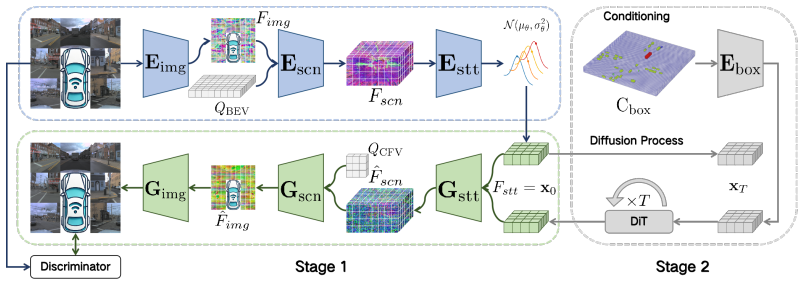
The load-bearing mechanism is the spatially aligned BEV latent representation itself. A $128\times 128$ grid of pillars, each of height 8, carries shared learnable queries whose reference points are projected into every camera by the known extrinsics, so deformable attention aggregates multi-view image features directly into a $768\times 128\times 128$ scene feature; the state encoder then partitions the horizontal plane into $32\times 32$ patches and applies self-attention to produce the compact latent $32\times 32\times D$. The decoder inverts this path, and two named mechanisms carry the downstream claims: the conditional occupancy tensor $C_{\mathrm{box}} \in \{0,1\}^{C\times 8\times 128\times 128}$, built by voxelizing 3D bounding boxes and downsampled to a $768\times 32\times 32$ feature $F_{\mathrm{box}}$ that is added to the state latent with a classifier-free-guidance scale $s$, and the diffusion transformer (DiT) that denoises in that same BEV latent before decoding. The latent dimension $D$ and the guidance scale $s$ are the two knobs whose trade-off between reconstruction fidelity and generation difficulty the experiments map out.
What would settle it
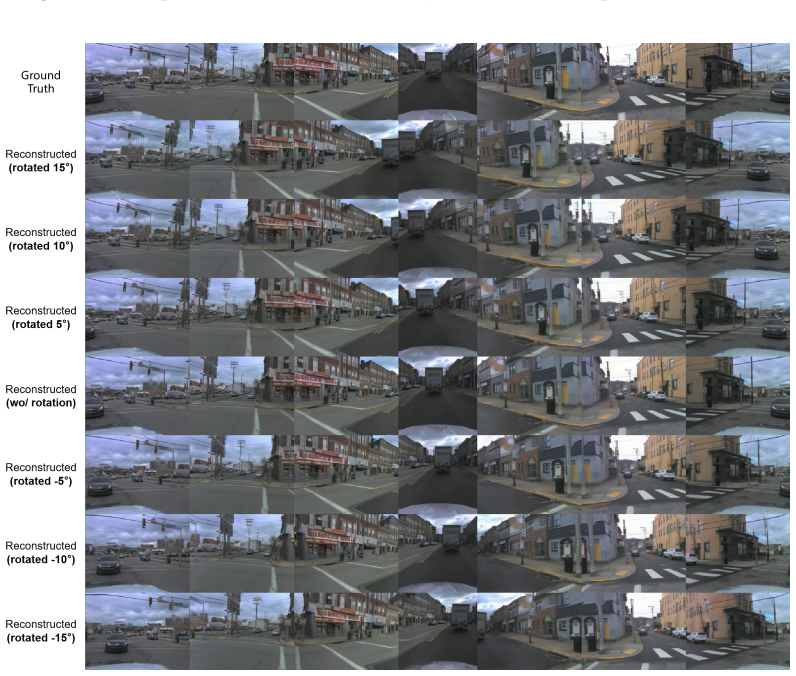
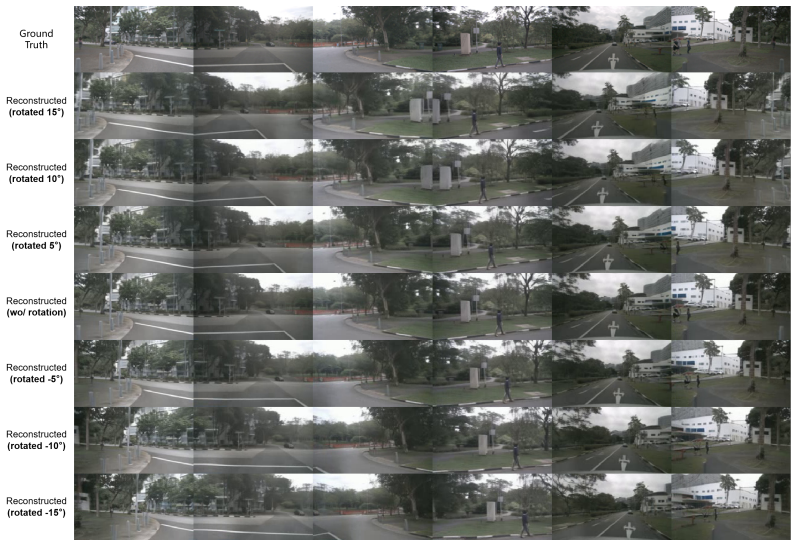
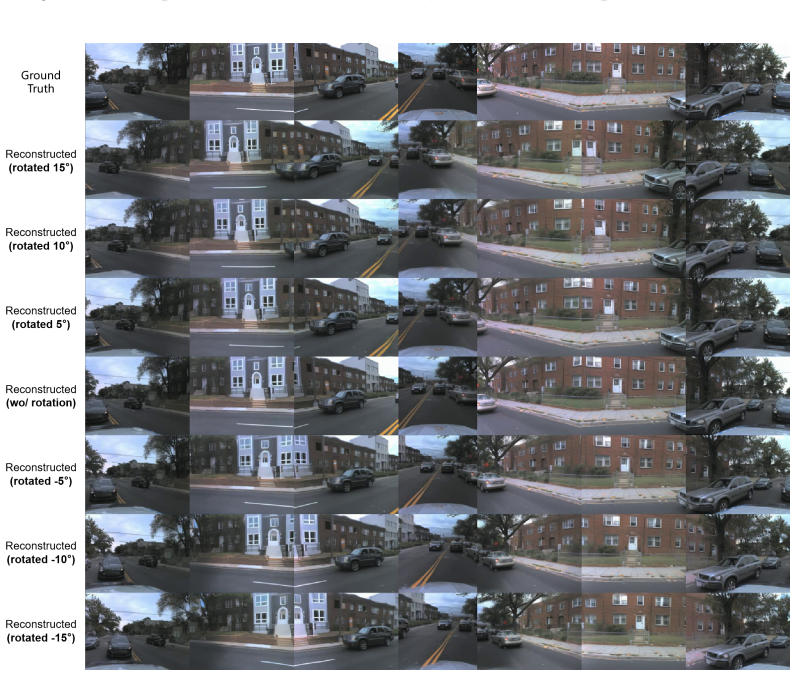
Inspect the released code at the conditioning injection point: for $D = 8$ and $D = 16$, an element-wise addition of the $768$-channel occupancy feature to a $D$-channel state latent is undefined, so the implementation will reveal either the missing projection or a mismatch with Section 3.5; ablating whatever operation is actually used (e.g., a linear projection or channel repeat) would isolate whether layout control comes from the BEV alignment or from that unstated step. Independently, decode one held-out AV2 scene under camera rotations well beyond the $\pm 15^\circ$ used in the paper (say $\pm 45^\circ$) and measure MVSC between adjacent views: if matching confidence collapses with rotation angle, the claimed spatial consistency is a property of the training pose distribution rather than of the shared latent itself.
Extended reading notes
Core claim
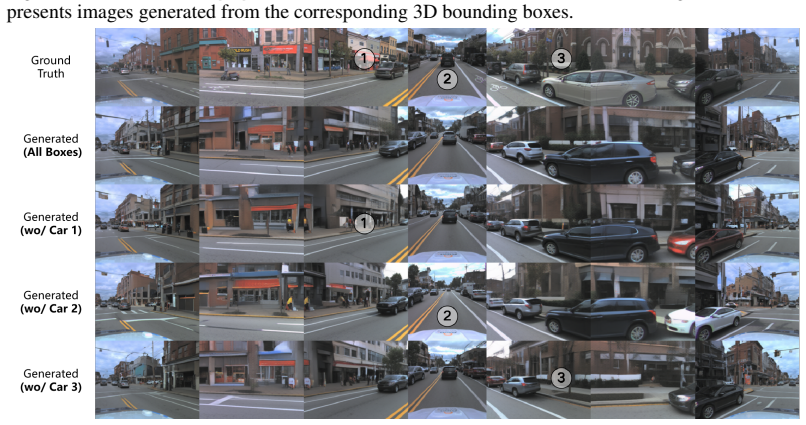
The paper's central discovery is that a unified BEV latent space ensures spatial consistency across all views, because the same spatial location corresponds to consistent content regardless of camera perspective. The encoder lifts per-image ViT features into a $128\times 128$ pillar grid in bird's-eye view via deformable attention, collapses the multi-height scene feature into a $32\times 32\times D$ state latent, and the decoder reverses this process so that overlapping regions of adjacent cameras are rendered from identical latent locations. From this representation follow the two capabilities the authors take to validate the structured 3D nature of the latent: decoding with rotated camera extrinsics produces spatially consistent novel views without retraining, and voxelized 3D bounding boxes, added as an occupancy condition aligned with the latent, give explicit control over object quantity, position, orientation, and category. The authors also report that BEV-VAE is the first method to generate all seven surround-view images on Argoverse 2, and that with no pre-trained priors it achieves an FID of 21.14 on nuScenes, beating the from-scratch baseline BEVGen (25.54) and approaching the Stable-Diffusion-fine-tuned DriveWM (12.99).
Load-bearing premise
In Section 3.5 the 768-channel occupancy feature $F_{\mathrm{box}}$ is said to be injected into the latent state feature by element-wise addition, yet for latent dimensions $D = 4, 8, 16$ the state feature has fewer than 768 channels and no projection or reshaping step is described, so the layout-controllability experiments reported for those dimensions depend on an unstated shape-alignment operation whose effect is never measured.
Editorial extensions
If this is right
- Because every camera view is decoded from the same BEV latent, multi-view spatial consistency is inherited from the representation itself rather than enforced through pairwise adjacent-view attention or overlap losses.
- A single trained model serves any camera configuration: rotating the extrinsic matrices at decode time yields novel views without retraining, and the same architecture handles six cameras on nuScenes and seven on Argoverse 2.
- Editing 3D bounding boxes in the occupancy condition translates directly into adding, removing, rotating, or repositioning objects in the generated images, giving an interpretable and physically grounded interface for scenario editing.
- Generation quality improves with data scale, from an FID of 21.14 on nuScenes to 10.68 on Argoverse 2, supporting the paper's claim that the method scales toward large driving datasets.
- The reported generation of all seven surround-view images on Argoverse 2, new for this task, means driving-scene generators no longer have to be specialized to a fixed camera rig.
Reading between the lines
- Because the BEV latent decouples spatial consistency from single-image sharpness, a natural extension is to attach a higher-capacity or pre-trained image decoder: the paper's own limitation note attributes blurriness to the lack of pre-trained priors, not to the BEV representation, so fidelity could be improved without touching the encoder or the consistency mechanism.
- The occupancy conditioning is just one aligned channel tensor, so map elements such as lanes, drivable areas, signs, and curbs could be added as extra channels of the same $32\times 32$ grid; the paper hints at broader conditions but implements only object boxes.
- The element-wise addition in Section 3.5 is shape-undefined for latent dimensions below 32 (a 768-channel occupancy feature against a $d$-channel state latent with $d=4, 8, 16$), so a reader reproducing Table 2 must first discover and resolve the unstated projection, and measuring that operation's effect would clarify what the controllability results actually depend on.
- Temporal modeling, which the paper leaves as future work, is the most direct next test: a video diffusion transformer over a sequence of BEV latents would inherit the spatial-consistency guarantee while adding temporal coherence, connecting directly to world-model and planning applications.
Editorial analysis
A structured set of objections, weighed in public.
Referee Report
Summary. BEV-VAE proposes a two-stage framework for multi-view driving image generation. Stage 1 trains a Transformer-based variational autoencoder that encodes six or seven surround-view images into a compact BEV latent space (32×32×D) and decodes them back into images, using KL, reconstruction, perceptual, and adversarial losses. Stage 2 trains a DiT latent diffusion model with classifier-free guidance; conditional generation is obtained by injecting 3D bounding-box occupancy features into the latent. The paper reports reconstruction quality versus latent dimension on nuScenes and Argoverse 2, FID for generated images under different guidance scales, a comparison with BEVGen and Stable-Diffusion-based methods on nuScenes, and qualitative demonstrations of novel view synthesis and object-layout editing.
Significance. If the described approach works as claimed, it offers a more explicit 3D-structured alternative to 2D image-space multi-view diffusion methods, with potential benefits for controllable data augmentation in autonomous driving. The paper is honest about some limitations (Supplementary Section E acknowledges blurriness and data-scale dependence), and it releases code. However, the evidence is currently incomplete: the conditioning mechanism in Section 3.5 is not reproducible as written due to a channel-dimension mismatch, novel view synthesis is only qualitative, and the AV2 generation numbers have no baseline. These gaps do not invalidate the core idea, but they must be addressed before the paper's central claims are fully supported.
major comments (4)
- [Section 3.5, conditioning equation] The conditioning injection F'_stt = F_stt + s * F_box is not well-defined for the latent dimensions reported in Table 2. F_box is defined as R^{768×32×32}, whereas F_stt is the sampled latent z with shape 32×32×D for D ∈ {4,8,16,32}; element-wise addition requires matching channel counts, which holds for no reported D. The state-decoder description in Section 3.3 ("transformed from 768×128×128") further suggests the state representation has 768 channels, in tension with Table 1. If a linear projection or embedding is applied to F_box before addition, it must be stated; otherwise the controllability results in Table 2 and Figures 5–6 cannot be attributed to the described mechanism.
- [Section 4.4, Figure 4] The claim that the BEV latent space supports novel view synthesis via camera-pose changes is supported only by qualitative figures (Figure 4 and Supplementary Figures 8–13). No metric is reported for rotated-pose reconstructions, such as PSNR/SSIM against corresponding real views or MVSC under rotation. Because arbitrary view generation is a central contribution, please add a quantitative assessment or clearly state why a quantitative evaluation cannot be computed.
- [Section 4.5, Table 2b and Supplementary Section E] The AV2 generation experiments report FID values but compare against no prior method, and the supplementary acknowledges that no baseline exists. The claim of being the first to generate all 7 surround-view images on AV2 is therefore a novelty claim but is not accompanied by evidence of competitive quality. Please include a comparison with an adapted baseline, a user study, or another calibration of the reported FID so that the AV2 numbers can be interpreted.
- [Section 3.5, occupancy downsampling] The text states that the occupancy tensor C_box ∈ {0,1}^{C×8×128×128} is downsampled to 96×8×32×32, but no mapping from the C class channels to 96 is given. If a per-class embedding or linear projection is used, it must be specified for the conditioning path to be reproducible. This is a second underspecified step in the same mechanism that underlies the controllability experiments.
minor comments (6)
- [Title and headers] The name is typeset inconsistently as "BEV-V AE" in the title, abstract, and headers; please standardize to "BEV-VAE".
- [Section 3.5] The sentence "Aligned with the state feature Fstt, , it is injected via element-wise addition" contains a doubled comma and should be rephrased.
- [Section 4.5] The phrase "different guidance scale" should be "different guidance scales" or "different guidance scale values".
- [Table 4] The row label "wo/L1insteadof L2" is missing spaces; it should read "w/o L1 instead of L2".
- [Supplementary Section B] The metric is called "Multi-View Spatial Confidence" in the supplementary but "Multi-View Spatial Consistency (MVSC)" in the main text; please use one consistent name.
- [Tables 1, 2, and 4] All quantitative results are reported as single numbers without standard deviations or the number of seeds; please add error bars or state explicitly that each number is from a single run.
Circularity Check
No significant circularity: BEV-VAE's derivation is self-contained; the only self-citation is non-load-bearing and the conditioning shape issue is an underspecification, not a circular reduction.
full rationale
The paper's derivation chain is an encoder-decoder VAE whose BEV latent is constructed from multi-view images via deformable attention, then decoded back to images; generation is a latent DiT conditioned on voxelized 3D boxes. Each component is defined independently and evaluated on held-out validation sets with standard metrics (FID, PSNR, SSIM) plus MVSC. The MVSC metric normalizes reconstructed matching confidence by real-image confidence; although it reuses the same matcher, it is an evaluation protocol rather than a fitted parameter that predicts its own input. The only self-citation found is reference [9] (UniAD, which shares senior author Hang Zhao) in the related-work discussion of top-down BEV methods; it is not load-bearing for the claimed contributions. The conditioning mechanism in Sec. 3.5 is under-specified (Fbox is R^{768x32x32} while Fstt is R^{32x32xD}), but that is a shape-alignment/reproducibility defect, not a circularity: no equation reduces the central result to the conditioning input, and the guidance-scale experiments in Table 2 are empirical hyperparameter sweeps. No fitted parameter is renamed as a prediction, and no uniqueness claim rests on prior work by these authors.
Assumptions & free parameters
free parameters (3)
- latent dimension D =
4, 8, 16, 32
- guidance scale s =
5 on nuScenes, 3 on AV2
- KL divergence weight beta =
1e-6
assumptions (3)
- domain assumption The 128x128x8 BEV grid with pillars is sufficient to represent the 3D scene for multi-view reconstruction and generation.
- domain assumption Camera extrinsic and intrinsic parameters are known and accurate for projecting BEV queries into image views and back.
- domain assumption LoFTR keypoint matching confidence is a valid proxy for multi-view spatial consistency.
Cite this review
Pith. "Pith review of BEV-VAE: Multi-view Image Generation with Spatial Consistency for Autonomous Driving." pith.science (2026). https://pith.science/paper/LOOU4GYZ
@misc{pith2026250700707,
  author       = {Pith},
  title        = {Pith review of: BEV-VAE: Multi-view Image Generation with Spatial Consistency for Autonomous Driving},
  year         = {2026},
  howpublished = {\url{https://pith.science/paper/LOOU4GYZ}},
  note         = {Machine review of arXiv:2507.00707}
}
read the original abstract
Multi-view image generation in autonomous driving demands consistent 3D scene understanding across camera views. Most existing methods treat this problem as a 2D image set generation task, lacking explicit 3D modeling. However, we argue that a structured representation is crucial for scene generation, especially for autonomous driving applications. This paper proposes BEV-VAE for consistent and controllable view synthesis. BEV-VAE first trains a multi-view image variational autoencoder for a compact and unified BEV latent space and then generates the scene with a latent diffusion transformer. BEV-VAE supports arbitrary view generation given camera configurations, and optionally 3D layouts. Experiments on nuScenes and Argoverse 2 (AV2) show strong performance in both 3D consistent reconstruction and generation. The code is available at: https://github.com/Czm369/bev-vae.
Figures


Figures from the paper (13 more)






Forward citations
Cited by 1 Pith paper
-
Variational Inference for Bird's Eye View Segmentation in Autonomous Driving
TVB combines a conditional variational autoencoder, normalizing flows, and attention-based fusion to produce bird's-eye-view segmentation from multiple car cameras, reporting small but consistent IoU gains on nuScenes...
Reference graph
Works this paper leans on
-
[1]
Magicdrive: Street view generation with diverse 3d geometry control
Ruiyuan Gao, Kai Chen, Enze Xie, Lanqing Hong, Zhenguo Li, Dit-Yan Yeung, and Qiang Xu. Magicdrive: Street view generation with diverse 3d geometry control. arXiv preprint arXiv:2310.02601, 2023. 1, 3
arXiv 2023
-
[2]
Xiaofan Li, Yifu Zhang, and Xiaoqing Ye. Drivingdiffusion: Layout-guided multi-view driving scenarios video generation with latent diffusion model. In European Conference on Computer Vision, pages 469–485. Springer, 2025. 1, 3
work page 2025
-
[3]
Yuqi Wang, Jiawei He, Lue Fan, Hongxin Li, Yuntao Chen, and Zhaoxiang Zhang. Driving into the future: Multiview visual forecasting and planning with world model for autonomous driving. In Proceedings of the IEEE/CVF Conference on Computer Vision and Pattern Recognition, pages 14749–14759, 2024. 1, 3, 7
work page 2024
-
[4]
Panacea: Panoramic and controllable video generation for autonomous driving
Yuqing Wen, Yucheng Zhao, Yingfei Liu, Fan Jia, Yanhui Wang, Chong Luo, Chi Zhang, Tiancai Wang, Xiaoyan Sun, and Xiangyu Zhang. Panacea: Panoramic and controllable video generation for autonomous driving. In Proceedings of the IEEE/CVF Conference on Computer Vision and Pattern Recognition , pages 6902–6912, 2024. 1, 3
work page 2024
-
[5]
Lift, splat, shoot: Encoding images from arbitrary camera rigs by implicitly unprojecting to 3d
Jonah Philion and Sanja Fidler. Lift, splat, shoot: Encoding images from arbitrary camera rigs by implicitly unprojecting to 3d. In Computer Vision–ECCV 2020: 16th European Conference, Glasgow, UK, August 23–28, 2020, Proceedings, Part XIV 16, pages 194–210. Springer, 2020. 2
work page 2020
-
[6]
Bevdet: High-performance multi-camera 3d object detection in bird-eye-view
Junjie Huang, Guan Huang, Zheng Zhu, Yun Ye, and Dalong Du. Bevdet: High-performance multi-camera 3d object detection in bird-eye-view. arXiv preprint arXiv:2112.11790, 2021. 2
arXiv 2021
-
[7]
Bevfusion: Multi-task multi-sensor fusion with unified bird’s-eye view representation
Zhijian Liu, Haotian Tang, Alexander Amini, Xinyu Yang, Huizi Mao, Daniela L Rus, and Song Han. Bevfusion: Multi-task multi-sensor fusion with unified bird’s-eye view representation. In 2023 IEEE international conference on robotics and automation (ICRA) , pages 2774–2781. IEEE, 2023. 2
work page 2023
-
[8]
Zhiqi Li, Wenhai Wang, Hongyang Li, Enze Xie, Chonghao Sima, Tong Lu, Yu Qiao, and Jifeng Dai. Bevformer: Learning bird’s-eye-view representation from multi-camera images via spatiotemporal trans- formers. In European conference on computer vision, pages 1–18. Springer, 2022. 2
work page 2022
Show all 25 references
-
[9]
Planning-oriented autonomous driving
Yihan Hu, Jiazhi Yang, Li Chen, Keyu Li, Chonghao Sima, Xizhou Zhu, Siqi Chai, Senyao Du, Tianwei Lin, Wenhai Wang, et al. Planning-oriented autonomous driving. In Proceedings of the IEEE/CVF Conference on Computer Vision and Pattern Recognition, pages 17853–17862, 2023. 2
2023
-
[10]
Neural discrete representation learning
Aaron Van Den Oord, Oriol Vinyals, et al. Neural discrete representation learning. Advances in neural information processing systems, 30, 2017. 3
2017
-
[11]
Taming transformers for high-resolution image synthesis
Patrick Esser, Robin Rombach, and Bjorn Ommer. Taming transformers for high-resolution image synthesis. In Proceedings of the IEEE/CVF conference on computer vision and pattern recognition , pages 12873–12883, 2021. 3
2021
-
[12]
Generative adversarial nets
Ian Goodfellow, Jean Pouget-Abadie, Mehdi Mirza, Bing Xu, David Warde-Farley, Sherjil Ozair, Aaron Courville, and Yoshua Bengio. Generative adversarial nets. Advances in neural information processing systems, 27, 2014. 3
2014
-
[13]
Perceptual losses for real-time style transfer and super- resolution
Justin Johnson, Alexandre Alahi, and Li Fei-Fei. Perceptual losses for real-time style transfer and super- resolution. In Computer Vision–ECCV 2016: 14th European Conference, Amsterdam, The Netherlands, October 11-14, 2016, Proceedings, Part II 14 , pages 694–711. Springer, 2016. 3
2016
-
[14]
Vector-quantized image modeling with improved vqgan.arXiv preprint arXiv:2110.04627, 2021
Jiahui Yu, Xin Li, Jing Yu Koh, Han Zhang, Ruoming Pang, James Qin, Alexander Ku, Yuanzhong Xu, Jason Baldridge, and Yonghui Wu. Vector-quantized image modeling with improved vqgan.arXiv preprint arXiv:2110.04627, 2021. 3
2021 arXiv
-
[15]
An image is worth 16x16 words: Transformers for image recognition at scale
Alexey Dosovitskiy. An image is worth 16x16 words: Transformers for image recognition at scale. arXiv preprint arXiv:2010.11929, 2020. 3
2010 arXiv
-
[16]
Denoising diffusion probabilistic models
Jonathan Ho, Ajay Jain, and Pieter Abbeel. Denoising diffusion probabilistic models. Advances in neural information processing systems, 33:6840–6851, 2020. 3
2020
-
[17]
Denoising diffusion implicit models
Jiaming Song, Chenlin Meng, and Stefano Ermon. Denoising diffusion implicit models. arXiv preprint arXiv:2010.02502, 2020. 3
2010 arXiv
-
[18]
High-resolution image synthesis with latent diffusion models
Robin Rombach, Andreas Blattmann, Dominik Lorenz, Patrick Esser, and Björn Ommer. High-resolution image synthesis with latent diffusion models. In Proceedings of the IEEE/CVF conference on computer vision and pattern recognition, pages 10684–10695, 2022. 3 10
2022
-
[19]
Scalable diffusion models with transformers
William Peebles and Saining Xie. Scalable diffusion models with transformers. In Proceedings of the IEEE/CVF International Conference on Computer Vision , pages 4195–4205, 2023. 3
2023
-
[20]
Street-view image generation from a bird’s-eye view layout
Alexander Swerdlow, Runsheng Xu, and Bolei Zhou. Street-view image generation from a bird’s-eye view layout. IEEE Robotics and Automation Letters , 2024. 3, 7
2024
-
[21]
Nerf: Representing scenes as neural radiance fields for view synthesis
Ben Mildenhall, Pratul P Srinivasan, Matthew Tancik, Jonathan T Barron, Ravi Ramamoorthi, and Ren Ng. Nerf: Representing scenes as neural radiance fields for view synthesis. Communications of the ACM , 65(1):99–106, 2021. 3
2021
-
[22]
Adding conditional control to text-to-image diffusion models
Lvmin Zhang, Anyi Rao, and Maneesh Agrawala. Adding conditional control to text-to-image diffusion models. In Proceedings of the IEEE/CVF International Conference on Computer Vision , pages 3836–3847,
-
[23]
Feature pyramid networks for object detection
Tsung-Yi Lin, Piotr Dollár, Ross Girshick, Kaiming He, Bharath Hariharan, and Serge Belongie. Feature pyramid networks for object detection. In Proceedings of the IEEE conference on computer vision and pattern recognition, pages 2117–2125, 2017. 4
2017
-
[24]
Loftr: Detector-free local feature matching with transformers
Jiaming Sun, Zehong Shen, Yuang Wang, Hujun Bao, and Xiaowei Zhou. Loftr: Detector-free local feature matching with transformers. In Proceedings of the IEEE/CVF conference on computer vision and pattern recognition, pages 8922–8931, 2021. 7
2021
-
[25]
Laion-5b: An open large-scale dataset for training next generation image-text models
Christoph Schuhmann, Romain Beaumont, Richard Vencu, Cade Gordon, Ross Wightman, Mehdi Cherti, Theo Coombes, Aarush Katta, Clayton Mullis, Mitchell Wortsman, et al. Laion-5b: An open large-scale dataset for training next generation image-text models. Advances in neural informa...
2022
Reviewed August 6, 2026 · model on record in the stance chip above.
Discussion (0). Sign in to comment.