REVIEW 4 major objections 5 minor 15 references
Guided Unconditional and Conditional Generative Models for Super-Resolution and Inference of Quasi-Geostrophic Turbulence
T0 review · 4 major / 5 minor · reviewed 2026-08-06 · deepseek-v4-flash
Pith's one-line read The paper compares four diffusion-model strategies for super-resolving quasi-geostrophic turbulence and finds that only conditional models trained on paired data reconstruct fine scales, stay cycle-consistent, and reproduce the turbulence…
desk verdict A solid, reproducible benchmark of diffusion methods for QG super-resolution; the qualitative ranking holds, but the quantitative margins are weakened by tuning on the single test snapshot. read the letter →
The pith
A machine-rendered reading of the paper's core claim, the machinery that carries it, and where it could break.
The reading
What carries the argument
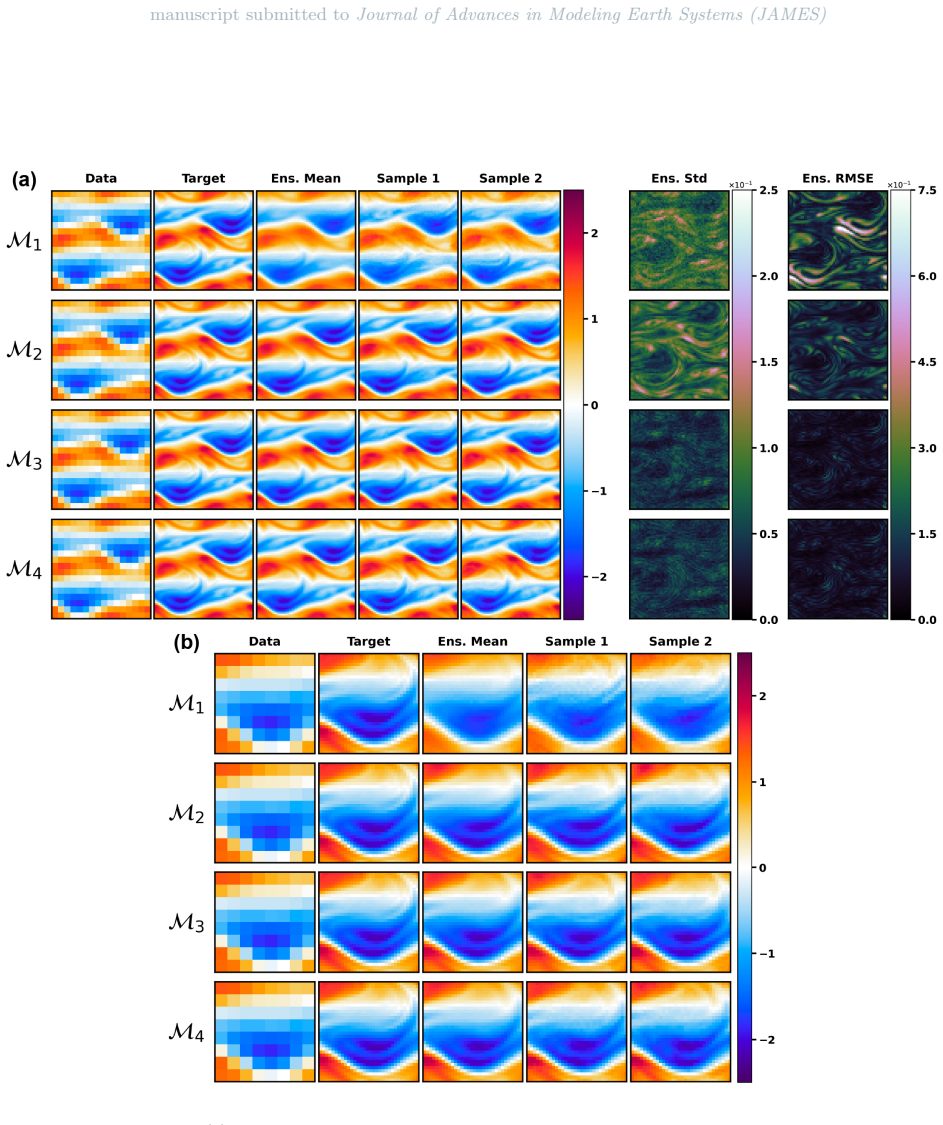
The central machinery is the score of the reverse diffusion process. In the Variance-Preserving SDE formulation, score-based models learn a denoiser that predicts the noise added at each pseudo-time, and sampling reverses the SDE. The two guided unconditional routes are SDEdit, which starts the reverse process from a noisy interpolated observation and never modifies the score, and DPS, which adds a measurement-matching term to the score under the approximation that conditioning on the noisy state equals conditioning on the denoised estimate. The two conditional routes train the denoiser with the observed field concatenated as an extra input, with classifier-free guidance forming a weighted combination of conditional and unconditional scores. The load-bearing behavior is where the measurement term acts: with sparse local observations, the DPS correction vanishes far from observed regions, so the reverse process degenerates to unconditional generation there, while conditional scores carry observation information everywhere.
What would settle it
Run the same eight test cases on many independent snapshots and check whether the conditional models still beat DPS in unobserved regions; if their ensemble standard deviation stops tracking root-mean-squared error, or if DPS closes the gap with more diffusion steps and Langevin corrections, the central ranking claim collapses.
Extended reading notes
Core claim
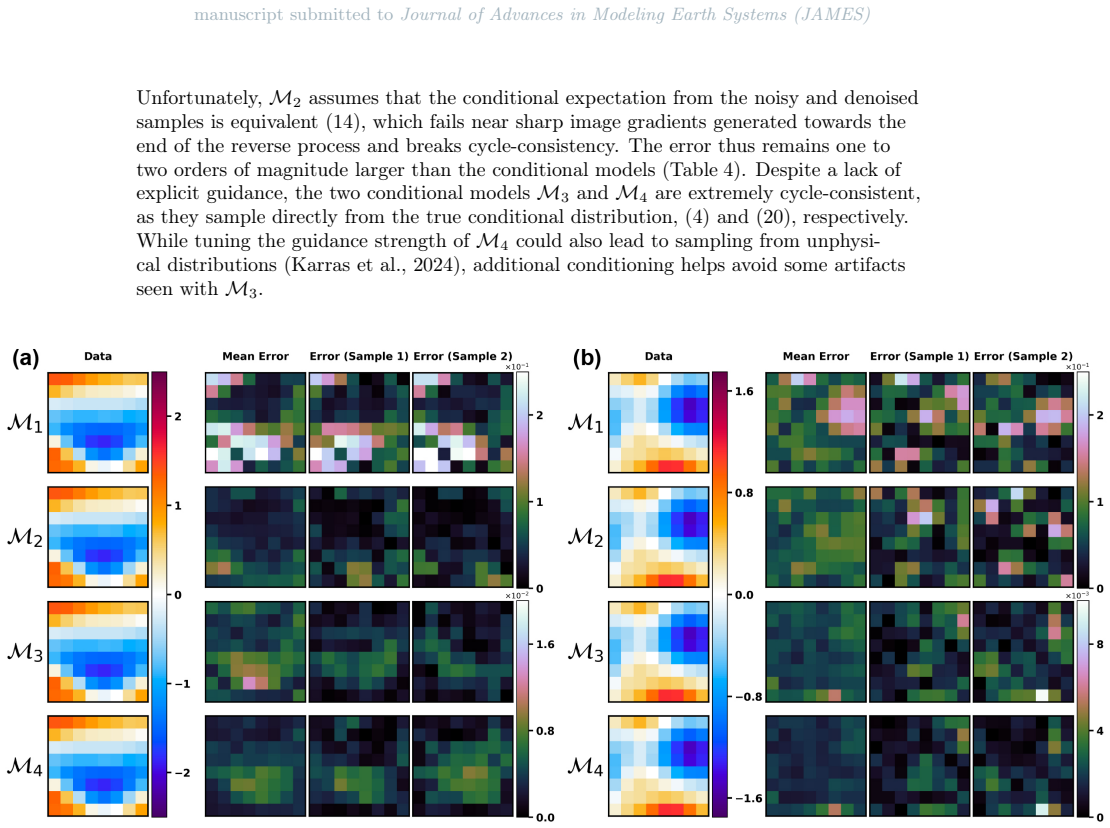
On its own terms, the paper establishes that sampling from the conditional reverse diffusion process is what makes super-resolution work for turbulent vorticity fields. The two conditional models, a vanilla image-to-image diffusion model and a classifier-free guidance variant, are trained directly on pairs of $64\times64$ filtered vorticity fields and $16\times16$ observed fields. Across eddy and jet regimes and Reynolds numbers $10^3$ and $10^4$, they produce the lowest reconstruction errors, nearly perfect cycle-consistency, and energy and enstrophy spectra that match the target, including the tails. The paper argues that this happens because conditioning enters the learned score everywhere, whereas Diffusion Posterior Sampling approximates the measurement likelihood using denoised samples, and its guidance term vanishes where observations are absent, leaving unobserved regions to be generated unconditionally. SDEdit, which only perturbs the initial condition, never samples the conditional distribution and yields fields that are too smooth, spectrally wrong, and ultimately unphysical. In addition, the conditional ensembles' standard deviation tracks their root-mean-squared error spatially, which the paper interprets as a usable error estimator.
Load-bearing premise
The rankings and uncertainty claims rest on skill metrics computed at a single fixed time per test case, so a different snapshot could in principle change the comparisons.
Editorial extensions
If this is right
- If the paper's claims hold, operators can use conditional diffusion ensembles as probabilistic super-resolution tools: the ensemble mean is the reconstructed field, and the ensemble spread flags where the reconstruction is unreliable.
- In geophysical settings where retraining is affordable, the observation operator need not be differentiable or even known at generation time, because conditional models learn the observation-to-target map from data.
- When retraining is impossible, DPS remains a low-cost option for full-field coarse observations, but users should expect smoothed fine scales and should not trust reconstructions inside data gaps.
- SDEdit should be avoided for sparse, gappy turbulence inversion, since it does not converge to the posterior and produces non-physical spectra.
- The effective-resolution analysis suggests that even the best models lose phase coherence beyond a scale set by ensemble variability, so probabilistic reconstructions should be evaluated with noise-to-signal spectra, not just pointwise error norms.
Reading between the lines
- If the ensemble-standard-deviation-to-error correlation survives out-of-sample testing, conditional diffusion ensembles could drive adaptive sampling: the model itself would point to the locations where new observations would most reduce uncertainty.
- Because conditional models do not require gradients of the observation operator, they are a natural fit for indirect observations such as sea-surface-height-to-interior inference, where DPS-style likelihood gradients are hard to obtain.
- The paper's fixed-time evaluation means its model ranking is provisional; a natural next test is to run the same four methods over many snapshots and over time-sequential assimilation cycles, where the information-propagation failure of DPS may be more or less severe.
- A testable extension suggested by the spectra analysis is that conditional models may overestimate eddy and filament amplitudes beyond their effective resolution, so adding an explicit amplitude-calibration loss could tighten the tails without sacrificing cycle-consistency.
Editorial analysis
A structured set of objections, weighed in public.
Referee Report
Summary. The paper benchmarks four score-based diffusion approaches for super-resolution and inference of forced 2D quasi-geostrophic turbulence on the beta-plane: two guided unconditional methods (SDEdit, M1; DPS, M2) and two conditional methods (vanilla conditional, M3; classifier-free guidance, M4). The authors train and evaluate these models on 64x64 target fields derived from 512x512 simulations, with 16x16 coarse observations, including sparse and gappy cases, across two flow regimes (eddy and jet) and two Reynolds numbers (10^3 and 10^4). Quantitative skill metrics include relative L2 errors, cycle-consistency, energy/enstrophy spectra, single-point vorticity PDFs, effective resolution via noise-to-signal ratio, and ensemble standard deviation versus root-mean-square error. The central claims are that the conditional models (M3, M4) reconstruct fine-scale features, remain cycle-consistent, and predict correct turbulence statistics, while the guided unconditional models either produce unphysical fields (M1) or smooth fine scales and fail to propagate information into unobserved regions (M2); additionally, the paper claims that conditional-model ensemble standard deviations are reliable predictors of actual errors. The paper also studies sensitivity to the guidance parameters and discusses practical trade-offs.
Significance. If the central claims hold, this study provides a useful systematic comparison of two families of diffusion-model inversion methods on a geophysical turbulence testbed, with direct relevance to subgrid-scale modeling, downscaling, and state estimation. Strengths include the breadth of test cases, the use of standard and reproducible implementations, the release of code, trained weights, and data on Zenodo, and the honest discussion of limitations in the conclusions. The qualitative conclusions—especially the failure modes of SDEdit and the superior cycle-consistency of conditional models—are visually well supported and likely robust. However, the quantitative margins and the error-predictability claim are weakened by the validation protocol, as detailed in the major comments.
major comments (4)
- [Sect. 4.4 and Sect. 5.3] The tuning protocol creates a circularity that can inflate the reported performance gaps. Section 4.4 states that super-resolution is performed at a fixed time, i.e., one test snapshot per case, while Section 5.3 says the tuning parameters (ti for M1, C for M2, w for M4) were chosen 'over all snapshots of super-resolution' by minimizing the L2 error of the reconstructed fields. If the metrics in Tables 4 and 5 are computed on that same snapshot, the parameter selection is effectively done on the test sample. The authors should either (i) use a separate validation snapshot for parameter selection, (ii) evaluate on multiple independent test snapshots and report the distribution of metrics, or (iii) explicitly report both the tuned and untuned performance to demonstrate the sensitivity. Without this, the quantitative error margins and the model ranking are not protected by independent validation.
- [Abstract and Sect. 5.2.1] The claim that conditional-model mean errors are 'highly correlated with and predictable from' ensemble standard deviations is not quantified. The paper shows spatial similarity between standard deviation and RMSE fields (e.g., Fig. 13, Fig. 15) but never reports a correlation coefficient, a skill score, or a statistical test. Since this is a central deployment-oriented claim (e.g., for adaptive sampling), the authors should compute a quantitative measure, such as the spatial Pearson or rank correlation between ensemble std and absolute error, and report its uncertainty across snapshots and ensemble sizes.
- [Table 4, eddy regime Re=10^4] The 'Ensemble Field Std.' value for M4 (0.01) appears inconsistent with the corresponding reconstructed-vorticity error (1.53e-1) and with the M3 value in the same row (0.10). This likely reflects a typo or a calculation error. Please verify the reported value and check whether similar discrepancies exist elsewhere in Tables 4 and 5.
- [Sect. 4.4 and Tables 4-5] All quantitative skill metrics are computed from a single fixed-time test snapshot per configuration. The reported ensemble mean ± standard deviation therefore reflects only the 16-member sampling variability, not the variability across different flow realizations. The qualitative ranking may be robust, but the quantitative margins (e.g., M3 vs M4 differences, or the claim that M2 outperforms M1 by a particular factor) are not statistically supported. The authors should either evaluate on multiple test snapshots (e.g., 5-10) or explicitly state this limitation and temper the conclusiveness of the numerical comparisons.
minor comments (5)
- [Sect. 4.4] The phrase 'We perform super-resolution at a fixed time' is clear, but the later statement in Sect. 5.3 about optimizing 'over all snapshots of super-resolution' is ambiguous. Please clarify whether 'all snapshots' refers to all test cases, all ensemble members, or multiple time snapshots, and reconcile the two descriptions.
- [Sect. 4.5] There is a typo in the text following Eq. (30): 'Zerror is is the enstrophy spectrum'; remove the duplicated 'is'.
- [Table 1] The table header is typeset as 'T able 1' and the caption has a formatting issue. Please correct the label and ensure the table appears as 'Table 1'.
- [Sect. 3.1.2, Eq. (18)] The definition of sigma_{y,scaled}^2 = sigma_y^2 + (sigma_t^2/mu_t^2) C is not dimensionally explained; please state the intended units or dimensionless nature of C and how it maps to the guidance strength discussed in Sect. 5.3.
- [Sect. 5.3] The optimal values (ti=0.25, C=2e-5, w=1.25) are reported for a single test case (jet regime, Re=10^4, coarse fields). The text says similar trends hold for other cases, but it would strengthen the paper to provide a table of optimal parameter values for all eight test cases, given that the sensitivity study is a stated contribution.
Circularity Check
No significant circularity: the diffusion methods and QG testbed are standard and externally grounded; the Sect. 5.3 tuning-on-super-resolution-snapshots is a validation concern, not a by-construction reduction.
full rationale
The derivation chain is self-contained. The score formulas (6)-(10), the SDEdit initialization (11), and the DPS approximation (14) are standard external results explicitly labeled as approximations; the four models are applied rather than derived from their own outputs. The QG testbed, observation operators, and skill metrics (25)-(30) are defined independently of the generative models, and the turbulence statistics used for evaluation come from the simulated target fields, not from the diffusion models. Self-citations (e.g., Lermusiaux 2015 cited only as an analogy for relaxation schemes in CFG) are contextual and not load-bearing; no uniqueness theorem or fitted physical constant is imported from prior author work. The paper also explicitly acknowledges its idealized testbed and the need for robust evaluation metrics, supporting a reading of the quantitative claims as application-specific rather than as a derived law. The only substantive concern is Sect. 5.3: 'We optimize over all snapshots of super-resolution by sweeping over a range of values and choosing the parameter value that minimizes the L2 norm of the error of the super-resolved fields.' Since Sect. 4.4 fixes evaluation at a single test time per case, if those snapshots are included in the sweep the reported error margins could be optimistic. That is a data-snooping/correctness risk for the quantitative ranking and for the ensemble-std/error correlation claim, but it is not circular in the by-construction sense: the generated fields are not equal to their inputs, and the qualitative regime and statistics comparisons retain independent empirical content. Accordingly, no circular step is flagged and the score is 1.
Assumptions & free parameters
free parameters (3)
- SDEdit intermediate pseudo-time ti =
0.25 (optimal for jet Re=10^4 coarse observation case)
- DPS guidance strength C =
2e-5
- Classifier-free guidance strength w =
1.25
assumptions (5)
- standard math VP-SDE forward process with a cosine noise schedule defines a valid diffusion model (Eqs. 2,5).
- standard math Tweedie's formula connects the score to the conditional expectation of the clean sample (Eq. 6).
- domain assumption DPS approximation: conditioning on the denoised estimate is approximately equivalent to conditioning on the noisy sample (Eq. 14).
- domain assumption The forced 2D QG equations with the chosen parameters (Re, beta, forcing) produce a statistically representative turbulence dataset.
- domain assumption A U-Net trained on 50,000 snapshots from 500 trajectories provides a sufficiently accurate denoiser for the target distribution.
Cite this review
Pith. "Pith review of Guided Unconditional and Conditional Generative Models for Super-Resolution and Inference of Quasi-Geostrophic Turbulence." pith.science (2026). https://pith.science/paper/HBE36XOY
@misc{pith2026250700719,
  author       = {Pith},
  title        = {Pith review of: Guided Unconditional and Conditional Generative Models for Super-Resolution and Inference of Quasi-Geostrophic Turbulence},
  year         = {2026},
  howpublished = {\url{https://pith.science/paper/HBE36XOY}},
  note         = {Machine review of arXiv:2507.00719}
}
read the original abstract
Typically, numerical simulations of Earth systems are coarse, and Earth observations are sparse and gappy. We apply four generative diffusion modeling approaches to super-resolution and inference of forced two-dimensional quasi-geostrophic turbulence on the beta-plane from coarse, sparse, and gappy observations. Two guided approaches minimally adapt a pre-trained unconditional model: SDEdit modifies the initial condition, and Diffusion Posterior Sampling (DPS) modifies the reverse diffusion process score. Two conditional approaches, a vanilla variant and classifier-free guidance, require training with paired high-resolution and observation data. We consider multiple test cases spanning: two regimes, eddy and anisotropic-jet turbulence; two Reynolds numbers, 10^3 and 10^4; and two observation types, 4x coarse-resolution fields and coarse, sparse and gappy observations. Our comprehensive skill metrics include norms of the reconstructed vorticity fields, turbulence statistical quantities, and quantifications of the super-resolved probabilistic ensembles and their errors. We also study the sensitivity to tuning parameters such as guidance strength. Results show that the generated super-resolution fields of SDEdit are unphysical, while those of DPS are reasonable but with smoothed fine-scale features; however, neither of these lower-cost models propagates observational information effectively to unobserved regions. The two conditional models require re-training, but reconstruct missing fine-scale features, are cycle-consistent with observations, and predict correct turbulence statistics, including the tails. Further, their mean errors are highly correlated with and predictable from their ensemble standard deviations. Results highlight the tradeoffs between ease of implementation, fidelity (sharpness), and cycle-consistency of the diffusion models, and offer practical guidance for deployment.
Figures


Figures from the paper (13 more)



Reference graph
Works this paper leans on
-
[1]
Adrian, M., Sanz-Alonso, D., & Willett, R. (2025). Data assimilation with ma- chine learning surrogate models: A case study with fourcastnet.Artificial In- telligence for the Earth Systems,4(3), e240050. Albergo, M. S., & Vanden-Eijnden, E. (2022). Building normalizing flows with stochastic interpolants.arXiv preprint arXiv:2209.15571. Anderson, B. D. (19...
arXiv 2025
-
[31]
Oommen, V., Bora, A., Zhang, Z., & Karniadakis, G. E. (2025). Integrating neural operators with diffusion models improves spectral representation in turbulence modelling.Proceedings of the Royal Society A,481(2309), 20240819. Orszag, S. A., & Israeli, M. (1974). Numerical simulation of viscous incompressible –43– manuscript submitted toJournal of Advances...
arXiv 2025
-
[32]
T., Ben-Hamu, H., Nickel, M., & Le, M
Lipman, Y., Chen, R. T., Ben-Hamu, H., Nickel, M., & Le, M. (2022). Flow match- ing for generative modeling.arXiv preprint arXiv:2210.02747. Liu, B., Tang, J., Huang, H., & Lu, X.-Y. (2020). Deep learning methods for super- resolution reconstruction of turbulent flows.Physics of fluids,32(2). Liu, Y., Yang, M., Zhang, Z., Bao, F., Cao, Y., & Zhang, G. (20...
arXiv 2022
-
[52]
Leinonen, J., Hamann, U., Nerini, D., Germann, U., & Franch, G. (2023). Latent diffusion models for generative precipitation nowcasting with accurate uncer- tainty quantification.arXiv preprint arXiv:2304.12891. Leith, C. E. (1968). Diffusion approximation for two-dimensional turbulence.Physics of Fluids,11(3), 671–672. Leonard, A. (1975). Energy cascade ...
arXiv 2023
-
[60]
Li, Z., Kovachki, N., Azizzadenesheli, K., Liu, B., Bhattacharya, K., Stuart, A., & Anandkumar, A. (2020). Fourier neural operator for parametric partial differential equations.arXiv preprint arXiv:2010.08895. Lin, M., & Yang, C. (2020). Ocean observation technologies: A review.Chinese Journal of Mechanical Engineering,33(1),
arXiv 2020
-
[120]
Fukami, K., Fukagata, K., & Taira, K. (2021). Machine-learning-based spatio- temporal super resolution reconstruction of turbulent flows.Journal of Fluid –38– manuscript submitted toJournal of Advances in Modeling Earth Systems (JAMES) Mechanics,909, A9. Fukami, K., Fukagata, K., & Taira, K. (2023). Super-resolution analysis via machine learning: a survey...
work page Pith review arXiv 2021
-
[124]
Martin, S. A., Manucharyan, G. E., & Klein, P. (2025). Generative data assimila- tion for surface ocean state estimation from multi-modal satellite observations. Journal of Advances in Modeling Earth Systems,17(8), e2025MS005063. Maulik, R., San, O., Rasheed, A., & Vedula, P. (2019). Subgrid modelling for two- dimensional turbulence using neural networks....
arXiv 2025
-
[232]
B., Raue, F., Frolov, S., Palacio, S., Hees, J., & Dengel, A
Moser, B. B., Raue, F., Frolov, S., Palacio, S., Hees, J., & Dengel, A. (2023). Hitch- hiker’s guide to super-resolution: Introduction and recent advances.IEEE Transactions on Pattern Analysis and Machine Intelligence,45(8), 9862–9882. Nichol, A. Q., & Dhariwal, P. (2021). Improved denoising diffusion probabilistic models. InInternational conference on ma...
work page 2023
Show all 15 references
-
[375]
G., Lu, D., & Zhang, G
Yin, J., Liang, S., Liu, S., Bao, F., Chipilski, H. G., Lu, D., & Zhang, G. (2024). A scalable real-time data assimilation framework for predicting turbulent atmo- sphere dynamics. InSc24-w: Workshops of the international conference for high performance computing, networking, ...
2024 arXiv
-
[418]
Guided unconditional and conditional generative models for super-resolution and inference of quasi- geostrophic turbulence
Subel, A., Guan, Y., Chattopadhyay, A., & Hassanzadeh, P. (2023). Explaining the physics of transfer learning in data-driven turbulence modeling.PNAS nexus, 2(3), pgad015. Sun, H., Yu, L., Dai, B., Schuurmans, D., & Dai, H. (2022). Score-based continuous- time discrete diffusi...
2023 arXiv
-
[570]
M., & Lin, S.-J
Harris, L. M., & Lin, S.-J. (2014). Global-to-regional nested grid climate simulations in the gfdl high resolution atmospheric model.Journal of Climate,27(13), 4890–4910. Ho, J., & Salimans, T. (2021). Classifier-free diffusion guidance. InNeurips 2021 workshop on deep generat...
2014
-
[795]
Eivazi, H., Le Clainche, S., Hoyas, S., & Vinuesa, R. (2022). Towards extraction of orthogonal and parsimonious non-linear modes from turbulent flows.Expert Systems with Applications,202, 117038. Errico, R. M., Yang, R., Privé, N. C., Tai, K.-S., Todling, R., Sienkiewicz, M. E...
2022
-
[1426]
(2006).Discrete inverse and state estimation problems: with geophysical fluid applications
Wunsch, C. (2006).Discrete inverse and state estimation problems: with geophysical fluid applications. Cambridge University Press. Xie, Y., Lu, C., & Browning, G. L. (2002). Impact of formulation of cost function and constraints on three-dimensional variational data assimilati...
2006
-
[2023]
A., Ferziger, J
Clark, R. A., Ferziger, J. H., & Reynolds, W. C. (1979). Evaluation of subgrid-scale models using an accurately simulated turbulent flow.Journal of fluid mechan- –37– manuscript submitted toJournal of Advances in Modeling Earth Systems (JAMES) ics,91(1), 1–16. Courtier, P., An...
1979 arXiv
-
[3673]
Vreman, B., Geurts, B., & Kuerten, H. (1996). Large-eddy simulation of the tem- poral mixing layer using the clark model.Theoretical and Computational Fluid Dynamics,8(4), 309–324. Wan, Z. Y., Baptista, R., Boral, A., Chen, Y.-F., Anderson, J., Sha, F., & Zepeda- Núñez, L. (20...
1996 arXiv
Reviewed August 6, 2026 · model on record in the stance chip above.
Discussion (0). Continue with ORCID to comment.